Rumors say that the British actor Daniel Craig was filming in the village of Sæbø in Sunnmmøre last month and not unexpectedly got a lot of attention in Norwegian media. Producers of a satiric show for the national Norwegian Broadcasting Company, NRK, even set up an incredible prank that fooled the country’s newspapers. But facts are that the James Bond 25 has been filmed in Norway.
First-look footage from the filming of the new James Bond movie has shown a dramatic chase sequence with a mysterious new villain. Several vans labelled ‘Pinewood’ and ‘Movie Makers’ were in the village at the west-coast of Norway. Independent sources confirmed that the crew of 120 people was there to provide services in connection with filming.
First-look footage from the filming of the new James Bond movie has shown a dramatic chase sequence with a mysterious new villain
After the new James Bond movie started filming in the country, all eyes have been on whether Daniel Craig, in the titular role, would actually be seen on that particular set.
James Bond 25 in Norway Independent sources say that the working title of James Bond 25 is ‘Eclipse’. Facts are that scenes have been shot both outside the capital Oslo and on the west-coast of Norway. But when NRK stated that the star had been spotted in a pub in Oslo, it was fake news. ‘’I have no comment on what is going to happen here’’ said line producer, Per Henry Borch.
As it stands, the genuine Craig has not been spotted in the country.
Independent sources say that the working title of James Bond 25 is ‘Eclipse’
Out on April 2020
Footage from the shootings shows a masked man, who appears to be injured, pursuing a young girl in the snow while shooting at her. The film will see Daniel Craig return to the role of 007, in potentially his last Bond outing, and Ralph Fiennes back as M. James Bond 25 is out on April 8, 2020, and no title or full casting details have been unveiled just yet. However, last month, it was reported that Bohemian Rhapsody star Rami Malek was in negotiations to play the film’s villain.
The film will be directed by Cary Joji Fukunaga, who took over from Danny Boyle after he departed the project due to “creative differences” last August.
Facts are that scenes have been shot both outside the capital Oslo and on the west-coast of Norway
Norway’s most beautiful scenery
Bond expert, Morten Steingrimsen, said he is impressed that Sunnmøre appears to have been selected as one of the recording sites. “This area of Sunnmøre has Norway’s most beautiful scenery, so they must use it for all it’s worth’’ he said.
To the south of Stockholm is Norrköping with its tree-lined avenues, outdoor cafés, 19th century canalscape, trams, and elegant architecture. Heading west of Stockholm towards Lake Mälaren’s bays and inlets, you come to idyllic Mariefred and the impressive Gripsholms Castle. Enjoy the charming towns and castles south and west of the capital of Sweden.
The main attraction in Norrköping is Kolmården Djurpark, Scandinavia’s wildlife safari, natural habitat and amusement park supreme.
Arbetets Museum in Norrköping
South and West of the Capital of Sweden Gripsholms Castle in Mariefred contains the royal portrait collections and a marvelous theatre from the late 1700s. Best of all is the architecture of this fortress, begun in the 1370s and continually updated. Around the edge of the moat is a collection of runestones carved with serpents, ships and inscriptions.
Strängnäs is a delightful small town dominated by a magnificent Gothic cathedral
Further west
Further west around the lakeshore is Strängnäs, a delightful small town dominated by a magnificent Gothic cathedral. Next to the church at Boglösa 20km (12 miles) north, are hundreds of Bronze Age rock carvings.
Feature image (on top): Strängnäs
South and West of the Capital of Sweden, written by Tor Kjolberg
Scandinavia has a huge variety of sausages, some for slicing like salami, smoked sausages meant for cooking with cabbage or dried peas and wiener/frankfurter-type sausages. Scandinavian sausages is an old tradition.
Many shop-bought sausages are industrial ones brimming with fat and preservatives that almost glow in the dark from the pinkish-red coloring and do not even contain regular meat.
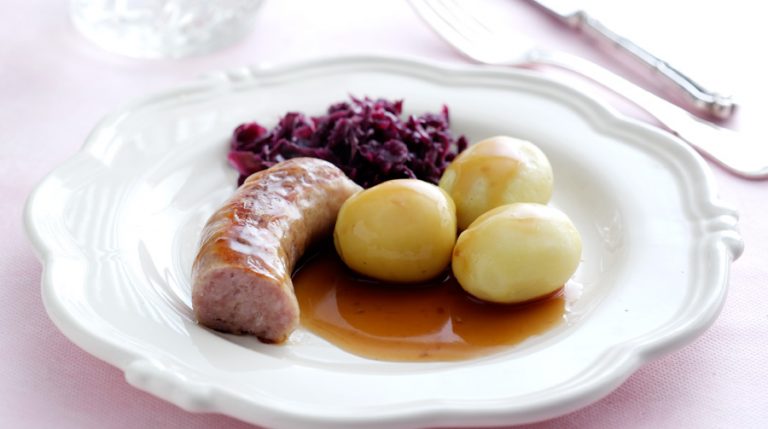
Frying medisterpølse
Scandinavian Sausages However, there is also a growing number of small-scale butchers and sausage-makers producing beautiful charcuterie, though it’s not always easy to find.
Related: Norwegian Food Traditions – A Living Museum in Oslo
Where to buy them
Farms shops, farmer’s markets and specialty shops in the cities are the best sources of delectable sausages and other charcuterie.
Home-made Scandinavian medisterpølse
Industrial medisterpølse
Store-bought medisterpølse are not generally to be trusted (it is too tempting for the industrial sausage-makers to tamper with a basic recipe) so they should be bought from a good butcher. You can also buy smoked medisterpølse, which is often fried in slices to eat with mashed potatoes, or used as a topping for open sandwiches.
Most traditional charcuterie is not easily replicable at home, since it needs cold smoking, but the medisterpølse recipe below is easy to make at home and well worth the trouble.
Home-made medisterpølse
This thick spicy sausage is eaten in varying ways all over Scandinavia. It is a classic part of yellow split pea soup and is often just fried in plenty of butter, as a dinner dish, and eaten with pickled red cabbage, pickled beetroot, and either creamed cabbage or creamed kale, mustard and potatoes. Leftovers are also very good on rye bread with pickled red cabbage and mustard.
The recipe below is admittedly more spiced and interesting than is traditional, but not so much that the sausages aren’t recognizable. It’s a popular Christmas dish. The natural sausage skins are made from the animal’s intestines, which are salted, and your butcher will supply them, if given proper notice.
For the brine 2.5 liters water
100g sugar
250g coarse sea salt
2 bay leaves
1 tablespoon whole coriander seeds
1 tablespoon black peppercorns
10 whole allspice
3 cloves
Walnut-size piece of fresh ginger
2 tablespoons fresh thyme leaves
For the sausages 3kg fatty cut of pork (belly, neck and/or rib) cut into 4x4cm cubes
250g onions, quartered
½ garlic bulb
6-7 tablespoons potato starch
Water or pork-stock (made from bones)
Butter, for frying
Salt and pepper
Natural sausage skins, preserved in salt
Spices from the brine
Butter, for frying
Makes about 4kg
To make the brine, boil up the water, sugar and salt in a pan. Remove the scum until no more appears. Add the spices and herbs and allow the brine to simmer for 30 minutes. Let it cool completely.
Add the meat, onions and garlic to the cooled brine. Leave it to salt for at least 8 hours, but no more than 12. Drain the spices, meat and onions from the bine using a colander, and discard the liquid. Wash the meat briefly with cold water while it’s still in the colander, then spread it on to a clean tea-towel to dry.
Mince the meat, onions and spices in an old-fashioned or electric mincer: if the holes are very big, mince it twice, though the meat must not be finely minced. Mix the forcemeat with the potato starch and sufficient water or stock to make a soft shapeable ‘dough’. The more you mix it, the juicier the sausages will be. When you think it’s finished, fry a small patty in butter. Adjust the seasoning.
Wash the sausage skins on the outside by folding the skin on to the cold-water tap, and then turn on the water to flush on the inside. It may look funny but it works.
Put the forcemeat through the meat-mincer with the sausage appliance attached but be careful not to stuff the sausages too tightly or they will burst when you fry them. You can make portion-sized sausages, or 1m lengths to fill a frying pan, when coiled up.
These sausages are made from fresh meat, and must be eaten within a few days, or frozen.
Gothenburg is the gray industrial city that grew large and colorful. Founded in 1621 by Gustav II Adolf it soon became an important trade city. Gothenburg is Sweden’s next largest city after the capital Stockholm and has approximately 550,000 inhabitants. Today the city stretches from the 17th century district of Haga to the modern area Lindholmen on the island Hisingen. Here’s your essential guide to the little big city in Sweden.
Gothenburg is the hometown of world-famous brands like Volvo and Hasselblad, and the city is still an important trade harbor. But today, this colorful city has so much more to offer.
Gothenburg is the hometown of world-famous brands like Volvo and Hasselblad
Gothenburg has a great reputation as a clean and green city with a friendly welcome for visitors. It’s easy to connect with the inhabitants in Gothenburg whether you are jogging in a nature reserve or joining in the Scandi ritual of fika.
Amusement
The feted theme park Liseberg is the most popular tourist attraction in Sweden. It is a mix of leafy grounds and thrill tides, attracting three million visitors annually. Its Valkyria is Europe’s longest Dive Coaster, a roller coaster with a vertical drop of nearly 50 meters.
The feted theme park Liseberg is the most popular tourist attraction in Sweden
Art, Music & Culture The Gothenburg Museum of Art is considered to have the world’s finest collection of turn-of-the-century Nordic art (three stars in the Michelin Green Guide.) The museum is located at the top of Avenyn, on Götaplatsen. The entrance hall also houses the Hasselblad Centre for Photographic Art.
At Röda Sten Konsthall you can experience exhibitions and performances by Swedish and international artists. Across four floors, you can see paintings, photography, performances, video and sound art – and there are plenty of opportunities to participate in creative processes and conversations.
Röhsska Museum shows everything from contemporary design to several thousand years old Chinese ceramics
Just off the Avenue in central Gothenburg you find the Röhsska Museum. The museum, opened in 1910, shows everything from contemporary design to several thousand years old Chinese ceramics.
The Museum of Gothenburg houses the bones of a Viking longship that sank in the 10th century as well as permanent and temporary exhibitions.
Gothenburg Concert Hall the home of 109 passionate musicians
The Gothenburg Concert Hall is located by Götaplatsen, at the top of avenue Kungsportsavenyn. It’s the home of 109 passionate musicians who together form the Gothenburg Symphony – the National Orchestra of Sweden.
Don’t miss the state of the art Gothenburg Opera House. According to the media the opera delivers “World class opera from top to bottom” (Aftonbladet), “The closest we come to the West End in Scandinavia” (Norwegian Dagbladet) and “A faultless ensemble” (Tanz)*. The Göteborg Opera has received a huge array of awards and prizes, and its shows receive the highest praise from critics both within Sweden and beyond borders.
Gothenburg Botanical Garden is one of Europe’s largest
Universeum Science Discovery Center is a little universe which combines science, technology and adventure. Follow the water from the mountains in the north down to the sea. There are big aquariums and plenty of hands-on experiments. In their rainforest you will find a 25-metre-high kapok tree with secret alleys and everyday there is a rainforest safari that will show you all the tropical beauty.
The museum of World Culture (Världskulturmuseet) includes contemporary exhibitions seen from an international perspective, where controversial and conflict-filled topics are addressed. The ultra-modern building also houses a café and restaurant. Make sure not to miss their exhibition, Together, about how wonderful and difficult it is to be with others.
Palmhouse Garden
Gothenburg Botanical Garden is one of Europe’s largest and best botanical gardens. It contains around 16,000 species of plants in the different greenhouses and areas like the rock garden and herb garden.
The German Church (Deutsche Kirche, also called Christinae Church is a church building in the central parts of the town. It was named after queen Christina of Sweden. The church was opened 1748.
The classic city tour on the Paddan boats shows you the beauty of Gothenburg from a waterside perspective
Boat Trips Paddan boats City Tours
See Gothenburg from a new perspective. The classic city tour on the Paddan boats shows you the beauty of Gothenburg from a waterside perspective. The tour takes you under 20 bridges and out to the harbor. The tour takes about 50 minutes and the boats depart from Kungsportsplatsen from end of April until mid-October.
The ferry Älvsnabben criss-cross the river Göta älv from central Lilla Bommen to Klippan culture reserve by the harbor entrance. Enjoy the fine views from the top deck and keep an eye out for Kuggen – a red, unique building with spectacular architecture. The Port of Gothenburg is the largest in Scandinavia.
In the Gothenburg archipelago you can discover lively villages and inhabited islets in beautiful settings. There are a lot of activities as for example swimming, paddling and fishing trips. Take the tram and then the ferry to get to the southern car-free archipelago. To the northern archipelago, there is a bus to Hönö and Öckerö by car ferry.
The main boulevard Avenyn is short for Kungsportsavenyn
The streets and parks of Gothenburg This town was completely destroyed in 1611 when the Danes burned it to the ground. Fortunately, the Swedes did not give up the idea of a western commercial city, and in 1619 the king Gustavus Adolphus proclaimed “Here, the city shall lie” and pointed to the ground in today’s Gothenburg.
One of few surviving 17th century buildings in Gothenburg is the former artillery Kronhuset from 1654.
The culturally listed 19th-century district of Haga, with cobbled streets and a special type of three-story house construction, featuring one story in stone and two in wood. Haga has an abundance of small cafés, second hand and crafts shops.
The culturally listed 19th-century district of Haga
The Linné district with Linnégatan, popular amongst Gothenburgers as the city’s ‘Second Avenue’, has plenty of excellent restaurants, bars and cafés. The intersecting Långgatorna – especially Andra Lång – is a Bohemian yet trendy area of the city.
The main boulevard Avenyn is short for Kungsportsavenyn. Here you find plenty of restaurants, cafés, bars and nightclubs and shops. There is also a pleasant shopping area with design shops and many independent fashion shops – mainly street wear, in downtown Vallgatan/Södra Larmgatan, running from Kungstorget by the market hall down to the crossing Magasinsgatan.
Some of Gothenburg’s most characteristic neighborhoods were built in the 19th century, for example Vasastaden, Lorensberg and the main boulevard Avenyn (clearly inspired by other formal European streets like Champs-Élysées in Paris). The infrastructure in Gothenburg evolved gradually during the 1900s and this changed the cityscape a lot. In 1902, the former horse-powered tram became electric and decades later the car traffic increased, which of course changed structures of many quarters and streets.
During the 1900s Gothenburg grew and as part of this expansion many new neighborhoods were built. In many aspects Gothenburg has gone from an industrial sea side town towards an innovative modern city.
The area around the square Järntorget, and especially the four parallell streets Långgatorna, is a hub for the alternative and relaxed nightlife. Enjoy a drink with friends, grab a bite to eat or go for theatre or a gig.
The Garden Society of Gothenburg, also known as Trädgårdsföreningen, is a most beautiful 19th-century park laid out along the old moat. The park boasts the Rose Gardens with 2,500 roses, from 1,200 species and the giant greenhouse the Palm House, built in 1878 as a copy of the former Crystal Palace in London.
The area around Frihamnen (the old Freeport in the central part) will become a whole new neighborhood for at least 15,000 inhabitants and in the area there will also be a big new jubilee park.
Where to eat and drink
Hoze restaurant
With six seats only, Hoze is a small-scale and intimate foodie experience where José Cerdá serves his exclusive take on Japanese sushi. Therefore you need to make your reservation long time in advance.
Try Swedish fare like grilled veal with sauced parley root at Familjen in Arkivgatan.
Norda restaurant
Just off Kungsportsavenyen, inside the Clarion Hotel Post, you may enjoy Swedish pork belly with potatoe purée and apple sauce in Norda. a restaurant in which you not only eat nourishing, organic food, but are served from a kitchen that still takes its inspiration from Manhattan and its vibrant melting pot of flavors and origins.
Champagnebaren
In 2013, at Kyrkogatan 13, Ina Forssén and Hanna Öberg opened the city’s only champagne bar in a small backyard in a hidden backstreet. The small venue has plenty of character, especially the yard is a lovely place with outside seating weather permitting.
Enjoy giant cinnamon buns under a century-old glass ceiling at Café Husaren in gentrified Haga.
The café, roastery and bakery in an old riding hall da Matteo Magasinsgatan opened in 2010 and has just reopened after almost half a year of refurbishment. Enjoy soup for lunch, wonderful pastries and buns created by creative bakers and filter coffee brewed by the cup. You can watch the bread being baked and the coffee being roasted.
Tacos & Tequila
South of Haga, Linné is another resurgent district, now full of bars and cafés. Tacos & Tequila is an example of its easy vibe, serving La Maracuya cocktails (tequila, grapefruit, passion fruit).
If you are looking for excellent seafood, catch the 11 tram south-west at the Brunnsparken stop. Ride to the end of the line at Saltholmen – a journey of seven miles (11km) and 35 minutes. Board a ferry to Donso in the Gothenburg archipelago. Here Isbolaget does seafood and local dishes in an old icehouse. From this summer on you can also stay at its new hotel facilities.
Feskekôrka Fish Market Hall offers top-quality fresh fish and seafood on sale in a distinctive church
Fish and Food Markets
Saluhallen Market Hall is a food market with produce from the region as well as from all over the world in some 40 shops and stalls. There are several small restaurants for lunch. The building dates from 1889.
Feskekôrka Fish Market Hall offers top-quality fresh fish and seafood on sale in a distinctive church-like building dating from 1874. There are two restaurants in the hall and the fish stands also sell “healthy fast food” for take-away.
Fish Auction is the largest fish auction in Sweden. See all species of fish and seafood from the nearby sea. It takes place at the central Fish Harbor. Get there on tram 3, 9 and 11 westbound from city center to stop Stigbergstorget, and from there some five minutes’ walk.
Artilleriet stands for an eclectic collection of interior, furniture, and details
Shopping Artilleriet stands for an eclectic collection of interior, furniture, and details. Its range consists of a proprietary blend of classics, vintage and modern products together with innovative design from around the world. At Artilleriet you’ll find well-known brands with recognized high quality, and – equally important – the lesser-known up and coming suppliers with great potential.
Norrgavel is an exclusive interior design and furniture shop with a strong focus on environmental sustainability.
Nudie Jeans, the denim brand founded in Gothenburg in 2001, you can purchase at the store on shopping drag Vallgatan.
Find antiques and Twenties dresses at Fafangans Antik, founded by Mickael Appelkvist in May 1990.
The best second hand shop in Gothenburg is probably Miss Ragtime. There you find a lovely mix of gorgeous dresses, blouses, boots, leather jackets, coats and personalized jewelry!
From Dorsia restaurant
Where to stay A boutique retreat which goes in for velvet drapes, dark colors and baroque ambience is Dorsia.
A stately five-star slotted into the former central post office is the Clarion Hotel Post .
When Avalon hotel opened nearly 15 years ago, almost none believed in its concept. Today, the feng shui certified hotel where furnishing, light, scent and sound play a major role, it has proved an important role in the city’s accommodation world. Good food and drink is also a part of its success.
Upper House Spa is a paradise for the senses encompassing a five-star hotel, a Michelin-star restaurant and a spa that brings a whole new meaning to well-being. The hotel claims you are halfway to heaven when you arrive at this exclusive place at the top of Gothia Towers.
The Gothenburg Pass
Buy your Gothenburg Pass when you visit Gothenburg. The card provides you with free entry to over 30 attractions in Gothenburg – from the thrilling amusement park Liseberg to fascinating museums and peaceful cruises through the archipelago.
The Little Big City in Sweden, compiled by Tor Kjolberg
Before hitting the open road for holiday travels or summer vacations, you need to make sure your car is up for the challenge. If your car breaks down in an unfamiliar place, you’ll spend a lot more money (and deal with a lot more stress) than you would by performing routine maintenance before departure.Here’s your guide on how to get your car road-trip-ready for Scandinavia.
In addition to towing fees and the mechanic’s bill, as well as the possible cost of a rental car, you could end up stuck in the middle of nowhere while waiting for a part to arrive — and that’s not how you want to spend your vacation! With that in mind, here’s what you need to do to avoid car troubles and ensure smooth sailing on your next road trip.
Photo by Takahiro Taguchi on Unsplash
Know Your Car’s Capabilities
Do you know how your car does on long uphill highways or unmaintained back roads? What about whether you have anti-lock brakes, blind-spot monitoring, or other valuable safety features? If you don’t know what your car is and isn’t capable of, you may find yourself in trouble. Review your route to learn the types of conditions you’ll be driving in, then research your car so you understand its advantages and disadvantages. For example, if you own a Volkswagen but you’re overly familiar with what it can do, this website is a good resource for model-specific information, as well as info on common issues in different vehicles.
Check and Replace Fluids
If your car is almost due for an oil change or your windshield washer fluid needs topping off, handle it before your trip. Not sure which oils are due for replacement? Your vehicle owner’s manual lists the recommended maintenance schedule for your car, but you should also check those fluids by getting under the hood; no experience is necessary for this simple task. If it’s your first time checking fluids, learn how with this step-by-step guide.
Photo: Reynier Carl on Unsplash
Inspect the Tires
Tires affect your car’s stopping distance and ability to grip the road in wet or icy conditions. If your tires are especially worn or not properly inflated, you could experience a dangerous blowout on your trip. Blowouts are responsible for 75,000 accidents and 400 deaths every year. Inspect tires for tread wear (you can do this using a penny), replacing if needed, and check the air pressure before leaving and every time you stop for gas.
Also, don’t forget to inspect the spare tire! Check the tire pressure and look for cracks, worn tread, and other signs your spare tire is due for replacement.
Test Lights and Wipers
Here’s another easy safety check you can do before hitting the road: Have a driver sit in the front seat and turn on the headlights, blinkers, hazard lights, and backup lights one-by-one while you monitor the vehicle to ensure all lights are working properly.
Photo: Dan Gold on Unsplash
Once you’ve checked the lights, take a look at the windshield wipers. If they’re worn or haven’t been working as well lately, buy and install a new set. An auto parts store can direct you to the right wipers for your vehicle’s make and model. Then, go here to learn how to install them.
Always wear a set of spare keys Getting locked out of the car is never fun, especially when you’re hundreds of miles from home. To prevent this from happening, remember to make a spare key before the trip and keep it somewhere it won’t get left behind, like in your wallet or purse.
Prepare a Roadside Emergency Kit
Taking these steps reduces the risk that you’ll experience a roadside emergency while traveling, but they don’t guarantee you won’t have car troubles at one point or another. Be prepared for everything by stocking your car with a roadside emergency kit. Your kit should include jumper cables, a tire iron and jack, and a tire pressure gauge, as well items to keep you safe, such as a flashlight, bottled water, space blanket, and first aid kit.
When you know your vehicle is in great shape, you can enjoy your road trip without worrying about a breakdown
If your car is making strange noises or isn’t running like it used to, be sure to get those issues checked out by your mechanic before your trip. While you don’t want to add expenses to your budget, it’s better than getting stranded and paying for an emergency fix. When you know your vehicle is in great shape, you can enjoy your road trip without worrying about a breakdown.
We thank Keith Jacobs, editor-in-chief of Carupkeep for compiling the guide How to Get Your Car Road-Trip Ready
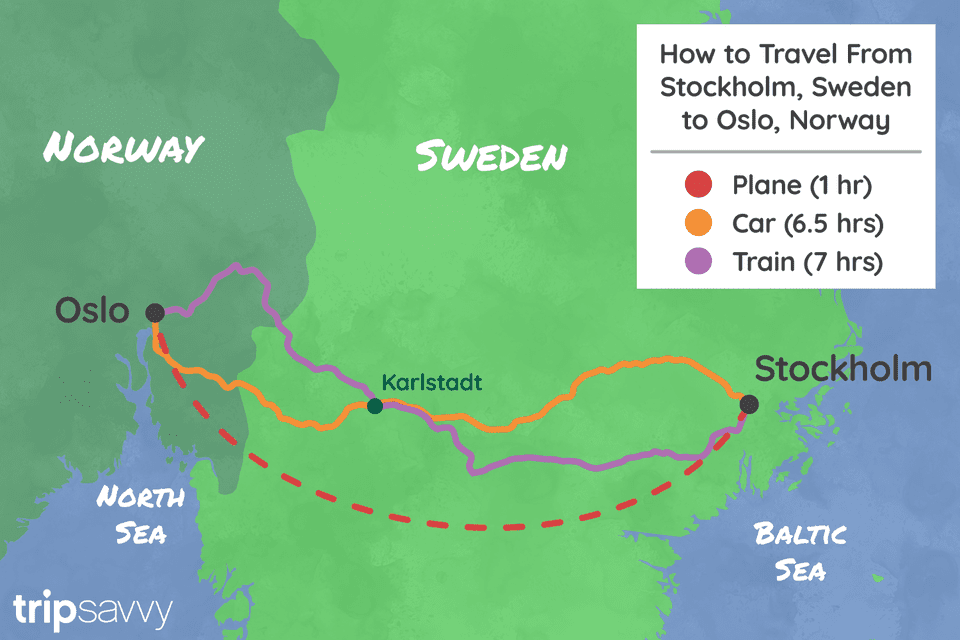
To go by train from or to the Swedish capital to the Norwegian capital is not only cheaper compared to flying. Sometimes you may even save time since you’re departing and arriving in the city centers. The best part, however, it’s a scenic route. Going by train Oslo – Stockholm: 6 hours.
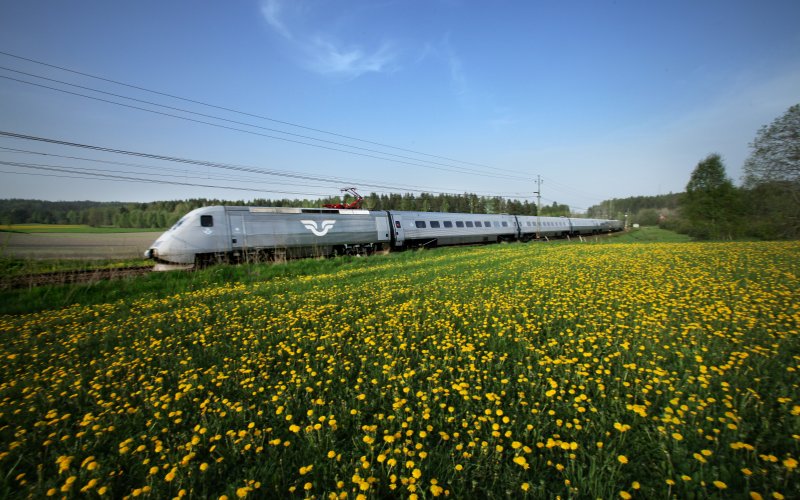
The train passes many beautiful lakes, the most spectacular is on the Swedish side of the border, Lake Vänern, the largest in the EU. On your travel across southern Sweden you can enjoy the sight of lush landscapes dotted with traditional wooden houses, many of them painted in bright red.
You can of course easily fly between the two capitals, but who wants to be hanging around in airports when you can take the train instead?
Both capitals worth a visit
You can of course easily fly between the two capitals, but who wants to be hanging around in airports when you can take the train instead? The trains between Stockholm and Oslo are operated by SJ (Swedish Railway) and both capitals are worth a visit. There are more museums per person than anywhere in the world, and in Stockholm there’s the Old Town (Gamla Stan) that was founded back in 1252, and in Oslo you can visit the Viking Ship Museum to watch real Viking longships.
Stockholm – Oslo By Train: Six Hours
If you want to explore the landscape during your trip, there are plenty of opportunities to hop off and on the train between the two capitals. The train is fast and comfortable and tickets available for as little as 540 SEK (USD 60). However, high-speed trains, three departures daily, take around six hours to reach the capitals. As they’re direct, you can basically just kick back and wait until you arrive without needing to worry about changing trains.
The train between Stockholm and Oslo is fast and comfortable
More than half the total land area of Sweden is covered in forest, and especially on the approach to Norway, you’ll pass farmland and woodland that give an idea of why outdoor life is a cornerstone of the Scandinavian lifestyle.
Bring your food or eat onboard
Travelers leaving from Stockholm can stock up on food from the recently opened stalls in the main concourse. However, a good selection of food and drinks are available on the train. Leaving from Oslo, there are plenty of cafés and restaurants in Østbanehallen, the original Oslo main central station, now a dining area. In the departure hall you find excellent stalls, among them Upper Crust, serving excellent fresh baguettes.
On your train trip from Oslo to Stockholm, you’ll pass farmland and woodland that give an idea of why outdoor life is a cornerstone of the Scandinavian lifestyle
The last direct train between the two capitals tends to leave Oslo a little before 5 pm, arriving in Stockholm at around 10.45pm. From Stockholm, the last train leaves at 3:19 pm and arrives in Oslo at 9:24 pm. There is no night train.
Following an international design competition, Shanghai Grand Opera House has been designed by Norwegian Architects, the Norwegian architect company Snøhetta.
The building’s most prominent feature will be a helical roof that connects to the ground via a spectacular open-air spiral staircase. Snøhetta has designed this to resemble an unfolding fan, evoking “the dynamism of dance and the human body”.
The new Opera House is an important part of a new urban master plan for Shanghai
Aiming to attract a broad audience for traditional, classical, and experimental performances, Snøhetta has developed the architectural, landscape, interior, and graphic design for the sweeping complex in collaboration with Shanghai-based architects ECADI.
New urban masterplan for Shanghai
The new Opera House is an important part of a new urban master plan for Shanghai that aims to place the city at the forefront of the globe, economically, scientifically, and culturally. The building is reminiscent of the Oslo Opera House completed by the company in 2008, which also featured a publicly accessible roof that slopes down to meet the waterfront.
The design is made to resemble an unfolding fan, evoking “the dynamism of dance and the human body
The radial movements of the roof form a spiraling staircase that connects the ground and rooftop while offering views across the city and river bank. This spiraling motion continues throughout the project in the lobby, halls, and three auditoriums.
One of Shanghai’s major cultural landmarks
The Opera House is expected to become one of the major cultural landmarks of Shanghai – the country’s 13th Five-Year Plan names it as the most important initiative to strengthen Shanghai’s cultural and global influence.
The building is reminiscent of the Oslo Opera House completed by the company in 2008
Shanghai Grand Opera House Designed by Norwegian Architects
“The Shanghai Grand Opera House is a natural progression of our previous work with designing performing arts centers,” explained Snøhetta co-founder Kjetil Trædal Thorsen, referencing the studio’s work on similar projects including the one in Oslo, and Busan Opera House in South Korea.
Situated in the Expo Houtan neighborhood, at a convex bank in the riverside, the scheme’s primary mission is to be a public, open venue that harmonizes with the radial layout of the surrounding landscape.
All images, copyright Snøhetta
Shanghai Grand Opera House Designed by Norwegian Architects, written by Tor Kjolberg
The aim of a research project administered by the University of Oslo, UiO:Nordic, is to investigate the gradual and uneven development of the public sphere and freedom of expression in the Nordic countries from the beginning of the 19th century, through conflicts, setbacks and battles, to a gradually broader public participation in the public sphere towards the end of the century.
A two day conference in Oslo, yesterday and today, marks the completion of the formal project “The Public Sphere and Freedom of Expression in the Nordic Countries, 1815-1900”.
The Freedom of Expression in the Nordic Countries
Constitutionally protected freedom of expression and the development of a free and open public sphere during the 19th century are important historical preconditions for the open Nordic societies of today, consistently ranked at the top of the World Press Freedom Index.
The project aims to explore the gradual, uneven development within these fields in the Nordic region, through an interdisciplinary and comparative approach.
Freedom of speach in the Nordic countries. Courtesy: Norwegian National Library
About the group The interdisciplinary research group is part of one of the university’s three main thematic initiatives, UiO:Nordic. The project will be hosted by the Department of Public and International Law at the Faculty of Law, University of Oslo, in close cooperation with the Faculty of Humanities and the Faculty of Theology, the National Library of Norway and the Storting Archives. The research group includes a number of participating and affiliated researchers, representing different regions and disciplines, such as law, history, theology, political science, literature and intellectual history.
From Blindern campus at the University of Oslo (UiO). Photo: Jon Olav Nesvold / NTB scanpix
About the project The project will explore Nordic differences and interaction, in an international perspective and context, through a range of different, interrelated subprojects, focusing on historical, judicial, political, religious and cultural preconditions. The aim is to provide new knowledge on the five Nordic countries’ different paths to freedom of expression and a free and open public sphere.
The Freedom of Expression in the Nordic Countries is based on a press release from UiO:Nordic
Scandinavian researchers are identifying suitable habitat management for endangered butterflies. However, your own garden can help them find food and shelter. Here you can read the Ultimate Guide to Butterflies & How To Prevent Their Decline.
Butterflies and moths have been around for millions of years. They used to be a common sight in gardens, but numbers have declined since the 1940s along with our other native wildlife species such as bees and hedgehogs.
It will come as no surprise to hear this loss is due to destruction of natural habitats such as wildflower meadows, peatbogs and ancient woodlands in favour of intensive farming practices, roads and housing developments that have stripped away the majority of their nesting and foods sites.
Climate change is partly responsible for butterfly decline too, producing wetter weather that alters the distribution of certain species.
The relentless march forward of ‘progress’ damages our 56 species of butterfly and 2,500 species of moths who are sensitive to change – but your garden can help them find food and shelter.
The Decline Of Butterflies The State of the UK’s Butterflies Report shows ‘serious, long term and ongoing decline of UK butterflies’. It highlights how 76% of our butterfly species have declined over the past forty years, with species such as the High Brown Fritillary at risk of extinction, and the once common Small Tortoiseshell becoming a rare sight.
The new State of Britain’s Larger Moths 2013 report mirrored this decline, which is hardly surprising since many moths are daytime creatures and others are what you could describe as night butterflies. Records show moths have declined 28% over the same period.
But why should we care about pretty, fanciful butterflies? Because it’s bad news for the food chain. Animals rely on butterflies for food, including us. Butterflies and moths are pollinators and without them our crops are in trouble.
The decline is not only of concern to butterflies, its evidence of a problem in our environment. The face of our environment is changing, it’s turning into an urbanised monoculture reliant on pesticides, intensive farming and building to house and feed our ever increasing population – and this comes at the cost of our wild creatures.
Some butterflies have declined so severely they’re protected under law – the Large Blue, Large Copper and Swallowtail being just a few at real risk of extinction.
It’s worth remembering that butterflies have four stages of life and with that many stages it’s no wonder environmental changes wreak havoc on their life-cycles.
We all learn about the caterpillar to butterfly in primary school, but it’s easy to forget that wriggling grub emerging from a tiny egg to eat your hard grown vegetables will turn into a beautiful pollinating insect. Talk about ugly duckling syndrome! Of course, they will be a chrysalis for a time too.
Butterflies don’t live that long, the lifespan depending on their species and the weather. Larger butterflies like the Peacock can live a season with hibernation, but other smaller ones only manage a few weeks to a few months.
The anathomy of a butterfly
The Anatomy of a Butterfly A butterfly or moths wings are the most dramatic part of their anatomy, but there are other parts too.
They have six jointed legs beneath a head, thorax which is the chest, and an abdomen – the tail. A butterfly’s head has large compound eyes that allow it to check all around for predators. It will also have two antennae.
Antennae assess the surrounding environment and report back on chemical activity – a bit like a snake’s tongue. They use them to detect nectar producing plants and to track the pheromones of a mate. Near the antennae is a special organ used for flight orientation and balance. It’s called the Johnston’s organ. Butterflies with a damaged Johnston’s organ may fly in circles and be unable to manage a straight line.
Their wings are made from scales, but not like fish scales, they are made from thin material called chitin which is stretched over vein type structures. There are four wings in all. The wings closest to its head are usually triangular in form, and the lower pair of wings is fan shaped. The wings provide insulation, allowing the butterfly to heat up, and they’re often brightly coloured to scare away predators.
Since a butterfly can’t live without heat, the wings are a very important method of retaining and building up body heat. They don’t regenerate, which is why butterflies seek shelter in winds and rain.
Where do Butterflies Live? This depends on the species and where they are on the point of the butterfly lifecycle.
Species prefer different locations for shelter and egg laying, which is one of the reasons why they are declining. Certain habitats like wildflower meadows are hard to come by – we’ve lost 97% of wildflower meadows over the past few decades.
Nettles are preferred by Small Tortoiseshell butterflies that lay their eggs on stingers, whereas Large Whites prefer your cabbages, and Brimstone butterflies lay their eggs on buckthorn.
A caterpillar and chrysalis won’t go far from the food source, but an adult butterfly will spend its life on the wing searching for nectar and egg laying sites.
At night they creep into small crevices, in hedgerows and masonry or anywhere that affords them protection. Moths do the same –there are many species of daytime moth flitting around with the butterflies too.
A butterfly house provides welcome shelter. Place your hotel in a south facing sunny location because butterflies like warmth – their wings are adapted to soak up as much heat as possible. Ensure it remains dry inside by attaching a porch if yours doesn’t have this vital addition. Fix it to fence post or brick wall to avoid a tunnel of freezing wind. A butterfly house stood on away from a wall or on a chain is little use.
Peacock butterflies and Tortoiseshells may hibernate in your butterfly house so don’t take the winter months as an opportunity to clean it out.
What Do Butterflies Eat?
Butterflies survive on nectar. They taste it through sensors on their feet, and drink it from the flower centre using a proboscis – a long, narrow tube just like a straw. If you stand quietly to watch a butterfly at a flower you will see this fascinating body part in action. Other sources of food depend entirely on the species but fruit, tree sap and the sodium found in our sweat are attractive to some.
Caterpillars eat plants, and plenty of them, each specific to their species. In fact, the children’s story The Very Hungry Caterpillar could be considered a factual book! So much energy is needed to transform into a butterfly that caterpillars are mini eating machines.
Peacock caterpillars eat and live on nettles as do Comma and Red Admiral caterpillars whereas Elephant Hawk moth caterpillars dine on willowherb and fuchsia, and the Holly Blue is specific to, you’ve guessed it, holly. Other caterpillars love trees such as alder buckthorn, others like wild roses, lavender – in fact most native flowers and weeds are utilised by our caterpillars.
In case you were wondering, only two out of the 2500 species of moth will eat your clothes, and they only enter the house because they are attracted to light, not because they want to dine on your expensive winter wool coat!
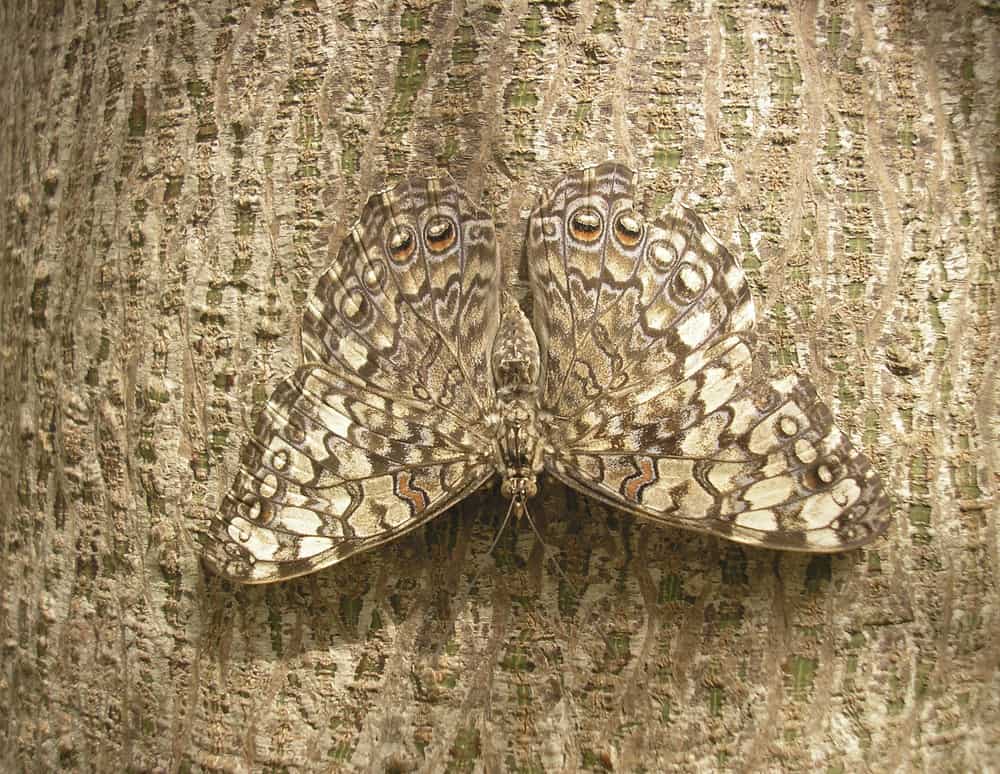
Camouflaged butterfly
Do Butterflies Have Any Predators?
Unfortunately for butterflies they have a range of predators at their caterpillar, pupa and adult stage. Birds, spiders, frogs, toads, hedgehogs, bats, cats, dogs, wasps all eat caterpillars, butterflies and moths. Butterflies are especially vulnerable when they emerge from the chrysalis to pump liquid into their wings and wait patiently for them to harden before flying away.
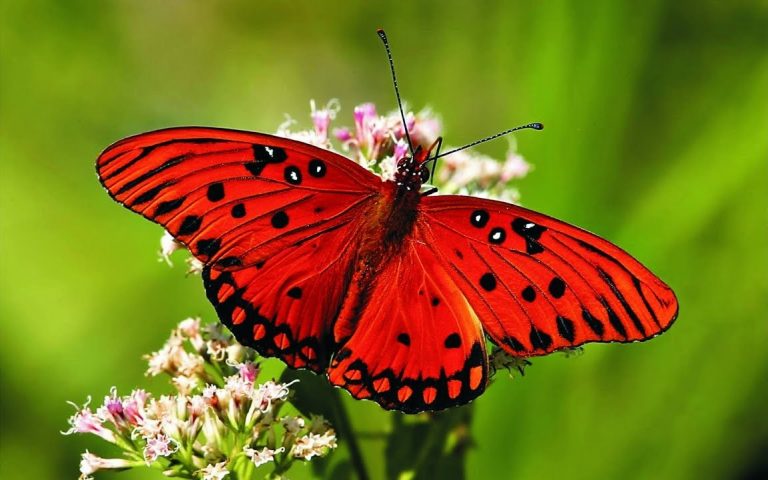
To defend themselves an array of defences have developed. Caterpillars blend into the foliage, others stand out a bright shade of danger, and some have spines. Butterflies often have bright markings that mimic something dangerous – for example the Peacock butterfly has two large spots that resemble eyes on his wings to scare predators, but at rest the wings are closed up to reveal a dull, camouflaged grey. When folded a butterfly is so thin it’s difficult to spot from above.
Some caterpillars and butterflies release a chemical scent to deter predators and other have foul smelling parts such as the Swallowtail.
Do Butterflies Hibernate? Some of the larger UK butterflies hibernate as eggs, as caterpillars, a chrysalis, or as fully fledged adults.
Our annual visitors such as the Painted Lady can’t stand winter temperatures and fly to back to warmer African climates. Most Painted Ladies retuning to Africa in autumn are fresh, following in their parents’ footsteps with no directions or guidance. The fact they can do this at an altitude of 500 metres makes the Painted Lady an astonishing creature.
Those hibernating do so in the coldest winter months because there are no food sources available. Brimstone, Small Tortoiseshell, Red admiral and Peacocks will all hibernate, potentially in your butterfly hotel, in dried-out grass stalks, in brickwork, or in your house.
Don’t disturb a hibernating butterfly, they do not harm, and releasing one that’s woken in the central heating means death if it’s cold outside. Instead, put it in a shoebox with a thin cut on one side. Then place it in a cold, dark place like your garage or shed to continue hibernating.
The slot is vital – don’t forget to cut the box so a waking butterfly can escape on its own. If it’s warm and sunny outside put the box into a hot spot, and the butterfly will fly away – if it made it through hibernation safely. Many don’t make it, either running out of stored energy or falling ill to fungal infections in damp hibernation spots.
How butterflies help the garden
How Butterflies Help The Garden Butterflies and moths are not only beautiful garden ornaments, they are vital pollinators.
Whereas bees get covered in pollen butterflies take a smaller amount on their slender legs, but they travel greater distances than bees, flitting around like nomads instead of returning to a hive or burrow. This means they spread pollen over a larger area strengthening the genetic variation of DNA in plants. This means our plants are tougher and less likely to fall prey to disease.
Butterflies and moths also provide food for our birds. Blue tit chicks in particular feast on caterpillars in spring, and the adult butterflies are a filling meal for both birds and bats. In fact without butterflies our native wildlife would go hungry as mating and breeding seasons are arranged around food sources.
You can help in a number of ways: Intensive farming practices find farmers more often growing tall grass for silage instead of the traditional wildflowers for hay, so butterflies have a hard time finding food.
Bees and butterflies need flowers to survive and in turn birds, bats and other mammals need bees and butterflies. But it’s not as simple as loading up your boot at the garden centre because caterpillars need certain plants to thrive – here are some good choices:
Nettles
Bird’s-Foot Trefoil
Nasturtium
Garlic Mustard
Ladies Smock
Long Coarse Grasses
Oak
Elm
Holly
Ivy
You might not be keen on common nettles, but a patch in a sunny garden corner is invaluable. Limit their spread by growing nettles in a sunken container.
Adult butterflies and moths need nectar – Most native wildflowers and weeds are appreciated by our pollinators, but here are some good choices:
Try to have as many suitable flowering plants as possible right through the seasons. Choose warm, sunny spots to plant your nectar-rich flowers and keep deadheading them so more blooms appear. This is especially important in spring and autumn when food sources are slim pickings.
Its good practice to buy genuine UK plants and wildflower seeds because exotic species are not always suitable food for butterflies.
What Else You Can Do to Help Butterflies Don’t collect them. This is an old fashioned hobby, but some people still catch butterflies in nets and pin them to boards. It’s a cruel practice and some butterflies are protected so you could get into trouble. Use a camera instead.
Join your local environmental group to learn about coppicing and natural techniques that enhance the environment. Environmental groups plant wildflowers and count the butterflies to give picture of their health.
Stop using pesticides. Pesticides kill everything they land on and sprays are carried around on the wind. This means butterflies, moths, caterpillars, eggs and pupa are destroyed. Bees, ladybirds, hoverflies and all pollinating insects are wiped out. A sterile garden is a wildlife free garden.
It won’t take long for natural aphid predators to arrive if you simply spray with citrus soaked water or remove them by hand. Just wear gloves it’s not that bad. Gardeners have managed for thousands of years without pesticides, so net your cabbages – don’t spray them.
As well as growing more nectar rich flowers, keep an area of garden wild. Leave it unmown, add bee and butterfly hotels, some native wildflower seeds, a hedgehog house, some logs, and the wildlife will move in. If you don’t have a garden, a hanging basket or container of flowers on a balcony will also attract bees and butterflies. Any little you can do will save lives and promote a healthy environment.
Water all around – but not a drop for our wildlife to drink. We have taps, but mammals, birds and insects don’t. In hot summer months wildlife dies from dehydration. A simple bowl of fresh water is so easy, yet saves countless lives. Butterflies drink water too and the best way to help is to fill a dish with marbles or pebbles and fill it daily. Bees and butterflies will sit safely in the pebbles with danger of falling in.
Save a Butterfly If you find a butterfly on a cold, wet day it’s probably in trouble. If it’s in water then it will certainly drown because once cold, they need sun to get moving again. Get involved and save that butterfly!
Remove it from the cold or watery situation into a sunny, sheltered area away from predators. If you are feeling generous a teaspoon of cool water with a bit of dissolved sugar will give the butterfly enough energy to find safety. Ensure you don’t get any of the solution on its wings as it will be unable to fly away and simply die. When it takes a drink, you’ll see that fabulous proboscis emerge. It’s a sight worth waiting for, so be patient.
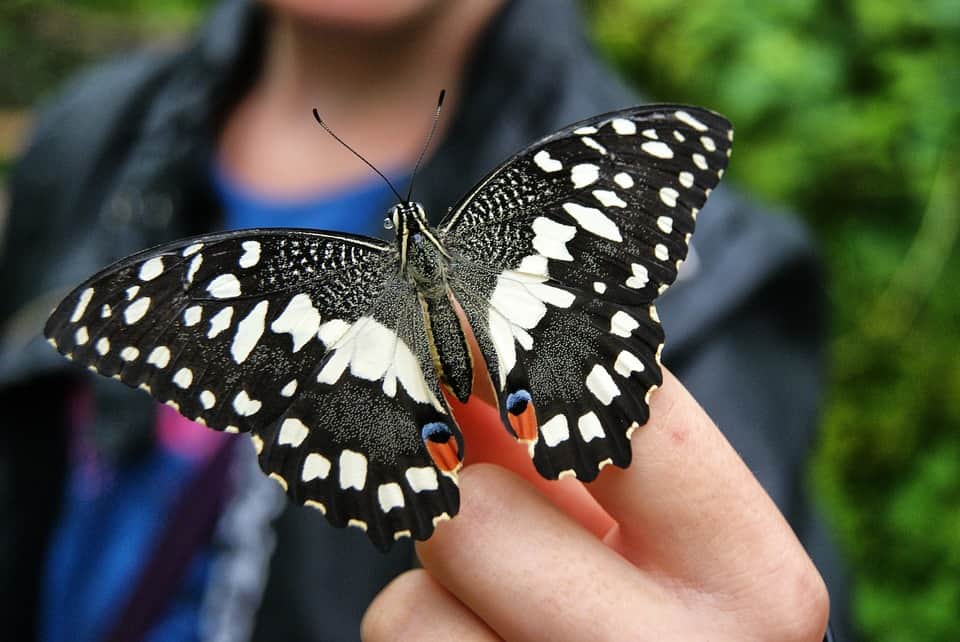
How to hold a butterfly
How To Pick Up A Butterfly Butterflies do not bite, sting or harm you in any way. Don’t leave a butterfly to die if you can help. If possible use a glass with a piece of card slipped beneath, but if this isn’t possible encouraging the butterfly onto your finger or a leaf is best all round.
If it’s in water, or won’t budge, you can gently pick it up. Cupped in your hands is a good method, and you can pick it up by the wings if you don’t rub them together. In order to escape from predators butterflies can fly with over 70% of their wings missing, despite us being told as children they die if you touch the delicate wings. Be gentle and slow at all times.
Always pop a watery butterfly, bee, moth, hoverfly, or ladybird somewhere sunny to dry out, away from winds and birds or bored cats.
Bye Bye Butterfly The loss of our iconic butterflies is more than a shame, it’s an indication we are changing our environment with building, intensive farming practices, urbanisation and a shocking lack of knowledge or conscience.
Losing our biodiversity impacts us in ways we may not consider or yet understand. Our crop harvest is mainly pollinated by bees and butterflies. Insect loss has an effect on birds and mammals too.
The degradation of our world by activities to solely benefit the human race is one of the biggest issues facing us today.
We must remember the planet belongs to all of us and when we change fundamental principles that have evolved over millennia we play god in a field we know little about.
Individuals like us can take steps to help re-flower our green spaces, avoid chemical insecticides and learn about our environment. These steps are essential and they need to quicken pace, because our native wildlife is running out of time and a world without flora and fauna would a difficult one.
The Decline of Butterflies in Scandinavia is written by Rachel Brown, editor of diygarden. We thank Rachel for permission to republish this guide.
The following represents 10 of Norway’s premier mountain hiking trails. Many other hikes are worthy of consideration, but these in particular embody Norway’s most iconic and awe-inspiring mountain views.
The length and difficulty of the hikes vary, but they are all worthy of serious consideration depending on what part of the country you are visiting.
Romsdalstrappa, Åndalsnes
A rather steep but very good path up the Romsdal Valley leads you 715 meters above sea level where you have a beautiful view over Åndalsnes and the Romsdalsfjord. The hike takes approximately 1 – 1.5 hours.
Galdhøpiggen, Norway
Galdhøpiggen, Jotunheimen
Galdhøpiggen is the highest mountain in Norway, Scandinavia and Northern Europe, at 2,469 m above sea level. It is located within the municipality of Lom, in the Jotunheimen mountain area.
Galdhøpiggen can usually be climbed in three ways from Spiterstulen: Easy, Hard and Extreme. It is possible to climb to the top of the “Gateway”, but we recommend a good knowledge and climbing guide for this.
Besseggen, Norway
Besseggen
Besseggen is one of Norway’s most famous mountain hikes, and each year around 30,000 tourists enjoy the breathtaking view from the top of the ridge.
The hike over Besseggen takes six to eight hours including breaks and is recommended for experienced hikers. The ridge is both windy and steep, so if this is the first time you are hiking in the mountains, it might be a good idea to choose an easier alternative. To ensure that your mountain hike will be a good experience, it is important to prepare yourself before you start. We recommend that you have at least two days at your disposal to increase the chances of nice weather.
Aurlandsdalen Valley
Aurlandsdalen is often described as the Grand Canyon of Norway. Lush nature, fantastic fjord views and roaring rivers that are perfect for outdoor activities.
The Aurlandsdalen Valley and Nærøyfjorden, located at the end of the Sognefjord, are two classic hiking areas with plenty of other outdoor adventures within easy reach. A few ideas that can be combined with hiking are to go kayaking on the fjord, cycle from 1,222 to 0 meters above sea level and join a RIB safari or fjord cruise. It is all there in one destination, making sure that you do not need to spend time on transfers.
Rallarvegen, Norway
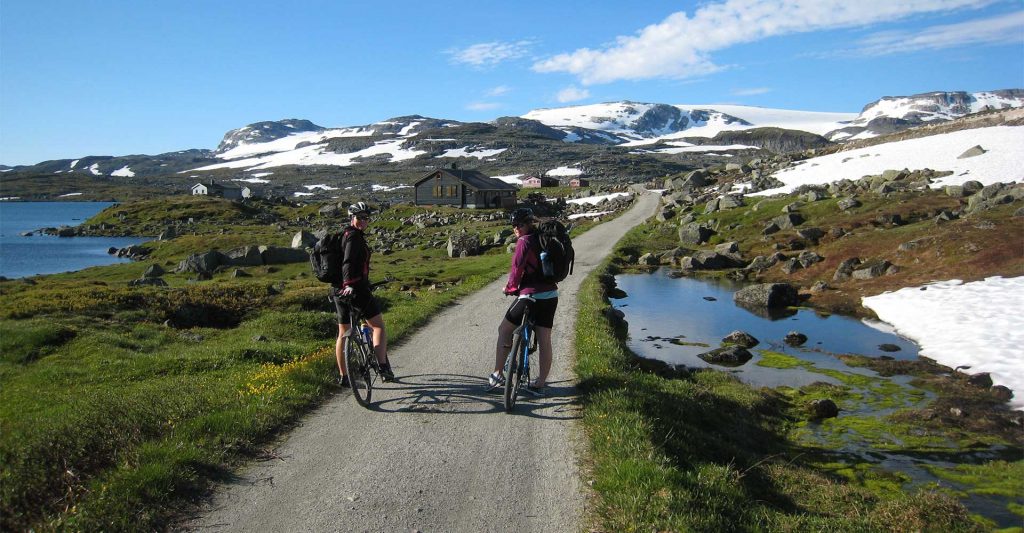
Rallarvegen Rallarvegen, following the outskirts of the Hardangervidda Plateau, leads you along the Bergen Railway Line from Haugastøl via Finse, Hallingskeid, Myrdal and down to Flåm. It is also possible to follow the road down to Voss. The road by itself is an attraction, but it also brings you through a fantastic highland area starting at 1000 meters above sea level, peaking at 1350 meters for then to lead you back down to the fjords at sea level.
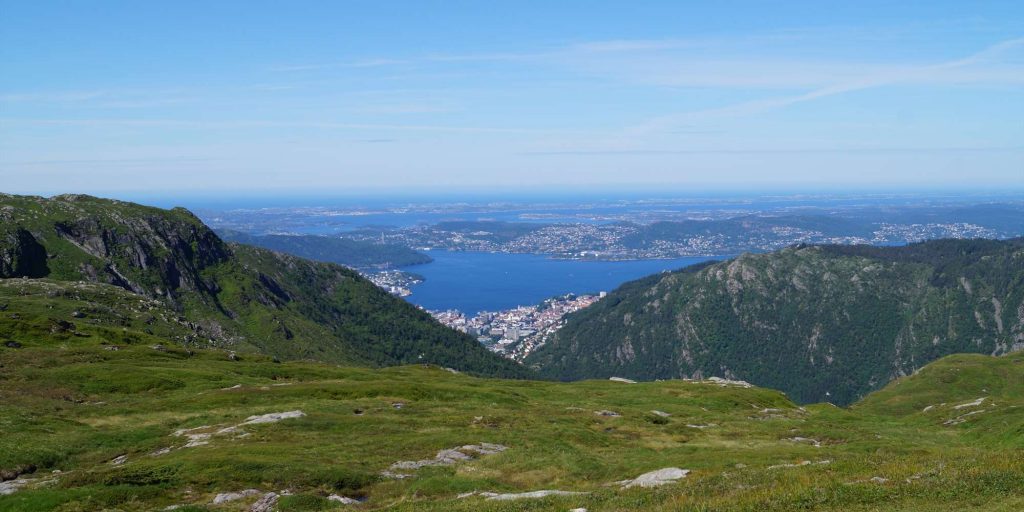
Across Vidden, Bergen
The tour between Mount Ulriken and Mount Fløyen is one of the the most popular tours in Bergen. Beautiful views of Bergen and the region.
You can start and end your trip by taking Ulriken Cable Car or Fløibanen funicular. Between these two beautiful mountains you can see the fjords and islands around Bergen. On a clear day you can enjoy the view to Folgefonna glacier.
Troll’s Tongue. Norway
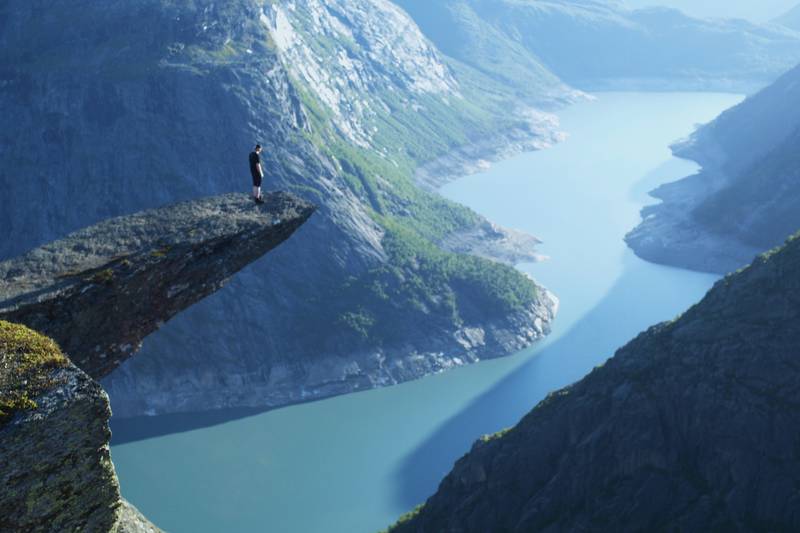
Trolltunga Trolltunga (Troll’s Tonhue) is one of the most spectacular rock formations in Norway. It’s located 1,100 meters above sea level and about 700 meters above Lake Ringedalsvatnet. Expect lofty and spectacular views. The hike is long and demanding, and passes through the high mountains.
The trail to Trolltunga is well signposted. From the main trailhead at P2 in Skjeggedal it is a 28 km return hike with an ascent of 1.200 and an estimated hiking time of 10–12 hours. There are additional trailheads at P1 in Tyssedal and P3 at Mågelitopp. Shuttle services connect Odda and P2 Skjeggedal and the P1, P2 and P3 parking lots.
Gaustadtoppen The majestic Gaustatoppen is considered one of Norway’s most beautiful mountains. Telemark’s highest peak can be found in the serene Tinn municipality. Many believe that the top of Gaustatoppen provides the best view Norway has to offer. In fact, on a clear day you are gazing out onto one-sixth of Norway’s landscape. You can see the mountain peaks and forest of Telemark, Oslo, and Buskerud municipalities as well as large parts of the Hardangervidda National Park.
Kjerag, Norway
Kjerag At 1084 metres, Kjerag towers above the other peaks along the Lysefjord. It has been traditional to admire this mountain face from the fjord, but in recent years, it has become increasingly popular to walk up the path to the plateau. Most people are happy just to enjoy the view of the Lysefjord from the plateau itself, but for some hikers, the climax of the excursion is to be photographed on the Kjeragbolten, a round rock wedged solidly in a mountain crevice. Kjerag has also become a popular attraction for mountain climbers and base jumpers.
Pulpit Rock, Norway
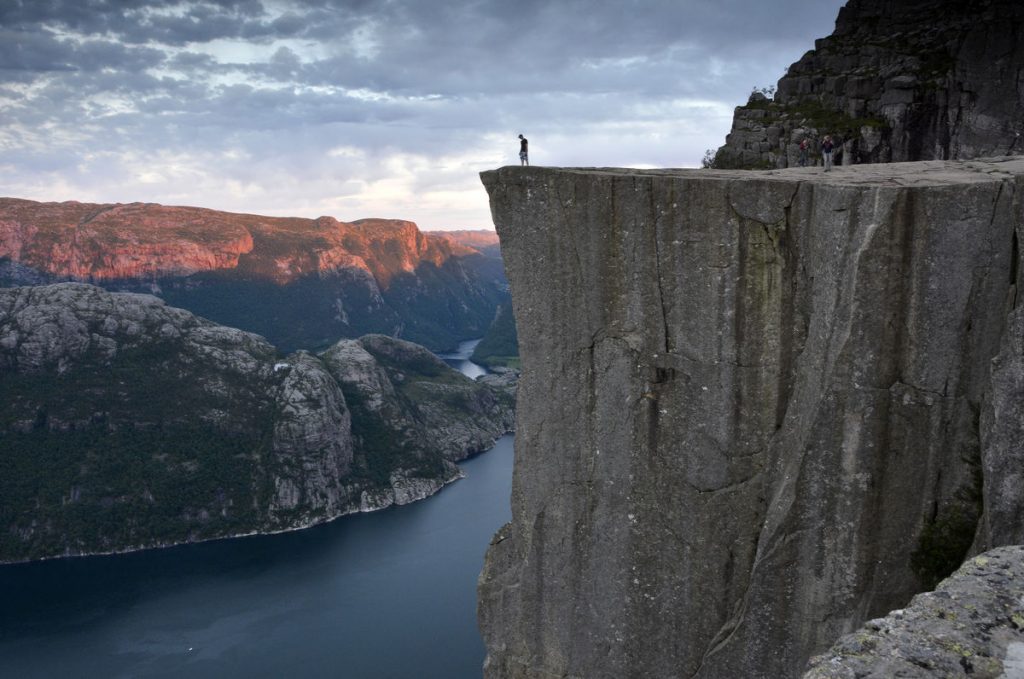
Preikestolen Climbing to the top of Preikestolen (Pulpit Rock) by the Lysefjord is one of Norway’s most popular hiking trips.
This hike is considered relatively easy by Norwegian standards. One can do the trip in just half a day, and there are multiple routes to choose from. A good alternative is to follow the main trail to the top, choosing one of the alternative routes downhill.
Feature image (on top): Romsdalstrappa, Åndalsnes
The 10 Most Popular Mountain Hiking Trails in Norway, compiled by Tor Kjolberg