
Swedish Legend in the Art World

Swedish Lars Nittve (66) was the the director of the Louisiana Museum of Modern Art outside Copenhagen (1995–98), founding Director of Tate Modern in London (1998–2001), director of Moderna Museet in Stockholm (2001–10), and until recently Director of the M+ museum of contemporary art in Hong Kong, which he joined in 2011.

The M+ Museum in Hong Kong was scheduled to open in 2017, but the latest construction delay was the last straw and from now on, he wants to spend more time at his home in Sweden and only remain a consultant to the project.

Swedish Legend in the Art World
Construction work at M+ Museum in Hong Kong

Lars Nittve goes to Hong Kong
Lars Nittve was born in Stockholm in 1953. He studied at the Stockholm School of Economics, and obtained an M.A. at Stockholm University. He also pursued postgraduate studies at New York University. In 2009, Nittve earned a PhD, HC, from the Umeå University in Sweden.

In 2010 when Nittve agreed to come to Hong Kong to lead the M+ project, the authority was overjoyed. M+ is aiming at reinventing the definition of a museum and has been described as the most ambitious museum project since the Centre Pompidou opened in Paris nearly 40 years ago.

Swedish Legend in the Art World
In 2010 when Nittve agreed to come to Hong Kong to lead the M+ project, the authority was overjoyed

Related: Sweden’s Largest Art Museum Opens After 5 Years of Renovation

In an interview in 2015, Nittve pointed out that he was not really leaving. He said he would be showing up for work as a consultant for one week each month in Tsim Sha Tsui. “M+ is a team effort but it is also very much my brainchild. I’ve been here five-and-a-half years. I want it to have a happy ending,” he concluded.

The building is now scheduled to be finished March 2020 and the M+ museum will open nine to twelve months later.

Swedish Legend in the Art World
Nevertheless, Nittve has had a prolific career as a curator and lecturer, and is a member of the Royal Swedish Academy of Fine Art. In 2013 he was ranked at number 73 in Art Review Magazine’s annual Power. He is also the author of several publications on art, as well as articles in journals and catalogues in Sweden and abroad

Swedish Legend in the Art World, written by Tor Kjolberg

TV Documentary Team on Earth’s Climate Change Visits Norway

National Geographic’s new six-part series, Hostile Planet focuses on how predator and prey struggles to survive in Earth’s rapidly changing extreme environments. Hostile Planet is an unvarnished depiction of the animals’ struggle to survive on an ever more relentless planet. The team has also been to the mountains of Telemark and the Reisa Fjord in Tromsø to perpetuate Norwegian fauna.

“It’s an honest account of what’s going on today,” says the series creator, Tom High-Jones. It has taken months of preparation followed by weeks of tracking various species to capture the perfect unexpected shots. Out of 1,800 hours of footage comes six segments focusing on distinctive biome: mountains, oceans, grassland, jungles, deserts and polar.

TV Documentary Team on Earth’s Climate Change Visits Norway
“It’s an honest account of what’s going on today,” says the series creator, Tom High-Jones

Related: Best Selling Norwegian Author Maja Lunde

TV Documentary Team on Earth’s Climate Change Visits Norway
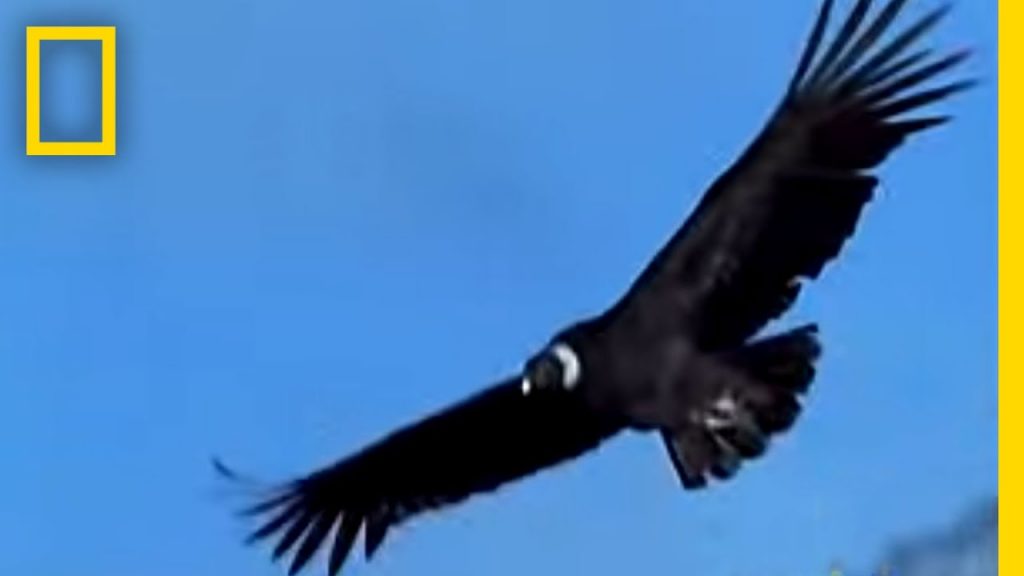
Eagle filmed for National Geographic in Telemark, Norway

Award-winning director
Hostile Planet is executive produced by Academy Award-winning cinematographer and director Guillermo Navarro (Pan’s Labyrinth), Emmy-nominated producer Martha Holmes (The Blue Planet) and Emmy Award-winning Tom Hugh-Jones (Planet Earth II).

Read also: Norway- the Kingdom of Whales

TV Documentary Team on Earth’s Climate Change Visits Norway
Gemma in Troms, Norway

TV Documentary team on earth’s climate change visits Norway
The series draws attention to the most extraordinary – almost supernatural – accounts of animals that have conformed to the cruelest evolutionary curveballs. “Norway was my absolute favorite part of these recordings,” says Navarro to the Norwegian newspaper Aftenposten after having filmed eagles and orcas respectively on his trip to Norway.

“The visual language is now what takes over. The old traditional way was pretty much a voiceover being illustrated with images. This is a much more immersive experience,” says Guillermo Navarro.

Read also: Dances With Wolves in Norway

TV Documentary Team on Earth’s Climate Change Visits Norway
Orcas in Norway

Hostile Planet Production Credits
Hostile Planet is produced by Plimsoll Productions for National Geographic. For Plimsoll Productions, executive producers include Grant Mansfield, Andrew Jackson, Martha Holmes, Bear Grylls, Delbert Shoopman and Tom Hugh-Jones, who also serves as showrunner. Guillermo Navarro is executive producer. For National Geographic, Kevin Tao Mohs is executive producer. Geoff Daniels is executive vice president of global unscripted entertainment for National Geographic Channels.

Feature image (on top): Mother polar bear, desperate for food

TV Documentary on Earth’s Climate Change Visits Norway, written by Tor Kjolberg

Scandinavian Ham

There are several traditional hams in Scandinavia, all salted and smoked, but not dried. It is possible of course to dry ham in the northern climate, as with fish, but for some reason it has just never been done.

Considering the quantity of pigs reared in Scandinavia, the number of gourmet preparations is surprisingly small, and a really good ham is hard to come by. Actually, a lot of salted and dried Italian ham are of Danish origin.

Scandinavian ham
Tradistional Swedish Christmas gam

Related: Norwegian Food Traditions – A Living Museum in Oslo

Should you feel the urge to make your own salted and air-dried ham, it’s not difficult, if you live in a a country where winters are cold.

Scandinavian Ham
Smoked salted hams are nearly always boiled or baked. The Swedish juleskinka, served for Christmas Eve, is prepared with a delicious layer of mustard, breadcrumbs and brown sugar. Boiled and sliced ham is a favorite topping for open sandwiches, often topped with Italian salad and cress.

Scandinavian ham
Scandinavian ham sandwich

Related: The Norwegian Asparagus Island

A whole ham is a daunting hunk of meat, but for a great big party it’s easy to prepare and there are no last-minute jobs to attend to, once it’s boiled and baked. You can prepare smaller family-size cuts in the same way.

Related: Scandinavian Game

Scandinavian ham
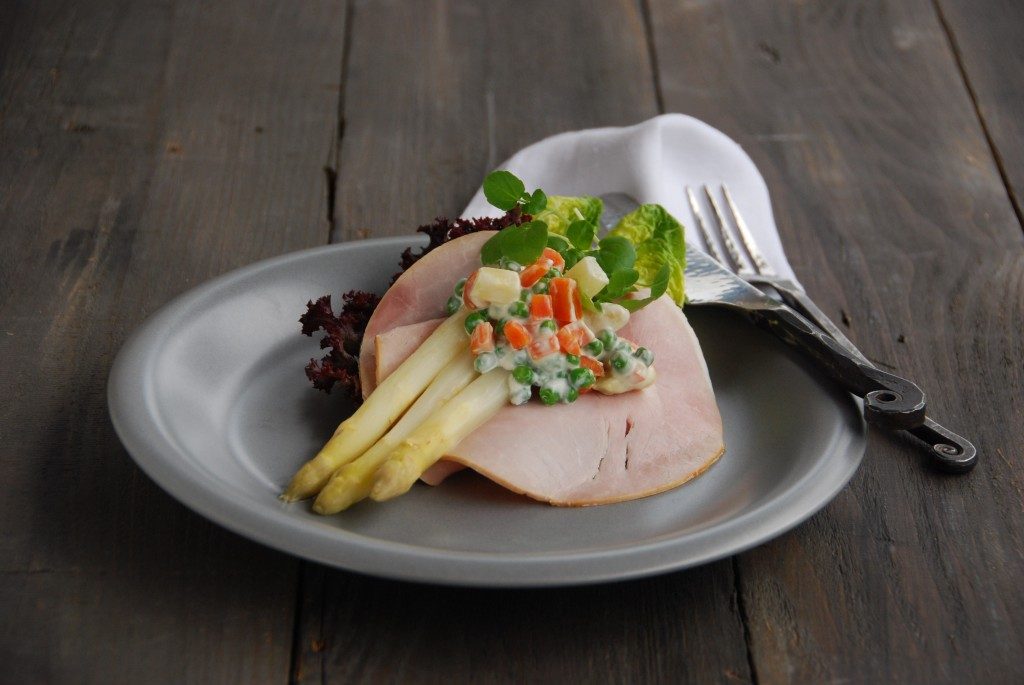
Scandinavian sandwich with ham and Italian salad/asparagus

Cooking ham
It’s far too easy to overcook ham, so the safest way for a 1kg piece is to put it in the fire in a pot with hay and/or herbs on the bottom and then plenty of cold water. Bring to the boil and turn off the heat. Let the ham sleep until the water is cool and it will be perfect.

Feature image (on top): Scandinavian honey baked ham

Scandinavian Ham, written by Tor Kjolberg

The Colorful Zealand in Denmark

Venture north from Copenhagen to Hamlet’s castle at Helsingør, or south to the white cliffs of Møn, and discover Zealand, a colorful land rich in culture and tradition.

The island of Zealand (Sjælland) is Denmark’s largest island, yet it is still compact and most of its attractions make ideal day trips from the capital. The area north of Copenhagen makes a classic tour for visitors, with its undulating countryside, beech forests, lakes and good beaches, as well as castles, manor houses, royal hunting lodges, art galleries and museums.

The Colorful Zealand in Denmark
Lake in Zealand

Related: Zealand Coast Around Copenhagen

The southern and western areas of Zealand have traditionally been entry points for new people and ideas coming from the Continent. This side of the island is an enchanting expanse of rolling hills, woodland and some wonderful seaside scenery.

The Colorful Zealand in Denmark
From the Louisiana Museum of Modern Art

The Danish Riviera
The coast road from Copenhagen to Helsingør, officially called Strandvejen, is also known as the “Danish Riviera” for its stylish houses and fine views across the Øresund to Sweden. Small protected harbors shelter working fishing boats and millionaires’ yachts alike, and converted marine buildings house fresh fish restaurants.

Related: Exploring North Zealand, Denmark

The Colorful Zealand in Denmark
While it’s true that the essence of North Zealand can be glimpsed in a day, it really warrants more time, either by an overnight stop at a charming Danish kro (inn) or by taking several day tours from Copenhagen.

The Colorful Zealand in Denmark
Biking holiday in Zealand. Photo: Ruby Rejser

Related: Coastal Hygge in Denmark

The Colorful Zealand in Denmark
Hundested beach in Zealand

From Copenhagen, drive north through fashionable Charlottenlund to quiet elegance nearby Ordrupgaard. It’s permanent collection of Danish and French paintings includes work by Matisse and Gauguin. The museum has recently incorporated the home of Finn Juhl, architect and furniture-designer extraordinaire.

Feature image (on top): Tisvildeleje, North Zealand (Photo: Klaus Bentzen)

The Colorful Zealand in Denmark, written by Tor Kjolberg


Norwegian Deepwater Prawns

Norwegian Deepwater prawns (Pandalus borealis) prefer cold, clean water which means that they grow and mature slowly. Prawns are an ingredient for any occasion. They have a remarkably intense fresh taste, a firm flesh and a natural pink color.

Prawns are a prized treat in Norway, and you’ll be able to spot the prawns thanks to their appealing light pink color. But that’s not the only thing that makes them unique.

Norwegian Deepwater Prawns
Prawn cocktail

Prawns are usually found at a depth between 100 and 700 meters but are found both shallower (up to 20 meters) and deeper (down to 900 meters), and they prefer temperatures between 1-6 ºC. The prawn stock is classified according to where it lives. In Norway, prawns are found in fjords, coastal areas, in the North Sea/Skagerak and in the Barents Sea. In the North Sea, the fishery involves the stock that is found in the Norwegian Trench.

Related: Scandinavian Shrimp

Norwegian Deepwater Prawns
The prawn fishery in the Barents Sea is sustainable and based on national and international guidelines for long-term, scientifically documented catch. The management of the northern prawn stock respects international environmental standards.

Norwegian Deepwater Prawns
Prawn fishing boat in Norway. Photo: Norwegian Seafood Council

Prawns are hermaphroditic, which means they start life as males, but transform into females later in life. These changes occur at different times depending on where the prawns are living. In the Barents Sea, the change occurs when the prawns are between 4-7 years old.

During the day, the prawn lies on the bottom to rest or feed. At night, it rises in the water column to eat zooplankton. The prawn mostly moves up and down in the water column, but the female can move to shallower water around hatching time.

Related: Scandinavian Shellfish & Molluscs

Norwegian Deepwater Prawns
Prawn sandwich

Fishing gear
The fishing gear used in the prawn fishery is trawls with a minimum mesh size of 35 mm. Sorting grates for fish are required on the prawn trawl. The sorting grate ensures that the majority of fish and small prawns over a certain size are sent out of the trawl again. Studies are also being done on fishing for prawns in Norway with pots, which are common fishing gear in other parts of the world where prawns are fished.

Nutrition
Prawns are very low in fat and calories and high in protein and nutrition. The proportion of polyunsaturated fatty acids makes up about 50% of the fatty acids in prawns. 100 g of prawns covers the daily requirement of omega-3. Prawns are also an excellent source of vitamin E (approximately 4 mg/100g). Vitamin E is an important antioxidant, which enhances the body’s utilization of vitamin A. In addition, prawns have a relatively high content of calcium (about 34 mg/100g), a mineral that is important for building the skeleton. Prawns do not contain carbohydrates

Norwegian Deepwater Prawns
Prawns are a prized treat in Norway

Norwegian prawns have a fresh, sweet and slightly salty taste, which means they can be served in a wide range of hot and cold dishes. The prawns must not be cooked and must be added to the hot dish in the last minute.

Norwegian Deepwater Prawns, written by Tor Kjolberg based on information from the Norwegian Seafood Council

Oslo Jazz Festival 2019 presents Jazz in Church

The neo-Romanesque Grønland Church in Oslo from 1861 will host three acoustic jazz concerts during the Oslo Jazz Festival 2019. Bedehus & Hawaii featuring Geir Sundstøl, Trondheim Jazz Orchestra with Alf Hulbøkmo and Nils Petter Molvært as well as Nordic Voices are three acclaimed Norwegian groups which will perform in the church in August.

Oslo Jazz Festival is one of Norway’s many jazz festivals and has been a key part of the capital’s music calendar since 1986. In later years, the festival has embraced genres beyond jazz like gospel, blues and electronica.

Oslo Jazz Festival 2019 presents Jazz in Church
The neo-Romanesque Grønland Church in Oslo from 1861

Related: DølaJazz – Highlights

Bedehus & Hawaii featuring Geir Sundstøl
Sildajazz is one of the other acclaimed jazz festivals in Norway and in 2017, when guitarist and composer Trond Kallevåg Hansen received the Statoil Sildajazz Prize, he was commissioned to compose a work for next year’s festival. The result was a composistion named “Bedehus & Hawaii” (translated into English “Little Bethel & Hawaii”.

Oslo Jazz Festival 2019 presents Jazz in Church
Geir Sundstøl supplies his magic touch on “Bedheus and Hawaii”

The work refers to all the summers Hansen spent at his grandparents’ place on Bømlo. He uses this and other elements from his childhood and adolescence as an inspiration for his compositions.

Oslo Jazz Festival 2019 presents Jazz in Church
What makes ‘Bedehus and Hawaii’ so distinctive is probably the particular blend of instruments and instrumentalists

What makes ‘Bedehus and Hawaii’ so distinctive is probably the particular blend of instruments and instrumentalists. Hansen has chosen to use his familiar trio partners, Alexander Hoholm on double bass, and Ivar Myhrset Asheim on drums and percussion, alongside the virtuoso violinist Adrian Løseth Waade. Adding Geir Sundstøl supplies the magic touch.

Related: Scandinavia- The Best Jazz Region in the World?

Oslo Jazz Festival 2019 presents Jazz in Church
Alf Gulbækmo was commissioned by Sparebank 1 last year to compose “Skumringsbarda”

Trondheim Jazz Orchestra w/ Alf Hulbækmo
The work “Skumringsbarda” composed by Alf Gulbækmo was commissioned by Sparebank 1 last year and will have its premier performance by Trondheim Jazz Orchestra in Molde Cathedral at the Molde International Jazz Festival 2019, just a month ahead of the concert in Grønland Church in Oslo.

Skumringsbarda is a fantasy-world, a sort of play with good and evil forces. With weirdoes, scary people and smart ones many things can happen, and you find many strange things. Alf discovered this tempting as a teacher, spending several recesses with pupils in the woods behind the school.

Related: A Norwegian Jazz Masterwork

Oslo Jazz Festival 2019 presents Jazz in Church
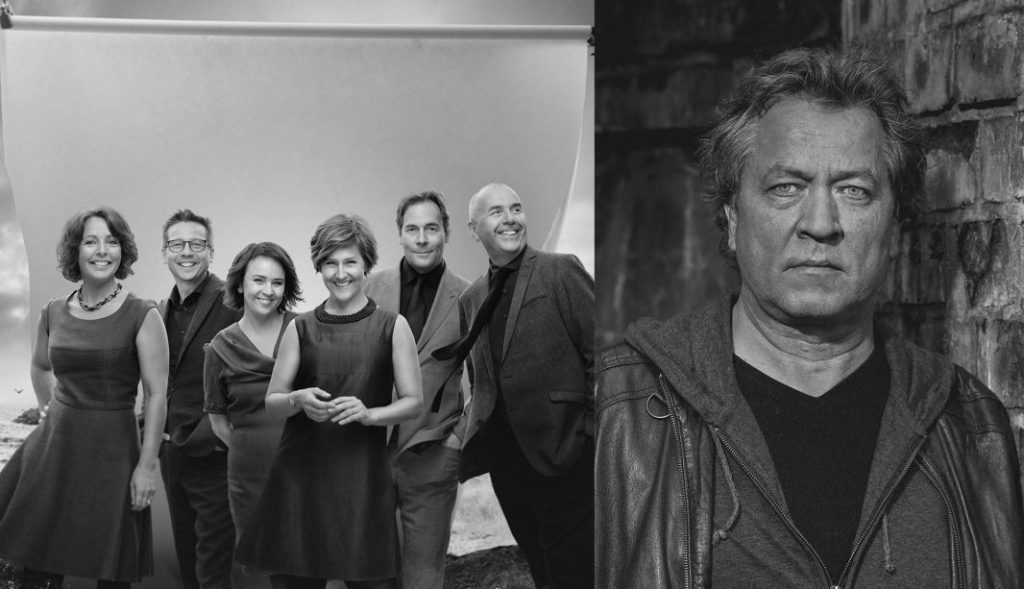
Nils Petter Molvær & Nordic Voices

Nils Petter Molvær & Nordic Voices
Jazz trumpeter Nils Petter Molvær is an internationally acclaimed group performing meditative music from the Middle Ages to modern times a capella, only accompanied by the trumpet of Molvær. The collaboration started in 2013.

Jazz trumpeter, composer and producer Nils Petter Molvær is considered a pioneer in combining different genres within jazz and electronic music. Molvær made his album debut in 1983 with the legendary Norwegian band Masqualero. Since then he has collaborated with several renowned musicians, like Marilyn Mazur and Ketil Bjørnstad who are also playing at this year’s Oslo Jazzfestival, and has created music for numerous tv series, films, documentaries and plays as well as ballet music for The Norwegian Opera & Ballett.

Oslo Jazz Festival 2019 presents Jazz in Church
You can buy tickets to all three concerts here.

Feature image (on top): Trondheim Jazz Orchestra

Oslo Jazz Festival 2019 presents Jazz in Church, written by Tor Kjolberg

Oat Milk From Sweden

As more and more people are looking for alternatives to traditional dairy products, the Swedish oat milk brand Oatly has exploded across the United Stated in recent years. Now the company sees huge opportunities in China.

Oatly wants to make it easy for people to turn what they eat and drink into personal moments of healthy joy without recklessly taxing the planet’s resources in the process. So, the Swedish drinks company helps farmers shift away from livestock farming and cut climate impact with its own oat milk brand

Oat Milk From Sweden
Rhe Swedish drinks company Oatly helps farmers shift away from livestock farming and cut climate impact with its own oat milk brand

Oat Milk From Sweden
Oatly was founded in the 1990s and is based on Swedish research from Lund University. The company’s patented enzyme technology copies nature’s own process and turns fiber rich oats into nutritional liquid food that is perfectly designed for humans.

Related: Scandinavian Dairy

Oat Milk From Sweden
Oatly was founded in the 1990s and is based on Swedish research from Lund University

The company operates out of the southern region of Sweden with Headquarters in Malmö with Production & Development Center situated in Landskrona. The Oatly brand is available in more than 20 countries throughout Europe, USA and Asia.

Extremely high demand in the US
Now, US demand for the company’s products has far outstripped supply, prompting people to sell cartons of Oatly on Amazon for up to $25, more than three times the retail price.

Oat Milk From Sweden
The Oatly brand is available in more than 20 countries throughout Europe, USA and Asia

The farmers do not need any dairy cattle to produce milk. Instead of using all these oats for animal feed, they can now produce an oat milk drink and tap into the growing market for dairy alternatives across the country and the world.

Related: Scandinavian Cheese

The market for cow’s milk in Sweden is waning, expected to decline by 2.5%, while that for plant-based alternatives like soy, almond and oat milk is expected to grow by more than 5% this year, according to market research firm Euromonitor International.

Oat Milk From Sweden
The farmers do not need any dairy cattle to produce milk

Environmentally friendly milk
The rearing of livestock and meat consumption accounts for 14.5% of global greenhouse gas (GHG) emissions. Alongside carbon emissions from deforestation (for pasture or crops to feed animals), the livestock sector is also the single biggest human-related source of methane (from cattle) and nitrous oxide emissions (from fertilizer and manure), two particularly potent greenhouse gases.

“We were growing really healthy in Europe and we’ve been there for a while, but then we entered the United States and the craze started,” Oatly CEO Toni Petersson said. Today, the Swedish company remains independent and dedicated to upgrading the lives of individuals and the general well-being of the planet through a lineup of original oat drinks.

On current trends, by 2050 we will be growing more crops to feed directly to animals than ourselves. Even small shifts to feeding crops to humans instead of livestock would lead to significant increases in food availability.

Related: Scandinavian Sour Milk Products

Oat Milk From Sweden
The market for cow’s milk in Sweden is waning, expected to decline by 2.5%

Growing popularity
Oatly’s popularity in the United States, driven by coffee drinkers who love it in lattes, prompted the company to open a factory in New Jersey this year, its first outside of Sweden. It’s opening another one in Utah next year, and one in the Netherlands to cope with demand in the United Kingdom and Germany.

Despite struggling to fill orders in Western markets, Oatly is now trucking ahead with an aggressive push into Asia.

Oat Milk From Sweden, written by Tor Kjolberg

The Danish Chair – An International Affair

The wonderful and diverse world of the export adventure often called Danish Modern can be explored at the Designmuseum Danmark in Copenhagen. There is a permanent exhibition displaying a global selection of chairs, with a focus on chairs from Denmark.

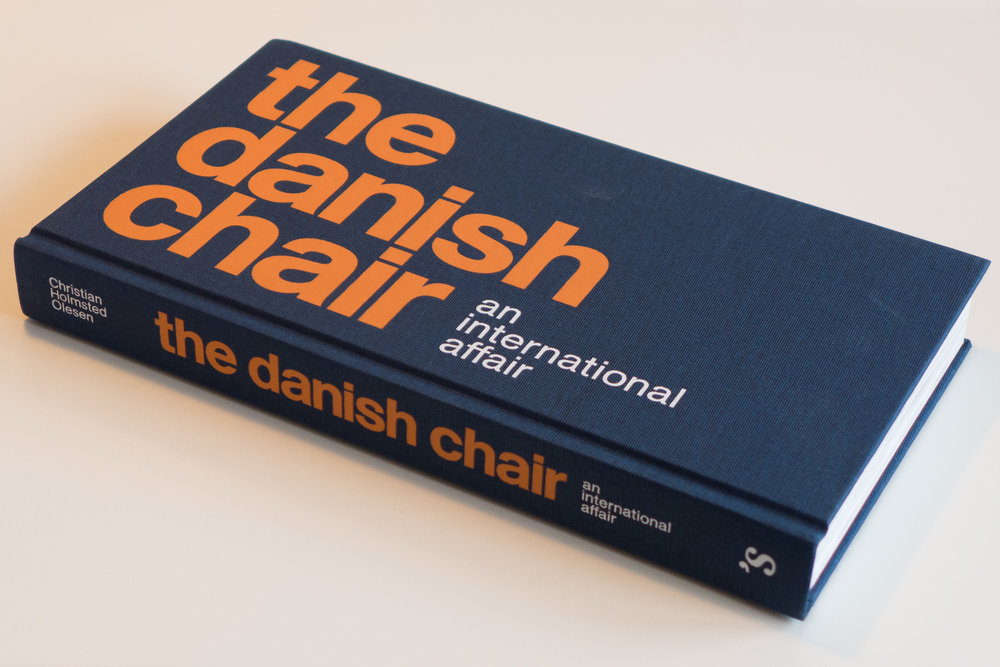
Christian Holmsted Olesen has written a book with the same title published by the museum, which tells the full story of the Danish chairs that were created during the 20th century. Danish designers are renowned around the world for their beautiful and functional chairs.

The Danish Chair - An International Affair
Designmuseum Denmark in Bredgade, Copenhagen

Most of the chairs are Danish from the 20th century although there are several chairs that were made in the 19th century –  an English Windsor Chair, an American Shaker Chair and Chinese chairs – that have been included because their forms of construction influenced Danish designs – and there are some modern international designs including chairs from England, Italy, Austria, Germany and the USA that help to set the Danish furniture in a wider context.

Related: Danish Flair for Design

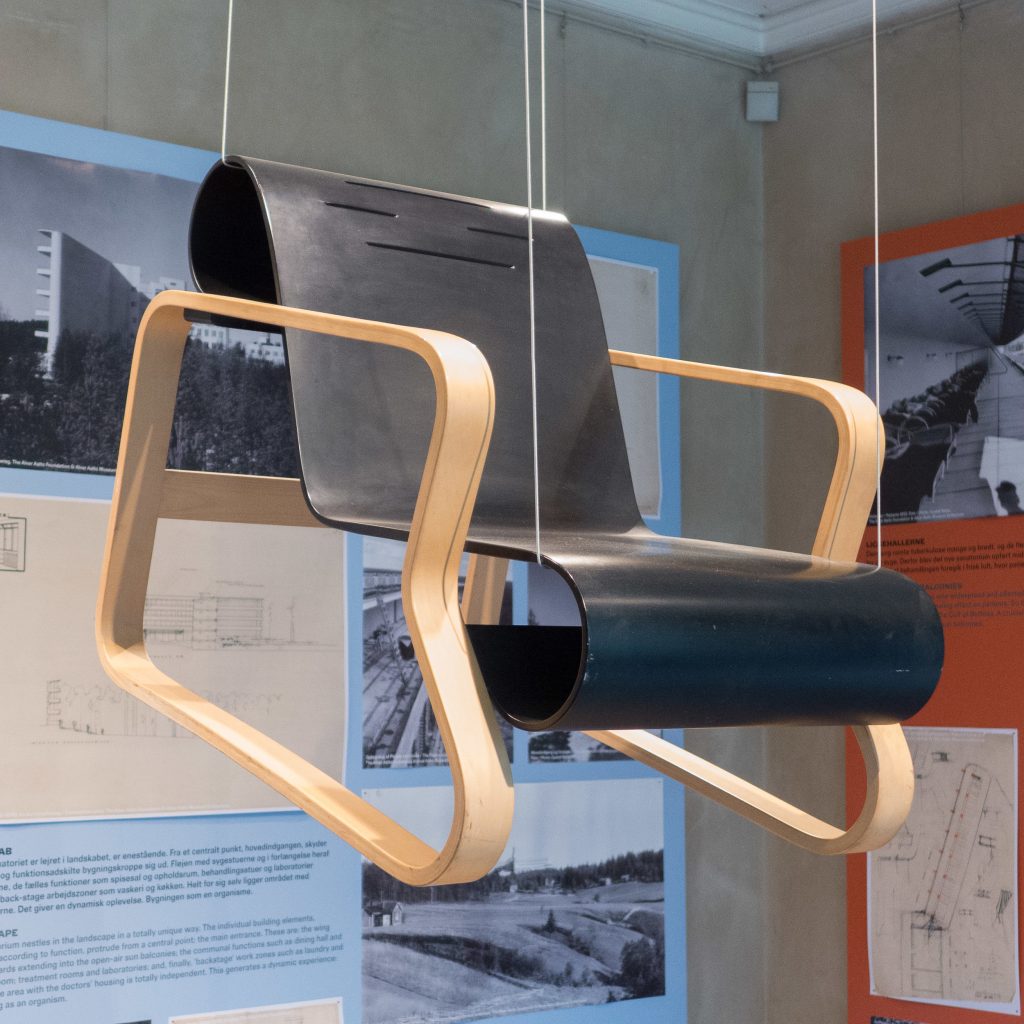
The chair is the piece of furniture that is closest to human beings. It touches and reflects the body that sits on it, with arms, legs, seat and back. It is a designer’s touchstone and design history’s favorite object. And the chair is one of the most culture-bearing design objects.

The Danish Chair - An International Affair
The Danish Chair, a book by Christian Holmsted Olesen

The Danish Chair – An International Affair, the book
The book is structured around chair types and illustrates how the ‘golden age’ of Danish furniture design was driven by the study and refinement of historical furniture types. It traces the family relations between the chairs and shows how they influenced each other in terms of detailing, construction and concept.

Related: Best in Scandinavian Design

The Danish Chair - An International Affair
The Danish Chair is a permanent exhibition at the Desigmuseum Denmark

Essentially, the book takes the form of a catalogue with separate entries for nine stools and for 104 chairs with each on a double-page spread, although for 31 of these the entries continue over to a second double-page that is used for historic photographs of the chair or for reproductions of working drawings.

The Danish Chair - An International Affair
Danish designers are renowned around the world for their beautiful and functional chairs

The Danish Chair – An International Affair, the exhibition
The exhibition emphasizes on the golden age of Danish furniture design, 1920-1970, allowing visitors to experience about 100 Danish and a handful of international chairs shown as individual works of art   – from wooden chairs to armchairs to folding chairs, lounge chairs, dining-room chairs and rocking chairs.

Related: Finn Juhl – The Golden Age of Danish Design

The Danish Chair - An International Affair
Arne Jacobsen’s Egg Chair

Design was the cultural phenomenon that put Denmark on the world map in the mid-20th century. The international brand of Danish Design arose in 1949 when American journalists began to write about the Danish furniture at the Copenhagen Cabinetmakers’ Guild exhibition.

Enormous chair collection
In the book, descriptions for each chair are succinct with most of the entries just over a hundred words although several are shorter and only two of the chairs have a text that goes into a second paragraph.

The Danish Chair - An International Affair
The chair is the piece of furniture that is closest to human beings

“With this new presentation of our enormous chair collection, we hope to give our guests an overview of the Danish chair’s roots as well as a look at the chair as a culture-bearing and artistic object. We want to communicate Danish Design’s DNA through the chair, which is one of the strongest representatives of the development of Danish design,” says exhibit curator Christian Holmsted Olesen.

The Danish Chair – An International Affair, written by Tor Kjolberg

Russian ‘Spy’ Whale on Mission in Norway?

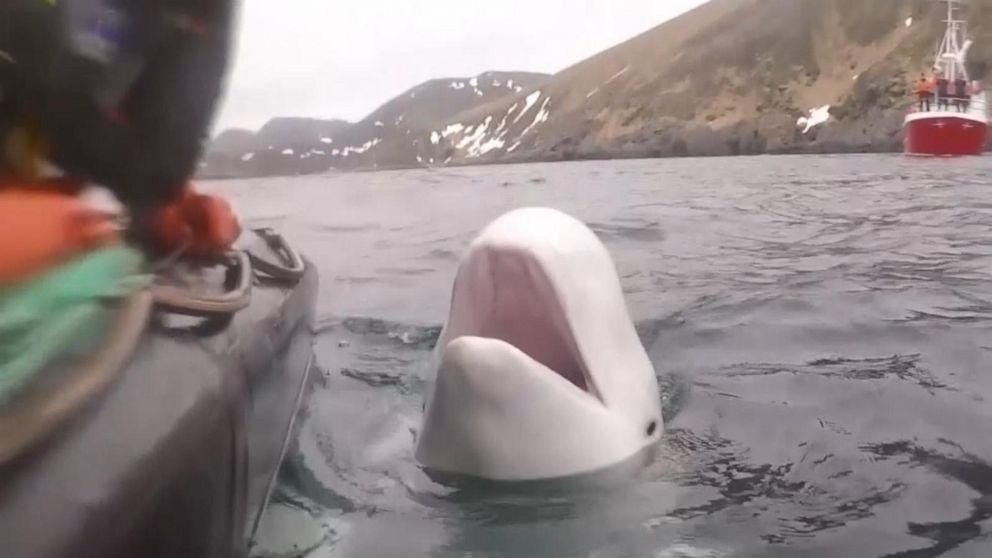
A beluga whale was found straying just a few miles from a small harbor in northern Norway on April 26. Residents have been requested by experts not to feed the beluga so that it can learn to forage.

The beluga whale has been entertaining locals with tricks and some believes it has been trained to spy for Russia. Videos posted online show the alleged Russian operative being fed by hand, dancing in circles and even checking out an inquisitive dog.

Russian ‘Spy’ Whale on Mission in Norway?
The beluga whale has been entertaining locals with tricks and some believes it has been trained to spy for Russia

“He’s so comfortable with people that when you call him he comes right up to you,” Linn Sæther, a resident of Tyfjord on the Arctic island of Rolvsøya, told Norwegian public broadcaster NRK, which has launched a poll to find a name for the mammal. NRK received more than 1,000 suggestions, and the most popular names include Snow White, Agent James Beluga and White Russian.

Related: Norway- the Kingdom of Whales

Russian ‘Spy’ Whale on Mission in Norway?
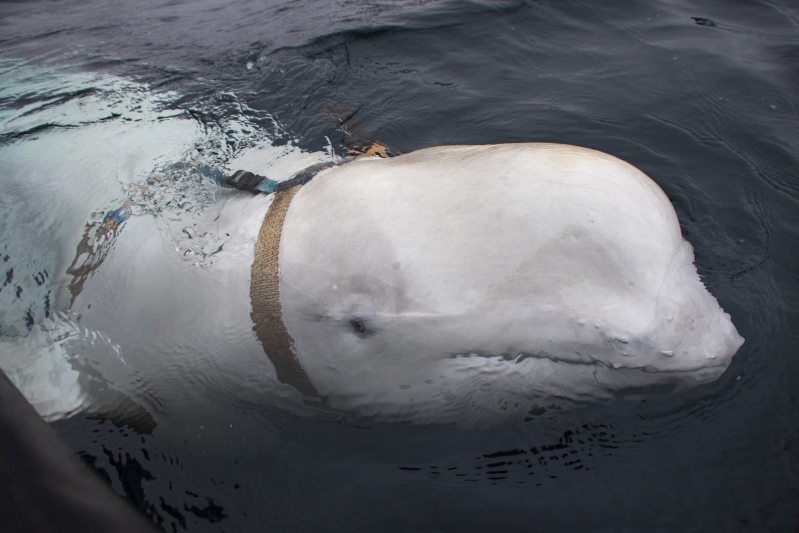
The beluga is refusing to leave the Norwegian harbor of Hammerfest after weeks of global attention. When the whale was discovered by Norwegian fishermen it was wearing a harness fitted with a mount – apparently for a camera or weapon – and stamped with the words: “Equipment St Petersburg.”

To the Washington Post, Norwegian Directorate of Fisheries official Jorgen Ree Wiig said the whale had moved only about 25 nautical miles within the past week and appeared to enjoy being close to humans, which he noted was “strange” for a beluga.

Russian ‘Spy’ Whale on Mission in Norway?
The beluga is refusing to leave the Norwegian harbor of Hammerfest after weeks of global attention

Related: Look Out for Whales in Norway

Obedient like a dog
“The whale followed my boat on a one-hour voyage from Rolvsøya back to Hammerfest,“ local Tor Arild Guleng told CNN. “It followed me, like an obedient dog without a lead. No wild animal seeks you out, sticks its head up and allow you to stroke its nose.”

Audun Rikardsen of Tromsø’s Arctic University of Norway suspects the Russian navy in Murmansk, the headquarters for Russia’s northern fleet, could be involved.

The Russian defense ministry has, however, denied running a sea mammal special operations program and Norway’s special police security agency (PST), which is examining the harness, has not yet concluded its investigation into where the whale came from.

Related: Scandinavian Adventure Activities

Russian ‘Spy’ Whale on Mission in Norway?
Beluga whale with Russian harness taises alarm in Norway

Evacuation plan
The beluga’s strange behavior in approaching fishermen and their boats, researchers warned, could ultimately pose a deadly risk.

For that reason, Norwegian officials are working on a possible evacuation plan. One option, Wiig said, was to transport the animal — who has yet to be given a name — to a sanctuary in Iceland, about 1,250 miles from Hammerfest.

That plan, he said, might increase the chances for “the survival of the whale.”

Russian ‘Spy’ Whale on Mission in Norway? Written by Tor Kjolberg

By Tramcar in Oslo

When electricity came to the capital of Norway in 1894, the horsecar lines quickly disappeared. It was a new era for the city’s transport system and new important tram lines were stablished. However, when the restricted car sales after WW II were released in 1960, several lines were closed down. An emerging environmental awareness and oil crisis in the early 70s gave urban development a different direction.

However, the history of Oslo Tramway and Oslo Metro goes back to 1868, when the engineer Jens Theodor Paludan Vogt and the architect Paul Due applied for a concession. The application was rejected because the city council felt that the streets were too narrow. They made a second application in April 1874, and this time permission was granted.

By Tramcar in Oslo
In 1894 Kristiania Elektriske Sporvei built the first electric tramways west from the city center, and within six years all tramways in Oslo were electric

Long cars were delivered from the United States and arrived in Christiania on 31 August 1875.

The first electric tramways
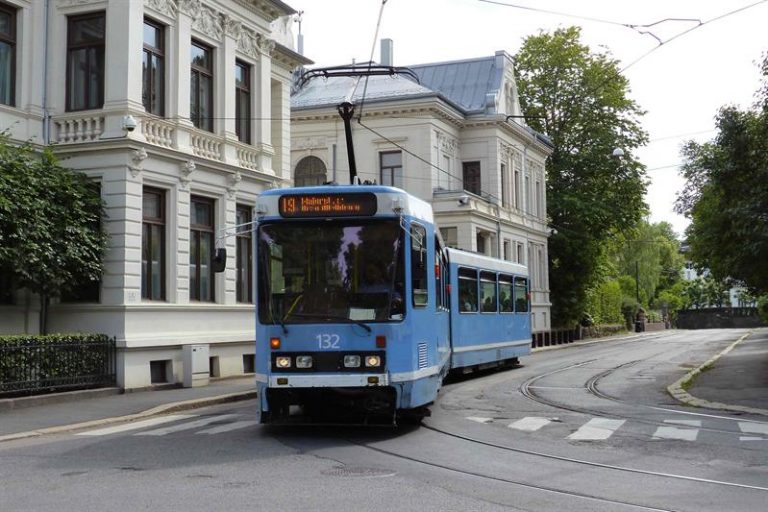
In 1894 Kristiania Elektriske Sporvei built the first electric tramways west from the city center, and within six years all tramways in Oslo were electric. The tramcars in Oslo provide a critical link to many parts of the city. Popular destinations reachable by tram are for instance the Vigeland Sculpture Park, Bislet Stadium, Aker Brygge, the Ekeberg Sculpture Park, Grünerløkka and most attractions in the city center.
By Tramcar in Oslo
The Holmenkollen Line

The Holmenkollen Line
The Holmenkollen Line was the first light rail line, which opened in 1898 and ran west of the city. In 1912, Holmenkolbanen started construction of a 2.0-kilometre (1.2 mi) long tunnel from Majorstuen station to Nationaltheatret station, with an intermediate Valkyrie Plass station. This was the first part of the Common Tunnel and was blasted through the rock beneath the city.

By Tramcar in Oslo
In 1924 two private tram companies were taken over by the municipality and became Oslo Sporveier

In 1924 the two private tram companies were taken over by the municipality and became Oslo Sporveier. By 1975 Oslo Sporveier had bought the private Holmenkollbanen and other private companies and gradually expanded the city tram network.

The Oslo Metro
The Oslo Metro opened in 1966, consisting of a line through the Common Tunnel to Jernbanetorget and the upgraded Lambertseter light rail line. In 1987, the Common Tunnel was completed. From 1993, the western lines were upgraded and connected to the Metro, allowing Metro trains to run through the city center. The Metro’s Ring Line was completed in 2006.

By tramcar in Oslo
Old tramcar in Oslo

The Oslo Transport Museum is located in Gardeveien 15 at Majorstuen in Oslo. The museum operates historic trams on Oslo’s network on every first Sunday of the month. The historic tram usually departs from Stortorvet (in the loop across the square) at 12:00, 13:00 and 14:00 towards Majorstuen, where you can visit the museum.

By tramcar in Oslo
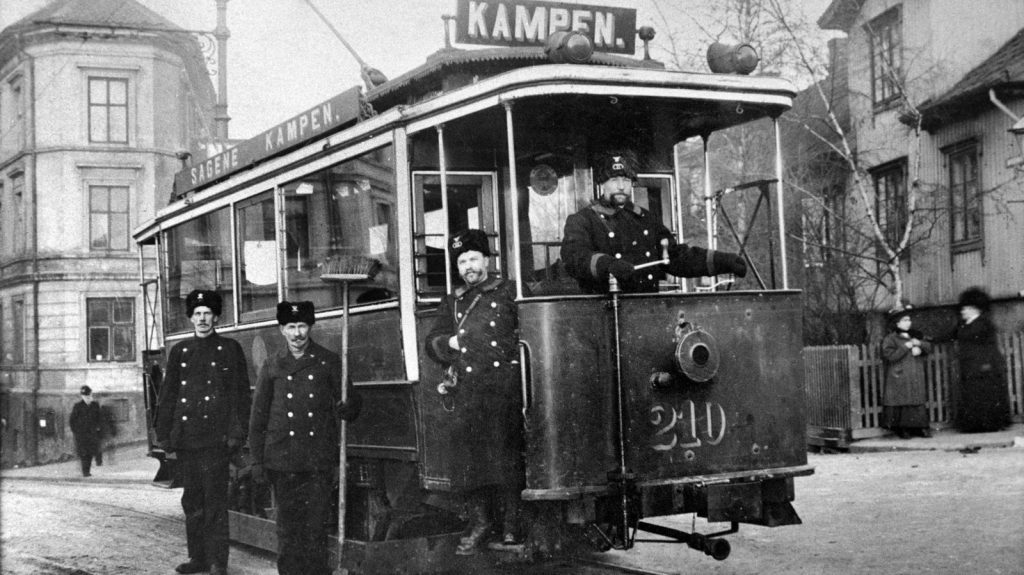
Oslo Tramcar Company 1924

By Tramcar in Oslo
Motorcar no. 70 and trailer no. 647 from 1913 are regular participants on the Majorstuen Ring. The tram stops at all tram stops along the line.

Please note that the historic tram may be cancelled on short notice due to technical issues or lack of personnel. But the museum does its best to avoid cancellations.

By Tramcar in Oslo, compiled and edited by Tor Kjolberg