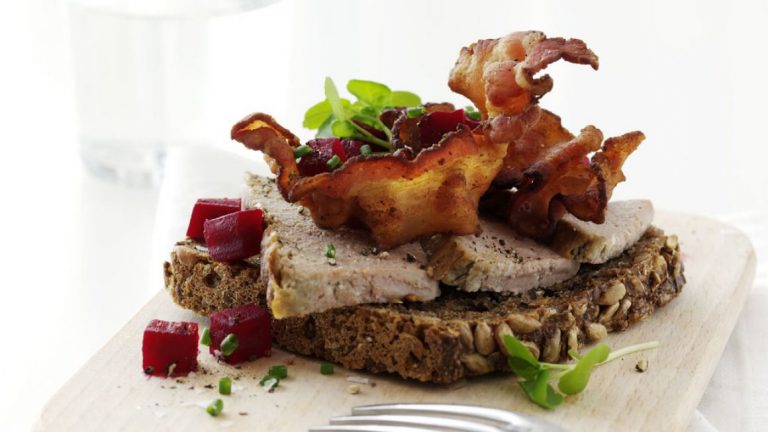
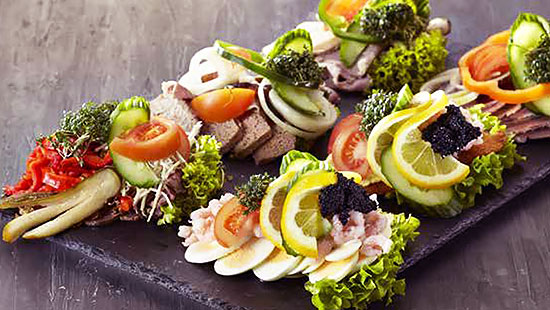
Danish smørrebrød (open sandwiches) eaten daily with cutlery are miniature works of art with a near-infinite choice of toppings. Lined up in café windows, served in specialty restaurants, and packed into their very own custom lunch boxes, smørrebrød are everywhere in Denmark.
Danish smørrebrød
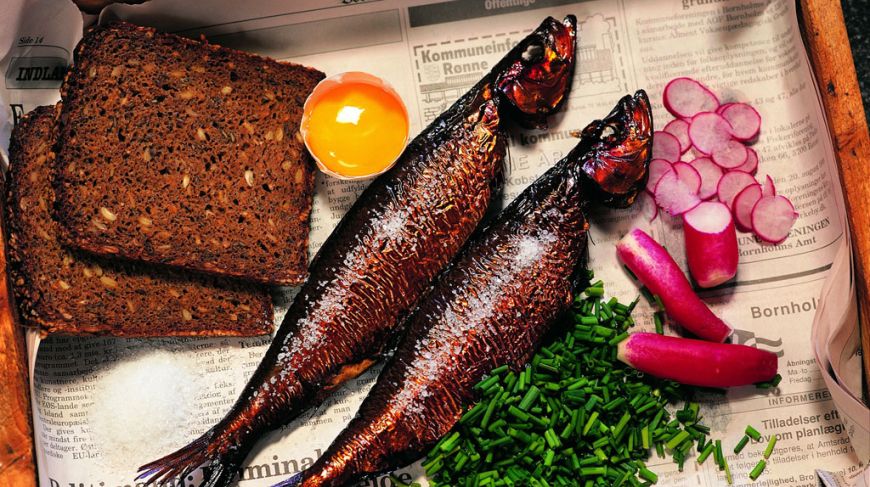
Slices of dense rye bread, packed with seeds and grains, serve as the base. They’re piled high with pickled herring, spoonfuls of sharp horseradish cream, and mound of fresh shrimp. It is customary to begin with a herring topping, washed down with cold-as-hallstones aquavit.
Swedish smörgasbord
But forget what you think you know about sandwiches; next comes a little warmth – perhaps fried fish, lemon and remoulade – then beef slices, pâté or meatballs. These guys are in a different class entirely. Cheese and fruit salad round off the meal.
Norwegian Christmas aquavit
Norwegian smørbrød and Swedish smorgasbord are equally artistic. A traditional smorgasbord doesn’t have to be complicated, bust usually also consist of hot-and-cold lunch buffets. As long as you follow a few traditional rules and know when to eat which bit, you won’t go wrong.
Scandinavian Smørrebrød and Smörgåsbord,Written by Tor Kjolberg
Yes, there is shops in London called Totally Swedish. It was founded by Annethe Nathan and Teresia Bergsandin 2005. Initially their intention was to build an online shop only, but when the opportunity to acquire premises in central London, they decided to open a real Swedish Affär.Totally Swedish has since become an important part of the Swedish community in London, and the company has now two shops in London.
Teresia Bergsand who lives in Gothenburg is no longer a partner in Totally Swedish but is always there to help out when needed in PR and Marketing. She and the company are spreading the word about Swedish food, children’s products and handicrafts to London’s various communities in the way that others have so successfully made Sweden number one for design. They are also selling books and magazine, so it’s a great place to explore.
Totally Swedsih
The interest and fascination for Sweden and all things Scandinavia seems to be on a rapid upwards rise. Hectic London is today home to more than 100,000 Swedes and is often called Sweden’s fifth biggest city by the Swedes themselves.
Skandium
If you are walking from the North end of part of Marylebone High Street, you will discover that the street is home to numerous of Swedish stops, not least the Swedish embassy and the century-old Swedish Church. On your right side, however, you’ll find Skandium, filled with all things Scandinavian, from the most influential furniture designers to salty liquorice.
On nearby Dorset Street you’ll get the smell of cinnamon leading you to a branch of the Nordic Bakery. It has become one of London’s favorite cafés and a great spot for a ‘fika’.
Scandinavian Kitchen
A slightly different range is available at the far east side of Marylebone. –Head to Scandikitchen on Great Titchfield Street for a delicious Scandi lunch, complete with Swedish meatballs and delicious brownie called kladdkaka.
If you want to practice your Swedish, the Swedish pub Harcourt Arms on Crawford Street is the right place.
Bageriet
Heading for Covent Garden, you may have some of the best cinnamon buns or Princess cakes in London at Bageriet, also ideal for a takeaway treat.
In the same area SugarSin includes a whole aisle dedicated to liquorice in all its forms.
Aquavit
Originally founded in New York, Aquavit has recently opened a new all-day bar and restaurant in London, with authentic Swedish food and snaps, including of course aquavit.
If you are looking for a sports bar, head to Kosmopolon Fulham Road, where Fredrik Olsson have been the manager for over 13 years.
Rök Smokehaouse Bar and Restayrant, Shoreditch
Enjoy Scandinavian-inspired food and drinks at Rök Smokehouse.
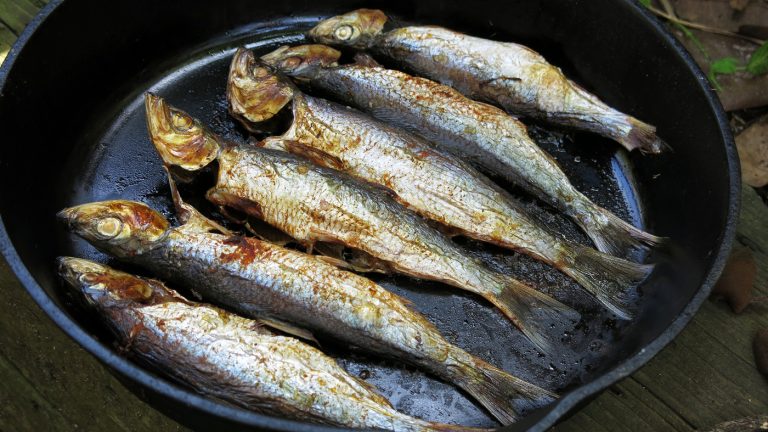
Clupea harengus: Herrings are the backbone of Scandinavian fish cookery, and are not endangered at the moment, even if some strains, as in the Baltic, are very low.
There are several species living in the Nordic waters, differing mainly in size and fat. By far the most of them are eaten cured in some way. Herrings are admittedly full of thin bones that are difficult to extract from the soft flesh, but they seem to disappear when the fish are cured. In a fresh herring you must either live with it or eat something else.
Herring
Appearance and taste Herrings are beautiful, small, silvery fish, with dark, soft meat, with a special oily flavor. The scales come off when the fish are washed.
Culinary uses Fishing trips are popular pastime, and sometimes you return with vats of herrings. The classic way to deal with large amounts is to salt them of course, but if you have more modest quantities, there are some delicious traditional recipes using fresh herrings.
Dill herring with hot potatoe
Herrings that are absolutely fresh are delicious fried, baked or grilled and, like other fatty fish, go well with sharp sauces. Even though the bones can be a nuisance, at least the scale come off easily. Like mackerel herrings should be eaten before the fat turns oily, which pretty much means straight away. Once soused or fried, herrings keep for a couple of days in the fridge.
Jansson’s Temptation
Two ways with fresh herrings There are two very simple but delicious ways to cook herrings in a deep clay pot or dish. Clay pot herring is very similar to a recipe called Jansson’s temptation, simply replacing the tinned northern anchovies with fresh herring fillets. He fillet should be pre-salted for a couple of hours and the dried with kitchen paper. Arrange onion rings, thinly sliced potatoes and the fish in your dish, season with salt and pepper, and fill the dish almost to the brum with cream, Bake at 18 C/gas mark 6 until the top is golden and the potatoes are done.
Sillaada
An alternative, but just as good, is sillåda. This time there are no potatoes, and each layer is spiced with a little ground allspice and powdered ginger, along with some chopped parsley, and the whole dish finished with breadcrumbs and generous knobs of butter. Bake in the same way until golden brown.
10 million NOK (USD 1.2 mill) will be used to help Norwegian architects to gain a foothold abroad. The initiative is led by Innovation Norway and Design and Architecture Norway (DOGA). For the very first time, Norwegian architecture will have its own export program.
The Norwegian Ministry of Industry and the Ministry of Culture are behind the historical initiative launched last Monday afternoon. The pilot program will last for one year, starting in autumn 2017.
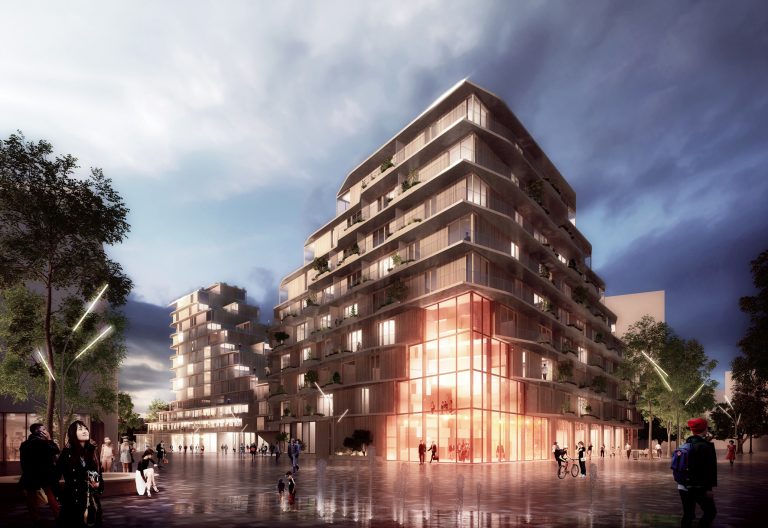
Region City, Gothenburg: A complex and unstructured area in Gothenburg to be transformed into new Central Station with more inviting and user friendly spaces. A new city within the city. Illustration Reiulf Ramstad Architects.Tor Inge Hjemdal. Photo: Reio Avaste
“Norwegian architecture has unique qualities in demand by international experts. Feedback we have received tells us that Norwegian architects in particular enjoy great respect in sustainability, climate and environment issues as well as social sustainability. Norwegian architects are also very good designers, where the relationship with landscape and nature is important. They are clever with materials and details and have an open mind for inclusive architecture. Our towns are compact, green and comfortable to live in. This makes us stand out in the architecture world,” says Tor Inge Hjemdal, director of architecture in DOGA.
Huge export potential
Although the architecture industry is profitable and generates a significant turnover on a Norwegian scale, 7 billion NOK in 2014, most of it happens in Norway. Despite some actors like Snøhetta, which has won prestigious contracts and raised signature buildings in other countries, export constitutes only 1 percent of the industry’s total revenue, according to Prognosesenteret.
“There are few architectural firms that have taken the plunge into the world, but those
Monica Mæland
who have, has received good results. Therefore it is gratifying to be able to help Norwegian architects to think more globally. Norwegian architecture originates from the Norwegian social model, creating inclusive and sustainable buildings and environments. We see this as a great export potential regarding what future cities will be facing worldwide,” says Minister of Economics Monica Mæland.
Local knowledge crucial
Collaborators DOGA and Innovation Norway will have completed the export program within next summer. Tor Inge Hjemdal suggests that efforts should be focused on 8 – 12 architect companies with clear ambitions to think internationally.
“Different countries and cities have different problems and needs. To succeed with this program, we need to gain more knowledge about the challenges, structures and competition in relevant markets, and combining this with the advantages Norwegian architect firms have,” said Hjemdal.
King Abdulaziz Centre for World Culture, Saudi Arabia. Photo: Snøhetta
Minister of Culture Linda Hofstad Helleland emphasizes that there is a strong and increasing interest in Nordic and Norwegian architecture.
“The industry has the knowledge and expertise that are in demand internationally. A number of architects are already participating on the international arena through exhibitions, international awards, and in discussions and development of the subject. It it should have a significantly greater export potential, and therefore we initiated this export program,” she said.
St. Kilda Visitor Center, Scotland: Visitor center under development on the island Lewis in the Outer Hebrides in Scotland, a partnership with Dualchas Architects. Illustration of Reiulf Ramstad Architects.
Professor Anne-Britt Gran, manager of Oslo Business School Centre for Creative Industries, believes there is a considerable export potential in Norwegian architecture.
“Norway is known for good and sustainable architecture and excellent architectural solutions, and this is something we can promote,” says Gran. “Then you can hit the right market with the relevant enterprises and achieve valuable networking and knowledge experience,” she adds.
Exporting Norwegian Architecture is based on a press release
Feature image (on top): Aspern, Helen & Hard: One of Europe’s largest urban development projects in Vienna, Austria. Photo: Helen & Hard
In Denmark, model ships hang in every church, as if to remind parishioners to give thanks for the fruits of the sea. Fish, particularly herring, is still a mainstay, commonly smoked, salted or pickled.
Danish herring
Traditional Danish food included lots of pork, butter and dairy products, but Danes today lean towards a lighter, healthier diet, inspired by modern Scandinavian cuisine.
Danish smørrebrød
Sandwiches and sausages Denmark us a synonymous with smørrebrød, for which it seems there are as many toppings as tastebuds. Liver pâté, shrimp, herring, caviar, smoked salmon, roast pork and steak tartare are combined with pickles, jams, remoulade and herbs in a kaleidoscope of culinary deliciousness. Specialist smørrebrød restaurants usually open at lunchtime.
Danish bacon
Bacon makes up over 5 percent of Denmark’s exports, but not all pork products are sent abroad. Danes wisely keep the tastiest for themselves; salami, crackling roast pork and frikadeller are national institutions. The last (perfect comfort food) are fried meatballs, usually made from minced pork, served with potato salad and pickled red cabbage. Sausages are popular, with each region having its own specialty – in south Jutland ølpølse (beer sausage) is a tasty snack at the local butcher. Blood sausage, blodpølse, appears around Christmas time. The pølsevogn (sausage wagon) is a common sight around Danish towns, a cheap place to pick up a lurid rød pølse (red hotdog).
Pølsevogn selling Danish red hot dogs
Sweet treats Danish pastry (wienerbrød) is famous for a reason. Visit a bakery and try rich, chewy “chocolate snail” pastries, layered cream cakes or a waffle cone filled with ice cream, marshmallow topping and marmalade. Scandinavians have a peculiar love of salty liquorice, found in its strongest form in Denmark.
Danish pastry
Food and Drink in Denmark, written by Tor Kjolberg
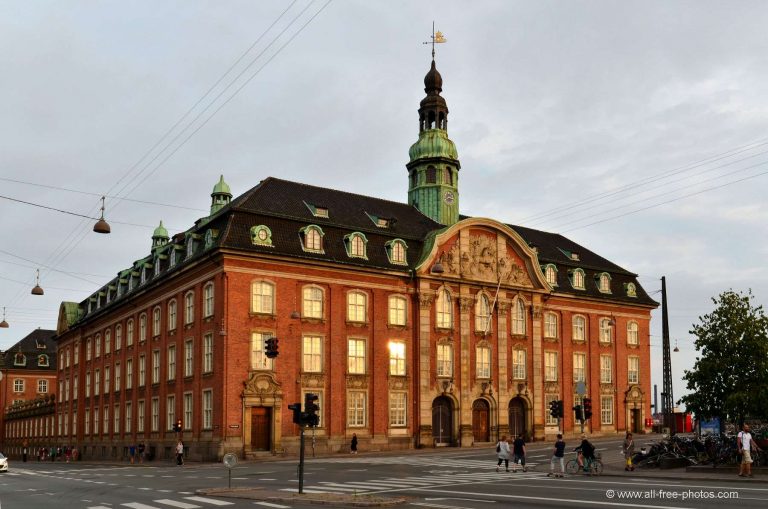
Norwegian hotel group Nordic Choice Hotels will convert Copenhagen’s former central post office into a 25,000 square meter luxury hotel with more than 400 rooms, several F&B outlets and spa, aiming to cater to the highest expectations.
The Central Post Office building in Copenhagen is over 100 years old and is expected to be a unifying element in the center of the new district being developed in that area of the city. The hotel is set to open in 2020.
Copenhagen central post office – stamp 100 years anniversary
The firm, a franchise of Choice Hotels International, owned by Norwegian investor Petter Stordalen, plans to invest around 1.3 billion Danish crowns ($190 million) in the project.
The impressive neo-baroque building, designed by architect Heinrich Wenck, has housed the Danish Post Office (Post Nord) for over a hundred years. However, as Post Nord recently moved their operations to another location, Petter A Stordalen saw a chance to give the old building a new purpose.
Chairman and owner Petter Stordalen
“When I heard that the Post Office building was for sale, I thought that it would be a perfect place for a hotel. The postal service is all about communication between people. That’s why I love the idea that the Central Post Office building will now be resurrected, like a phoenix, in the shape of a hotel,” says Stordalen.
The first person to lead the upscale hotel project in Copenhagen will be Susanne Barfoed, Director of Marketing & PR. “After a long international career in hospitality, Susanne brings a wealth of experience in all aspects of brand management, latest from Starwood Hotels & Resorts where she oversaw the brand management in EAME of brands like Sheraton and Westin,” states a press release from the hotel group.
Director of Marketing and PR, Susanne Barfoed
“After many years abroad, I am thrilled and very excited to return to my home city, Copenhagen, and to be part of transforming the old Central Post Office, an iconic building, to become a luxury hotel. With a holistic approach to branding, I believe in creating unique and differentiated guest experiences through all touch points with our customers, and I look forward to working with my talented colleagues at Nordic Hotels & Resorts in doing so”, says Susanne Barfoed.
CEO of Nordic Hotel & Resorts, Trond Bastiansen
“The “Post Office” represents one of our biggest current projects, and we’re at the beginning of what will be a comprehensive concept development process. The goal is to build a hotel that will create magic in our Danish capital when the doors open in a few years. Susanne has the perfect background to lead this project with international experience in branding and concept development for some of the world’s premier hotel companies. We look forward to working with her and create this exciting project, says Trond Bastiansen CEO of Nordic Hotels & Resorts.
Classical Post Office in Copenhagen will be converted into Luxury Hotel, written by Tor Kjolberg
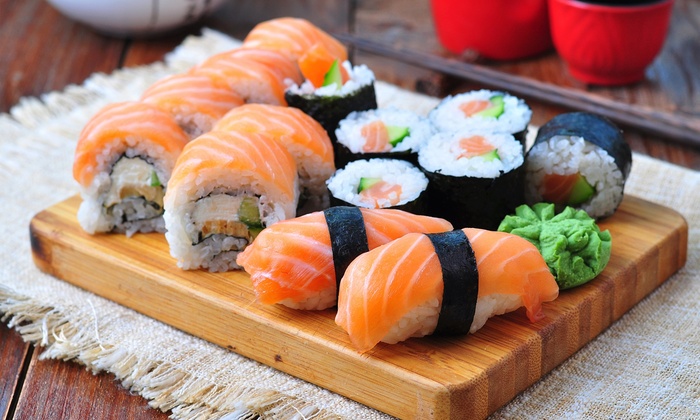
Do you like Salmon sushi and sashimi? Then you should thank the Norwegians, who not only dreamt up the dish but also got the Japanese to eat it. We have visited some of the ever growing number of sushi restaurants in Norway. Enjoy!
Sushi consists of cooked rice added sucker and rice vinegar (shari) with a topping (neta), usually fish or seafood.
Sashimi is just raw fish or meat in thin slices.
Sushi and sashimi
Maki is rice and topping rolled in “nori”, crispy sheets of seaweed.
Sushi was originally a way to preserve raw fish. The fish were packed in rice to be fermented.
The first sushi restaurant in Norway opened in Oslo in 1985.
The expansive sea areas off the Norwegian coast are ideal for harvesting seafood. The waters are very cold and as a result, seafood grows slowly and is extra tasty and juicy.
Alex Sushi, Tjuvholmen
Alex Sushi Tjuvholmen
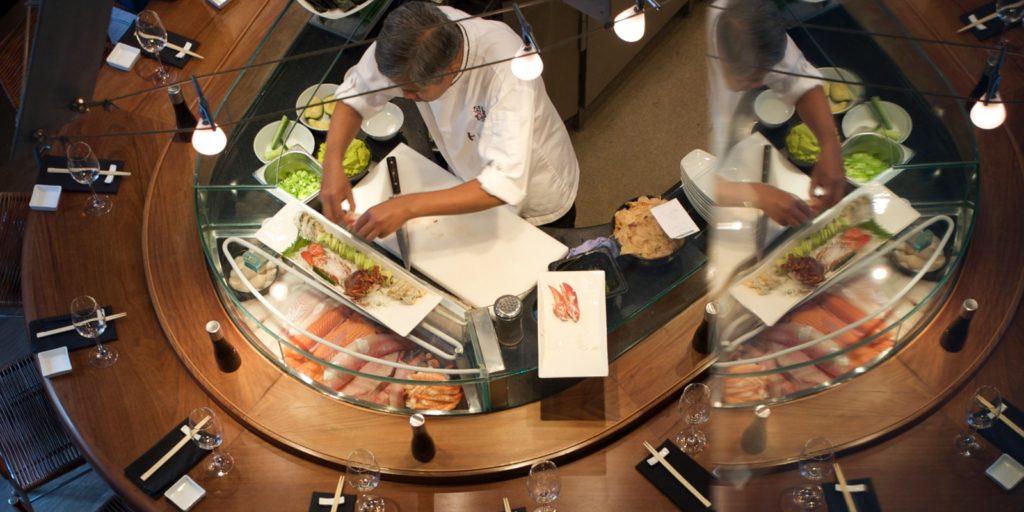
The concept is based around the elegant sushi bar that dominates the restaurant. Seated in the heart of the restaurant, you can watch the chefs perform their tricks before your very eyes.
Alex Sushi, Solli
Alex Sushi Solli Square
Since its opening in 2001, Alex Sushi at Solli Square has become the very definition of sushi art in Norway’s capital. And like traditional sushi bars in Japan, the best seats in the restaurant are the oval sushi counter in the middle of the venue, where guests have prime view of the chefs making fish into raw pieces of art.
Hanami
Hanami
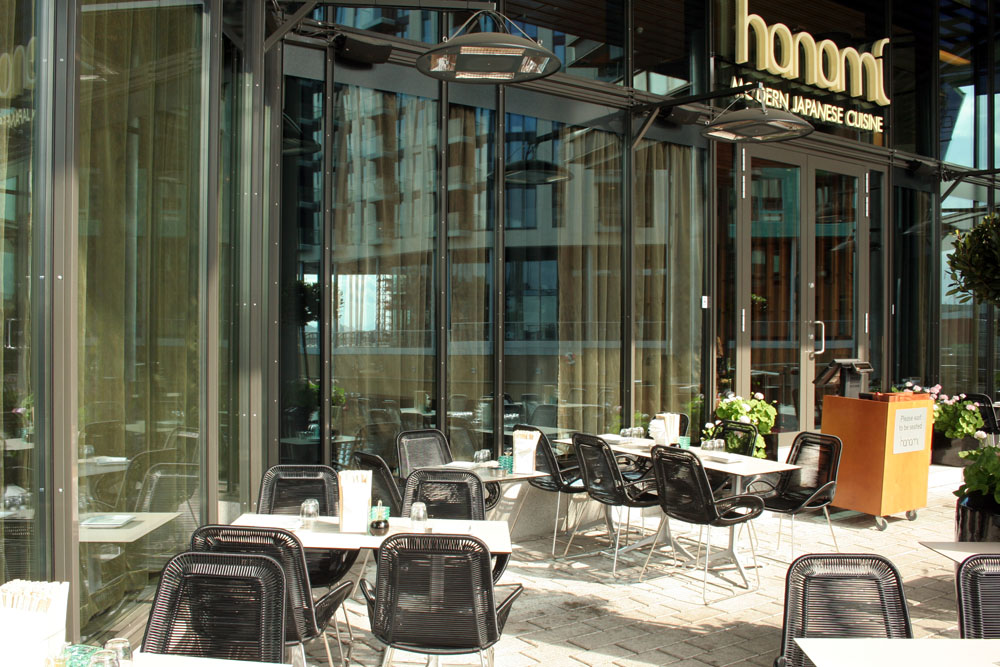
Outstanding presentation of Japanese fusion food. If you want a unique combination of food, drinks and atmosphere, this is the place for you. The menu includes a combination of Japanese robatayaki, Izakayaa and sushi bar. The concept is that guests order several small dishes to share at the table.
Sabaki
Sabaki
Whether you fancy sushi, sashimi and maki – or would like to try Robbatayaki og Teppanyaki – here you can taste what Japanese food should be: Simple and elegant yet able to incorporate complex subtle flavors.
Mamo Sushi
Mamo Sushi Classic and simple meny; Nigiri, maki, sashimi, five different sushi menus, where the cheapest three course dinner costs 165 kr (!) More diverse menus consist of eight starters and 15 main courses (mostly Thai).
Sea Siushi Bar
Sea Sushi Bar
In Brugata this sushi bar has almost unnoticed slipped in between brown pubs, kebab shops and Asian outlets, offering everything from gaudy juggle to vegetables.
Sushi in Oslo, compiled by the Daily Scandinavian team.
A short subway ride from Manhattan by the L line, we enter Williamsburg, Brooklyn. Why do people travel over the bridges from Manhattan and even from more distant places to get to the unidirectional, globalized, derided and very influential capital of the hipster culture?
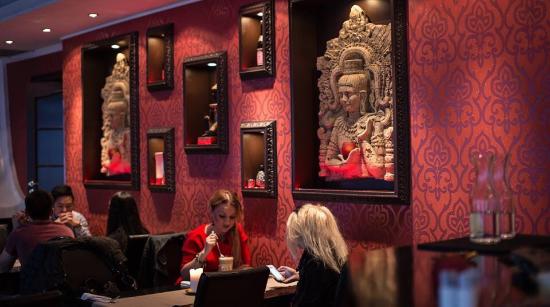
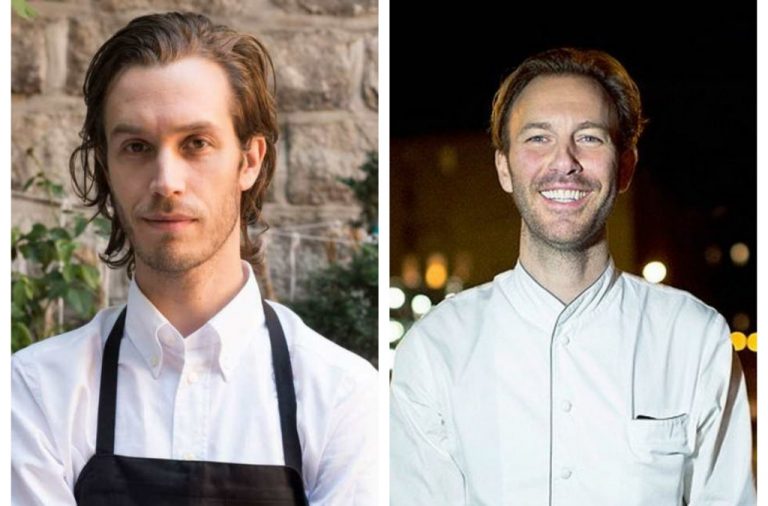
It might be the fine dining restaurant Aska. It is located in an 1860’s restored warehouse building at the edge of Williamsburg Bridge. It is run by Michelin-starred Swedish chef and former snowboarder Fredrik Berselius.
Fredrik Berselius
There you will find Danish furniture classics and can enjoy ingenuous variations on rutabaga, sour milk, oysters and lobster; balanced masterpieces of “New Nordic”.
“We wanted people to take an excursion to get here, forcing them to go from Manhattan, a small project,” says Fredrik Berselius, who also became a part of the city’s master chefs by coincidence.
“In the US we are still just at the beginning of the Nordic wave,” says Berselius
“I found this place online, actually, just by randomly Googling rentals. That was in November of 2014. We signed the lease January or February of 2015,” adds Berselius.
From Aska in Brooklyn
New Nordic was seriously put on the menu in 2004 by restaurant Noma in Copenhagen. The food is clean, moderate heat treated and flavored, highly seasonal and with an emphasis on sustainability, with extensive use of crops and vegetables. In Scandinavia, the New Nordic is represented by restaurants like Danish Geranium, Swedish Faviken and Norwegian Maaemo.
“In the US we are still just at the beginning of the Nordic wave,” says Berselius.
However, on the New York’s visionary restaurant scene, Scandinavian restaurants were few and long between. It was limited to a few remains from the nineties, some traditional smorgasbord, the most conventional luxury restaurant Aquavit, and the Swedish-Somali chef Marcus Samuelsson who crossed meatballs with soul food at the Red Rooster in Harlem and became Obama’s preferred chef.
Mads Refslund, Photo Daniel Krieger
Mads Refslund helped kick off the Nordic food craze in NYC when he ran the kitchen at the glossy revamp of Acme back in 2012. Last year he left that NoHo hot spot, and moved, like Berselius, to Williamsburg.
His restaurant Fire and Ice will bring us back to nature, preparing food the way the caveman was cooking. However, the restaurant has not opened yet. Even the exact address remains a mystery sinceit is still under construction. In the meantime, check out this video of Mads and James on a foraging adventure:
Scandinavian Master Chefs in New York, written by Tor Kjolberg
The amazing love story of 24-year old P. K. Mahanandia became the subject of an international best-selling book by Swedish author Per J. Andersson.
Andersson’s book is based on the famous India-born Swedish painter Dr. P. K. Mahanandia’s real life story and his 4 months and 3 weeks journey by a second hand bicycle from New Delhi to Gothenburg in 1977 to meet his love Charlotte von Schedvin.
Charlotte-von-Schedvin and Pradyuma Kumar (P.K.) Mahanandia in Lody Colony, New Delhi
Charlotte von Schedvin (Lotta) from Sweden was visiting India as a tourist in 1975 when she completely by chance met Mahanandia, who was working as a sketch artist in a shopping and business hub in Delhi. His sign “a portrait in 10 minutes for 10 rupees” tempted her to test the claim. However, she was disappointed with the result but intrigued by the man.
Mahanandia shot into fame when studied fine arts at Delhi College of Art and drew a portrait of Indira Gandhi under the holy fountain at Connaught Place. When drawing Charlotte, Mahanandia was very nervous, since his mother had once said that his bride to be would “come from a far-away land, born in the Zyriah sign of Taurus, would be musical and own a jungle”. He immediately knew that Charlotte was the one.
Charlotte and P. K. Mahanandia. Photo: P. K. M.
She came back the next day to have another portrait made, but the result was no better. However, the making of these portraits changed the life of both as they fell in love with each other and married according to Odishian tribal tradition.
When Charlotte had to return to Sweden and asked Mahanandia to come with her, he decided to stay in India, even if she tried to leave him money for a plane ticket.
French, German and Swedish book-covers
They kept in touch through letters while the proud young Mahanandia tried to get his financial status better so he could afford a plane ride to Sweden. He didn’t succeed, but in 1979 he refused to give up his love of his life, sold all his belongings and bought a bike for 60 rupees and cycled all the way on the popular “hippie trail” to Sweden (7,000 km).
The author together with P. K. at Puri Beach, Odisha 2007
They are now living in Charlotte’s home town Borås together with their son Siddharth (Karle) and their daughter Emelie. In honor of their love the Swedish Government has made films to document this immortal love of the century.
English book-cover
P. K. Mahanandia’s paintings have been exhibited in major cities of the world and have also been printed on prestigious UNICEF greeting cards. On 4 January 2012, he was awarded an honorary doctorate degree (Degree of Honoris Causa) from Utkal University of Culture (UUC) in Bhubaneshwar, Odisha state, India. He was also designated as the Oriya Cultural ambassador to Sweden by the Government of Odisha.
This fantastic love story has been published in Swedish, Danish, Norwegian, French and German and last year in English by the British Oneworld Publications, distributed in India by PanMacmillian. So far, there are also publishing rights for Chinese/Mandarin, Korean, Icelandic and Polish.
The author is still waiting for a publisher keen to make a Hindi
Author Per J. Andersson
version – or even a version in Oriyah.
Reviews:
“This story makes me believe in the goodness of humans and the power of love.”
– LitteraturMagazinet
“PK’s life story has what it takes to make a brilliant page turner.”
– Svenska Dagbladet
Indian Cycled to Sweden for Love, written by Tor Kjolberg
Daily Scandinavian thanks the author for giving us the right to use the photos in this article.
Just across the border from each other, Värmland in Sweden and Hedmark in Norway, offer the same wonderful open-air escape.
Deciding where to go is often the hardest decision when booking a holiday – but that becomes a little bit easier when you combine two countries in one simple trip.
Moose in Värmland
Värmland in Sweden and Hedmark in Norway are neighbors, and it’s easy to cross the border between the two. Both offer unspoiled forest landscapes, lakes and rivers, not to mention the same potential for relaxation and excitement.
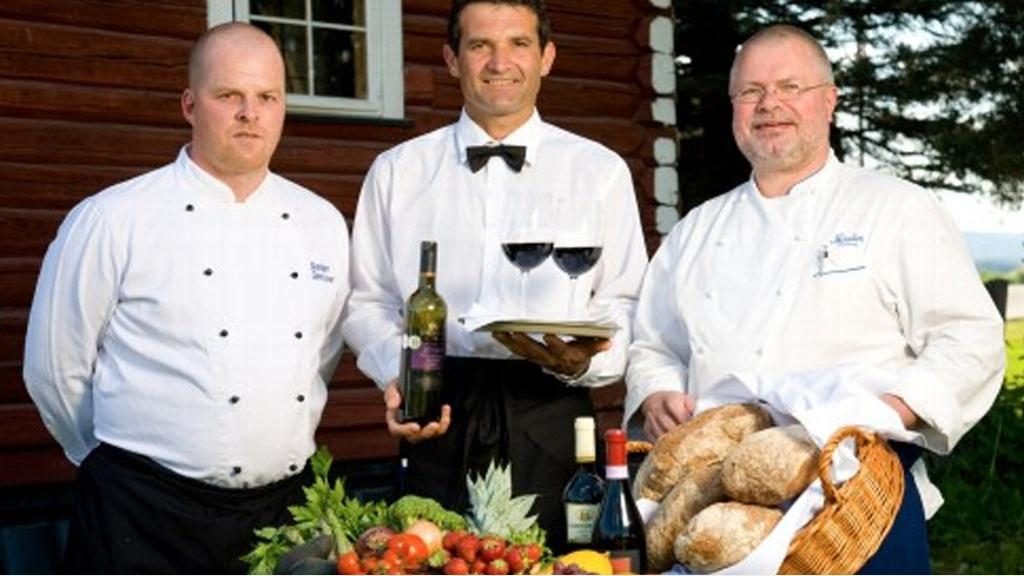
Skaslien gjestgiveri (guesthouse)
Join in a moose safari in Långberget or take a canoe out one of the great waterways. Sleep along the trees in Tott Hotelor in the comfort of the exquisite Selma Lagerlöfs in Mårbacka. Build your own raft of timber and sail down the River Klarälven. Watch the skilled craftsmen blowing glass in Magnor. Absorb the amazing smells coming from the kitchen at Skaslien Gjestgiveri, follow snow-guaranteed cross-country ski trails or take to the waters in Trysil. Everywhere you turn, a new adventure awaits.
Add to this, preserved traditional cultures and handicrafts and a warm welcome from the friendly locals. There may be a border in the middle, but the same great hospitality exists whichever side you travel.
Selma Lagerlöf house in Mårbacka
Few places offer the same opportunity for outdoor exploration – and even fewer provide the chance to visit two great Scandinavian countries on just one holiday.