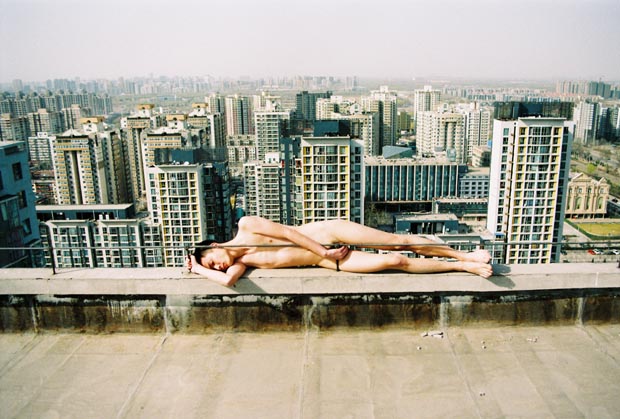
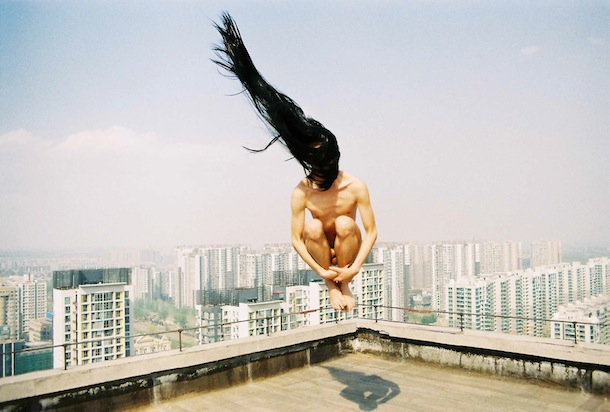
A new photographic exhibition has opened in Fotografiska, Stockholm, «Human Love» by the Chinese photographer Ren Hang. The Hang has often been chased by the police when photographing naked people on rooftops, in the woods or other public places.
“My pictures’ politics have nothing to do with China,” says Ren. “It’s Chinese politics that wants to interfere with my art. China doesn’t allow outdoor nudity. I’m very careful about taking pictures outside. If I see police, I’ll run. But I’m not hiding as I’m taking pictures,” he adds.
“My pictures’ politics have nothing to do with China,” says Ren Hang
It’s not everyday that a new photography exhibition as powerful, touching and as imaginative as Ren Hang’s vision is available to the public. Fotografiska in Stockholm is therefore proud to announce “Human Love,” a solo photography show by Beijing-based artist Ren Hang, on view through 2 April.
Ren Hang is famous for his exploration of the multi-faceted, quasi-magical links between man and nature. In an interview with the daily Dagens Nyheter, Renm Hang said, “Chinese journalists wonder what my images mean, while European journalists want to know what the Chinese art scene is like.”
From the exhibition “Human Love”
Ren’s photography is so open and bright, yet his direction can sometimes be dark and private. Mixing the two together is what you’ll find in the exhibition “Human Love”. He is a poet and photographer. Splicing imagery of urban and rural environments as a metaphor for the increasingly citified millennials of today, he arranges the naked limbs of his friends in his hide-and-seek photographs.
His work has been largely misinterpreted in the past, often seen as “a staged display of the modern Chinese subcultures and youths on the margins of society”, as one critic wrote.. However, Ren Hang’s intention is on the opposite spectrum and does not offer a criticism of contemporary Chinese society or youth in general, but rather aims to capture men and women in their most natural and authentic state: the nude within nature.
‘Human Love’ takes us on a personal journey into the daily life of Ren Hang
Ren Hang is photographing a generation, which has lived its life after Mao. ‘Human Love’ takes us on a personal journey into the daily life of Ren Hang. It shows us that, we are all human, and amidst our busy day to day life, there is always something beautiful to be captured on camera.
Hang takes nudity and nakedness to another level; exposing the vulnerability and uninhibited sexual nature of a playful and exciting new world. Ren Hang has the uncanny ability to capture voyeurism, loneliness, love, darkness, and self-expression in very special ways.
Hang takes nudity and nakedness to another level
Ren Hang tells that he started taking pictures of naked bodies when he was a student of marketing in university: “I shot whatever I saw. When I lived in the student dorm, what I saw most was my roomie’s naked body.”
Ren Hang is a poet and photographer
In “Human Love”, the subjects’ expressions are casual yet provocative, hinting at the erotic and playful energies between Ren Hang and his intimate circle of companions. The young artist offers no concept behind his images, leaving them open to infinite interpretations. He only emphasizes a deep engagement with humanity’s relationship with nature, expressed through the freedom of the nude intertwined with the natural environment.
Naked Chinese in Stockholm, written by Tor Kjolberg
Each summer in Gudvangena week long market festival congregates to celebrate the Vikings.On the area, a permanent Viking Village is soon to be established. The construction work started in August 2016, and phase one will be open for business already in May 2017.
The name Gudvangen means “God’s place by the water” and in the Viking era it was an important market place and communication center, and there have been several places of worship. The Gudvangen village is situated at the end of The Nærøy Fjord, Sogn og Fjordane, Aurland Kommune, Norway. The Kjelfossen waterfall, one of the highest in Norway, is located just to the southeast of Gudvangen.
Viking market
Back in 1994, a customer mentioned to Georg Olafr Reydarsson Hansen that he looked like a Viking. He took it literally and started his quest to become one. 22 years ago he moved from Oslo to the tiny village of Gudvangen where he has worked hard to fulfil his dream of creating an authentic Viking merchant town and to teach visitors about the life of Scandinavian Vikings.
Georg Olafr Reydarsson Hansen, a real Viking? Photo: Visit Norway/Kyrre Lien
The village will be called “NJARDARHEIMR” (which means “the home dedicated to the Norse God Njord”) The Viking Valley as a concept will be an historical, living and working Viking settlement, where the Viking age and their exciting history will be brought to life. Members of the public will be able to interact and step back into time to experience and engulf the Viking age for themselves. You may even have the chance to take to the water in a replica Viking boat.
Chieftain’s longhouse, Njardarheimr
Many various activities and experiences are arranged for children and adults. A special day is dedicated to the children’s market, and the visitors are involved into the world of Vikings during all the Festival, experiencing fighting, archery, theatre, concerts, Viking ship, fire shows, storytelling, historical ballgames, Viking wrestling and other animations. The market offers handicrafts, and a combination of tastes and flavors of the traditional food.
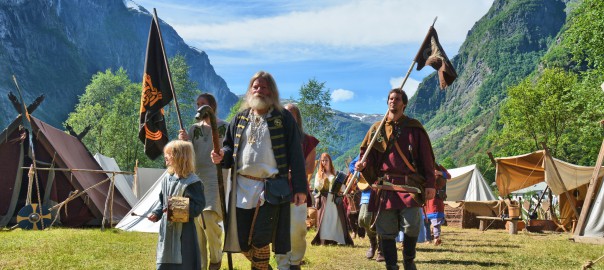
The Viking Market, held 18–23 July, is the camp’s only event while the main village is under planning. It is recognized as one of the biggest Viking markets in Europe, with over 3,000 visitors every year. Some 500 re-enactors, traders, warriors and craftswomen and -men, from over 20 nations, travel to the little village to form a bustling and diverse market – just like in the olden days.
“Viking Wedding” Photo: Paul Edmundson
“Viking Wedding” is published by kind permission of Paul Edmundson. Watch more of the photographer’s images here. From his gallery in the heart of the Norwegian fjords, you can enjoy the power of nature on an epic scale by warching his exclusive collection of photography.
Viking Valley will become an educational park dedicated to forging memories through learning and interacting with the inhabitants of the Viking village. All will be in accordance with archaeological evidence but still in a fun and entertaining way.
Valley of Vikings in Norway,written by Tor Kjolberg
Tourists and leisure lovers can look forward to enjoy the world’s fifth largest water park in Copenhagen in 2020.
The western Copenhagen suburb of Høje Taastrup has revealed plans for what will be Scandinavia’s largest water park. The massive aqua park will open in not too distant future.
Plan of Nordic Water Universe in Copenhagen
The Nordic Water Universe will cover 840,000sqm, divided into two parts – a holiday and amusement ride area, and a recreational nature park.
“We’re talking about the world’s fifth largest water park. We’re talking about a vacation and amusement village and nature park with all kinds of activities. With hotels and vacation homes. It will be fantastic and it will put Høje Taastrup not only on the Danish map, but on the world map,” said the municipality’s mayor, Michael Ziegler.
World’s fifth largest waterpark planned in Copenhagen
‘Nordic Water Universe’ is the park’s early working title. “It’s a fantastic project – for Høje-Taastrup and the rest of Denmark,” proclaimed Ziegler, who added that it would “attract thousands of guests, from families with children and conference participants to tourists from abroad. It will become an attraction without comparison near Copenhagen.”
In addition to the indoor/outdoor water park, the project will also include a mini golf course, a playground, a number of restaurants and shops and a large conference center.
Mayor Michael Ziegler (left) and Ulf Høyen, Nordic Corporate Finance, 2017. Pressefoto.
Construction isn’t expected to begin October and the water park is due to open in 2020. The rest of the complex will be completed by 2028, and Ziegler said the project will create 3,000 jobs. The world’s biggest hotel operator, Wyndham Hotel Group, is already signed on for the ambitious project.
“The first and largest [phase] will cost 2.2 billion kroner to build and then the rest will be added as visitor numbers increase,” Ulf Højen of Nordic Corporate Finance, which represents a number of international investors involved in the project, told business daily Børsen.
It is estimated that the aqua park will attract almost 3 billion kroner in tourism revenue when completely finished
“As opposed to many other similar resorts in Europe, this project is prepared, via its size, to handle many years of guest growth,” added Højen.
It is estimated that the aqua park will attract almost 3 billion kroner in tourism revenue when completely finished.
Nordic Water Universe in Copenhagen, written by Tor Kjolberg
Cod (Gadinae sp. Lotinae sp) is both the name of a certain fish, and a roomy expression for a large number of fish that are closely related. At this time of the year, winter cod is extremely popular in Norway, the world’s No. 2 seafood exporter behind China. The seasonal delicacy is known as “skrei”.
Skrei migrate between its nursery area in the Barents Sea and spawning areas along the Norwegian coast. The skrei season is an event between January and April, where millions of fish come to spawn – and especially to areas around Lofoten. The official start of the spawning season is February 14.
Skrei
However, Scandinavians in general are not particularly imaginative fish eaters. The traditional ways to prepare these fish are certainly not very varied, but they are good all the same.
Appearance and taste Cod are long, smooth-skinned fish, often with dark or greenish stripes along the sides, sporting a small beard, and with mostly white, flaky fish. Most can grow to an impressive size, and are just as good when humungous as when they have a more usual size of 1-4kg. The flesh is mildly salty-sweet and delicious. All cod are most flavorsome in winter.
Skrei fisherman
Culinary uses Cod can be made into fishcakes and soup, or baked, fried, boiled or grilled. Scandinavians normally eat cod with the same accompaniments as salt cod, namely horseradish, mustard sauce, melted butter, capers, crispy bacon, pickled beetroot, hard-boiled eggs and potatoes – quite a meal, even without the fish!
Skrei and cod’s roe dish
Cod with pork fat This is a simple but delicious recipe. Personally I prefer the thick slabs of boneless cod, lightly pre-salted, and covered with thin bacon rashers. It is simply baked in a buttered, deep dish at 200C/gas mark 6 until the fish is opaque and the bacon crispy. It’s amazing! You can use smoked or unsmoked bacon.
Cod with estragon
Cod and sons Boiled cod is a huge achievement if you are a perfectionist. But you can make your life less exhausting by simply baking it. It will be just as you want it to be – perfect flakes of opaque marble. Newly boiled cod’s roe, still warm, is a very different thing from cooled; it’s creamy, a little gritty, and is so nice with a lemony hollandaise sauce or caper sauce. It has become a luxury, but so has real cod.
Cod’s roe
Serve the dish with a bowl of waxy potatoes and asparagus or pointed cabbage with dill, and your preferred sauce.
6 small cod’s roes
1.6 kg thick piece of cod on the bone
50g salted butter, cut into thin slices
Salt and pepper.
Serves 6
Wrap the cod’s roes in six small parcels of parchment paper and secure with cotton string. Sink them into a pan of boiling salted water. Turn down the heat and let them simmer for 5 minutes. Leave to cool a little in the water.
Arrange the cod in a deep dish and place the butter slices on top. Sprinkle with salt and pepper, then cover with kitchen foil. Bake at 180C/gas mark 4 and test after 25 minutes.
When the fish is still a bit rosy by the bone, it’s done.
Scandinavian Cod – A Delicacy in February, written by Tor Kjolberg
Justin Cremer has been The Local Denmark’s editor since the site’s very launch. Now he is saying goodbye as he prepares to move back to the United States. Here he reflects on what he’s most likely to miss after nearly seven years in Copenhagen.
Written by Justin Cremer.
This article originally appeared on The Local and has been republished with the author’s permission.
– – – –
Well, this is it. After nearly seven years of living in Denmark and covering the Danish news in English, I’m on my way back to the US. I already know there are a lot of things I’ll miss about this wonderful country and its people – and things I won’t, but we’ll save those for another day – but I’m sure the real impact won’t be felt until I’ve been gone for a few months. For now, here are the ten things that definitely make my list.
The beauty of Copenhagen and the allure of the water never faded over seven years
Biking everywhere
It may sound like a small thing, but I’ve come to truly appreciate starting every morning on my bike rather than fighting traffic in a car. Whether escorting my kids to school and daycare or biking to the train station for the short ride into Copenhagen (where, in a true sign that I became semi-Danish, I had a second bike waiting for me), I love the fresh air, moderate exercise and sense of freedom that comes with riding a bike. I even developed a strange fondness for biking in the snow and rain, although I never could accept the strong winds that seemed to blast me in the face no matter which direction I faced.
The author biking over Bryggebroen. Photo: Cody Robinson
Work-life balance
Long before I left for Denmark, I was incredibly put off by the hyper-competitive nature of the American workplace. In one of my jobs back home, there seemed to be a sick contest between employees over who could work the longest hours. Ironically, those who often “won” that contest were the same people dicking around during much of the traditional work day.
I much prefer the Danish method of getting down to business during work hours and then getting the hell out of the office when 4pm (or earlier) rolls around. And in Denmark, you don’t get dirty looks when you have to leave the office early to take your kids to swimming class and you don’t need to try to curry professional favour by staying late. Your boss wouldn’t even notice anyway, as he/she was probably out the door at 3pm with the rest of them.
But I will miss what ‘hygge’ means to me, which is putting in the effort to make any given situation more enjoyable and cozy.
While there are of course exceptions, I’m always struck by how different my get-togethers with friends are in the US when compared to Denmark. When meeting with American friends, whether in their homes or at a bar, there always seems to be a television screen on that sucks attention from the people you are supposedly there to see. Hell, in some American bars and restaurants you can’t even escape the ubiquitous TV screen in the bathroom. Add in the smartphone in everyone’s hand, and you have a recipe for very superficial and not particularly satisfying conversations.
Call me crazy, but I’ve come to expect actually speaking to the people I’m out with rather than grunting a few exchanges during the commercial break of some random televised sporting event.
The author and his daughter on the island of Funen. Photo: Signe Cremer
Water, water everywhere
I grew up in completely landlocked Iowa so living in Denmark has given me all sorts of opportunities to quench my longing for the sea. Many of my fondest memories include the water, whether it’s just a run-of-the-mill summer afternoon drinking beers and diving into the harbour at Islands Brygge or the family holidays we’ve had in Æro, Funen, Bornholm and northern Jutland. Yes, on some of those occasions the water was so damn cold that I got sick a few days later but it was worth it.
The beauty of Copenhagen
Even after spending the better part of a decade in the Danish capital, I was still regularly struck by how truly wonderful Copenhagen is (just as the 1952 song by Danny Kaye promised). Coming from the aforementioned Iowa – which is actually a lovely place, I promise – I constantly marvelled at the fact that people came from all over the world to take in the sights that I see everyday. I tried to maintain that sense of appreciation throughout my time here and between the city’s hidden gems and well-known attractions, that wasn’t hard to do.
It became a tradition to celebrate 4th of July at Roskilde. Photo: Justin Cremer
The music scene
It’s only February and I’m already bummed that I’ll miss this summer’s Roskilde Festival after attending for six consecutive years. I’ve also had to unfollow all of the Copenhagen music venues on Facebook because I keep seeing upcoming concerts that I can’t attend. The Danish capital is a great music city – just ask all the Swedes who regularly cross the bridge for shows – and I’ve been able to check act after act off my ‘must-see’ list and discover all kinds of new favourites.
An efficient and technically-advanced society
Danes love to complain about rail operator DSB and I certainly have joined in the chorus myself, but overall things in Denmark, including public transport, are quite efficient. From the multitude of ways to pay for your goods, almost none of which include something as old fashioned as cash or cheques (I could hardly contain my shock when the landlord of our new house in New York suggested that I write her one) to a personal ID number that is used for pretty much everything, I’ve grown used to things just working like they are supposed to.
“Enjoying” the Danish summer
(Complaining about) the weather
Can I truly say that I’ll miss Danish weather? No. But complaining about the weather is something of a national sport and I got quite good at it over the years. I’ve also found that I appreciate those perfect summer days more when they’re rare than I do when long sunny and warm stretches are just the norm. Ok, ok, you got me. I needed an extra item to get to the nice round number of ten. I won’t miss the Danish weather at all!
My love/hate relationship with the Danish language
I have a Danish wife and two half-Danish kids, so leaving Denmark does not mean that I’ll escape the language that I’ve so struggled to learn. But it does mean that I will obviously use it much less than I do now and likely forget much of what I learned. That’s a shame; Danish is a damn hard language, but it has some true gems that work better than their English equivalents, if one even exists.
The Danes are a generally happy and proud people, and they have good reason to be. Photo: Justin Cremer
A society that’s so well-functioning that people have to go looking for problems
There was a 2015 headline in the left-leaning Politiken newspaper, which has been my paper of choice during my time here, that has really stuck with me: ‘Hvorfor skal det altid være synd for nogen i Politikens spalter?’, ‘Why is it always a shame for someone in Politiken’s columns?’ it asks. Basically, the author argues that Danes are so well off that they constantly create ‘problems’ that aren’t there. After seven years here, I agree. Of course Denmark, like any country, has its issues but life here is generally so good that some of the things people find to complain about are rather petty. That, frankly, strikes me as a pretty good indicator that Danes have this whole life thing pretty much down. After all, all of those ‘world’s happiest people’ designations have to count for something, right?
Delivering the news in English
Before I brought The Local to Denmark in 2014, I spent around three and a half years as the news editor of a competing English-language publication. During the six-plus years of covering Danish news, I’ve heard from countless readers who’ve expressed their thanks for helping them understand their new home and I’ve been featured by media around the world who were interested in my insight into what was happening in Denmark.
Denmark has an enormous inferiority complex, but it shouldn’t. There is great interest out there in what goes on in this small, but important and fascinating, country. I truly enjoyed doing my part over the years to help get those stories out there – the good, the bad and the ugly.
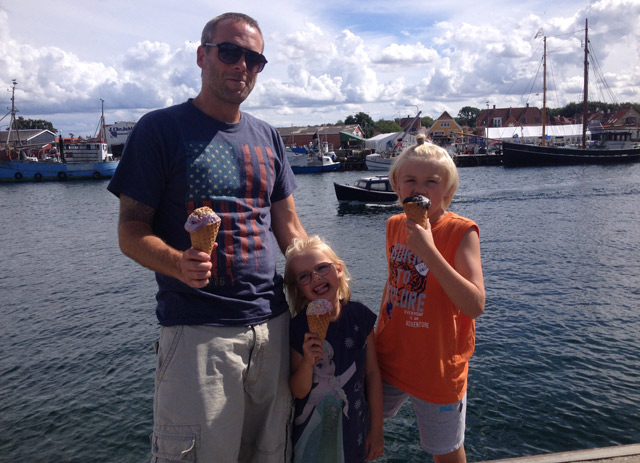
Feature image on top (Photo: Signe Cremer): Plenty of time for ice cream with the kids when you live and work in Denmark.
Justin Cremer has been The Local Denmark’s editor since the site launched in June 2014 and has also operated The Local Norway since November 2015. He will be moving to upstate New York and if all goes according to plan will return to Copenhagen in 2019. You can contact him at justin.cremer@gmail.com and/or on Twitter at @MrJustinCremer.
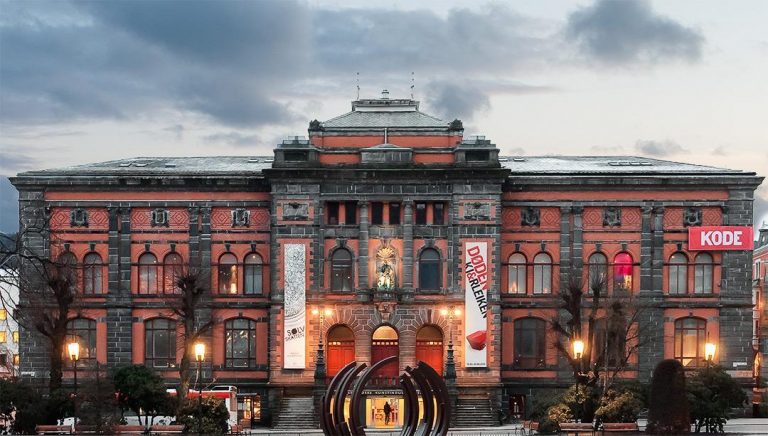
Visitors can again admire the spectacular permanent exhibition ‘Silver Treasure’ after the re-opening of the KODE 1 building in Bergen in May, The exhibition displays beautiful objects in gold and silver, made in Bergen over the course of 500 years,.
There’s also the Singer Collection, consisting of European and Asian antiques and works by Old Masters. Later in the season the museum also re-opens the China Collection and mount new exhibitions of craft and design.
For hundreds of years, Bergen has been an important center for the production of gold and silver objects
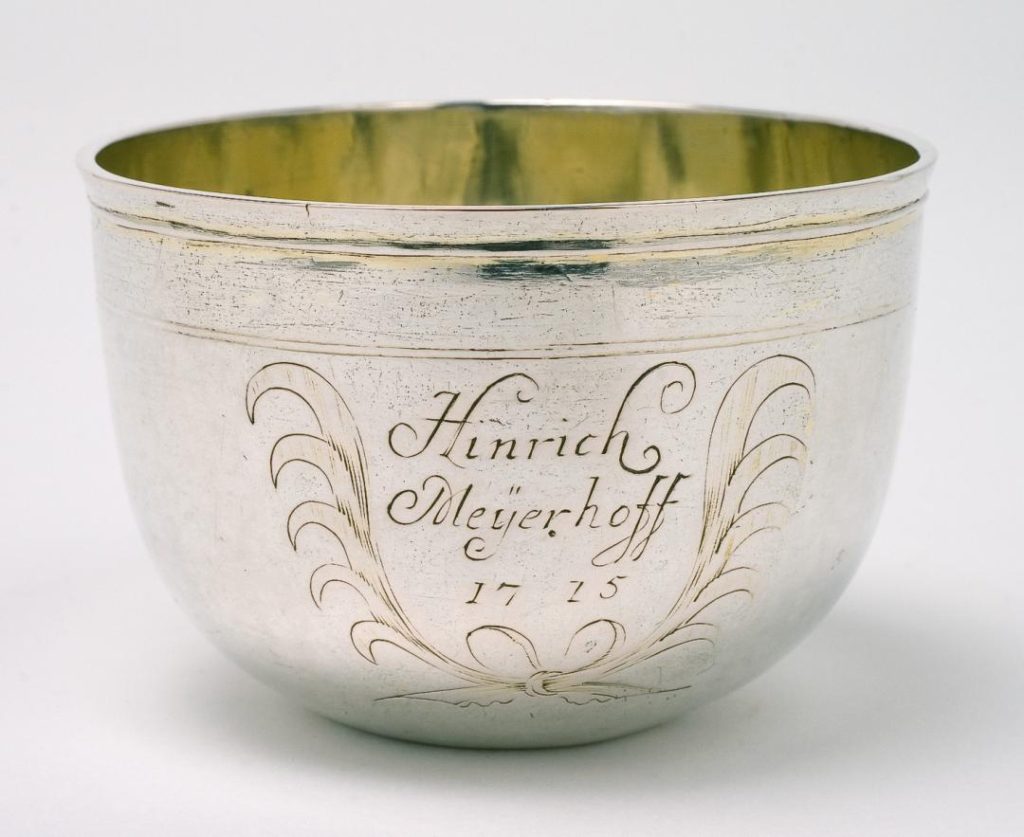
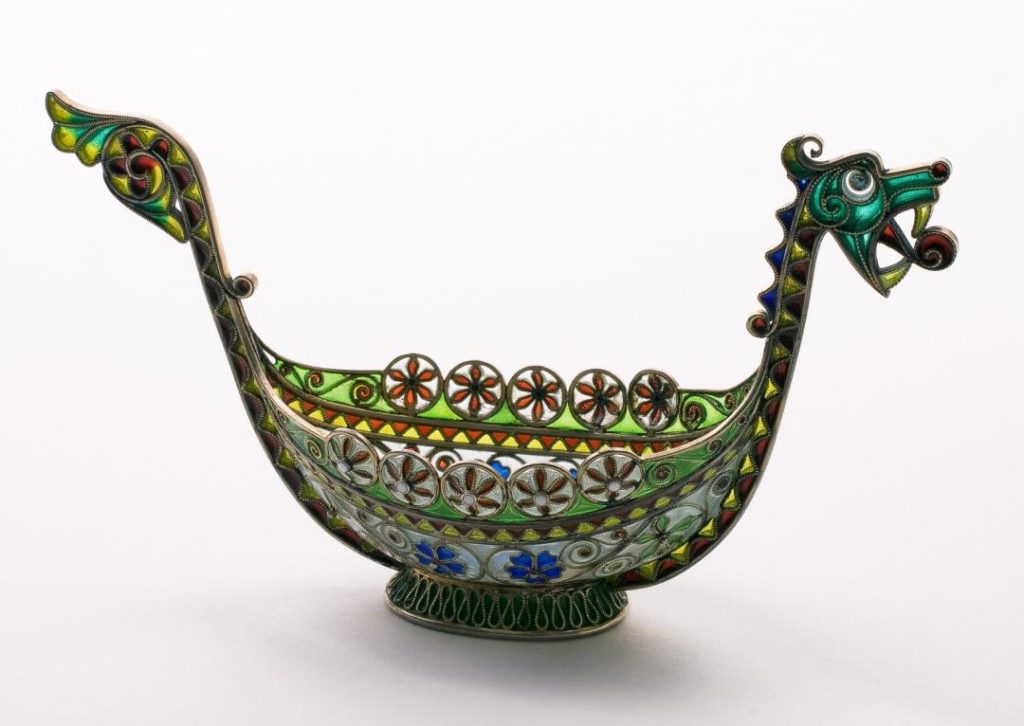
The Silver Treasure Tankards, cups, spoons and jewelry is just some examples of what you can find. The exhibition was opened by Her Majesty Queen Sonja on the 7th of May 2009, and is presented in a large display case designed by Kristin Jarmund Architects. For hundreds of years, Bergen has been an important center for the production of gold and silver objects. The Bergen Goldsmiths’ Guild, established in 1568, formed part of an international artisanal community that ensured that the pieces produced were of high quality.
The items have played a central role in both public and private rituals. The wedding ring, the heirloom silverware, and the mayoral collar are all important objects with great symbolic value. For a long time, silver and gold objects also acted as a store of value at a time when there were no banks in Norway, and in recent years they have also become popular collector’s items.
Important objects with great symbolic value are on display
The exhibition is based on items from a number of sources. Ever since its beginning in 1887, the West Norway Museum for Decorative Art has been collecting gold and silver from Bergen. It has been one of the museum’s most important areas of expertise, and it can now boast a sizeable collection.
A crucial part of the exhibition is the collection that Christen Sveaas and the foundation Bergensølvet (Bergen Silver) donated to the museum. It is an extraordinarily large and magnificent collection of Bergen silver, most of it dating from the guild period (approximately 1550 – 1850).
The exhibition is based on items from a number of sources
The Silver Treasure is built up around a number of themes, such as guild tankards, steins, spoons and jewelry, but special attention is also given to notable individual goldsmiths: Lucas A. Steen, J. J. Reimers Sr. Jens Kahrs and Christian Børs.
Senior Curator Trond Indahl is the exhibition project manager. Kristin Jarmund Architects AS has designed the exhibition.
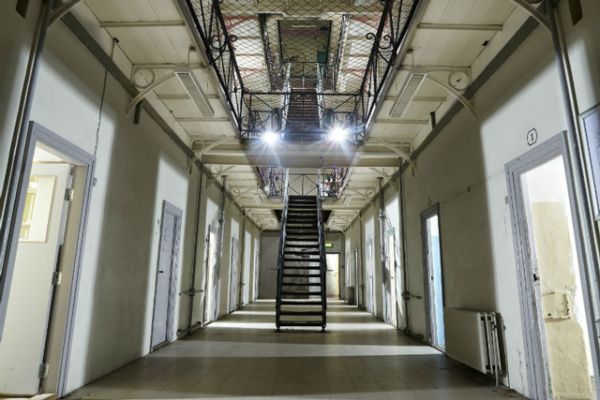
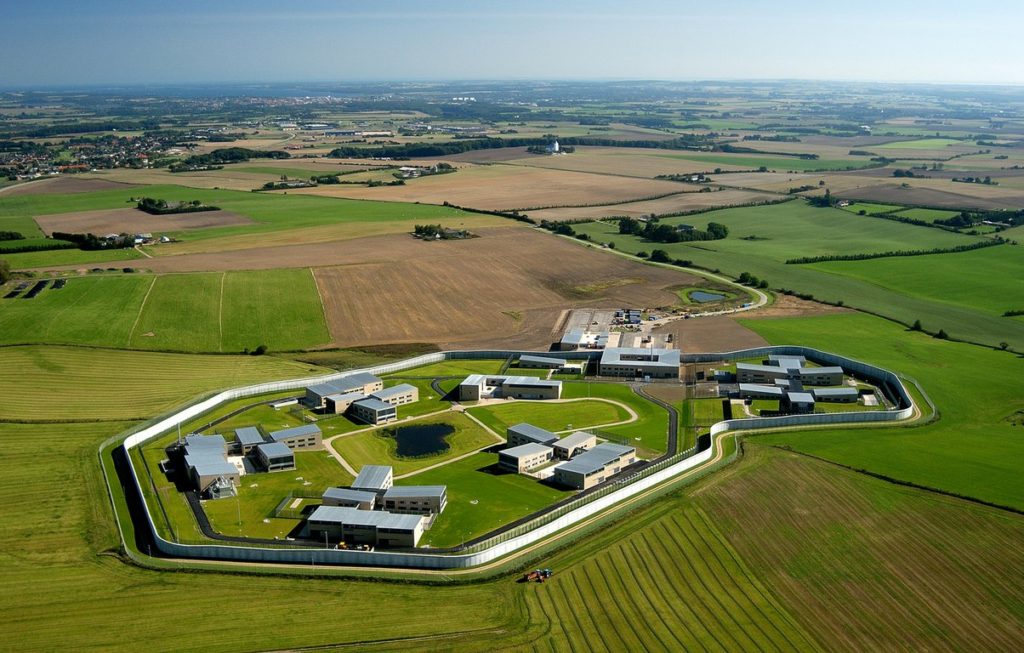
In the city of Horsens, Denmark, you find the Largest Prison Museum in the World.Since 2006 when the last inmate left the former Horsens State Penitentiary, intense work and effort have been invested in the project which is now a reality: Fængslet (The Prison).
The city of Horsens doesn’t necessarily have the same ring to it as Copenhagen or Aarhus, especially when it comes to culture. But maybe that will change when you encounter The Prison.
Horsens prison from air
The Prison Museum in Horsens has the world’s largest collection of prison items. Altogether, they give you a rare opportunity to experience the otherwise closed world of a prison. Here you can find out what life behind the walls was like for both inmates and guards throughout history.
And for the first time ever you can get a virtual tour of the largest prison museum in the World.
Fængselet (The Prison) 2005
Today the historic buildings of the former state penitentiary houses FÆNGSLET, the cultural institution that encompasses The Prison Museum, the city’s tourist information center VISITHORSENS, the prison hotel SleepIn Fængslet, business events, festivals, concerts, the shared office space FÆNGSLET 2 and much more.
Museums + Heritage Award2016, the Oscars of the museum world, awarded the captivating experience as the world’s best museum experience! Quite impressive considering only 10 years ago it was still a real prison, which had existed for more than 150 years and housed some of Denmark’s worst criminals.
Isolation room at the Horsens Prison
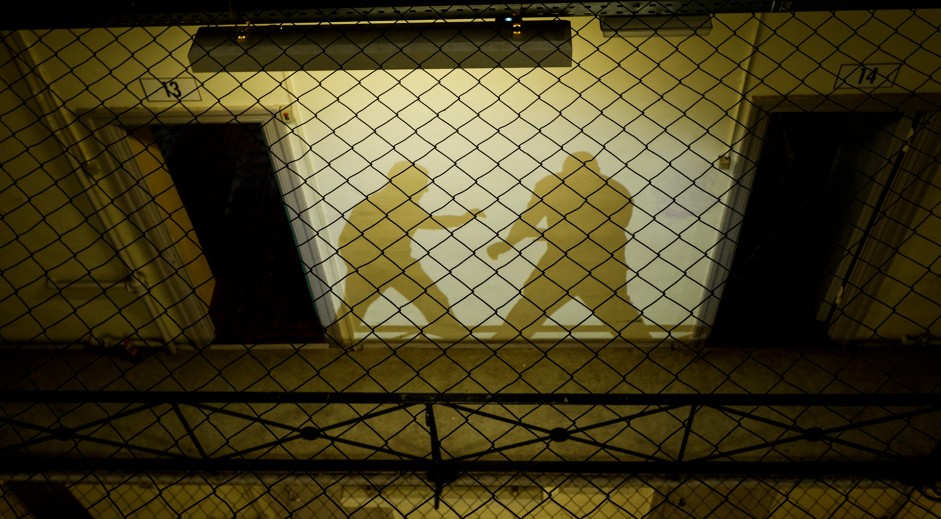
Modern technology brings prisoners and guards back to the prison and you can see them as shadows on the walls, hear the sound of them walking on the stairs or knocking on a cell door.
You can also see and hear them on screens, in phones and through intercom systems, where they talk about matters of importance to life behind bars. It can be anything from drug problems to the detested weekly fish day.
You can see prisoners and guards as shadows on the walls
The former prison yard where inmates used to enjoy fresh air and exercise is today a concert arena. Outdoor concerts and event of any taste can be enjoyed here throughout the summer season. The rock legends Metallica with Danish drummer Lars Ulrich have played there twice, and German rock band Rammstein is scheduled to play this summer.
Prison cell
Some of the facilities of the old penitentiary – the prison workshops, the gathering hall, the gym – are now available for rental by those who are looking for a very distinct framing of their event – whether it´s meetings, conferences or parties.
Rock group Metallica performing at Horsens Prison
There are even cells you can explore and try what prison life was like. Search for graffiti and hidden things with the prison guards or lay down on a bed and let your thoughts wander in the company of inmates. You can find the ax that was used during the last execution in Denmark, homemade tattoo-kit and all sorts of other creative prison craftsmanship.
The interactive experience works in two way:
First, as a virtual tour which lets you explore the many floors and rooms of the notorious, including:
· The inmates first meeting with the prison
· The trip to the infirmary
· Transfer to isolation
· Special block for gangs
Second, as an informative tool that presents stories from the inmates along the way
German rock band Rammstein performing at Horsens state prison
To create this unusual virtual tour The Prison teamed up with Expedia Denmark. With help from Google Street View you can take a virtual tour of FÆNGSLET.
As a conqueror rather than the conquered, Sweden developed strong cultural traditions, particularly in theatre, music and dance. Diplomatic and commercial links with Europe allowed new ideas to travel into the country.
Prosperous Swedish monarchs were patrons of culture, and their private collections became the basis for national art museums.
Drottningholm Court Theatre, Stockholm
King Gustav III (1746-92), the “Theatre King”, took many of his cues from the royal court of France and patronized drama and the arts. In 1775, construction began on the Kungliga Teatern (Royal Theatre, known today as the Royal Opera), and on the Kungliga Dramatiska Teatern (Royal Dramatic Theatre or Dramaten) in 1788. He hired Swedish actors and singers, forming the basis for a tradition of opera and drama performed in Swedish, instead of French or Italian.
The most noptable Swedish venue is Drottningholms Slottsteater (Drottningholm Court Theatre), in the grounds of Drottningholm Palace outside Stockholm. Built in 1766 and restored in the mid-20th century, every summer this intimate stage draws spectators from all over the world eager to see Baroque and rococo operas original backdrops and stage machinery.
Carl Bellman
Award-winning writers One of the best-known (at least among Swedes) and still popular writers of the past is Carl Bellman (1740-95), a troubadour, whose lyrics and poems immortalized 18th-century daily life.
Works such as The Red Room by August Strindberg (1849-1912) and Gösta Berlings Saga by Selma Lagerlöf, whose personal life was marked by a series of failed marriages, alcoholism and instability, produced books, stories, plays and screenplays that often featured social criticism, satire and emotional angst. The creative output of Lagerlöf, the first woman to win a Nobel-Prize in Literature (1909), is distinct from Strindberg, depending more on legend, history and childhood memories (Jerusalem, 1901-2, The Wonderful Adventures of Nils, 1906).
Selma Lagerlof Photo: A. Blomberg, Stockholm.
Other Swedes have wond Nobel Literature prizes, most recently Eyvind Johnson and Harry Martinson, in 1974. A fascinating read, particularly for US visitors with Swedish ancestors, is Vilhelm Moberg’s four-volume epic novel, beginning with The Emigrants. The book inspired the musical Kristina from Duvemäla, written by former ABBA members, Benny Andresson and Björn Ulvaeus.
One of the most read Swedish writers is Astrid Lindgren, the indefatigable creative mind behind Pippi Longstocking, Emil of Lönneberga and other free-spirited child heroes, heroines and anti-heroes and heroines. Currently taking the world bystorm is Stieg Larsson’s posthumely published Millenium trilogy, The Girl with the Dragon Tattoo, The Girl Who Played with Fire and The Girl Who Kicked the Hornets’ Nest, which have sold over 50 million copies to date.
Noomi Rapace as Lisbeth Salander in Millennium movies
We can only guess what Astrid Lindgren might have made of Lisbeth Salander, the books’ violent, antisocial, computer-backing heroine – created partly through Stieg Larsson imagining Pippi Longstockings as an adult.
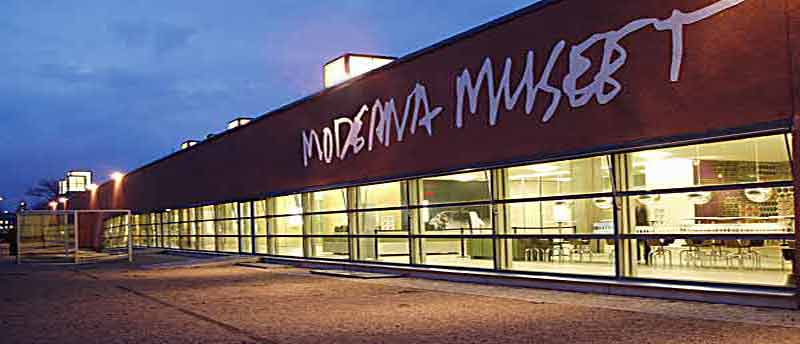
Swedish design The well-known “Swedish look” is greatly indebted to the graphic work and paintings of Carl Larsson (1853-1919), as well as to the design of his home at Sundborn. Larsson’s images are marked by strong outline, subdued colors and a gentle curvilinear quality. Today, however, Swedish visual arts are extraordinarily multifaceted. Artists such as Ann-Sofi Sidén, Elin Wikström and Carl Michael von Hausswolff work in a variety of media, addressing complex contemporary issues. These trends can be seen at Moderna Museet in Stockholm, which reopened in 1998 in a new building by Rafael Moneo, and at its sister museum in Malmö, inaugurated in late 2009.
Moderna Museet, Stockholm
Art and Culture in Sweden, written by Tor Kjolberg
Feature image (on top): Rectangle Big Retina at Moderna Museet, Stockholm
Norway’s Henrik Ibsen is often considered the most-read playwright after William Shakespeare, and the reason is perhaps that he talks about women, the corruption in our society and the middleclass values. 150 years ago, however, he wrote the dramatic poem of Peer Gynt, which at that time was not at all intended for the theatrical scene.
Peer Gynt is a farm lad who wastes his time in lazy dreaming, boasting and brawling – a symbol of the man who ever colors truth and fact in wishful compromises, evasion and selfishness. The tales about Per have been told through generations, and these, together with the nature and culture in the valley, is what inspired Henrik Ibsen to write the dramatic poem.
Peer Gynt. Photo: Dashuber
2017 marks the 150th anniversary of Norway’s national epos Peer Gynt and the anniversary is celebrated with a grand outdoor performance at the venerable Akerhus Fortress, as well as at the annual Peer Gynt festival In the Gudbrandsdalen valley, one hour north of Lillehammer.
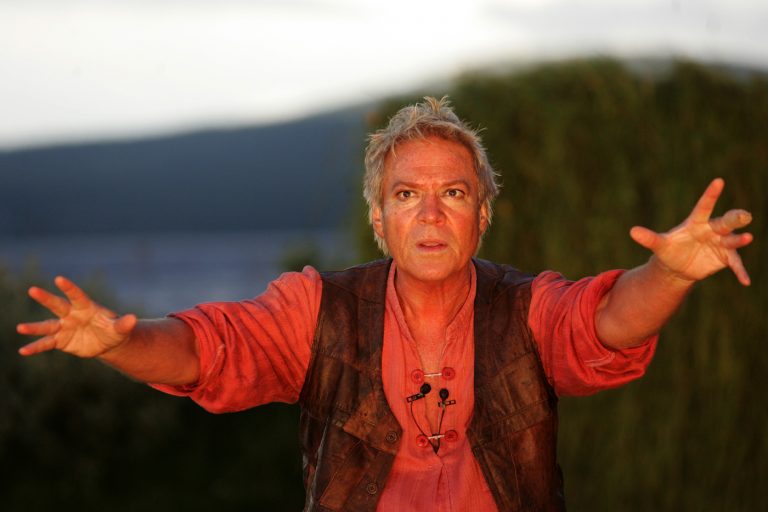
The performance in Oslostays true to both Henrik Ibsen’s text and Edvard Grieg’s wonderful music, and features six professional actors, 30 singers and dancers, and 40 musicians from the Staff Band of the Norwegian Armed Forces. Director is Sturla Hungnes, who has worked with Peer Gynt throughout his whole career. Peer Gynt will be performed at Akershus Festning 8 – 10 June.
From the Peer Gynt Festival in Gudbrandsdalen
In Gudbrandsdalen, the Norwegian drama, music and nature comes together in the middle of Peer Gynt’s kingdom.
The festival in Gudbrandsdalen will give its guests a good insight into the Norwegian spirit; through nature, culture and traditions.
The festival takes place from 4-13 August.
Peer Gynt – Shipwreck
Ibsen’s play was first performed in 1867 set to music by Norwegian composer Edvard Grieg. Peer Gynt has in fact immortalized them both and this work lives now literally a worldwide existence as a “three-headed troll”: as the orchestral suites (op. 46 and 55), as the stage version with the music of Edvard Grieg and as the stage version without Grieg´s music.
Both performances are in Norwegian, but there is plenty of wonderful music and nature to be enjoyed.
Feature image (on top): Svein Sturla Hungnes as Peer Gynt
150th Anniversary of Norway’s Peer Gynt, written by Tor Kjolberg
The Astrup Fearnley Museum in Oslo, Norway is now presenting a solo exhibition of the world-famous Japanese artist Takashi Murakami (b. 1962, Tokyo).
The exhibition will not only feature his artworks, but will also present aspects of his activities as a collector, gallerist, businessman, and activist. Takashi Murakami is the originator of the “Superflat” Theory and the artist most associated with its tenets.
Takashi Murakami – Murakami by Murakami
In the last twenty years, Murakami has been extremely visible on the international art scene, but he has also taken an active role in Japan, redefining the position of the artist through his involvement in different arenas of society.
In this exhibition, Astrup Fearnley will concentrate on two periods in Murakami’s artistic development. It explores the phenomenon that is Takashi Murakami from a number of different angles. There will be works from the late 1990s related to his creation of the figure ‘DOB’ and the notion of ‘Super flat,’ which place him within the legacy of Pop art but with an exceptionally original artistic language.
Murakami by Murakami
Murakami has maintained a multifaceted career as an artist, curator, collector, film director, and the founder of Kaikai Kiki Co., Ltd. In recent years Murakami has developed an intelligent personal dialogue with Japanese historical paintings. A special room will be dedicated to his films and TV series.
As a curator, Murakami organized a trilogy of exhibitions, beginning with SUPERFLAT ( which traveled from Parco Gallery, Shibuya to MOCA, Los Angeles and other museums) and continuing with Coloriage (Fondation Cartier pour l’Art Contemporain), and Little Boy (NY Japan Society), the last of which was awarded the prize for Best Thematic Show by the US of the International Association of Art Critics.
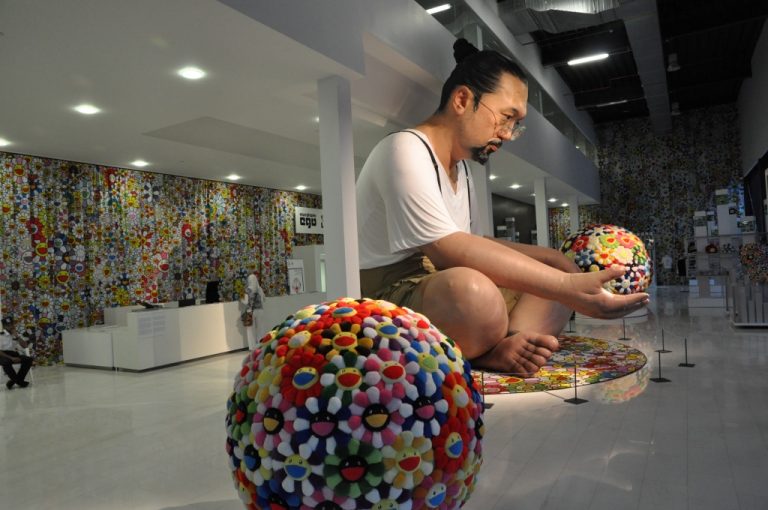
Murakami in Oslo. Photo: Tord BakklundMurukami in Munch Museum, Oslo
The Astrup Fearnley exhibition will also present an insight into Murakami’s impressive art collection through an ‘exhibition within the exhibition’ featuring antique Japanese ceramics and painted scrolls, curated by Murakami himself, as well as works by other artists and those whom he has discovered or promoted. In addition, there will be an important selection of his merchandising, which Murakami, more than any other artist, has developed, produced and propelled into the art world,
which normally he exhibits in his Kaikai Kiki Gallery, which he founded in 2008.
Curators: Gunnar B. Kvaran and Therese Möllenhoff
In 2016, the first episode of the original anime series 6HP (Six Hearts Princess) was aired on TV. Murakami is currently preparing to release a new live action feature film, Jellyfish Eyes 2.
Murukami in Oslo. Photo: Tord Bakklund
Every Thursday there will be a screening of Murakami’s feature film Jellyfish Eyes (2013) at the museum. Click here for more details.














 Justin Cremer has been The Local Denmark’s editor since the site launched in June 2014 and has also operated The Local Norway since November 2015. He will be moving to upstate New York and if all goes according to plan will return to Copenhagen in 2019. You can contact him at justin.cremer@gmail.com and/or on Twitter at