It is the first run if the day, and the morning sun glitters on the pristine, white blanket of new-fallen snow. From the top of the lift, we glide out onto the deserted piste, the wind freezing our cheeks to immobility as we pick up speed. It doesn’t matter.
We have the sun, our own tracks cutting through the virgin snow, and a cup of coffee waiting for us very soon.
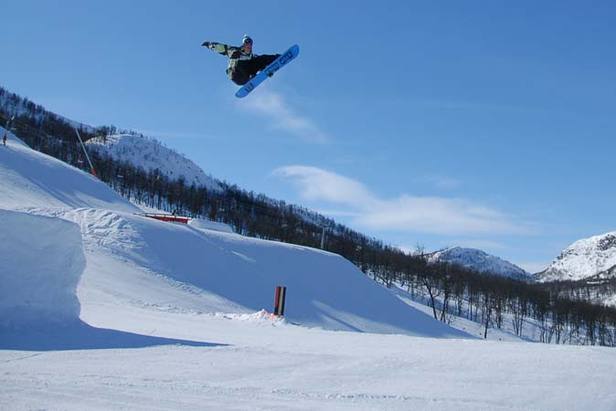
Blåparken (Blue Park), Hemsedal
We are skiing at Hemsedal Skisenter. This is Norway’s best place to ski when the sun is shining and the snow is at its very best early in the season. It is also where you will find the most popular off-piste skiing. It has been dubbed ‘the little Matterhorn’, and snakes along the side of the stubby mountain that is called after one of Europe’s most imposing peaks.
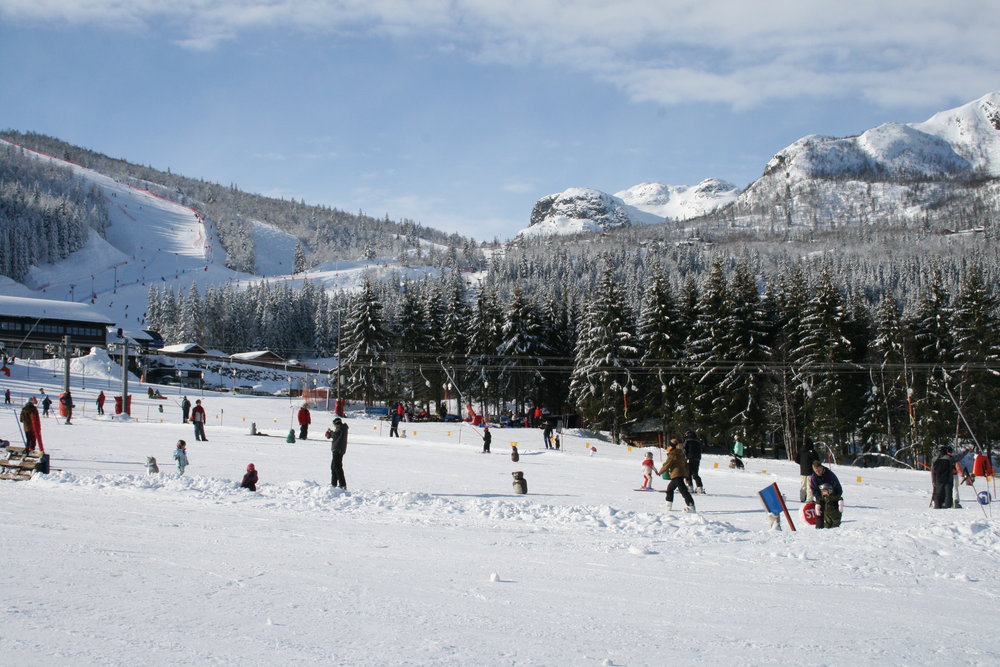
Children’s area, Hemsedal ski center
The body is still stiff this early morning, but a delicious, life-saving cup of coffee is waiting down in the birch wood at Skarsnuten Hotel. The skiing is so steep and demanding that a caffeine shot seems superfluous, but it will be good to have a hot drink and a break, and allow the muscles to recover from the shock of this early morning exercise.
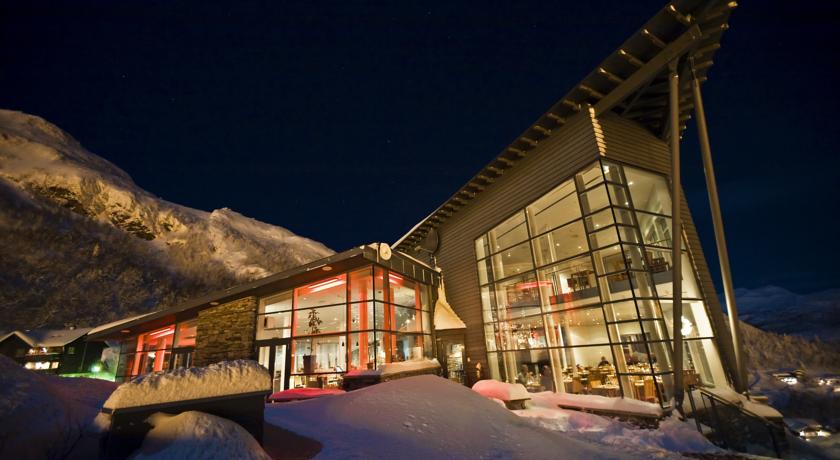
The hotel’s façade of glass and stone is by no means ostentatious, but when you duck inside the warm reception you are surprised by its size. The room extends up over three floors to the bar and restaurant. A double latte thaws out frozen fingers, while we gaze out over the resort from the comfort of the bar, which offers panoramic views over the whole valley.
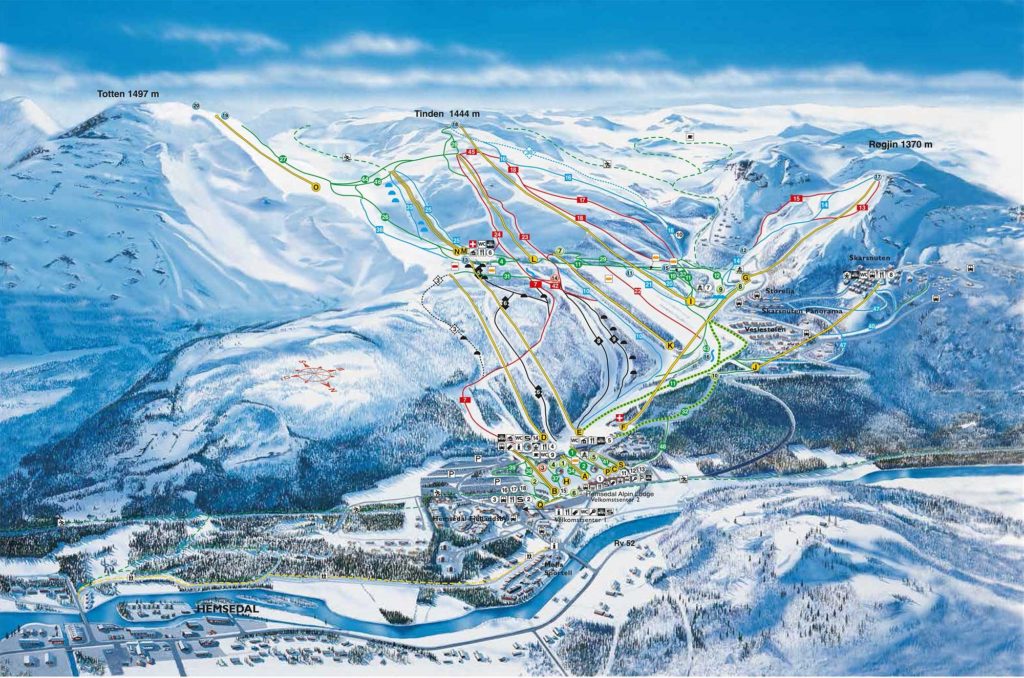
Hemsedal trail map
The tiny dots out on the mountainside multiply as more and more skiers take to the slopes. It is time to get going again.
It is tempting to take a few carving runs down Hemsedalsløypa to warm up. The previous night’s prepping to ballroom-floor smoothness is still intact, and the slope begs you to make wide, swinging turns. The eight-seater chairlift keeps the queues short, so we soon have a mass of height under our feet. And since we are already in the swing of it, we duck down the black. Såhaug run. That certainly lights a fire in the tight muscles.
Skarsnuten Hotel, Hemsedal
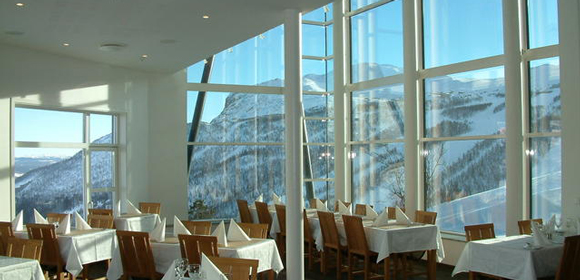
And now it is suddenly time for lunch. Since the Skistua lodge is starting to fill up, we decide to head back to Skarsnuten. A fabulous off-piste run later, and we are sitting at a table so vertiginous it would kill the appetite of anyone afraid of heights. Even in the Alps, you rarely find a hotel that puts you so dizzyingly close to the edge.
Hemsedal Cafe & Restaurant
Through the afternoon we try out a variety of different runs. Everyone who skis in Hemsedal agrees on one point: the best thing about the place is the variety to be found here. From extensive nursery slopes and green runs to black runs and precipitous off-piste skiing, both high above the tree line and through the woods.
The terrain park is also famous for the challenge it offers to both expert and novice snowboarders. And parents thank their lucky stars for Trolla, the supervised play area at the bottom of the hill.
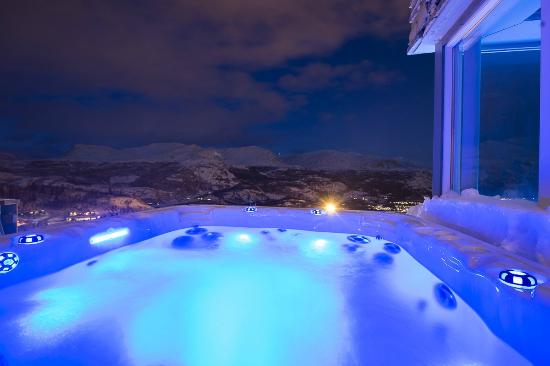
Pool at Skarsnuten hotel
One thing everyone should do while they are here is to take the lift up Tottenfjellet to a height of 1,450 m, and then walk the last 10 minutes to the top. The views are spectacular. Afterwards you have 800 m of drop to ski from the top of Norway’s highest lift. Experienced skiers who have a guide with them can choose to make the descent off-piste from here. But that is not something to be attempted by just anyone.
When you have come to the end of your last run of the day, down the pristine slopes of the Little Matterhorn (or taken lift, like most people), it is tempting to quench your thirst with a drink in Skarsnuten’s precipitous bar. The bar is frequented by a grown-up clientele, who chat over the day’s achievements to the accompaniment of light music.
Inside Skarsnuten hotel
Meanwhile, the après-ski is getting into full swing at Skistua at the bottom of the lift. Hemsedal Café in the center of town is also a popular venue. On Saturday nights the nightlife is impressively exuberant. When midnight approaches, Hemsen nightclub is the place to be, though Skarsnuten nightclub, The Edge, also has its devotees.
Thanks to an excellent terrain park and varied off-piste opportunities, Hemsedal is popular with snowboarders. Among those with apartments at Skarsnuten are veteran snowboarders, Olympic team members and snowboarding athletes. As a result, this small Norwegian mountain resort ends up on the pages of the world’s biggest snowboarding magazines and in the dreams of hopeful young snowboarders the world over.
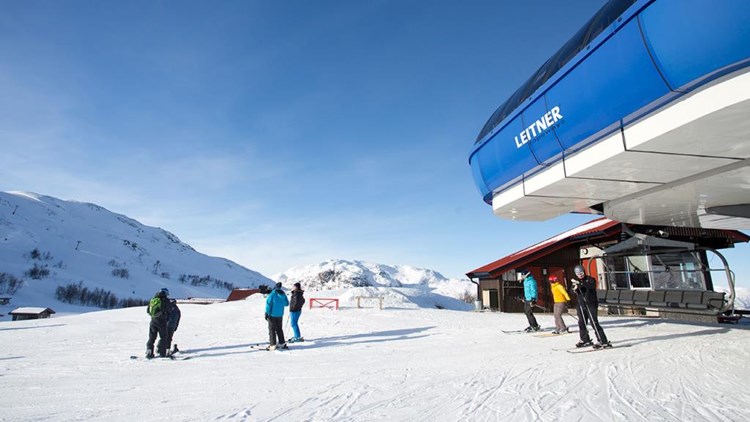
One if the skilifts in Hemsedal
Facts about the resort 21 lifts, 48 runs, season from mid-November to 1 May. Highest altitude at the top of a run, almost 1,500 m, with a drop of up to 850 m – if your legs can stand it. Information about avalanche hazards is posted at the bottom of the hill.
Skiing on the Sunny Side in Norway, written by Tor Kjolberg
Six years ago the decision to award the Nobel Peace Prize to the imprisoned democracy advocate Liu Xiaobo opened a rift between the two countries.Last month the governments of Norway and China unexpectedly announced that diplomatic relations had been fully restored.
Liu Xiaobo
Donald Trump’s impending presidency, and signs of considerable change in U.S. China policy, are likely to have been contributing geopolitical factors prompting Beijing to seek a solution. However, as both Chinese and Norwegian officials, including Norwegian Prime Minister Erna Solberg, noted, the normalization was mainly the result of years of painstaking diplomatic negotiations, in the form of a series of low-level meetings.
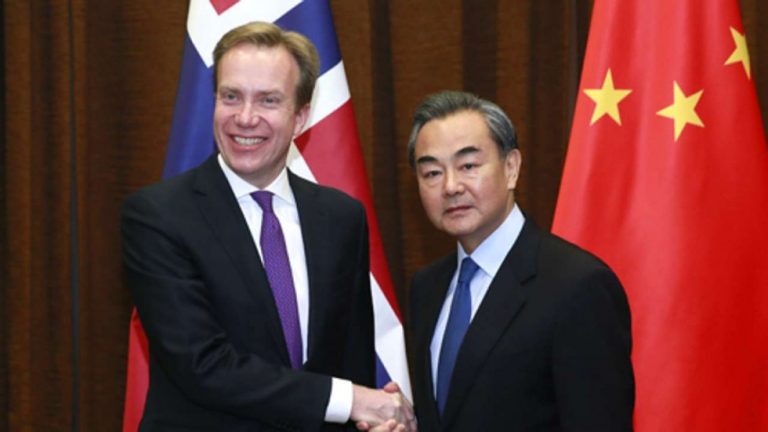
Norway’s Foreign minister Borge Brende
The news accompanied an unannounced visit to Beijing by the Norwegian foreign minister, Borge Brende, who met with Premier Li Keqiang.
Norway’s Prime minister Erna Solberg
The news is likely to have numerous positive economic after-effects for both countries, given that during the impasse, a bilateral free trade agreement was placed on hold and periodic disruptions to Norwegian salmon exports to China were reported. Norwegian energy and shipping firms are also likely to reap short-term benefits from the rapprochement.
Very shortly after the deal was announced, it was reported that restarting the FTA talks would be a priority, and that a Norwegian government delegation would return to Beijing this spring.
“Through meticulous and numerous conversations, the two sides have, over the last years, reached a level of trust that allows for resumption of a normal relationship,” they said in a joint declaration, which stated that Norway was “fully conscious of the position and concerns of the Chinese side” over the prize.
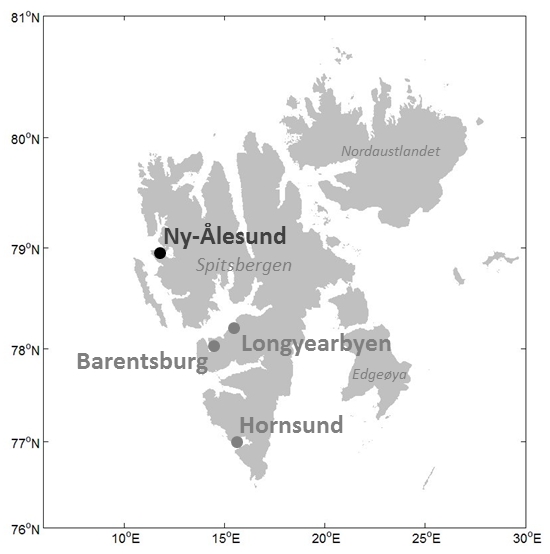
Ny Ålsesund
Looking beyond the spheres of business and trade, this diplomatic deal is also likely to have significant effects on Arctic cooperation and joint partnerships, given Norway’s position and Beijing’s expanded interests in the circumpolar north.
The post-Nobel Prize dispute has frequently spilled over into Arctic affairs in the past half-decade. In September 2014, Oslo turned down a request by China to build a large radar antenna on Svalbard (although China’s Yellow River research station at Ny-Ålesund on Svalbard was unaffected by the diplomatic troubles). Also during that year there was a controversial, and unsuccessful, bid by Chinese entrepreneur Huang Nubo to purchase Arctic land in Norway, including in Svalbard. In October 2015, three Chinese naval vessels conducted a goodwill tour of the Nordic countries to further demonstrate Beijing’s developing Arctic diplomatic interests, but there were no stops in Norway.
In the four-part agreement between Beijing and Oslo that officially restored diplomatic ties, Polar issues were listed among the matters for future “win-win cooperation.” Not only would this include the Arctic, but also Antarctica, where Norway has also had a longstanding presence and where China has also augmented its exploration and scientific interests of late. In the Arctic alone, there are several areas that could be subject to greater bilateral cooperation in the future, like research cooperation, shipping and regime-building.
It is fair to assume much of the diplomatic negotiations over the years have consisted of trying to merge the contents of the proposed public and secret statements into the one mutually acceptable, although in parts ambiguous, statement published last month.
In the statement, Norway said it “fully respects China’s sovereignty and territorial integrity, attaches high importance to China’s core interests and major concerns, will not support actions that undermine them, and will do its best to avoid any future damage to the bilateral relations.”
The Chinese foreign minister, Wang Yi, said in a statement that “Norway deeply reflected upon the reasons bilateral mutual trust was harmed, and had conscientious, solemn consultations with China about how to improve bilateral relations.”
John Peder Egenaes, secretary general of Amnesty International in Norway
However, John Peder Egenaes, secretary general of Amnesty International in Norway , is concerned about the agreement. “We are worried about some of the wording in the declaration,” he said in an interview. “If this sentence means the Norwegian government becomes subservient, we will criticize them for it. Time will tell. Human rights have been a foreign policy priority for Norway, and in particular support for champions of human rights. This policy has to apply to China, as much as to any other place.”
Stein Tonnesson, a historian and former director of the Peace Research Institute Oslo
Stein Tonnesson, a historian and former director of the Peace Research Institute Oslo, on the other hand, said the agreement was “of huge importance to Norway” because of the commercial potential. Norway’s salmon industry stands to benefit significantly.
Much of the wording of the agreement is in broad enough terms that there can and will be copious analyses to follow as to how much diplomatic ground was ceded by each government. For example, the third paragraph of the agreement, which outlines Norwegian support for the Chinese sovereignty and core interests, also stated that Oslo would “do its best to avoid future damage to bilateral relations,” a phrase which could be interpreted as the Norwegian government acknowledging a degree of responsibility for the original incident in 2010.
Mr. Tonnesson said he doubted that the agreement would impair Norway’s reputation as an advocate for human rights, but he added that the timing — weeks after the election of Donald J. Trump as president of the United States — was significant.
A commentary in the People’s Dailynoted Foreign Minister Wang’s view that Oslo had the chance to “deeply reflect on its mistakes” before the agreement was completed; however the Norwegian side emphasized rather the fact that Oslo had avoided being pressured into apologizing for the actions of an independent Nobel Committee.
Marc Lanteigne, a senior research fellow at the Norwegian Institute of International Affairs, bilateral trade
The overall impact on trade, even in the seafood sectors, has not been very profound, and according to Marc Lanteigne, a senior research fellow at the Norwegian Institute of International Affairs, bilateral trade hit record levels in 2015.”
China and Norway Normalize Relations, written by Tor Kjolberg
According to Innovation Norway Tourism there are many reasons to visit Norway. Among them are the low exchange rate, a safe and beautiful destination with several adventure opportunities, easy access and low oil price. Norway – worth a visit.
Margrethe Helgebostad, seniro advisor in Innovation Norway Tourism
“In 2015 there were31.6 million international tourist arrivals at Norwegian hotels,” says senior advisor Margrethe Helgebostad in Innovation Norway. “The solid growth is largely due to the 13% increase in holiday overnight stays.”
There are different ways of reporting the number of tourist arrivals. Some countries use border crossings, but the vast majority use, as Norway, foreign tourist arrivals at commercial accommodation providers.
The Norwegian krone depreciated against many currencies, including the euro, pound and US dollar in 2014 and 2015, which benefited the tourism industries in Norway. From July 2014 to July 2015 Norway’s ability to compete improved by 11%.
Guest nights by foreign visitors
For the first time since 2010, there has been an increase in the number of foreign guest nights, in both the summer and the winter season. Eastern Norway, Northern Norwayand Trøndelag represent solid relative growth in the winter season, while the fjord counties saw the largest growth during the summer season.
From Geiranggerfjord
The increase is due to several factors. Around 40% of the increase can be attributed to Innovation Norway’s expansion of the Tourism Survey to include tourists on Hurtigruten.
More tourists visited Norway in 2015 than in 2014, and surveys show that the vast majority was very satisfied with their stay. Regardless of where the tourists come from, they would highly recommend a holiday in Norway to others.
How Norway is perceived
On the whole, the tourists from most markets rated their holiday in Norway more highly than the tourists in 2014. British, American and Danish tourists in particular are more enthusiastic in 2015.
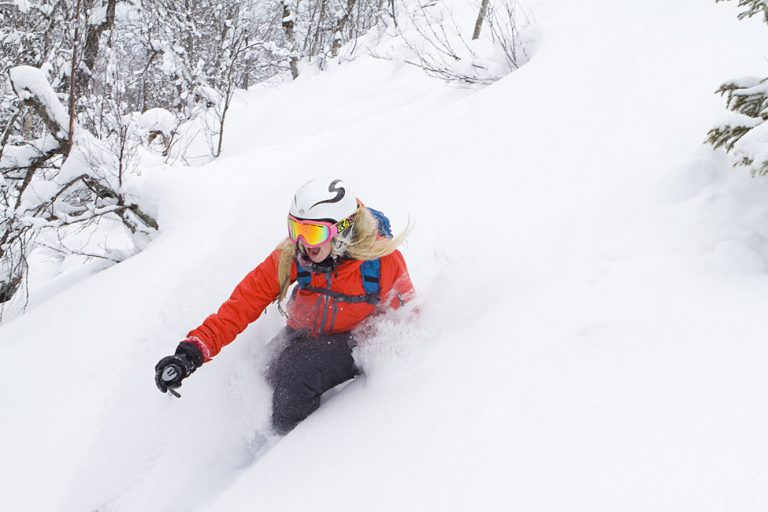
Morning ski at Hemsedal
The average age of people who holidayed in Norway rose by one year from 47.6 years in 2014 to 49 years in 2015.
Perceptions of Norway as a holiday destination Fjords, mountains and natural phenomena top the list of things people associate with Norway.
From Nideleven, Trondheim – Norway’s third largest city
Innovation Norway conducts weekly surveys in several foreign countries, asking people about their perception of Norway as a holiday destination and likelihood that they will travel to Norway on holiday.
Among other things, the respondents are asked to write down the first thing that comes to mind when they think of Norway as a tourist destination and holiday experiences in Norway. They are then asked to give their opinion on a number of statements related to holidaying in Norway.
The strongest association that most people have to Norway is fjords. Many people also think of Norway as being a good place to pursue outdoor activities.
Pulpit Rock. Photo: Visit Norway
Interesting culture, history and city life are receiving more positive statements in 2015 compared to 2014.
According to Helgebostad all tourism operators expect a growth also in 2017. Incoming companies expect a growth of 9.9%.
About Innovation Norway Innovation Norway is owned by the Norwegian Ministry of Trade, Industry and Fisheries (51%) and the county authorities (49%).
Its objective is to be the Norwegian State’s and the county authorities main instrument for achieving value-creating business development throughout the country. With its nationwide network of offices, Innovation Norway is able to meet its customers in their business environment. Internationally, customers are served through offices in the most important markets worldwide.
The travel and tourism sector within Innovation Norway work to promote a nationwide tourist and tourism development throughout the whole country in order to increase the overall economic growth within this industry.
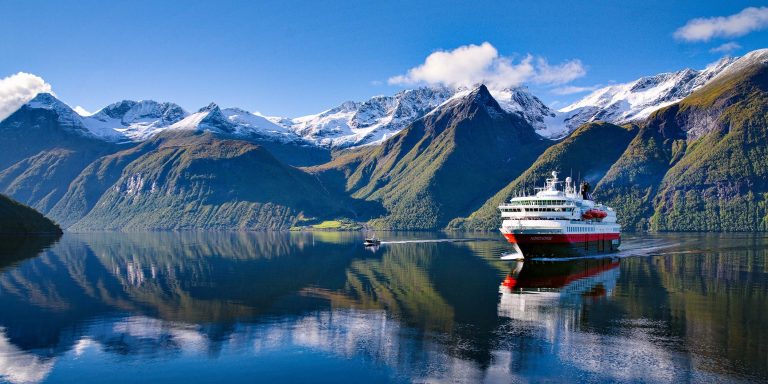
Feature image (on top) Hurtigruten.
All images (except where noted) Visit Norway / Innovation Norway
Swedish luxury brand Röshults has launched a charcoal grill where the glow bed is agitated by inaudible infrasound. It’as a Swedish BBQ revolution.
One of the benefits compared to other charcoal grills is the heating speed. Instead of the normal 20-30 minutes the Rösholts grill is heated up within 5-7 minutes. The intensity of the glow bed and grilling temperature can be regulated between 150°c to 350°c and it takes away flames from the glow bed when fat drips onto the charcoal.
One of the benefits compared to other charcoal grills is the heating speed
Complete combustion makes minimum of smoke and the consumption of charcoal is about one third of a normal charcoal grill.
Booster BBQ
“We have finally created the ultimate grill,” say the designers. “We are presenting the most exciting product in the history of Röshults. With passion, experience, years of development and thousands of tests and evaluations, this revolutionary barbecue combines innovative technology with our characteristic design language of sophistication and elegance. Röshults is taking barbecuing to a whole new level.”
Stockholm’s most expensive penthouse is equipped with Röshults signature products. The apartment of 165 square meters was last autumn sold by luxury real estate agency Siv Kraft. Equipped with the latest technology as well as exclusive materials and designs, the penthouse is a ‘dream come true’ for the discerning individual. Located on Banérgatan in beautiful Östermalm, with stunning views from the two terraces, the penthouse was sold for 39 million SEK, with a price of 235 000 SEK per square meter.
Stockholm’s most expensive penthouse is equipped with Röshults signature products
We are proud to announce that was selected by Siv Kraft selected Röshults as supplier of outdoor furniture and outdoor kitchen products.
Allmannajuvet in Norway was once the center of Norway’s nascent zinc mining industry, a labor-intensive process that saw the ore dragged out of deep tunnels and thrown off the cliff, a part of Norway’s mining past The resulting shattered chunks were then shipped to Wales for processing.
Allmannajuvet, National Tourist Route Ryfylke. Architect: Atelier Peter Zumthor & Partner.
Opened in 1881, barely two decades went by before zinc prices changed and these labor intensive methods were no longer viable. The site fell into disrepair. During 1882 1n3 1898 the Allmannajuvet mines produced over 12,000 tonnes of zinc ore.
The abandoned zinc mines from the late 1800s have inspired the Swiss architect Peter Zumthor to create yet another historical art installation along the Norwegian National Tourist Routes.
During 1882 1n3 1898 the Allmannajuvet mines produced over 12,000 tonnes of zinc ore
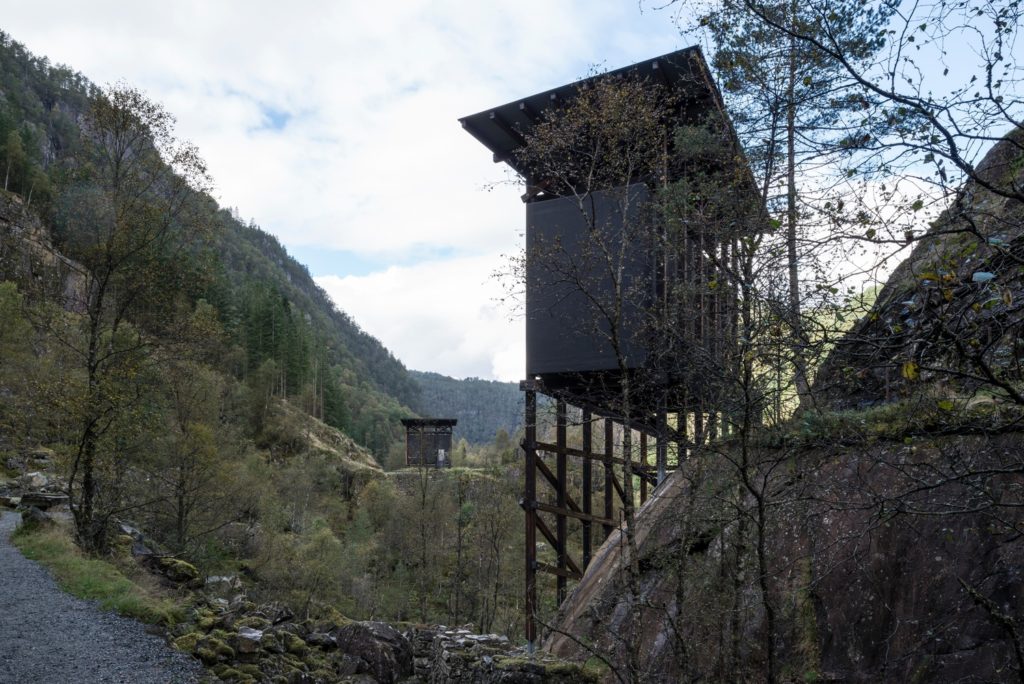
With one structure that hangs off a wall and two that are raised on stilts over a steep cliffside,
Zumthor has created three buildings at the old Allmannajuvet zinc mines in Sauda, which were in use for just 18 years at the end of the 19th century.
Zumthor has created three buildings at the old Allmannajuvet zinc mines in Sauda
Since its inception in 1994, Norway’s National Tourist Route Program has blended infrastructure, heritage and design innovation with landscape. To date, there are 18 established routes, criss-crossing the coastline and interior of this spectacularly beautiful country. The roads themselves are rarely less than stunning – when passable – but it’s the rest stops and attractions along the way that have elevated the initiative into a grand architectural experiment.
Zumthor’s installation includes a cafe, a service building and a museum
Zumthor’s installation includes a cafe, a service building and a museum dedicated to mining history.
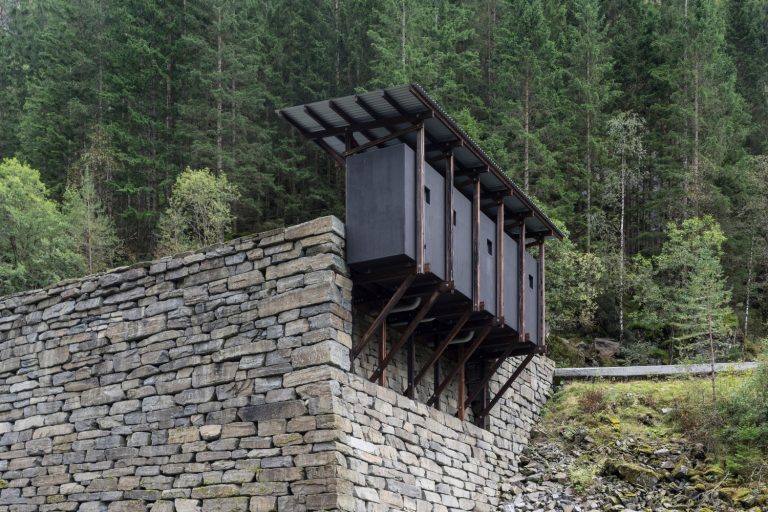
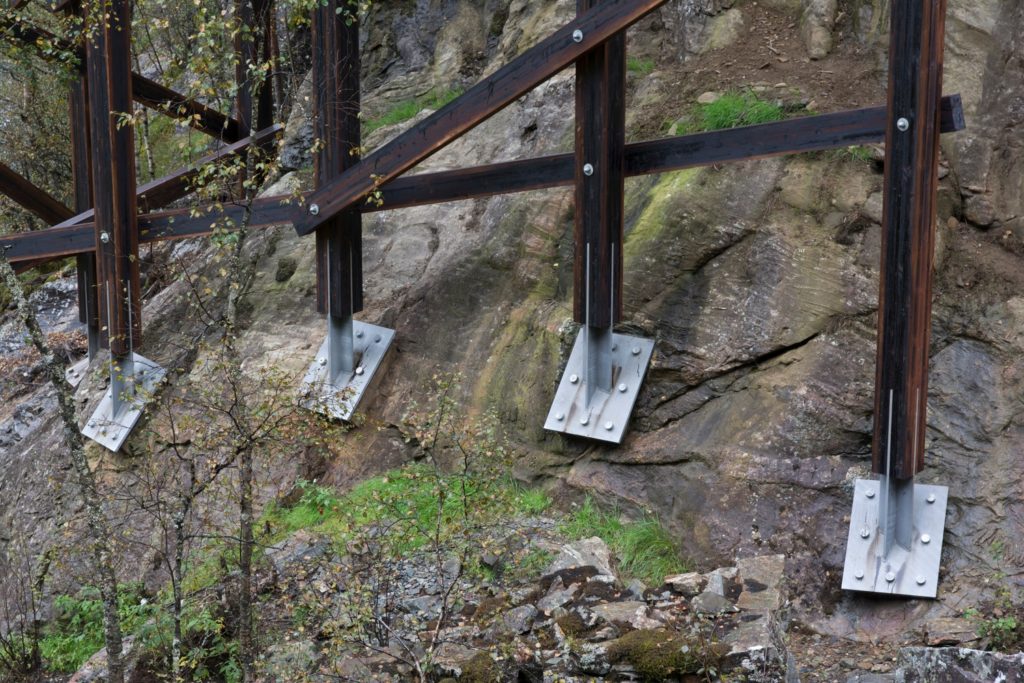
The cafe and museum are raised up over the craggy landscape on a grid of timber supports, while the service building – containing toilets and parking facilities – is perched on the side of a stone wall. All of these structures are made up of three main elements: a simple black box, an encasing support structure made from wood, and a corrugated zinc roof canopy.
Allmannajuvet, with its characteristic landscape and rich cultural history, is one of the 10 largest attractions along the National Tourist Routes
Allmannajuvet, with its characteristic landscape and rich cultural history, is one of the 10 largest attractions along the National Tourist Routes. The Norwegian Public Roads Administration commissions architects and designers to create bold contemporary interventions in the landscape – often in order to enhance a viewpoint or commemorate an event or the history of the site.
In 2002, world- renowned architect Peter Zumthor was commissioned to design a tourist route attraction for the purpose of welcoming visitors and bringing the old mining history of Sauda back to life.
A fourth building was also constructed as part of the complex, in a slightly different style to the other three. It marks the entrance into the mine for tourists.
The simplistic buildings are inspired by the mining operation, the drudgery and the workers’ strenuous everyday lives. All the buildings were prefabricated in Saudasjøen and then assembled in Allmannajuvet. The exterior support system consists of creosote impregnated laminated wood. The exterior walls of the building consist of 18 mm plywood sheets and jute burlap, coated with a German acrylic material (PMMA). The parking facility has been masoned with natural stone from Hardanger. The stones were transported from Jondal to Sauda. The visible corner of the wall is approximately 18 meters tall and has been firmly fixed three meters to the riverbed.
This isn’t the first project Zumthor has worked on for the National Tourist Routes. A few years ago, he worked with artist Louise Bourgeois to create the Steilneset Memorial, commemorating suspected witches who were burned at the stake.
The simplistic buildings are inspired by the mining operation
From the outset, the steep-sided fjords, mighty waterfalls and epic sweeps of coastline can withstand even the boldest architectural intervention, from Carl-Viggo Hølmebakk’s sinuous Sohlbergplassen viewing point at Atnsjøen lake in Rondane, to the abstract scattered forms of the Kleivodden rest area in the far north, by Landskapsfabrikken and Inge Dahlman, and Todd Saunders’ celebrated Aurland Lookout.
The Allmannajuvet gorge lies along the Ryfylke National Tourist Route, a picturesque stretch of road that runs east-west from just outside Stavanger in the south to Røldal.
This was not a project that needed to be rushed. Construction started back in 2011, but discussions about the site began nearly ten years earlier.
The complex was officially opened in September 2016.
Norway haddock are actually a number of closely related fish in the rockfish family. Some of these are endangered, some are not.
The Nordic species are deep-water fish that gorge on giant Greenland prawns and are caught in large numbers as they follow the shoals of prawns through the deep seas around Greenland. For many years they were considered a pest as they ruin the nets with their ferocious thorns and spikes and cut the hands of the fishermen. They were simply not eaten until some ingenious Greenlander hatched the idea to make them popular as a table fish.
Norway haddock
This has been a huge success over the past 20 years, as people have realized how delicious Norway haddock is to eat – so much of a success, in fact, that some are now seriously endangered.
Norway haddock
Appearance and taste The fish are beautiful creatures with huge eyes made to catch the sparse light deep in the oceans, a vivid orange body to scare off predators, and spikes that will cut your fingers if you are not careful. The flesh is delicious, dense and white. It can be eaten even by people who are allergic to crustaceans.
Culinary uses Norway haddock is sweet-fleshed, and becomes almost lobster-like and densely flaky if fried on the skin. The skin becomes perfectly crispy and delicious if you fry it with a chervil cream and new potatoes. The huge head and bones should be kept for fish soup.
Haddock fishcakes
Norway haddock herbed fishcakes The Scandinavians love all kinds of fishcakes, often very simply spiced. These are different, however, as they are made more like a burger, using the gelatinous quality of the fish to make the cakes stick together, and including no other ingredients except fresh herbs and salt.
Norway haddock, with its shellfish taste, is perfect for the task, but you can also use any member of the cod family, pike or grey mullet.
East the fishcakes hot with herbed butter, potatoes with dill and lemon wedges, or as a regular burger. With tomato, lettuce, and chervil cream.
Serves 4 750g Norway haddock fillets, skinned and boned
3 large handfuls of fresh herbs, such as parsley, dill, tarragon, chives and chervil
1 teaspoon coarse sea salt
Butter for frying
Make sure first that the fish contains absolutely no bones.
Chop the fish, herbs and salt together on a board, using a heavy, wide-bladed knife. No machine can do the job properly. Chop away, but stop while the fish is still coarser than minced meat and is beginning to stick together.
With wet hands, mold the fish into eight burgers. Melt the butter in a frying pan until browned, then fry the fishcakes very slowly until they are just set, and browned in one side. Don’t push them around the pan as they will disintegrate. Turn them over once and brown on the other side. They will need about 6 minutes altogether; leave them too long and they will become dry.
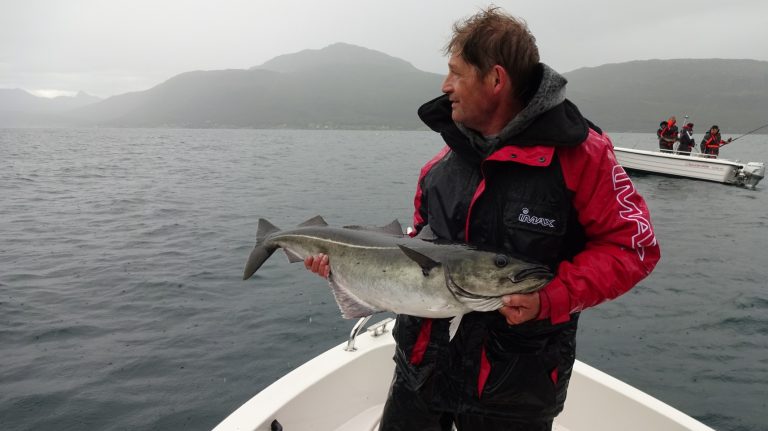
Feature image (on top): Fisherman fishing giant Norway haddock
Hip bars, plenty of hygge and daring design, Aarhus – European Capital of Culture 2017, Denmark’s second largest city, invites visitors to be happy and (re)think.
What are the Capitals of Culture?
EU member states submit a proposal for consideration, usually through their Ministry of Culture. This way Europe highlights the richness and diversity of cultures throughout Europe. At the same time it increases European citizen’s sense of belonging to a common cultural area. This is probably more important today than ever before.
People relaxing at Aarhus river at dusk
With four major events, 12 ‘full moon’ happenings and more than 300 projects lined up for visitors, Aarhus is gearing up to an extraordinary year of thought-provoking art and culture. A caste of several thousand people, including both Danish and international artists, will be coming together to create unique, magical moments, that will rethink art, food, music and ballet on a grand scale providing even more reasons to visit Aarhus in 2017.
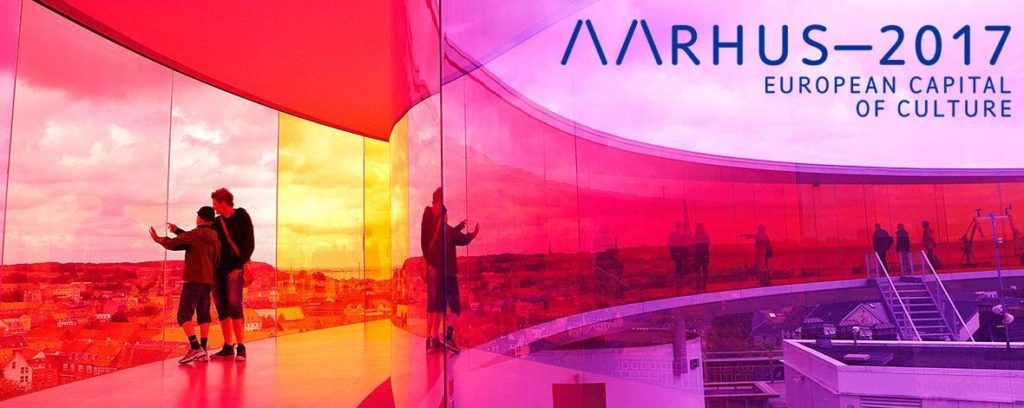
Aarhus – European Capital of Culture 2017
Festivals and projects kick off on 21 January under the banner “Let’s Rethink”, reflecting the creative spirit that has long permeated this cool harbor-side sprawl.
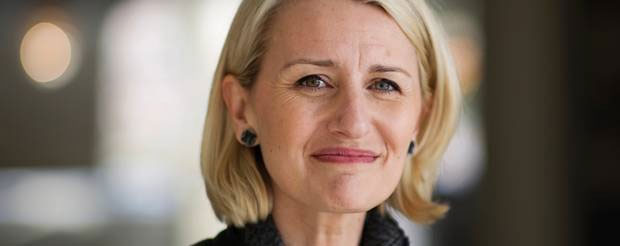
“For an entire year, we will create spectacular events, extraordinary experiences and magical moments,’’ said managing director, Rebecca Matthews.
Managing director Rebecca Matthews
As the centerpiece for the celebrations, the harbor district in Aarhus is currently undergoing a major redevelopment program to create a new Maritime Urban Area, transforming the former industrial area into a new urban space. Dokk1, which houses the main library and civic center.
Aarhus is gearing up to an extraordinary year of thought-provoking art and culture
Visitors can take a stroll along the charming revamped canal with sustainable buildings and recreational areas to the city’s most striking new building The Iceberg, a uniquely angular housing development, which has been designed to take in the sea views whilst reflecting the natural beauty of an iceberg, how it breaks up and floats across the sea’s surface, capturing light.
The Iceberg is a uniquely angular housing development
Aarhus sits on the eastern coast of Denmark’s Jutland peninsula and feels more like a laidback town than a city, with cobbled streets, picturesque canals and charming docks. And with most points of interest accessible on foot or by bike from the compact center, getting around is easy.
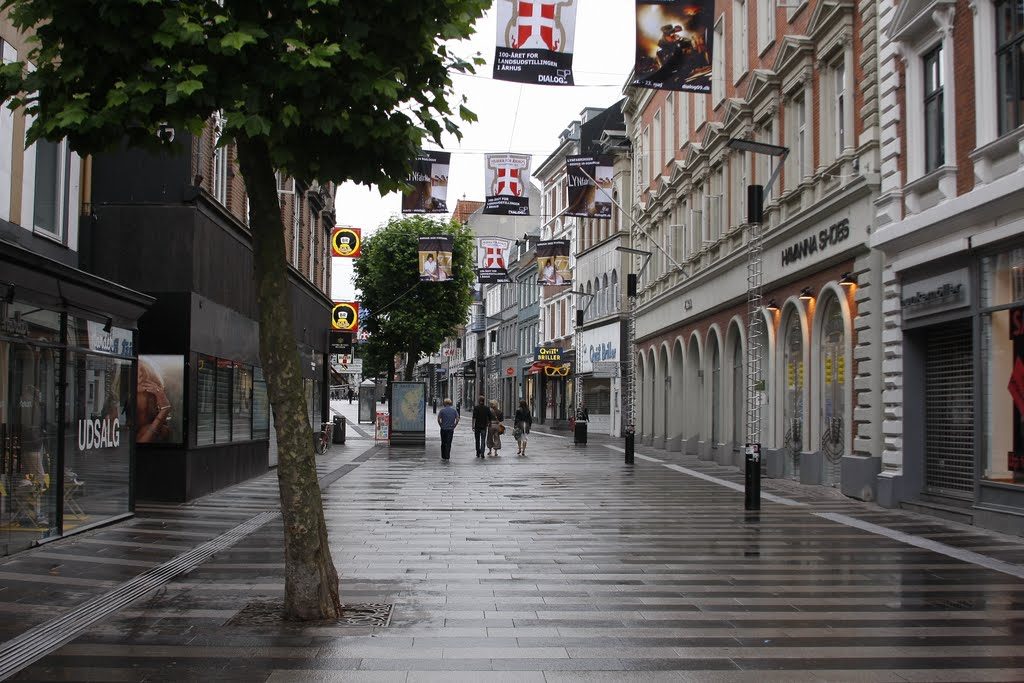
Stroget, Aarhus
Following a walk around the complex, visitors can take a break at Strandbaren – the Beach Bar – a new area with a lively beach vibe where they will be able to lie on the beach, chill out on HAY furniture with a cocktail, go for a sail or join in one of the many group activities such as volleyball, zumba, salsa and yoga.
A fleet of yellow city buses operate throughout central Aarhus. An AarhusCard gives unlimited travel, plus free or discounted entry to many of the city’s headline attractions, and costs Dkr 129 (USD 16) for 24 hours. Cards can be purchased at the bus station and most attractions.
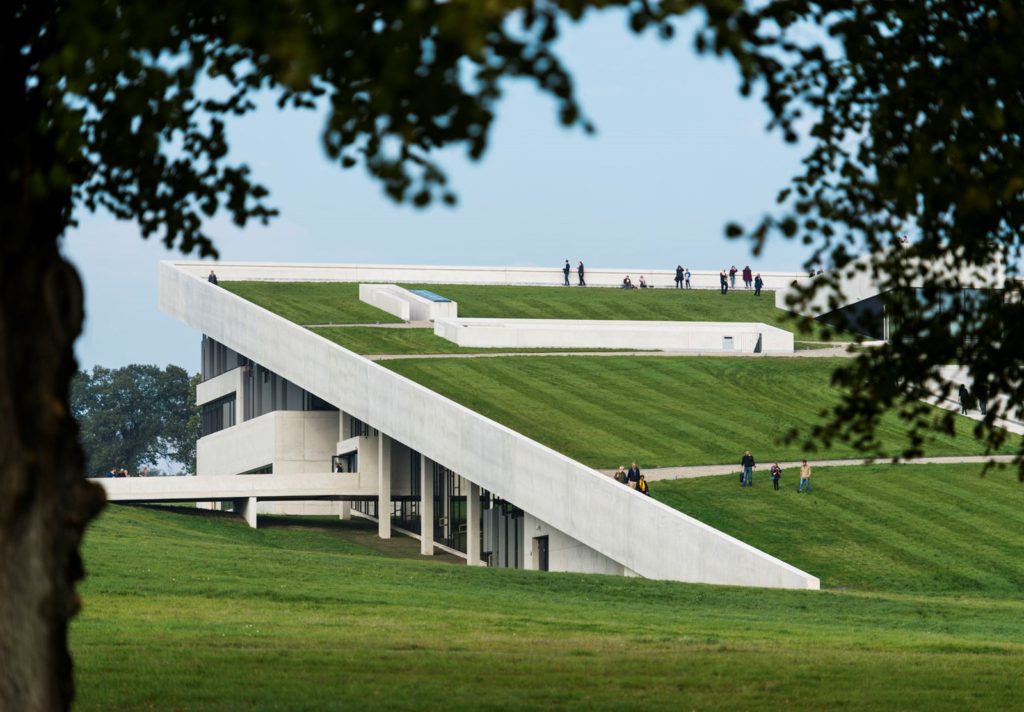
Miesgaard Museum
On the outskirts of the city, Moesgaard Museum re-opened in October 2014 following a major redevelopment, retells the nation’s story in archaeology and ethnography. It houses some of Denmark’s most important artefacts such as beautifully preserved ‘Grauballe Man’.
Exhibition at Moesgaard Museum
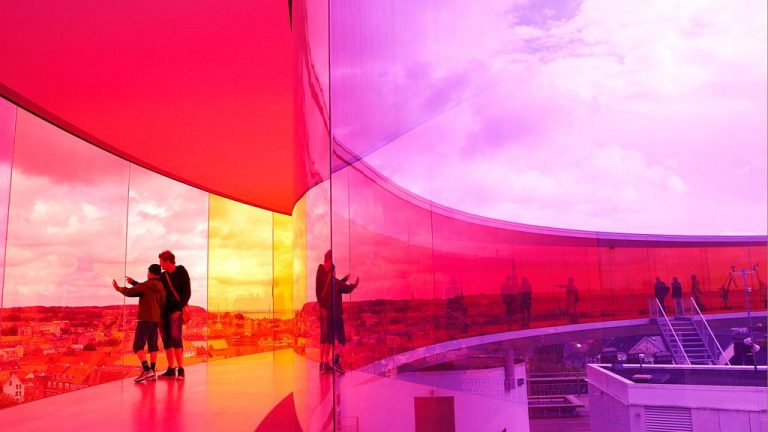
An eclectic mix of arts projects are being lined up for Aarhus 2017 drawing on the creative input of Scandinavia’s foremost cultural figures. These include the renowned Danish-Icelandic visual artist Olafur Eliasson, whose 150-metre skywalk installation ‘Your rainbow panorama’ dominates the roof of the city’s ARoS art museum.
Aros takes its main theme from Dante’s “The Divine Comedy” and is designed as a journey from hell to heaven. Hell is The 9 Spaces, a black-walled basement of eerie installations, while heaven is Eliasson’s multi-coloured halo hovering high above the streets.
In Aarhus’ center point, Domkirkepladsen, the city’s 12th century cathedral looms large. At Nordea Bank, across the square, the Vikings founded the city in the ninth century. Its name comes from “Aros”, meaning “place at the river’s mouth”). The Viking Museummarks the exact spot.
As part of Aarhus 2017, Eliasson is collaborating with the Manchester International Festival, Park Avenue Armory, Paris Opera Ballet, Sadler’s Wells and FAENA ART and British music producer Jamie XX to create a contemporary ballet that rethinks American writer, Jonathan Safran Foer’s book Tree of Codes. Having débuted at the Manchester international Festival in in 2016 the ballet will visit Aarhus with six performances in the Concert Hall this year.
The charming MoellestienOscar award-winning film director Susanne Bier
In the city’s oldest neighborhood, and by far Aarhus’ prettiest, you can wander through cobbled lanes, past churches and half-timbered houses in the Latin Quarter. The pastel-colored facades have looked the same for centuries.
The Danish Oscar award-winning film director Susanne Bier is another big name supporting the city’s celebrations with three of her feature films, Open Hearts, Brothers and After the Wedding all getting the ‘rethink treatment’ and will be performed as a ballet, an opera and a musical-drama respectively.
Aarhus Central Food Market
Gastronomy in Aarhus has seen huge advancements in recent years with many new restaurants, bars and cafés adding to the city’s evolving culinary scene and making Aarhus more vibrant and stylish than ever.
Don’t miss the Aarhus Central Food Market,which opened last October. This buzzing indoor market is full of specialist shops, delis and breweries, where you can grab everything from Kahler’s seasonal smorrebrod to gourmet porridge at Grod.
From the 2014 Food Festival. Photo: Daniel Mois
The nearby Aarhus Street Food opened last summer in a former car park with stalls in repurposed shipping containers. Enjoy melt-in-the-mouth pulled-duck burgers at Duck It, or spicy Vietnamese buns at Banh Mi Bandits.
Aarhus Food Festival has grown to become the largest in Scandinavia and celebrated its fifth anniversary in 2016.
Three of the city’s restaurants being recognized with a coveted Michelin star for the first time in 2015 and building on these initiatives and showing the strengthening cooperation between chefs and food manufacturers the International Institute of Gastronomy, Culture, Arts and Tourism has awarded Aarhus and its surrounding area the title of European Region of Gastronomy for 2017.
From the Beach Bar
Shopping is also tempting in Aarhus. The Stroget is the backbone of Aarhus’ shopping life with an 850-metre long pedestrianized parade of stores. Highlights include Skagen, the iconic Danish watch house; department store Salling with big-name brands such as Royal Copenhagen porcelain; and Georg Jensen, featuring exquisite silverware and jewelry from the Danish master.
You will find more independent retailers in the so-called “Side Streets Quarter” between Aboulevarden and Norre Alle, where cheaper rents have allowed new designers and artisans to flourish. Check out 1+1 Textil for hygge-enhancing homeware and nearby St Valentin for stylish Scandi menswear.
In time to welcome extra visitors to the city in 2017, the new ‘Wakeup Hotel’ will be opening offering superb value for money and a level of comfort guests would normally expect from the city’s 3 and 4 star hotels but at hotel prices more in keeping with a 2 star establishment. The Wakeup hotel concept is based on relatively small, yet very well appointed rooms, with furniture from top Danish designers and will offer fabulous views over Aarhus.
The lively Scandic Aarhus City on Ostergade is a stone’s throw from the main shopping artery, Stroget, and just a five-minute stroll from the train station. Doubles from $119, including breakfast.
Guldsmeden (The Goldsmith)
A stylish townhouse in the heart of the Latin Quarter, Aarhus Guldsmeden offers French colonial style rooms with four-poster beds and Persian rugs, plus a charming garden for cocktails. Doubles from €171 ($213) with breakfast.
Cabinn Hotel
Cabinn Aarhus has functional but budget-friendly rooms reminiscent of ship cabins that stretch along a vibrant canal front opposite Aarhus Cathedral. It offers compact rooms with twin or bunks beds as well as family rooms for four. Rooms from Dkr 495 ($62), room only.
The Library Hotel
For literary lovers further new accommodation will be made available when the city’s main library moves to its new location at Dokk1, by the harbor, making way for the new Library Hostel.
Mølleparken, which opened last year in the old library building, will complement the city’s existing accommodation with 100 rooms plus a café and social meeting space for locals and visitors.
Commenting on the plans, Kristian Würtz, Technology and Environment Councelor, said that “The Central Library is one of the city’s most distinctive buildings and a landmark of Aarhus. We will retain the main library’s architecture but rethink the content with bedrooms alongside a public café on the ground floor. Its new function of urban life will elegantly match the building’s original function as a popular public meeting place.
Biking is convenient in Aarhus
Don’t forget to do as the Danes do and get on a bike. With wide cycle lanes, few cars and relatively flat roads, Aarhus is geared for two-wheeled discovery. Cycling Aarhus offers rental bikes for Dkr 110 a day, as well as several themed tours of the city’s highlights.
An attractive 450km cycle route will be developed. This new bicycle route will take cyclists to various cultural attractions, beautiful landscapes, nearby villages, lakes and along the coast close to Aarhus. A book of maps, plus digital guides and signs will point the way with specially designed cycle shelters conveniently placed along the way for visitors.
Aarhus – European Capital of Culture 2017, edited by Tor Kjolberg
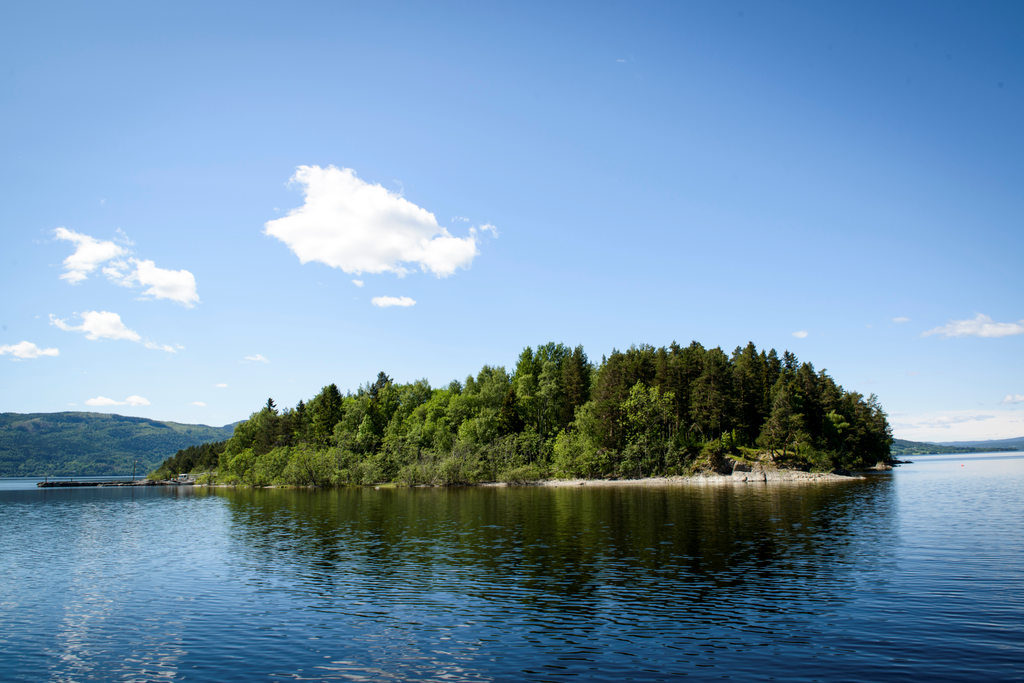
Five years after the shooting by Anders Breivik at Utøya in Norway, where he killed 69 people, mostly teenagers, Utøya Memorial Pavilion, Norway has been transformed into a place that tells the story with stark, stirring power.
Utøya islandArchitect Erlend Blakstad Hafner
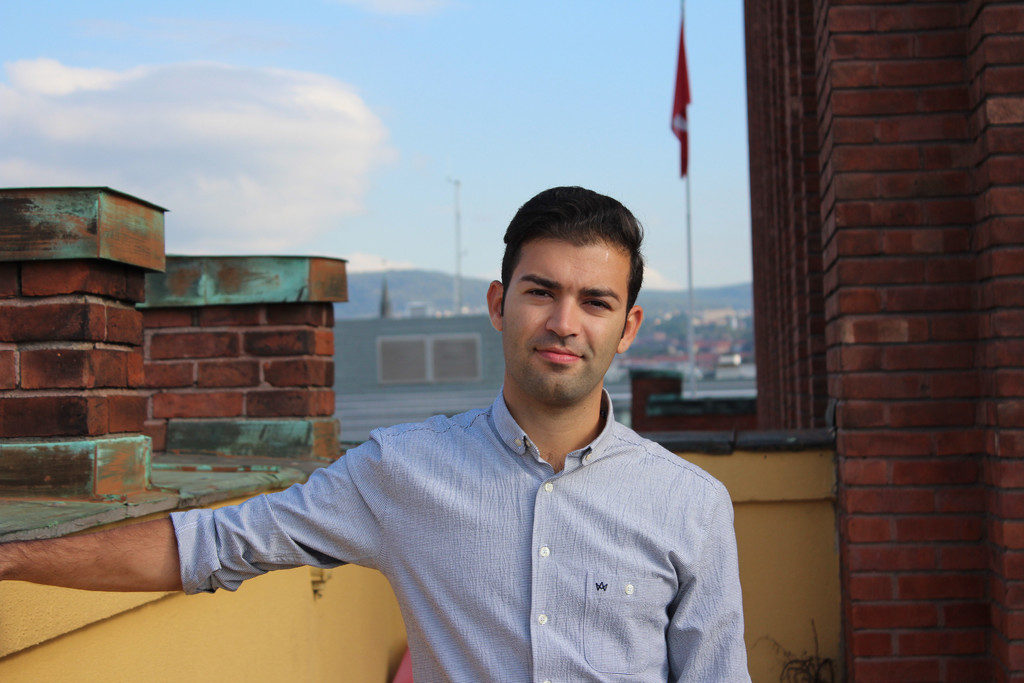
Last summer the Labor Party’s youth camp opened for the first time since the massacre, on July 22, 2011. “We would not allow that dark day to overshadow the nice and bright memories of past camps or future weekend youth meetings and social events,” said camp organizer Emilie Bersaas.
The cafe building where the Norwegian terrorist Breivik shot 13 people in 2011 has been enshrined within a new learning center by architect Erlend Blakstad Haffner.
Camp organizer Emilie Bersaas
More than 1,000 students enrolled for three days of seminars on politics last July, and private visitors included NATO Secretary General Jens Stoltenberg, a former Labor Party leader who was Norway’s prime minister at the time of the massacre.
Former Labor Party leader and Norway’s Prime Minister Jens Stoltenberg
The open windows, tilting out from the walls of a black wooden cabin, are the very same windows through which teenagers jumped, fleeing the bullets of the terrorist inside this small café building.
Blakstad Haffner has spent the last five years on the rehabilitation of the tragedy-stricken island. The biggest challenge has been finding a way to both preserve and conceal the café together with the Workers’ Youth League (AUF), which has held its summer camps on the island for the last 60 years. “They wanted to tear everything down and totally erase the memory of what happened,” he says. “It was too traumatic for them to keep any reminders.” It’s understandable that they wanted to remove all trace of the existing buildings and erect new ones.
Inside Utøya Memorial Pavilion, Norway
Today, however, the cafe building now stands like a piece of forensic evidence in this woodland vitrine, chopped and sliced in a process of architectural editing, so that only the rooms relevant to the events of that day are left standing. A piano stands in the corner – some of the victims tried in vain to hide behind it.
“This is a story of both survival and death,” explained Blakstad Haffner during an exclusive tour of the site. “Our task was to give this place a new beginning, but also to take care of the memory.”
Hegnehuset (“The safeguarded house”)
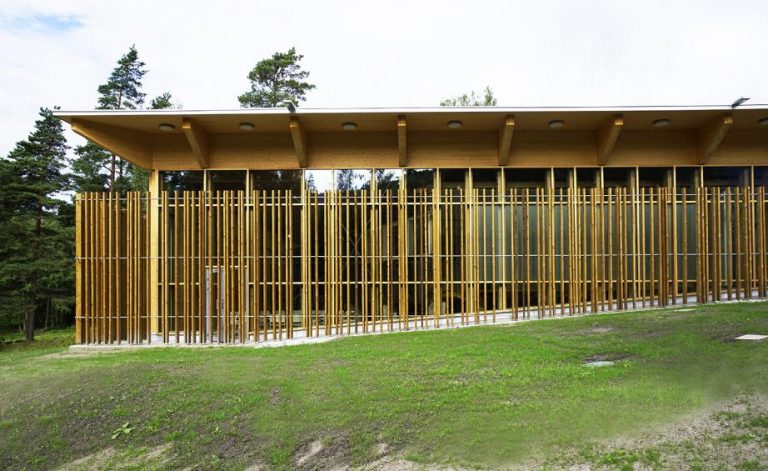
The new building, called Hegnhuset, roughly translated as “safeguarded house”, has a double-layer facade, creating a sheltered cloister around its perimeter.
A screen of 495 wooden posts marches around the outside of the building, marking the number of survivors of the attack, and forming a cloistered walkway between the outer and inner facade where 69 structural columns symbolize the number who died here.
“This is a story of both survival and death,” explained architect Blakstad Haffner
Inside, there are two levels. On the upper floor, the remainder of the cafe block appears to have been frozen in time. Bullet holes mark the walls and the furniture, while the windows left open, show where people tried to escape.
Rotated off-axis with the charged relic it houses, the Hegnhuset is aligned with a new cluster of barn-like buildings that stand nearby, providing spacious facilities for the camps and other conferences held here, in a loose courtyard arrangement. A dining room, auditorium and library enjoy lofty nine-meter high pitched-roof spaces, where tall bookshelves brim with volumes by Marx and Mandela, Tito and Trotsky – who spent the summer of 1936 on Utøya (which appropriately means “outer island”), after fleeing Stalin and winning asylum in Norway.
President of the youth group Mani Hussaini
Mani Hussaini, the president of the youth group, believes that a good balance has been found in constructing buildings and restoring old ones, describing the reopening as “an important step” for going forward after the events of 2011.
Many of the the island’s traditional red-and-white wooden buildings have also been renovated, and construction of new conference and meeting rooms has also been completed. A bright circular steel memorial engraved with the victims’ names has been given pride of place among pine trees on a secluded spot overlooking Tyrifjorden, the surrounding lake.
Author Åsne Seierstad
Also the parents of the victims, who were sidelined in these early discussions, had other ideas. To destroy the only surviving trace of the place where their children died was too much too soon. “It seems the AUF did not understand the force of grief,” said Åsne Seierstad, author of a bestselling book about the massacre, to the Guardian when the summer camp first returned to the island last year. “For traumatised young people, it was all about moving on. That mistake destroyed a lot.”
“You wander between the dead and the living. It represents those that survived that day, and who carry that memory with them every day,” said the architect.
In 2012, Breivik was convicted of mass murder and terrorism and was given a 21-year prison sentence that can be extended for as long as he is deemed dangerous to society — which legal experts say likely means he will be locked up for life.
Norwegian Prime Minister Erna Solberg
During the fourth anniversary commemoration ceremony in Oslo, Prime Minister Erna Solberg said that July 22, 2011, will remain a dark day in the country’s history for “scenes of evil and heinous acts” and that the victims are “remembered with love” and will never be forgotten. She later inaugurated a July 22 Center, which shows how the assailant carried out the cold-blooded attacks — an initiative some opposed on the grounds that it was too poignant.
The Guardian has ranked the Hegnhuset among the top 10 buildings of 2016
The Oslo Trade Union Confederation acquired the island in 1933 and later donated it to the AUF, transforming it from the holiday home of a former Conservative minister into a place where future Labor leaders would cut their political teeth.
Utøya Memorial Pavilion, Norway, written by Tor Kjolberg
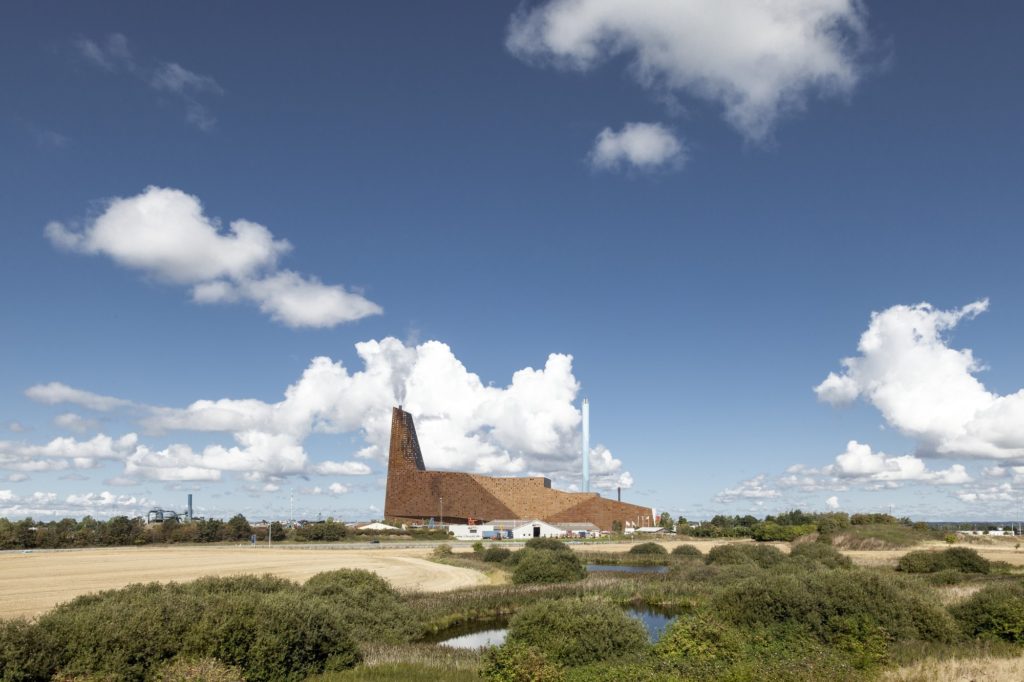
The city of Roskilde in Denmark has constructed a second towering landmark, beside the UNESCO world heritage Cathedral, the Energy Tower, designed by the Dutch architect Erick van Egeraat.The facility, the Twin Towers in Roskilde, Denmark, was inaugurated by His Royal Highness Crown Prince Frederik in September 2014.
The incineration line in Roskilde
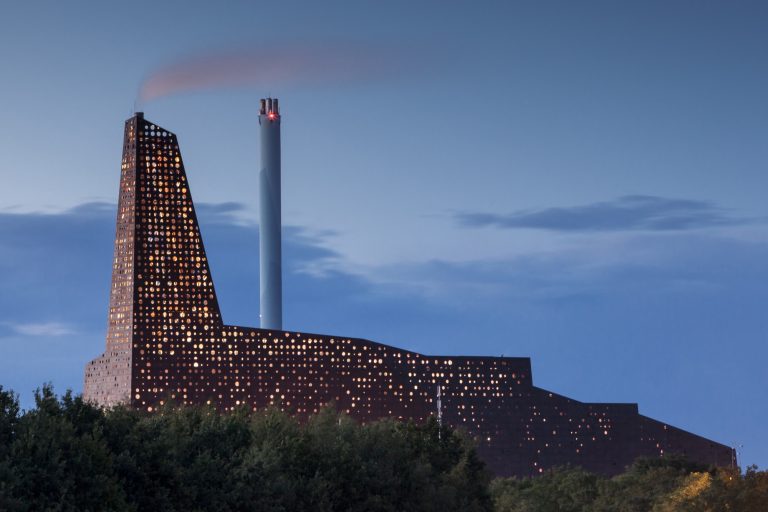
The iconic waste incinerator and power plant is a hypermodern and sustainable energy plant with a spotty perforated façade that lights up at night as if there’s a fire burning within.
The plant incinerates waste from nine surrounding municipalities and from many places abroad to produce electricity and heat power for the whole region of Roskilde.
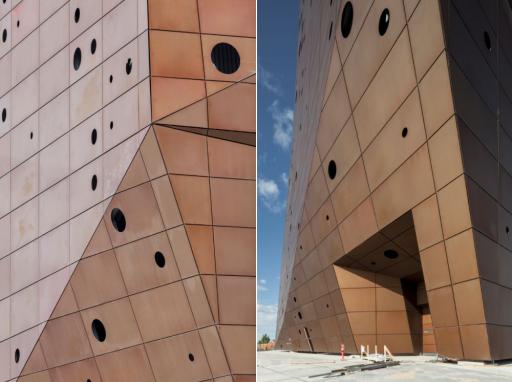
The energy tower in Roskilde, details
An international design competition was organized, and in 2008 the jury selected the design proposed by Erick van Egeraat unanimously.
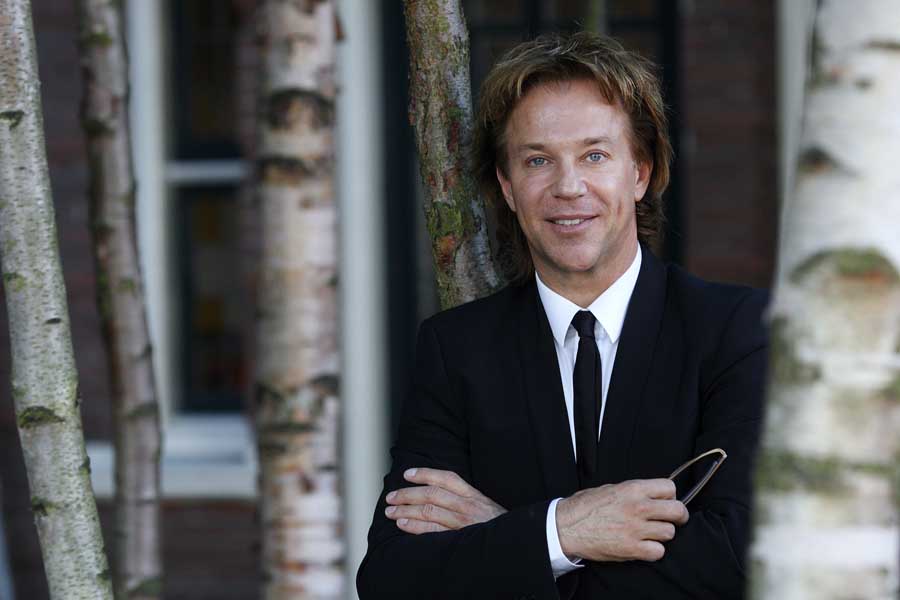
Architect Erick van Ereraat
The scale of the building – known as the Incineration Line – made it an instant landmark against the backdrop of the small city and the flat Danish landscape. The design expresses its function and the cutting-edge sustainable technology used inside to convert waste into energy.
Erick van Egeraat logo
The façade consists of two layers: the inner layer is the skin which provides the actual climatic barrier, allowing the second skin to be treated more freely – raw umber-colored aluminum plates with an irregular pattern of laser cut circular holes. The aluminum plates are treated to give them the desired color and patina at day time. At night, the programmable lighting, installed between the two facades, gives the building an additional metaphor.
“At night the backlight perforated facade transforms the incinerator into a gently glowing beacon – a symbol of the plant’s energy production. Every hour a spark of light will gradually grow into a burning flame that lights up the entire building. When the metaphorical fire ceases, the building falls back into a state of burning embers,’’ Erick van Egeraat stated about his design. For the illumination of the façade it was important that only the light and not the light sources themselves were visible.
Erick van Egeraat’s incinerator in Roskilde is created specifically to add value to anotherwise purely industrial complex.
Inside the plant
Enriching the skyline of this small Danish city, once the Danish Capital, the silhouette of the incinerator also provides an historic comment.
The stepped and angled lower portion of the building evokes the rooftops of the factories that surround the structure in its industrial setting.
A 97-metre spire towers above the landscape and wraps around the plant’s chimney, creating a contemporary counterpoint to the steeples of the city’s historic cathedral.
“Although almost 1,000 years apart, the cathedral’s twin towers made of warmly colored stone and brick, and the new iconic glowing incinerator, have now together become the novel guardians of the city’s otherwise modest presence in the Skagerak landscape,” said Van Egeraat
The Twin Towers in Roskilde, Denmark, written by Tor Kjolberg
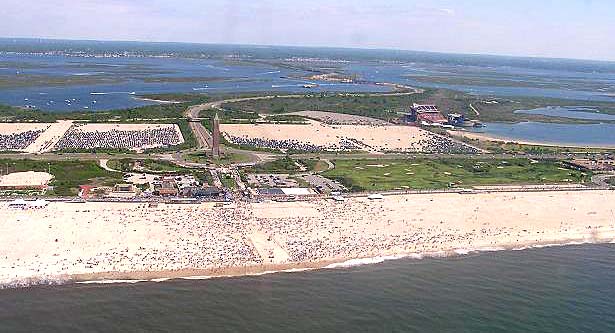
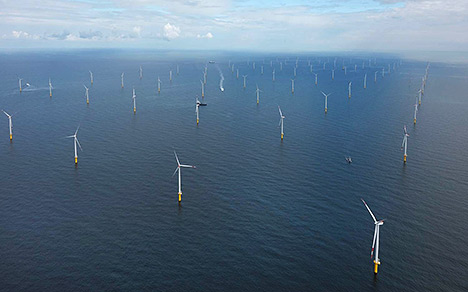
Statoil is building a huge wind farm off New York’s Jones Beach. Last December the Norwegian energy major was declared the provisional winner of the U.S. government’s wind lease sale of 79,350 acres offshore New York.
Statoil is building a huge wind farm off New York’s Jones Beach
Statoil subsidiary Statoil Wind US LLC will pay out $42 million for provisional rights to develop wind energy off New York — by far the biggest play yet for a wind lease in U.S. waters. The project aims to provide clean electricity to New York City and Long Island. Statoil said it submitted the winning bid during the online offshore wind auction concluded Dec. 16 last year by the U.S. Department of the Interior’s Bureau of Ocean Energy Management (BOEM).
Statoil must pass federal agency reviews before it can open a one-year preliminary lease — and a hearing in U.S. District Court, where a Feb. 8 date has been set to hear commercial fishermen’s motion for an injunction against the lease.
Winds off the coasts of the United States are so dependably strong that turbines built offshore could produce four times the amount of electricity that’s currently generated from all sources in the country. Located 11.5 miles south of Jones Beach, N.Y., on Long Island, the New York Wind Energy Area is a triangle of 79,350 acres on the sea floor, wedged between two busy shipping lanes for New York Harbor, covering water depths between 65 and 131 feet.
The lease comprises an area that could potentially accommodate more than 1 GW of offshore wind, with a phased development expected to start with 400-600 MW.
“We now look forward to working with New York’s state agencies ,” said Irene Rummelhoff, Statoil´s executive vice president for New Energy Solutions
“We are excited to have submitted the most competitive bid in a highly attractive project, Statoil’s first offshore wind lease in the United States. We now look forward to working with New York’s state agencies and contributing to New York meeting its future energy needs by applying our offshore experience and engineering expertise,” said Irene Rummelhoff, Statoil´s executive vice president for New Energy Solutions.
“We will work closely with the New York State Energy Research and Development Authority (NYSERDA) on these studies and throughout the permitting process, and in connection with power offtake options,” Rummelhoff added.
“We have seen robust competitive interest for this auction,,” said Abigail Ross Hopper, director of the federal Bureau of Ocean Energy Management
“We have seen robust competitive interest for this auction, as evidenced by 33 rounds of bidding — the most we have seen for any of our lease sales to date,” said Abigail Ross Hopper, director of the federal Bureau of Ocean Energy Management in announcing the sale. “BOEM will continue to work with the members of out New York Intergovernmental Renewable Energy Task Force and the public on any future wind energy project proposed for this lease area.”
The $42 million commitment from Statoil is more than twice the $16 million BOEM has brought in so far with leasing one million acres for wind energy development in previous sales.
Statoil Sustainability
“The US is a key emerging market for offshore wind – both bottom-fixed and floating – with significant potential along both the east and west coasts. As today’s announcement shows, Statoil is well positioned to take part in what could be a significant build out of offshore wind in New York and other states over the next decade. This effort is in line with the company’s strategy to gradually complement our oil and gas portfolio with viable renewable energy and other low-carbon solutions,” said Rummelhoff.
New York Gov. Andrew Cuomo (D)
Before Statoil can begin construction, the firm plans to survey the waters. It’s unclear how many turbines the project will include. By 2030, New York Gov. Andrew Cuomo (D) wants to get half of the state’s electricity from zero-emissions sources.
The U.S. produces roughly 75 gigawatts of wind energy already, almost all of which comes from land-based turbines in windswept states like Texas, California and Iowa. But offshore wind, popular in Western Europe, has failed to take off until last year.
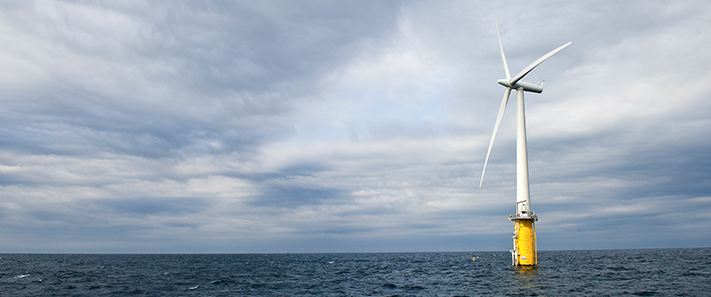
World’s first floating wind farm Hywind, Scotland
Last December, the first offshore wind farm in North America ― a five-turbine operation abutting Rhode Island’s vacation hub Block Island ― began producing electricity. The project, which took seven years to complete, marked a historic turning point for a long-stalled subsector of the renewable energy industry.
Statoil is the fossil fuel cash cow that made Norway the world’s seventh richest country. In Europe, Statoil is developing an offshore wind portfolio. Statoil currently holds a 40% share in the Sheringham Shoal wind farm in the United Kingdom, which has been in production since 2012. The Dudgeon offshore wind farm, also located offshore Norfolk in the UK – and the world’s first floating offshore wind farm, Hywind Scotland – will come into production in 2017. Last year, Statoil acquired 50% of the Arkona offshore wind farm in Germany, which will come into production in 2019.
Statoil in Germany
Statoil is an integrated, technology-based international energy company primarily focused on upstream oil and gas operations. Statoil’s Energy Ventures Fund, launched in February 2016, is one of the world’s largest clean technology venture capital funds, dedicated to the successful advancement of viable renewable energy projects.
Like Statoil, DONG (Danish Oil and Natural Gas) is a major player in the North Sea wind turbine industry, and is taking an avid interest in the U.S. market. DONG has acquired lease rights to areas offshore of Martha’s Vineyard, Mass., and New Jersey.
Europe added 114 commercial offshore wind turbines in the first six months of 2016 alone. Last year, nearly 1 out of every 3 new turbines built in Europe went offshore, according to The Guardian.