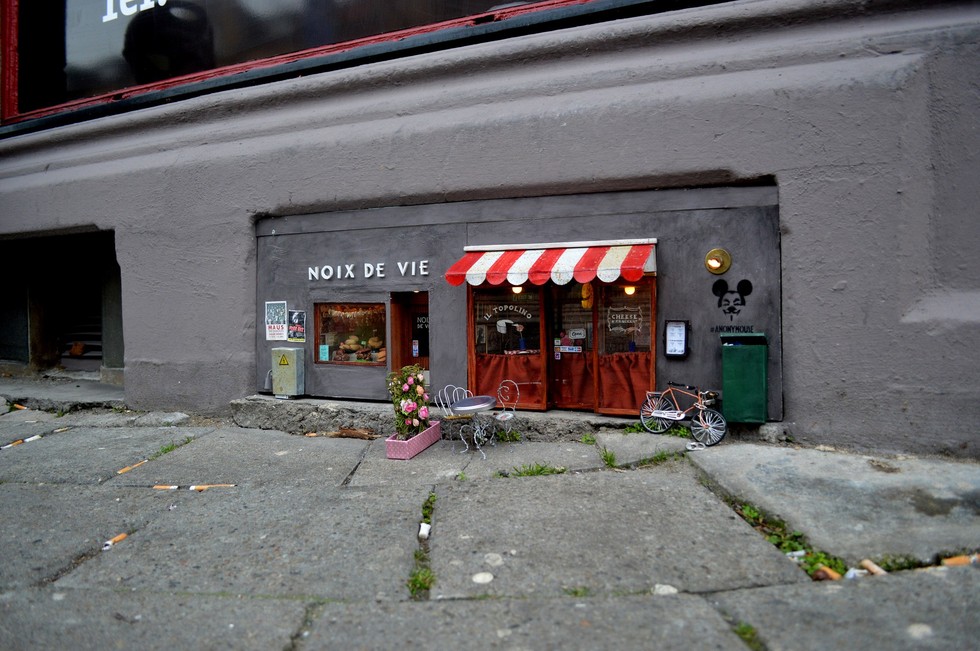
A group called “AnonyMouse” installed a mouse-sized restaurant in the base of a building in one of the streets of the Swedish city Malmö last December. The appearance of anonymous art has brought smiles to the faces of the city’s residents with this mouse-sized restaurant in Sweden.
The news about the small nut shop and cheese restaurant in Malmö quickly spread all over the world. But on a Sunday evening, the miniature restaurant for mice disappeared. But next Monday morning it was back in place, renovated.
Noix de Vie, Malmoe
According to UPI, Sweden has the classiest rodents. At least, that’s what some local artists think. The city’s residents are falling hard for the adorable scene, documenting it on social media and adding their own touches.
Anyone in the area of the intersection between Bergsgatan and Almbacksgatan in the southern Swedish city, well known for its nightlife and clubs, should pay attention to where they walk: hidden at ground level lies a French nut store named “Noix de Vie” (Nuts of life) selling a range of nuts for the city’s mice, which two Malmö residents, still unknown to the public, put up.
There are two storefronts in the display: one tiny dining spot called Il Topolino (the Italian name for Mickey Mouse) has small furniture out front, glass windows revealing brick walls inside, checkered tablecloths, and minute black-and-white photos, including a signed photo of Remy, the rat chef from the animated movie Ratatouille. The other spot in the 25-by-12-inch space is Noix De Vie, meaning “Nuts of Life,” as Curbed notes. Small plates of pistachios, almonds, pecans, and cashews fill the window display, piled underneath walnuts that hang from a wire overhead.
Noix de Vie, Malmoe. Photo: Peter Frennesson
Early Wednesday morning what was going to be the talk of the town in the south Swedish town Malmo on the street Bergsgatan, put up a little miniature nut shop called Noix de Vie and an Italian restaurant called Il Topolino, which is Italian for Mickey Mouse. The creators call themselves AnonyMouse.
“The people of Malmö seem to have taken it to their hearts and almost immediately miniature things started to show up on the scene — club posters, cheeses, all kinds of plastic animals and much more,” an AnonyMouse member told Eater in an email.
The display is made from scraps, including bottle caps, tin cans, and matches. It even includes lights that switch on inside at night for a truly romantic setting.
Noix de Vie, Photo Bjorn Lindgren
When the local newspaper Sydsvenskan reported about it, the news spread fast through social media. International media such as American Huffington Post, British BBC, German Focus and lots of others have reported about the small mouse restaurants.
“Il Topolino” is complete with a pin-sized menu attached to the wall detailing its range of cheese and crackers. There are even posters for mouse-related films, and a tiny power station and bicycle outside.
The anonymous artists have periodically been posting images on their Instagram account detailing the installation, from the construction stage onwards.
“The grand opening of Il Topolino was met with a slightly larger interest than anticipated. It’s been good fun but also resulted in a bit of a wear on the inventory, so this afternoon we were forced to shut down temporarily (there might have been an incident with a chef and some loose wiring). Anyways, we’re back again, just in time for breakfast!” AnonyMouse wrote.
And it seems there is more mysterious work planned for the future. “Without spoiling too much we can tell you that we’re working on a new scene, and in 2017 you’re going to be able to see plenty more,” the last Instagram update we spotted read.
Mouse-Sized Restaurant in Sweden, written by Tor Kjolberg
Small museum treasures may be found throughout Denmark, but the most complete and satisfying of them all us the Louisiana Museum of Modern Art, situated in a sublime spot in Humlebæk, 35km (22 miles) north of Copenhagen.
This is one of Denmark’s most lauded cultural attractions, where its director Poul Erik Tøjner gives his insider guide to its most intriguing artworks, beautiful corners, distinctly Danish features and unexpected treasures.
Louisiana Museum of Modern Art
But Louisiana Museum of Modern Art is so much more than an experience in modern and contemporary art – the property strikes a perfect balance between art, architecture and landscape. In the well-balanced style of the late 1950s’modernism, the museum presents itself as a horizontal and understated building complex that fits gracefully and intimately into the landscape.
Louisiana houses a splendid collection of 20th-century art, including pieces by Pablo Picasso, Andy Warhol, Alberto Giacometti and Asger Jorn.
Dead drunk Danes, by Asger Jorn
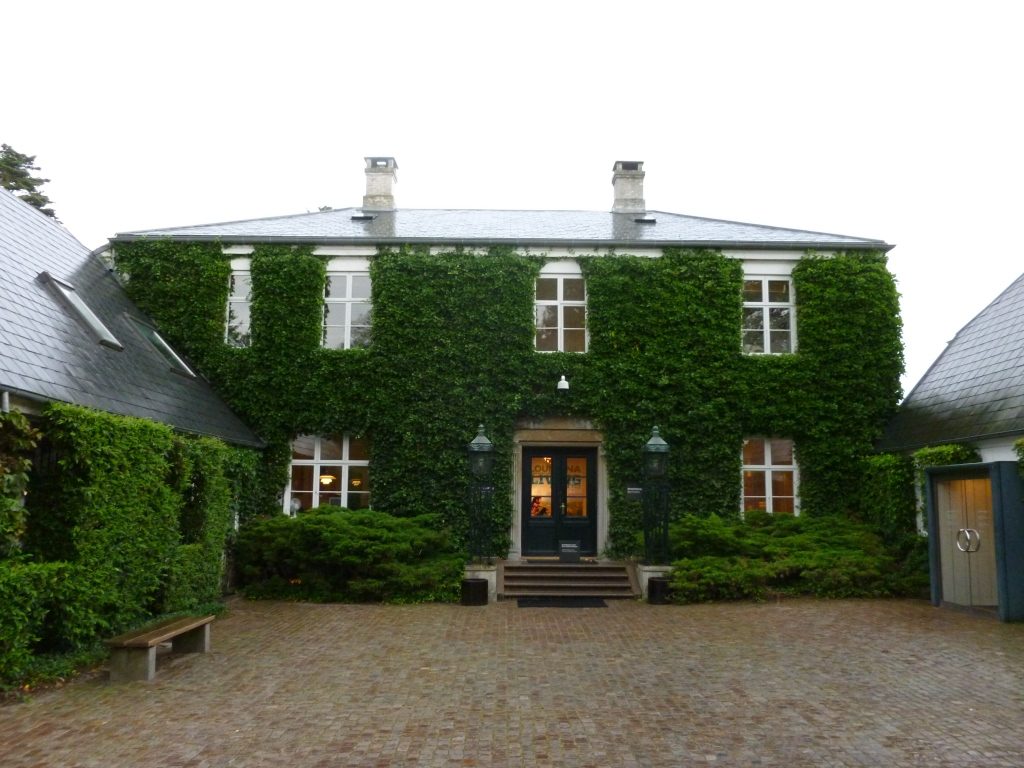
The true Louisiana experience is sensorial, seamless, personal and ultimately not really about structure at all. Every first visit here seems to be sparked by the surprise of what opens up once you have entered through the modest courtyard and old country villa. From here you just feel like meandering, discovering the unexpected and taking it all in at your own pace.
The old country villa
Louisiana is so discrete, you almost might miss it as some of the buildings camouflage themselves into the spectacular site in stealth style. It is precisely the unpretentious aspect of Louisiana’s architecture that strikes the eye on the first visit.
Reclining figures, by Henry Moore
It lies on the water’s edge, and the extensive sculpture garden, featuring work by Henry Moore and Alexander Calder, that surrounds the unassuming building (much of this space is underground)) is backdropped by exquisite coastal scenery and landscaping.
The Giacomeeti feel
There is actually no one thing you have to see here, but one should pause to reflect in the Giacometti Gallery. The collection of Giacomettis, the proportions of the gallery and the view of the lake form an artistic totality – majestic, serene and breathtaking. The Sculpture Park with its Henry Moores and Alexander Calders and view of the sea cannot be missed either.
Only a handful of museums in the world have achieved the well-tempered interplay between architecture and nature that has been realized at Louisiana.
Louisiana Museum of Modern Art, written by Tor Kjolberg
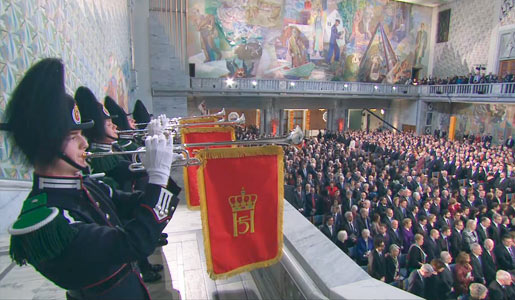
Colombias President Juan Manuel Santos was awarded the Nobel Peace Prize 2016. Three hours after the announcement, he found his place in the Nobel Field, together with all the laureates of the Nobel history.
As soon as a new Peace Prize laureate is announced, the committee starts the updating of the Peace Center’s permanent exhibitions, at first in the The Nobel Field, often named “the heart of the Nobel Peace Center”.
President Juan Manuel Santos
There, all laureates are presented on their own screen, surrounded by thousand small lights. Designer David Small is behind the concept, together with architect David Adjaye. He says the ambiance in the room is more important than the technology.
Nobel Passage by David Adjaye
“We wanted to create something timeless. Here you can meet all the Peace Prize laureates from today and going back more than a century – all in the same room – and they even speak to each other.”
Exhibition at the Nobel Peace Center, Oslo
The Peace Prize Exhibition 2016 The Wall Papers are filled with information, photos, texts, videos and animations about the Peace Prize laureates’ life and work. On five large screens, you may navigate your way through facts about the Nobel Peace Prize, the Peace Prize laureates and the Nobel system. When the Nobel Peace Center opens to the public the morning after an announcement, photos and articles about the new laureate are on display. The audience can read about Santos’ background, Colombias’ history and the peace treaty with FARC. More than 2,800 other articles, 1,500 images and hundreds of videos and animations can be retrieved and explored.
The Wall Papers are filled with information
Among those who have been awarded the Nobel Peace Prize since 1901, are some of the most significant figures in our recent history. True to their ideals, but at the same time focused on dialogue and collaboration, and of doing mankind good. Laureates like Nelson Mandela, Martin Luther King, Jr., Dalai Lama, Mother Teresa, Fridtjof Nansen, the International Committee of the Red Cross (ICRC), Albert Schweitzer and Alva Myrdal all contribute to making the Nobel Peace Prize the world’s most prestigious prize.
In his testament from 1895 Alfred Nobel instructs the executors of the will to give the Peace Prize “to the person who shall have done the most or the best work for fraternity between nations, for the abolition or reduction of standing armies and for the holding and promotion of peace congresses”.
Nobel Peace Center, Oslo
In The Nobel Chamber on the second level, you will find the magic book about Alfred Nobel’s fascinating life. Here, his experiences and inventions come to life. The book is in itself an adventure, and provides the visitors with a reading session very much out of the ordinary. There is also a lot of information about Alfred Nobel in The Wall Papers and on the Norwegian Nobel Committee’s website.
The peace cloud
As soon as you enter the Nobel Peace Center you meet the Peace Prize laureates. Hanging from the ceiling is a warm and colorful installation. The Peace Cloud is a tribute to all the unique people and organizations that have received the Peace Prize since it was first awarded in 1901. The installation consists of 1000 round discs all varying in size and color, displaying either portraits or logos of all laureates. They have been split into six different categories and each has been allocated a color.
Fotografiska in Stockholm presents a selection of 114 portraits of people who can inspire you to realize your dreams. What prompted them to take the plunge? What were they thinking and feeling? See the portraits and read the stories, from the Dalai Lama to Zara Larsson, collected by two friends who nourished a dream of collecting voices that can inspire and provide hope. The exhibition “We have a Dream” all began with a simple camera and a hotmail address.
Bertil Goransson by Albert Wiking
Having a dream is a powerful driving force. The exhibition We Have a Dream aspires to inspire everyone to dare to dream and to live out their dreams, whether it is small or big, close in time or far ahead later on in life. To dream gives strength and courage. Fotografiska presents a selection of 114 portraits of people from around the world whose stories convey the message that for those who dare to dream and want to act nothing is impossible. This is an important document of its time, showing many of the world’s most influential people, who act on the global stage – side by side with young people and everyday heroes who genuinely want to influence and change their surroundings. The common denominator is that they take a stand for their values, go against the tide and dream of creating change.
Dalai Lama, press picture
“The people in this project are proof that change is possible. With their portraits, their stories and their dreams of a more charitable world they are united on equal terms. From Lund to the 38th floor of the United Nations building in New York. From Kofi Annan to Ida Engblom in Karlstad. We Have a Dream is not a story about saints or superheroes. Nobody is infallible and they have all started with a dream,” photographer Albert Wiking (Photo on top) explains.
Malala Yousafzai / Press photo
Initiated a decade ago by Albert Wiking and Oscar Edlund, who interviewed and recruited the participants, the project We Have a Dream is about courage, humanity and human rights. Fundamentally a photo project, it reaches far beyond portraiture and commercial frameworks and was born out of their desire to do their bit for a more charitable world. Complex and countless networks and filters of contacts, agents, managers and other gatekeepers have both aided and obstructed their endless attempts to reach Nobel laureates, royalty, activists, artists, entrepreneurs and everyday heroes by e-mail. Once the question reached the right person it sometimes took years to arrive at an agreement and organize a meeting.
“We sought Malala Yousafzai and Jane Goodall for four to five years. Getting to meet many of these people is like gaining access to the Pentagon. The common denominator for all the participants is that their story touched us,” says Oscar Edlund.
Albert Wiking’s photographs are moving, inspiring and provocative. With small means he succeeds in capturing the essence of a person. The images of those portrayed demonstrate seriousness combined with a glimpse of playfulness.
Zara by Albert Wiking
“Both ourselves and the participants are convinced that art has a real potential to influence – one person at a time. Our dream is that each viewer will pass on the stories and be inspired to take action – actions that have the power to change. It is the viewer who passes on ideas that have the power to change. I think the fact that we didn’t have an organisation, a country or a prime minister behind us was an advantage. This was something that fascinated the participants,” Albert Wiking speculates.
Since 2002 they have travelled to various places to take portraits and collect inspirational stories, which have resulted in an exhibition, a book and educational materials. During the exhibition visitors will have the opportunity to share their own dreams.
“As much an exhibition about people and their stories, We Have a Dream is also about the new dreams that are born every day. Albert Wiking and Oscar Edlund have spent many years collecting portraits of people whose words and actions have left a lasting impression. Peace activists, writers, pop artists, politicians, business leaders and grassroots activists have all raised their voices in order to make a difference. However, change is a collective process. With this exhibition we want to inspire everyone to formulate and pursue their dream. Together we can try to build a better world,” says Pauline Benthede, Exhibition Manager at Fotografiska.
One of the first people who agreed to participate in We Have a Dream was the Swedish minister for foreign affairs, Anna Lindh. We all know what happened. Not long after the portrait was taken she was assassinated, but her legacy lives on. So it is for dreamers who fight to act and to make their vision a reality; if you have something important to impart and an opportunity to inspire, you exist for more people than yourself.
Among the people portrayed we find the members of the punk band Pussy Riot, Sir Bob Geldof, the musician who started BandAid, Samuel Opio who fights for LGBT rights, the Chinese dissident artist Ai Weiwei who fights for democracy, the world’s youngest Nobel Peace Prize winner, Malala Yousafzai, who is fighting for girls’ right to education, the human rights judge Navi Pillay and others such as Annie Lennox, Quincy Jones, Timbuktu, Ruby Rose, Anders Kompass, Chimamanda Ngozi Adichie and Zara Larsson.
Zara, who is very adept at inspiring and influencing others, describes her dream.
“I am primarily concerned about girls. I would, of course, like to see girls receive as much respect as boys in today’s society, to be able to decide over their own bodies, their choices and their own lives. It is a fundamental right that does not exist in many parts of the world.”
The majority of the participants were photographed in connection with the interviews which were often conducted under considerable time restrictions. Sometimes the meetings lasted no more than a few minutes.
“I always start with a question about childhood, this puts everyone in the same situation, whether you are Richard Branson or Patti Smith,” says Oscar Edlund who conducted the interviews.
Because we all have in common that we were born and that we are going to die – in between, we can dream…
We Have a Dream will be published as a book and will tour as an exhibition, and will be exibited at Fotografiska in Stockholm until 19 February 2017. The book includes educational material for young people.
Daniel Rydén has written the texts in the book.
Henrik Lörstad has created the sound installation in the exhibition.
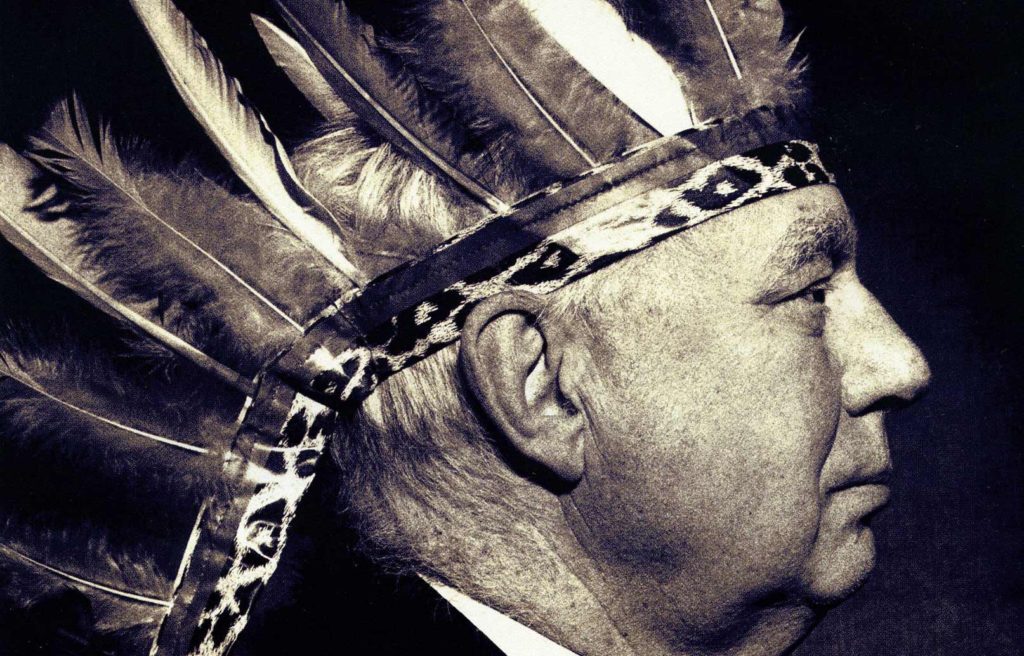
Briefly about Albert and Oscar: Albert Wiking (b. 1956). Photographer, designer and initiator for We Have a Dream. Wiking has held numerous exhibitions and published several books and is perhaps best known for the travelling exhibition and the book Eldvatten [Fire Water] (1998), on famous and unknown people’s relationship to alcohol which toured for several years to 22 cities and was seen by over a million visitors. He and Oscar Edlund are the co-initiators of We Have a Dream. Albert Wiking and Oscar Edlund have previously produced the book and the exhibition Rött – Mellan kärlek och revolution [Red – Between Love and Revolution], (2001).
Oscar Edlund (b.1979). Co-initiator of We Have a Dream. Responsible for the interviews and recruiting the participants in the project. Edlund is an organiser and event coordinator with commissions from, among others, Swedish Television, H&M, H.M. King Carl XVI Gustaf’s Foundation for Young Leadership and the Nobel Foundation.
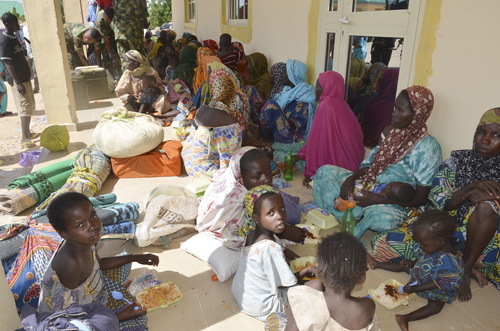
The Government of Norway has donated $11.5 million to improve basic education and support girls and women who have been victims of sexual violence by Boko Haram in the conflict-affected northeast Nigerian states of Borno, Yobe, Adamawa and Gombe, according to a statement by UNICEF.
Lake Chad population gleeing Boko Haram violence
The funding is part of the Safe Schools Initiative in northern Nigeria. In 2013, Norway was a pioneer member of the Safe Schools Initiative committee established in response to Boko Haram attacks on schools in the northeast and the urgent need to provide a safe learning environment for children.
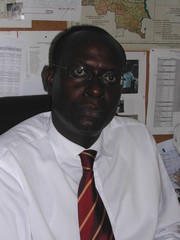
Mohamed Fall, UNICEF Nigeria Representative
“Tackling the crisis in northeast Nigeria requires a broad coalition of support from all”, said Mohamed Fall, UNICEF Nigeria Representative, “The Government of Norway was with us at the beginning of this crisis, providing support, and they are still here. This latest funding will go a long way to get thousands of children back in school and will help to reintegrate girls and women who were victims of Boko Haram back into their communities”.
“The funding will also support approximately 1,600 of the thousands of girls and women that UNICEF estimates have been raped, abducted and forcibly married as a result of the conflict,” according to the statement.
Norwegian Ambassador to Nigeria, Jens-Petter Kjemprud
“We believe in the importance of doing what we can to break the cycle of violence in
northeast Nigeria”, said the Norwegian Ambassador to Nigeria, Jens-Petter Kjemprud. “This funding will provide more children complete basic education in a good learning environment and will provide much-needed counselling for girls who have suffered unimaginable trauma at the hands of Boko Haram”, he added.
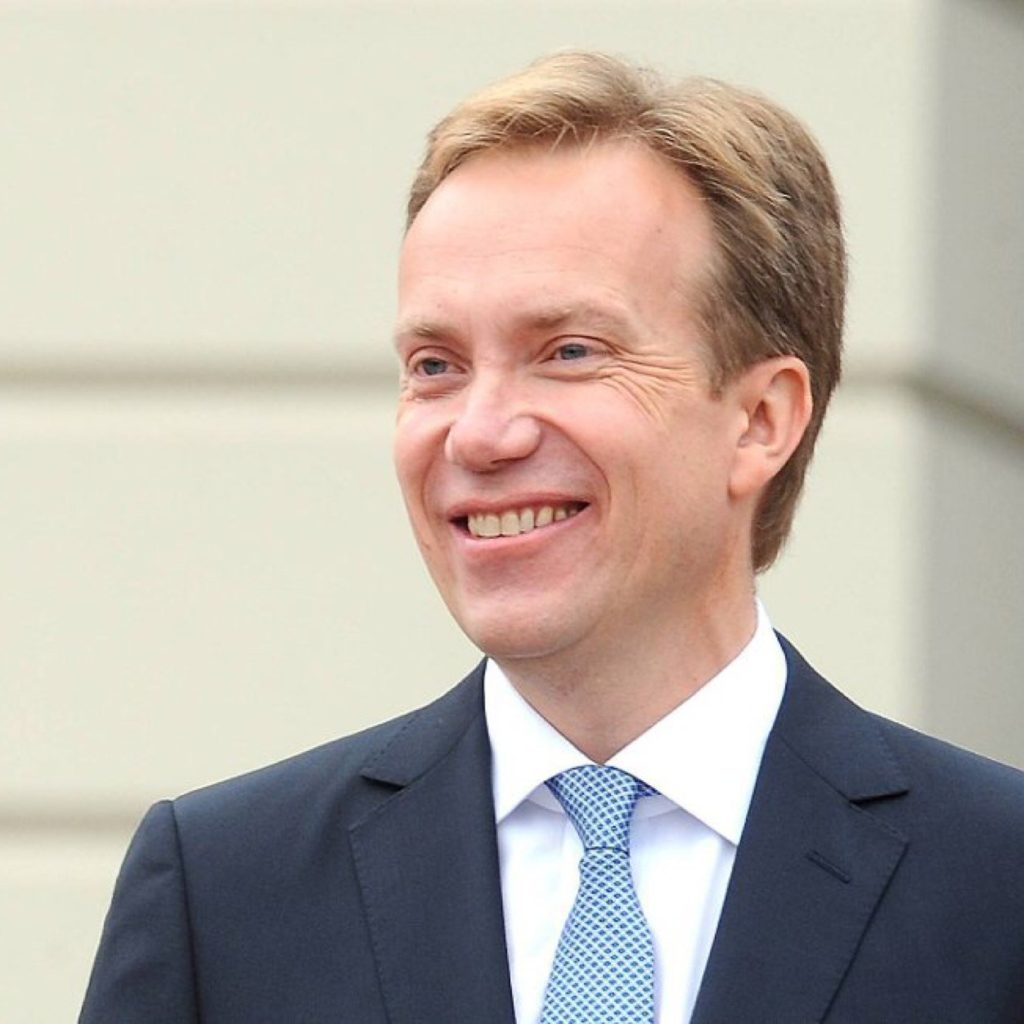
Norwegian Foreign Minister Mr. Børge Brende also attended the signing ceremony to formalize the grant.
Norway’s Foreign Minister, Børge Brende
In addition to traditional stigma associated with sexual violence, many communities are afraid that girls and women who have been held by Boko Haram may have been indoctrinated by their captors.
Mermbers of al Shabaab. Photo: NorwayNews
Now, teachers will be trained to improve their skills so they can deliver quality teaching and improve learning results for children; school systems will be improved through training and mentoring of head-teachers on management knowledge and skills. School Based Management Committee (SBMCs) members will be trained in school planning, including disaster risk reduction to make schools a safer place for children.
Nigeria’s northeast is ravaged by Boko Haram violence, which has killed estimated 20,000 people and displaced over two million.
Norway helps female victims of Boko Haram, written by Tor Kjolberg
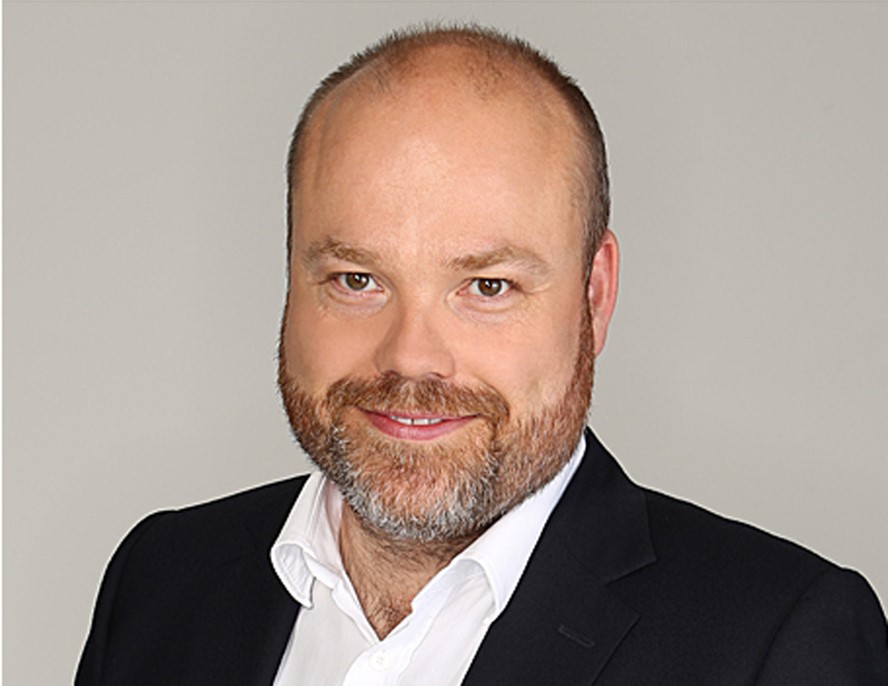
Denmark’s second richest person, the 44-year old Anders Holch Povlsen, has ever since he was on a childhood fishing trip to Scotland, dreamt to own some of the beautiful country. Today the Danish Billionaire owns 1% of Scotland.
Although Anders Holch Povlsen inherited the retail business from his father, Troels Holch Povlsen, he is solely responsible for the new heights of success he has taken the business to. With dedication, hard work and perseverance, he has become one of the most successful businessmen in Denmark.
Anders Holch Povlsen
Now owning around 1 percent of the Scottish land area means that Povlsen pwns more of Scotland than the Queen herself.
Anders Holch Povlsen took over his father’s business at the age of 28, and eventually became its sole owner and CEO. Today, with retail giants Bestseller and Zalando, he has become one of the youngest and most successful billionaires not only in Denmark, but around the world.
“Not since the Viking era has a Scandinavian taken so much British land,” wrote British Daily Mail.
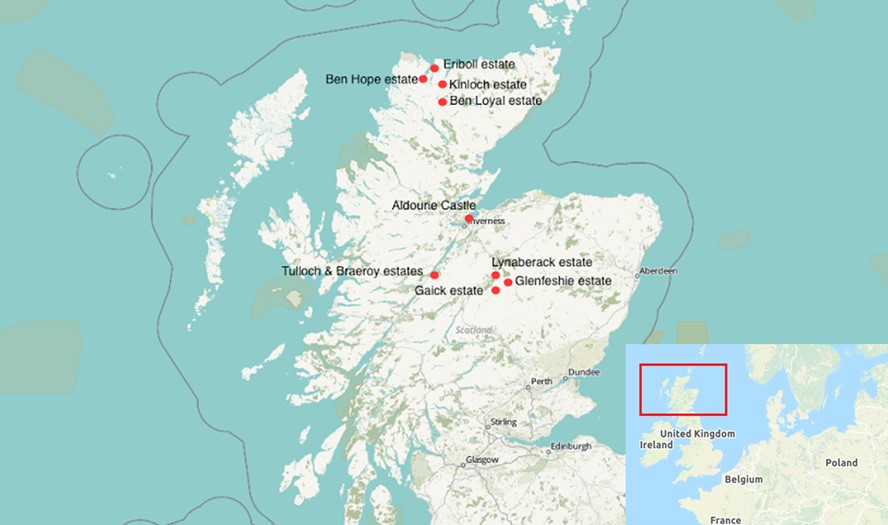
Land owned by Povlsen
Under his leadership, Bestseller became a fashion player in Denmark worth $3.2 billion. The company is dedicated to selling clothes and accessories for men, women, children and teenagers. It is operational across 46 markets of Europe, Asia, Canada and the Middle East. The company’s products are marketed under 10 different brand names, which include Vera Moda, Name It and Mamalicious.
Over the last ten years, Povlsen has poured part of his estimated $4bn earned through his clothing empire Bestseller – with holdings in brands like ASOS and Zalando – into estates around the Scottish highlands.
His company employs more than 12,000 men and women across the globe, 25% of whom are based in Denmark alone. Even after he has completely taken over his parents’ enterprise, they are still involved in its business operations, with Troels sitting on the board and his wife, Merete, as the chairman. Although Anders gained complete ownership of the company in 2012, the company’s website says that it is a family owned business.
With land holdings totaling over 218,000 acres, he is soon set to become the biggest British landowner. He is trailing the Duke of Buccleuch & Queensberry with only 7,000 acres, according to The Times.
In total, he owns 11 estates in the Scottish highlands, including 17th-century Aldourie Castle, which is the only habitable castle on the banks of Loch Ness. His most recent acquisition is the 18,000 acre Eriboll estate on the Atlantic coast.
Moyanbrenn Castle (Flickr)
In addition to the estates in Scotland, Povlsen has recently bought some land in the Carpathian Mountains of Romania, with an aim to make a wilderness reserve for surviving bears, lynx and wolves.
Feature image (on top): Aldouri Castle (press image)
Danish Billionaire owns 1% of Scotland, compiled by Tor Kjolberg
The tomte is an essential part of Scandinavian folklore. He’s a little gnome of sorts, dedicated to one home or farm, looking out for the farm animals and children of the place, pattering about by night, unseen, to check on everyone’s welfare. Astrid Lindgren has adapted a poem into a wonderful tale about the Tomten.
The Tomten by Astrid Lindgren, illustrated by Harald Wiberg
Viktor Rydberg, one of Sweden’s pre-1900 famous writers, wrote a classic poem, Tomten, about the lonely nighttime wanderings, inspections, and reflections of one tomte on a cold winter’s night, which has become a favorite Christmas piece. Astrid Lindgren, the author of Pippi Longstockings, adapted the poem in 1960, and it has turned into a lovely book, illustrated by Harald Wiberg.
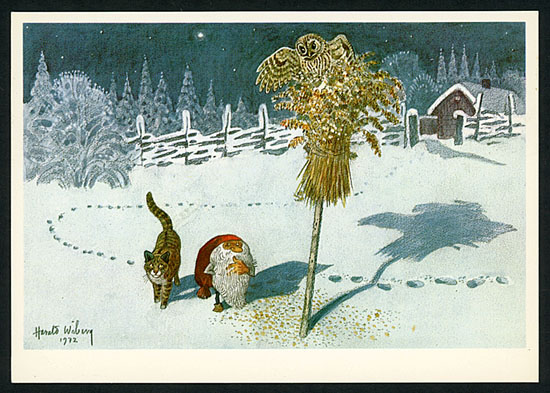
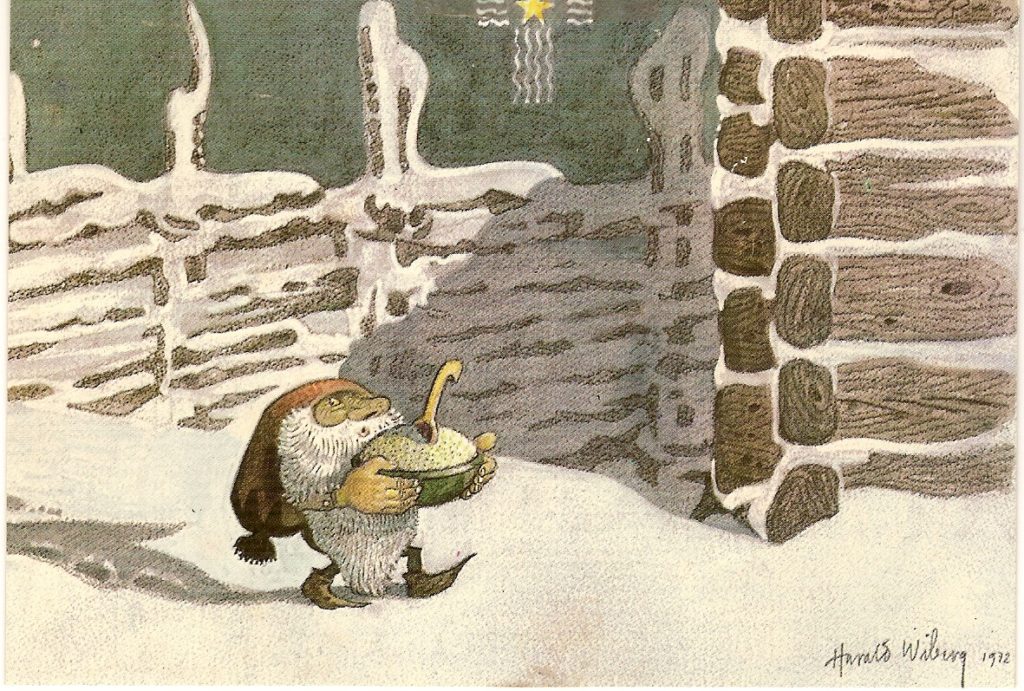
It is quite different from the poem, though it does contain the main ingredients. In the darkness and quiet of a winter’s night, this little gray fellow with his long, shaggy, white beard, slumpy, red hat, and tiny feet, silently moves about the farm. He visits each of the animals in turn, comforting them with a few kindly words in tomte language, which animals and children can understand.
Illustration by Harald Wiberg
It’s a quiet tale, with no grand story arc and actually no mention of Christmas at all, but simply a peeping in on this mysterious gnome, watching him go about his business, eavesdropping on his whisperings. A series of circumstances have linked tomtes inextricably with Christmas in Sweden, thus this has become a Christmas tale.
Harald Wiberg’s wonderful paintings brilliantly capture the frosty cold, the loneliness of the middle of the night
Harald Wiberg’s wonderful paintings brilliantly capture the frosty cold, the loneliness of the middle of the night, the quintessential tomte, the gleam of moon on snow, the warmth of this thoroughly Swedish home, the icy beauty of starlight. I remember listening to my dad read this story to me in Swedish when I was a very young child. Quite magical.
Viktor Rydberg, one of Sweden’s pre-1900 famous writers, wrote a classic poem, Tomten
Today you can easily find this book on the Internet and download it or read it online. But don’t forget to protect your laptop with a VPN for macOS like Tomten protected his farm. It is important to be cyber-secure even when searching for books online.
Astrid Lindgren wrote two books about the Tomten. The first book was simply named as The Tomten. This was the book in which the Tomten was introduced and his various antics in the farm were explained. This is a short children’s tale that features the Tomten as the central character. Children have read and reread this story because of the appeal that the Tomten exudes.
Statue of Harald Wiberg
The second book is named The Tomten and the Fox. This book is mostly an adventure tale about a fox named Reynard who gets hungry and tries to plunder a farm – the very farm that the Tomten is protecting. However, the Tomten gets wind of this plan and he does his best in order to protect all the creatures that are present in the farm. He does so quite cleverly, but then his very nature makes him feel pity for the fox. He understands that it is the fox’s nature to eat the animals that are present in the farm and his heart melts when he realizes that the fox will have to go hungry. He then makes a solution for this problem too, and sees that the fox is well-fed also without harming any of the animals in the farm.
At the Bergen Museum of Art (KODE) on the west-coast of Norway you can follow the city’s own art collection through several centuries, from the oldest paintings in the collection up to the 1900s. The exhibition is called Bergen and the World: 1400-1900.
KODE, Bergen Museum of Art
In the oldest part of the collection you can experience religious motifs, stately portraits and bustling crowds in Dutch genre paintings. Immerse yourself in magnificent depictions of Norway’s mountains and fjords in art from the 1800s – these can also include evocative scenes from everyday life.
Painting by Christian Krogh
Norwegian ‘golden age artists’ such as Christian Krohg, Harriet Backer and Frits Thaulow are represented with works that offer, among other things, realistic depictions of poor neighborhoods in Kristiania (Oslo), women’s everyday lives, woodcutters, the joys of sea bathing and lively trade at Bergen’s fish market.
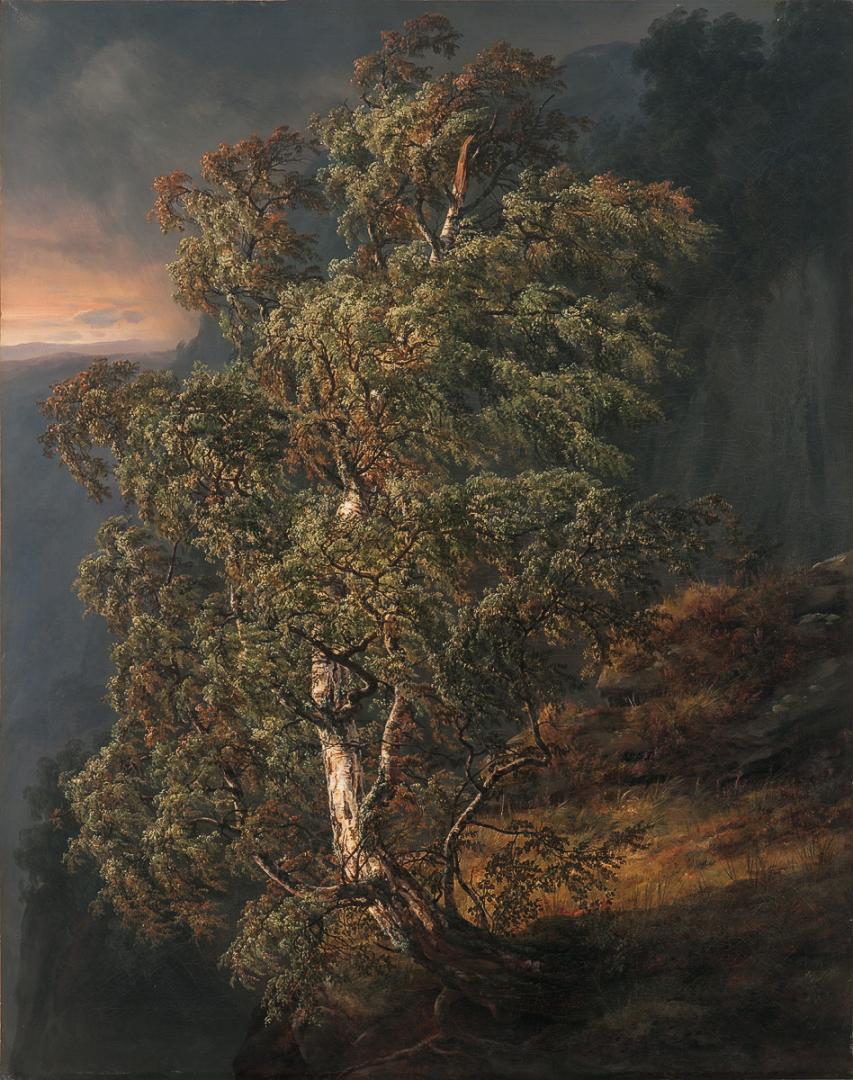
“Birch in Storm” by J. C. Dahl
A separate section is devoted to the nineteenth-century master J.C. Dahl and his students. The amazing story of Dahl, who came from a poor, underprivileged family but became a professor of painting in continental Europe, is also a story of how the Norwegian art scene came to be established after 1814. Several pictures in this exhibition are not only painted by Dahl but also donated by him from his private art collection. Dahl functioned as an advisor when the collection was first established, particularly for purchases of works from Italy, France, the Netherlands, Spain, the German-speaking regions and England – all nations with rich cultural heritage.
Painting by Lars Hertervig
The objective for part of this collection was to give Bergen’s inhabitants cultural insight and to present artists and craftspersons with superlative examples to emulate. The collection was intended to promote a European ideal of taste and to be an instrument for educating citizens and ennobling their character. Education and offering visitors first-hand experiences with art are still basic objectives for today’s museum. In this way, the legacy of the first founders of Norway’s modern institutions remains alive.
In Western Sweden you can follow in the footsteps of a Swedish crusader, the fictional Arn Magnusson, created by the Swedish author Jan Guillot.
If your fancy does not run to fighting with drawn sword or fleeing from evil forces over rough terrain, you can lean back and enjoy the historic atmosphere of one of western Sweden’s many manor houses.
Farmland at Skogholt Castle
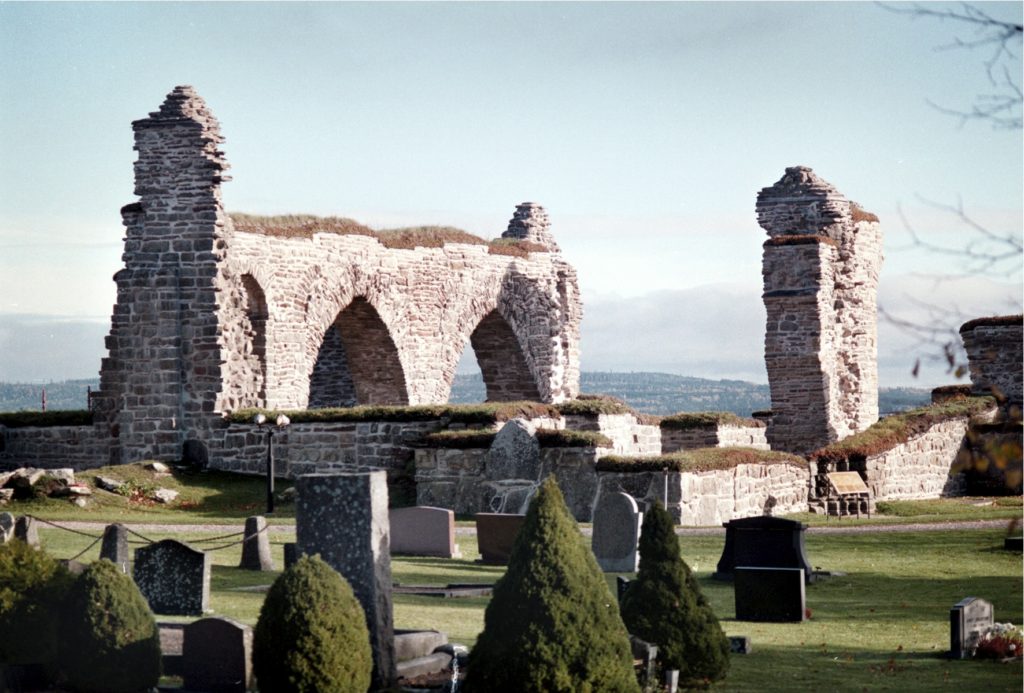
We have visited Thorskog Castle, which has been restored to its former glory. The castle has a long and exciting history, and has provided the backdrop for medial attempts to resolve hostilities between Norway and Sweden, as well as present-day international discussions.
Gudheim, Sweden
If walls could talk…
We have to go back to 1249 to glimpse the momentous events that have played out between these walls. Norway’s Håkon Håkansson, the elder and Swedish Earl Birger stayed at Torsbakke (the Norwegian name for Thorskog) and agreed what they thought would be eternal peace between Norway and Sweden.
Thorskog Castle – map
The peace treaty was linked to the marriage of two important members of the respective royal houses: 11-year old Rikitsa, daughter of Earl Birger and Princess Ingeborg Eriksdatter, and Norway’s Håkon Håkonssen the younger.
Old times at Thorskog Casrle
But there was to be no eternal peace. In 1397, Norway was absorbed into a union with Denmark that was to last for more than four hundred years. After centuries of on-and-off fighting between Denmark-Norway and Sweden, the county of Bohuslän was ceded to Sweden under the treaty of Roskilde in 1658. The castle thus became Swedish.
The current castle was built in 1892
In 1720 Olof Wenngren established an estate and built a manor house where the castle stands today. Olaf was a farsighted man, he had large dams built, which subsequently led to the construction if a power station. The current castle was built in 1892 by the estate holder Petter Larsson, and was taken over by his son Eskil and daughter-in-law Ester.
Thorskogs Castle room
Since then many owners have used the castle as a private residence.
Feature image (on top): Christmas at Thorskogs Castle
In the Footsteps of a Swedish Crusader, written by Admin
Do you believe in fairy tales? Imagine a place cradled among grand mountains, waterfalls and deep fjords. Imagine a place honoring Norse mythology and great Norwegian architecture. In Flåm, at the innermost part of the Sognefjord, Ægir Brewpub emerges, and you can enjoy Norse beer – Viking style.
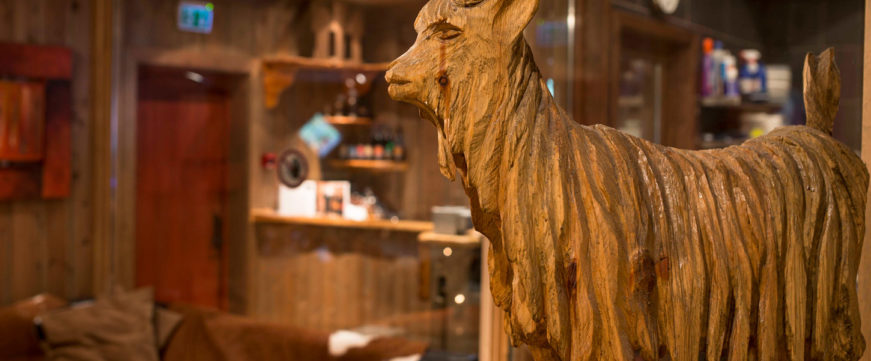
Ægir is the very own brewery of Hotel Flåmsbrygga, the Brewery hotel on the quay in Flåm. The pub is built in Viking style with dragon heads telling the saga of Thor, Odin and the Tree of Life, Yggdrasil.
Flaamsbrygga hotel
Ægir pub opened in 2007 and is now one of the best craft breweries in Norway – and one of the biggest attractions in Flåm.
Food and beer tasting at Aegir
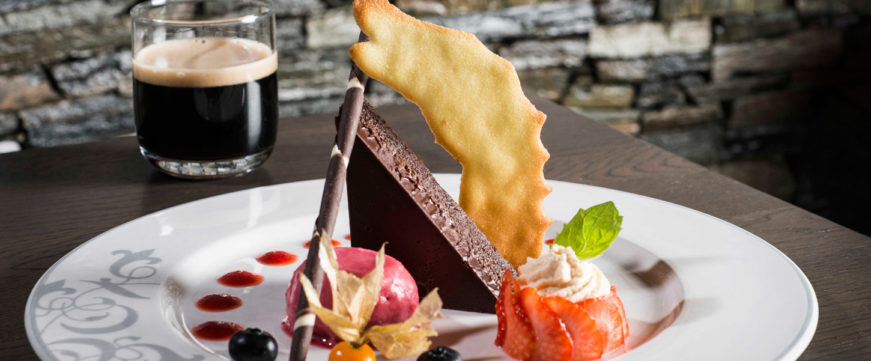
Gather around the table and enjoy a fabulous combination of local food and artisan beer. A Viking-inspired menu and a combination of beer and food that’s just out of this world truly sets this magical place apart.
Aegir Bryggeru Pub
The pub is world-class, and has won gold, silver and bronze medals in international competitions. Ægir also makes its own aquavit.
Agir Bryggeri means Aegir brewery
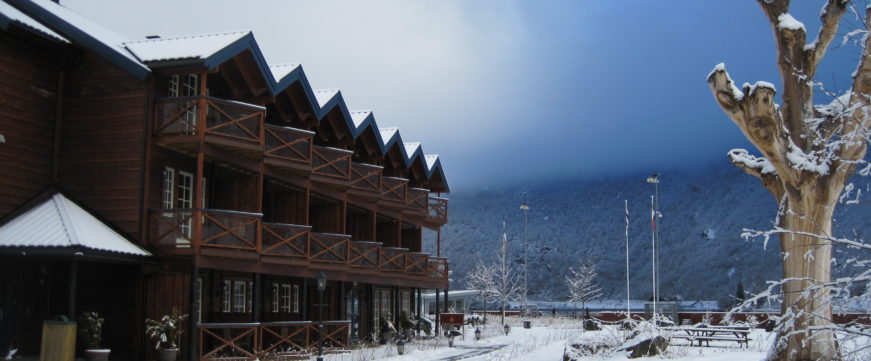
Then imagine a hotel crafted from Norwegian driftwood, stone and glass. Flåmsbrygga Hotel is your destination for leisure and business, where conference facilities, world-famous attractions and thrilling activities await.
Enjoy beer and food at Aegir Bryggeropub
Enjoy beer and aquavit tasting and Viking-inspired menus that take you on a voyage of culinary discovery 1000 years back in time.
Flaam hotel in wintertime
It sound like it’s taken out of a fairy tale, but such a place does exist. Visit Flåmsbrygga Hotel and Ægir Brewpub for yourself and enjoy once-in-a-lifetime Flåmtastic Experiences.
Norse Beer – Viking Style, written by Tor Kjolberg