Aarhus is a fine alternative to a Copenhagen weekend. The city has also been appointed European Capital of Culture 2017, but has so far kept just under the radar. Consuder a Christmas in Denmark’s City of Smiles
Aarhus was recently named “best Nordic shopping city”, and you find the best shops around Strøget, the Latin Quarter and Brunsgade / Jægergaardsgade. Take a break at one of the cafes at Åen in the middle of town.
Christmas in Aarhus
Just now you can experience the history of Christmas through more than four centuries in the Old Town Museum. Tables are set and it is beautifully decorated everywhere in the same way that it was done from the 17th century right up to 1974. In Den Gamle By you can also find a unique selection of gifts in the period shops or at the stalls, and you can take a break to enjoy traditional Danish Christmas food, sweets, goodies, and hot drinks.
Christmas shopping and dining in Aarhus
The Aarhus kitchen is, by the way, exciting and the restaurants Substans, Frederikshøj and Gastronomé have a Michelin star, while Hærværk and Pondus are listed in Bib Gourmand.
Enjoy the Christmas elves at the Mintmaster’s Mansion and try the traditional Danish Christmas rice pudding served by the elves. In olden day-traditional style, the whole family can eat from a communal bowl. The “Hele Historien” (‘Whole Story’) theatre company provides the pudding, the story, the pranks, and the Christmassy atmosphere at the Mintmaster’s Mansion. The Elf Elder will be seated in the great chair in the Tapestry Hall where he will tell the story of his long and varied life as an elf, and the children can give him their Christmas lists.
Mintmaster Mansion in Old Town
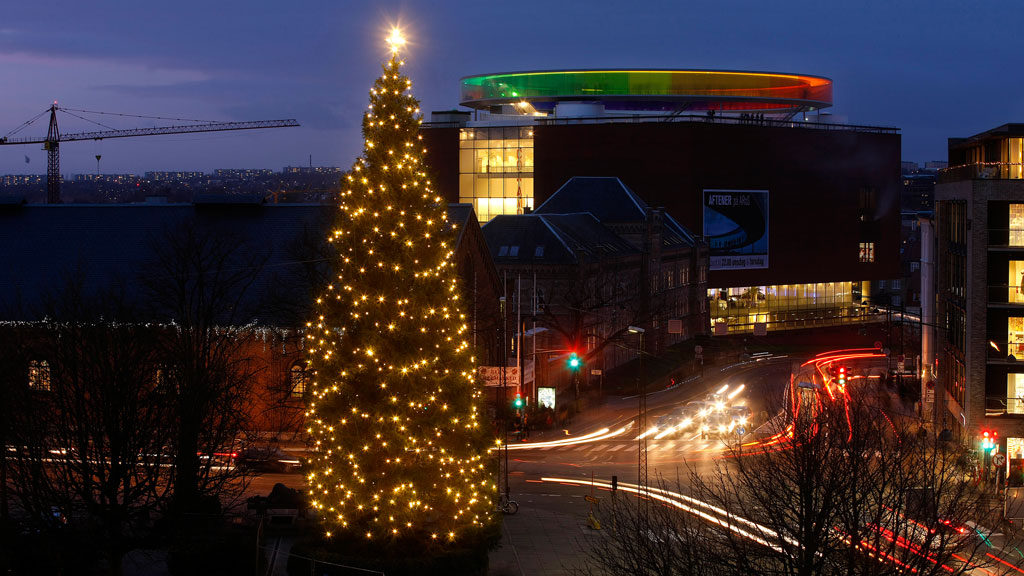
ARoS Art Museum, a cutting-edge art gallery (with a particularly excellent food hall) topped by a ring of colored glass you can walk around to view the city in a rainbow, is the biggest attractions.
Moesgaard Museum
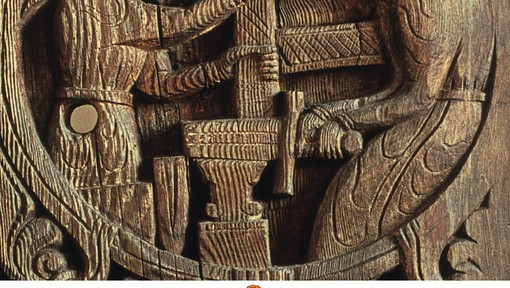
Actually, the whole city balances the old and the new in a clever but also playful way, typified by the Moesgård museum. Here you can view exhibitions on Viking history and human evolution in an arresting modernist building, designed both to evoke the layers of an archeological dig and (with its sloping, grass-covered roof) to be a great place to have a picnic in summer or go sledging in winter.
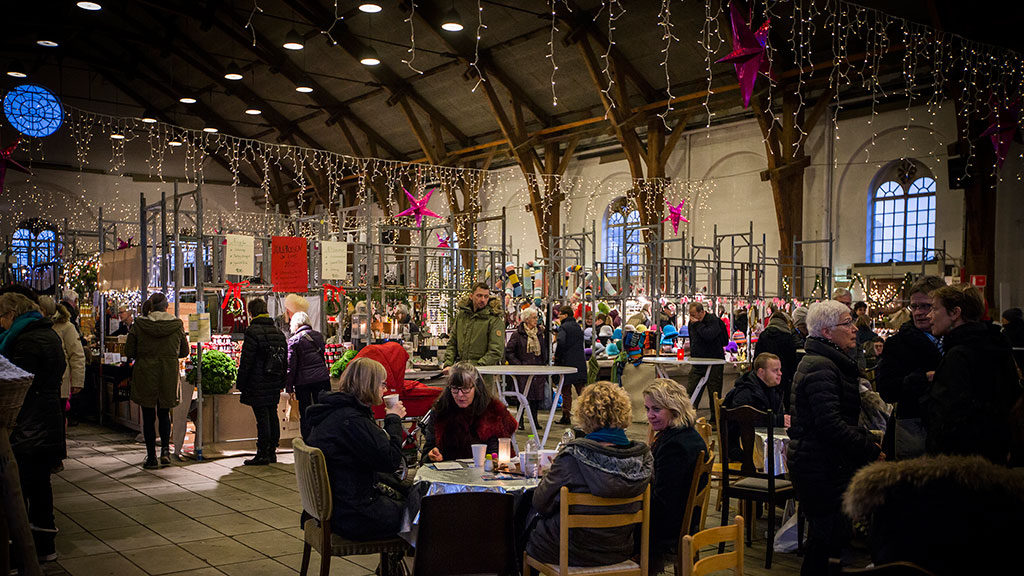
Bernstorff Market Farden
At this time of the year, you should visit the Christmas market with lots of original gift ideas. The market stalls, the handicrafts market, and the period shops are adventures in themselves and great inspirations for more out of the ordinary Christmas shopping. Here you will find things you won’t find anywhere else. You can buy anything from toys, books, the Danish-traditional Madam Blå coffeepot, wonderful posters, homemade jewelry, scrumptious cakes, and homemade schnapps. And in the Bernstorff market garden you can buy flowers and plants, apples and nuts, herbs and decorations for Christmas.
Den Gamle By is closed December 24th, 25th and 31th and January 1th.
If you cannot make it this year, know that there several cool festivals held throughout the year.
Christmas in Denmark’s City of Smiles, compiled by Admin
Sagas are stories mostly about ancient Nordic history, about early Viking voyages, the battles that took place during the voyages, about migration to Iceland and feuds between families. They were written in Old Norse language. They are sometimes romanticized, but always dealing with human beings one can understand. The Saga of the Volsungs is the first story in a series of Norse Sagas.
The saga of the Volsungs is the first story in a series of Norse Sagas.
Sigi is a man who, it is said, was the son of Odin. He went hunting with a thrall named Bredi. Siri killed him when Bredi returned with a greater kill and buried the body in a snowdrift. Was decreed murder, and he was declared an outlaw.
Odin then guided Sigi to a place where many warships lay and provided him with troops, and he became a powerful king, ruling over Frakkland (France).
Volsungs map
Sigis son, Rerir, became an even more powerful king. But for a long time he and his wife had no offspring, and they prayed fervently to the gods, asking for help. A wish-maiden assumed the shape of a crow and dropped an apple onto King Reri’s lap.
Soon afterwards the queen discovered that she was with child, and a short time later King Rerir died. The queens pregnancy continued for six years and she recognized that she could not live much longer. The child was cut from her body, and the child, already well grown, kissed his mother, and she died.
Sigurd Siegfried was the greatest hero in Germanic legend and central character of the Saga of the Volsungs
The son was named Volsung, and became King of Hunland. He married Hljod, and together they had ten sons and one daughter. It I said that King Volsung had an excellent palace built, with a large tree growing from the main hall which was named “Barnstock” (child-trunk).
A king named Siggeir ruled in Gautland (part of Sweden), and he came to King Volsung to ask for the hand of Princess Signy, who was the twin sister of King Volfung’s eldest son.
Odin Odin kidnaps Sinfj¨tis Leiche. Drawing by Johannes Gehrts 1883
One evening a stranger, probably Odin, came into the hall, wearing a hooded cape, drew a sword and thrust it up and into the trunk, saying, “I give this sword to whoever can pull it from the tree.” No one knew who he was or where he went.
One noble man after another tried to out the sword from the tree without success until Sigmund came forward and easdily pulled the sword from the trunk. Siggeir then offered to give Sigmund three times the sword’s weight in gold for the weapon.
Sigmund refused, saying, “You could have pulled the sword from the tree as easily as I did, if it were meant to be yours, but you were not able to do so.” Siggeir was angry and resolved to gain revenge against his future brother-in-law.
The next day Siggeir wanted to return to his own country, but Signy did not want to go with him. However, her father insisted, claiming that there was no sufficient cause to break the marriage contract. Before leaving, Siggeir invited King Volsung and all his sons to visit him in Gautland. A date for the reunion was set. them and warned them that King Siggeir had planned to ambush them. “Return at once and come back with a large army,” she implored her father.
Volsungs’ family tree
King Volsung and his sons visited Gautland in three ships. Signi met
King Volsung replied that he did not lack courage and that he would face whatever danger came in his way. King Volsung and all his men were killed in the attack that followed the next morning. Only his ten sons survived and were taken prisoner.
Signy asked her father to let them suffer before they should die, hoping to rescue one or more of them. The ten brothers were imprisoned by their feet somewhere in the woods.
Sigurd and Fafnir by Hermann Hendrich 1906
Each night a she-wolf attacked one of them, killing him and eating him, until only Sigmund remained alive.
Through a trusted servant Signy learned the fate of her brothers. She gave the servant some honey, instructing him to smear it on Sigmund’s face. When the wolf approached Sigmund she started to lick the honey from his face and Sigmund bit her tongue down hard. The wolf pulled so hard back in pain that she split the tree trunk apart, and Sigmund escaped.
Norse mythology, The Dice by Hardy
With the help of Signy and a few trusted servants, Sigmund built an underground dwelling in the woods, where he now lived as a free man.
King Siggeir thought that his revenge was complete, that all the Volsungs, save his wife Signy, were dead.
The Saga of the Volsungs
King Siggeir had two sons by his wife Signy, and Signy thought that they might help her avenge the death of her father and brothers. When the elder one was ten years old she sent him to visit Sigmund in his underground dwelling. Before sending him out, she tested his courage. He failed and was killed.
A year later much the same events transpired with Signy’s younger son. He too was found lacking in courage, and he too was killed at his mother’s bidding.
Signy knew a sorceress, and wanted the two of them to exchange shapes, and one night the sorceress, in Signy’s shape, slept with King Siggeir. She was very beautiful, and they shared the same bed. After three nights she returned home and exchanged shapes again with the sorceress.
The Saga of the Volsungs
Some time later Signy gave birth to a son who was named Sinfjotli. He grew large and strong, very much like the Volsung stock. When he was not quite ten years old she sent him to his father Sigmund in the underground shelter to be tested for courage.
When Sinfjotli was fully grown and properly tested, he would now, with the help of Sigmund, avenge the death of his father and his brothers. The two of them went to King Siggeir’s estate and hid themselves in an outer room. Queen Signy saw them there, and together they planned the act of revenge.
She-wolf attacking
A great battle ensued. Sigmund and Sinfjotli fought valiantly, but the king’s soldiers finally overpowered them. King Siggeir had Sigmund and Sinfjotli buried alive inside a large stone mound.
Signy managed to smuggle a sword into the stone mound, Sigmund and Sinfjotli escaped and set the king’s hall at fire. The king, surrounded by flames, asked who had done this deed, amd Sigmund answered, “I, Sigmund, and my sister’s son Sinfjotli have done this deed! Know this, that not all the Volsungs are dead!”
Sigurd and Fafnir
Signy wished Sigmund and Sinfjotli farewell, walking into the flames she said, “I married King Siggeir against my will, but now that my father’s and my brothers’ deaths have been avenged, I die with him willingly.”
Sigmund now returned with Sinfjotli to his homeland, and he regained the kingship that had once belonged to Volsung.
Sigurd, the Volsung
Sigmund married a woman named Borghild, and they had two sons, one named Helgi and one named Hamund. It was said of Helgi that he was destined to become the most famous of all kings.
While out raiding, Helgi came upon a woman named Sigrun, who had been promised in marriage to a man named Hodbrodd. However Sigrun said, “There is no king anywhere, whom I would prefer to you.”
Mythology, The Saga of the Volsungs
Helgi assembled a large convoy of men and ships just off King Hodbrodd’s coast. King Hodbrodd assembled his own troops, and a savage battle ensued. Helgi’s troops were victorious, and Hodbrodd was killed. Helgi took possession of his kingdom and married Sigrun. He is now out of the saga.
Sinfjotli continued with his raiding, and was always victorious in battle. During one of his raids he saw a beautiful woman whom he desired to have. The brother of King Sigmund’s wife Borghild was also seeking the hand of this woman, and it came to pass that he and Sinfjotli fought a duel over her. Sinfjotli prevailed, killing Borghild’s brother.
The Viking world
Sigmund returned home and drove out Borghild. She died a short time afterward. Sigmund continued to rule, and it is said that he was the greatest king in ancient times.
Some time later King Sigmund sought the hand in marriage of Hjordis, a wise and beautiful princess, the daughter of King Eylimi. Lyngvi, another king, also wanted to marry Hjordis, so her father let her choose between the two suitors.
The Volsung saga
“King Sigmund is very old,” she said, “but he is the most famous of all kings. I choose him.”
King Lyngvi did not accept this loss easily, and he attacked Sigmund’s forces with a large army. The tide turned against Sigmund and his men, and Sigmund was wounded.
The Volsungs/Tumblr
That night Hjordis came to the wounded Sigmund. “Odin no longer wants me to wield this sword,” said Sigmund to her, looking at the broken pieces. “You are carrying our son,” he continued, “and this sword is meant for him. It will be called Gram, and will serve him well.
Hjordis sat with Sigmund until he died, then she ran into the woods with a faithful bondwoman.
A large troop of Vikings had observed the carnage from their ships, and they also saw the women fleeing into the woods. They pursued the women and brought them to their leader, a king named Alf, who recognized the royalty of Hjordis.
Upon hearing her story, Alf agreed to marry Hjordis forthwith and to care for her unborn son.
Hjordis gave birth to a son who was named Sigurd. When the most famous heroes of the ancient sagas are named, Sigurd must be counted first in valor, strength, and accomplishments.
In keeping with tradition, Sigurd was placed under the care of a foster father, Regin, the son of Hreidmar. Regin taught him runes, sports, chess, and languages.
One day Sigurd went into the woods, where he came upon an old man with a long beard. The man, who was none other than Odin, offered Sigurd a horse, saying, “Raise this horse carefully, for it is descended from Sleipnir.”
Sigurd named this horse Grani.
One day Regin said to Sigurd, “You have too little wealth. Let me tell you where a great treasure lies. If you could take possession of it, it would bring you great glory. It lies but a short distance from here at a placed called Gnitaheath, and is guarded by a serpent named Fafnir.”
Then Regin related to Sigurd the story of how Fafnir came to control the great treasure.
The saga continues with the Regin’s story.
It is said that the Volsungs (Sigurd’s family) and the Gjukungs [Gudrun’s family] were the greatest people of ancient times. This ends their saga.
Source: Jesse B. Byock: The Saga of the Volsungs: The Norse Epic of Sigurd the Dragon Slayer (Penguin Classics)
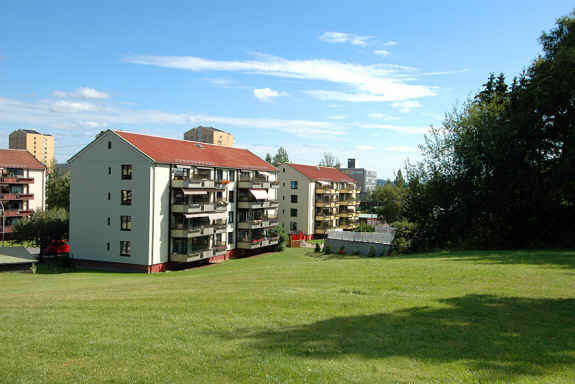
Contemporary Oslo, the capital of Norway, has an annual population growth of circa 2% and viewed in a Norwegian perspective, it is growing faster than any other city. The growth since the 1950s has made suburban Oslo a Klondike for architects.
Kalbakken
Kalbakken – typical 1950s A little gem of a fifties idyll. Low buildings and duplexes in wood. The blocks are placed in fine clusters around lawns and playgrounds. The architecture is typical of the 1950s; hushed, sober and rock solid. Kalbakken’s “cultural” center is found at Old Nordtvedt hard. The welfare state’s core buildings are closely collected; homes, schools, community centers and sports facilities.
Bøler church
Bøler – almost annoying successful
The architects Jens Selmer and Preben Krag (high-rise buildings), Sverre Fehn (community hall), Helge B. Thams (artist colony Trolltur) and USBL (low rise blocks) have ensured a varied quality suburb. The high-rise buildings in Bølerlia were rewarded with Sundt Prize for Good architecture for 1956-1957. House-seeking policemen took shovels into their own hands and built the white concrete blocks for the Police self-building committee.
Romsaas
Romsås – enthusiastic planning
Romsås is a politically correct seventies dream in the forest edge, with a little school, a community center, a courtyard, walkways and a private pond. Cars had no access, and it was like a southern village in the middle of a Norwegian spruce forest.
Architects: Romsås team, supervised by Alex Christiansen and Alf Bastiansen
Sinsen
Sinsen – Brick stones from the 1930s With its 2,600 homes and 75 commercial premises Sinsen is a small town. Between 1935 and 1939, functionalistic visions of detached blocks in parks were materialized. It is functionalist idiom, but old-fashioned plan. Functionalistic houses came after the war. Sinsen became a park town just outside the city limits; modern urban residences with bathroom, WC, central heating and electric stove.
Stovner
Stovner –quirky, large and many blocks
Architect Olav Selvaag was long considered a loose cannon in urban development and was a tireless advocate for rationalization and simplification of the construction process. Terrace blocks and pyramidal blocks are legitimate children of Selvaag. Selvaag had no high star among architects, and his terrace houses will hardly have an important place in architectural history. But when they appear in flocks, they get a peculiar monumentality.
Lindeberg
Lindeberg – prefabricated village look USBL’s yellow and red low-rise blocks and townhouses from the 70s provide a rough but not brutal combination of brushed and painted concrete. Lindeberg is like a small car-free village with low terraced houses and walkways that meander through the area. The outdoor areas have higher priority than before, and at Lindeberg not a single sandbox is left to chance.
Aarvoll
Aarvoll – tough little USBL On Årvoll’s major development area in the 1950s, USBL left craftsman-building in favor of industrial housing production, and masons were replaced by cranes. The blocks were not built by brick stones, the old fashioned way, but consisted of factory-produced wall elements. USBL was a pioneer, many years ahead of its big brother OBOS.
Mortensrud
Mortensrud – cool environment friendly housing OBOS’s box houses In Mikkelgrenda are low-energy housing. Functionalism has always been more than an idiom. In the interwar period it was all about taking the environmental challenges seriously, and it was easier to save power in a compact, cubic building than in a crow’s castle.
Vjorndal
Bjørndal – country romance in the city In the 1990s pine furniture and latticed windows were the big thing, also in the suburbs. In Bjørntun condominium at Bjorndal , OBOS built romantic, rustic small houses in red panel. Trash houses with storehouse bells are undoubtedly a new element in suburban Oslo.
Suburban Oslo, written by Tor Kjolberg
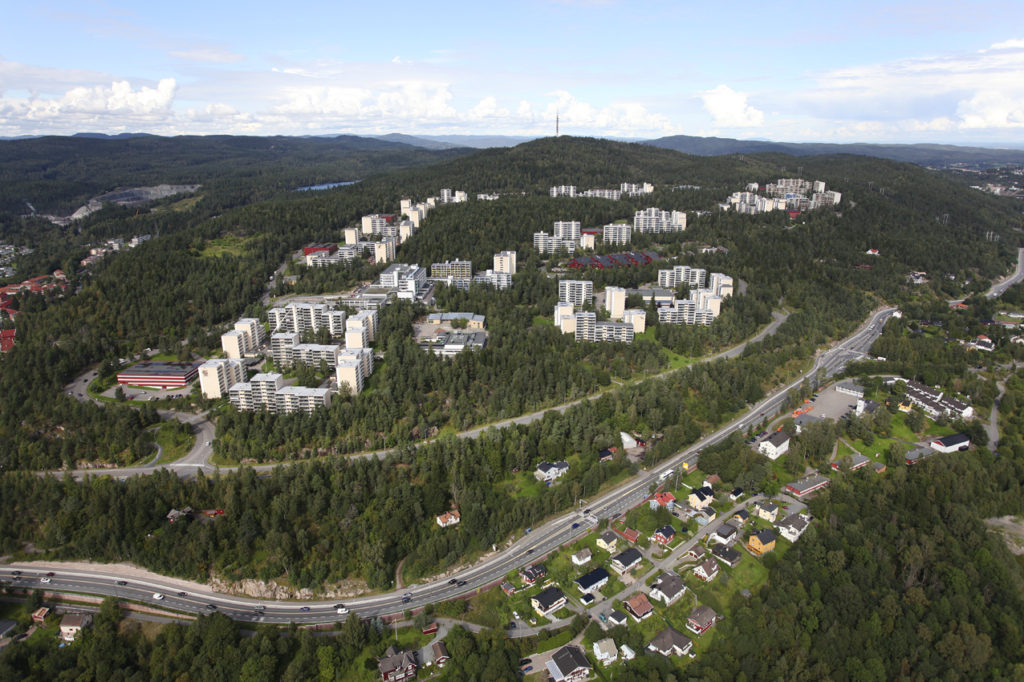
Feature image (on top): Groruddalen from the air, by Lasse Tur
A new attraction in Odense, Denmark, will do justice to the Danish fairytale author’s “great fame and completely unique fairytale universe”. Read more about the new Hans Christian Andersen Museum.
Japanese architect Kengo Kuma and Associates, who also designed the 2020 Olympic stadium in Tokyo, won the competition to design a new Hans Christian Andersen Museum in the Danish city of Odense, the hometown of the renowned author. The design will revolve around the writer’s popular fairytales.
New Hans Christian Andersen Museum by Japanese architect Kengo Kuma Kengo
Best known for works like ‘The Little Mermaid’ and ‘The Ugly Duckling’, Andersen’s fairytales have been translated into well over 150 languages. Over 140 years after his death, he remains “completely and without comparison the world’s most famous Dane” in the words of Johan de Mylius, a renowned expert on the author.
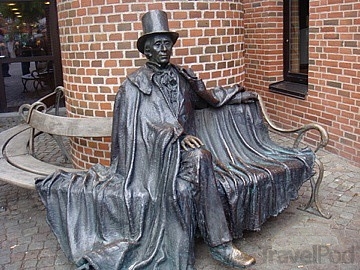
H C Andersen sulpture
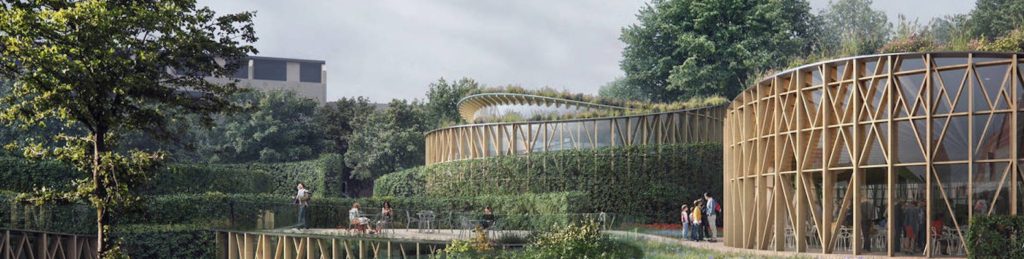
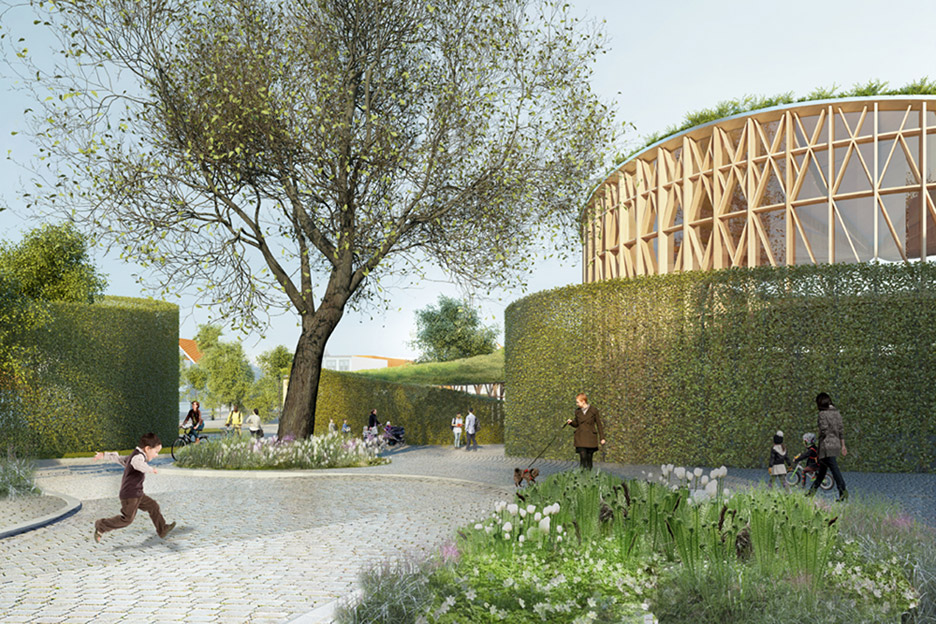
Kuma’s design for the museum features a series of cylindrical volumes with glass and latticed timber facades, and scooped green roofs.
The financing of the new museum, H.C. Andersen Museum, which totals 305 million Danish kroner (about 45 million U.S. dollars), has been completed, 225 million kroner by the A.P. Møller Foundation, 20 million kroner by the Augustinus Foundation, , while the City of Odense has donated the remaining 60 million kroner.
Kuma’s design for the museum features a series of cylindrical volumes with glass and latticed timber facades
“The winning project of Kengo Kuma & Associates is fantastic because it – like Andersen in his fairytales – uniquely manages to conjure up the big themes in the small things and to connect the local aspects with international ones: The new Hans Christian Andersen Museum adds new magic to the museum, new magic to the place – the new Hans Christian Andersen Museum adds new magic to Odense,” Odense Mayor Anker Boye said in a statement.
Odenese mayor Anker Boye
The museum will also provide a new home for Tinderbox, a children’s center that is themed around Andersen’s famous fables.
The museum will also provide a new home for Tinderbox
Although the author’s childhood Odense home already serves as the Hans Christian Andersen Museum, the new project will focus more on the author’s famous fairytales. The small yellow house, thought to be the birthplace of the writer, was opened as the H.C. Andersen Museum to document his life in 1930.
H C Andersen’s home in Odense
Two thirds of the 5,600-square-metre building will be situated below ground, to leave room for ample outdoor space including a sunken courtyard.
British exhibition design agency Event Communications is responsible for the content design of the museum.
Odense’s head of cultural affairs Jane Jegind
“Precisely the fairytale touch is lacking from the present museum, which concentrates on his personal biography. For that reason, one great wish is to create a new setting and a well-staged dissemination that do justice to his great fame and completely unique fairytale universe,” said Boyer. “I am sure that the new museum will make Hans Christian Andersen feel even more present and alive for the children and young people of the city, while I also expect the new museum to significantly boost the city’s culture tourism. Right in the middle of Odense, it will blend in with the new neighborhood that is currently being built on the old street called Thomas B. Thriges Gade,” the mayor added.
Kuma’s renderings show the upper floor of the complex surrounded by “enchanted” gardens with large trees, lawns and a circular pond surrounded by a curving box hedge. Tall hedges will also wrap sections of the building.
“It was important to us that gardens, building and exhibition design were envisaged as an interconnected whole that clearly captures the spirit of Andersen and brings out the essence of the city of Odense at the same time,” said Odense’s head of cultural affairs Jane Jegind.
The construction of the new H.C. Andersen Museum is expected to begin early 2017 and to be completed in 2020.
New Hans Christian Andersen Museum, written by Tor Kjolberg
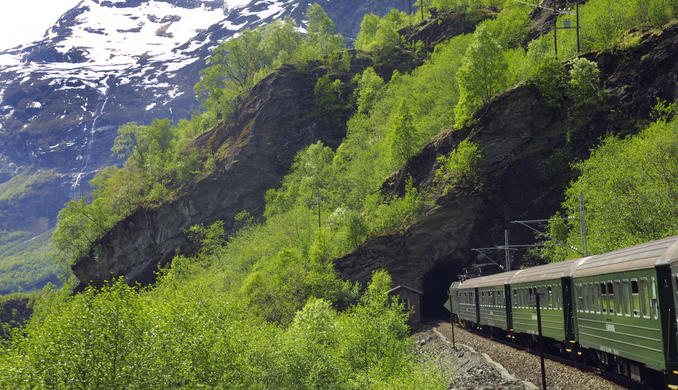
Now you can experience the breathtaking virtual train journey, The Flåm Railway, in the comfort of your own home. This is one of the world’s most beautiful train journeys and also one of the leading tourist attractions in Norway.
Flåm reilway
The 20km train ride runs from the end of Aurlandsfjord, a tributary of the Sognefjord, up to the high mountains at Myrdal Station. The journey displays the very best aspects of Western Norway’s stunning scenery. Want to test the steep railway from the comfort of your home? Now you can watch the stunning Virtual Reality video from the journey, produced by the tourist organization Visit Flåm and Expedia Norway. The video was created on the occasion of the railway’s 75-year old anniversary.
Flåm railway runs in the middle of NorwaY
By attaching a 360-degree camera on the train itself, you can from start to finish experience the wild and breathtaking mountain scenery and waterfalls from the comfort of your own home. Filmed by UK marketing agency Verve Search, Virtual Flåm is “a virtual reality train journey”, its creators say, and is also compatible with virtual reality devices to make a “fully immersive 360º video”. . It can even be viewed in virtual reality mode on a smart phone and a set of VR glasses.
Note that its creators recommend using Google Chrome or Internet Explorer to get the proper 360-degree experience.
Now wonder this beautiful trip, and one of the steepest train journeys in the world on regular tracks, is increasingly acquiring international attention. Lonely Planet Traveller named it the world’s most incredible train journey of 2014.
Take the Flåm railway from the Sognefjord to Myrdal
According to National Geographic tew 44-minute-long and steep trip is among the top 10 best train journeys in Europe.
The spectacular train ride is 20km – and comfortable
Charlotte Gogstad, spokesperson for Expedia, said: “Virtual Flåm is an innovative way to present the spectacular Flåm Railway. It has made it possible to show everyone why this specific train journey is so popular.”
World Famous Norwegian Attraction, written by Tor Kjolberg
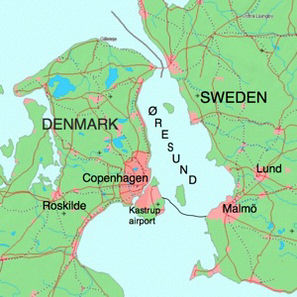
In the early Middle Ages, the sound between Sweden and Denmark was so full of herrings that the water seemed to boil. When the fish migrated in and out of the Baltic in early spring, and back again in the autumn, they were so abundant that they could be caught by hand, and were landed in thousands of tons.
The Øresund Coas
Fishing and salting stalls were put up along the shore, and the fish were salted in huge barrels and traded along the Baltic coast for salt, amber, weaponry and iron.
Øresund map
This ‘Herring Adventure’ and the commerce following it, marked the beginning of Copenhagen as the capital of Denmark, with a resident king. Previously the king had a moveable feast, going from castle to castle around the country. Even before that, fish was the staple food all along the thousands of kilometers of coast, fresh fish for shore-dwellers, dried and salted, or just plain dried, for inlanders.
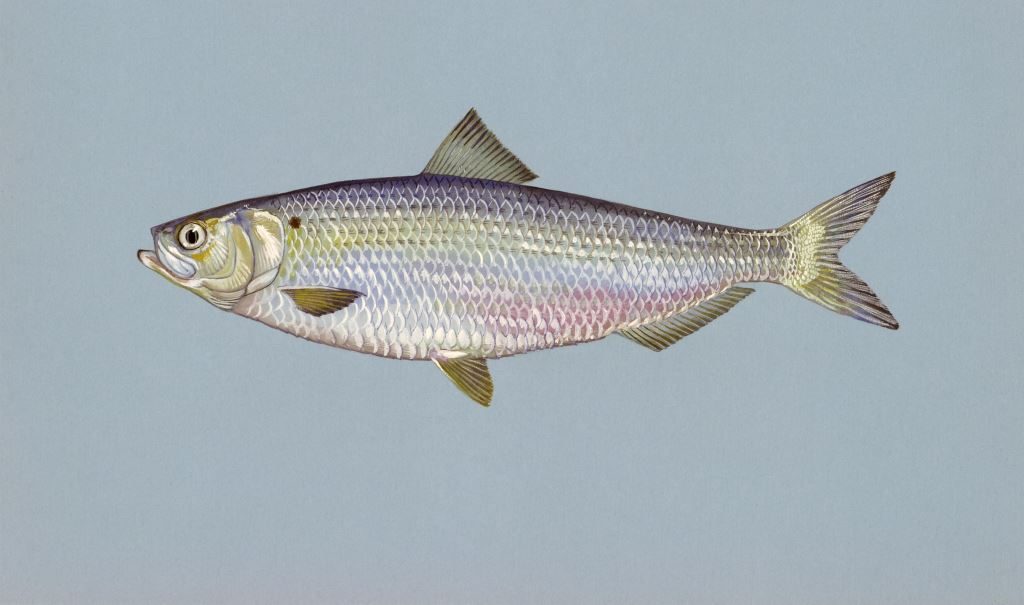
Herring
The need to make seasonal fish last during cold and unfishable winter months is the origin of the great northern tradition of preserving fish.
Scandinavian herring
Fish from cold waters have a certain delicacy; they grow slowly and their flesh becomes dense, juicy and filled with minerals from the abundant plankton, small fish and algae they feed on. Fatty fish such as herrings and mackerel have a perfect balance of essential fatty acids for human bellies, and like all other natural fed animals, slow-growing fish are much more flavorsome and easier to make into tasty meals, even if prepared very simply.
Scandinavian pickled herring
Buying and storing Fresh fish must be fresh. It is self-evident, but nevertheless true, that the beautiful experience of eating completely fresh fish is in no way comparable to eating not-fresh fish, even if it’s still technically edible. If you want to teach your children truly to enjoy fish, stay away from fish packed in a controlled atmosphere, fish imported from far away and frozen fish, and find a fishmonger that you can trust.
Herring apocalyps
The difference is huge, if elusive, but it can be detected with every sense you have, and especially when you are very young – fresh fish is a joy, not just food.
Sweetness, juiciness and firmness diminish dramatically and very quickly as fish ages. Eat your fish the day it is bought, and keep it in the fridge until ready to prepare. When kept at 0C it will keep 10 times longer as when kept at 5 degrees C, so get some ice with it, if you can, and go straight home from the fishmonger.
Swedish sour herring
Culinary uses The traditions are, in fact, very simple. Fresh fish are simply tossed in rye flour and fried in butter, grilled, boiled in salted water or baked in the oven. The accompaniments are effective, if not varied: horseradish, capers, mustard, lemon or vinegar, parsley, dill, butter and potatoes. Felicious if the fish is fresh; the sharp notes set off the mild taste, the butter acts as a sauce, and the herbs add color and a subtle freshness.
The Scandinavian Herring Adventure,Written by Tor Kjolberg
The festive season is here and if you’re still feeling a little Bah! about it, there’s still plenty to enjoy in downtown Oslo.
Torggate Christmas Street
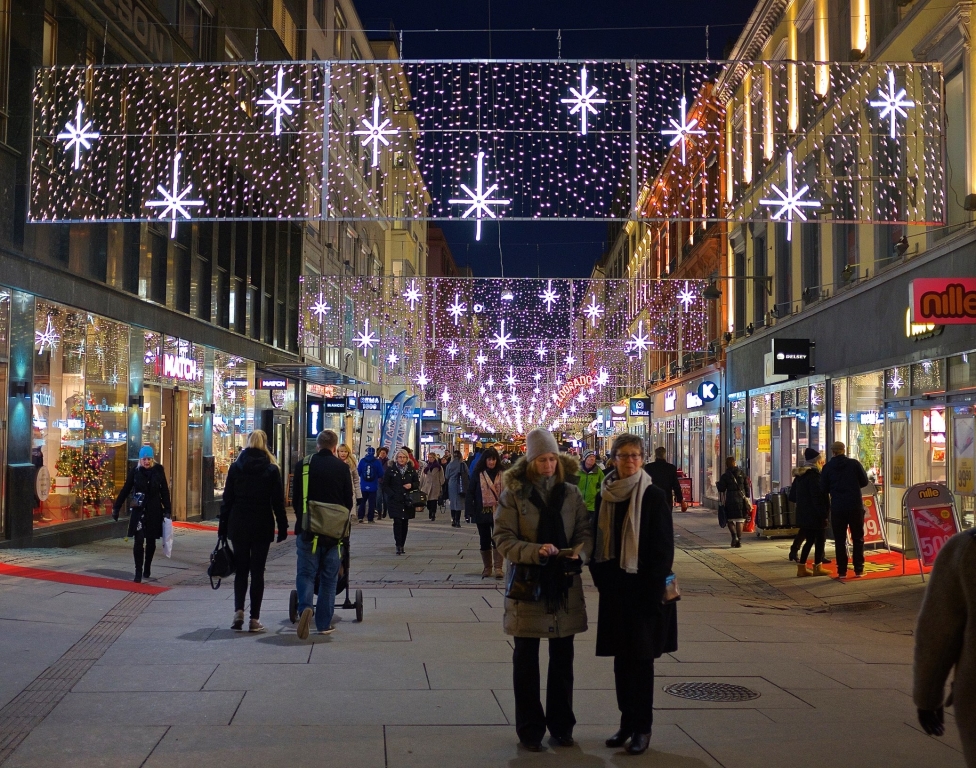
Christmas streets, like the one in Torggata, downtown Oslo, are perfect for lifting the spirits, and the city is beautifully adorned with holiday decorations in many places. The typical symbol of the holiday season is the lit Christmas trees. The biggest Christmas market is right in the center at Spikersuppa (The Nail Soup), for adults as well as children, where you can buy presents and enjoy food and drinks, Christmas delicacies, Christmas decorations and arts and crafts.
From the Christmasmarket at Spikersuppa
There’s also carousels to keep youngsters entertained. Stay warm with Norwegian mulled wine (gløgg), grilled sausages and marzipan sweets.
Christmas decoreated Gladmagasinet at Youngstogret
Get your skates on at the Spikersuppa Ice rink between the National Theatre and the Parliament. It’s open every day in winter until February/March and is free for everyone. You can bring your pwn ice skates, or rent a pair from the pavilion next to the rink for NOK 100 per day.
Christmas decorated tramcar in Oslo
Ice skating rink between the National Theatre and Parliament, open every day in winter (November/December–February/March). Use of Spikersuppa is free for everyone.
Christmas lamp in Bogstadveien
Also at Youngstorget there is a Christmas marked, filled with stands and tents, lit and decorated. for Christmas.
From Valkyrien Square
Before Christmas, everyone rushes to buy presents so that all their loved ones will have at least one small surprise under the Christmas tree.
From Valkyrien Square – 2
Just outside the city center, you’ll find Oslo’s Oxford Street (Hegdehaugsveien and Bogstadveien). If you begin your walk from Majorstuen and Valkyrien Square, you’ll approach the Royal Castle Garden, which you can walk through and arrive just at Continental Hotel decorated with beautifully lit Christmas trees.
Count the Christmas trees at Hotel Continental
Oslo has a fantastic selection of stores and malls where you can shop till you drop, including several shopping malls. It will be busy, so try to plan what you’re doing and where you are going. Take a list of what you need to get and find time to head for a coffee shop for a sit-down so you can recharge before heading back into the crowds.
Christmas at Stortorget (Grand Square)
On Christmas Eve, December 24th, the whole family eats a special holiday meal together. The menu in Oslo traditionally includes ‘ribbe’. The Ribbe (roast pork rib) is a classic on the Norwegian Christmas table. The rib, which is actually a whole side of pork rather than just spare ribs, is very rich and juicy and is therefore served with equally rich and juicy trimmings: Cowberry sauce, sauerkraut, potatoes, thick gravy, Christmas sausage, apples and prunes.
Christmas decoration in Oslo
After dinner, the family gathers around the festively lit Christmas tree to sing carols and open gifts. Christmas in Oslo means plenty of concerts, exhibitions and other cultural events, and if you’re lucky – snow.
Christmas in Oslo is celebrated in most of the city and the holiday is the most anticipated by Norwegians who have passed down its simple traditions from generation to generation.
Christmas Mood in Oslo, was created for you by editor-in-chief Tor Kjolberg and photographer Jon-Arne Foss
Two Norwegian architect companies gain international attention for their plans for one of the biggest airports in the world, Istanbul New Airport.
A trio, consisting of one British and two Norwegian architect companies, has been appointed to design the first phase of the terminal, which is scheduled to open in 2019.
Istanbul’s gigantic new hub will have six runways, the world’s biggest duty free shop, flights to 350 destinations, Europe’s largest car park, with 24,000 spaces, and a capacity of 150 million passengers, when it is fully operational by 2028.
The new airport is located on the black sea, 35 kilometers outside of Istandbul
Located on the black sea, 35 kilometers outside of the Turkish city, the project is on track to become the world’s largest airport terminal, with a gross floor area close to one million square meters.
Istanbul New Airport, the name given to the project so far, will have four phases, the first aiming to serve 90 million annual passengers.
Istanbul New Airport Haptic entrance visualized in wintertime
Despite its enormous scale, the building retains a human scale throughout with an expansive central plaza and a traffic forecourt, which serves as a hub integrating rail, metro, bus and car transportation. Project bosses are thereby aiming to simplify passenger flow with spacious terminals, ‘comfortable’ walking distances and new technology.
New air traffic control tower
Grimshaw partner, Andrew Thomas commented, “We are delighted to have been appointed to this bold and aspirational project. We share the consortium’s ambitions to develop a truly outstanding airport design worthy of the world city of istanbul.”
Pn site from left to right: Thomas (Haptic), Andy (Grimshaw), Gudmund (Nordic)
“We are glad to be able to respond to the high demands of the client and create an exceptional solution, both in terms of functionality and architecture,” added Gudmund Stokke principal partner of Nordic.
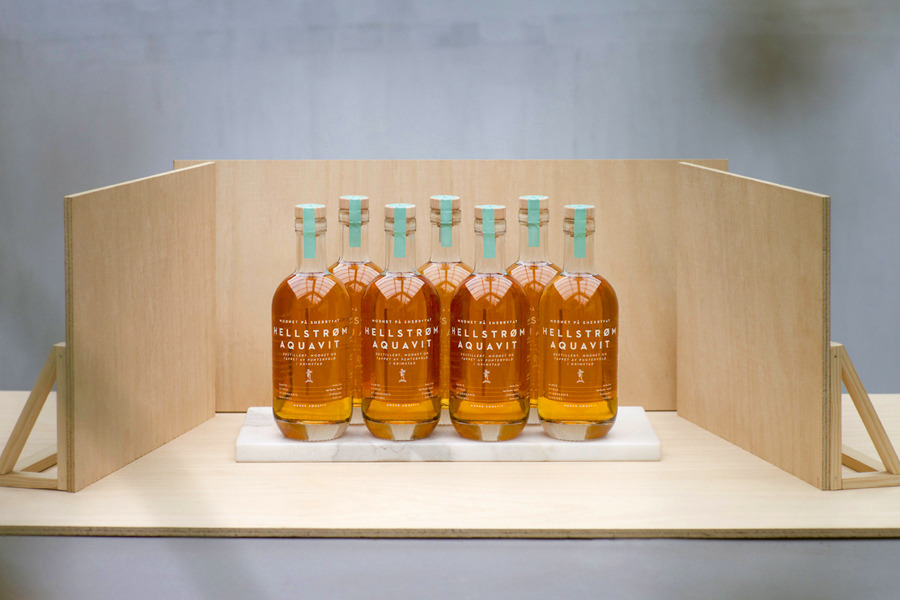
Norwegian Chef Eyvind Hellstrøm was part owner of the two stars Michelin restaurant Bagatelle in Oslo and president of the Bocuse D´Or Europe, but also a TV personality, who in 2013 developed his own aquavit. The Norwegian-Italian design company Olssøn Barbieri was asked to design the bottle.
Oivind Hellstrom wuth his Christmas aquvavit and Christmas gloggHellstroem Christmas Aquvavit
By the end of December same year, when Christmas-time was approaching, a new chapter was added to the Scandinavian assortment of liquors.
Aquavit has for a long time been a part of Norwegian traditions and it is usually consumed on special occasions and national holidays, such as Christmas and the 17th May (Norway’s constitution day). The name stems from Latin, ‘Aqua Vitae’, meaning ‘the water of life’.
In modern times Christians is celebrated all over the world. It is believed that this date was chosen to offset pagan celebrations of the Winter solstice, occurring in the northern hemisphere during the coldest season of the year. Although winter was regarded as the season of dormancy, darkness and cold, the coming of lighter days after the winter solstice brought on a festive mood. The return of light (life) was a reason to celebrate that Nature’s cycle was continuing. At this time, the animals for slaughter were the fattest, flour had been processed, all the work of autumn was completed, and it was time to celebrate.
Hellstroem Christmas Aquvavit 2016
The ‘Primstav’ is an ancient Norwegian perpetual calendar stick. After Lutheranism was introduced into Norway this calendar changed its function and became agricultural almanacs, where the signs representing the Catholic saints acquired new meanings, now related to housekeeping and agriculture.
What differentiates Norwegian aquavit from that of its neighboring countries, Denmark and Sweden, is that it is based on potatoes and not grain, and it is matured in oak sherry barrels
What differentiates Norwegian aquavit from that of its neighboring countries, Denmark and Sweden, is that it is based on potatoes and not grain, and it is matured in oak sherry barrels.
Hellstroem Christmas Aquavit
Aquavit can be both clear and golden, and generally has an alcoholic volume of around 40 %. The main spices used are caraway and dill. There are many varieties of Norwegian Aquavit. The different types depend on the spices used for flavoring, the length of its maturity, and the barrels within which they are stored.
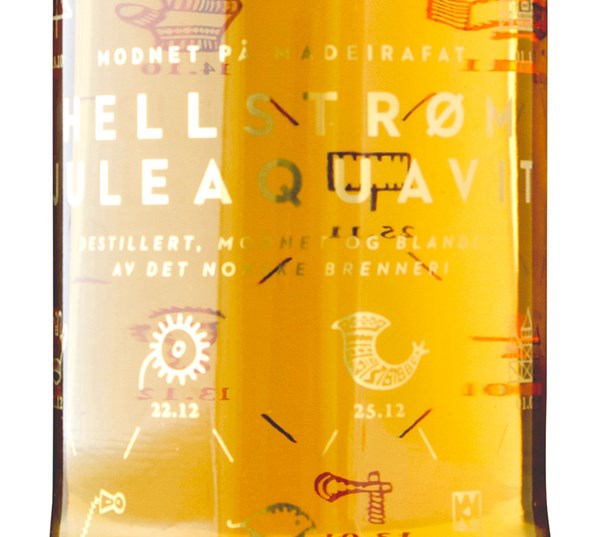
Hellstrøm’s liquor, named Juleakevitt or ‘Christmas Aquavit’, reaffirms the ancient Norwegian symbols with former glory as they are enameled in gold on the bottle. The symbols on the bottle are loaded with century-old wisdom in the form of a pattern transmitting both a festive mood and a vast heritage connected to nature, farming and conviviality. Hellstrøm’s Christmas Aquavit is stored in sherry barrels for at least 12 months, and is a well-rounded aquavit.
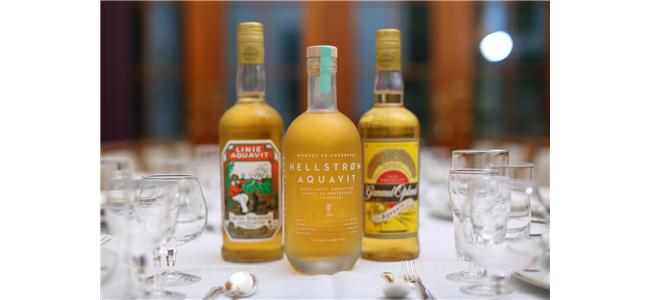
Three popular Norwegian aquavites
About the bottle designers
The multidisciplinary design agency, Olsson Barbieri was founded in 2005 by Henrik Olssøn and Erika Barbieri, specializing in brand identity and packaging design with particular focus on wine/spirits, luxury, fashion, culture and art industries. Founded with the intention of working independently and without compromises in regards to conceptual development and quality of execution, the company evolves by pursuing new standards of design through research and experimentation. The company´s projects range from brand creation, visual identity, illustration and packaging design to brand design strategy and creative direction. At Visuelt 2013 the beautiful Hellstrøm Aquavit bottle was awarded the Gold price.
Norwegian Christmas Aquavit, written by Tor Kjolberg
A new village for dementia residents opened its doors in Denmark last month.
The town will have 125 homes, and residents will have at their disposal a shopping street, a fitness center, a hobby center, a full library and a restaurant serving high-quality food. The village is reserved solely for people suffering from dementia, and thereby making their everyday life safer.
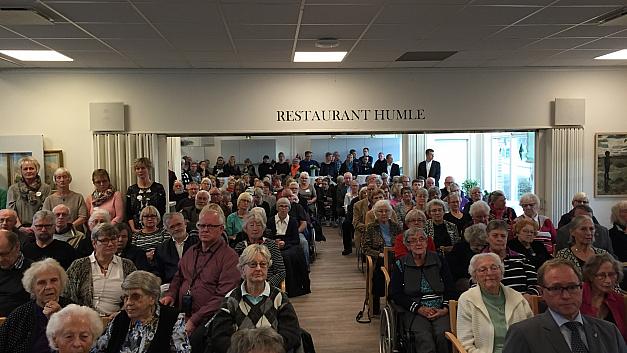
Opening of Svendborg Dementia Village in Denmark
Svendborg Demensby (Svendborg Dementia Village) is the first of its kind in Denmark, modelled after similar projects in the Netherlands, Italy and Canada.
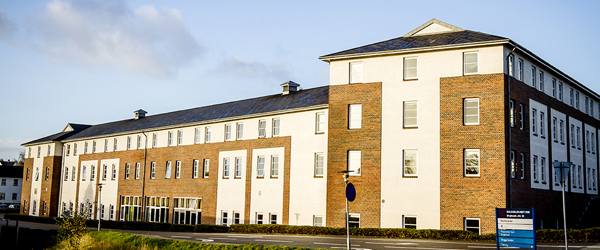
Svendborg Dementia Village
The village, located on the island of Funen, focuses on stimulating residents and is designed as a genuine village with a city square surrounded by shops such as a restaurant, a bar, a hairdresser, a theater, a music library, a wellness salon where residents can get manicures and massages, an exercise center, and a closed garden. Residents live in communal housing with shared kitchens and living rooms in addition to having their own apartment.
Airphoto of Svendborg Dementia Village
The dementia village is expected to give sufferers a more fulfilling life in comparison with ordinary sheltered housing.
“Dementia Village, with its good framework and fantastic opportunities for physical activities, will help give its residents a better quality of life. Dementia Village will also give us incredibly unique experience that we can apply to other care centres with demented residents,” said spokeswoman Hanne Ringgaard Møller in Svendborg Municipality.
Dementia Village, with its good framework and fantastic opportunities for physical activities
The Danish Alzheimer’s Association (Alzheimerforeningen) cautiously welcomed the initiative but expressed concerns about the village’s residents being cut off from the outside world.
To counter the feeling of exclusion among nursing home residents, the facilities in the village are open for non-residents as well. The nursing home also allows pets, so residents can bring their own pet.
To counter the feeling of exclusion among nursing home residents, the facilities in the dementia village in Denmark are open for non-residents as well.
The decision to establish Dementia Village was partly taken because of demands from the relatives of dementia sufferers in Svendborg.
The village has extra focus on safety and has extra precautions to protect the residents who have a tendency to leave their nursing home and get lost.
The dementia village was inaugurated on November 21, 2016. More dementia villages are in the works in Denmark.
Dementia Village in Denmark, written by Tor Kjolberg