



The 2026 edition of the European Hotel Distribution Study by the European hospitality organization HOTREC shows an imbalance in hotel bookings through OTAs in Europe. Booking and Expedia lead Europe’s OTA market.
Europe’s hotel distribution market is increasingly concentrated, strengthening the case for firm EU action to ensure fair and transparent digital markets. According to the study, Booking and Expedia account for 85% of Europe’s OTA market. To protect competition and innovation in the sector, HOTREC calls for effective enforcement of the Digital Markets Act and for the EU to preserve the key transparency and fairness protections of the Platform-to-Business Regulation.
A period of productive tension
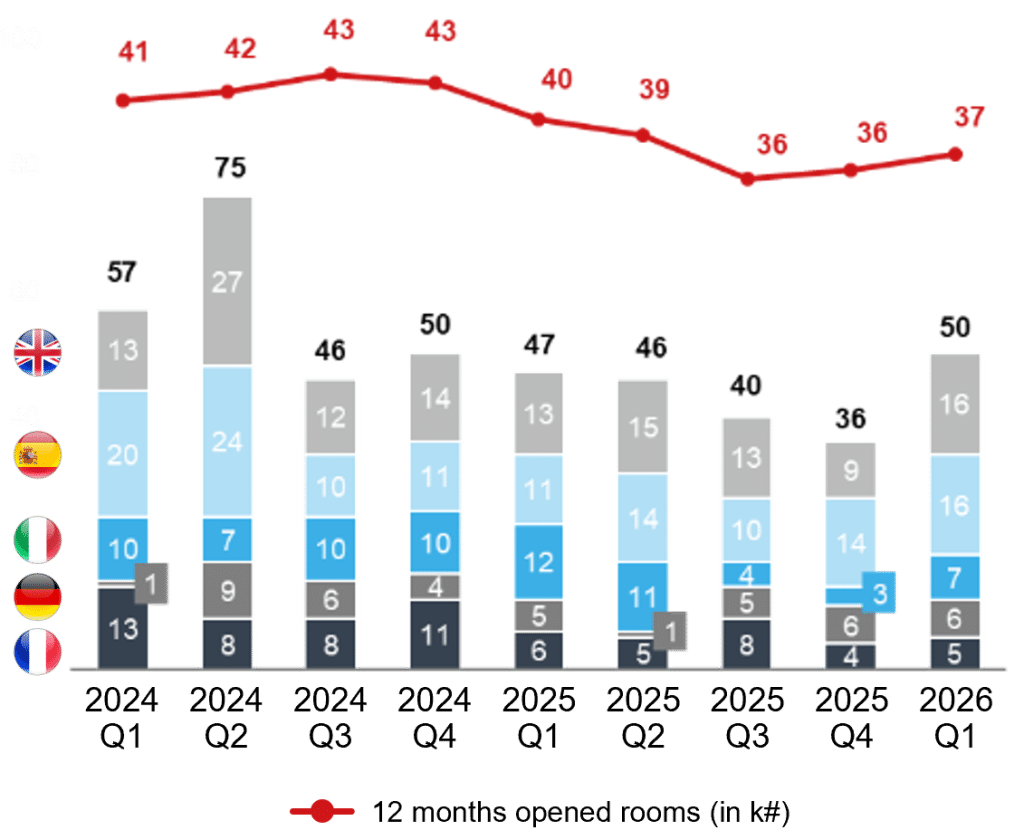
In September 2026, the European hotel industry is in a period of productive tension: traveler demand remains at historic highs, the construction pipeline has reached record levels, and the luxury segment continues to outperform—yet operating costs are eroding profit margins faster than revenues are growing. According to Lodging Econometrics, Europe’s hotel construction pipeline stood at 1,736 projects and 255,976 rooms at the close of Q2 2026, up 3% year over year.
For the 2026 European Hotel Distribution Study, Professor Roland Schegg of HES-SO Valais-Wallis and HOTREC surveyed 2,713 hotels across Europe. Of those, 1,882 were individual hotels from 28 countries, while 831 were hotel-chain properties.
European hotel distribution in numbers
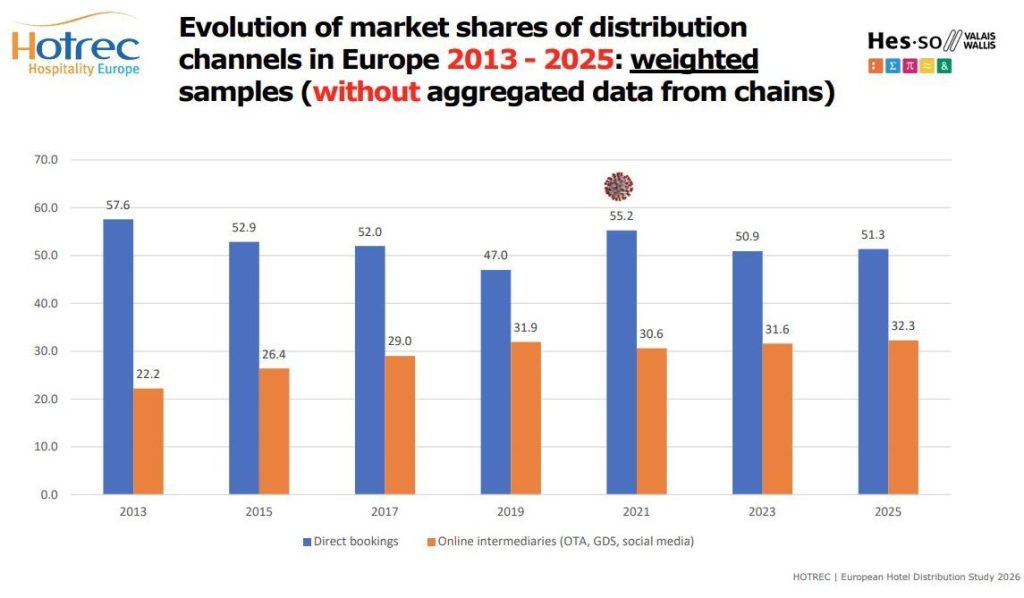
- 51.3%
1 in 2 bookings is made directly with the hotel. - 29.9%
3 in 10 bookings go through OTAs. - 68.8%
Almost 7 in 10 OTA bookings go through Booking Holdings. - 85.4%
More than 4 in 5 OTA bookings go through Booking Holdings and Expedia Group.
The most striking finding
The most striking finding is the high concentration in the OTA market, which has steadily increased over time. Booking Holdings accounted for about 60% of European OTA bookings in 2013; today, its share is nearly 70%. Together, Expedia Group and Booking Holdings, the two largest global groups, now account for more than 85% of all OTA bookings in Europe. This matters particularly for Europe’s independent hotels and SMEs, given growing dependence and risks to innovation in the sector.
In full-year 2026, 307 new hotels with 39,798 rooms are projected to open across Europe. LE forecasts 303 new hotels and 42,729 rooms for 2027 and—for the first time—304 new hotels and 43,099 rooms for 2028.
Online Travel Agencies (OTAs) appear deeply embedded in hotel distribution. In 2026, they accounted for 29.9% of hotel room bookings, up from 19.7% in 2013. This represents an increase of more than 10 percentage points over 12 years, while the share of direct bookings declined by 6 percentage points.
 Highlighting challenges
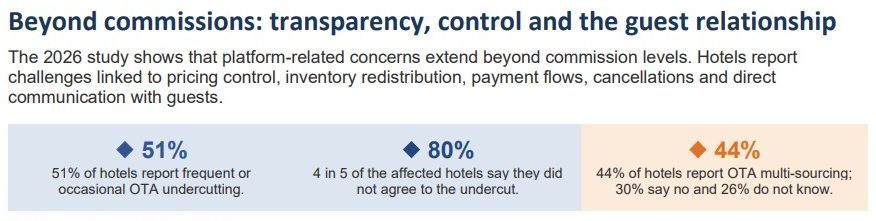
The new study also highlights challenges that extend beyond market share and commission costs. More than half of hotels (51%) now report that OTAs undercut their prices frequently or occasionally, up from about 4 in 10 (43%) in 2023. Among affected hotels, 4 in 5 (80%) say they did not agree to the lower price being offered. Meanwhile, more than 2 in 5 hotels (44%) report OTA multi-sourcing, in which rates or availability can be redistributed through other platforms or intermediaries. Hotels report that this can lead to price inconsistencies, guest confusion, billing difficulties, incorrect information, and reduced control over inventory.
The real story
The real story lies on the cost side. Labor costs, utility expenses, and brand fees are rising faster than revenues, putting sustained pressure on GOP margins. Booking.com’s 2026 European Accommodation Barometer shows that 66% of European lodging operators expect positive business development in the coming months—but the gap between large chains and independent operators is widening sharply, with 72% of chains reporting good economic conditions versus only 55% of independents.
The OTA market is increasingly dominated by a small number of stakeholders. Booking Holdings accounted for 60% of European OTA bookings in 2013, rising to almost 70% in 2026. Together, the two largest global groups, Booking Holdings and Expedia Group, now account for more than 85% of all OTA bookings in Europe. For Europe’s independent hotels and SMEs, this means greater dependence and a risk to innovation in the sector
 The importance of Europe’s digital rules
The findings underscore the importance of Europe’s digital rules for the hospitality sector. With Booking Holdings designated as a gatekeeper under the Digital Markets Act (DMA) and the Platform-to-Business Regulation (P2B) at risk under the proposed Digital Omnibus, HOTREC calls for the effective implementation and enforcement of the DMA and for preserving the P2B Regulation’s essential transparency and fairness safeguards. These protections are vital to ensure that hospitality SMEs retain meaningful control over pricing, payments, distribution, data, and guest relationships, while giving the next generation of hospitality entrepreneurs room to grow.
Booking and Expedia Lead Europe’s OTA Market, based on a press release from HOTREC.