

The Nordic nations have been working together for more than 60 years, but current crises, wars, and climate change raise the question: What is the future role of Nordic cooperation if it is to remain a collective strength?
The focus was on the future of Nordic co-operation when ministers and other representatives of the eight Nordic countries met in Åland for a seminar. Civil preparedness, trust, tangible results, and the role of Greenland, the Faroe Islands, and Åland in official Nordic cooperation were among the main themes. Despite broad agreement that collaboration is essential, a desire has also been identified to clarify the role of the Nordic Council of Ministers so that co-operation remains relevant in a changing world.

The new Helsinki Treaty
Nordic cooperation is based on the Helsinki Treaty, signed in 1962. The treaty has been amended several times, but the last update was back in 1996, and it no longer provides an adequate framework for addressing the challenges we face today.
Working more closely together could also have a greater impact than official Nordic co-operation has had over the past 20 years, especially if we step up collaboration on issues such as emergency preparedness, competitiveness, digitalization, and a more integrated Nordic labor market, to name a few.
As straightforward as that may sound, a consensus has still to be reached on what to add to the treaty and what to remove from it. In his introduction to Challenges and Opportunities for Future Co-operation, Professor Johan Strang pointed out that members often create new challenges by talking past each other. Not everyone necessarily sees the same opportunities. The eight countries do not all have the same status, even though Åland, the Faroe Islands, and Greenland handle certain matters independently and have their own role in official cooperation.

How Greenland and the Faroe Islands view membership
The Faroe Islands have a clear desire for full and self-financing membership, according to Gunvør Balle, the Faroese member of the Nordic Council of Ministers (NSK). The situation is more complex for Greenland, where the government must prioritize its political resources in response to a new geopolitical reality and the crises facing the country. Government Minister Bentiaraq Ottosen told the seminar that his country aims to collaborate with the Nordic Council of Ministers in the future, but that its neighbors in the Arctic are equally important partners.
The world situation is highly dynamic, and Greenland has undergone significant changes. We must address the consequences of climate change, conflicts, and wars. For us, co-operation is not just about the official Nordic version. We also have other interests in the Arctic region and look to our neighbors, such as Iceland and Canada, as well as Finland and Norway, said Bentiaraq Ottosen, Minister for Social Affairs, Labour, Domestic Affairs, and the Environment, Greenland.
Civil preparedness: We already do a great deal together
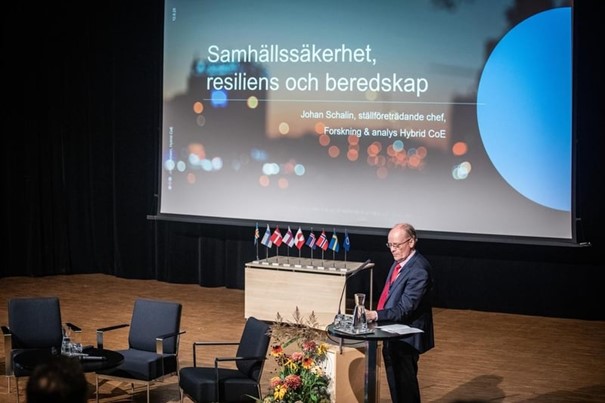
Its long border with Russia and large land areas in the Arctic make the Nordic Region a focal point in Europe’s security landscape, which means a broad focus on security and resilience is a necessity at all levels of society. Johan Schalin, Head of Analysis and Research at Hybrid CoE, emphasized that the Nordic countries can achieve far more together in this policy area, including in areas such as food safety and health. Alexander Zilliacus from the National Emergency Supply Agency in Finland reminded the seminar that COVID-19 was “the world’s largest emergency response exercise”. They showed that cooperation – including with the business community – is crucial.
Katrin Sjögren, the Åland Premier, emphasized that her island country works very well with Finland when it comes to preparedness, a co-operation stress-tested by the pandemic and storm Alfrida in 2019. She pointed out Åland’s special strength – ‘The best food preparedness in the Nordic Region’ – with enough potatoes, apples, and onions for its people to manage 72 hours on their own.

“When you are enjoying the company of good friends, you can also discuss difficult questions,” said Elina Pirjatanniemi, Professor, Åbo Akademi University.
A force for democracy in uncertain times
The seminar showed that the eight countries do not all agree on everything – not on the future of the Helsinki Treaty, the role of foreign policy, or full membership for Åland, the Faroe Islands, and Greenland – but that closer Nordic cooperation can be a democratic response to an uncertain world situation. If we were able to agree on a framework for co-operation in the past, we can do it again. It will call for analysis, research, and dialogue – and why not involve the people? It’s all about the citizens of the Nordic Region. It is democracy’s strength that there is room for different points of view and respect for each other’s voices – for a stronger Nordic Region.
“The Nordic Council of Ministers has an unequivocal mandate. We are part of an extensive network and can leverage our collective strength now and in the future. Emergency preparedness is undoubtedly one of the most highly relevant areas to us all,” said Karen Ellemann, Secretary General, Nordic Council of Ministers.
The Future Role of Nordic Cooperation, a press release from the Nordic Council of Ministers.
Feature image (top): Johan Schalin presents thoughts on the role played by the Nordic Council of Ministers in preparedness and societal security—all photos by Hülya Ehres.