


Tourists from dozens of countries, including Scandinavia, could be asked to provide a five-year social media history as a condition of entry to the United States under a new proposal unveiled by American officials. The US could ask foreign tourists for a five-year social media history before entry.
The plans have been criticized by US lawmakers over privacy concerns and their impact on the country’s travel and tourism sector. Millions of travelers could skip visiting the US if the proposed social media policy is implemented, industry experts warn.
The warning — from the World Travel & Tourism Council — comes after the global industry group surveyed nearly 5,000 international residents who regularly travel abroad and found one-third of respondents would be somewhat or much less likely to visit the US if applicants to the Visa Waiver Program are required to submit information about their social media accounts.
***************************************************
Related: 4 Great Reasons to Move to Scandinavia from the USA (and 5 Practical Tips)
***************************************************
The new condition would affect people from dozens of countries who are eligible to visit the US for 90 days without a visa, provided they have completed the Electronic System for Travel Authorization (ESTA) form.
The proposed shift in US policy would apply to citizens of 42 nations when they visit the US under visa waiver rules, bringing them in line with applicants for immigrant and non-immigrant visas who are already subject to similar social media disclosure rules, introduced in 2019. All email addresses used over the last five years, plus the names, dates of birth, and addresses of the visitors’ spouses, children, parents, and siblings, would also be required.
Since returning to the White House, President Donald Trump has moved to toughen US borders more generally – citing national security as a reason.
The potential decline in travelers could cost the US an estimated $15.7 billion in lost visitor spending, according to WTTC. Under one scenario, the US could miss out on as many as 4.7 million international arrivals, representing a 23% drop in visitors from ESTA countries in 2026.
**************************************************
Related: Sweden’s Boycott of US Products is Growing
**************************************************
Asked whether the proposal could lead to a steep drop-off in tourism to the US, Trump said he was not concerned. “No. We’re doing so well,” the president said in December 2025.
Now, two Democratic senators, Ed Markey and Ron Wyden, said the US Customs and Border Protection policy would deter would-be visitors and represent an unreasonable expectation that would not be acceptable to American citizens going abroad. Markey is the senator for Massachusetts, where Canadian visitors make up around 25% of the market, and Wyden represents Oregon, where Canadians account for around half of foreign visitors, followed by Mexico.
“The travelers affected have other destination options,” Gloria Guevara, president of WTTC, told CNN in an interview on CNN International’s “Quest Means Business,” and they consider the request for social media account information “intrusive.”
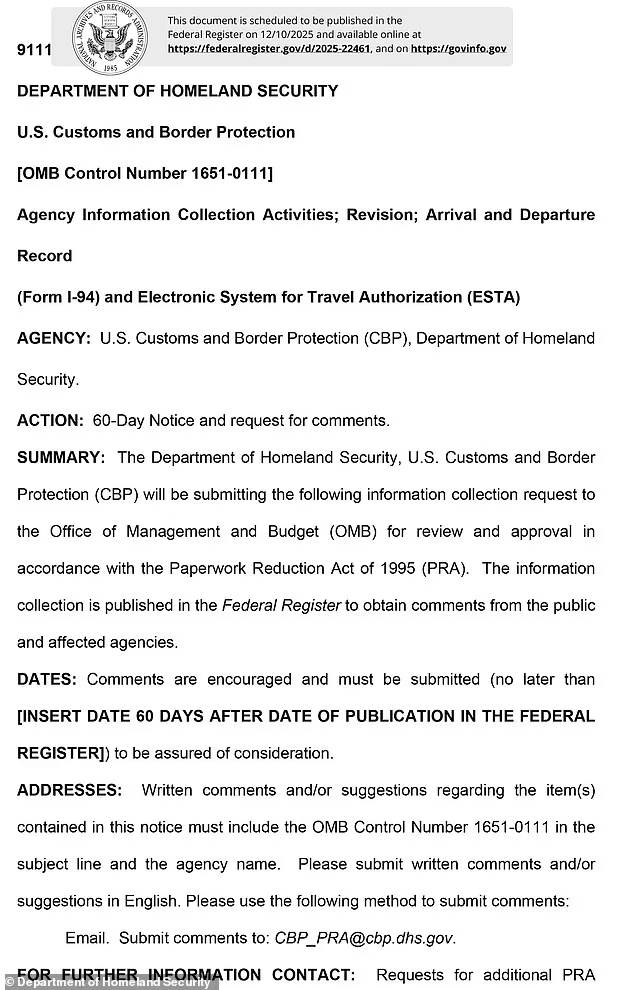
The proposal document was filed by the Department of Homeland Security (DHS) and its component agency, Customs and Border Protection (CBP). It was published in the Federal Register, the official journal of the US government.
In a separate move, the State Department has already instructed embassies and consulates that they may scrutinize student visa applicants for “hostile attitudes towards our citizens, culture, government, institutions, or founding principles.”
The US Could Ask Foreign Tourists For a Five-Year Social Media History Before Entry, Tor Kjolberg reporting.
Feature image (top) © travelvoice.uk