


 and Tohoku University in Japan published joint research in the Journal of Experimental Psychology: General showing that auditory precision and how the brain processes raw sound strongly influence foreign language acquisition.)

Researchers at University College London (UCL) and Tohoku University in Japan published joint research in the Journal of Experimental Psychology: General showing that auditory precision and how the brain processes raw sound strongly influence foreign language acquisition. Is this a method to learn languages more easily and faster?
The study found that people with a particularly good ear for sound process unfamiliar speech differently. Rather than interpreting it through the patterns of their native language, their brains treat it more like plain sound.
Prof. Padraic Monaghan, professor of cognition at Lancaster University, agrees that our brains are “naturally attuned to acquire languages through exposure,” though learners vary in their sensitivity to sound, at least in the early stages.
The team tested 67 Japanese learners of English on their ability to detect subtle acoustic shifts (such as changes in pitch, tone, and duration) in non-speech sounds. The results showed that those with greater auditory precision learned new sounds more quickly and accurately. Their brains seemed to process these sounds as unfamiliar acoustic signals rather than mapping them directly onto patterns in their native language.
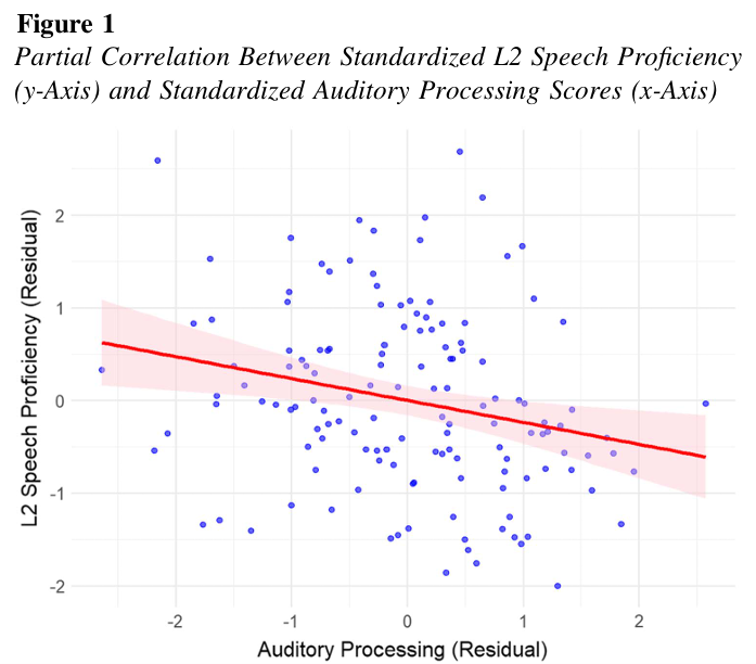 © Saito-Van Poeteren et al.
Using fMRI, they then monitored participants’ brain activity as they distinguished between two English vowels that have no direct Japanese equivalent: the ‘a’ in ‘cat’ and the ‘u’ in ‘cup’.
Learners with higher auditory precision mastered unfamiliar pronunciations more quickly. Their brains processed the new foreign sounds more as raw acoustic signals rather than immediately mapping them onto native-language phonological patterns. This reduced the brain’s heavy reliance on the left sensorimotor cortex (normally active during language processing).
Those who had more difficulty distinguishing these nuances relied more on brain mechanisms associated with the language they already knew. This could make it harder to identify new sounds and lead them to reproduce them closer to their native language.
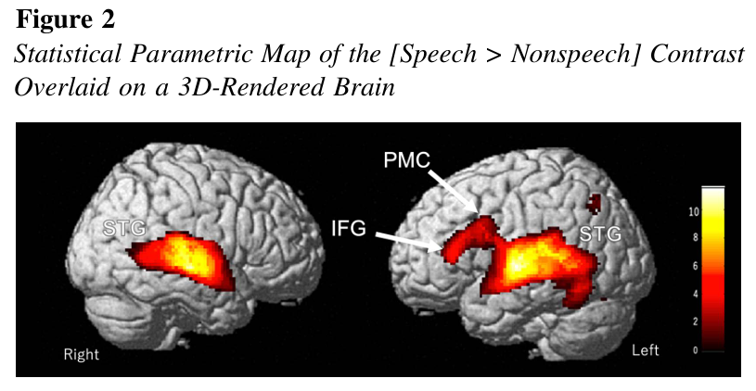 © Saito-Van Poeteren et al.
The study did not consider spelling, but writing systems may add another dimension. When a learner’s mother tongue lacks letters for certain sounds, they may map new words to the nearest familiar spelling, which could erase subtle distinctions in memory and in the ear.
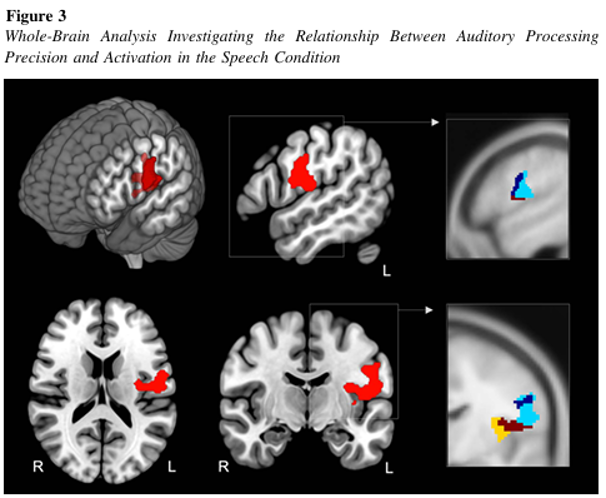 © Saito-Van Poeteren et al.
The researchers believe these results may influence foreign language teaching. Rather than focusing primarily on grammar exercises, vocabulary lists, and repetition, classes could incorporate more activities that train the ear and help students recognize sounds that don’t exist in their native language.
New Method to Learn Languages More Easily and Faster, Tor Kjolberg reporting.
Feature image (top) © PolyChat