


Copenhagen has more gyms than ever. Commercial chains on every corner, small studios, CrossFit boxes, and a growing number of private gyms. The question is, private gym or commercial gym in Copenhagen: What’s actually different?
If you’re an international considering starting at a private gym in Copenhagen instead of a standard commercial gym, this guide breaks down what’s actually different — and whether it’s worth the higher price.
What a commercial gym gives you
The large chains — SATS, PureGym, FitnessX — are affordable, accessible, and easy to join. For 200–600 kr. per month, you get access to equipment and floor space. If you already know how to train, have your own program, and don’t need coaching, they work fine.
But that’s all you get: access. There’s no structured program, no personal trainer to track your progress, and no one adjusting your training as you develop. You’re on your own in a room full of equipment, surrounded by people you don’t know, often waiting for machines during peak hours.
For expats new to Copenhagen, this can feel particularly isolating. Everyone seems to know the unwritten rules. The equipment layout is different from what you’re used to. People speak a language you’re still learning. It’s nobody’s fault, but the result is that you never quite feel at ease — and that affects how you train.

What a private gym gives you
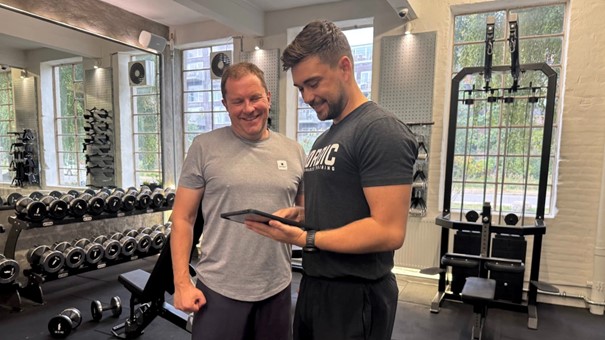
Private gyms in Copenhagen operate differently. They’re smaller, appointment-only facilities where you train with a dedicated personal trainer. There are no crowds, no waiting for equipment, and no navigating social dynamics you didn’t sign up for.
************************************
Related: Why Scandinavian Methods Work Better Than Extreme Dieting
************************************
You walk in, your coach knows your name and your program, and you spend the next 45–60 minutes focused entirely on getting stronger. Every session builds on the last. Weights, reps, and sets are tracked, so you always know where you stand.
For many internationals, that simplicity is exactly what makes training sustainable in a new city. The environment removes every barrier except showing up.
Private Gym vs. Commercial Gym in Copenhagen: What’s Actually Different?, articlecontinues below the image.

Why the environment matters more than you think
This is something most people underestimate until they feel the difference.
Research consistently shows that 1-2 well-structured full-body strength sessions per week are enough to build muscle and increase strength. But “well-structured” is the key word. Random gym visits without a plan rarely lead anywhere.
In a commercial gym, structure is your responsibility. In a private gym, it’s built into the service. Your program is designed, your progression is tracked, and your personal trainer adjusts everything based on how you’re responding. You don’t have to decide what to do — you just show up and train.
What it costs
A commercial gym membership in Copenhagen costs 200-600 kr. per month. Personal training at a private gym typically costs 900-1,500 kr. per session, or roughly 3,000-9,000 kr. per month for 1-2 sessions per week.
The price difference is significant, but the relevant comparison isn’t between the two monthly figures. It’s between training that produces measurable results over 6 months and a membership you abandon after 2 months. When you factor in false starts — memberships you don’t use and programs that lead nowhere — structured training is often the more economical choice in the long run.

What to look for in a private gym
Personal trainers with a health science background. Physiotherapists have 3.5 years of university training in anatomy and biomechanics. In Denmark’s unregulated market, where anyone can call themselves a personal trainer, this is one of the few reliable quality signals.
Documented results. Any serious facility should be able to provide client stories, Google reviews, and measurable outcomes. If they can’t, you’re trusting marketing over substance.
English-speaking coaching. Not just basic communication, but the ability to explain programming decisions and provide real-time technical feedback without language barriers.
A structured program with tracked progression. You should be able to see exactly how you’ve progressed after 3 months. If each session feels random, something is wrong.
One option worth knowing about
Nordic Performance Training is a private gym in Copenhagen where all coaches are licensed physiotherapists and fluent in English. They work exclusively in structured, full-body strength training, with 1-2 sessions per week, and have over 8 years of experience, 3,000+ clients, and 50,000+ training sessions, with more than 350 5-star Google reviews. You can see their personal training prices in Copenhagen on their website and book a free start-up conversation with no obligation.
This article was written for Daily Scandinavian in collaboration with the physiotherapists at Nordic Performance Training — the highest-rated private personal training gym in Copenhagen.
All images © Nordic Performance Training.