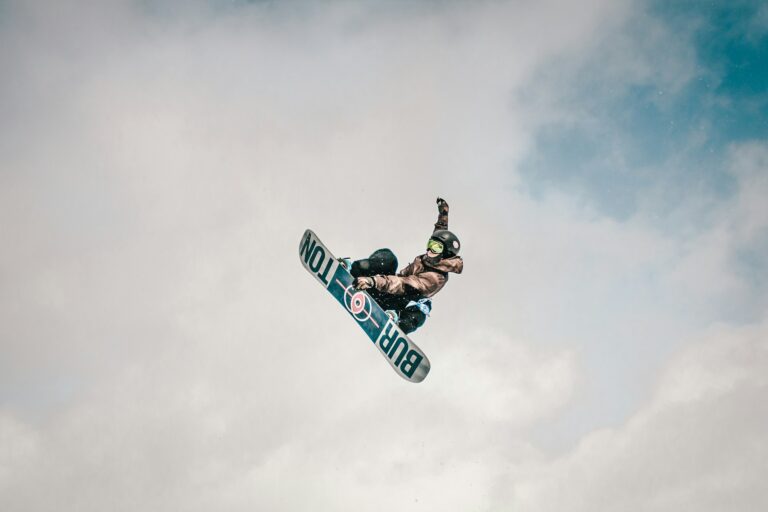
Two films on professional snowboarding were created last year, by two of the biggest snowboarding stars in the world, Norwegians Torstein Hogmo and Mons Røisland.
Last winter, Torstein Hogmo, Mons Røisland and professional photographer Celia Miller journeyed to Canada to explore its legendary light and powdery snow, Together they created Crystalline, a film that dives into the deeper meaning of snow from the perspective of professional snowboarders.
The power team of Torstein Horgmo, Charles Beckinsale and Jeff Pensiero from Baldface, collaborated in the making of the film Return. Together they visited the north island of Japan and British Columbia in Canada. According the Torstein and the producers,Valhalla in Japan changed the landscape of snowboarding by melding big mountain riding with man-made fantasy. Flowy lines that have never been attempted before were created. With the skills of Tim Manning and Gabriel Kocher behind the lens, this is a cinematic journey that stirs the senses.
Norweigan Mons Røisland rose to the international stage as a uniquely talented slopestyle machine. Over the course of his career, he’s been a regular appearance on podiums at every major international freestyle snowboard event, from X-Games, to the World Championships and even the Olympics themselves, bagging a well-earnt silver in 2022’s unique Big Air showdown in Beijing.
******************************************
Related: Freedom on Snow in Oslo
******************************************
Norweigan Mons Røisland rose to the international stage as a uniquely talented slopestyle machine. Photo: Process Films.
A true master of his craft, Mons’ trick repertoire is one of the best in the game, whilst away from the floodlights, Mons is already carving a niche for himself in the media landscape, as a regular in Torstein Horgmo’s Shredbots shorts, as well as producing his own edits.
*******************************************
Related: Sweet Protection from Norway
*******************************************
Torstein Horgmo did the world’s first “frontside 1080” in 2007. Photo: Red BGull.
Torstein Horgmo became known for his difficult tricks. He did the world’s first “frontside 1080” in 2007. He completed a “triple cork” in 2011 and competed in the X-games in Aspen, Colorado that same year. Horgmo has won numerous international competitions in his favorite sport, slopestyle.
Two of the Biggest Snowboarding Stars in the World, written by Tor Kjolberg
The Northern Norway Tourism Board takes great pride in seeing Lofoten globally recognized as one of The Best Places to Eat in 2025 by Condé Nast.Lofoten Ranks Among the Top Food Destinations for 2025
This prestigious mention highlights the region’s world-class culinary scene where sustainable, locally sourced ingredients meet wild landscapes, together defining a one-of-a-kind dining experience.
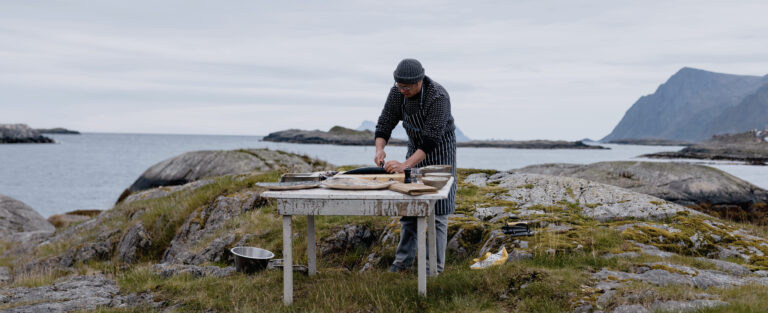
Among the standout restaurants featured in Condé Nast’s list is Landhandleriet Café in Nusfjord, Børsen Spiseri in Svolvær, and Villa Lofoten in Kvalnes to name a few, which are part of putting Lofoten on the global culinary map. Adding to this recognition is Holmen Lofoten, home to the renowned concept Kitchen On The Edge (Feature image on top). This culinary series brings world-class chefs to Lofoten’s remote shores, where they create and serve a unique, four day experience, showcasing the farm to table concept driven by the changing seasons.
Recently, head chef Halvar Ellingsen at Kvitnes Farm was named Best International Chef by the prestigious Italian food magazine Identità Golose. Photo: Visit Lofoten.
Beyond Lofoten, Vesterålen is also mentioned in Condé Nast for making waves in the culinary world. Kvitnes Gård, a farm to table dining destination, has received significant international recognition. Recently, head chef Halvar Ellingsen was named Best International Chef by the prestigious Italian food magazine Identità Golose. Ellingsen is the first Norwegian chef to receive this honour, marking a historic milestone for both him and the broader culinary scene in Northern Norway.
Several standout restaurants featured in Condé Nast’s list. Photo: Visit Lofoten.
Savoring Success
With the growing global trend of food tourism, Northern Norway is increasingly gaining attention as a destination for travellers seeking authentic, local culinary experiences. As the travel and tourism market in the Nordics continues to grow, the region is seeing increasing interest in its local food traditions.
“We’re proud to see Northern Norway recognized worldwide for its local food culture,” says Siw Sandvik, Head of Communication and Marketing at the Northern Norway Tourism Board.
Siw Sandvik, Head of Communication and Marketing at the Northern Norway Tourism Board. Photo: Mynewsdesk.
“The recognition from Condé Nast, along with Halvar Ellingsen’s prestigious award, is a testament to the dedication of local producers, chefs, and everyone who contributes to using local, sustainable ingredients. This global attention is just the beginning, and we look forward to welcoming even more visitors to experience the flavours of Northern Norway,”
she adds.
Lofoten Ranks Among the Top Food Destinations for 2025, a press release from the official Tourist Board of Northern Norway.
Car registration data shows that the U.S. electric vehicle maker faces a test of popularity following billionaire CEO Elon Musk’s high-profile foray into politics.Tesla’s Market Share Tumbles in Sweden and Norway.
A total of 405 new Teslas were registered in Sweden in January of 2025, down 44% from January of 2024.
Registrations in Norway fell to 689, a decline of 38% over the same period, despite soaring overall demand for cars in the two countries.
Elon Musk’s involvement in US politics causes many Scandinavians to feel ashamed of driving their Teslas. U.S. Air Force photo by Trevor Cokley/WikipediaElon MUsk’s involvement with President Donald Trump, which resonated negatively in Europe. Photo: Wikipedia
This is notable amid a 14% overall rise in car registrations in Sweden and an impressive 82% in Norway, suggesting strong economic conditions and consumer activity. Tesla’s decline has been attributed to CEO Elon Musk’s political endorsements, particularly his support for US President Donald Trump, which resonated negatively in Europe. A Novus Group survey highlights a dip in positive views from 19% to 11% among Swedes, alongside increased negative perceptions.
While Tesla’s Model Y crossover SUV was the most sold car in both of the two Nordic countries in 2024, the group’s image has taken a hit in recent weeks, a market sentiment survey by Sweden’s Novus Group found according to Swedish news agency TT.
Musk has waded into European politics drawing criticism from Norwegian Prime Minister Jonas Gahr Stoere. Photo: Wikipedia
In addition to his strong backing for US President Donald Trump, Musk has waded into European politics drawing criticism from Norwegian Prime Minister Jonas Gahr Stoere.
The drop in Tesla’s registrations raises implications for its market stance, with potential risks from consumer sentiment influencing demand shifts. While Musk’s controversies may deter European buyers, it’s vital to consider factors like production cycles and new model launches, which could also affect these numbers. Investors should be mindful of potential volatility from public perception and competitive product environments.
Tesla’s model Q,
The registration volume of individual auto brands can, however, change significantly from month to month dependent on production cycles, product offerings and competition.
Tesla’s Market Share Tumbles in Sweden and Norway, reporting by Tor Kjolberg
The hardening of geopolitics in Europe, and above all, the Ukraine war, has documented a twist in the way the hard side of foreign policy combines with the soft version of diplomacy and international relations. Denmark has experienced that dealing with Donald Trump isn’t just politics — it’s an art form – and introduces Hygge diplomacy.
Denmark is one of the countries that in the decades bridging the 20th and the 21st centuries has been able to navigate between the two extremes most effectively, and without doubt most credibly. This is so, in part, because they devised – not in words but in deeds – a culture of egalitarianism, of social rights, of solidarity between free individuals and turned it into a new identity and a new way of navigating themselves throughout the world.
Danish Prime Minister Mette Frederiksen has for weeks conducted a high-level diplomatic tour across Europe to rally support against renewed interest from US President Donald Trump in acquiring Greenland—a Danish territory rich in minerals and strategically located in the Arctic.
As she’s toured Europe’s capitals to meet Nordic, German, French and UK leaders, her Trump playbook has become increasingly clear: Get support from your neighbors, project unity, and float modest concessions, but above all, avoid escalating the conflict by not publicly engaging with Trump’s threats.
The Danish reinvention of enlightened values is not just a statement of intent; it has a practical anchor, and if there is anyone who believes in the founding principles of the EU – beginning by keeping their own backyard in a decent state, which is the origin of all unimposed cosmopolitanism – it is the Danes.
Danish Prime Minister Mette Frederiksen has for weeks conducted a high-level diplomatic tour across Europe. Photo: Virginia Mayo/AP/dpa dpa-Bildfunk
Despite a bruising phone call with Trump — followed by near daily remarks from the president and his circle — Frederiksen has tried to remain measured and composed, maintaining that the US is Denmark’s closest ally.
For decades, Denmark has been at the forefront of initiatives that mean to strengthen horizontal ties between countries, championed throughout the world by the international institutions that emerged after the Second World War with the aim of fighting poverty and hunger, helping the displaced, or combating climate change.
Denmark is one of the countries that in the decades bridging the 20th and the 21st centuries has been able to navigate between the two extremes most effectively.
“Denmark is a small country with strong alliances. Together with our European partners, we have faced great trials before, and European cooperation has proven its worth in handling crises,” Frederiksen has been quoted by the media when she emphasized the need for unity amid shifting geopolitical realities, including the war in Europe and rising competition in the Arctic.
It’s a strategy distinct enough that Finland’s president, Alexander Stubb, has given it a name: “hygge diplomacy.” The term “hygge” (think candles, fuzzy sweaters, and warm conversations over tea) has become Denmark’s most famous cultural export in recent years. It embodies the feeling of coziness and togetherness and emphasizes the Danish culture of slowing down and fostering meaningful connections.
For decades, Denmark has been at the forefront of initiatives that mean to strengthen horizontal ties between countries. Photo: Mark Konig/Unsplash
Big words and soft speeches are increasingly difficult to hold together on the basis of a reality that requires ever tougher policies, so it makes sense for countries like Denmark to break new ground.
Prime Minister Mette Frederiksen has managed to keep tensions from boiling over. But Danish diplomacy will face more tests ahead, from Trump as well as from an emboldened independence movement in Greenland.
Denmark Introduces Hygge Diplomacy, written by Tor Kjolberg
The Finnish company Kelluu Oy, specializing in environmental data collection with airships, is one of 75 companies chosen for the NATO DIANA Program 2025. The company claims it is the world’s largest airship fleet. Kelluu Oy is based in Finland.
Terrafame, a Finnish responsible battery chemicals producer for electric vehicles, has selected Kelluu to provide accurate and geo-referenced terrain data for continuously monitoring its 60 km² industrial site in Finland.
Based in Joensuu, easter Finland, Kelluu, operates in a niche between drones and aircraft. The former has a short flight time, while the latter are expensive, environmentally harmful and fly above the clouds.
Kellu team
The Defence Innovation Accelerator for the North Atlantic (DIANA) aims to discover new technological solutions for defense and security through collaboration with companies. The program is designed for startups and SMEs developing dual-use technologies—products or services that support both defense and civilian markets. DIANA provides resources, networks, and support from experts and investors to aid in development.
Kelluu’s hydrogen-powered airship, mounted with several spectral cameras, sensors, and scanners, gives Terrafame an accurate and dynamic 3D digital twin of its 60 km² industrial production site in Finland.
What Kelluu actually does is imaging, and instead of flying people from place to place, Kelluu’s airships photograph the Earth. With state-of-the-art cameras, they can capture incredibly detailed photographs of a wide area.
“With just five of our airships, we are able to photograph the entity of Germany with a level of accuracy that no satellite can match,” says Janne Hietale, CEO of Kelluu Oy and continues, “With NATO’s support, we can push our technology further alongside professionals who demand the best. A changing world needs companies like Kelluu to enhance both security and societies, and this collaboration with NATO is a great example.”
The combination of high-resolution RGB, multispectral, and Flir images, combined with the same 3D mesh, is a fascinating tool, especially in a heap leaching and open pit slope stability modelling.
Clients are diverse and forestry companies that are keeping an eye on the health of the land are on the list of customers.
In addition, the cameras can provide hyperspectral imaging, which its clients can use in monitoring metrics such as humidity and temperature. The images can also be used to construct detailed 3D maps, or what the company calls “digital twins”. Clients are diverse and range from forestry companies that are keeping an eye on the health of the land and power companies monitoring the state of its lines in remote locations to urban planners, who need to know how the traffic is flowing.
Kelluu’s airships are highly efficient, emitting 99.5% fewer CO2 emissions than traditional aerial monitoring, and frequently cover mission times of over 12 hours. The airships are effectively operational in subzero temperatures. Kelluu’s facility in Finland is the only airship factory and product development laboratory in Northern Europe.
The World’s Largest Airship Fleet – in Finland, Tor Kjolberg reporting
Taxis are a popular option when traveling to a new destination. While pricier than a bus or train, taking a taxi will get you to your destination faster without having to pay attention to the route as closely as you would while taking a train or bus. And if you’re splitting the cost with your travel partner, it might be cheaper. We’ve taken taxis around the world, and prices and availability varies enormously.
If you opt for a taxi, it’s imperative to research the typical fare for a trip to the city center, especially when interacting with opportunist taxi drivers who claim their meter is broken and charge an exorbitant rate to foreigners.
With the rise of ride-hailing apps like Uber, getting a taxi has never been easier, especially in major cities. All you have to do is sign up with your full name (e.g. Grace Gail) and email address. Essentialliving.co.uk analyzed 38 major cities to determine the best taxi services globally. Washington D.C. in USA scored best, while Stockholm, Sweden and Oslo, Norway ranked 23 and 27 respectively.
Do not be afraid to negotiate with taxi drivers.
I always refuse to ride in a taxi with a ‘broken meter’ as you will find the agreed upon fare mysteriously increase once you get to the destination.
In some countries, the common practice is to have a flat rate from the airport to the city center. In this case, do not be afraid to hop in the taxi. I find it good practice to have the driver write down the agreed-upon fare before getting into the car. This way it is more difficult for the driver to change the price once you arrive at your destination. Always handle all these things before you get in the car or begin loading your luggage. Once you get in the vehicle and the driver begins the trip, you have lost your leverage.
Essential living reports that the most-costly Uber in the world is in Warsaw, Poland. Helsinki, Stockholm and Oslo rank 15, 16 and 17 respectively.
Do not be afraid to negotiate with taxi drivers as well. I often try this tactic after already having researched the typical fare. Sometimes I try it without knowing the typical fare. You will know that you are not that far out from a fair amount if the taxi driver keeps following and pestering you. If a taxi driver leaves you alone after you take a hard line on an amount, you will know that your offer was too low. I always act as I am not in a hurry and have gotten as much as a 50 percent discount on their original offer by waiting them out.
Which city has the longest waiting time for an Uber. Some examples according to Numbeo: Shortest waiting time has New Delhi, India with 3 minutes. In Stockholm, you have to wait 6 minutes, while the waiting time in Oslo is 18 minutes.
I always act as I am not in a hurry and have gotten as much as a 50 percent discount. New York taxi. Photo: Wikipedia.
***********************************
Related: Hotel Booking Secrets
**********************************’
Recently, I arrived at the airport in Bucharest, Romania and watched where the locals went to get a taxi, which was a bit further to the left of the exit doors. I found a ride to the city center for $15. Later, I was told that the normal ‘tourist’ price was double. Get a lay of the land before choosing your ride and it can save you a lot of money. Be wary of taxi drivers who offer to take you to your destination in an unmarked car. Most likely the driver is simply trying to earn a living on the side, but drivers of these unmarked cars are more likely to participate in kidnapping or robbery schemes since they do not have a taxi company or government authority to answer to. That is not to say that taxi drivers who work for companies in marked cars do not participate in these schemes, they simply have more to lose if reported.
Many countries have a taxi desk inside the airport near the exit.
Many countries have a taxi desk inside the airport near the exit. You pay a predetermined fair at the desk and receive a coupon that you present to the driver at the front of the line of taxis outside the airport. This is a great way to avoid corruption and make tourists feel confident they are not being taken advantage of. A lot of these kiosks accept credit cards as well – an added bonus.
The Norwegian browser company Opera seeks to promote its web services and invites “hygge testers” to apply for stays in some of the most stunning locations in Norway. Read on and learn how to apply for your free digital nomad trip to Norway.
The browser company is setting up hyggedesks in the most beautiful cabins across Norway and is looking for ten people to browse the web from them for a week.
Hygge is a big thing in Scandinavia. It’s all about creating a warm, cozy, and relaxed vibe. Think hot chocolate by the fire, snuggling up with a good book – that feeling of pure comfort and contentment. Opera’s hygge desks take this idea and bring it to your workspace. They’re putting these desks in gorgeous spots around Norway, surrounded by nature, and kitting them out with things like fur throws, soft lighting, and calming décor. The goal? To help you be productive and totally at ease. As Jan Standal, Opera’s VP, puts it, “We’re used to hygge in Scandinavia, but now we want the world to understand what it truly means. This initiative blends productivity with the essence of a simple, stress-free lifestyle.”
Jan Standal, Opera’s VP
You could find yourselves immersed in a cozy six-day stay at a private cabin, with flights and ground transportation included. During the stay, testers will be able to try out the hygge desk and see for themselves just how productive the right environment can be.
Opera is zooming out of the browser and focusing on the physical desk on which laptops, computers and phones rest. A hygge desk is one that allows you to leave anything annoying or emotionally overwhelming behind. It accentuates both the pleasure that comes from browsing and the presence of the smallest, coziest elements at hand – like warm lighting or an epic view of nature.
Hygge is a big thing in Scandinavia. It’s all about creating a warm, cozy, and relaxed vibe.
Winners might head to the Lofoten Islands or Norefjell. Each place offers a mix of work and adventure, from seeing the Northern Lights to hiking and even spotting moose! Opera has considered everything to show how your surroundings can make a huge difference to your workday and how you feel overall.
As part of the promotion, Opera has released a helpful video with a Norwegian guide demonstrating exactly what is and isn’t ‘hygge’.
You could find yourselves immersed in a cozy six-day stay at a private cabin, with flights and ground transportation included.
Why Norway is the perfect escape
Opera’s hygge desk campaign shows just how much your environment can affect your productivity and your mood. For Scandinavians, hygge isn’t just a fad; it’s a way of life. And now, Opera’s giving the rest of us a taste of it. If your workspace needs a serious dose of hygge magic, this is your chance. A week in Norway might just change your whole perspective on work.
How to participate
In order to get a chance to experience the Opera hygge desk in Norway, candidates can apply now by telling Opera why they think they should be the ones to browse from a hygge desk. Applicants can submit either text or images to back their claim, and they can apply from now until 28 February 2025.
Opera is zooming out of the browser and focusing on the physical desk on which laptops, computers and phones rest.
About Opera
Opera is a user-centric and innovative software company focused on enabling the best possible internet browsing experience across all devices. Hundreds of millions use Opera web browsers for their unique and secure features on mobile phones and desktop computers. Founded in 1995 and headquartered in Oslo, Norway, Opera is a public company listed on the Nasdaq stock exchange under the ticker symbol OPRA. Download the Opera web browsers and other Opera products from opera.com. Learn more about Opera at investor.opera.com.
Apply for Your Free Digital Nomad Trip to Norway, Tor Kjolberg reporting
Skiing in Norway is intertwined with the country’s rich historical heritage and traditions for good and obvious reasons. Norway is known for its magnificent white landscapes; the fjords and mountains are spread all over this long stretched country, which makes sliding on snow and ice very accessible. Read on and learn more about the modern history of skiing in Norway.
Skiing has a history of at least eight millennia. The earliest archaeological examples of skis were found in Karelia (a region in western Russia on the border with Finland) and date to 6000 BCE. Although skiing’s origins were purely utilitarian, the modern sport evolved from beginning in Scandinavia. In the mid-1800s skiing became a popular recreational activity and sport. In the 20th century it was practiced in snow-covered regions worldwide, providing a market for the development of ski resorts and their related communities.
Sondre Norheim Statue in Morgedal
Mail on Skis
In 1799, French traveler Jacques de la Tocnaye visited Norway and wrote in his travel diary:
“In winter, the mail is transported through Filefjell mountain pass by a man on a kind of snow skates moving very quickly without being obstructed by snowdrifts that would engulf both people and horses. People in this region move around like this. I’ve seen it repeatedly. It requires no more effort than what is needed to keep warm. The day will surely come when even those of other European nations are learning to take advantage of this convenient and cheap mode of transport.”
The Telemark turn
One of the key figures in the history of skiing in Norway is Sondre Norheim. Born in Morgedal, Norway in 1825, Norheim was a ski maker and skier who is credited with revolutionizing the sport. He developed the Telemark turn, which involved a distinctive knee bend and sweeping motion, and is still used by Telemark skiers today. Norheim’s innovations and skills on the ski slopes earned him the title of “father of modern skiing.”
Christiania Skiklub (Ski Club of Christiania) was founded in 1877 to promote skiing, which eventually arranged the Holmenkollen Ski Festival. The capital of Oslo was named Christiania then. The very first ski jumping competition in Holmenkollen took place in 1892 in front of a crowd of 12,000 people.
Christiania Ski Club was a closed club with a maximum of 50 members drawn from the capital’s upper class. Academics, civil servants, military personnel and businessmen.
Norwegian royal family on skis. Photo: Skiforeningen.
In 1882, the club’s tasks had become too burdensome, and the initiative to establish an open ski association that could take care of competitions, and the general promotion of skiing was taken. It led to the establishment of the Association for the Promotion of Skiing (founded in 1883), today, just called Skiforeningen (The Association of Skiing). It has about 70,000 members, maintains several thousand kilometers of cross country ski trails around Oslo and holds several events at Holmenkollen.
The Ski Museum at Holmenkollen was founded in 1923 and is the world’s oldest ski museum located at the base of the Holmenkollen ski jump in Oslo. It is one of Norway’s most visited attractions and a famous sporting arena.
Holmenkollen ski jump. Photo: Skiforeningen
The Olympia of skiing
Holmenkollen became the Olympia of skiing, a miniature Telemark, where the men of the capital could spread the good news of skiing and cultivate what ski historian and author Tor Bomann-Larsen called “The Telemark theology.” Here, skiing took on an almost religious dimension.
Another important figure in the history of skiing in Norway is Fridtjof Nansen, a scientist, explorer, and skier who lived from 1861 to 1930. Nansen was one of the first people to use skis for exploration, and he used them to cross the Greenland ice cap in 1888. His adventures on skis inspired others to take up the sport and helped to establish skiing as a popular activity in Norway.
Norwegian workers on the Buenos Aires – Valparaiso railway line introduced skiing in South America around 1890. In 1910, Roald Amundsen used skis on his South Pole Expedition. In 1902, the Norwegian consul in Kobe imported ski equipment and introduced skiing to the Japanese, motivated by the death of Japanese soldiers during snowstorms.
Birkebeiner ski race. Photo: Visit Lillehammer
The 20th century
The Birkebeiner Ski Race has been held annually since 1932, and commemorates a trip made by the Birkebeiner loyalists to save the infant pretender to the Norwegian throne, Håkon Håkonsson, in 1206. All participants carry a backpack weighing at least 3.5 kg, symbolizing the weight of the then-one-year-old king.
In the 20th century, Norway continued to play a key role in the development of skiing. The country hosted the first Winter Olympics in 1924, and it has since become a major destination for ski enthusiasts from all over the world. Today, Norway is home to some of the world’s best ski resorts, including Hemsedal, Geilo, and Trysil, and it continues to be a leader in the sport.
in the 1950s, the Norwegian photographer Espen Tveit was interested in ski jumps – perhaps to a greater extent in the facilities themselves than in the sport that is practiced in them. He compiled an excellent book on these ski jumps.
Modern History of Skiing in Norway – Conclusion
The modern history of skiing in Norway, as well as the historic origin, is rich and fascinating, and it is intertwined with the country’s heritage and traditions. From the early days of the Vikings to the modern era, skiing has played a significant role in the lives of Norwegians, and the sport has shaped the country into the skiing destination that it is today. From Sondre Norheim and Fridtjof Nansen to the many ski enthusiasts of today, the legacy of skiing in Norway lives on.
Modern History of Skiing in Norway, compiled by Tor Kjolberg
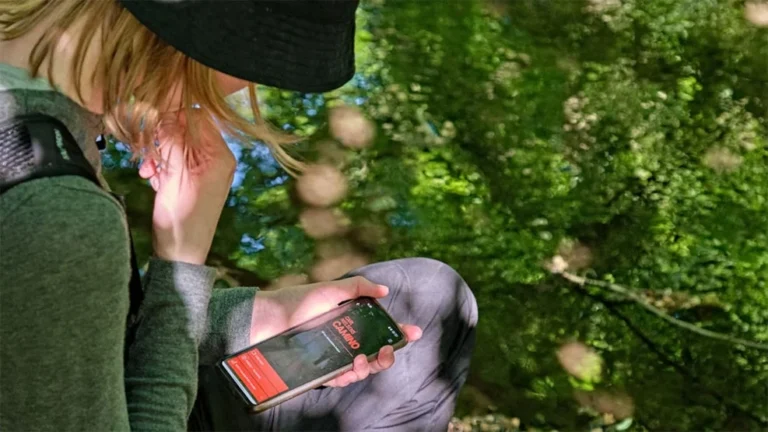
The new 120-kilometer Carl Nielsen’s Camino has opened on the island of Funen in Denmark. Inspired by the world-renowned composer Carl Nielsen, the path offers a unique combination of nature, history and music. It’s a musical hiking experience in Denmark.
Along the route, hikers will find beautiful natural environments, local eateries and fascinating historical sites. At the same time, they can enjoy the musical and cultural stories from the Nielsen era, which provides a deeper understanding of both the composer and the rich cultural heritage of the area.
Carl Nielsen (1865–1931) is considered Denmark’s foremost national composer. Photo: Carl Nielsen Selskabet
Denmark’s foremost national composer
Carl Nielsen (1865–1931) is considered Denmark’s foremost national composer, compared to Edvard Grieg in Norway, Hugo Alfvén in Sweden and Jean Sibelius in Finland. Carl was born on Funen and the son of a fiddle player. Carl Nielsen’s Camino recreates the routes that he and his father often walked to perform at various events around the island.
Inspired by Nielsen’s humorous and poetic work “My Childhood on Funen”, as well as his letters and diary entries, the path offers a unique audio experience through various listening stops along the route. Hikers can enjoy quiet moments and reflection in the peaceful surroundings of nature.
From Carl Nielsen Camino
Carl Nielsen’s Camino
Carl Nielsen’s Camino is divided into 12 different stages with varying themes. Along the way, hikers pass charming Danish inns, wind shelters, cozy farm shops and small local eateries. This division provides flexibility, so that visitors can choose to enjoy shorter walks of a few hours or plan longer walks over several days.
The Camino is part of a larger network of hiking trails in Denmark. The longest and most famous is Hærvejen, a 500-kilometer hiking trail and 450-kilometer cycling trail, known for its many inns, hotels and hostels called “Hærvejsherberge” which are specially designed to accommodate hikers and cyclists.
Carl Nielsen Museum. Photo: Rico Feldfoss
CARL NIELSEN’S CAMINO is produced by Tine Louise Kortermand/Nordic Performance Art in collaboration with Carls Venner, Ida-Marie Vorre/Carl Nielsen Museum and Geopark – Det Sydfynske Øhav. A Musical Hiking Experience in Denmark, based on a press release from Visit Denmark.
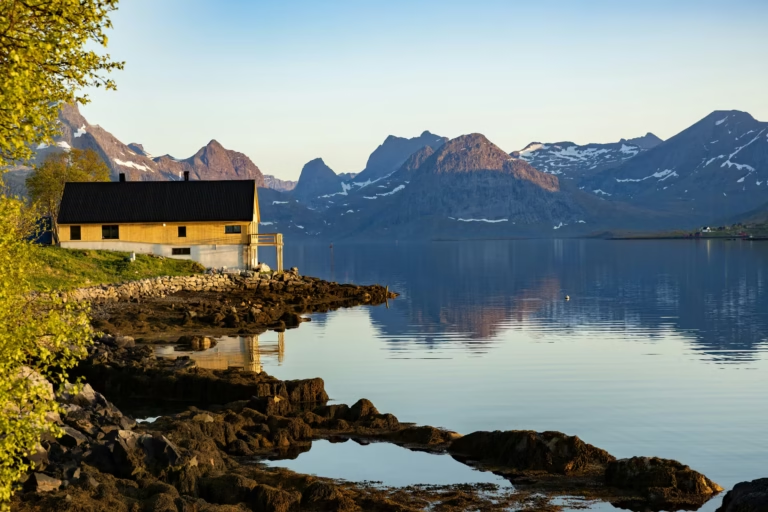
It’s said almost every Norwegian family has a “hytte” – or a cabin – or a country lodge – or a holiday home. And Norway is indeed – a cabin country.
To Norwegians, a hytte is a place to escape the city and reconnect with nature. Not every family in Norway own a cabin, but it is on the wish list of almoost every Norwegian urbanite. There are over 450 000 cabins in Norway, and only about 5.5 million people, so if we do the math, 8% of the population owns a cabin.
Cabin owned by Norwegian author Hans E. Kinck at Maihaugen outdoor exhibition. Photo: Camilla Damgård.
Quality time with beloved ones
Norwegians flock to their wooden cabins with their cars, to spend quality time with their beloved ones, many every weekend although some must drive for hours. One would expect that these cabins would be super stylish, modern and equipped with the latest technology, based on Norway’s lifestyle and standard of living, but no. They are most often wooden and basic.
Norwegians from all walks of life, have been making their way to seasonal rural residences. These hytter and “årestuer” (traditional huts) offer a base of favorite Norwegian pastimes of hunting, fishing, hiking and cross-country skiing.
A lot of outside activity is expected during a hytte weekend. Photo: Visit Norway
In the middle of nowhere
A hytte is usually made of wood and is located somewhere in the middle of nowhere – and there is plenty of that in Norway. That’s the point. To be somewhere far away from anything, so that you can disconnect with everything and reconnect with yourself, the people you love and nature.
Usually, family members are spread across the country, living or working in different places, so gathering at the hytte is the perfect meeting point for all. A lot of outside activity is expected during a hytte weekend. You know, Norwegians love nature and hiking. Or they simply sit outside, in the sun, to get some cool winter tan!
With one in three families in Norway owning a hytte, it’s no surprise that some of the finest architects are turning a hand to their design. Here are just a few examples.
For Rindalshytter, One of Norway’s leading producers of leisure homes, Snøhetta has designed the cabin Gapahuk. Combining tradition and innovation, Gapahuk is intended to be a readymade cabin that fits into nearly any scene – whether in the mountains, the forest, or the sea. Focus has been put on designing a flexible cabin concerning wind and sun conditions that can adapt to various terrains and environments. Gapahuk is a social cabin. Its layout gives priority to the common areas. A spacious indoor living room and kitchen, as well as generous outdoor patios, create spaces where people can spend time together.
Ringdalshytter Gapahuk by Snøhetta.
High up on the slopes of Varden in Kvitfjell, Norway, lies the Trippel Hytte—three quaint cabins designed to encapsulate the spirit of the mountains and meet the practical needs of a skiing family. Mork-Ulnes Architects have achieved a masterful blend of functionality and form in this mountain retreat, offering stunning vistas of the Norwegian landscape while respecting the region’s architectural heritage.
Trippel cabin by Mork Ulnes Architects. Photo: Anne Bratveit.
Hedda Hytter has been building cabins in Hedalen, Valdres since 1980. For many years, Bete Beitski, a cabin model designed by Turid Haaland, dominated the production line at Hedda Hytter. With a need for a more flexible building system, Hedda Hytter hired the renowned cabin architect Jon Haug to develop what would become the Hedda Cabin. HEDDA came into production in 1990, and Beitski was eventually fazed out of production.
A Hedda Hytter cabin.
Based on prefabricated modules, and focusing on individual solutions and adaptations to the surrounding environment, HEDDA composes the majority of the foundations of modern Norwegian cabin construction. The cabins today are known as established classics of high quality, traditional Norwegian construction. Until he retired in 2009, Jon Haug collaborated closely with the Hedalen cabin factory, and provided architectural Hedda solutions carefully adapted to the individual customer’s cabins and needs.
A hytte is found all over the country
Around half of all Norwegians have access to a hytte, and they are found across the country, from the arctic North to the islands off the South coast, by the sea, on island lakes, in the woods and in the hills.