


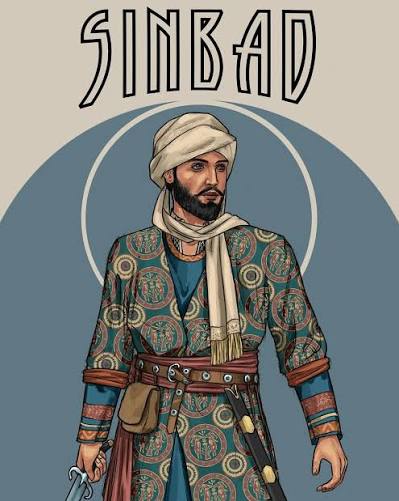
Sinbad the Sailor is a beloved legend you can read for free online, following two men whose lives collide by chance on a Baghdad street. Sinbad the Porter, exhausted and resentful of the wealthy, stops outside a grand house — only to be invited inside by its owner, a seafarer who shares his name. Sinbad the Sailor is our third article in the Historic Travel Stories series.
Over seven evenings, Sinbad the Sailor recounts the breathtaking voyages that built his fortune, each tale more astonishing than the last. As the porter listens, his bitterness slowly gives way to something unexpected.
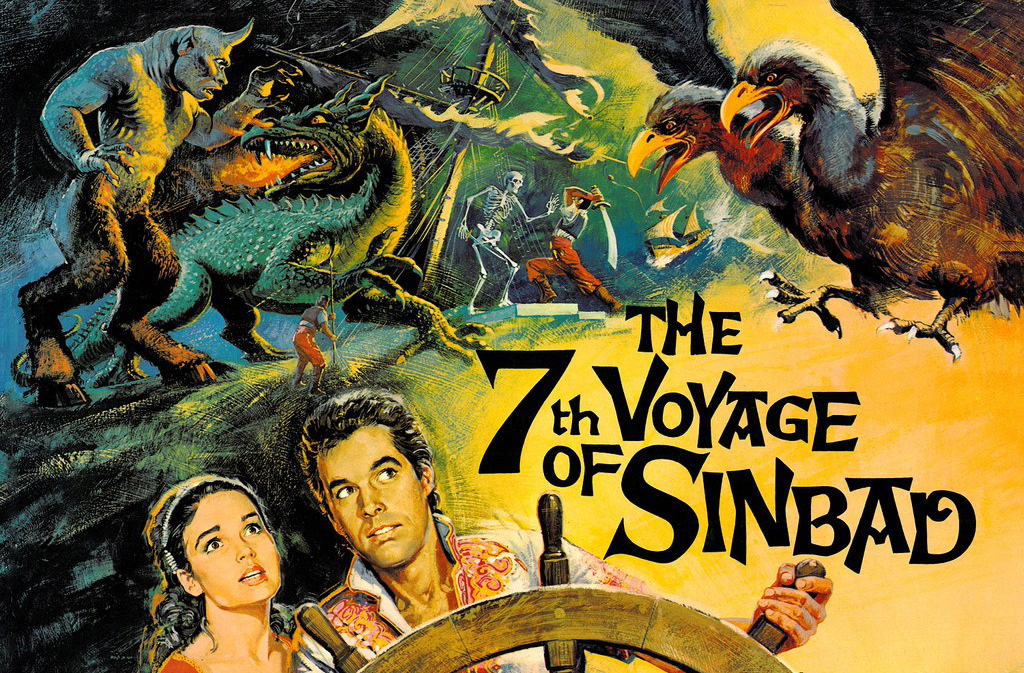
Among the tales of “The Arabian Nights,” or the “Thousand and One Nights,” those of the seven voyages of Sindbad the Sailor are perhaps the most familiar to people around the world. There have been numerous films about Sindbad. There are many animated cartoons about Sindbad’s travels: as early as 1936, Paramount Pictures released “Popeye the Sailor meets Sindbad the Sailor,” and as late as 2003, “Sinbad: Legend of the Seven Seas” was produced by DreamWorks Animation. There are also TV series, video games, comic books, and many other items that feature Sindbad.
The stories were told to the ruler Shahryar by Scheherezade. The seven stories of Sinbad the Sailor describe his journeys. They are similar yet distinct.
On all of his journeys, Sinbad was convinced he’d die, but his faith in Allah kept him alive. He always said that every journey was his last, yet he never settled down. He wanted to travel and see the world.
All the stories share the same beginning. The journey is calm and pleasant, but then something happens. Sinbad was always saved by Allah, and his faith in Allah grew with each voyage.
After Sinbad the Sailor told Sinbad the Carrier his stories, he gave him 700 goldfinches. He told the stories so that Sinbad the Carrier would appreciate his life more and have greater faith in Allah. After that, Sinbad the Carrier repented for his sins and asked Allah for forgiveness.
The beginning
A long, long time ago, in Baghdad, there lived a man. Sinbad the Porter worked hard every day for his money, yet he still didn’t have much of it. One day, Sinbad took a break and stopped at the house of a rich merchant. Sinbad smelled the most delicious aromas coming from the house and heard the most beautiful music. “It’s so unfair that some people can enjoy the finer things in life without working hard, and I work hard every day and still can’t enjoy them!” Sinbad complained.
At that moment, a boy came out of the house and walked up to Sinbad. He took the porter by the hand and led him inside. Sinbad was mesmerized by the house’s beauty. “This must be the house of a King or Sultan,” he thought. In a grand hall, Sinbad saw an impressive man with a long gray beard. The host pointed to a chair and asked for his name. “My name is Sinbad the Porter,” Sinbad replied. “What a coincidence! My name is also Sinbad. Sinbad the Sailor,” said the host.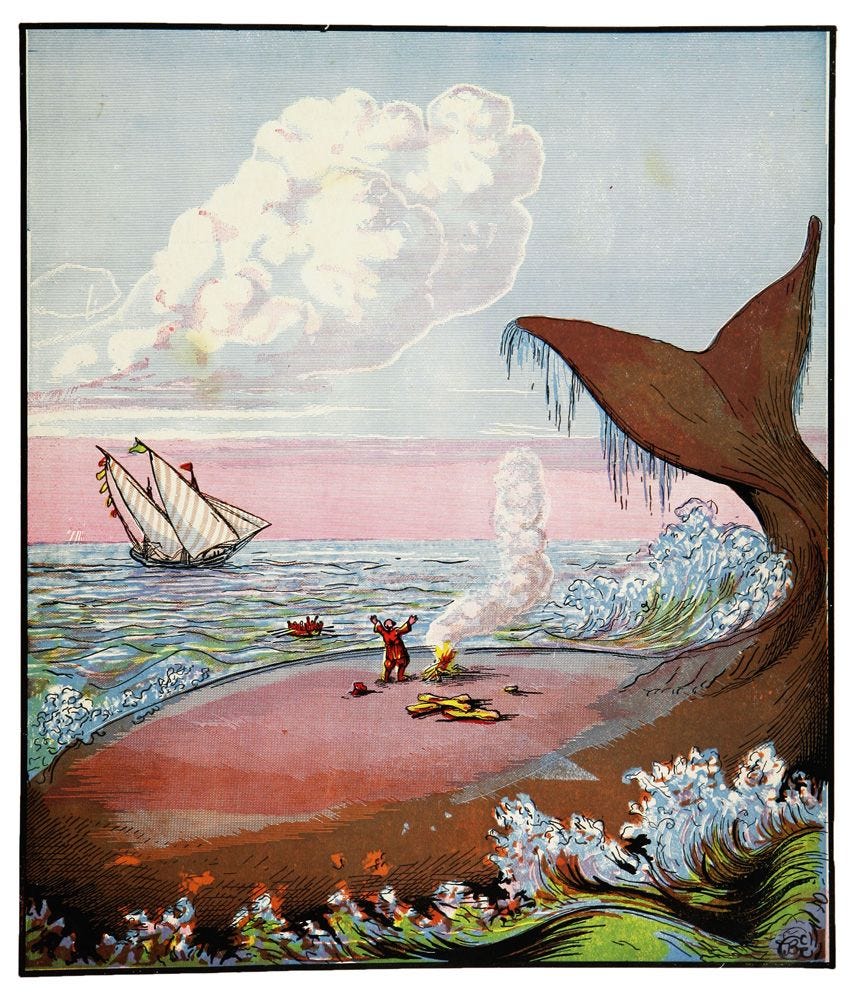 The first journey
Sindbad’s seven voyages should be understood as tales of derring-do in pursuit of fame and fortune. On his first voyage, Sindbad sails to what he thinks is an island, but it is actually a huge whale that dives deep into the sea when he and his sailors light a fire to cook. He is eventually rescued by a passing boat and ends up on an island ruled by a king whose horse he saves, earning rich gifts that he sells for a huge profit. Eventually, he returns to Baghdad a rich man.
The second journey
Sinbad the Sailor decided to travel again. On his second journey, he came to an island that looked like Paradise.
Sinbad was tired, so he fell asleep on the island. When he woke up, he was all alone. His crew had left without him. Since he was alone, he had to do something to survive.
He saw a giant bird and decided to tie himself to her legs, hoping she would carry him to an inhabited island.
The bird carried him high to a mountain, and beneath it lay a valley. He went to the end of the valley and saw something strange. A piece of meat fell from the sky. He tied himself to the meat, and then an eagle came and carried him to the top of the mountain.
He met a group of merchants and traveled with them back to Baghdad. He lived a carefree life, but soon he wanted to go on a new adventure.
 The third journey
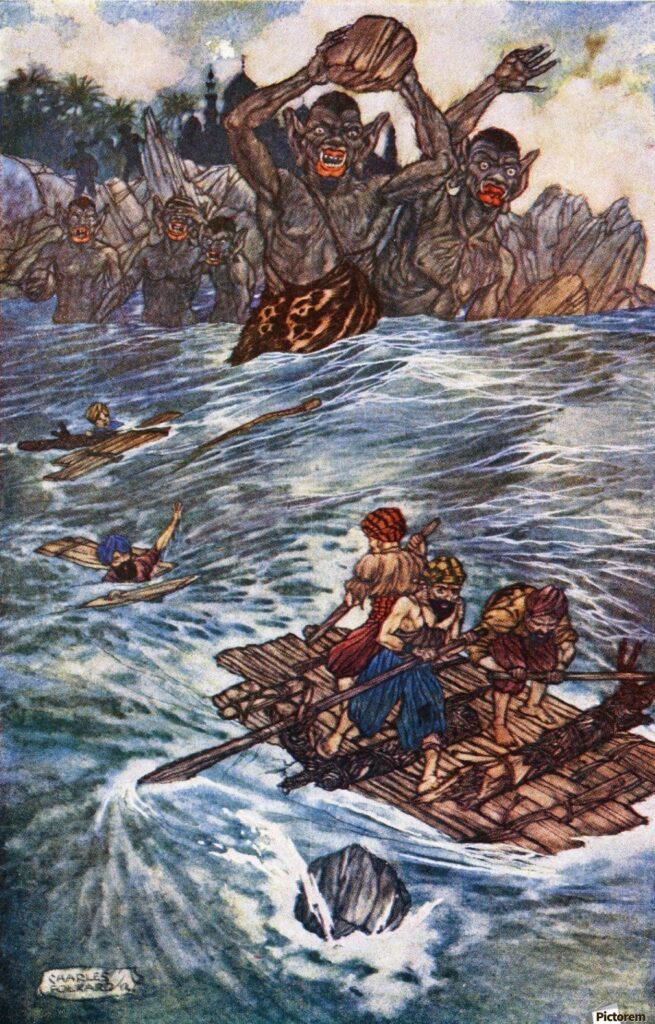
They traveled to another sea when the wind caught them and blew them to the mountain of monkeys. Nobody came out alive from that mountain. The monkeys surrounded the boat and threw them onto the island, where they saw a castle.
They entered the castle, and it was empty, so they decided to spend the night there. In the morning, a big monster woke them, grabbed their captain, and threw him to the ground. After that, he stepped on his neck, demanded that a fire be lit, and then baked and ate the captain.
The same situation repeated the next day when the sailors tried to outsmart the monster and kill him. Before nightfall, another of them was dead. After that slaughter, the monster decided to sleep.
The sailors grabbed spears and shoved them into his eyes. They managed to beat him that way.
They built a boat and went back to Baghdad. Sinbad the Sailor lived happily, but his inner voice made him travel again.
 The fourth journey
Yearning to return to the sea, Sindbad sets off on his fourth journey, landing with his shipmates on an island populated by cannibals who feed and drug the crew. Realizing the danger, Sindbad refuses to eat and escapes. An itinerant group of “pepper-gatherers” carries him to their king, who befriends him and gives him a beautiful woman in marriage. When the woman dies, he realizes that the customs of that island require that he be entombed with her. He eventually escapes after robbing the grave and returns to Baghdad.
 The fifth journey
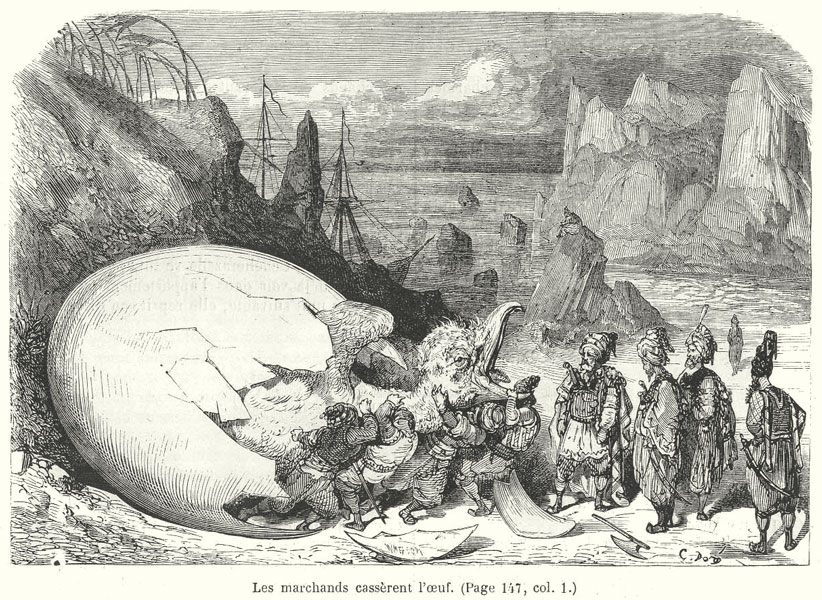
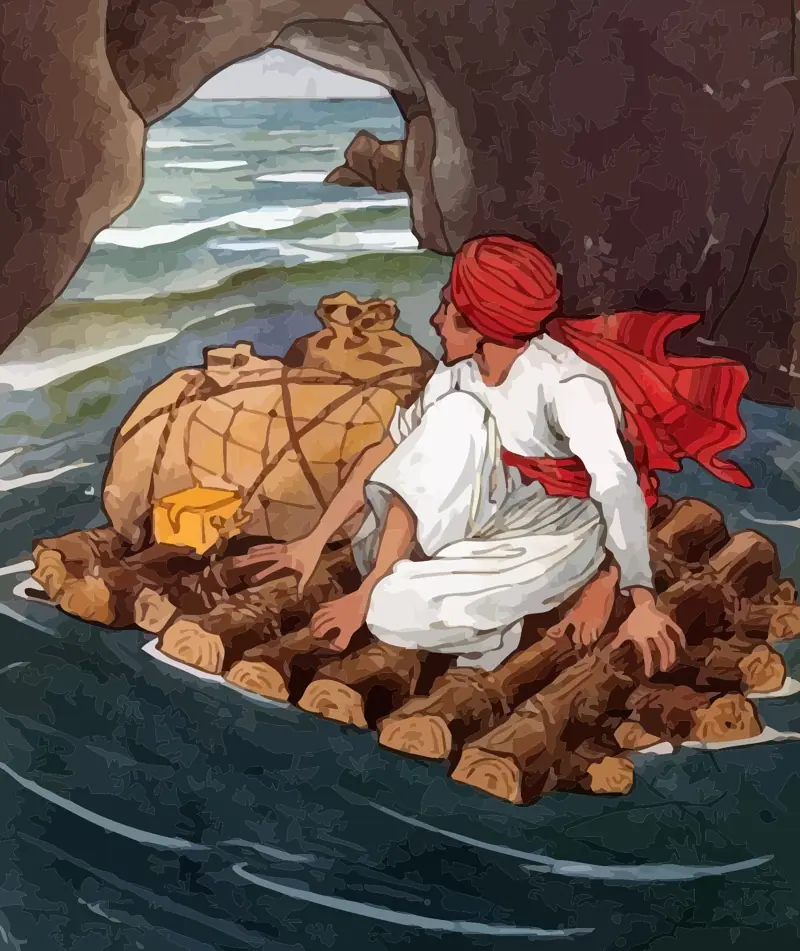
A while later, having “forgotten all,” Sindbad decides to buy a new ship in Basrah and, once again, sail the seas. He fills the boat with goods to trade, hires a captain and a crew, and sets off on his fifth voyage. His boat is sunk by roc birds. He is enslaved by the Old Man of the Sea, who rides on his back for weeks, and he ends up in the City of the Apes. There he learns to deal with the apes and gets them to pluck fruit and coconuts, which he sells, building another fortune before returning home to Baghdad.
 The sixth journey
Sinbad traveled with a group of merchants. They had a happy journey, but the captain ended it. He realized they had strayed from their route and had unloaded on an island.
All of the merchants soon died, and Sinbad was left alone. Sinbad had to survive, so he wandered until he found an emperor who lived a happy life. With his help, he finally managed to get back to Bagdad.
 The seventh journey
The last voyage is no different from the others: he is shipwrecked on an island, but this time he discovers a beautiful city and another kindly king who takes him under his wing. He eventually tells Sindbad that, as he is growing old and has only one daughter, he would like him to marry her and become his legitimate successor.
Sindbad agrees and marries a very beautiful and wealthy woman, and when the King dies, he inherits the throne. The city has one peculiarity, though: once a month, some of the people turn into birds and fly out of the city. One day, he decides to go with them to find out where they fly. Riding on one of the birds, he rises high in the sky and hears angels glorifying God. So he too praises God when fire descends from heaven and destroys almost all the birds. He eventually learns that these birds are evil spirits who will turn against him, so he decides to return to Baghdad with his wife and much of his wealth.
Sinbad remembered that whenever he was in trouble, he would pray to Allah, who would save him, only to find himself in trouble again. He swore to Allah that if he survived this time, he would never sail again or seek trouble. Allah saved him, and Sinbad never traveled again.
Sinbad the Sailor, compiled by Tor Kjolberg
Previous articles in our series of historic travel stories:
The World’s Oldest Surviving Travel Story
The World of the Odyssey: A Palimpsest of the Hellenic Art of Living Well