

 and the Global Business Travel Association (GBTA) confirm that although the industry has structurally recovered, companies are managing trips with greater strategic precision.)
Reports from both the Events Industry Council (EIC) and the Global Business Travel Association (GBTA) confirm that although the industry has structurally recovered, companies are managing trips with greater strategic precision. The Global Business Travel Market is Experiencing “Steady Progress” As It Moves Through 2026.
The Global Events Barometer for the last quarter of 2025 notes that demand remains strong in the sector while acknowledging new headwinds in 2026. The progress is marked by high spending volumes and increased operational caution.
************************************************
You may also like to read Conversational AI Lets Travelers Search and Compare Travel Options
************************************************
 The Core Indicators of “Steady Progress”
- Record Spending: global business travel spend is forecast to reach USD $1.69 trillion in 2026, an 8.1% increase from 2025.
- Stable Volume: Nearly half (47%) of corporate travel buyers expect trip volumes to match 2025 levels, while 35% expect them to increase.
- Price Stabilization: After years of sharp, unpredictable spikes, corporate travel costs are finally beginning to level out. Airfares are projected to increase by a modest 0.4% globally, while hotel rates are expected to rise by a modest 1.8%.
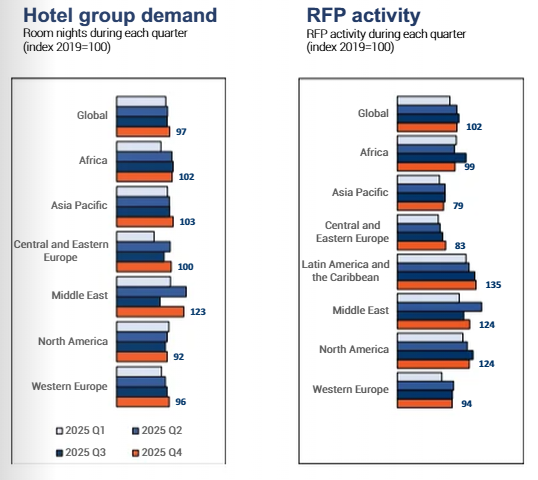
At the country level, Oxford Economics data show that hotel group room nights are well up from 2019 levels.
A Fragmented Regional Reality
While the global outlook is steady, progress varies significantly by country, depending on local economic conditions and infrastructure recovery:
| Region/Country | Group Room Nights vs. 2019 Benchmark | 2026 Spending Outlook |
| India | 151% (Leading global growth) | High growth, near or above 10% |
| Netherlands | 120% | Part of a robust 8.2% overall European growth spike |
| Canada | 102% (Full recovery achieved) | Strong, steady corporate spend upward of 10% |
| United States | 93% (Lagging pre-pandemic volume) | Reclaiming the top spot globally for total spend |
| United Kingdom | 83% | Mixed sentiment; companies are heavily optimizing trip duration |
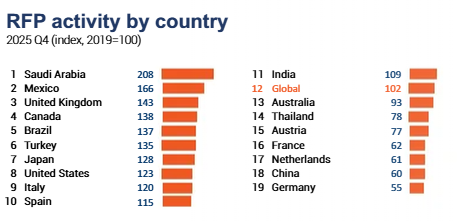
Meanwhile, given that the data cover the last quarter of 2025, before the Israeli-US attacks on Iran and the current Middle East oil crisis, planners’ RFP activity was through the roof in Saudi Arabia (208), Mexico (166), the UK (143), Canada (138), and Brazil (137). Activity was also up from 2019 levels in Türkiye, Japan, the US, Italy, Spain, and India. The positions of Saudi Arabia and Türkiye could shift as the latest figures emerge, with one estimate putting the region’s travel and tourism losses at €600 million per day.
********************************************
You may also like to read Social Media’s New Role in Travel Promotion
********************************************
Emerging Operational Headwinds
The “steady progress” is navigating a backdrop of rising complexity.
- Rising Geopolitical & Supply Chain Friction: Ongoing conflicts and trade tensions are forcing organizations to route travel with heightened security measures, eroding confidence—particularly in Europe.
- Purposeful Travel Over Frequency: Due to a 139% increase in room rates compared to 2019, businesses are cutting back on casual trips. Instead, they are prioritizing high-ROI events: internal training, major industry conferences, and critical client dealmaking.
- Mandatory AI & Sustainability Integration: Agility is shaping corporate travel programs. Companies are relying on AI-powered predictive tools to secure lower rates and track their carbon footprints to meet corporate environmental mandates.
The barometer’s authors also note the likelihood of broader knock-on effects on consumer sentiment, energy prices, and financial markets, pointing out that “turbulence may delay business investment decisions.”
The Global Business Travel Market is Experiencing “Steady Progress” As It Moves Through 2026, Tor Kjolberg reports. Feature image (top) is AI-generated.