

Long before wellness apps existed, Scandinavians had already figured out how to survive the dark months — by making something beautiful. In this article, you can learn about the Nordic art of slow creating: How Scandinavian culture inspires mindful making.
In farming communities across Norway, Sweden, and Finland, the arrival of winter didn’t signal a retreat from life. It signaled an invitation to create.
That tradition is older than most of us realize, and it carries a quiet wisdom that feels more relevant today than ever.
A Tradition Born from Long Winters
From roughly the 17th century onward, Scandinavian folk artists filled their winter hours with intricate handwork. Norwegian rosemaling — the sweeping floral scroll painting that decorated furniture, walls, and wooden household objects — emerged around 1750 as a way for rural communities to bring beauty into the long, dim months. Swedish craftspeople carved and painted Dala horses, those iconic red wooden figurines that were originally made to entertain children and decorate homes. In Finland, Himmeli — delicate geometric mobiles woven from rye straw — hung from ceilings to mark the rhythm of seasons.
None of this was “fine art” in the gallery sense. It was purposeful making: hands occupied, mind focused, something tangible and beautiful taking shape from raw materials. The craft itself was the point.
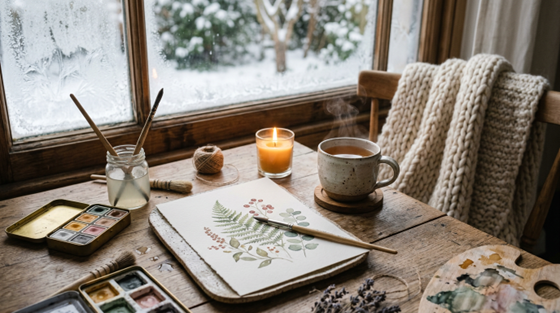
This spirit maps almost perfectly onto what we now call hygge — the Danish and Norwegian concept of cozy, restorative presence. Hygge is often described as the antidote to hustle culture: slowing down, returning to simple pleasures, letting the nervous system settle. And what better embodies that than sitting quietly at a table, brush in hand, building something, patient stroke by patient stroke?
What Nordic Wellness Philosophy Tells Us About Making Art
Scandinavian cultures have given us a remarkable cluster of concepts that all point in the same direction. Hygge (Denmark/Norway) centers warmth and togetherness. Lagom (Sweden) counsels balance — not too little, not too much, just the right amount of everything. Friluftsliv (Norway) champions connection to nature and unhurried outdoor time as essential nourishment.
What ties these ideas together is a deep resistance to perfectionism. None of them demands excellence. They demand presence.
That resistance to perfectionism is what makes art-making so fitting a vessel for these values. The folk artists of earlier centuries were not competing for gallery placement. They were practicing something closer to what psychologists today call a “flow state” — a condition of absorbed, effortful attention where self-consciousness dissolves and time moves differently. Research suggests that this kind of focused creative engagement lowers cortisol levels and activates the brain’s reward circuitry. Denmark consistently ranks among the happiest countries in the world despite its long dark winters, and hygge-oriented practices are widely credited as part of the reason why.
Art-making, in this framing, is not a hobby. It is a wellness practice with centuries of Nordic precedent.
The Modern Heir to the Folk Art Tradition
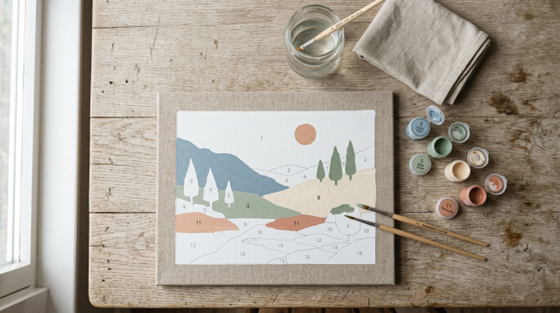
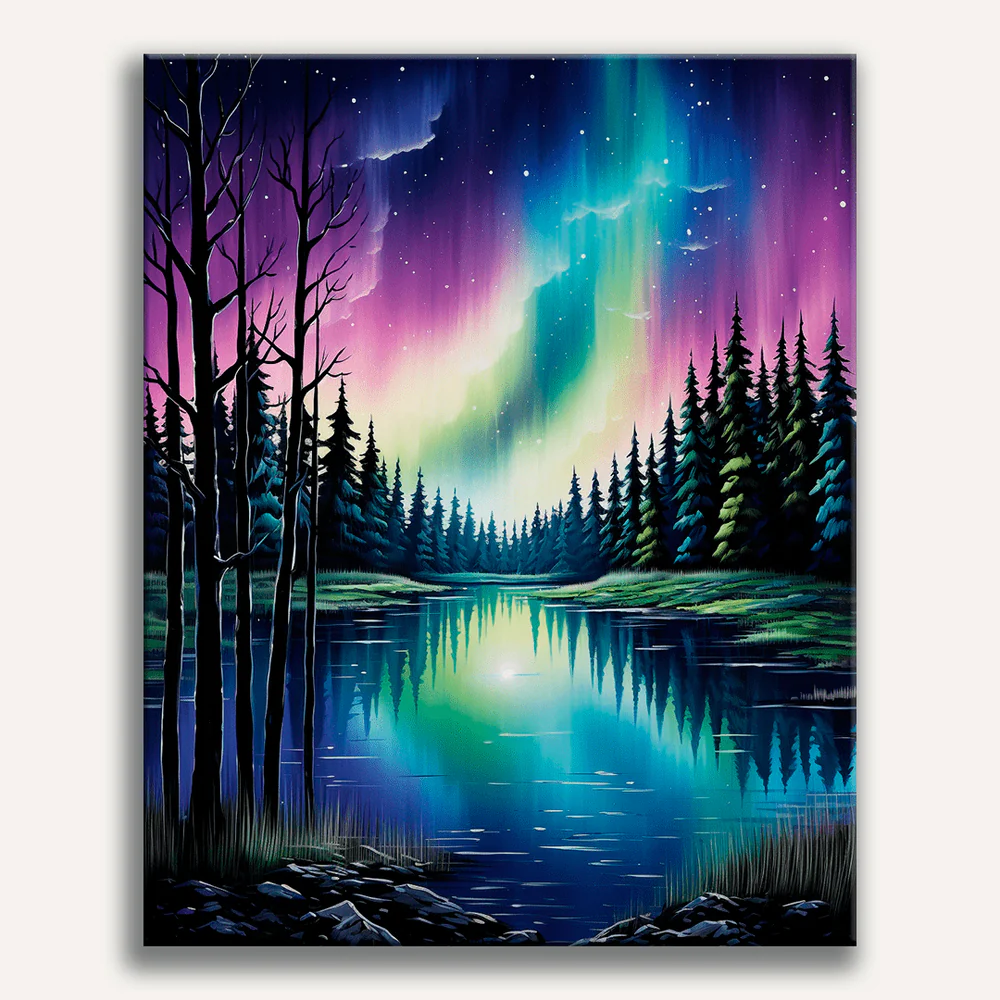
Today’s DIY art movement carries on this tradition in a form that anyone can access. Modern calming DIY art kits — paint-by-numbers sets designed for adults — are built on the same principle as rosemaling or Dala horse carving: guided, pressure-free creativity that prioritizes the act of making over the quality of the result. The numbered sections and pre-mixed paints remove the intimidation of the blank canvas. What remains is the meditative rhythm of brush on surface, color filling shape, and a growing sense of quiet accomplishment.
For people overwhelmed by screens and constant digital input, this kind of hands-on creating offers something increasingly rare: a screen-free hour that genuinely restores. Art therapists and wellness writers increasingly describe painting as “the new meditation” — particularly effective for people who find traditional seated meditation difficult, because the hands give the restless mind somewhere to go.
This is precisely the logic that Nordic folk crafters understood intuitively. The work was never separate from the rest of life. It was woven into evenings, into winter, into the domestic rhythms that gave the year its texture and meaning.
The Emotional Language of Nordic Abstract Art
The Nordic tradition is not only about quiet, guided craft. It also produced some of the most emotionally raw and daring abstract art in history.
Sweden’s Hilma af Klint was painting large-scale geometric abstractions in the early 1900s — well before Kandinsky or Mondrian — driven by a belief that art could channel invisible truths about human consciousness. Norway’s Edvard Munch famously turned away from depicting outer reality to paint inner emotional states: anxiety, longing, grief rendered in swirling color and line. This emotional directness, the willingness to use abstraction as a language for feeling rather than description, runs deep in Nordic creative culture.
That lineage continues in contemporary Nordic-influenced abstract work. Art by Maudsch carries forward this tradition of bold color and emotional expressiveness — abstract paintings that speak in the same register as the Nordic masters: feeling-first, form as vehicle for inner life.
Where DIY art kits offer a structured, meditative entry point into making, abstract painting offers the other end of the creative spectrum: raw expression, color as emotion, the canvas as a place to put what words cannot hold. Both belong to the same long Scandinavian story about why humans need to make things.
Bringing the Tradition Home
You do not need to live through a Nordic winter to adopt its creative philosophy. The invitation is simpler than that: set aside an evening, put down the phone, and make something with your hands.
Whether you begin with a guided kit or hang an expressive abstract painting where you can absorb its mood daily, you are participating in something that Scandinavians have known for centuries. The act of creating — slowly, deliberately, without pressure — is not a luxury or a distraction from real life. It is one of the oldest and most effective ways to feel like yourself again.
In that sense, the Nordic art of slow creating was never just an art practice. It was always a practice of being.
The Nordic Art of Slow Creating: How Scandinavian Culture Inspires Mindful Making, written for Daily Scandinavian by NumberArtist. Feature image (top) © Unsplash.