



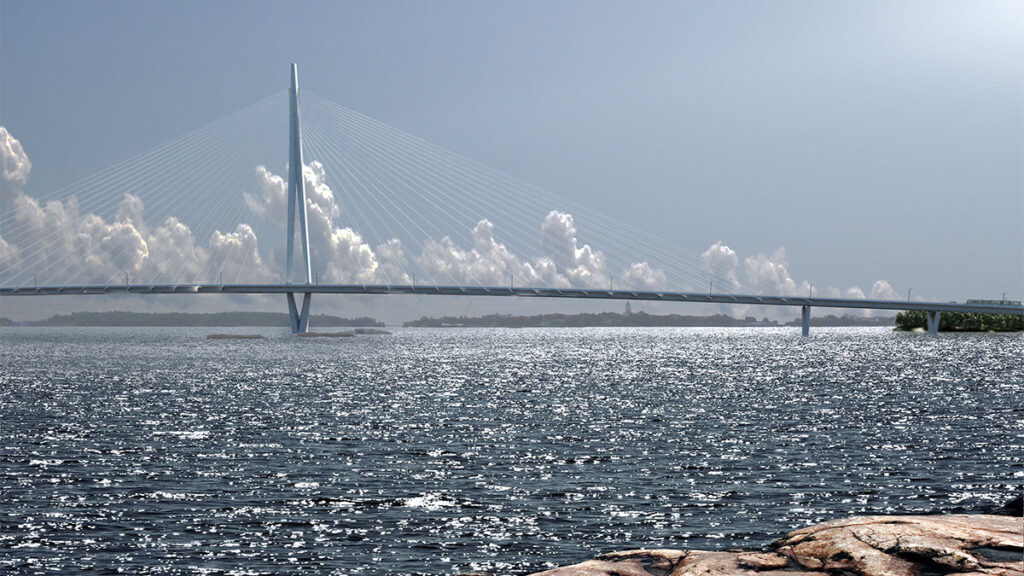
The Kruunuvuorensilta bridge is Finland’s longest and highest bridge, spanning 1,191 meters across the Kruunuvuorenselkä bay. It is unique globally because it is completely car-free, serving pedestrians, cyclists, and the upcoming light-rail trams. The world’s longest pedestrian bridge in Helsinki was officially inaugurated and opened to the public on Saturday, April 18.
The grand opening drew more than 50,000 visitors over its first weekend. To mark the ribbon-cutting by local city officials, the festivities featured a live brass band, a samba performance, food trucks, and even a temporary tent sauna.
The new bridge connects the waterfront residential neighborhood with the island of Korkeasaari, the district of Laajasalo, and central Helsinki, significantly shortening travel to the city center.
Helsinki Partners have called the bridge “a distinctive new identity” for the Finnish capital’s skyline because it features a striking 135-meter-high diamond-shaped central pylon, making it taller than Finland’s highest residential buildings.
The Kruunuvuorensilta bridge is designed by Knight Architects and WSP Finland and incorporates a gentle curve to make long-distance walking and cycling feel more approachable.
City Mayor Daniel Sazonov said: “Kruunuvuorensilta bridge is the new, unique, and exciting landmark for Helsinki. A sight that will draw visitors from near and far. The new bridge reshapes how we look at Helsinki. It connects the areas of Kruunuvuorenranta and Laajasalo to the larger central city area in a completely new way. The bridge reflects our commitment to sustainable solutions and embraces Helsinki’s unique maritime setting.”
The bridge is built with high-strength stainless steel and advanced concrete technology to last up to 200 years. Construction began in 2021 and, according to official figures, cost around €326 million. The bridge now cuts the distance between neighboring city districts by nearly six kilometers. By 2030, it is predicted to handle around 23,000 tram trips and 3,750 cycling trips per day. Work on a light rail system is ongoing.

Pedestrians and cyclists share dedicated lanes. Cyclists have a 3-meter-wide lane, and benches are placed halfway across for resting and taking in panoramic city and sea views. Helsinki is implementing a long-term vision to prioritize public transportation, walking, and cycling in urban mobility. The majority of journeys in Helsinki are made using sustainable modes: about 41% on foot, 25% by public transport, and 11% by bike, while only about 20% are made by car. Two tram lines (part of the larger Crown Bridges light-rail project) will begin operations across the bridge, providing direct access to and from central Helsinki.
The bridge’s sustainability credentials are also evident in its carbon footprint of approximately 129,000 tCO₂e over a 50-year period, with 76% from construction and 24% from operation and maintenance. Emissions have been reduced by using low-emission materials and renewable energy sources.
Strong marine winds are common. A specialized wind guardrail runs along the southern side, protecting pedestrians and cyclists. The bridge rises about 20 meters above the waterline to accommodate boat traffic, creating a noticeable incline on both sides. The city prioritizes this route for winter maintenance, so snowplows regularly clear the bike path during the colder months.
For fans of Finnish architecture, one of the Nordics’ oldest indoor swimming pools reopened in the capital earlier this year, blending Classicism and Art Deco and also offering not only a place to do laps but also a taste of Finland’s sauna culture.
World’s Longest Pedestrian Bridge Has Been Inaugurated in Helsinki, Tor Kjolberg reporting.