



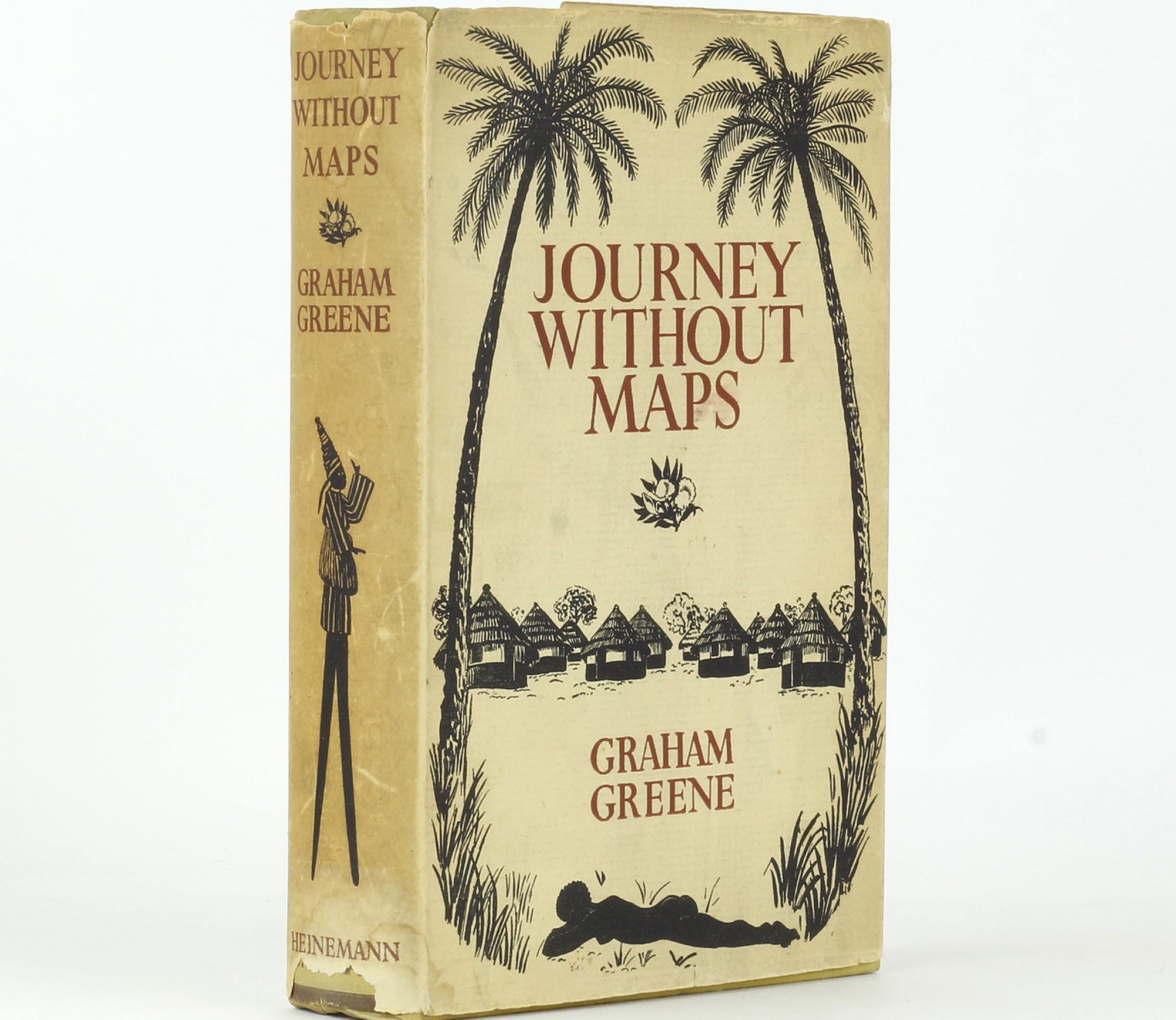
Graham Greene’s 1936 book is widely considered the author’s most important travel book. This review is the 9th in our Historical Travel Books series.
For writers drafting historical travel literature, this text is a crucial case study because it established the structural framework that the 1930s British literary generation defined as “the psychological travelogue.”
The “Inner and Outer” Journey
Greene famously used the physical, agonizing layout of an unmapped landscape to mirror the topography of the human subconscious. The book is less about reaching a destination than about how physical duress exposes the traveler’s internal psychological, moral, and spiritual anxieties.
Greene wouldn’t use such a word, but he was perhaps “finding himself.” Boredom was one reason he went, but he clearly also needed a challenge. He may have been inspired by the great adventures of explorers like Livingstone and Stanley.
Literary Cartography
Written when European powers still produced highly inaccurate colonial maps, Greene deliberately chose a region marked by blank spaces. He uses the map’s literal absence to build a broader metaphor for structural uncertainty, spiritual displacement, and the breakdown of modern Western civilization.
In the first volume of his autobiography, A Sort of Life, Greene wrote that he would not have traveled to Liberia if he had not read H. Rider Haggard, an English adventure-fiction author whose stories are set in Africa and other exotic locales. Greene called his decision to go to Liberia “foolhardy” and the journey itself “absurd and reckless,” “a kind of Russian Roulette.” He did not travel lightly, though, hiring 25 porters in Sierra Leone to accompany him.
Greene draws a parallel between his journey without maps and psychoanalysis, another journey without maps to find yourself. Psychoanalysis was very fashionable in the 20s and 30s. Greene writes: “The method of psychoanalysis is to bring the patient back to the idea which he is repressing: a long journey backward without maps, catching a clue here and a clue there, as I caught the names of villages from this man and that, until one has to face the general idea, the pain or the memory. This is what you have feared, Africa may be imagined as saying, you can’t avoid it, there it is creeping round the wall, flying in at the door, rustling the grass, you can’t turn your back, you can’t forget it, so you may as well take a long look.”
A Roadmap to His Fiction
Historically, this trip laid the narrative groundwork for Greene’s entire literary career. His grueling march through West Africa directly introduced the complex moral conflicts and oppressive backdrops that later defined masterworks such as The Heart of the Matter.
Greene’s account offers insights into Liberia in 1935. Beyond the inhabitants, Greene encountered American and English missionaries, a German adventurer, an American doctor, and a gold prospector. Most of the villages he passed through had seen whites before, but years earlier. Greene documents the deplorable state of public health: only a handful of doctors existed in the whole country. Diseases that ravaged Liberians included yellow fever, malaria, venereal disease, and leprosy.
Greene drank whisky throughout the trip, and it took its toll. He became ill halfway through the journey, during their stay in Zigiter, and almost died in Zigi’s Town near the end of the trip. During this experience, he discovered a “passionate interest in living,” which “seemed that night an important discovery.” The trip also shaped his future writing career.
Greene traveled with his cousin, Barbara Greene, who published her own memoir of the trip, Land Benighted, in 1938 (republished in 1981 as Too Late to Turn Back).
Greene’s main aim on the journey was to find himself. He succeeded: he found a reason to live.
“I was discovering in myself a thing I thought I had never possessed: a love of life.”
He was in far better shape after he began the journey than before: “The sense of taste was finer, the sense of pleasure keener, the sense of terror deeper and purer.”
His conclusion: “This journey, if it had done nothing else, had reinforced a sense of disappointment with what man had made out of the primitive, what he had made out of childhood.”
Historical Travel Books #7: Journey Without Maps, compiled by Tor Kjolberg.
Previous articles in our series of historic travel stories:
Journey Through Wales
The Customs of Cambodia
Gulliver’s Travels
Travels with a Donkey in the Cévennes
Frigate “Pallada” – A Tour Around the World