Innovation in Copenhagen

0

The city of Copenhagen has been named the most innovative city in Europe by Fast Company Magazine, and Denmark remains one of the world’s 10 most innovative countries.

How can a capital in the Northern region foster climate friendly developments, which have bbecome ideals for the rest of the world?

190615-biking-in-copenhagen-wikipedia
A biking population
Copenhagen is the second most bike friendly city in the world. Nearly 40 percent of Copenhagen’s commutes are on bike, and the public transportation system is well developed. The organization  Gobike is developing new ideas – and make them a reality – and hereby making a greener and more liveable city.

190615-open-data-copenhagen
Collaboration across political party lines
At CRCResearch they claim there are three factors critical to Copenhagen’s success:
1. Significant efforts have been made to collaborate across party lines and government departments.
2. Long-term vision.
3. Priorities and initiative based on facts and sound science.

Copenhagen has also been hailed to be one of the best cities to do business in Europe.

Copenhagen Science City

Open Data Portal and climate targets
Copenhagen has its own unique website sharing several sets of data for free, from traffic and road works information to how to create new business opportunities.

In 2013, a corporate team from Cisco visited Copenhagen, and in 2014 Cisco entered into a partnership with the municipalities of Copenhagen, Albertslund and Frederikssund, to research and develop digital infrastructure for the future, the Internet of Everything. The goal is to strengthen services for citizens while supporting Copenhagen’s climate targets.

190615-green-financing
Transition to low carbon economy
Entrepreneurs are invited to share their ideas on a website called Vores omstilling (Our transition). It’s a crowdsourced platform to encourage citizens, companies and the public sector to share their projects.

The image below is from the 8 Houd or the Big House, a large mixed-use development built in the shape of a figure 8 on the southern perimeter of the new suburb of Ørestad in Copenhagen.

190615-carbon-neutral-copenhagen
A unique public-private partnership called the
State of Green is the official green brand for Denmark. Here everybody can find places to improve, test and demonstrate their technologies or systems by exploring the facilities and organizations relating to their themes.

Widespread collaboration
Copenhagen is also looking to reduce consumption and promote collaborative consumption. At the online shop Resecond women can swap nice dresses for a monthly fee of DKK 139 (US$ 20) you have admission to a walk-in closet with quality dresses. You may then swap as many dresses as you like. Jepti is an online portal where citizens can rent, lease or borrow anything from household items and tools to cars.

190615-resecond_website
Financing in Denmark
Copenhagen is still not a financial haven for entrepreneurs, and many have to seek financing from abroad.  However, Michael Eis has founded a crowdfounding platform, boomerang.dk, where entrepreneurs, artists and organizations may fund their smart ideas with support from individuals. Today there is also a crowdfunding association, Dansk Crowdfunding Forening.

Number Eight, Orrestaden, Copenhagen


Want to adopt Copenhagen’s solutions?
Copenhagen won the European Green Capital Award 2014 ahead of 17 other European cities. The experts were impressed by the efforts in Copenhagen to get more people to bike, and to be carbon neutral by 2025. The city want to share their experiences with the rest of the world.Come and see, and come and share with us,” said Casper Harboe, Programme Manager of Sharing Copenhagen.”

Innovation in Copenhagen, compiled by Tor Kjolberg

Four Best Camping Sites in Norway

0

There are so many alternatives, both in summer and winter, so you might having trouble choosing the right camping site in Norway. You may prefer to try your luck fishing in the countless rivers, lakes and fjords, or perhaps your family prefers an amusement park or zoo. If you are seeking a place to relax and stress down, Norway is the right destination. Here are the four best camping sites in Norway 2015 according to NHO Travel.

NHO Travel (Reiseliv) is a member organization consisting of hotels and other accommodation, restaurants, catering and other food service businesses. Members also include campsites, family amusement parks, alpine facilities and other attractions. NHO Travel’s members make their living offering experiences ranging from lodging to rafting: in short, anything in the area of tourism.

Experience the best camping-sites in Norway this year.

Kristiansand feriesenter, Dvergnestangen.
Open all year for rental of cabins, apartments and campsites with capacity to 250 tents or trailers.

190615-Kristiansand_Holiday-Center-Dvergsnestangen-Norway
You may enjoy One Ocean Dive Center, Kristiansand Zoo and amusement park, Agder Nature Museum and botanical garden. Why not a boat trip to Ny Hellesund in Søgne or picturesque Lillesand? If you travel to Evje you may experience forest and mountains and the Evje stone museum. Try canoeing in the waters of Birkenes and Iveland. Experience the nearby forests and mountains , travel to Evje. Visit the Evje Mineral Park. The Kristiansand Region holds a lot.

Moysand Family Camping, Grimstad
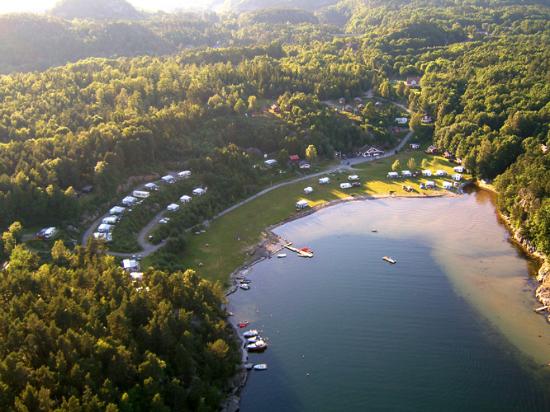
Moysand Family Camping (Established 1929) is surrounded by beautiful nature, nice walking areas and has a wonderful beach. Nearby, only 10 minutes away, you’ll also find Grimstad Golf Course for those interested.

190615-Moysand-Family-Camping-Norway
Moysand rents out motorboats and rowing boats, and there’s a playground and trampoline for kids.

Three 5-star cabins can be rented on a weekly basis. Short distance to Kristiansand (see above).

Sølvgarden Hotell & Holiday center, Setesdalen.
Established in 2007, Søllvgarden is surrounded by waterfalls and mountains, where you can unwind in serene surroundings, enjoy the magnificent scenery and experience Norwegian culture and traditions. Sølvgarden is in the centre of the village of Rysstad, close to the River Otra, where you can go fishing, swimming and canoeing.

190615-Sølvgarden-Hotel-and-Holiday-center-norway
Short distance to Lysefjorden and Stavanger, alpine skiing and mountain climbing.

Hallingdal Holiday Park, Ål
Established in 2013. The only campsite in Scandinavia admitted member of Leading Campingsites Europe (2015). You may rent one of the17 high standard camping cabins, or there are – 180 comfortable sites for trailers and mobile homes, 10 large luxurious trailers for rent, tent sites and main building with restaurant.

190615-Hallingdal-Holiday-Park-Norway
Four Best Camping Sites in Norway, compiled by Admin

Sounds of Scandinavia

The differences are bigger than the similarities in these three very different recordings of Scandinavian Orchestras.

From Denmark:
Niccolo Castiglioni (1932-1996): La Buranella, Altisonanza, Salmo XIX
Denmark Radio Syphony Orchestra/Giandrea Noseda (Chandos)

The composer Niccolo Castiglioni is perhaps not as well-known as his Italian post-war colleagues Luciano Berio and Luigi Nono. If you don’t know the composer you might believe this is unknown baroque music with somewhat unusual orchestration, as the firs composition, La Buranella.

The work is, however, written in 1990, as a tribute to the Italian baroque composer Baldasare Galuppi.

The two next compositions, Altisonanza and Salmo XIX, represent a strong, modern contrast. The interpretations by the conductor and orchestra with choir are impressing.

160615-castiglioni-denmark-radio-symphony-orchestra
“… The simplicity of La Buranella presents a sharp contrast to Altisonanza(1990-92), a three-movement, 20 minute work with, at its centre, a Sarabanda pointing to Castiglioni’s predilection for old forms. The music, though, is thoroughly contemporary, rich in energy and vibrancy, rhythmically complex and brilliantly orchestrated, with a hint of Messiaen about it in the suggestions of birdsong but with a creative personality of its own. The setting of Psalm 19 ratchets up interpretative complexity to another level altogether … a powerful, fervent, haunting experience when performed as compellingly as it is here.”

Geoffrey Norris – Gramophone magazine – June 2015
From Norway:
Leos Janacek (1854-1928): Orchestral Works, Vol. 2
Bergen Philharmonic Orchestra/Edward Gardner (Chandos)

Mystical and humoristic Janacek is here interpreted by the newly assigned conductor of BFO, Edward Gardner, which began to explore the Czech composer last year.

This issue gives us an interesting bundle of orchestral works from Janacek’s midlife compositions, dominated by Slovenian folk music. Most interesting is the orchestral poem Taras Bulba, inspired by the Gogol novel.

160615-janacek-bergen-philharmonic
Both Taras Bulba, Blanik and the symphony Danube are inspired by East European poems and stories. This is musical storytelling of high quality.

From Sweden:
Carl Nielsen: Symphonies nos. 2 and 6.
Royal Philharmonic Sweden/Sakari Oramo (BIS)

The Danish composer Carl Nilsen is perhaps most known for his six symphonies. Here two of them are performed by perhaps the world’s best Carl Nielsen interpreter.

Carl Nielsen, born a short generation after Edvard Grieg, mastered the big orchestral format, and all his symphonies have now been recorded by Kungliga Filharmonikarna, as the orchestra is named in Swedish.  All recordings have received startling reviews.  The orchestra’s Finnish conductor brings the orchestra to new heights; the humoristic parts become happy listening, the tragic parts become real sad, and the melodic themes are heavenly.

160615-carl-nielsen-stockholm-filharmonikarna
“Oramo certainly pushes his orchestra to the limit, and yet the first movement never seems rushed or overdriven. Indeed, there’s a sense that the conductor is playing the music for all it’s worth, and his willing band are well up to the challenge,” wrote Dan Morgan in Musicweb International

If you want to familiarize yourself with Carl Nielsen, this is a recording for you.

Feature image (on top) Stockholmsfilharmonikarna, photo Jan Olav Wedin

Sounds of Scandinavia, written by Tor Kjolberg

Norwegian Songwriters Conquer Asia

Several Norwegian songwriters and production companies have succeeded in the Asian market. More than 4.5 million copies have been sold in the period 2013-2015. The group Girls’ Generation is for instance considered ten times bigger in Asia than Spice Girls.

050615-Girls'-Generation
Here are the best-selling albums and singles:

Wolf, performed by EXO, Number 1 in South Korea and China, sold 1.400.000 copies. Songwriter Dsign/Herman Harambasic. (Album: XOXO)

The Star, performed by EXO, Number 1 in South Korea and China, sold 700.000 copies. Songwriters Dsign/Martin Mulholand and Nermin Harambasic (Album: Miracles in December)

Starting over, performed by J Soul Brothers, Number 1 in Japan, sold 420.000 copies. Songwriter Warner/Chapell Norway – Mats Lie Skåre. (Single-release)

This is Love + Let’s Dance, performed by Super Junior, Number 1 in South Korea and Taiwan, sold 400.000 copies. Songwriter Dsign/Nermin Harambasic. (Album: Mamacita)

Melrose, performed by Exile Atsushi, Number 1 in Japan, sold 361.000 copies. Songwriter Warner/Chapell Norway – Mats Lie Skåre. (Album: Love Ballad + Music)

Rise, performed by TVXO, Number 1 in South Korea, sold 196.000 copies. Songwriters Dsign/Martin Mulholland. (Album: Tense)

Soul, performed by Girls’ Generation, Number 1 in South Korea, sold 184.000 copies. Songwriters Dsign/Anne Judith Wiik, Ronny Svendsen, Nermin Mulholland and Robin Jenssen. (Album: Mr. Mr.)

https://youtu.be/EKUZk0HpTsU

Back hug, performed by Girls’ Generation, Number 1 on South Korea, sold 184.000 copies. Songwriters Warners/Chapell Norway – Jesper Borgen and Ingrid Skretting. (Album: Mr. Mr.)

Genie, Beep Beep, Love & Girls, performed by Girls’ Generation, Nu,ber 1 in Japan, sold 175.000 copies. Songwriters Dsign/ Anne Judith Wiik, Ronny Svendsen, Nermin Mulholland and Robin Jenssen. (Album: The Best)

https://youtu.be/iCz55KH5LpU

Sunny Day Hero, performed by Shinee, Number 1 in South Korea, sold 124.000 copies. Songwriters: Warner/Chapell Norway – Kim Bergseth and Tom Hugo. (Album: I’m your boy)

Chaos + Dear performed by The Second from Exile, Number 1 in Japan, sold 63.000 copies. Songwriter: Warner/Chapell Norway – Mats Lie Skåre. (Album: The II Age)

Imagine, performed by Kumi Koda, Number 1 in Japan, sold 60.000 copies. Songwriter: Warner/Chapell Norway – Mats Lie Skåre. (Album: Bon Voyage)

LOL, performed by Kumi Koda, Number 1 in Japan, sold 59.500 copies. Songwriters: Dsign/Anne Judith Wiik, Ronny Svendsen, Nermin Mulholland. (Album: Bon Voyage)

Pain is Love + Deep lines, performed by Tomomi Itano, Number 1 in Japan, sold 34.000 copies. Songwriter: Warner/Chapell Norway – Mats Lie Skåre. (Album: Little)

050615-tomomi-itano
Dsign Music, which appears several times is a songwriting/production company, originally from Trondheim, Norway. Today the core team is based in Los Angeles [US] and Seoul [Korea]. Dsign Music was formed in 2006 by Robin Jenssen, Anne Judith Wik, Nermin Harambašić and Ronny Svendsen.

The core team was signed to Universal Music Publishing Group in 2008. They have been involved in numerous #1 singles worldwide, a total of 15 #1 on the US Billboard and multiple platinum and diamond albums. Dsign Music is also involved in other ventures such as musicals, TV-shows and movie scores.

050615mats_lie_skare
The songwriter Mats Lie Skåre has reached the Japanese hit-lists about 30 times.

Norwegian Songwriters Conquer Asia, compiled by Tor Kjolberg

Feature image (on top)Image. Norway-based Dsign Music — (from left to right) founders Nermin Harambasic, Robin Jenssen, Anne Judith Wik and Ronny Svendsen

Star Food in Copenhagen

0

Should you be unable to book a table at the world’s best restaurant, there are 15 Michelin star restaurants in Copenhagen. Here’s our guide to 11 of them.

Geranium
Per Henrik Lings Allé 4

Go to Fælledparken in the Østerbro area and you’ll find Geranium restaurant on the 8th floor. Tte restaurant holds two stars in the Guide Michelin Nordic Cities 2015.

170615-geranium-restaurant-copenhagen
Geranium was ranked the 42nd Best Restaurant in the World in 2014 by Restaurant Magazine and is run by the world’s best chef in 2011, Rasmus Kofoed.

In addition to excellent food you can catch glimpses of Copenhagen’s green copper roofs and the windmills of Øresund.

The chef Rasmus Kofoed is a triple winner of the gold, silver and bronze medals, the most winning chef in Bocuse d’Ore ever.


Noma
Strandgade 93

Noma Restaurant was this week for the third year in a row voted the World’s Best Restaurant. No wonder 20,000 people try to make a reservation at the restaurant with two Michelin stars every month. There are, however, only 45 seats in the restaurants, so be prepared to be on the waiting list.

170615-Noma-Restaurant-Denmark
René Redzepi is the chef and owner of Noma and is widely reconized as one of the world’s most influential chefs. Redzepi has also written several books, and A Work in Progress is his latest.

AOC
Dronningens Tværgade 2,

AOC restaurant has two Michelin stars.

170615-aoc-restaurant-copenhagen
Head chef Søren Selin and his team are using fresh Nordic produce sourced from both earth and sea and are striving to achieve perfection within the ‘New Nordic Kitchen’.

Somelier Christian Aarø taste and select wines from the bottle to perfectly accompany the food.

Marchal
Hotel d’Angleterre, Kongens Nytorv

Marchal has one Michelin star.

170615_Marchal-restaurant-copenhagen
Jean Marcal and Maria Coppy established the restaurant in 1755. Chef Christian Gadient is commanding the kitchen and serves a classic French menue with traditional delicacies like lobster, truffle and foie gras.

Most dishes are served starter-sized, but you may have some larger favourites (livretter) such as chateaubriand if you order for at least two people.

Grønbech & Churchill
Esplanaden 48/Amaliegade 49

Grønbech & Churchill was awarded one Michelin star in 2015.

The restaurant is owned bu the well-known Danish chef Rasmus Grønbech. The restaurant is located in the center of the Danish Resistance Museum – hence the name.

170615-Grønbech-Churchill, Copenhagen
According to the Michelin inspector “this ultra-chic restaurant comes with crisp linen, fine china, minimalist styling and views of the chefs in the designer kitchen. Two set menus offer cleanly and confidently prepared dishes with bold flavors. Relaxed service is courtesy of a young team.”

Kadeau
Wildersgade 10, Christianshavn

Kadeau restaurant was awarded its first Michelin star in 2013 and was situated on the island Bornholm. Today ot shares the Bornholm delights with Copenhagen.

170615_Kadeau_Restaurant_Copenhagen
The menu is ionspired by Bornholm specialties and Danish ingredients, like octopus, oysters, pork belly and beetroot. The menu changes according to season.

Era Ora
Overgaden Neden Vandet 33B

This one Michelin star restaurant offers the very best of North Italian cuisine.

Dishes are prepared according to time-honored, traditional methods using fresh ingredients that are flown in from Italy.

170615-era-ora-restaurant-copenhagen
The wine cellar contains 75,000 bottles and approximately 700 labels. Critics claim that Era Ora is the best Italian gourmet restaurant outside Italy.

Kiin Kiin
Gulbergsgade 21

Kiin Kiin restaurant is the first Michelin-awarded Asian gourmet restaurant in Copenhagen.

170615-kiin-kiin-restaurant-copenhagen
This charming and exclusive restaurant epitomizes the best of Oriental and European cuisines. A set menu include seven delectable dishes and accompanying wines.

The restaurant is closed in July, when chef and staff go to Thailand to gather inspiration for the next seasons.

Studio
Havnegade 44, Nyhavn

Restaurant Studio creates dishes that represent Danish nature. Studio received its Michelin star in 2014.

170615-studio-Standard-restaurant-by-GamFratesi-Copenhagen-Denmark
The restaurant offers a la carte and a menu which is assembled from 12 daily a la carte dishes. You find the restaurant on the first floor of The Standard, which also houses the restaurants Almanak and Verandah, as well as a jazz club.

Kokkeriet
Kronprinsessegade 64, Nyboder

This one Michelin star restaurant is located a bit off the hustle of the inner city.

Charming interior design a personal, relaxed atmosphere and excellent food is your guarantee for a pleasant experience.

170615-kokkeriet-restaurant-copenhagen
The menu is modern European, flavored with Danish finesse and old traditions. You may choose between a 3, 5 or 7 course menu. The price range is a pleasant surprise.

Clou
Borgergade 16

This Michelin one star restaurants is managed by the twin brothers Jonathan and Alexander Berntsen.

The small room is luxurious but the atmosphere is informal. The menu represents flawless classic craftsmanship and you may choose between a seven dishes set menu or á la carte.

170615-Clou-restaurant-copenhagen
Beside the restaurant, there is a wine bar and wine shop.

Star Food in Copenhagen, compiled by Admin.

Pop Art Design Exhibition in Oslo

The Pop Art Design Exhibition takes place at the Henie Onstad Kunstsenter and explores the connections between art and design in a selection of hundreds of works by both designers and artists.

Pop Art is widely regarded as the most significant artistic movement since 1945.Famous design icons and classics have revolutionized our relationship to everyday objects. The exhibition covers art and design objects from the early 1950s to the early 1970s and features Jim Dine, Richard Hamilton, Pontus Hultén, Claes Oldenburg, Verner Panton, Ed Ruscha, Reiner Ruthenbeck, Andy Warhol and others.

100615-pop-art-design-3
Bold objects designed by Raymond Loewy, the colourful furniture and even more colourful lifestyle proposed by Charles and Ray Eames, or the intricate graphic designs of the period, have all penetrated the art world marking it unforgettable.

Vitra Design Museum presented the first-ever comprehensive exhibition on the topic “Pop Art Design” in 2012. The exhibition has since traveled to major cities around the world and paints a new picture of Pop Art – one that finally recognizes the central role played by design.

100615-pop-art-design-5-daily-scandinavian
The exhibition was presented at London’s Barbican in 2013.

https://youtu.be/-e2WwmCwzW0

About the exhibition in London, Ben Luke in London Evening Standard wrote:

“Amid the vast amounts of material, there’s a profound sense of artists and designers wanting to form new languages and engage with modern technologies, so a group of then-new Tupperware boxes sit close to a sublime plastic lozenge of light by Californian artist Craig Kauffman”.

“Pop Art Design” includes photography, architecture and both graphic and furniture design and explores the decades following the Second World War, providing an insightful and colorful perspective on the arrival of art into the everyday.

100615-pop-art-design-4-daily-scandinavian
The exhibition is on cooperation with the Vitra Design Museum, the Louisiana Museum of Modern Art, Humlebaek and Moderna Museet, Stockholm.

The exhibition lasts until September 6.

Pop Art Design Exhibition in Oslo, written by Tor Kjolberg

Artist Talk in Stockholm

World famous fashion photographers Inez van Lamsweerde and Vinoodh, opens the exhibition “Pretty Much Everything 2015” at Fotografiska in Stockholm today. Tonight visitors might hear the couple Inez & Vindooh telling their own story about their images and their work. The exhibition is. however, open through 27 September.

It’s hard to read an international fashion magazine these days without seeing an image created by the Dutch couple Inez van Lamsweerde and Vinoodh Matadin. Their work is an exciting blend of art, fashion and advertising. At Fotografiska in Stockolm you may experience some of their iconic portraits, fashion photographs, collages and sculptures.
120615-Fotografiska-Stockholm-Inez-van-Lamsweerde-Vinoodh-Matadin
In more than two decades the couple has challenged and inspired the fashion photography world by their somewhat reckless photographic language. It always seems to be a low-spoken twist in their apparently simple images. Many of their fashion photographs have an ironic sprinkling, an humorous whim or a life-loving expression which differs from traditional posing.
120615-Edita-Vilkeviciute-for-Bonbon-by-Viktor-and-Rolf1 Pop into a magazine store, and you’ll find their photos I fashion bibles like Vogue, V Magazine, W Magazine, Flair, Porter, Bonbon and others, promoting today’s world fashion leaders.

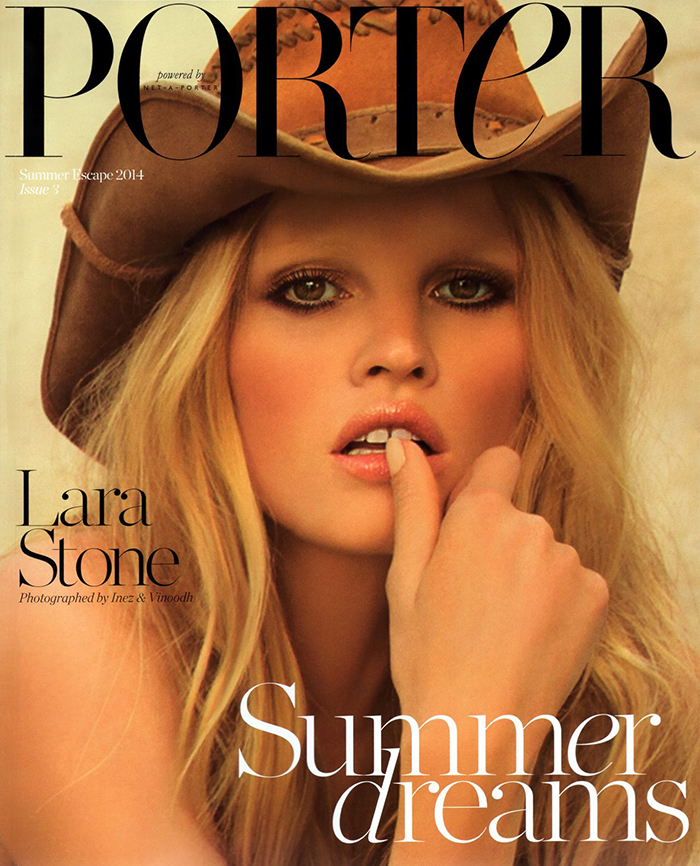
120615-Lara-Stone-by-Inez-and-Vinoodh-for-Porter-Magazine
In this summer’s T Magazine, The NY Times Style Magazine, Icelandic artist Bjork takes the cover story on women’s fashion spring 2015 edition, lensed by Inez & Vinoodh.
120615-Gisele-Bundchen-covers-Vogue-Brasil
The photographers work hard on small details and symbols which mirror the models’ personality, like a body form, accessories or a pattern. They unwind the borders between the traditional male and female and focus on the human being, rather than the origin or sex.

The couple has issued a photography book, “Pretty Much Everything”, made a perfume and a jewelry line. The music video they directed for Lady Gaga’s Applause has cumulated almost 211 million plays on You Tube.

https://youtu.be/pco91kroVgQ

Inez and Vindooh has worked with fashion labels like Dior, Calvin Klein, YSL and Louis Vuitton. They have portrayed stars like Bjork, Lady Gaga and Clint Eastwood, all thoroughly idea based on the person’s personality or the label’s style. This often results in something the couple has named Sculptographs, a blend of photography and sculpture in cooperation with Eugene van Lamsweerde.

120615-Bjork-T-NYTimes-Style
Inez and Vinoodh live and work in New York. They are represented by Gagosian Gallery, and their exhibition in Stockholm is their first in the Nordic region. Visitors may see more than 100 images, showcasing a universe of images.

Several of their fashion and music videos will also be shown at the exhibition.

Inez and Vinoodh met as students at Art Academy in Amsterdam and their formal cooperation began early in the 1990s. Lamsweerde was at that time inspired by Helmut Newton and Guy Bourdin, not least because her mom bought home the French Vogue from her workplace in Paris. Vinoodh Matadin was inspored by Ed van der Elsken and Richard Avedon.

Alexander McQueen - V Magazine, 2004
Alexander McQueen – V Magazine, 2004

The Dutch couple, who also are married, have been darlings of the fashion world for much of their two decades career. Now they are crossing over into a cultural mainstream. Their goal is to become a lifestyle brand.

The exhibition is a cooperation between Inez and Vinoodh, Gagosian Gallery and Fotografiska, Stockholm.

Artist Talk in Stockholm , written by Tor Kjolberg

A Norwegian’s Passion for Design

0

An humble Norwegian from the small island of Fogn, outside Stavanger, is one of the world’s most exciting designers. Per Ivar Selvaag studied transport design at the Royal College of Art in London, and has been lead designer for BMW as well as chief designer at Peugot.

110615-peugeot-per-ivar-selvaag
Selvaag got a kick-start when Land Rover by chance noticed his university project at the Coventry University. The company was so impressed that it sponsored his Master’s degree at The Royal College of Art in London (1997).

Alu Design marine chairs

Later he relocated to San Francisco where he was managing partner at Native Design LLC.

Today Selvaag has signed an exclusive agreement with the Norwegian-based (Kristiansand) company Alu Design where he will design advanced marine pilot and operator chairs. Einar Ulrichsen, the CEO at Alu Design claims this as “a huge coup for the business”.

As a part of the San Francisco-based company Montaag he has agreed to work on the state-of-the-art moulded aluminium chars and not design chairs for any other manufacturer.

110615-alu-design-marine-chairs-2
Alu Design supplies advanced pilot chairs and deck rails to clients including Kongsberg Maritime, Oceaneering, Rolls Royce and Aker Solutions. The firm’s MH OCH 300 operator chair attracted global attention this summer when it was featured prominently in the Transformers: Age of Extinction film sets.

Peugeot HX1 concept interior

Per Ivar Selvaag  worked for General Motors Advanced Design in Birmingham (1999-2000) and Lincoln Design Organization in Detroit (2000-2006).

110615-BMW
He designed the 4-series range for BMW, unveiled his startling Peugeoy HX1 hybrid concept car, where he was chief designer from November 2010.  He founded Montaag after 15 years as a vehicle designer.

A Norwegian’s Passion for Design, written by Tor Kjolberg

Michael Booth on Sweden

0

Are the Swedes different from the Danes or the Norwegians? In his book «The Almost Nearly Perfect People» British author and journalist Michael Booth wonders what the Scandinavians really are like. Here are excerpts from his book, published by kind permission of the author. Michael Booth on Sweden.

Writing about what the three Scandinavian tribes really think of each other is a bit like discussing someone else’s marriage – you never really know how one feels about the other, deep down, how they talk to each other when they are taking their make-up off and brushing their teeth at the end of the evening. I only know how Danes, Swedes and Norwegians talk to an Englishman about each other, and it has to be said that the main topic of conversation on that front is how annoying the Swedes are. None of their neighbors seem to like Swedes very much. Historic enmities still simmer, resentments linger, the Swedes still have a habit of getting up people’s noses. The Swedes meanwhile, tend to remain aloof to the regional resentment.
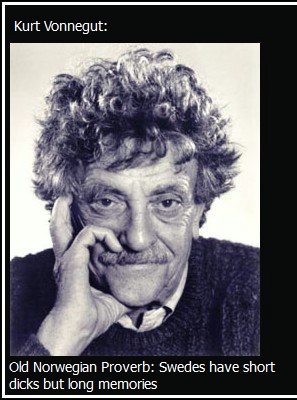
100615-norwegians-about-the-swedes-Kurt-Vonnegut_Fotor
“We really like the Danes, they are lovely people,” Åke Daun told me. “There are Danish characterizations of the Swedes, saying we are more efficient and hard-working, more serious and so on, while we think the Danes are charming, warm. Lovely, a little chaotic. We envy their lack of alcohol restrictions.”

“Tha Danes have always been seen as the more easygoing, cosmopolitan, less working, more drinking, more frivolous people; less, shall we say, industrious than Swedes,” Jonsson, the multiculturalism expert from Stockholm University told me. “We go to Copenhagen to breath Europe, to have a beer. It’s looser, freer, more European, and you also have this more open attitude to drugs and alcohol, but more recently people are shaking their heads that Denmark has become a fascist country, at war with Islam, extremely eager to send aircraft to bomb Libya.”

100615-denmark__sweden_and_norway_by_jennimakemake
Leaving aside the notion of Danes really ‘knowing how to have a good time’ (clearly he has never spent an afternoon on a sports hall in Slagelse watching a women’s handball matrch – neither have I, actually, but the though…), Jonsson, Daun and many of the Swedes I spoke to seemed oddly obvious to how disliked the Swedes are. I suspect they might be taken aback by the extent to which the Danes bad-.mouth them to anyone who’ll listen.

“They are so stiff and boring,” is the common Danish description of the Swedes, ‘and they don’t know how to handle their beer.’  They didn’t win back Skåne,’ one Danish friend told me, referring to the stroll traumatic (to the Danes, at least) year of 1658 when the Swedes wrestled the Danes’ southern province from them. ‘We granted them their freedom.’ (I once heard a Danish radio talk show in which the host only half-jokingly suggested that Sweden’s traditional August crayfish party season would be a good time to reinvade the south and take back their former territory.)

100615-danish-beerdrinker
I asked Henrik Berggren about Swedish-Danisk relations, pointing out that Swedes could afford to remain aloof from the Nordic trash-talk as they have, but just about every measurement, ended up richer, and more successful than their neighbours.

“Yes, we were the winners,” he agreed. “The big brother, definitely. But there is more animosity in it than we understand at first. When I was growing up we had a very positive view of the Danes and Denmark. They were like us – welfare state, modern – but by God they were a lot more fun than us. Danish women! Christiania! Smoking hash! I think a lot of Swedes felt like the Danes had it all, plus a bit more joie de vivre. But with this whole Danish anti-immigrant thing the perception of Denmark has changed drastically into “God, we don’t understand this. Where did this come from?” And it’s kind of funny because I think it’s kindled a kind of Swedish nationalism in a sense that before we felt a bit inferior to the Danes, but suddenly now we can get on a moral high horse.”
100615-swedes_attack_by_zabdyr
And boy don’t the Danes know it: they are mightily tired of the Swede’s sanctimony towards their immigration policy and their condescension regarding the rise of the anti-Islamist Danish People’s Party. Tee Swedes haven’t just got on their high horse over what they perceive as Danish racism and xenophobia, they are standing on its back, riding round the circus ring juggling fire and playing kazoos. Oh, how long they have waited to repay all the slights about their Nazi past and ‘cowardly’ neutrality, the jokes about the hairnets and the armament sales. And they have seized their chance.

In truth though, if we can set aside the typical younger brother resentment of a patronizing older sibling, the Danes don’t have very much reason to resent the Swedes, and neither do the Norwegians, who certainly those days have enough money to rise above ancient bitterness. They probably do have grounds for anger, but guys, I think it’s time to move on. For all the moaning about the Swedes, I remain convinced that there is greater fellow feeling up here in the North than between any of the other countries in Europe. I am not aware of much grudging affection emanating from the Belgians towards the French, for instance, or from the Swiss towards the Italians, do you? For all the bickering, the Nordic region is hardly likely to go the way of the Balkans. As Stefan Jonsson pointed out to me when I got a little carried away on the subject of inter-Scandinavian rivalry, “This isn’t Israel-Palestine, you know.”

100615-sweden_welfare
The fact that the Swedes have appeared fallible in recent years ought to have helped temper neighborly jealousies a little. They are facing similar problems to the Danes in terms of having to curb their welfare state and keep their provinces from dying a slow death, and have even greater challenges in the areas of integration and globalization.  The truth is that the great Swedish social democratic adventure hit the buffers a couple of decades ago when the country’s economy tanked and the then government introduced quite radical privatization programs, reduced taxes and began to tackle the welfare state. Yet the rest of the world has still not really cottoned on how much Sweden has changes – in the US, right-learning politicians still cite Swedish society as an example of socialist extremism when really it is no such thing. The Sweden we came to know and politely admire while secretly being glad we didn’t live there, is, these days, an uncertain place in a state of political flux.

According to Stefan Jonsson, his country has reached a crucial crossroads. “There is huge confusion in Sweden. I think it is a society on the edge of cracking up. Mentally it is disintegrating, questioning what it is. Questioning social democracy. Many are now wondering what to salvage, whether this is sustainable, and what will come if it is not sustainable.”

100615-swedes
This sounds dramatic – we are still talking about Sweden here, after all – but to pluck out one sobering statistic, as I write Sweden’s ratio if tax revenue to GDP is 47.9 percent – the fourth highest in the world (with Denmark third). To give you an idea of what kind of an indicator this is of the economic well-being of a country, Zimbabwe is second and Kiribati first.

“I am not optimistic for Sweden,” agrees Ulf Nilson. “We have to open up this rigid system; the welfare state is too bureaucratic. Too many people are invested in the system. Tax strategy is the obvious key to it all. I live in France and there, if I earned 100,000 kroner a month, they take maybe 30,000 of it. Here they take 50,000, but there is no doubt that French healthcare is better. So are we being taken for a ride? Yeah, we are being taken for a ride. The fact that we have thousands of people who could work living on the dole is of course not good. That dependence system is no good. I have left Sweden and become a millionaire by work. You could never do that here. I feel I have escaped, I was lucky.”

100615-leaving-sweden-banner
As always, Henrik Berggren remains a lone voice of optimism: “The system is doing rather well. I’ve lived through all these prognoses that it isn’t going to work because people aren’t motivated to work, and so on. Do you see a society decaying around you? Be honest. We might be a bit rude, but….”

One deeper issue did trouble me about Sweden’s long-term prospects: in rejecting their Lutheran principles to embrace consumerism and the various temptations of the modern world, had the Swedes perhaps thrown the puritanical baby out with the globalization bath water? Put differently, consider all those old agrarian principles of self-sufficiency, caution, modesty, equality and parsimony, the instinctive urge to compromise, to cooperate and share – the very characteristics that laid the foundations for the Social Democratic experiment. Are these characteristics not inevitably, fatally eroded by increased wealth, consumerism, globalization and urbanization? Is the country’s great modern, urban experiment not destabilizing the very foundation on which that modernity was constructed?

100615-Typical-swedes
Åke Daun answered this with the breezy “Oh yes, I think so, yes” of an elderly man who has seen it all before and has resigned himself to the world going to the dogs.

Andrew Brown appeared to agree to: “Whether prosperity can survive without the memories and disciplines of poverty is a question I don’t know the answer to.” In his book Fishing in Utopia Brown points to the marked rise in crime in Sweden since the 1970s, in particular rape (in recent years Sweden has seen the highest number of reported rapes per capita in Europe); to the McDonald’s fever sweeping the country with the result that he begins to notice obese people in the streets of Stockholm for the first time; to the changing media landscape (“A generation of flamboyant gangsters and businessmen, not always easy to tell apart, moved through the newspapers”);  to a new openness about alcohol, symbolized by the slick rebranding of Absolut Vodka, once a resolutely unglamorous state-owned alcohol producer (‘Drunkenness came back into fashion”), not to mention the loss of two-fifths of industrial jobs since the mid-seventies. All, he says, are signifiers of a country which is, essentially, making one final circumnavigation of the plughole.

100615-absolute-dislexia
I don’t believe this is the case, but Sweden does appear to be sitting on a demographic time bomb. It is the only country in the world in which people over eighty years old make up over 5 per cent of the population (the global average is 1 per cent). Almost 20 per cent of Swedes are over sixty-five, making Sweden the oldest country in Scandinavia, and the eighth oldest in the world. The World Bank predicts that by 2040 a third of Swedes will be over retirement age. But Sweden, as you would expect, is well prepared (unlike, say, Italy, which is truly screwed in this regard). It has a highly developed state pension system which is expected to be able to cope with future demographic challenges; the IMF ranked Sweden seventh globally for its current elderly care and its future preparedness in terms of looking after an aging population.

In the final analysis, perhaps we shouldn’t be so worried about Sweden. As Henrik Berggren pointed out, people have been writing off his homeland since the seventies, and even after the early nineties, when the Swedish model did appear to have been fatally undermined by its economic imbalance, it recovered quickly and strongly. Sweden still has one of the highest-achieving economies in the world chiefly because it overhauled the old Democratic structures and transformed itself into a rather unique type of mixed economy, and introduced both some marked liberal economic tendencies and strict fiscal and banking controls.

100-year-old Swedish twins Gunhild Gaellstedt (L) and Siri Ivarsson (R) with a cake from the "Twinregistry" as they holds their long lifes first pressconference in their home in Stockholm 28 January 2005. The birthday is on Sunday 30 January. The two are the oldest twins in Sweden that according to the Twinregistry, counts to 86 000 couples. The two manage their daily life without a permanent assistance. They will celebrate their 100th birthday on 30 January 2005.

So Sweden is probably safe economically for the time being. Politically it has endured the assassination of its prime minister and its foreign minister (the latter, Anne Lindh, was stabbed to death in a Stockholm department store in 2003; as it happened the day after I had visited). But how resilient is it culturally? One thing that often surprised me during my travels in Sweden was the dismissive attitude of many Swedes I spoke to about their country’s cultural output. I’ve always thought of Sweden as being home to heavy hitters like Strindberg and Bergman, as well as all those massively popular authors like Astrid Lindgren, Henning Mankell and of course Stieg Larsson. From Jenny Lind, the Swedish nightingale on whom Hans Christian Andersen doted, to ABBA and Robyn, Sweden has also sent forth great popular singers and songwriters into a grateful world.
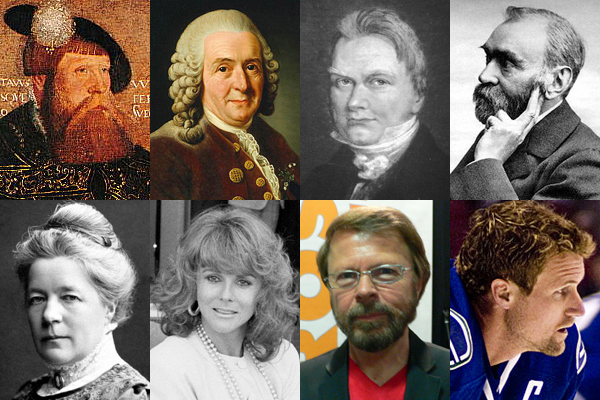
100615-famous-swedish-people
Nevertheless, comments such as this from Åke Daun were not untypical: “Culture is not a big thing in Sweden. We are technically creative, not artistically.” He suggested that Sweden’s self-image was more invested in being a successful manufacturer of ball bearings, zippers and safety matches.

“It’s true, you run out after Bergman and Strindberg,” agreed Stefan Jonsson. “Culturally and intellectually the international contribution of Sweden is quite limited, but the typical Swedish intellectual believes the country is big enough for him to have a career, and not so small that he feels he needs to go outside and bring things in. It’s the tragedy of being a mid-sized country.”

100615-swedish-safety-matches

When I tentatively mentioned the country’s paucity of cultural titans to Henrik Berggren, he reacted with his customary patriotic vigor.

From what objective standpoint are you saying this? That sounds rather typically British, to be honest, a rather snotty British attitude to the world: ‘I can sit on my island and I can judge all cultures…’”

Oh dear. Honestly, Henrik, that’s not what I meant.

Though, you are right, I probably am a snotty Brit.

You might laso like to read:

A Literary Masterpiece About the 22nd July Massacre in Norway

The Nearly Almost Perfect People

Danish Bacon

Michael Booth on Scandinavia

Egoiste from Norway

Positive Trend for Norwegian Salmon

0

Norway exported salmon worth NOK 3.5 billion in May. This is the same value as in May 2014, according to analysis from the Norwegian Seafood Council.

Salmon from Norway is in a class by itself among international consumers, according to the latest statistics from the Seafood Council. “Salmon has its natural place in the future,” according to physician, professor and EAT-advisor Alessandro R. Demaio.

IMG0034.PCD;1
”The salmon market has developed broadly as expected following the exclusion of Norwegian salmon to the Russian market”, says Bjørn-Erik Stabell, Marketing Manager for Salmon at the Norwegian Seafood Council.

The annual global consumer research conducted by the Seafood Council shows that the public opinion of Norwegian salmon has improved from 64 to 69point in the course of only one year. More than three times of consumers prefer Norwegian salmon compared to salmon from Alaska, which has a good number two ranking.

”Exports to Eastern Europe have returned, increasing exports to core markets within the EU. Particularly pleasing is the positive development of the largest export market France. This is a market that has seen a negative trend in recent years, but that trend has now reversed”, observes Stabell.

“The world looks to the North when it comes to food, which gives food producers from these countries advantages on international markets. At the same time it is evident that the rest of the world cannot eat the way you do in the north. We have to change to a more vegetarian based diet and supplement with fish and poultry instead of red meat,» says Allessandro R. Demaio.

090615-Norwegian-salmon
84.739 tons of salmon were exported in May, an increase of 4 per cent compared with the same period last year.

So far this year, salmon exports have been worth NOK 18.1 billion. This is NOK 97 million more than during the same period in 2014. Export volumes so far this year, in total 408.000 tons, an increase of 7 per cent year-on-year.

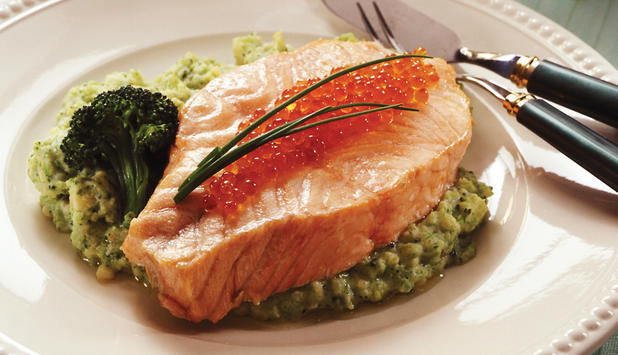
090615-salmon_steak-daily-scandinavian
Last year the international fish farming group Cermaq, with head office in Oslo, were purchased by the Japanese Mitsubishi Corporation. The director of the board, Yu Sato, confirms that the organization’s sustainable profile was a decisive motivation for the acquisition.

Positive Trend for Norwegian Salmon, written by Tor Kjolberg