Norway’s Parliament Building Celebrates its 150th Anniversary

0

The Storting building (Norwegian: Stortingsbygningen), the seat of the Storting, the parliament of Norway, is located in central Oslo. It was taken into use on 5 March 1866 and was designed by the Swedish architect Emil Victor Langlet.

Langlet was intent on making the Storting building accessible to the population. The stairs to the Storting Chamber’s public gallery start from just inside one of the three elegant doors, facing main street Karl Johan.

240316-lion-sculture-outside-stortinget-oslo
When the Storting building was completed in 1866, it was unique and innovative. It didn’t look quite like other parliaments; a relatively small building, yet one with a character all of its own. Rather than towering grandly above the people, it joined them at street level, comfortable among the city populace.

The Storting Chamber, its circular form clearly visible to the outside world, provided the population with a tantalizing glimpse of the democratic debate taking place inside. The front of the Storting was an example of how a parliament ought to appear and be: open and accessible, with windows looking out on the electorate, and nine equal entrance doors to invite the public in.

240316-parliament-building-oslo-interior
“By marking the 150th anniversary of the building, we will also be celebrating what takes place inside. This will be a truly festive occasion,” said Olemic Thommessen, President of the Storting.

Today the Storting is among Norway’s most characteristic buildings, and has become an integral part of the urban landscape. Yet the fact that the Storting is sited where it is, and the fact that it looks like it does, was hardly a foregone conclusion. The building’s completion in 1866 was the culmination of several decades of vehement debate about location and design. An architectural competition was arranged, and the original winning entry was a towering neo-Gothic structure. This was never built.

The Nazi-occupied Parliament in 1941

The Storting is a building that richly deserves to be celebrated. 2016 will play host to a wide variety of jubilee events and initiatives, including exhibitions, seminars and city walks. And on 9th May the Storting has invited children to a very special outdoor jubilee party. Invitations have already been sent to all 5th year school classes in Oslo and Akershus. That same afternoon, the Storting will also be opening its doors to the public.

After only a few decades, however, it became clear that Langlet’s Storting was too small. A new architectural competition was announced in 1949, and once again the building became the center of intense debate.

240316-storting-oslo-interior
When celebrating the 150th anniversary of the Storting building, we are also toasting the successful union of two architects and two epochs. “The new has entered into a joyful union with the old,” as President of the Storting, Nils Langhelle, so aptly put it in 1959.

A new book about the Storting building, written by the architect Peter Butenschøn, has been launched. A film about the history of the building will also be given its premiere. Both the book and film will also be available in English.

240316-jubilee-book-by-botenschon-about-norway-parliament-building
The National Museum of Art, Architecture and Design will be putting on a special jubilee exhibition to mark the anniversary of the Storting building. The museum will be displaying original drawings and models connected to the process leading up to the building of the Storting in 1866. The anthology Debatten om stortingsbygningen 1836–1866 (“The debate about the Storting building 1836-1866”), edited by Mari Hvattum, will be launched at the opening of the exhibition on 12th March. More about the National Museum’s exhibition.

Norway’s Parliament Building Celebrates its 150th Anniversary, compiled from Stortinget’s official websites
Welcome to Norway’s Factory Towns

0

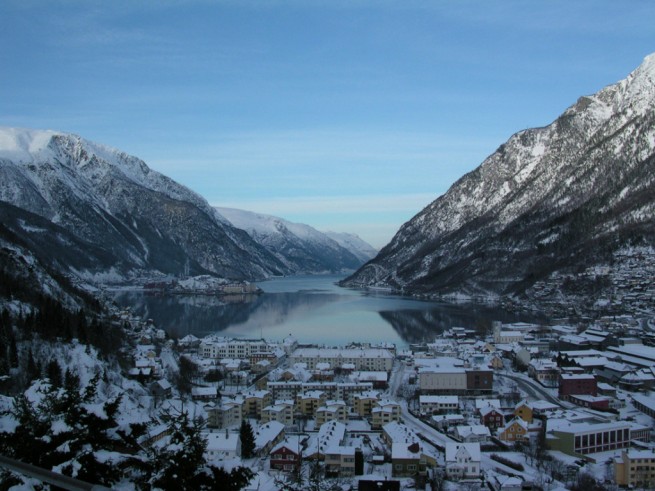
The story of how Norway in the course of one hundred years went from poverty to riches started in the factory towns. In the period 1905-1920, the towns were established by the deep fjords in the valleys where there was access to power: Rjukan, Notodden, Tyssedal, Odda, Høyanger, Sauda, Ålvik and Glomsfjord.


110316-factory-towns-in-hardanger110316-eva-royrane_photo_jan_m_lilleboe
Every day the residents of these towns crept out of their architect-designed houses and showed up at the factory. Afterwards they visited Norway’s best libraries, were swimming in one of the country’s first swimming pools, were kissing in the back row in the finest theatres and watched sports games at the country’s best stadiums.

Eva Royrane has written a book on the “Factory Towns in Hardanger”. “In the early 1900s the most modern cities of Norway was to be found here,” she writes. The book is an encyclopedia of contemporary Norwegian architecture. The country’s foremost architects got frolic in these factory towns.

The industrialists needed family people and stability should they make money. They must have had a purpose and a philosophy to create fine cities. There were music pavilions, large “city schools”, parks, gardens and alleys.

Sam Eyde, photo 1908

“This way you don’t only build towns, you build societies,” writes Royrane.

From Aalvik, Hardanger

White waterfalls were tamed, and the power used for industrial electrochemical and electrometallurgical production. The waterfalls were the Norwegian, white gold.

Tyssedal power plant

The industrialist Sam Eyde, who founded Norsk Hydro at Notodden in 1905, had seen how the Germans secured labor using good homes in beautifully designed urban areas. He brought his knowledge with him to Norway, and the workers came. Why should they leave for America, when they could find work at the factory and have houses with water closets?

Rjukan, Notodden, Odda and Tyssedal were placed on the prestigious Wold Heritage List on 5 July 2015 with the following description of “prominent, universal value”:

“Located in a dramatic landscape of mountains, waterfalls and river valleys, the site comprises hydroelectric power plants, transmission lines, factories, transport systems and towns. The complex was established by the Norsk-Hydro Company to manufacture artificial fertilizer from nitrogen in the air. It was built to meet the Western world’s growing demand for agricultural production in the early 20th century. The company towns of Rjukan and Notodden show workers’ accommodation and social institutions linked by rail and ferry to ports where the fertilizer was loaded. The Rjukan-Notodden site manifests an exceptional combination of industrial assets and themes associated to the natural landscape. It stands out as an example of a new global industry in the early 20th century.”

Feature photo (on top): Odda, February 2004

Welcome to Norway’s Factory Towns, written by Tor Kjolberg

Cozy Apartment Design in Gothenburg

0

Today we invite you into a small apartment in Gothenburg, Sweden, to show you how the Swedes maximize space and make you feel welcome.

The apartment is located in a charming turn of the century building in the popular Vasastan district of Gothenburg.

090316-gothenburt-apartment-exterior
In spite of rather small space, the rooms are well organized with a strong appeal and comfortable amenities, showcasing Scandinavian interior design at its best. The apartment perfectly meets the living needs of a couple or a small family.

090316-gothenburg-appartment-balcony
The apartment has a large balcony to the east.

090316-gothenburg-appartment-kitchen
The renovated kitchen has a modern design and is gorgeous.

090316-gothenburg-appartment-livingroom
There is a generously-sized living room. Scandinavians know how color choices in the rooms impact on your mood, energy level and appetite. Some colors can make you feel calm and bring down your blood pressure, while others can make you feel excited and raise it.

Two large windows flood the entire home in light.

090316-gothenburg-appartment-bedroom
A cozy bedroom is separated from the social area through traditional double doors, so guests can have a peak at the next room, without it having to be too tidy.

In general, the color white had been chosen for this lovely apartment since it highlights its modern elements, and gives the feeling of a bright and airy space.

Bathroom
Bathroom

All images: Alvhem

Cozy Apartment Design in Gothenburg, written by Admin.

2015 – A Profitable Year for Norwegian

0

Europe’s third-largest low-cost carrier, Norwegian reached a total revenue of 22.5 BNOK (£1.8bn) in 2015 – an increase of 15 per cent. The production growth (ASK) increased by 5 per cent, which illustrates a breather in the company’s expansion, explained by phasing out older aircraft whilst adding new aircraft to the fleet. The load factor remained high at 86 per cent in 2015, up 5 percentage points from the year before. Norwegian carried close to 26 million passengers in 2015, an increase of 7 per cent from 2014.

070316-Norwegian_Air_Shuttle_Boeing_737
Not only did unit revenue grow, driven by a sharp increase in passenger load factor, but also unit cost fell. Pre-tax result improved by £137 or 1.7 billion Norwegian krones (NOK) over 2014.
The company reports a net profit of £6 million (75 MNOK). The figure was heavily influenced by an unrealized loss on fuel hedging for 2016 and 2017, which makes up 800 MNOK. Adjusted for such unrealized hedging, the 2015 pre-tax result was £70 million (875 MNOK). This was a strong improvement compared to -1.168 MNOK the previous year.

070316-Bjorn-Kjos
However, chief executive Bjørn Kjos warned that plans to introduce a passenger tax in Norway is creating an “uncertain situation. It is a paradox that the company with the lowest emissions seems to be punished the hardest.”

Norwegian operates 20 bases worldwide and opens its first in Italy at Rome Fiumicino airport on March 27.

070316-Norwegian_737-800
The airline’s low-cost long-haul fleet of Boeing 787 Dreamliners, which operate transatlantic routes from Gatwick, is set to grow to 12 by the end of 2016.

Kjos said: “Norwegian is establishing and preparing for an organizational structure that will secure cost efficient international expansion and necessary traffic rights for the future.

Norwegian's long haul network 2014
Norwegian’s long haul network 2014

In February 2016, Norwegian reached an agreement with cabin crew in Norway and Denmark. The new collective agreements are for a two-year period and will secure a steady foundation for the coming years.

070316-Norwegian-Air-Shuttle-787-Dreamliner
We enter 2016 with favorable fuel costs and one of the youngest fleets in Europe, which presents a significant competitive advantage.”

2015 – A Profitable Year for Norwegian, written by Tor Kjolberg

Michelin Star Sprangled Scandinavia

0

The Michelin Nordic Cities Guide for 2016 was released last week and proves that Michelin Stars are shining bright in Scandinavia.

The most notable addition this year is that Michelin has handed down two new three-star awards, marking the first three-star rankings to appear in the Nordic Guide.

From Geranium restaurant in Copenhagen

Geranium in Copenhagen and Maaemo in Oslo are the first Scandinavian restaurants ever to earn three stars in the Michelin Nordic guide, making them part of the exclusive club of just 116 three-star restaurants worldwide.

From Maaemo restaurant in Oslo

In the two star category the Fäviken restaurant in Åre, Sweden jumped straight to two stars. Noma in Copenhagen remained at two stars. There were a total of 11 new one star restaurants added to the guide; five in Sweden, four in Denmark and two in Norway.

From Faviken restaurant in Aare, Sweden

The guide also included a total of 33 Bib Gourmands, which is up from 30 last year. These are restaurants 2hich “offer excellent value for money”.

140316-bib-gourmand-scandinavia
Rebecca Burr, editor in chief of the Michelin Nordic Guide says, “This year’s Nordic guide is particularly exciting. We are welcoming two new three-star restaurants, and, for the first time ever, expanding our reach beyond the major cities and out into the country.”

140316-michelin-nordic-guide-2016-illustration
Proofs of her statement are Fäviken restaurant in Åre, Sweden and Re-Naa in Stavanger, Norway.

Read also:
Michelin-starred restaurants in Norway
Star Food in Copenhagen
Where to Eat in Stockholm

Michelin Star Sprangled Scandinavia, compiled by Tor Kjolberg


Norwegian Star Actor

0

Norwegian actor Kristofer Hivju came from nowhere – now he is Norway’s soon to be Hollywood hero.

The red carpet were rolled out when the movie about the ‘Birch legs’(The Last King) premiered in Norway last month.

The film is directed by Nils Gaup (Pathfinder, 1987 and The Kautokeino Rebellion, 2008) and set in the year 1204, telling the story of a flight that changed Norway. Two Norwegian warriors, played by Kristofer Hivju and Jakob Oftebro, escape across the mountains in order to bring the last remaining heir to the throne to safety.

From left: Kristofer Hivju, Jakob Oftebro and Paal Sverre Hagen

The Birkebeiner (birch legs) were a political-armed group in Norway between 1174 and 1218, during the period known as the Civil Wars. In its origin, it was a marginal rebel group that rose up in arms against the reign of Magnus V of Norway and his father, Erling Skakke.

030316-birch-legs-the-last-king
They reached the throne in 1184 and were since then the most powerful group in the country until their King Haakon IV of Norway was recognized by the main opposing factor, the Bagler.

030316-birch-legs-on-horse
Kristofer Evju (37) has won the Oslo Championship of Rock, crashed three sail boats and was hit by depression at the age of 21. He grew up in a family, where even his father’s mother was an actor. His father, Erik Hivju, is a prominent character actor who appeared with his son in the short film Flax where Kristofer shared screenwriting credit with Bård Ivar Engelsås.

The Last King - production scene
The Last King – production scene

Kristofer made his American film debut in Matthijs van Heiningen Jr.’s 2011 remake of John Carpenter’s The Thing. Next he was seen in M. Night Dhyamalan’s After Earth but he is most recognizable as fan favorite Tormund Giantsbane on HBO’s Game of Thrones.

But now Hivju jr. is of current interest with the new film, The Last King, or Birkebeinerne (The Birch Legs).

030316-Lillhammer-shield
The picture above shows the coat of arms of Lillehammer. It is the only town in the world with a skier on its coat of arms.

030316-Skiing-Birchlegs-Crossing-the-Mountain-with-the-Royal-Child-by-artist-Knud-Bergslien-from-1869
The painting ‘Skiing Birchlegs Crossing the Mountain with the Royal Child’ by artist Knud Bergslien from 1869 is located at the Ski Museum, Holmenkollen in Oslo.

The film is based on real events and the painting is said to have had a major influence on the production design. Since the producers started casting in in 2013 to find several hundred ‘bearded, rugged men’ as well as ‘warrior women’ to star as extras, the anticipation has been high.

030316-the-bitch-legs-movie
One Norwegian film critics states, however, that “there is too much sticky snow and that the dialogue is sometimes awkward. The film is not particularly nuanced. Evil is evil, and Birchlegs seem so good that you can almost see their glory. I had expected more depth.

The action scenes on the other hand are pretty good. Here it goes snowballed, literally. “The ski chases are masterfully portrayed. Sometimes you feel you are up on the ground, birkebeiner style”.

Norwegian Star Actor, written by Tor Kjolberg

Related article:
Norwegian Action Adventure Drama

Assassination Shockwaves in Sweden

0

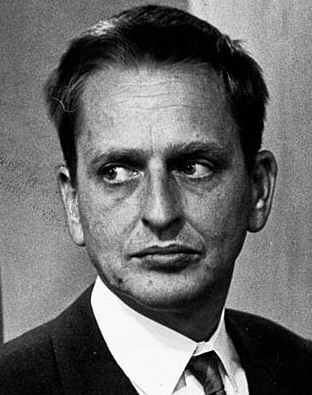
On Sunday, 28 November, it is 30 years since Sweden’s prime minister Olof Palme was assassinated in central Stockholm.

Despite Scandinavia’s economic ups and downs, an underlying sense of social wellbeing has always prevailed. This was shattered on 28 February 1986, when Sweden’s prime minister, Olof Palme, was assassinated in central Stockholm as he and his wife walked home from the cinema.

260216_Olof_Palme
Shock and incredulity swept across Scandinavia – increasing when the police failed to find either the murderer or his gun. Palme was a politician of international standing, with strong socialist views that he did not hesitate to express. Conspiracy theories abound, with the KGB, the CIA and the Yugoslavian UDBA variously blamed, but a satisfactory explanation for the assassination has never been found.

WEB_INRIKES
Scandinavia was further stunned in 2003 when history appeared to repeat itself. The popular Swedish Minister for Foreign Affairs, Anna Lindh, widely tipped to be the next prime minister, was knifed while shopping in central Stockholm, and subsequently died of her wounds. Mijailo Mijalovic was eventually convicted of her killing: he blamed “voices in his head”.

Assassination Shockwaves in Sweden, written by Tor Kjolberg

You may also be interested in reading:
Egoiste from Norway

Coffee Lovers, Look to Sweden

0

In Helsingborg, Sweden, between Gothenburg and Copenhagen, you’ll find one of Sweden’s finest coffee bars, Koppi. So, coffee lovers, look to Sweden!

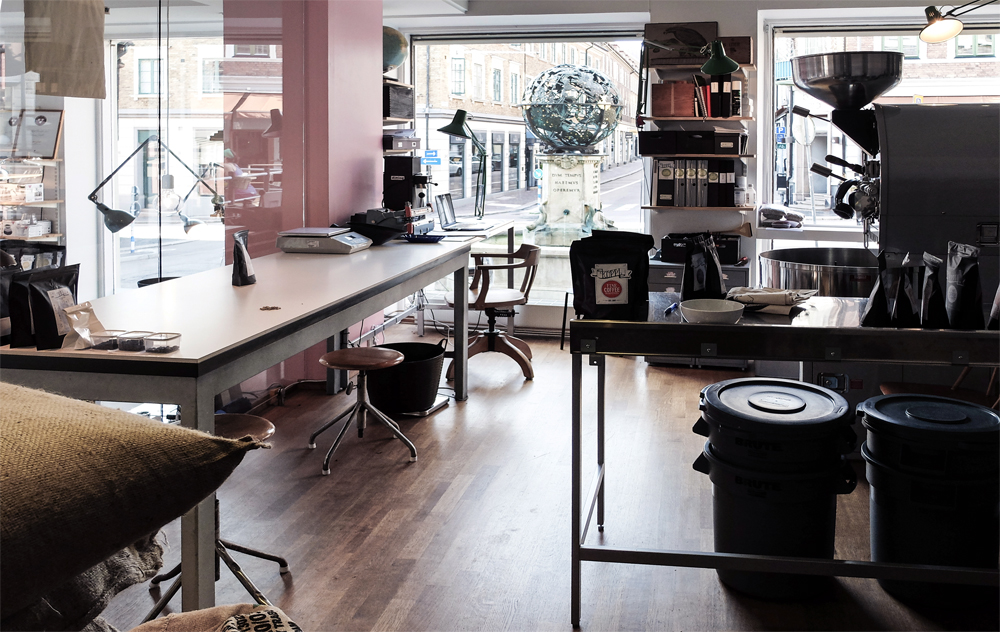
The charming café has a vibrant atmosphere with a mix of on the go customers, people in the seating area socializing with friends, or catching up on work. Some are only dropping by to buy one of their eight varieties of beans.

040316-koppi-helsingborg-interior
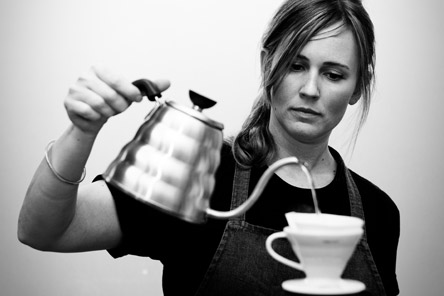
The two owners, barista champions Anne Lunell and Charles Nystrand have a taste for both great coffee and design and founded Koppi in 2007. Koppi has since then been described as the best café in Sweden with words like welcoming, pleasant, attractive, talented, world class and delicious.

040316-Anne-Lunell-and-Charles-Nystrand
“Our aim is to be one of the best roasters in the world by buying, roasting, brewing and serving coffee from the world’s best coffee producers,” they say.

040316-Koppi-Coffee-Pots
Anne and Charles offer consistently delicious and surprising coffees. They work extremely hard to build direct relationships with farmers and travel to origin as often as possible.

The cafe space is unique with its large glass enclosed roaster, storage and cupping rooms. The dining space is also big, bright and contemporary, but warm and comfortable with flowers And wood paneled accent wall. The coffees are all roasted carefully to shine in their espresso and Aeropress or pour-over brews.

040316-KOPPI-Cafe-Counter
Anne and Charles coffee career started while they studied, working with coffee part time, and in 2005 Charles won the Swedish Barista Championship and was offered a job at a roasting company in Oslo, Norway. The following year, Anne won the same title and has been on the Swedish national team at the Nordic Barista Cup four times.

They both moved to Oslo and started their coffee careers full-time there. After two yhears they received a call from Niklas Eksted, chef and owner of Restaurant Ekstedt in Stockholm, telling them that his restaurant space in Helsingborg was for sale. They signed the contract within two weeks.

On their website they state: “We strive to buy the world’s finest coffee through as few intermediaries as possible and co-operate with small and passionate producers, who care for their crops, their co-workers and the environment.”

Nine years into the business, Koppi is now established as a popular brand due to their flavorful beans, roasted at the back of the flagship café. Buying their coffee directly from the producers or through as few distributors as possible, ensures that the producers are paid well under fair and just working conditions.

040316-koppi-helsingborg-sweden
“The process of buying coffee is easier now compared to when we started,” says Anne. “We are continuously looking for unique and complex coffees that showcase the absolute best of their origin. By adjusting our roasting profile for each coffee we are able to bring out all the delicate flavors, notes and aromas that are characteristic to each varietal, processing method and origin.”

Koppi has established relationships with five producers in Costa Rica which they have been visiting for the past six years. They spend time with the families, see the progress at the farms and choose what micro-lots to buy.

A new Koppi shop will open in the brand new Malmö Saluhall in November 2016.

If you are staying in Copenhagen or Malmo, the 1 – 2 hour train ride to Helsingborg is doable in a day. Be sure to taste their sandwiches as well. It’s a total experience!

Coffee Lovers, Look to Sweden, written by Tor Kjolberg

Related article:
Oslo – The Best Coffee City in Europe?


Food Traditions in Telemark County

0

In the Norwegian county of Telemark, traditions have been influenced by the industries that have been important there. The diet is solid; it was important that it be nourishing, and at the same time economical.

The family was a strong unit with the older and younger members together even if living in different households.
020316-Norway_County_of_Telemark_Position
The food menu in Telemark from the last century might have looked like this:

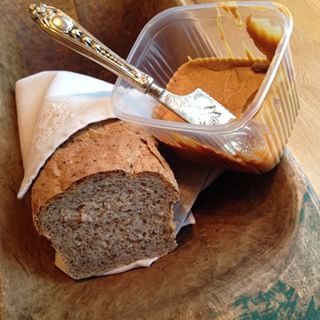
Homemade breas and prim

Morran (Morning meal):
As a rule there was oven baked bread, butter, cheese, prim (soft, sweet, brown whey-cheese) and milk on the table – alternatively kalvesuss (a dish consisting of head, feet and entrails from calf, cooked in milk), hot potatoes and coffee.

Fried ham and sauce
Fried ham and sauce

Medda (Midday meal):
Often meat, pork and vegetables, flat bread and milk gruel with barley. Other variants were fried sausage and bacon with duppe (sauce) or fresh herring, buttermilk porridge or milk porridge.  Dessert was often saftsuppe (juice soup).

Herring and potatoes

Kveldsmat (Evening meal):
Milk porridge, beer cheese, water porridge of barley flour with sour or sweet milk. Potato porridge with milk, salt herring and potatoes or cold porridge with boiled milk.

020316-book-food-from-telemark
On festive occasions  grandparents were always guests, although they on a daily basis tended to themselves and stayed in the kårstue (cottage in which the retired farmer lived). Similarly, the young would arrive as guests in the cottage, or go there when they needed help from the more experienced elders.

Tveitenstua. Telemark museum

The inhabitants of Telemark are generous and good people who know how to care for the old and to keep ancient traditions alive.

Food Traditions in Telemark County, written by Tor Kjolberg

020316-lefsekling-from-telemark
Lefsekling from Telemark

Ingredients 

  • 5 dl (2 cups) full fat milk
  • 3 tablespoons margarine
  • 500 g (8¼ dl, 3½ cups) flour

Directions

  1. Bring milkand margarine to a boil.
  2. Pour over the flour.
  3. Stir to make a thick porridge.
  4. Cover and refrigerate overnight.
  5. Knead in flourto make a pliable dough.
  6. Divide the dough into pieces of equal size.
  7. Roll out into thin sheets and cook on a griddle , rolled side down.
  8. Immediately as the lefse are placed on the griddle, sprinkle with lukewarm water.
  9. Cook until light brown on both sides with small golden bubbles and crisp.
  10. Store in a dark, cool place.
  11. These keep well.
  12. Soften in a damp cloth.
  13. Spread with butterand sprinkle with sugar if served with coffee.

Floating Hotel in Copenhagen

0

Next time you’re in Copenhagen, why not stay in an original barge in the middle of the busy metropolis?

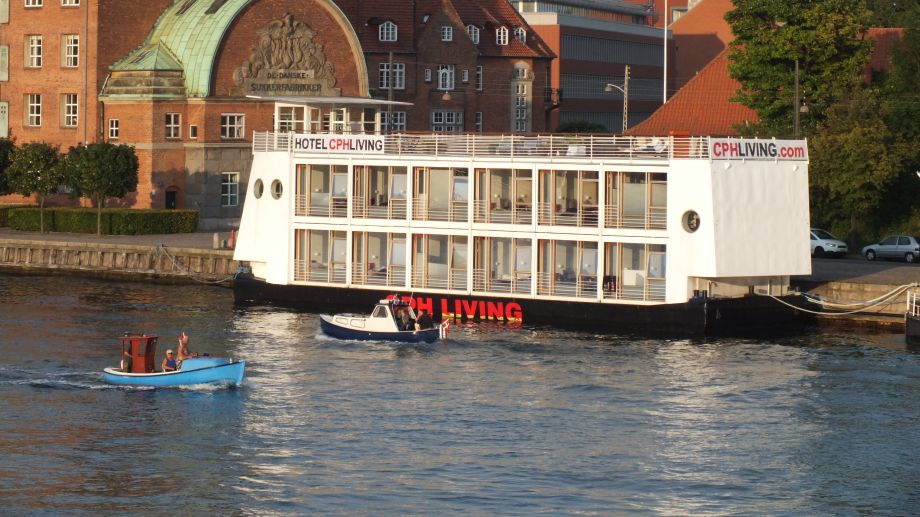
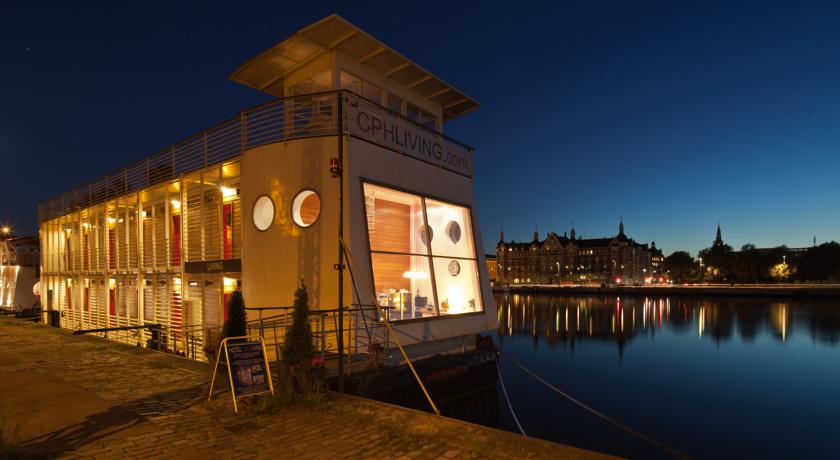
CPH Living is perhaps one of the quirkiest hotels in Copenhagen. It was originally a barge built in Germany. The barge was towed from Germany to Poland, where it was extended by several meters. Then it was towed to the Loksa shipyhard in Estonia, where the rooms and the rest of the hotel were constructed.

010316-CPH_Living-Copenhagen-Hotel_outdoor_area
In the spring of 2008 the boat was placed at its current position at the quay in Copenhagen’s city center, and officially opened as a hotel in 2009. This is the only ‘boat-el’ in Copenhagen, and you will be staying close to the heart of things, since the barge is moored in trendy Christianshavn, and offers guests a simple yet amazingly unique design experience.

Christianhavn itself is an intriguing mix of local hipsters, Greenlanders hanging out on the island’s main square and the denizens of Free Town Christiania. Spend a day there and explore the streets and squares.

010316-cph-living-hotel
A 10 minutes stroll takes you to the arty Islands Brygge and stock up on the great bread and pastries at Wulff + Konstali Food Shop, or continue for another few minutes to either Food Shop No 26 or Emmery’s, which both do scrumptious breakfast and really decent coffee.

There’s a breakfast buffet and vending machines for drinks and snacks on board the boat, but we recommend you to take the stroll.

010316-chp-living-room
There’s a breakfast buffet and vending machines for drinks and snacks, but if you really need good coffee (which can be hard to find in the city), and some fine baked goods.
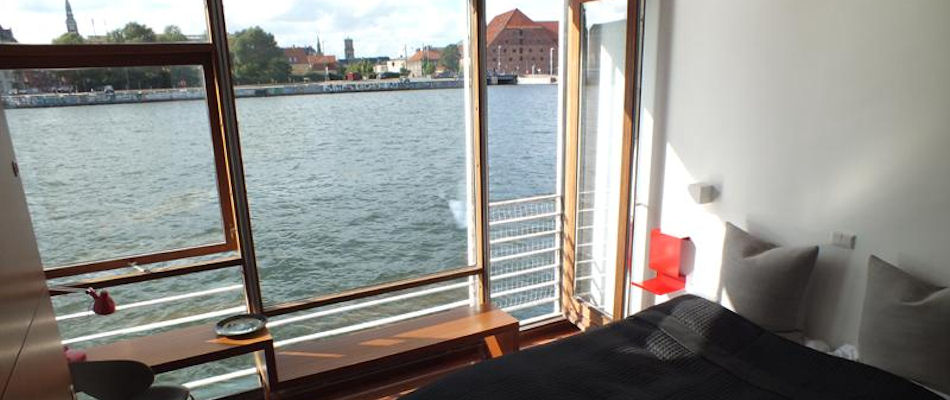
010316-cph-living-view
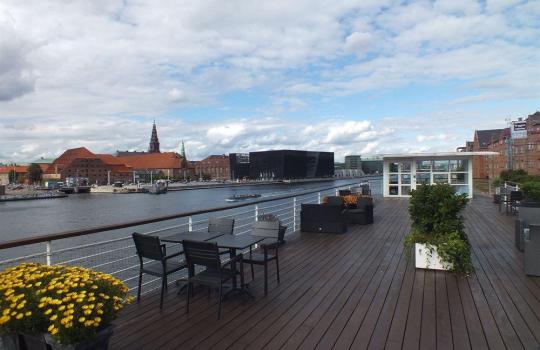
Denmark’s first floating hotel is privately owned by Lasse, Marianne and Michael, who run the hotel as a part of their family business. There are 12 minimalistic designed rooms that all are boasting of panorama river- and city views. However, the most striking part of this hotel is perhaps its sundeck, which invites guests to enjoy fresh air and sunshine from the unique rooftop terrace with seating and sun loungers.

010316-chh-living-terrace
Floating Hotel in Copenhagen, written by Tor Kjolberg