A bright early autumn’s day in Copenhagen was the backdrop for the Pop Up wedding event held at the Museum of Copenhagen, organized and coordinated by Golden Days Festival.
I must admit, until my visit to Copenhagen to participate at the wedding, I didn’t even know what a pop-up wedding was. I realize now that not all pop-up weddings are the same, but they do have a common purpose: to make it easy for a couple to get married and to make it less expensive.
The day was filled with vendors bringing all of their talents together to celebrate Christine Finnie from Scotland and Sadik Baran from Turkey saying “I do” to each other, surrounded by their closest friends and paying visitors.
I was told that the bride didn’t even know that she was going to be wed for real this Saturday afternoon.
The venue at Vesterbrogade was properly styled and live music in the garden set the scene when the couple and guests arrived. The bride was spoiled with a gorgeous floral bouquet and her husband to be was dressed in Scottish national costume to honor her home country.
The couple was officially wed on the museum’s balcony by the museum’s director, handing over the wedding certificate after the ceremony.
After a toast, a professional photographer was making 3D photos and before dinner everybody could enjoy drinks from the bar or attend different attractions, like learning to dance the bridal waltz or having their nails and skin henna decorated.
The dinner was served in a separate room on the first floor, and the toastmaster Klaus Bondam addressed the newly-wed couple, saying: “I realize you have been together for a while, since you’re bringing your beautiful daughter to the party!”
And the party was going on into the wee small hours of the morning, while the couple and the guests were dancing to St. Tropez Live Band.
“We have found a cool venue, the hottest photographer, really creative stylists and florists and rocking celebrants together with 300 paying guests and put them all together for a dream wedding,” said festival organizer Josefine Albris.
Pop-Up Wedding in Copenhagen, text and photos: Tor Kjolberg
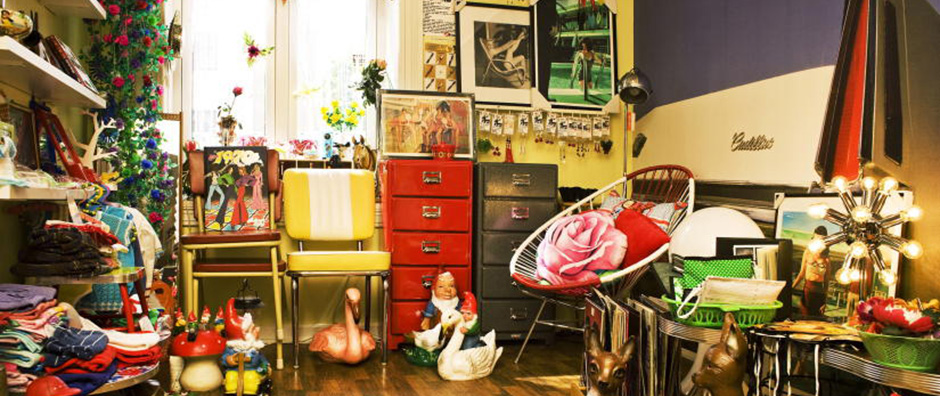
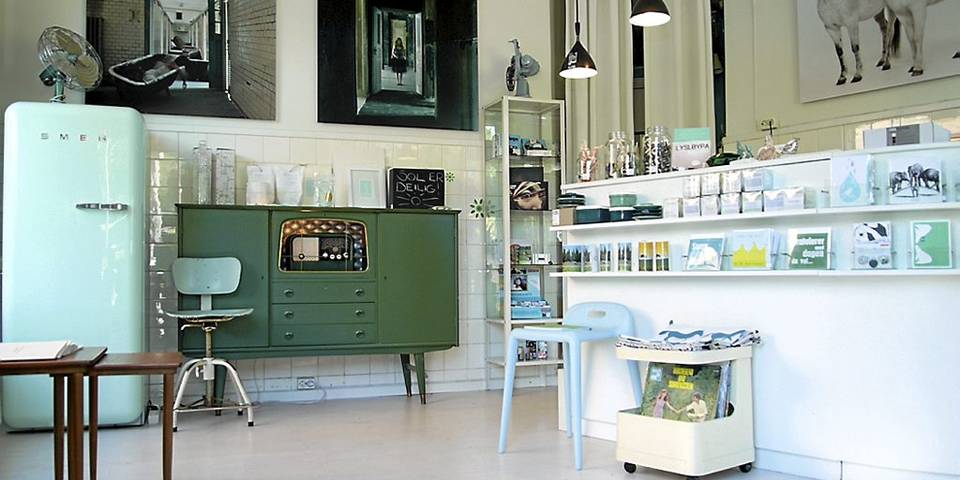
Norwegians are home loving people. They are redecorating their homes for billions every year. Interior shops are therefore flourishing in the Norwegian capital. Here are our selected few.
Hay House
Josefinegt. 23, 0351 Oslo
Hay is owned by Rolf Hay and the Danish clothing company Bestseller. The company was established in 2003, and it soon became an ambassador for contemporary Danish furniture design. The company has two shops in Copenhagen and one in Aarhus. The shop in Oslo is a pleasant combination of gallery and outlet.
Ruth 66 Torshovgt. 3, 0476 Oslo
Ruth 66 is a different kind of shop, shouting out, «Welcome home to me!» Here you’ll find a combination of old and new items, however, emphasize is on retro.
Tante Guri (Aunt Guri) Sonsgt. 7, 0654 Oslo
Experience Tante Guri at the Kampen area in Oslo. In this designer collective you’ll find a mixture of photo art, fashion clothes, funriture, lamps and much more.
Hole Design Drammensvn. 130, 0277 Oslo
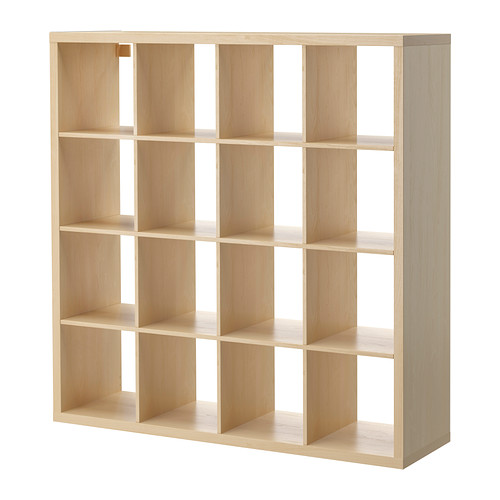
Materiality, playfulness and craftsmanship are the core values at Hole Design. The craftsmanship is expressed in the products made by Norwegian manufacturers, with a passion for furniture and a high knowledge about the materials. You may experience some of the furniture classics “live” side by side with inspiring art. The playfulness is shown through the unexpected and contrasting elements in the products.
Feature image (on top) Hole Design, shelving systems
Plan your visit now and shed those musty winter thoughts. On paths that wind o’er rock and marsh, where the wind blows in from Dogger Bank, carrying the smell of seaweed and adventure.
This was Swedish songwriter Evert Taube’s invitation to Sweden’s west coast.
Seafood delicacies With fresh, hot shrimp, new-caught fish delightfully prepared and a glass of chilled white wine, we embark upon a brief journey of exploration of the Sotenäs Peninsula, Bohuslän, just over half-way between Oslo and Gothenburg.
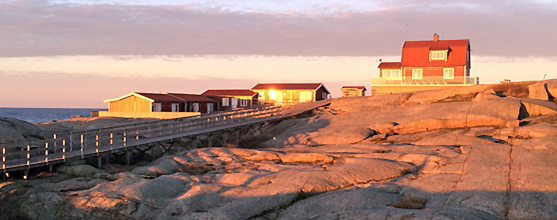
We’re sitting at our ease on the terrace of Bella Gästis in Hunnebostrand, and enjoy the view of the marina as the sun spreads its golden glow over the naked cliffs before dipping down into the Skagerrak Sea.
Our hosts explain that every day they serve a new fish dish made from fresh local ingredients. Today’s menu includes fried bleke with chopped egg and horseradish. The Kungshavn center trains chefs specializing in fish and shellfish. Students come from all over Sweden, and after they have completed their studies they will be able to develop new seafood-based business ideas.
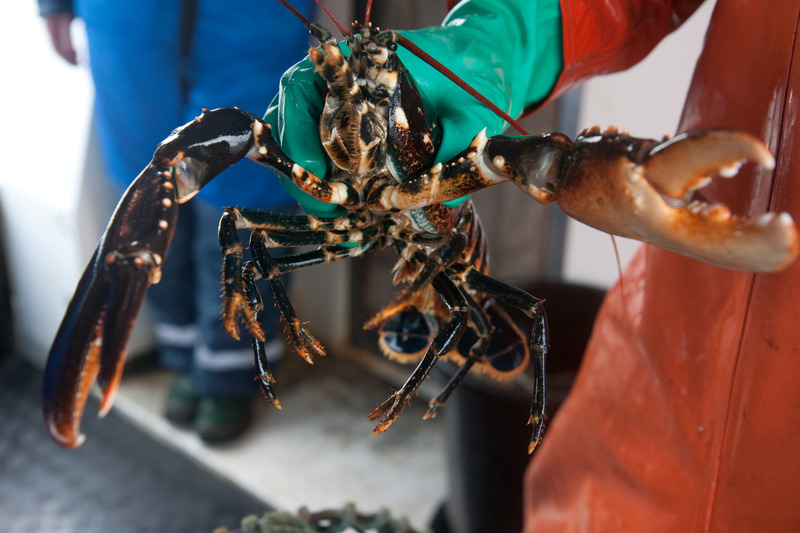
“You must come back in the autumn when lobster plays the starring role,” says my host, adding that the Swedish Lobster Academy in Hunnebostrand organizes guided tours, lobster safaris and lobster suppers.
In the neighboring village of Bovallstrand you will find Bryggkafeet, one of the many inns that are taking part in the Västsvensk Mersmakproject, which was started in 2000 to further the collaboration between restaurants and the farming and fishing industries and provide visitors and locals alike with a variety of culinary delights.
Smogen
Evert Taube’s Bohuslän There is a concert on at Villa Gästis tonight, and Evert Taube’s songs are on the program. The songwriter was born at Vinga Lighthouse, a little to the south, and he made his debut as a singer in Smögen in February 1918, when he sang “Alt uti blåa kläder” and “Karl Alfred and Ellinor”.
Taube is supposed to have inspired to write the song about Karl Alfred and Ellinor one stormy night at Vinga when a sailor told of his adventures in Port Adeleide, Australia. Evert Taube visited Port Adeleide himself as a cabin boy, and a decade later the song was written in Smögen.
It is said that Taube always had the sharp rocks, wind-swept pine trees, hawthorns and heathers of Bohuslän in his thoughts when he was off on his travels, and he longed to return to the light summer nights.
Sotenesleden
Child-friendly Sotenäs If you bring children with you to the Swedish west-coast next summer, it will be a summer journey of discovery. There are a lot of “winners” for children of all ages there. Island hopping is popular.
Halloe
With a little boat you can easily get from Smögen to Hållö, a beautiful nature reserve facing the open sea, with sheltered coves that are perfect for bathing, flat rocks, potholes and plenty of nooks and crannies for energetic children to explore.
Soten kanal
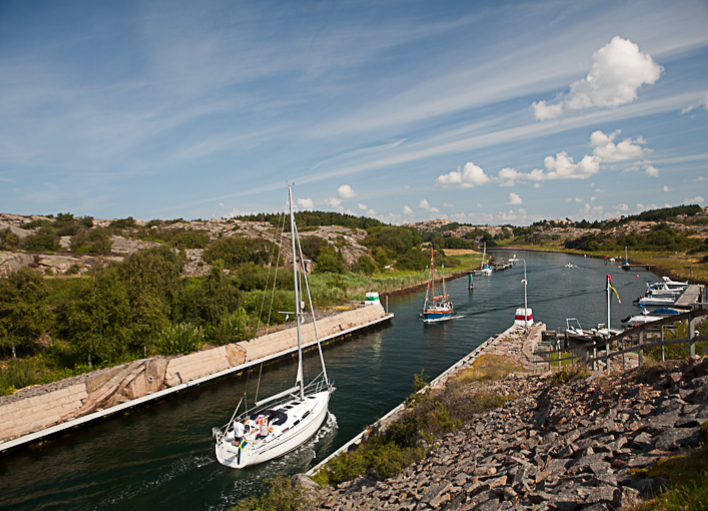
We recommend a canal trip on the Soten Kanal, which was built nearly 80 years ago by more than 200 unemployed stonemasons, and which is reckoned to be a monument to the stonemason’s craftsmanship. The idyllic canal was intended to be an alternative waterway for the nearby Soten Sea. Evert Taube has described this stretch of water in the dramatic verses of the “Blue Bird of Hull”.
The highpoint for both adults and children is a day trip to Nordens Ark. Nordens Ark is built on the animals terms, and the aim is to take care of endangered species from all over the world, so that they can breed and subsequently be returned to their original habitats.
Jonatan Borling shooting wolverines at Nordens Ark
Nordens Ark really is child-friendly, with fun pathways, play areas and competitions.
It is also lovely to stroll along the quayside in Smögen, watch the people go by, admire the boats in all shapes and sizes, and it your fill of fresh shrimp. You are not alone in Smögen on a summer’s day, but there are pathways which lead to secluded spaces, with rocky knolls and coves and views of the sea.
Facts about Sotenäs Sotenäs has just under 10,000 permanent residents scattered between a dozen villages and farming areas. Fish processing and tourism are the most important business sectors.
Smögen is situated around 90 kilometers south of Strömstad. Oslo is 200 km away, and its 150 km to Gothenburg.
Hotel Kaprifol, Hunnesbostrand
Accomodation Sotenäs Peninsula has 8 campsites. Around 20 places offer accommodation, ranging from youth hostels and Bed & Breakfast to 4-star hotel standard. There is also a wide range of restaurants, inns and cafes.
Activities Sotenäs Golf Club is one of western Sweden’s best 27-hole courses. Riding, sailing school, bicycle hire, boat hire, organized boat tours and fishing trips, seal safaris and diving center. More than 20 bathing beaches/coves.
From Kungshamn
Culture Local history museums, arts and crafts galleries, maritime antiques fairs and auctions. Stonemason museum and sculpture park in Hunnebostrand. Folk evenings and jazz concerts. Every August international performers come to Kungshavn for a tradjazz festival. The fish auction in Smögen is a colorful and ear-splitting experience.
Nature Several nature reserves. Soteleden is a 70 km long walking route through varied terrain along the coastline. It passes through beechwoods and over expanses of rolling heather. Several shorter walking routes. Nordens Ark featuring a variety of endangered species.
Summer on the Swedish Coast! written by Tor Kjolberg
Oslo is the capital of Norway. The history of Oslo goes back to around year 1000 AD. Since the Middle Ages Oslo has gone through great changes, even the name of the town has been changed a few times, before it became the city it is today.
Oslo, Kristiania or Christiania? One can easily be confused by the capital’s different names through the years. The town was originally called Oslo. In the Middle Ages it was located on the east side of the Bjørvika inlet. After a dramatic fire in 1624, king Christian IV decided that the town be rebuilt in the area below the Akershus Fortress, and he changed its name to Christiania. From 1877 the name was spelled Kristiania, and in 1925 it was changed back to the original name, Oslo.
Christiania Square
Now that you’re armed with a little trivia, let’s look at how to explore Oslo on the cheap…
Skip a pricey downtown hotel and check out Late rooms.
Oslo main street Karl Johan
The public transportation system in Oslo takes you almost everywhere.
The Oslo Pass gives you free entry to more than 30 museums and attractions, free travel on all public transport, free parking in municipal car parks, free entry to outdoor swimming pools, free walking tours, discounts on sightseeing, ski simulator, Tusenfryd Amusement Park, concert tickets, climbing, ski and bike rental, and special offers in restaurants, shops, entertainment and leisure venues.
The last stage of World War II, with German forces scorching the earth in their retreat from the advancing Soviets, hurt northern Norway.
Recovery from the war in Denmark and Norway was set in motion by the Marshall Plan (1947-51). Neutral Sweden also accepted Marshall aid, and all three Scandinavian countries were caught up in the wave of economic growth that swept through post-war Europe.
German troops and bombers in Norway
The comprehensive “cradle-to-grave” welfare systems came into full being during the 1950s and 1960s. To begin with at least Scandinavians were happy to live with the high taxes needed to cover their cost, if only because memories of bitterly hard times without a social safety net were still so fresh.
Cradle to grave welfare system in Scandinavia
Sweden’s international reputation, somewhat damaged by its questionable war role, was given a boost by the selection of diplomat Dag Hammarskjöld as Secretary-General of the UN in 1953. He threw himself into the role, enhancing the reputation of the UN and acting as peace-broker in international disputes from China to Palestine to the Suez Canal.
Post-war Scandinavian shipping
In 1961, Hammarskjöld was killed in a plane crash. He was the first person to be awarded the Nobel Peace Prize posthumously.
Feature image (on top): Dag Hammarskjöld
Peacetime Recovery in Scandinavia, written by Tor Kjolberg
A Norwegian man, Arne Vigeland, hired two workmen to cut his neighbors outbuilding right in half because it crossed over onto his land. Then they dumped the rubble on the neighbor’s vegetable patch.
The owners of the property at Nesoya outside Oslo, Roger and Wenche Waage, were on holiday in Spain when the incident took place in April 2014. They reported the matter to the local police. Vigeland explained that he only reduced the building to a legal size so he did not brak the law. However, he was charged with aggravated vandalism last month.
Vigeland is not new to controversy surrounding his neighbours’ property. He has demolished a stone wall in the very same area because he claimed it was on his property, as well as sawed down trees and bushes.
Norwegian man cut neighbor’s outbuilding into two, written by Tor Kjolberg
Founder of Ikea, Ingvar Feodor Kamprad, was born on March 30, 1926 in a small province Smaaland in Pjätteryd (now a part of Âlmhult Municipalty), Southern Sweden. Kamprad’s biographers believe that the trading hobby was passed to Ingvar by inheritance.
In 1897, the company that belonged to the grandfather of the future billionaire was on the verge of bankruptcy. His grandfather could not pay the mortgage and committed suicide.
Ingvar’s grandmother, however, was able to save the business. So she taught her grandson to bridge over the difficulties with willpower and perservance. Grandmother Francis had a huge positive impact not only on Ingvar, but on the entire family. She was a very intelligent woman, although of simple origin though.
To most present-day Swedes, the date and the names, in a famously rural region, resound of harsher times, when Sweden was agrarian and poor. They speak of hard work, frugality and egalitarianism rooted in shared poverty – values which would eventually enter the IKEA ethos.
Even as a young boy Ingvar knew he wanted to develop a business. At the age of five he started selling matches to his nearby neighbors and by the time he was seven, he started selling further afield, using his bicycle. He found out he could buy matches in bulk cheaply in Stockholm and re-sell them individually at a very low price, even with a good profit.
Later he started selling flower seeds, greeting cards, Christmas tree decorations, and later pencils and ball-point pens and fish.
Map of Ikea stores around the world 2014-2015
People, who closely work with Ingvar Kamprad, say that he is a brilliant marketer, a wise man who never kames a mistake. The strategy of Kamprad is indeed studied and examined by major entrepreneurs from all over the world. Ingvar never attended a university and school teachers could not even teach him to read for a long time, since he was dyslectic. His lack of a university degree has always been replaced by enthusiasm.
Ikea catalogue
“If you work and do not feel incorrigible enthusiasm, consider that at least a third of your life has gone down the drain,” Ingvar once remarked.
In 1943, when he was 17 years, Kamprad’s father rewarded him with a small sum of money for doing well in school. With it, Ingvar founded a business named IKEA, an abbreviation for Ingvar Kamprad from Elmtaryd, Agunnaryd, his boyhood home.
At the beginning of its operation, the young Kamprad engaged in the trade of different things, from matches to discount stockings. But the biggest demand was for pens. At the beginning of 1940s they were a novelty even in Sweden. Kamprad ordered 500 pens from Paris, taking a loan of 500 SEK in a district bank, at that time around 63 USD. According to Kamprad, this was the first and the last loan that he had taken in his life.
Later he started selling wallets, picture frames, table runners, watches, jewelry and nylon stockings, meeting needs with products at reduced prices.
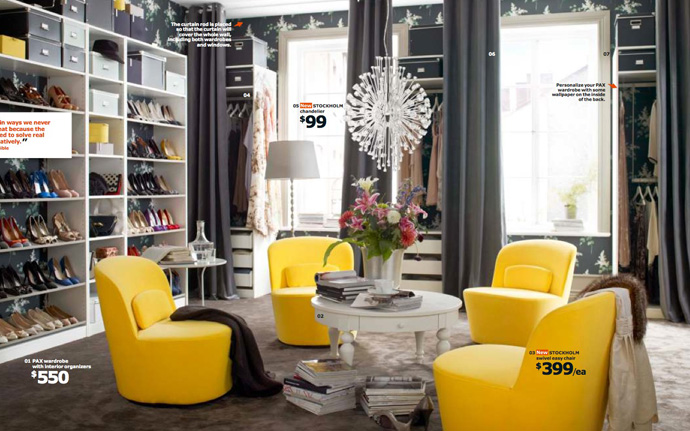
Ikea store interior
Two years after starting IKEA, Kamprad began using milk trucks to deliver his goods. In 1947, he started selling furniture made by local manufacturers. By 1955, manufacturers began boycotting IKEA, protesting against Kamprad’s low prices. This forced him to design items in-house.
Kalle shelf
Kamprad is also behind the simple, yet revolutionary innovation that is the flat pack. He began selling IKEA products in flat-pack form, from his own warehouses. Thus the basic IKEA concept – simple, affordable flat-pack furniture, designed, distributed and sold in-house – was complete.
To attract prospective customers to the presentation of the store, the young entrepreneur promised a free cup of coffee and a bun to everyone who would come. Imagine his surprise when this modest event attracted more than a thousand people. The idea of opening a fast food restaurant in each store looked great for the owner of IKEA. Time passed and each IKEA store got a fast food restaurant.
The first IKEA advertisement appeared in 1945 when Ingvar Kamprad’s business outgrew his ability to make individual sales calls. He began advertising in local newspapers and operating a makeshift mail-order service.
The driving idea behind IKEA was, and is, that anyone should be able to afford stylish, modernist furniture. Kamprad felt he was not only cutting costs and making money, but serving the people as well.
Ikea store Shanghai
Kamprad’s business grew and grew. IKEA expanded throughout Sweden, to Norway and Denmark, via Germany to continental Europe, and on to the ends of the world. When IKEA opened in Shanghai, 80,000 people visited the store. Today, there are over 300 IKEA stores in the world – in 38 countries. All this time, Kamprad has never borrowed money or issued a stock.
Ikea solar powered Red Hook store
In 2009 IKEA opened a new store in Red Hook, Brooklyn, and music is an important element of the shopping experience there. It’s a part of the company’s expansive globalization process. To expectant New Yorkers the old, familiar music tracks are comforting when they’re about to buy furniture with unusual and minimalistic design and even has names which for most Americans are impossible to pronounce.
The Swedish Furniture Giant, written by Tor Kjolberg
Norwegian is a language that English-language writers and translators seem willing to pick up. James Joyce learned it to read Ibsen. Lydia Davis is learning it solely by reading Dag Solstad.
On the Literary Hub Lydia Davis (photo on top) shows her handwritten notes in the margins of a novel called “unreadable” and “as dull as the phone book” by critics in Norway where it was published.
In Davis’s meticulous handwriting, systematic descriptions of vocabulary, style, and grammar spill over the pages of the novel and onto a stack of papers. The makeshift booklet, made up of sheets of paper folded in half, densely annotated on both sides, constitute a grammar not only of the novel itself, but of the language in which it was written, a grammar constructed entirely by Davis herself.
After visiting a literary festival in Norway in 2013, Davis embarked upon her most ambitious linguistic project to date. She decided to learn Norwegian, a language previously unknown to her, from this novel, and this novel only.
“I can’t pronounce the title, so I just call it ‘the Telemark novel’,” Davis admits.
“The Telemark novel” is in fact what the book is dubbed even in its native Norway. The full title, which roughly translates as The Insoluble Epic Element in Telemark in the Period 1591-1896, suggests the level at which Davis has chosen to start her self-tutoring.
Dag Solstad
It is a novel, of sorts, in which the acclaimed author Dag Solstad delves into the genealogy of his own family, fact by fact, name by name. The result—a 400-page epic, chronicling births, deaths and marriages over the course of four centuries—was described by some critics as somewhere between the endless genealogies of Genesis (“and Abraham begat Isaac, and Isaac begat Jacob”) and Finnegans Wake.
“I did not want to stop reading Norwegian,” Davis wrote about the experiment in The Times Literary Supplement: “I had become attached to my daily immersion in the tales, some quite dramatic, all curiously entrancing.” The result was a heartfelt passion for the book itself.
“You may ask questions in Norwegian—if they are simple,” Davis wrote in an email before the interview for Literary Hub.
“It all started with a resolution. After my books started coming out in various countries, I made a decision: Any language or culture that translates my work, I want to repay by translating something from that language into English, no matter how small. It might end up being just one poem or one story, but I would always translate something in return.”
Haruki Muramaki
Davis’s choice of Dag Solstad, arguably the finest, and undoubtedly the most critically lauded, contemporary novelist in Norway, is less random than it may appear. The author of 33 books, translated into 30 languages, and the recipient of every major literary award in the Nordic countries, Solstad seems to be enjoying something of a belated international breakthrough. Having only recently been translated into English, all three translated titles were longlisted for the Independent Foreign Fiction Prize. Another fan, Haruki Murakami, is translating Solstad into Japanese (“He’s a kind of surrealistic writer, very strange novels. I think that’s serious literature,” Murakami told the Guardian.
Dag Solstad, now 73, has for the past 50 years continued to experiment with the form of the novel. Each new Solstad title is not only received as a major cultural event, but they often spark heated debates. His centrality to the cultural life of Norway is perhaps best illustrated by the 2006 publication of a novel that touched on the country’s role in Afghanistan—the book prompted the Foreign Minister to write his own review, debating its political ideas over several pages.
Now imagine Philip Roth publishing a novel deviating so radically from expectations, as to make the critics of The New York Times and The New Yorker claim it really wasn’t a novel at all, and you have some idea of the controversy surrounding the book Lydia Davis has chosen to struggle with.
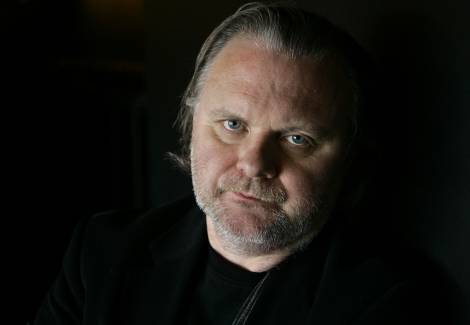
Jon Fosse
Dan Piepenbring, editor of The Paris Review, learned Norwegian to read Jon Fosse. He says it helps that the grammar is simple, with few tenses and word endings; the vocabulary is small; the language is one of the deep cores of English, so reading it feels eerily familiar, like a song you half know. After being asked to read Fosse’s novel Melancholy in German, Piepenbring decided to co-ytanslate it with a native Norwegian speaker friend, and he has since translated, on his own, two more of Fosse’s novels, Alias at the Fire and Evening, two stories, and a libretto.
Jon Fosse is less well-known in America than some other Norwegian novelists, but revered in Norway—winner of every prize, a leading Nobel contender. Piepenbring thinks of the four elder statesmen of Norwegian letters as a bit like the Beatles: Per Petterson is the solid, always dependable Ringo; Dag Solstad is John, the experimentalist, the ideas man, Karl Ove Knausgaard is Paul, the cute one; and Fosse is George, the quiet one, mystical, spiritual, probably the best craftsman of them all.
Karl Ove Knausgaard on drums. Photo: Anders Gronneberg
Reporting on a Karl Ove Knausgaard reading last summer, The Baffler wrote that “two young men kept comparing the event to a rock concert and complaining that they should have brought 40s … Knausgaard has become a rock star.” The writer himself has told of a German journalist “who compared me to a rock band. He said, the books don’t really have any focus, it’s just loose, it’s like just having some songs about drinking and they don’t have anything else … he saw pictures of me, he said, ‘You pose like a rock star.’ ”
Karl Ove Knausgaard
At the Norwegian-American Literary Festivalin New York last May, Knausgaard played the drums with his reunited college band, Lemen, thus sundering the flimsy membrane that separates him from full-on rock stardom. For this is what rock musicians have done throughout history: sundered membranes.
The performances—on May 20 at Westway, in Manhattan, and on May 22 atSunny’s, in Brooklyn—marked the band’s United States debut. “I think everyone understands that we are not trying to get into the U.S. market with our music,” Knausgaard told the Norwegian paper Dagbladet. Its headline said: “KNAUSGAARD BELIEVES HE HAS NOTHING IN COMMON WITH RINGO STARR”. He goes on to suggest that he’s not a terribly versatile drummer and that Lemen is an ad hoc project.
But don’t let his Scandinavian modesty undercut your expectations. After all, if you’ve been reading My Struggle, you know that Knausgaard has been a musician for a long while. His mastery of such soaring classics as “Smoke on the Water” is well documented. Indeed, his books are full of anecdotes about his restless experimentation, as when, in Book 3, he dreams of starting a rock group with his friend Dag Magne: “He wanted it to be Dag Magne’s Anonymous Disciples; I wanted it to be Blood Clot. Both were equally good, we agreed.”
Perhaps most important, Book 4 reveals his devil-may-care attitude toward equipment—a must for any serious musician:
At a planning meeting some days later Eva went berserk. We had been given permission to use equipment belonging to the band her son played in, but we had treated it carelessly, a string had been broken and not replaced, a drumstick had snapped and not been replaced … People were so preoccupied with trivialities, they kept searching until they found something and then they went for jugular instead of keeping sight of the bigger picture, here we all are, humans on one earth, we’re only here for the short term, in the midst of all this wondrous creation, grass and trees, badgers and cats, fish and sea, beneath a star-strewn sky, and you get worked up over a broken guitar string? A snapped drumstick? … Come on, what’s the matter with all of you?
If you mention the name Hasselblad, every professional photographer in the world would think of cameras for professionals. The Hasselblad name has been linked with cameras almost since the early days of photography.
But who was the man behind the iconic name? The Hasselblad family established its first trading company, F. W. Hasselblad & co in the city of Gothenburg in Western Sweden in 1841. The location was ideal for an international import-export firm with its proximity to the European continent and its historic trade connections there.
The name “Hasselblad” is said to have been originated when an ancestor in the early 1600s needed a ‘good name’ to wed the daughter of a wealthy man. They should pick the name after an object found during a road trip. The first object was a leaf falling from a hazel tree, and so the name Hassel (hazel) and blad (leaf) was put together. Hasselblad was on its way to be world famous.
However, it was the son of the founder of F. W. Hasselblad & Co., Arvid Viktor, who after purchasing a camera in 1885, opened a small photography division within his father’s business and began importing supplies for the innovation of photography.
“I certainly don’t think that we will earn much money on this, but at least it will allow us to take picture for free,” he is reported to have said.
Tree Lake by Eoghan Kavanagh, Hasselblad 2012 winner
He could not have proved to be more wrong about the potential profitability, since the photographic department became a major part of the company and in 1908 led to a “sister company” named Hasselblad Fotografiska AB, which also was the exclusive Swedish distributor for what was now Eastman Kodak products. Arvid Viktor had met George Eastman, the founder of the Kodak Company, while on his honeymoon in England.
Hasselblad V-system camera
However, it was the onset of World War II that happened to be the opportunity Hasselblad needed to begin building his own camera.
Photo by Joachim Schmeisser, Hasselblad finalist
The country was forced to shoot down a Luftwaffe plane when it entered Sweden’s neutral air space. The Royal Swedish Air Force found a surveillance camera in the plane and asked Victor Hasselblad if he could duplicate it.
“No,” he said, “I cannot make a camera like that, but I can make one better.”
After the war, the family business resumed with great success and Victor could finally concentrate on making ‘civilian cameras’.
2010 Hasselblad Masters Award Binh Trinh
Today Hasselblad is much more than just a camera after having made it through moon landing, the turn of a millennium and caught thousands of motifs through its very pristine lens. The Hasselblad Master Awards is an annual award and have since 2001 recognized selected photographers across various specialties for exceptional accomplishment through photography.
In 2012 Hasselblad opened up their London studios to all photographers regardless of what camera they used and they present regular workshops to develop the craft with their award that honors those who fight the cause of rhino poaching in Africa.
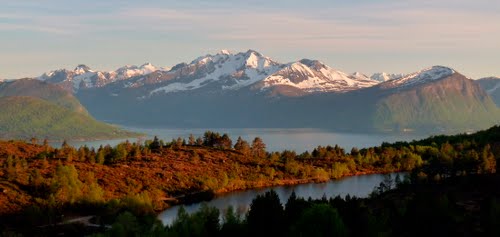
Western Norway includes Moere og Romsdal, Sogn og Fjordane and Hordaland. It is an area which possesses a “fortune” of resources both on land and sea.
There is an area off the northwest-coast, which the locals call the “Storehouse Area”. The name originates from the always availability of fish there; it was like collecting food from a storehouse.
However, It was not always so easy. In tight years, when the sea was “empty” and both herring and other fish were missing, the small farms came to rescue. The tough people in this area are known for their ability to survive under scarce conditions – all the way back to ancient times.
Fishing vessel in Western Norway
The west coast is perhaps best known for its mighty fjords, which is surrounded by green hillsides and waterfalls falling several hundred meters down into the sea. These wonderful waterways make it possible to sail from the North Sea straight into the heart of Norway. At the tip of the west coast we find a climate which is typical coastal, with mild winters and chilly summers, while areas farther into the country have a distinctly transitional climate. The countryside is very diverse. We find all kinds of environments. That way the west coast is Norway in a nutshell; we find roaring rivers, beautiful mountain peaks and calm water. The coastline is a chapter in itself with a myriad of large and small islands.
Western Norwegian Fjord
Møre From Norse times Møre meant “land by the sea”, and oceans are plentiful in Norway. The Norwegian Sea crashes against the northwestern coast, and several of the country’s residents live on islands and are dependent on ferries. The inner part of the country is dominated by mountains which attract thousands of tourists from home and abroad. Møre og Romsdal’s premier attraction is Trollstigveien (The Troll’s ladder Road) and the Troll’s peaks with its famous Trollveggen (Troll’s wall).
Troll’s Ladder, Westwern Norway
Sunnmørsalpene (the Sunnmøre Alps) and the Geiranger Fjord are other tourist attractions. Although the tourism industry is the fastest growing industry in the area, there are still other industries that have kept people employed since ancient times. Fishery has of course been extremely important.
The Sunnmoere Alps
The coastal population was incredibly resourceful in obtaining variety in their diet. Fish were obviously cooked in all varieties; be it kamsehoder (heads of a particular fish), komperute (kind of potato balls), sildesodd and sildesuppe (kind of herring soups), blandaball (mixed potato balls) or lutefisk (dried whitefish treated with lye).
Blandaball
Thin wafer crispbread was made here as elsewhere in the country, and barley was mixed into in the dough for party and feast. Lefse (soft flatbread) was also served on special occasions
Lefse
Meat was a valuable commodity and gave people access to cash. For ordinary people, fresh meat on the dinner table was a rarity. It was usually salted or dried. At weddings, christening and funerals bærekurver (food baskets) were distributed. This and most other ancient customs have been lost along the way.
Old Norwegian trunk, photo Vesterheim Norwegian American Museum
Norwegian Nettle Soup This is a simple and good soup. Nettle found almost everywhere and are a great resource. Pick it into summer, blanch and freeze.
Serving 4 persons:
1 onion
1 tablespoon olive oil
2 pints/1l broth
2 tablespoons thick cream
½ carrier bag blanched and finely chopped nettle tops
salt and freshly grinded white pepper
Method:
Peal and finely chop the onion, carefully fry it in a pan in olive oil. Liquidize with broth and running cream. Bring it to the boil and let it boil for 5 minutes. Add the nettle and let it cook for a couple minutes more.
Taste with salt and pepper.
If you want a somewhat thicker soup use cornstarch and water.
Serve with freshly baked brown rolls.
Western Norway – The Storehouse Area, written by Tor Kjolberg