



Ideas don’t spread because they’re smart—they spread because they’re well told. Clever storytellers don’t just communicate ideas; they shape what audiences believe is worth thinking about. Leaders who shape stories shape markets.
In most boardrooms, “thought leadership” is still treated as a function of expertise. Publish a white paper, commission proprietary research, share a bold prediction—repeat at scale. The assumption is simple: if the thinking is strong enough, influence will follow.
But in practice, it rarely works that way.
We operate in an environment defined by content saturation and shrinking attention spans. Insight alone is no longer scarce; interpretation is. And in that shift lies a more useful definition of thought leadership: not just possessing valuable ideas, but shaping how others understand and apply them.
That is the work of storytelling.
Clever storytellers don’t merely communicate ideas—they organize them, give them direction, and make them travel. In doing so, they become the voices that industries listen to, quote, and build upon.
 Rethinking Thought Leadership
Traditional thought leadership prioritizes information transfer. Reports, op-eds, and keynote presentations all aim to deliver knowledge to an audience assumed to be rational and attentive.
The flaw is not in the ambition, but in the model. Information does not automatically convert into influence. In fact, without structure, most ideas dissipate quickly, regardless of their quality.
What distinguishes influential leaders is not the volume of their output, but the clarity of their narrative. They don’t just add to the conversation—they frame it.
Storytelling, in this context, is not about embellishment or entertainment. It is a strategic discipline: the ability to package insight into a form that is memorable, repeatable, and meaningful to a specific audience.
Why Storytelling Drives Influence
There are four mechanisms through which storytelling transforms expertise into thought leadership.
- Stories organize complexity
Modern markets are complex systems. Data points are abundant, signals are ambiguous, and competing interpretations are constant. A well-constructed story acts as a compression tool—it reduces complexity into a coherent throughline.
Instead of presenting ten disconnected insights, a narrative connects them into a single perspective. This allows audiences to process, retain, and apply information more effectively. In executive settings, especially, clarity often outperforms completeness.
- Stories travel further than facts
Ideas gain influence when they move beyond their original context. A statistic may be accurate, but it is rarely repeated. A narrative, however, is inherently portable.
When an idea is embedded in a story—with a clear tension and resolution—it becomes easier to share across teams, organizations, and media channels. This repeatability is what turns a point of view into a widely adopted perspective.
In other words, storytelling creates distribution leverage for thinking.
- Stories signal original thinking
In a landscape where access to data is increasingly democratized, differentiation comes from interpretation. Two organizations can look at the same dataset and reach entirely different conclusions.
Storytelling is the vehicle for that differentiation. It reflects how an organization frames reality—what it prioritizes, what it challenges, and what it believes comes next.
A distinctive narrative signals that the thinker is not just informed, but insightful. It demonstrates a point of view, which is the foundation of thought leadership.

- Stories build emotional credibility
Expertise establishes authority, but trust requires more. Audiences need to understand not only what you think, but why it matters.
Storytelling introduces context, stakes, and human relevance. It connects abstract ideas to real-world implications, making them more persuasive and credible. In doing so, it bridges the gap between intellectual agreement and genuine conviction.
From Content Production to Narrative Design
Many organizations attempt to build thought leadership by increasing content output—more articles, more posts, more campaigns. The result is often fragmentation: isolated pieces of content that fail to reinforce a consistent perspective.
A more effective approach is narrative design.
This involves shifting from a campaign mindset to a system mindset. Instead of asking, “What should we publish next?” the better question is, “What is the core narrative we want to own—and how does each piece of content reinforce it?”
The distinction is critical:
- Content production distributes information.
- Narrative design shapes meaning.
In practice, this means aligning leadership communications, marketing efforts, PR activity, and internal messaging around a shared story architecture. Each touchpoint becomes a variation of the same core idea, adapted for context but consistent in direction.
Over time, this consistency is what builds recognition and authority.

A Practical Framework for Story-Led Thought Leadership
For organizations looking to operationalize this approach, a simple four-part framework can be effective.
- Insight
Start with a non-obvious observation. What do you see in your market that others are overlooking or underestimating? This is not about novelty for its own sake, but about identifying a meaningful shift, contradiction, or emerging pattern.
- Tension
Insight alone is not enough; it needs urgency. What problem does this insight expose? What assumption does it challenge? Tension creates relevance by answering the question: why should anyone care?
- Frame
The frame is how you package the insight and tension into a clear, compelling perspective. This often takes the form of a simple, memorable idea or phrase—something that can anchor multiple pieces of content and conversations.
- Story System
Finally, the narrative must be expressed consistently across channels. This includes executive communications, marketing campaigns, media engagement, and even sales conversations. The goal is not repetition for its own sake, but reinforcement—ensuring that the same core idea is encountered in multiple contexts.
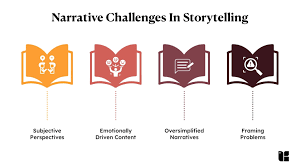 Common Pitfalls
While the value of storytelling is increasingly recognized, execution often falls short. Several patterns tend to undermine effectiveness.
- Confusing storytelling with entertainment: Business storytelling is not about being amusing; it is about being meaningful. Clarity and relevance should take precedence over creativity for its own sake.
- Over-reliance on anecdote: Personal stories can be powerful, but without a clear strategic link to the broader insight, they risk becoming distractions rather than drivers of understanding.
- Fragmented messaging: Producing disconnected content pieces dilutes impact. Without a unifying narrative, even high-quality content struggles to build cumulative influence.
- Chasing virality over authority: Short-term attention spikes do not equate to long-term thought leadership. Consistency of perspective is more valuable than occasional visibility.

The Strategic Implication
As artificial intelligence accelerates content creation, the supply of information will continue to increase. In such an environment, the competitive advantage shifts away from producing content and toward shaping interpretation.
This is where storytelling becomes decisive.
Organizations that invest in narrative capability—defining clear perspectives, structuring ideas effectively, and communicating them consistently—will be better positioned to influence how markets think and evolve.
They do not risk becoming part of the background noise, regardless of how strong their underlying ideas may be.
In the end, thought leadership is not simply about having something to say. It is about ensuring that what you say changes how others see.
And that is the work of a clever storyteller.
 If you want a free copy of my new book, “How I’ve Survived as a STORYTELLER for Over 50 Years: 12 Survival Techniques”, just contact me. The only requirements are to include your name, your email address, and “Storytelling” in the subject line.
Leaders Who Shape Stories Shape Markets, written by Tor Kjolberg
Other articles on storytelling:
How Storytelling Can Help Launch Your Product in Scandinavia
Rethink How Destinations Are Experienced
My 12 Survival Techniques as a Storyteller
Brand Masters of Storytelling
dailyscandinavian.com/how-to-use-humor-in-storytelling-to-break-through-advertising-clutter/