


The Periplus of the Erythraean Sea is an essential manuscript from around 60 AD that helps us understand how international trade developed. It is one of those human documents, like the journals of Marco Polo, Columbus, and Vespucci, that express not only individual enterprise but also the awakening of a whole race toward new fields of geographical discovery and commercial achievement. Read on to learn more about the first record of organized trade with the nations of the East.
The text has been dated to various times between the first and third centuries, but classical scholar Wilfred Harvey Schoff and historian Dionisius Agius both date it to around 60 CE. It was first translated by Schoff in 1912.
According to orientalist writer William Mac Guckin Slane, the Periplus was likely written by an Egyptian Greek sailor familiar with the region and is nearly unique in offering accurate insights into what the ancient Hellenic world knew about the lands around the Indian Ocean. Schoff notes that the author could not have been “a highly educated man,” as “is evident from his frequent confusion of Greek and Latin words and his clumsy and sometimes ungrammatical constructions.” Because of “the absence of any account of the journey up the Nile and across the desert from Coptos,” Schoff prefers to pinpoint the author’s residence as “Berenice rather than Alexandria.”
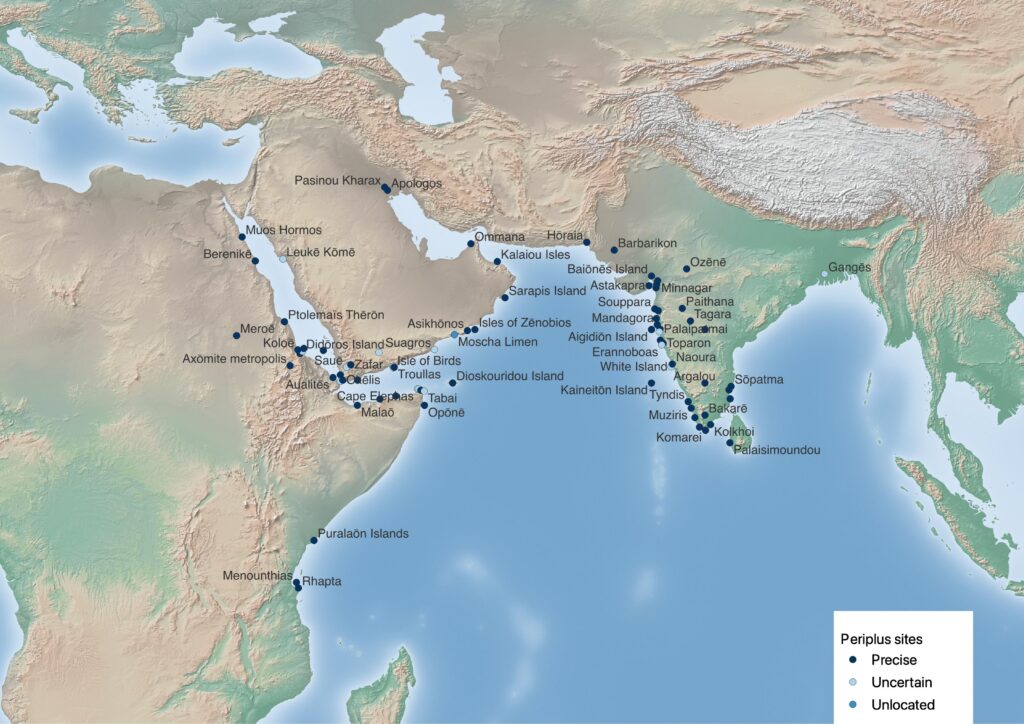
The Erythraean (Red Sea) was an ancient geographical designation that always included the Gulf of Aden between Arabia Felix and the Horn of Africa and was often extended (as in this periplus) to encompass the present-day Red Sea, Persian Gulf, and Indian Ocean as a single maritime area.
It is the first record of organized trade with the nations of the East, conducted in vessels built and commanded by subjects of the Western World. It marks the turning of a tide of commerce that had flowed in one direction without interruption since the dawn of history.
The work consists of 66 sections, most of which are roughly the length of a long paragraph. In many cases, the descriptions of places are sufficiently accurate to identify their present locations; for others, there is considerable debate. For instance, “Rhapta” is described as the farthest market along the African coast of “Azania,” yet at least five locations match the description, ranging from Tanga to south of the Rufiji River delta. The description of the Indian coast clearly mentions the Ganges River, but afterward it becomes ambiguous, describing China as a “great inland city Thina” that is a source of raw silk.
As culture spread in both directions, Egypt and the nations of Ancient India came into being, and a commercial system was developed to exchange products within those limits, with its center of exchange near the head of the Persian Gulf.

The Periplus was originally known only through a single manuscript dating from the 14th or 15th century, now held by the British Library. This manuscript proved to be a corrupt, error-ridden copy of a 10th-century Byzantine manuscript written in minuscule. The Byzantine manuscript was taken from Heidelberg to Rome during the Thirty Years’ War (1618–1648), then to Paris under Napoleon after his army’s conquest of the Papal States in the late 1790s, and finally returned to Heidelberg’s University Library in 1816, where it remains.
The First Record of Organized Trading with the Nations of the East, compiled by Tor Kjolberg.
Previous articles in our series of historic travel stories:
The World’s Oldest Surviving Travel Story
The World of the Odyssey: A Palimpsest of the Hellenic Art of Living Well
Sinbad the Sailor