




Logic can convince us that something makes sense. Emotion can make us believe it matters. Together, they form a powerful foundation for action. In brand storytelling, facts tell, stories sell.
Logic may convince the mind, but stories can win the heart.
Henri René Albert Guy de Maupassant said, «The public is composed of numerous groups whose cry to us writers is: ‘Comfort me.’ ‘Amuse me.’ ‘Touch my sympathies.’ ‘Make me sad.’ ‘Make me dream.’ ‘Make me laugh.’ ‘Make me shiver.’ ‘Make me weep.’ ‘Make me think.’
Maupassant wrote the passage to critique the commercial and emotional demands that readers and critics place on authors. He sought to distinguish the true artist from a mere entertainer who bends to the shifting whims of the masses. In business, however, it sometimes helps to be a little human in communication.
Imagine two ways to promote a destination. The first presents a compelling collection of facts: sunny days, hotel quality, historical attractions, restaurants, transportation connections, and prices.
The second tells the story of a traveler who discovers a tiny village, shares an unforgettable meal with a local family, and wishes she could stay another week.
Both approaches convey information. Both may be truthful. But they do not necessarily achieve the same thing. The first helps us understand what the destination offers. The second helps us imagine what it might feel like to experience it.
And that difference matters.
Convincing is not the same as believing
We often assume that if we provide enough evidence, people will reach the conclusion we want them to. Give them the facts, present the arguments, demonstrate the benefits, and let logic do its work.
Sometimes it does. Facts can establish credibility, answer questions, reduce uncertainty, and help people compare alternatives. No serious destination marketer should underestimate their importance.
However, relying on facts alone has a problem: people do not make decisions solely by evaluating evidence. We bring our experiences, expectations, prejudices, ambitions, fears, and dreams to every decision. We interpret information through what matters to us.
 The difference between knowing something and feeling its significance
Seth Godin has written about the limits of proof when trying to reach people who are unwilling to believe. His argument challenges a familiar marketing assumption: that more evidence will necessarily lead to more persuasion.
He said, “The problem is this: No spreadsheet, no bibliography, and no list of resources is sufficient proof to someone who chooses not to believe. The skeptic will always find a reason, even if it’s one the rest of us don’t think is a good one. Relying too much on proof distracts you from the real mission – which is emotional connection.”
A statistic can show that a destination is popular, but it cannot, by itself, make us want to go there.
A hotel description can establish that a room is comfortable. It cannot fully convey the feeling of waking to the sound of the sea, opening the curtains, and realizing there is nothing urgent to do that morning.
The difference isn’t between truth and fiction. It’s the difference between knowing something and feeling its significance.
Consider a traveler who believes that a particular destination is too expensive, too crowded, or simply not suitable for people like them.
You can respond with competitive pricing, visitor statistics, and a list of attractions. These facts may be accurate, but the traveler can still dismiss them.
Prices may be lower than expected, yet the traveler fears the experience will feel commercialized. Perhaps the destination has beautiful scenery, but the traveler assumes it will be hard to meet locals.
The problem may not be a lack of information. It may be the absence of a meaningful connection. A story offers another way in.
Instead of insisting a destination is welcoming, tell us about the restaurant owner who remembers a returning guest’s favorite dish. Instead of claiming a place offers authentic experiences, introduce the craftsperson who has spent forty years perfecting a traditional skill.
These details do not replace evidence. They make an abstract promise tangible. A good story gives people something to picture, something to feel, and something to test their expectations against. It invites them to reconsider, not merely agree.
 What do people really want from a story?
In the preface to his 1888 novel Pierre et Jean, the French writer Guy de Maupassant listed what readers seek in literature: comfort, amusement, sympathy, sadness, dreams, laughter, fear, tears, and thought.
His observation points to a fundamental truth about human communication. People do not turn to stories merely to gather information. They also seek experiences. They want to recognize themselves in others. They want to explore unfamiliar worlds, feel emotions, and imagine possibilities beyond their everyday lives.
 Destination marketing can benefit from the same insight
A traveler may be interested in a region’s history, but a story about a family struggling to preserve its ancestral home can make that history feel personal. A visitor may appreciate information about local cuisine, but a story about a grandmother teaching her granddaughter to prepare a traditional dish can make the cuisine memorable.
A landscape may be spectacular, but the story of the people who depend on it, protect it, or find meaning in it can give it deeper significance.
The destination has not changed. Our relationship with it has. That is the power of storytelling.

Facts provide the foundation. Stories create the connection.
Framing this argument as a choice between facts and stories would be a mistake. Facts matter. Accuracy matters. Credibility matters.
A compelling story built on false claims may attract attention, but it ultimately erodes trust. When travelers are ready to book, they still need practical information on prices, accommodations, transportation, accessibility, and available experiences.
The challenge is to combine the two in the right order and proportion.
First, capture attention with something meaningful. Introduce a person, a conflict, a surprising discovery, or an unexpected detail. Then develop the story so the reader understands why it matters. Finally, present the facts that support the promise and help the reader take the next step.
Think of facts as a house’s foundation. They provide stability. Storytelling gives the house character and helps us imagine living in it. Neither is sufficient on its own.
Facts Tell. Stories Sell. Written by Tor Kjolberg
 Take-away
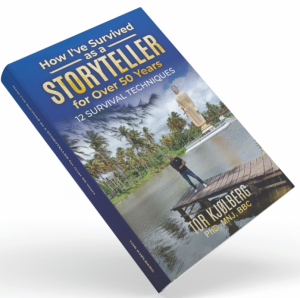
If you learned something from this article, I believe you’ll also enjoy my recent book, “How I’ve Survived as a Storyteller for Over 50 Years: 12 Survival Techniques.” Get your FREE e-book copy by sending me your name and email address, and including “Storytelling” in the subject line. Thank you for reading!
More articles on Storytelling by Tor Kjolberg you may like:
Brand Storytelling for Nonbelievers
Stop Selling Perfect Destinations
Destination Storytelling: The Questionnaire Is Your Map – Not Your Prison
Tales of the Unexpected: The Hotel Detective Is on the Case
The Customer Magazines That Sell Without Selling