Through February 28 the Exhibition “Poor Art – Rich Legacy” will be displayed at the Museum of Contemporary Art in Oslo, the venerable, former Norwegian Bank building.
The thematic exhibition of works from the collection concentrates on the arte povera movement, which is central to the museum’s collecting policy.
The basis for Arte Povera was furnished by the political protest movements of the late 60s – student revolts and civil rights efforts, and a general opposition to consumerism and the increasing commercialisation of the art world. The term arte povera was introduced by the Italian art critic Germano Celant, who organised the exhibition “Arte Povera – Im Spazio” together with a small group of young Italian artists in 1967.
Arte Povera’s conceptual views, approach to materials and working processes have influenced contemporary artists for the past 40 years. This is reflected in the history of the museum’s collection, which includes both acquisitions of significant Arte Povera works, as well as related practices within land art, post-minimalism and conceptual art.
The exhibition “Poor Art – Rich Legacy: Arte Povera and Parallel Practices 1968–2015” is based on some of the most significant works from the Norwegian National Museum’s collection of contemporary art.
The exhibition gives visitors a new chance to see Michelangelo Pistoletto’s notorious installation Image and Body (1991). Consisting of the museum’s old pieces of furniture, some of which have been turned upside down, Image and Body was shown at the solo exhibition “Minus Objects” in 1991 and later purchased by the museum. The acquisition gave rise to a major public debate.
Mario Merz
Arte povera was a short-lived but influential art movement whose roots lay in the protest movements of the late 1960s. One thing the arte povera artists had in common was their revolt against the commercial art scene. They were opposed to modern consumer society and wanted to make art more common and quotidian. The leading artists of the movement included Michelangelo Pistoletto, Mario Merz, and Gilberto Zorio.
Paolini L’Altra Figura
All in all, sixty-three artists and ninety works of art are represented in the exhibition. Also featured are fourteen filmed interviews with artists, critics, and the museum’s director, as well as the NRK documentary Time, Money, and Art from the Museum of Contemporary Art’s opening in 1990.
Artists represented at the exhibition: Giovanni Anselmo, John Baldessari, Miroslaw Balka, Per Barclay, Per Inge Bjørlo, John Bock, Hanne Borchgrevink, Louise Bourgeois, Kristina Bræin, Bård Breivik, Gerard Byrne, Pier Paolo Calzolari, Jeannette Christensen, Hanne Darboven, A K Dolven, Elmgreen & Dragset, Ida Ekblad, Ólafur Eliasson, Matias Faldbakken, Ian Hamilton Finlay, Hilmar Fredriksen, Jon Gundersen, Gjertrud Hals, Svanhild Heggedal, Siri Hermansen, Georg Herold, Marianne Heske, Ane Mette Hol, Ragna St. Ingadottir, Iver Jåks, Marte Johnslien, Donald Judd, Ilya Kabakov, Berit Soot Kløvig, Jannis Kounellis, Sol LeWitt, Løvaas & Wagle, Camilla Løw, Mario Merz, Camille Norment, Kirsten Ortwed, Sidsel Paaske, Giulio Paolini, Guiseppe Penone, Michelangelo Pistoletto, Kirstine Roepstorff, Dieter Roth, Ulrich Rückriem, Lara Schnitger, Richard Serra, Robert Smithson, Susana Solano, Bente Stokke, Gerd Tinglum, Mario García Torres, Mette Tronvoll, Tone Vigeland, Camilla Wærenskjold, Franz West, Snorre Ytterstad, and Gilberto Zorio.
The museum’s permanent installations are also part of the exhibition. In the square outside the museum’s entrance, the audience can view Richard Serra’s towering sculpture Shaft (purchased in 1992), Per Inge Bjørlo’s installation Inner Room V by the ground floor staircase (purchased in 1990), Ilya Kabakov’s installation Garbage Man (The Man Who Never Threw Anything Away, acquired in 1994), and Louise Bourgeois’ Cell VIII.
Exhibition: “Poor Art – Rich Legacy” in Oslo, compiled by Admin
The German invasion of Denmark and Norway began on 9 April 1940. Some troops crossed the Jutland border into Denmark, others emerged from hiding in German merchant ships in Copenhagen harbor, and paratroops landed at key points around the country.
The invasion of Denmark was a part of the operation “Weserübung” directed towards the invasion of Norway. German invasion was to ‘protect’ Denmark against an Allied attack.
German planes over Denmark 1940
Hitler was not particularly interested in Denmark in itself, but he needed to control the country and its air bases to make it easier for the German army to attack Norway.
The Danish army was in barracks, the navy was too surprised to fire a single shot, and the air force was destroyed on the ground. If nothing else, the Royal Life Guards at Amalienborg Palace in Copenhagen prevented the Germans from capturing King Kristian X just long enough for him to order a surrender. Hitler now added a second conquered nation to his quarry, which began with Poland.
Denmark remained in theory a sovereign state under German protection, but when the king ignored Hitler’s effusive greetings on his birthday in 1942, the pretence was dropped.
Operation Weserubung
By the summer of 1943, in the midst of World War II, Denmark had been occupied for more than three years. Resistance to the invaders had been sporadic, mainly limited to displays of Danish cultural identity or scattered acts of sabotage.
However, provoked by German brutality and refusing to sanction death sentences of the increasingly active Resistance movement, the Danes began to act more boldly to resist the Nazi war machine. Mass nonviolent direct action began first with labor strikes. When SS troops arrived to round up Danish Jews for deportation to the death camps, the Danes rescued their fellow citizens, ferrying most to safety in Sweden.
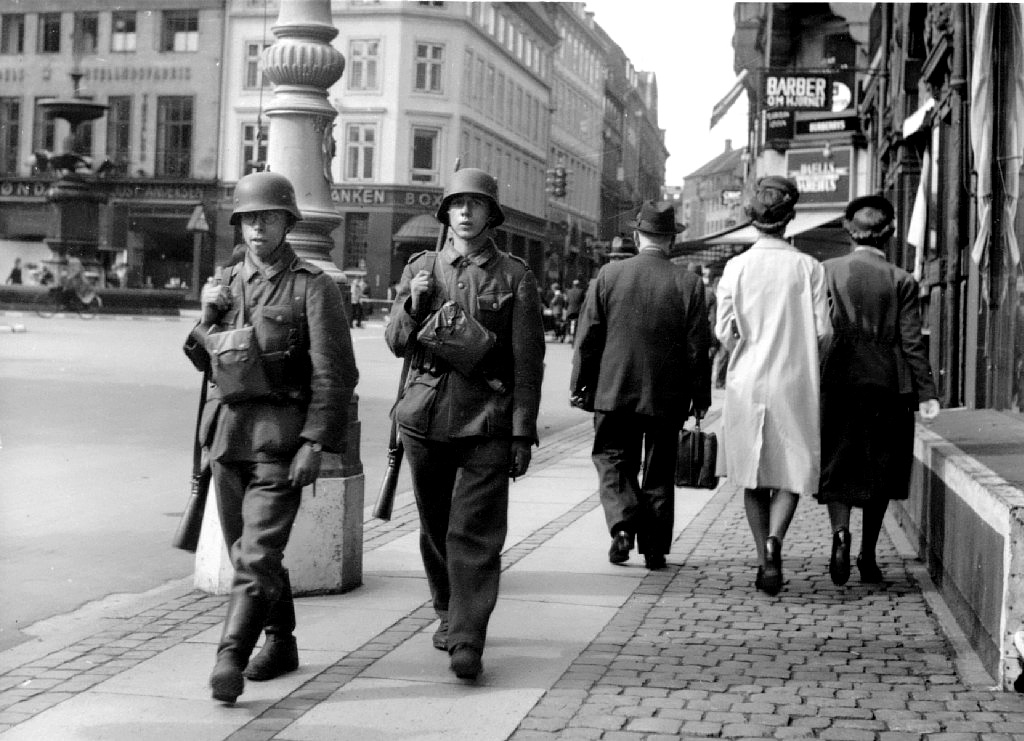
German troops pass Danish civilians in Copenhagen
Although Denmark is not liberated until the end of the war, nonviolent resistance stymied German plans for extracting value from the occupation.
A new government was expected to jump at Hitler’s whim, but it refused to sanction death sentences on members of and made arrangements to smuggle Denmark’s endangered Jews to safety in Sweden.
Feature image (on top) Invasion of Denmark 1940 (Photo Bundesarchiv Jutland)
German Invasion of Denmark, written by Tor Kjolberg
Swedish designer Jonny Johansson and his fanatically popular fashion brand, ACNE, are in the power seats.
When Jonny Johansson and three colleagues started his lifestyle label in Stockholm in 1996, they claimed they would conquer the world after having created 100 pairs of unisex jeans and given them to 100 influential friends. A cult was born.
Acne Fashion 2015Acne Studios 2015
Soon the brand was supplying a young global fan base with everything from radically elegant casual sportswear to stuffed animals. They even have their pwn biannual magazine. The name, by the way, is an acronym for Ambition to Create Novel Expressions.
Jonny Johansson has put Scandinavian fashion on the world map with his jeans, shoes and basic garments with a bit avant-garde twist. Has been named designer of the year, denim designer of the year and Sweden’s most powerful fashion man. Among others, he has made a collection in cooperation with fashion house Lanvin.
Today it seems like Acne has transformed from a streetwear label to one that is comfortable in the world of ready-to-wear.
Johansson says that the challenge has been to be able to make really interesting designs which are functional but still remain interesting. He started out in a time where Helmut Lang and Prada were making amazing clothes without being too abstract.
Johansson is a hardworking and exceptionally inspiring designer and good at finding the right people to work with. More importantly, perhaps, is the willingness to do something different, something that nobody has done before, often with people who are better than him.
From London Brompton Cross Studio
He did not have a traditional fashion education, so he had to be learning by trial and error, creating styles that the industry might dub ‘editorial’ (oddly fitting trousers, ungainly proportions and frankly ugly fabrics). The core Acne style is not only ready-to-wear, but easy to wear.
With styles that the industry might dub ‘editorial’ (oddly fitting trousers, ungainly proportions, frankly ugly fabrics), the core Acne style is not only ready-to-wear, but easy to wear. In a way it mimics Scandinavian furniture design with its simplicity and focus on fusing both form and function into clothes that work. You can’t help but think of Ikea, and their championing of interesting design that still does its job incredibly well. Acne’s doing the same for your wardrobe.
Jonny Johansson grew up in Umeå, north in Sweden. He was a good guitarist, played in band and was fired after a concert in Japan. To take revenge, he moved to Stockholm.
His mother wanted him to go to art school because she saw that he was a creative boy, but he wanted to pursue music, which was important in his family, on his father’s side. But in the end it was about creating.
One day Jonny was walking down Drottninggatan, having dyed his hear red, wearing white lederhosen, black t-shirt and rockabilly shoes – and was spotted by a party-fixer who wanted to have him on his list. One party led to another. Johanssen became familiar with every who’s who in advertising, media and fashion, and in 1996 he and three buddies invested 200,000 kroner and established Acne International.
One day the founder of Wallpaper came by the office and hailed the company in the magazine. After that things happened in furious pace. The Fashion department grew to over 20 people and the upcoming star, Ann-Sofie Back, who today runs her own brand, Cheap Monday, was hired to create women’s clothing.
Acne Studios Lookbook The Impression Resort 2015
In an interview Johanssen said, “The older I get, I realize I have a Swedish inheritance. I never really knew about it, I almost fought against it, and tried to be international… I think we are different; local and global at the same time.”
And he actually never wanted to do something that was Swedish. Acne is global – but it’s been achieved by exporting that local sense of Swedish ease. It has over 650 outlets in 66 countries around the world, and a turnover of over €100m, achieved without advertising, but rather through the cultish pull of the clothing.
Sweden’s Most Powerful Fashion Man , written by Admin
Last summer a convicted sex offender managed to escape from an island prison in Norway on a surf board, paddling to the mainland with the help of a plastic shovel.
The prisoner, said to be in his mid-20s, went missing overnight. The next morning a surf board and shovel that were property of the prison were found on the mainland around three kilometres away. The man is not considered a danger to the general public.
Prison chief Tom Eberhardt said: “If it hadn’t been a surfboard, it could have been something else. “It’s not so hard to find a floating device of some sort on the island.”
Escape attempts are rare at Bastoy, which was founded in 1982 and hosts approximately 115 inmates, partly because of its unparalleled amenities and partly because those who are subsequently caught have little chance of returning. Escapees are usually placed in one of Norway’s high-security facilities.
Norwegian prisons are known for being among the world’s nicest places to be locked up. One of them, Bastoy, is situated on a plus one-square-mile island and features no walls or fences or cells. instead it’s treating inmates to tennis courts, beaches and a sauna. It’s all part of the Scandinavian country’s emphasis on humane rehabilitation rather than harsh punishment.
When inmates come to his island jail, the governor Arne Kvernvik Nilsen, gives them a little talk.
Among the wisdom he imparts is this: “If you should escape and make it across the water to the free shore, find a phone and call so I know you’re OK so we don’t have to send the coast guard looking for you.”
Prisoners need to pass a screening test before being selected for the Bastoyprison, where tasks include organic farming and cooking.
Set on the picturesque island, the prison is designed to prepare inmates for an eventual return to normal life.
In Hälsingeland north of Stockholm visitors may watch and photograph wild Scandinavian Brown Bears (ursus arctos) from safe wooden hides.
Hälsingland is a historical province in central Sweden. It borders Gästrikland, Dalarna, Härjedalen, Medelpad and the Gulf of Bothnia. It is part of the land of Norrland. In English the province is sometimes referred to as Helsingia.
If you want to see a wild bear in your lifetime, then you should go to the Bear Mountain in Hälsingeland. There is a high success rate and you often see the bears’ daily life up close in peace and quiet in safe and comfortable wooden hides with chairs and berths.
Included is also a great picnic, together with accommodation and breakfast in the hide’s cosy beds.
Don’t forget to bring your camera since there are excellent photo opportunities. The hides are adapted to photography and your images will have natural backgrounds.
The journey to the hide is a short hike of about an hour. Visitors leave cars and minibuses behind, entering slowly the forest of the bears and absorbing the special ambience of the wilderness. Often there are signs of the animals tracks, pawed anthills and claw-marked stumps. Ants are a favorite snack of the brown bear, especially nice juicy carpenter ants. The territorial markings on the trees let you know that you are in the right area, and if you’re lucky you might see a bear right here!
Brown bears can run in 50 kilometers per hour, but only over short distances. Vision and hearing are not particularly well developed, but the sense of smell is excellent. The lips are also very sensitive and is actively used when the bear is searching for food.
Photo: Mikael Brandsten
Males weigh 100-350 kilograms, while females can weigh 60-200 kilograms. Withers height can be up to 1.5 meters.
Brown bears eat berries, roots, grass and small animals, moose calves and reindeer.
Photo: Göran Ekström
There are approximately 3,000 brown bears in Sweden. They are not particularly aggressive. Usually they run away when they detect the scent of humans.
Excursions are ‘quality marked’ with the Swedish Eco-tourism Society’s ‘Best of Nature’ award. You can read more about the safaris here.
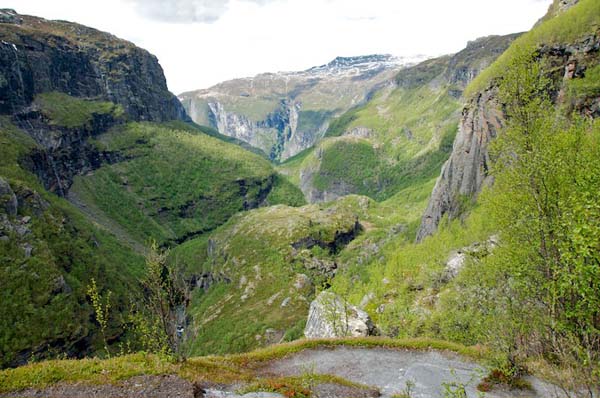
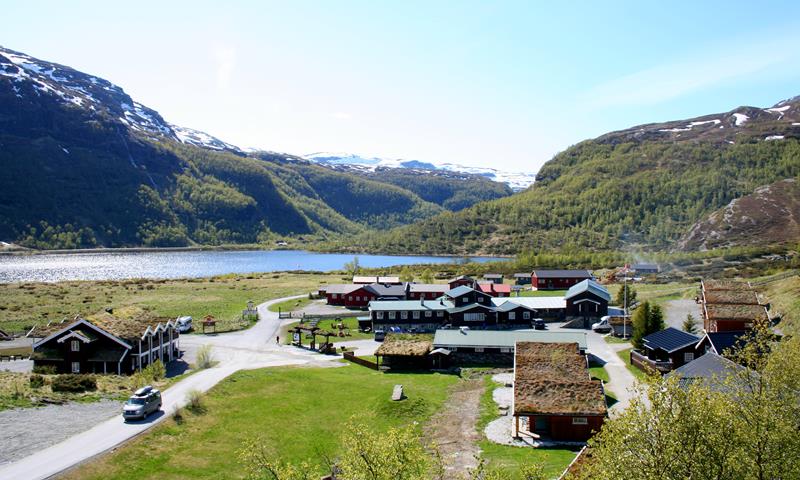
The Aurland Valley is wild with breathtaking nature, often compared to Grand Canyon in the US.
Aurlandsdalen, as it is called in Norwegian, is located in the county of Sogn og Fjordane in West-Norway. The Norwegian Trekking Association (DNT) has marked a trail from Finse (1,222 meters above sea level) to Vassbygdi (50 meters above sea level). This is a four days trekking, and you can stay in the association’s cabins along the trail. If you prefer, you may choose to hike only parts of the valley.
In former times, Aurland Valley was one of the most important connections between west and east Norway.
Trekking suggestion
Walk from Østerbø to Østerbø Mountain Lodge (820 meters above sea level). The path is in the lower part of the valley, mostly going downwards, and is easy to walk. Some minor parts, however, are exposed, and extra caution needed.
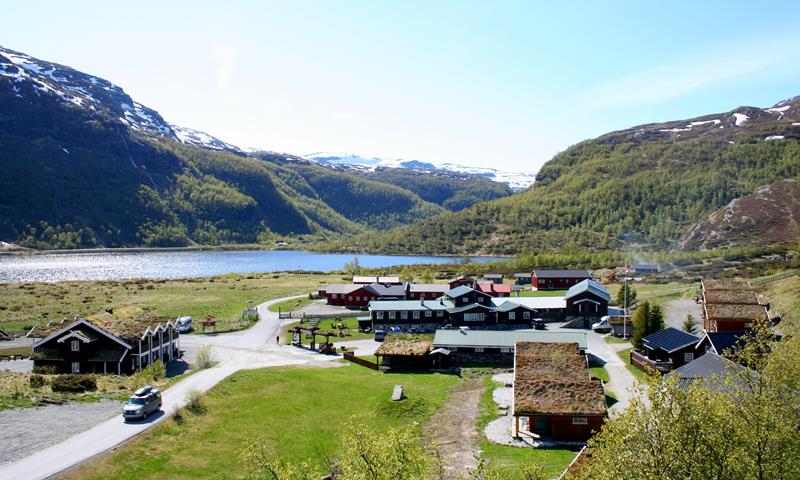
Østerbø Mountain Lodge
As late as in 1850, there were a total of ten farms and crofts in the valley. Today, these farms are abandoned, but many are restored and in good conditions. The two farms at Østerbø became tourist cabins in the early 1900’s.
Nesbø Lake
Continue to Nesbø Farm, situated at the beautiful Nesbø Lake. The farms was abandoned 100 years ago, but is now restored by the owner. People has lived here from 1664. Most of the farms in Aurland Valley were left between 1875 and 1907.
From here you have two choices, but we recommend you to walk the Bjørnestigen (Bear’s ladder) trail. This is a steep part, rising to more than 1,000 meters above sea level. You will enjoy a fantastic view. Wires are installed at the most difficult parts.
Bear’s Ladder
The other choice is along the Aurland River. The two paths meet again further down in the valley at Vetlahelvete (“Little Hell”), a giant pothole, the biggest in the valley. Underground veins hold the water in the pothole at a constant height and temperature.
View from Little Hell
Enjoy the fantastic landscape on your way to Sinjarheim Mountain Farm. You’ll pass a wild waterfall before on your way. Sinjarheim was the last farm to be left in the Aurlandsdalen Valley. It was left in 1922, and was used as a mountain farm until 1964.
Sinjarheim Mountain Farm
Sinjarheim is situated at the edge of a cliff. Down in the valley below the cliff, there is a raging river. Therefore, in the old days, it was common to secure the children with rope. The farm exists of seven buildings, including a drying house for corn, and has now been restored.
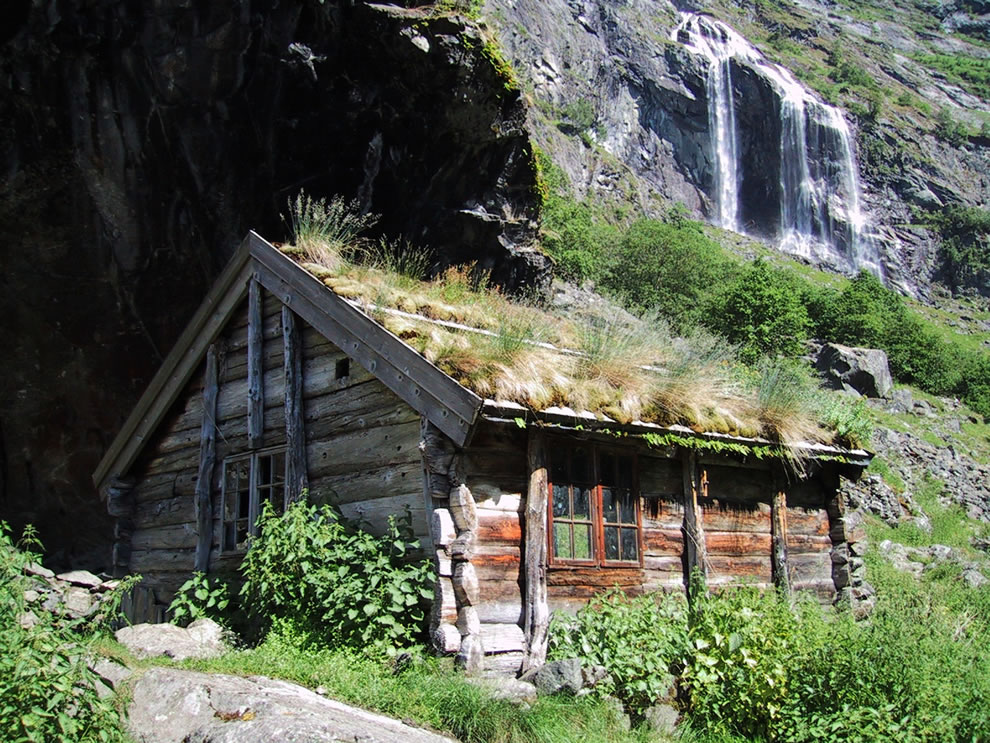
From Sinjargeim the path goes steep down towards the Almen Farm, the last farm in Aurland Valley. The Almastova (the building) is well protected under a big rock.
Almen Mountain Farm
The end point of the Aurland Valley is Vassbygdi. From here you can trek to Gudvangen, the innermost part of the Nærøyfjord. You may stay at the Styvi Farm. If you like kayaking, you should take a brief tour out the fjord to Skalmeneset.
About the Aurlandsdalen Valley
The Aurlandsdalen Valley is one of the most popular hiking trails in Norway. It is located in Sogn, close to Aurland and Flåm at the inner part of the Aurlandsfjord, a 29-kilometer long branch of the 204 kilometer long Sognefjord. It is normal to use between six and seven hours to walk the lowest part of the valley, but I recommend to spend the whole day so you can see more of this beautiful piece of Norway.
Farming in Aurland Valley
Facts
– The Aurlandsdalen Valley, from Geiteryggen to Vassbygdi, is approximately 40 kilometers long. The most common places to start the walk are at Finse, Geiteryggen, Stemmerdalen or Østerbø.
– The lowest and most picturesque part of the valley, from Østerbø to Vassbygdi, is approximately 20 kilometers long.
– The Aurlandsdalen Valley lies between 50 and 1,660 meters above sea level. The lowest part of the Aurlandsdalen Valley from Østerbø to Vassbygdi lies between 820 meters above sea level (Østerbø) and 50 meters above sea level (Vassbygdi).
– As late as 1850, there were a total of ten farms in the Aurlandsdalen Valley: Almen, Sinjarheim, Teigen, Berekvam, Skori, Nesbø,Vikaneset, Aurviki and two farms at Østerbø. These farms are now left, but many of them are restored. The students from Sogn Agricultural School in Aurland use Sinjarheim Mountain Farm as a teaching aid
– The Norwegian Trekking Association (DNT) has two cabins in the upper part of the Aurlandsdalen Valley, Finsehytta and Geiteryggshytta.
– Østerbø Fjellstove and Østerbø Turisthytte are two private cabins located at Østerbø in the lower part of the Aurlandsdalen Valley.
Guided walk or walk by your own
There are well-marked trails, and most people walk from one of the mountain huts located along the trail. The wildest and most picturesque part of the valley is the lowest part, between Østerbø and Vassbygdi. You normally walk this part of the valley in six to seven hours. The Norwegian Trekking Association (DNT) offers led group hikes and tours in the Aurlandsdalen Valley.
Nice to know
The weather in the Norwegian mountains can change rapidly, and snow during summer is not unusual. Remember to bring clothing and equipment designed for all types of weather. Solid hiking shoes are highly recommended. The Norwegian Trekking Association (DNT) is providing a summer hiking gear list.
Combine the walk with biking and a fjord cruise
You can combine this walk with other adventures in the nearby area. Bike along Rallarvegen (the Navvies’ Road) from Finse to Flåm. Or join a Fjord Cruise or a Rib Boat on the Nærøyfjord and Aurlandsfjord. Read more about what to do in the Nærøyfjord and Aurlandsfjordin the Fjord Guide.
Getting to the Aurlandsdalen Valley
The Aurlandsdalen Valley in the Sognefjord area is centrally located in the heart of Fjord Norway, between Oslo and Bergen, and is easily reached by public transport. You can travel to the Aurlandsdalen Valley with a combination of plane, train, bus and boat or by car. From Oslo and Bergen, you can travel by train to Flåm. From Bergen, you can also travel by express boat to Flåm. From Oslo and Bergen, there are daily flights to Sogndal Airport. From Sogndal Airport, there are bus departures to Sogndal. From Sogndal you can travel by bus or express boat to Aurland and Flåm.
From Aurland and Flåm, there is only a short distance with bus to the different starting points of the walk in the Aurlandsdalen Valley. This bus route starts at the end of May and ends at the end of September, check Fjord1 for more information.
You can also contact Østerbø Fjellstove. They can pick you up with their own bus and give you transport to Vassbygdi, Østerbø or Stemmerdalen when the bus route is closed.
The Norwegian Trekking Association (DNT) has two cabins in the upper part of the Aurlandsdalen Valley, Finsehytta and Geiteryggshytta. There are also two private mountain cabins at Østerbø in the lowest part of the valley, Østerbø Fjellstove and Østerbø Turisthytte. Members of the Norwegian TrekkingAssociation (DNT) get discounts on both the DNT-huts and the private cabins in the valley.
The best time for hiking in the Aurlandsdalen Valley is from late May to late September. In May and June, there is usually snow left in the upper part of the valley. Due to the snow, you should avoid walking this part of the valley, between Finse and Østerbø, in May and June. The lower part of the valley, from Østerbø to Vassbygdi, is possible to walk from late May to the beginning of October. The mountain lodges at Østerbø are open from late May to the beginning of October.
Who can join
The walks in the Aurlandsdalen Valley varies from easy to difficult, and you must be in normal good shape. In parts, the path goes through exposed terrain. Take this in consideration if children are joining the walk. It is not recommended to bring children less than eight years on this walk.
Prices
Train and bus
You can travel from Oslo or Bergen to Flåm by train. From Flåm, there is a short distance with bus to Østerbø, the starting point of the walk. There are also bus connections from Vassbygdi (the end point of the walk) back to Aurland and Flåm.
When Nazi-Germany swallowed Europe, the Danish physicist Niels Bohr fought back with the only weapon he had: chemistry.
Niel Bohr transformed into something like Oskar Schindler in a lab coat. From his Institute for Theoretical Physics in Copenhagen, the Nobel laureate aided and protected Jewish scientists, which landed him in hot water in 1940.
The Nazis had attempted to lock down Germany’s gold supply by making exportation of the metal a state crime. During the 1930s, two German physicists, the Jewish James Franck and the outspoken Hitler critic Max von Laue, smuggled their Nobel medals to Bohr’s lab for safekeeping.
Max von Laue
The lab made a perfect hiding spot until April 1940 when the Nazis invaded and occupied Copenhagen. They are literally marching through the streets, and Bohr has just hours, maybe minutes, to make two golden Nobel Prize medals disappear. He knew the Germans would confiscate them, and they were not his medals.
Made of 23-karat hold, the medals are heavy to handle, and being shiny and noticeable. Clearly inscribed “Von Laue” (for Max von Laue, winner of the 1914 Prize for Physics) and “Franck” (for James Franck, the physics winner in 1925) — they were like two death warrants.
On the day that the Nazis arrived in Copenhagen, Hungarian radiochemist George de Hevesy was working in Bohr’s lab. They discussed how to hide the medals and thought about burying them at first.
“I suggested we should bury the medals, but Bohr did not like this idea of them being unearthed,” recalls de Hevesy in his autobiography.
James Franck
“I decided to dissolve them. So while the invading forces were marching down the streets of Copenhagen, I was busy dissolving von Laue and Franck’s medals.”
But the medals would not simply disappear as von Hevesy recalled from his studies how gold is “unreactive and difficult to dissolve”. All the while, the Nazis were getting closer.
George Charles von Hevesy
Racing against the clock, de Hevesy saved the day by dissolving the bulky gold medals in aqua regia, which is made up of three parts hydrochloric acid and one part nitric acid. When the gold was dropped into the solution, the hydrochloric acid will separate the gold as long as the nitric acid loosens the metals’ atoms. And then it is left to the chloride ions to complete the process.
As you can see in this video from the University of Nottingham, dissolving gold is a slow business. When the German soldiers pounded on the lab’s door, all which remained of the medals was an inconspicuous bottle of bright orange liquid.
The Nazis, without expertise on chemistry, left empty-handed.
In his book The Disappearing Spoon, the science writer Sam Kean writes:
“When the Nazis ransacked Bohr’s institute, they scoured the building for loot or evidence of wrongdoing but left the beaker of orange aqua regia untouched. Hevesy was forced to flee to Stockholm in 1943, but when he returned to his battered laboratory after V-E Day, he found the innocuous beaker undisturbed on a shelf.”
The flask was untouched.
In 1950, de Hevesy reversed the chemistry by separating the metal from the solution. He then sent the raw metal to the Swedish Academy in Stockholm. The gold was recast into two Nobel Prize medals that were re-presented to Franck and von Laue at reward ceremonies in 1952.
Bohr was also a winner of the Nobel Prize for Physics, but his medal did fortunately not need to be liquified. It had a month before the Occupation been put up for auction to raise money for Finnish Relief. The unknown bidder then donated the medal to the Danish Historical Museum of Fredrikborg, where it still remains.
Danish Nobel Winner Foiled the Führer, compiled by Tor Kjolberg
In Canvas Hotel, in the deep, magic forests in the county of Telemark, the check-in point is a tent. You have arrived at a paradise for biking enthusiasts.
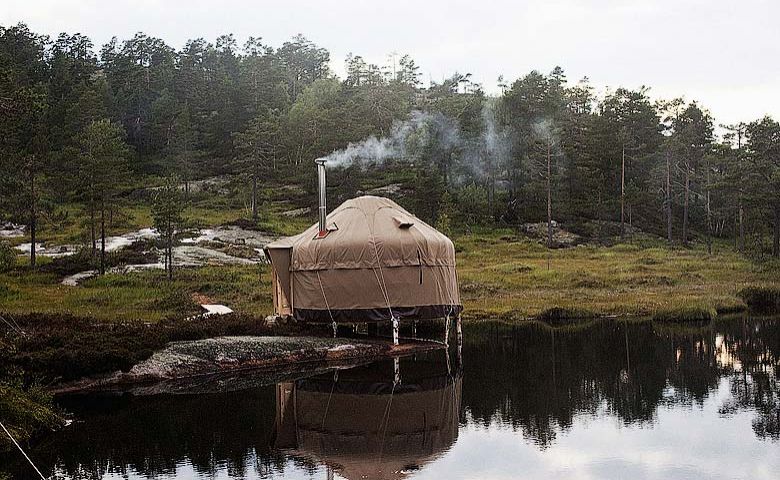
This niche hotel has been developed for mountain biking and offers miles of guided hikes with overnight stays in yurts (Mongolian portable tents).
The initiator, Øivind Lie, says he has been biking in the woods for quite a few years and has always talked to his friends about creating a place for mountain biking.
“We were looking for the best spot in our area and found the owner of a property who also was a mountain biker. We didn’t want to destroy the wilderness, so that’s how the idea of the yurts arose,” he says.
Beside mountain biking there’s plenty of alternatives. There is a gourmet chef, you may relax in the sauna and there are outdoor bathtubs at all tents as well.
The owners claim that their guests get the best accommodation available – since they deserve it.
Guests can choose between small routes ranging from about half an hour to two hours and big routes which are seven hours. In Norway you are by law allowed access anywhere in the forest, so it’s very easy to get on a bike and go wherever you want.
The Canvas Hotel also offers special training programs with all kinds of difficulty levels to accommodate anyone from beginners to experienced riders. This is far away from the busy fitness centers. It is all about enjoying nature and silence.
A typical day begins with a decent breakfast, like eggs and bacon and pancakes. After breakfast you ride on your bike for a few hours. Back to the hotel for lunch, and if you’re not of the most eager type, you may stay for the rest of the day and read books or listen to the birds. On day trips, the guide prepares a meal on open fire.
When guests arrive at the yurks after a good day of biking, they generally go directly into the sauna. If they prefer, there are also French vintage bathtubs that can be placed wherever the guests want to.
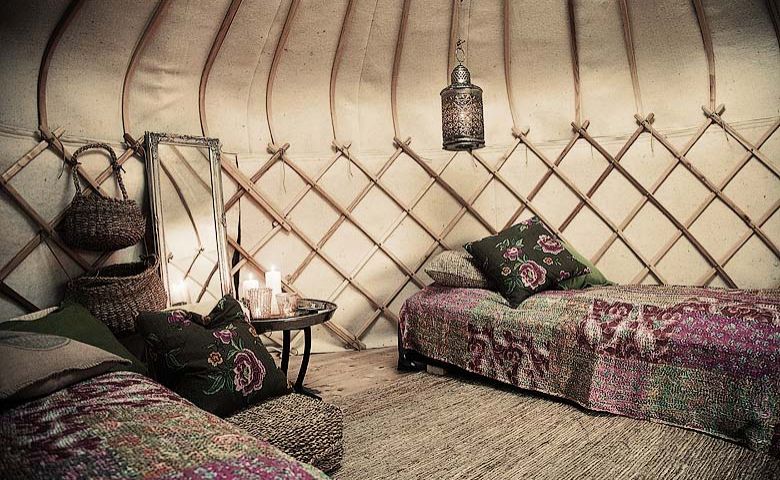
The yurts are standing on posts, and some are partly over the water. The yurts have wooden platforms and each has its own wood-burning stove. The tents are insulated with a layer of wool with canvas on the outside. They are cozy and warm and completely made of natural materials.
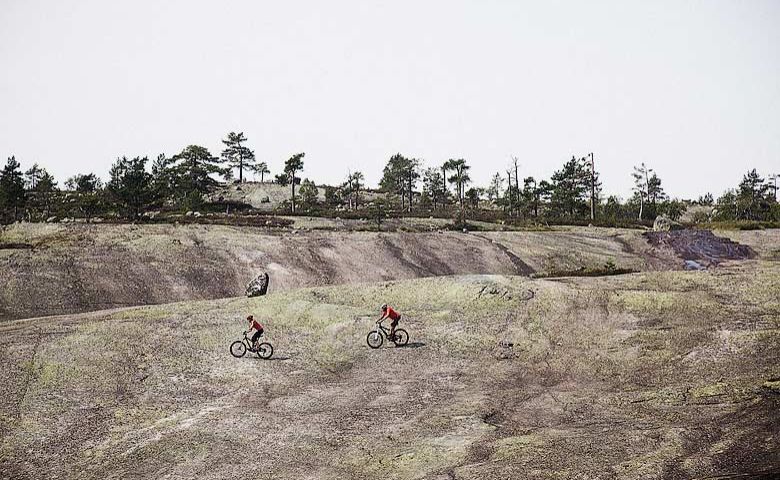
The area is perfect for biking since the ground consists of a thin layer of soil, basically a big area of rock, with many open areas and not many trees. Guests may enjoy hundreds of small lakes, rivers and streams.
The Canvas hotel is easily accessible and attracts private as well as corporate guests from all over the world, even if there’s no electricity or running water at the hotel, only a wood fire pit and propane gas.
Jan Fasting
To go there by car from Oslo:
Follow E-18 towards Kristiansand. Follow road 38 towards Skien/Drangedal, then road 358 at Bostrak towards Treungen.
The hotel opens around first of May and are closed during winter from first of November.
This year Canvas hotel was listed as one of the 100 best hotels in Europe by the German travel magazine Geo Saison.
The Most Remote Hotel in Norway, written by Tor Kjolberg
We’ve met up at the Broberg & Ridderstråle office, a fairly messy space with prototypes, sketches and odd pieces of furniture here and there, with no apparent structure.
None of the precise finish that is typically so prevalent in Broberg & Ridderstråle’s interior design work is visible here. But this is not actually where the most important work takes place: that happens “anywhere at all”.
And what we talk about is how Mats Broberg and Johan Ridderstråle got a piece of mesh that Swedese’s then-CEO had found interesting, a kind of fabric that would shrink 30% when steamed.
Kite Lounge chair is designed to look like a traditional box kite trapped in flight, seemingly delicate and lightweight, but with a strong structural form.
“Then we got the actual foundation: a direct association with kites and the balsa airplanes we built as kids. We understood that we needed to find a frame, across which to stretch it,” remembers Mats as he talks about Kite, the surfer-inspired easy chair that launched at Il Salone del Mobile 2015 as a conference chair.
Kite conference chair
“We have an unstructured approach to work,” explains Mats Broberg, making it sound like an established work method. “We don’t sit here in the office and work. We go all over, often on walks to museums and exhibitions. Ideas have to come with happiness, a joy of discovery; otherwise, they’ll never be good.”
For that reason, they have no employees or interns; they are not bound to the office, nor are they influenced by finances when choosing assignments. “It gives us freedom.” And this approach has been very successful so far.
Divido table
“I’m a little more zealous and have ideas more often, which Johan then scales down intellectually. He’s more structured than I am,” says Mats. Johan fidgets a little, but not disagree.
Mats and Johan met while studying interior architecture. They chose to work together immediately on both side projects and their school assignments. Given that they had made their degree project together, it felt natural to continue working together.
The company was launched in 2001 – “because we sold a candlestick and needed to send an invoice.” Since then they have won numerous honors and awards, not to mention that their products have appeared in rugs, outdoor furniture, grills, lamps, a rack for wood, an oil lamp and street poles, they also work as interior architects, designing environments in stores, offices, homes and at exhibitions.
For Swedese they also designed the Stella chair, a consistent solution for a company or institution’s comprehensive chair needs. At the desk, in the waiting room, lunch room, auditorium, or for the receptionist or CEO: a version of Stella exists for every conceivable function.
Srella chair
The very first product for Swedese was the Divido table, which so elegantly solves the meeting between the legs and table top that it is tempting to set the table beneath, rather than on top of Divido. It is brilliant – especially considering that the most aesthetically sensitive part of almost every table is precisely the space where the legs and table top meet.
The first seed of a product is usually a simple pencil sketch – which was the case when Kite armchair was to be transformed into a conference hair.
“We start that way so we can discuss, because we’re working together. Next we move over to digital material, which is the easiest way to communicate with the factory,” says Johan. “Then we try to go to the factory as early as possible to get a rough shape, something to look at. We want something we can get a feel for in terms of design, but also purely technically,” explains Mats. “Chairs made for offices are usually so incredible technical, with so many functions. But with Kite, we decided to make something basic, because that’s a way to compete as well. If you buy a chair that can do a thousand different things, you’ll be really satisfied when it arrives, but you’ll end up in a certain position that you like. It was a relief to think: no height adjustments. Instead, we let the shape decide.”
Kite is almost even better as a conference chair. “It’s great to have a non-upholstered chair, because it breathes. Especially if you’re sitting for hours in end,” points out Mats. Johan agrees. The construction characterizes the aesthetic. Because Kite is a little transparent, you can see through the chair. The similarities to a sail are particularly evident in the lighter version.
Kite Lounge Chair
To summarize what distinguished Broberg & Ridderstråle, and Divido and Kite especially: it is a kind of meaningful excellence. An idea that is so uncompromisingly and consistently implemented that the furniture could have arrived by way of natural law. If you did not know before, now you do: a conference chair should always be made of mesh.
How else can you sit for long periods of time?
The article “Talking Scandinavian Design” was printed in the book, Swedese Portfolio and published by Swedese Möbler Ab, 2015.
Canadian-born, Norwegian-based architect Todd Saunders returned to Newfoundland to design a 29-room inn on tiny Fogo Island.
Therefore, in 2004, the Shorefast Foundation was established in order to revive the island and attract visitors who asides from their interest in various forms of art, are also looking to enjoy cultural and sustainable tourism. Later on, in combination with the idea behind creating a 29 room Fogo Innas a meeting point for artists from all over the world, the Fogo Island Arts Corporation was established, so that the island’s local tradition would be preserved. The newly formed Corporation focused on taking the initial concept to the next level through providing visitors with not only a place to sleep but also a number of other amenities such as a library, spa & sauna, an art gallery, a small cinema and gourmet creations from one of Canada’s top chefs.
Fogo Island Studiosare slowly becoming an urban myth. The imposing landscape of the North Atlantic heralds the setting for fourexclusive studios, soon to be six, on the North coast of Newfoundland, Canada. With a population of 2,706, the economy of the island which was initially based on fishery rapidly changed along with the global economic background.
Tom Saunders and his border collie
The largest of the studios in the collection, its’ exterior surfaces are comprised of pre-finished rough-sawn painted pine planks. The left zone of the studio features mechanical equipment, storage areas, water tank, compost toilet, shower, kitchenette, wood-burning stove and a ladder that leads to the elevated sleeping loft. Built on stilts in order to take advantage of the exceptional views, its abundant natural light makes this space an ideal workplace for artists and designers.
Fogo Island Inn A five star inn for the Shorefast Foundation on Fogo Island, Newfoundland, Canada. Using wood as the main material, Saunders designed the 29 room Fogo Inn as a means towards the island’s economic and cultural survival, but also as a timeless piece of architecture, which would be ‘made just for Fogo’. The Inn includes a restaurant, directed by one of Canada’s best chefs, together with a lobby, a library, a small movie theatre and an independent art gallery on the ground floor; four floors of rooms above ground level; and a sauna and spa facility on the top of the building.
Credits: Todd Saunders with Ryan Jørgensen, Joseph Kellner and Attila Béres
Photographers: Iwan Baan, Alex Fradkin, Bent René Synnevåg
In Norway Tom Saunders has been responsible for artistic architecture all over Norway.
Aurland Lookout was designed by Todd Saunders and Tommie Wilhelmsen.
The architects won first prize to in an invited competition in 2002. This project is part of a national program on tourist routes commissioned by the Norwegian Highway Department. The pictures actually say more than a thousand words.
Photographer: Bent René Synnevåg, Nils Vik
Credits: Todd Saunders with Attila Béres and Ken Beheim-Schwarzbach
Aurlandsvangen This large multi-functional structure is located on the waterfront in Aurland, down in the valley from the Aurland Lookout on a site that overlooks the expanse of the Aurland Fjord which is a World Heritage Site. The brief was for a competence centre for the local environmental think tank, including business and conference space, publically accessible areas, as well as a financial centre.
Stokke Forest Stair designed for Sti for Øye (Visual Path) Sculpture Park This sculptural installation was designed for the Sti For Øye Sculpture park in Stokke, set amongst the Vestfold oak forest to the West of Oslo, Norway. Working with landscape architect Rainer Stange in order to create the infrastructure for a woodland walk past a series of artists’ installations, Saunders proposed a series of steel and wooden walkways set at the highest point of the site, looking east towards a castle.
Credits: Todd Saunders with Attila Béres and Ken Beheim-Schwarzbach
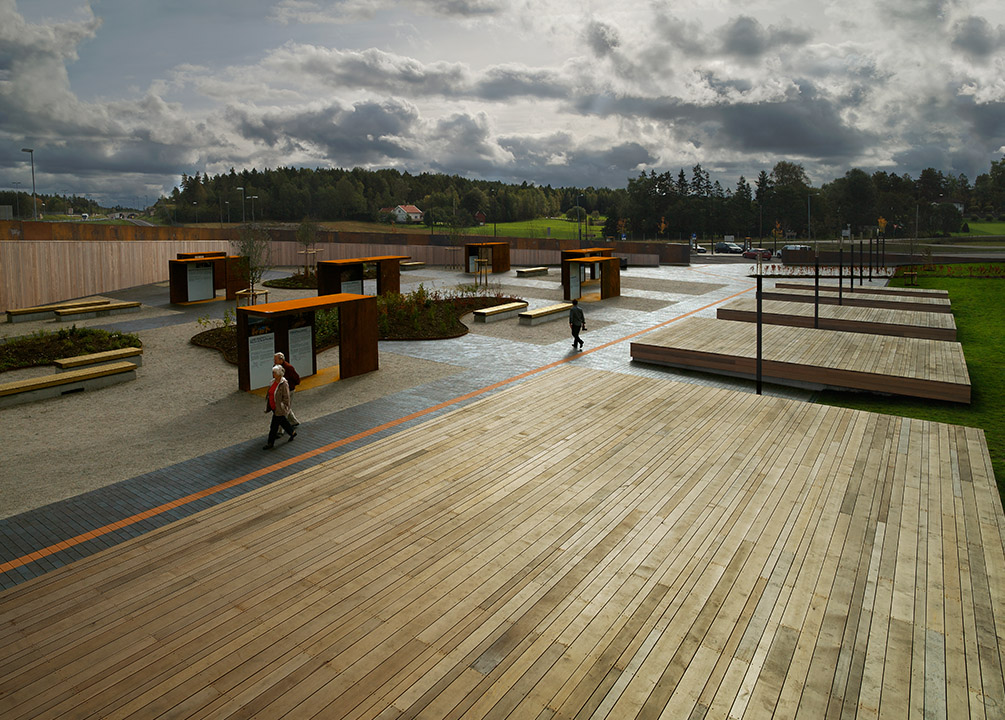
Solberg Tower & Parks Saunders was commissioned to design a park at the entrance of Norway coming from Sweden. This park is one of the first places travelers will stop when entering Norway. The park is surrounded by a long wall composed of cortain steel on the outside and wood on the inside surface. The wall encompasses a 2000m2 space, making it into a quiet park. The wall continues to the surround the park and then rises 30m in the air to form a tower. The tower is just a simple stair. On top one will be able to see the Oslo fjord.
Artistic Architecture in Norway and Newfoundland, credits: Todd Saunders with Attila Béres, Inês Moço Pereira, Mats Odin Rustøy, Greg Poliseo, Mathias Kempton.
Feature image (on top): Fogo architecture Bridge on Fogo Island (Studio Bent Rene Synnevåg)