The Norway Debate, which began May 7, 1940 was a significant debate in the British House of Commons. It caused Neville Chamberlain to resign, and he was succeeded as Prime Minister by Winston Churchill.
However, the real heroes of the Norway Debate were a group of rebels from the British conservative party, who for a long time had tried to fight the government’s reconciliation and compliance policy.
Neville Chamberlain by William Orpen,1929
Harold Nicholson calls the Norway Debate “a pitiful speech only applauded by yes-people” in his “Diaries and Letters 1930-1964”.
The Norway Debate took place on May 7, 1940. Here are some extracts.
As the House of Commons began its historic debate on the conduct of the war in Norway, the British public were seeing the first Newsreel of British ships in action off Namsos and troops in Norway. The upbeat tone of the Newsreel was not replicated in Parliament where the Prime Minister Neville Chamberlain was severely criticized for his handling of the war.
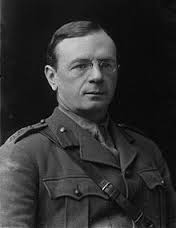
Lieut-Colonel Leo Amery M.P, spoke for many when he said:
“The right hon. Gentleman the Prime Minister—[…] in a digression explained why he used a certain unlucky phrase about Hitler missing the bus. He explained that what he meant was that during these eight months of war Hitler had lost the opportunity which he had at the beginning of the war because we had been catching up on Germany’s preparations. Believe me, that is very far from the truth. While we may catch up on her presently if only we do what we ought to, there is no doubt that during these eight months, thanks to Germany’s flying start and our slowness off the mark, the gap between the German forces and ours has widened enormously as far as troops, their equipment, tanks, guns and all the paraphernalia of land war are concerned.”
Famously, he concluded his speech with:
“I have quoted certain words of Oliver Cromwell. I will quote certain other words. I do it with great reluctance, because I am speaking of those who are old friends and associates of mine, but they are words which, I think, are applicable to the present situation. This is what Cromwell said to the Long Parliament when he thought it was no longer fit to conduct the affairs of the nation: You have sat too long here for any good you have been doing. Depart, I say, and let us have done with you. In the name of God, go.”
Caption feature image (on top)
British and French Commanders waiting to greet troops returning from Norway. General Sir Edmund Ironside, General Carton de Wiart, General Audet and General Mittelhauser
The Norway Debate 75 Years Ago, source: World War II Today
The call of duty stays strong, no matter where you are in the world, for four Swedish policemen on holiday in Big Apple. They made headlines in New York when they helped stop a flight on the subway.
The four men, all in their twenties, were taking a train to watch a performance of the musical Les Misérables on Broadway. Suddenly the train announcer on Uptown 6 informed the passengers that an assault was taking place in the front car and asked if any police officers happened to be on board and might be able to assist.
https://youtu.be/dDAB35SYIr0
At the next stop, Bleeker street, the Scandinavian policemen headed to the front and saw two passengers beating another. The New York Post reports that Makrus Åsberg, Erik Naslund, Samuel Kvarzell and Eric Jansberger subdued the attacker, managed to apply an arm lock and held him down until local police arrived.
“It was pretty routine. We came just to make sure that no one got hurt,” said Jansbereger to the Post. Asberg said, “We came here for vacation. We’ve only been here one day. We’re not heroes, just tourists.” Jokingly he added that they desperately needed a beer after.
New York Police Commissioner Bill Bratton swooned over the ‘boy band’, complimenting their use of safe and effective restraint tactics.
The story has received a lot of attention in Swedish media, and a number of US sites have featured the incident.
Swedish Police Officers Stopped Vicious Assault in New York Subway, written by Tor Kjolberg
The 2011 Norway attacks conducted by a lone wolf terrorist on 22 July 2011 claimed a total of 77 lives. In his book «The Almost Nearly Perfect People» British author and journalist Michael Booth wonders what the Norwegians really are like. These are excerpts from his book, published by kind permission of the author.
‘Innocence ends when one is stripped of the delusion that one likes oneself.» John Didion
Even in midwinter the sun is so sharp it forces me to squint, reflecting off the snow it turns the landscape into a light box. The air is brisk and, as I make my way from the airport terminal, I catch the scent of fresh pine. The bus driver grunts when I ask if he is going to Oslo centre. I assume this is an affirmative but, as we drive, I scan the view anxiously for clues that we are heading in the right direction. We drive past the yacht harbours that fill the fjords surrounding Oslo and, between the regimented conifers, I catch glimpses of dayglow hikers bearing those high-tech walking sticks that make them look like they have mislaid their skis, striding in single-file along the forested hillside paths. I am reminded just how extraordinarily beautiful Norway is. It is perhaps the most beautiful country I have ever seen.
It is seven months since a 32-year old Oslo man, the racist extremist Anders Behring Breivik, single-handedly doubled Norway’s average annual homicide rate in one afternoon, killing a total of 77 people. One of his chief bugbears about non-Western immigrants – who were the indirect subjects of his attack that day – was that he held them responsible for most of the violent crime in Norway. Well, not now they weren’t.
From my seat in the bus nothing appears to have changed. What did I expect? Razor wire and police patrols? Hardly likely in a land where the then prime minister, at the memorial service to the dead of Utøya and the Oslo bomb, gave one of the most courageous speeches in defence of public freedom I have never heard. Jens Stoltenberg had called for ‘more openness, more democracy’, at a time when most politicians elsewhere in the world would have used an attack of that nature to pledge revenge, exploit the anxieties of the electorate, garner greater authority and power, and then compromise civil liberties. His speech was a reminder that the political leaders of the North have often served as moral compass of the world.
Wandering around the capital – mostly trying to find a restaurant I could afford, peering at the menus outside like some starving match girl – the atmosphere seemed to confirm my impression that little had changed. There were no barricades on Oslo’s streets; no new security measures in this sturdy, restrained city; no X-ray machines on the Metro; no armed police patrolling its malls; no security checks at public institutions. You could still walk right up to the front door of the royal palace, which remained free of any kind of fencing or gates.
Royal Palace Oslo. Photo: Tor Kjolberg
So the furniture and fabric of Norwegian society appeared not to have altered, and it occurred to me later that day, as I caught the tram to Blindern, the stop of Oslo University, that merely to ask the question, ‘How has Breivik changed Norway?’ was to grant the man a far greater significance than will ever be his due. But the question needed to be asked, and that was why I had returned.
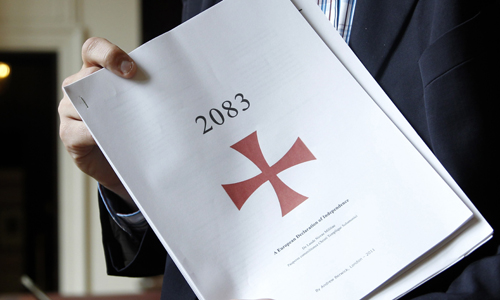
Though eventually judged to be quite sane, this crazed narcissist, the son of a Norwegian diplomat and a nurse, was clearly mad as far as the average observer was concerned, his psychological well-being apparently fatally fractured – assuming it had ever been whole – from an early age. The crack-up had been compounded by personal setbacks in adulthood, his life in retrospect seeming to have traced an inevitable parabola towards destruction of one kind or another (his suicide at some stage in the future would seem to be the natural end point). Breivik was the classic tragic loner, living with his mother, fuelling his racist paranoia by browsing Islamophobic rantings on the Internet, meticulously, nerdishly cutting-and-pasting them into a garbled 1,500-page manifesto detailing everything from his multiple, hate-filled delusions about the Muslim threat, to his preferred aftershave – Chanel Platinum Egoiste – a diatribe that he then mailed to 1,003 people across Europe. (Therefore we can call him Egoiste from Norway, ed. remarks).
What could the actions of a mentally bill man tell us about the country that made him? Nothing, presumably. Yet Breivik’s attacks must have shaken the foundations of Norwegian society – the unprecedented scale of his slaughter would have ensured that – but there was also the inescapable fact of his ethnicity to deal with. This unthinkable act of violence had been carried out by a Norwegian, not a non-Western Islamic extremist, not a foreigner – as was the case with various, thankfully small-scale, attacks in Sweden and Denmark in recent years – but a Norwegian born and bred: Europe’s first anti-Muslim terrorist.
‘The first picture I saw of him on 22 July was where he was wearing his Lacoste T-shirt with upturned collars,’ one Norwegian had told me. ‘And, you know, I thought, “I know him, I see him at football games, I’ve gone to school with this guy.” He’s so ordinary.’
I have to admit, and I am not especially proud of this, but there was the very slightest sense of relief when, in the house after the first bomb had been detonated in central Oslo and the world’s media had jumped to its default Islamic terrorist conclusions, the real identity of the perpetrator emerged and it transpired that he was as Norwegian as one could be. The relief that this was not the work of Islamic terrorists was, of course, entirely separate from any reaction to the crime itself, relating more to fears of the potential retribution such as an attack might have inspired. An Islamic terrorist attack as heinous as this would have seen the political discourse om immigration and race blasted back to the Middle Ages. One presumes life would have become untenable for many Muslims living here, as was the case in the US in the wake of 9/11; and one assumes, too, that the attack would have been used by the mainstream right wing throughout Scandinavia to shore up their support, as also happened after 2001. In the few hours before Breivik’s identity became known, various far-right websites and blogs had already begun to unleash their predictable and violent anti-Islamic sentiments, and several Muslims were physically assaulted in the Norwegian capital.
Certainly, the Norwegian Police Security Service had not foreseen such an event; in a report written just a few months prior to the attacks they stated that right-wing extremists did ‘not represent a serious threat to Norwegian society in 2011’.
One presumes it would have been at least marginally easier – only very marginally, admittedly – to come to terms with the attacks had the perpetrator been an outsider, someone from an established category of aggressor. Instead, it was a blond-haired, blue-eyed Norwegian ‘patriot’. One of them.
The Norwegians had reacted to the attacks in various ways: horror, obviously; solidarity, mainly; revulsion at Breivik’s opinions, of course. Nut some felt there had been too much discussion of Breivik’s mental state and not enough about his views and the extent to which other Norwegians might agree with them. One Norwegian commenting on an online article on the Guardian website about a Danish theatre production based on Breivik’s manifesto, which premiered, rather tastelessly, during his trial, wrote: ‘Here in Norway there has been very little discussion of what he said. The fact is that it’s much less far from the mainstream than many are willing to accept – whilst most Norwegians are not racist, some held deeply troubling views…Norway does need to ask itself some very serious questions about why the world’s worst single-gunman atrocity happened here, in the apparently peaceful and harmonious country where nothing bad ever happens.’
Prior to 22/7, as the attacks are more commonly referred to in Norway, the country had the strongest mainstream right-wing party in all of the region, and one of the strongest in Europe: the Fremskrittsparti, or Progress Party. Though its popularity dipped following Breivik’s attacks, in the last parliamentary election to take place in Norway, in September 2013, the Progress Party, led by the pugnacious blond Siv Jensen, won 16.3 per cent of the vote. Its triumph was all the more astonishing given the fact that Breivik was, for many years, a highly active member of the party. Until 2013, the Progress Party had been routinely shunned by the other political parties but, crucially, this electoral triumph was enough to make it a partner in the new centre-right coalition government for the first time in its history.
The Progress Party’s unprecedented electoral success would appear to confirm the description of Norwegians I had heard from their neighbors as just a shade to the right of the Ku Klux Klan. Norway has accepted far fewer immigrants than either Denmark or Sweden, for instance, and has recently taken to repatriating denied asylum seekers at a rate of 1,500 or so a year. Coverage of the Breivik attacks had also mentioned numerous right-wing Norwegian organizations, activists and bloggers, highlighting what appeared to be a disturbing sub-culture of Islamophobia in the country, ranging from Facebook groups for people who refused to ride in taxis driven by Muslims, to those of the so-called Eurabian school, who believed their government was part of an early seventies conspiracy on the part of European oil-thirsty governments to allow Muslims to take over Europe in order to appease the OPEC nations (there are actually people who believe this, the fact that Norway is one of the largest oil producers in the world seeming to have escaped them).
Vidkun Quisling
On a previous visit to Norway I had read in Dagbladet that the Holocaust-denying British historian David Irving was going to be given a talk near Lillehammer that week. Though the Norwegians proudly boast of having a more active and successful resistance movement than the Danes, some Norwegians did collaborate with the Germans during the occupation of 1940-5, not least their then prime minister Vidkun Quisling, whose surname was famously adopted as an eponym for traitors everywhere. Norway’s most celebrated literary figure, Knut Hamsun (kind of their James Joyce), gave his Nobel Prize to Goebbels, and wrote a famous obituary of Hitler in the Norwegian collaborationist newspaper, Aftenposten, calling him ‘a reformist character of the highest order,’ adding, ‘We, his close followers, bow our heads at his death.’ Hamsun’s reputation never really recovered. Aftenposten remains the country’s most popular daily newspaper.
Just how right wing was Norway? How had Breivik’s actions altered the political landscape? Had the black shirts been tucked away at the back of the wardrobes, where the swastika neck tattoos being hidden by high collars, had the Islamophobic Internet trolls withdrawn to lick their wounds?
Five years ago, on May 21, Jan and Per Bromann opened Fotografiske in Stockholm. Their vision came true, and the five year celebration will go on for six whole days from May 21st! We are proud to present the program and a selected choice of photographs.
Thursday 21 May
Party, mingling and music. Preview images by Nick Brandt and enjoy stars on the stage; Emma Larsen, Anders Wendin (Moneybrother) and a secret guest.
Photo by Nick Brandt
Friday 22 May Opening of the Nick Brandt exhibition, book signing by Anders Petersen, private talk with Nick Brandt.
Drinking elephant by Nick Brandt
Saturday 23 May Have your portrait made by Fotografiske Academy’s teacher Knut Koivisto. Private talk with Nick Brandt. Inspiration afternoon follows with hints on how to be a better photographer. Mini courses by some of Sweden’s best photographers; Karolina Henke, Mia Galde (on mobile photo), Jacob Felländer, Anna Clarén, Erik Thor (on light), Anette Nantell, Knut Koivisto (on portraits), Lisen Stibeck, and Göran Segeholm (on how to view images).
Eskobar on the stage from 8 p.m.
Sunday May 24
Bring your children and let then experience the fantastic animal photos by Nick Brandt. The children will have the opportunity to draw pictures of what they have seen at the café. At 4 p.m. the brothers Jan and Per Bromann will tell their story from vision to the present time and a look into the future.
Monday May 25
Artist talks with Maria Friberg and Dutch-Swedish photographer Pieter ten Hoopen.
Travel off the beaten path, or rather way off the beaten path, and experience some of the three thousand polar bears on the island of Svalbard in the Barents Sea.
Svalbard is an island chain between Norway and the North Pole, well inside the Arctic Circle. There are no cities, no roads and if you want to get around you will need snow shoes, a dog team or snowmobiles, and that’s what Spitsbergen travel offers any visitors wanting to track polar bears. They will also remind you to bring a rifle, because carrying a gun is the law.
Spitsbergen is certainly a particular place. The temperature never go above 45°F (6°C) and four months out of the year the sun never sets.
After being briefed and equipped by the professional tour operator, you head out of Longyearbyen by snowmobiles towards the East coast of Spitsbergen. You’ll experience the characteristic natural beauty of Svalbard, over wide plains and narrow valleys, with plenty of stops underway, you can enjoy the ice covered mountains and nowhere can a tree be found. But it’s indeed far from lifeless. Svalbard is great for viewing birds, reindeer, arctic fox, whales, walruses, dolphins and seals. If you are lucky, you may see polar bears on the pack ice.
How do you spot a polar bear?
If your aim is to spot polar bears, you should rather hop on a boat cruise specializing in wildlife tours. They know what visitors want to see and know exactly where to go to get up close to these impressing beasts. The boats also allow you to squeeze into breathtaking fjords.
There are, however, lots of alternatives to choose from; exploring ice (glacier) caves, ice climbing, cross-country skiing, hiking and ice-hole fishing. Rent a kayak and follow the gentle whales and playful seals. Visit the coal mines and small villages and try the arctic cuisine.
Swedish Belatchew Architects unveils innovative designs for Stockholm bike garage at Södra Station in the center of Stockholm.
The project, still in the early stages, will cater for the city’s growing ranks of cyclists and will have parking facilities for up to 700 bikes but no space for motor vehicles. There will be 57 appartments in the house.
The bike garage will be built on a site next to a major train station and will also act as a community space, with cafes, repair shops and social space.
Combining health and fitness with good design is a key feature for Belatchew Architects, which plans to also provide showers and lockers for people to leave their helmets and belongings.
Bike-friendly design is apparent throughout the building’s plan which features sliding doors to enable cyclists to pedal in from the street and large windows to create a visual connection between inside and out.
Bike Garage in the Center of Stockholm, written by Tor Kjolberg
The Norwegian-American Artist Camille Norment has been commissioned by the Office of Contemporary Art Norway (OCA) to develop the project Rapture for the 56th International Art Exhibition, La Biennale di Venzia. The exhibition opened on May 6, and this year Norway will be solely responsible for the Nordic Pavilion.
Camille Norment’s (b. 1970) Rapture is a site-specific, sculptural and sonic installation, for which the American-born, Oslo-based artist has composed new music on glass harmonica – a legendary 18th century instrument that creates ethereal music for glass and water.
The instrument was invented by Benjamin Franklin and once played by Mozart and Marie Antoinette. The glass harmonica was at first celebrated for curing people with its entrancing music, but later it was banned because it was thought to induce states of ecstacy and arouse sexual excitement in women.
In a contemporary context, Norment explores the tensions this music raises today by creating a multi-sensory space, which reflects upon the history of sound, contemporary concepts of harmony and dissonance, and the water, glass and light of Venice. She is composing a new chorus of voices that correspond to the notes of the glass harmonica, and this chorus will surround visitors to ‘Rapture’.
‘Rapture’ will explore the relationship between the human body and sound, through visual, sonic, sculptural and architectural stimuli. Today the sonic realm can be both a space of misuse, as we have seen in the militaristic use of sound to abuse the body, and of affirmation, as in the performative utterance of free speech to affirm the right of the body’s very existence.
‘Sound, by its nature, permeates borders – even invisible ones. Throughout history, fear has been associated with the paradoxical effects music has on the body and mind, and its power as a reward-giving de-centraliser of control,” says Camille Norment and continues, “Recognized as capable of inducing states akin to sex and drugs, music is still seen by many in the world as an experience that should be controlled – especially in relation to the female body – and yet it is also increasingly used as a tool for control, especially under the justifications of war.’
Katya Garcia-Anton, Director of OCA, Norway and Curator of the Nordic Pavilion comments: ‘We have commissioned Camille Norment to represent Norway at the Nordic Pavilion of the Venice Biennale 2015 because she is one of the most innovative, cross-disciplinary artists working in Norway today.”
About Camille Norment Camille Norment (b. 1970, Silver Spring, Maryland, USA lives and works in Oslo, Norway) works as an artist, musician and composer. Norment’s practice includes performance, installation, drawing, writing and sound, and draws from the artist’s training in music, dance, the visual arts and literature. Norment is concerned with investigating the relationships between sound, music and the visual arts and questioning the meanings of harmony and dissonance. Her art explores the socio-political encoding of sound historically and in the present, reflecting upon the power of dissonance to carve out a space for dissent and creative thinking.
Norwegian-American artist Represents Norway in Venice, Source: the Office of Contemporary Art Norway (OCA)
Enjoy interior designs from the 50’s and 60’s inspired by Danish designers. Choose between 22 newly renovated rooms inspired by among others Arne Jacobsen and Borge Mogensen.
If you come to Copenhagen by air, just take the airport train to the Copenhagen main station (Hovedbanegaarden). Then you can just walk about five minutes, and you’ll arrive at a newly authentic renovated boutique hotel.
Hotel Alexandra has brought their rooms back to the 50’s and 60’s by filling each room with Danish mid-century furniture. Staying at the hotel, you will love genuine wallpapers, lamps and textiles.
The hotel, situated right in the heart of Copenhagen, almost next to Town Hall Square and the Tivoli Gardens, contains 61 rooms, of which 44 now is fully renovated, and all with modern facilities.
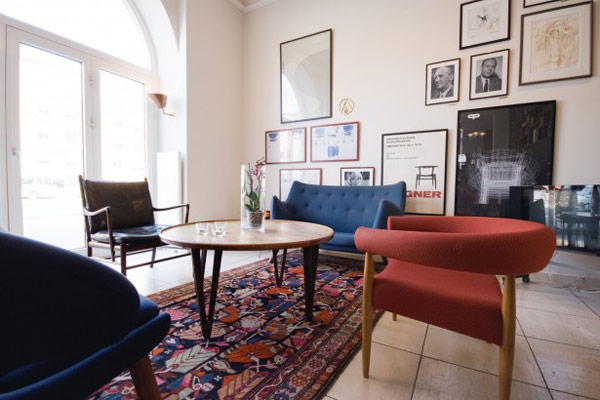
The lobby
There is a choice of different rooms, from single rooms (Small Danish Retro), single rooms superior, Retro Double rooms, Twin, Double rooms Superior and Double rooms Luxe in addition to the Finn Juhl Suite and Verner Panton Suite. There’s a description of the designer’s work in each room.
Don’t be surprised by the bicycles stacked outside the hotel. Bikes are a popular transport vehicle in Copenhagen. You should actually watch out for them if you are a pedestrian. The lobby includes a guest library and a shop where you can buy hotel memorabilia and small design items, designed by the very same designers, who has been the inspiration for the boutique hotel; Arne Jacobsen, Hans J. Wegener, Finn Juhl and Børge Mogensen.
In the Verner Panton Suite you may read that Panton is considered the most colorful and inventive designer of his time. He experimented with color, materials, and production methods in innovative lighting and furniture designs
Room 338
The living room features a pair of 1-2-3 lounge chairs from 1973 and his Studio-line sitting group from 1961. His wire shelf is used as a table and his potent Geometry carpet from the 60s unifies the center of the room. His most classic design, the Panton Chair, is used as a desk chair. First produced in 1966, it was the world’s first floating chair molded in polyurethane without any seams or joints.
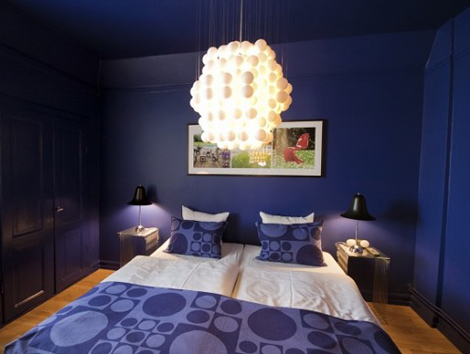
Under his impressive Kugel Pendant Lamp in the deep blue bedroom, the bed is made by using his iconic geometric prints as a bedcover, and his wire shelves act as bedside tables. The Pantop Table Lamps are used as bedside lights.
We recommend this Copenhagen hotel to all our readers searching for high class comfort in the middle of the city. We recommend to book early in advance, since this seems to be an extremely popular second home for business people.
Hotel Alexandra, Copenhagen – a Tribute to Danish Designers, written by Tor Kjolberg
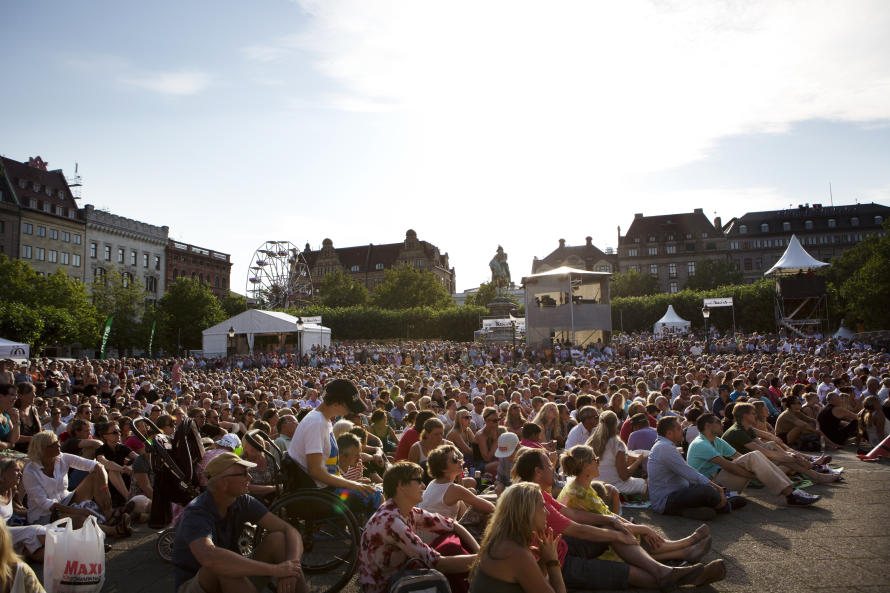
Music lovers should be heading to an exciting festival summer in Sweden this year. Daily Scandinavian has compiled a list of some of the venues worth visiting. Read on.
May Gröna Lund
Venue: Stockholm
May 7 throughout summer months
While not exactly a festival, Sweden’s most famous amusement park puts on a whole set of gigs every year. Big names draw thousands of fans to the Stockholm park to enjoy a day of playful attractions – and great music. A huge variety of different artists for different crowds are expected to hit the stage this summer, from UK pop wonders Sam Smith and Olly Murs to Marilyn Manson. The park opens its doors on April 25th and its first concert will be by Swedish pop soul diva Veronica Maggio on May 7th.
Gigs will be organized throughout the summer. The full line-up can be foundhere.
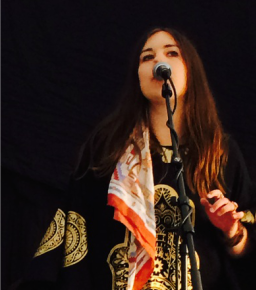
Veronica Maggio will perform at Gröna Lund in Stockholm this summer
Summerburst Gothenburg Venue: Nya Ullevi, Ullevigatan Gothenburg, Sweden
May 29-30, 2015
Summerburst is Scandinavia’s premier contemporary music event! It’s a two day music extravaganza being held in Gothenburg & Stockholm. In 2015 the festival celebrates five years as a leading music event. Music lovers from all over the world are welcome.
For the Stockholm event, see June (below)
Korsakoff will perform at Summerburst Gothenburg this summer
Ljudvågor (Sound Waves) Venue: Visby, Gotland
May 13-16 mai
This is the annual composers’ music festival where students as well as professional musicians present their latest compositions. This year’s festival offers a wide range of styles from brass band to jazz. Information in Swedish only (link above).
Sweden Rock Festival is a rock festival outside the town Sölvesborg in Blekinge in southern Sweden. The purpose of the festival is to offer its audience the best possible mix of classic rock, hard rock, metal, blues and related genres. We give a lot of weight to the overall experience and our aim is to raise the level of comfort for our guests every year.
We do not only want to present our audiences to the best music in the world, but also create a fantastic festival ground with a focus on service and hospitality. For instance, we are working hard to make sure that there is plenty of different kinds of food available while keeping lines to a bare minimum. We think that a festival area should offer clean, flushing water toilets instead of overfilled porta-potties. We have five stages to make sure that each artist gets a decent set length while our guests always have different styles of music to choose from at any given time. While other festivals clean their grounds after their events are over, we have 200 people continuously making sure that our guests can enjoy sitting on our grass slopes throughout the festival. And so on.
Summerburst Stockholm(See Summerburst Gothenburg above), May) Venue: Gärdet Open Air Venue, Valhallavägen, Sweden
June 12-13
Tigerlilly will perform at Summerburst Stockholm this summer
This festival is sure to tickle the excitement of the 1990s pop generation, with one of the headline acts being a former member of British boyband Take That – Robbie Williams, who will perform alongside Calvin Harris. With only two years since its creation, Bråvalla’s popularity has increased exponentially and it has sold more than 50,000 tickets every summer, making it the most visited music festival in Sweden’s history.
Musik vid Siljan (Music at Siljan) Venue: Spread around the three communicipalities in Siljan, Leksand, Mora og Rättvik in Dalarna
June 27- July 5
According to the organizers, Musik vid Siljan is a total immersion in beautiful music and breathtaking natural surroundings!
They claim it to be Sweden´s leading summer festival with musical events in concert settings filled with atmosphere. You can choose between indoors, in beautiful churches, museums or concert halls, or outdoors in genuine Dalecarlian villages, in the stunning Dalhalla lime stone quarry, or maybe way out in some picturesque pasture.
Musik vid Siljan has been a festival tradition since 1969, always in the first week of July, and it offers a wide variety of music to suit all ages and tastes. Enjoy concerts with symphony orchestras, chamber music, church concerts, choir music, jazz concerts, ballads and traditional folk music, poetry recitals, traditional dancing to fiddle music in various village cottages, children’s programs and workshops – as well as singer songwriters, popular music concerts and rock´n roll – close to 60 events in a feast of musical extravagance!
The concept of the Peace & Love festival was to spread the message of Diversity, Solidarity and Understanding. It’s about crossing borders and bringing differing cultures from near and afar together and trying to get people to change their attitudes towards themselves and others.
Peace and Love come to the Swedish town of Borlange this summer, bringing their message of diversity, solidarity and understanding to this Scandinavian land. More than just your average rock music festival, Peace and Love is week-long event that acts as an annual meeting place for people of all ages and of all cultures and nationalities. Aside from good vibes and good messages however, the Peace and Love festival also brings incredible tunes! In the past artists as diverse as Patti Smith, The Hives, Lilly Allen, Jay Z and The Kooks have graced its stages. And in case all that isn’t good enough, Peace and Love Festival is aligned with Greanpeace and Amnesty International, so as you watch your favourite bands you can rest easy in the knowledge that your ticket fee is doing good work for the world!
Putte i parken (Putte in the Park) Venue: Mariebergsskogen i Karlstad, Värmland
July 2-4
Putte I Parken is a Swedish music festival that takes place in the beautiful Mariebergs wood, the city park of Karlstad. The festival began eight years ago, and admission is now free. You may enjoy artists like Beatrice Eli, Markus Krunegård and Tove Styrke. Malungsfors Ballad Festival Venue: Malungsfors, Dalarna
July11
Sweden’s coziest festival for the whole family in the rapids glade with music starting at 12 noon to 11 pm. Enjoy Sweden’s best performers of ballads.
For six years in a row, singers beyond the ordinary have performed at the festival.
Unpack your picnic basket and enjoy a lovely summer day in the countryside with Johan Eriksson at this year’s song festival in Malungsfors.
Geggan in Lerdala Venue: Lerdala, outside Skövde, West Sweden
July 16-18
A huge rock festival oirganized for the third year. Among this year’s performers are:
CCCPn, Danava, Dee Rangers, General Surgery, Gregory Raimo, Hey Elbow, K-X-P, Lady Banana, Magna Mater, Norcosatanicos, Night Viper, Räjäyttäjät, Saturnalia Temple, Slowgold and Transylvania.
Gotland Chamer Nusic Festival Venue: All around Gotland.
July20-24
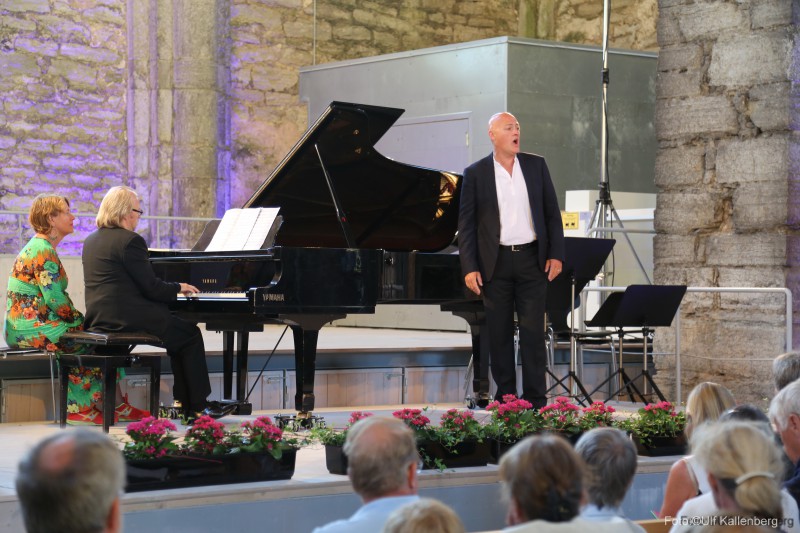
Experience Gotland Chamber Music Festival in the atmospheric medieval church ruin of S:t Nicolai in Visby and other churches on Gotland. The annual festival has been organized since 1986.
På begynnelsen av 80-tallet tok den verdensberømte pianisten Staffan Scheja initiativet til å etablere en kammermusikkfestival på Gotland. Det som begynte som en eksperimentell visjon i den gamle Roxybiografen, er nå et tradisjonelt og veletablert arrangement på den flotte øya. Festivalen har blitt holdt hvert år siden 1986, og i år er intet unntak. De fleste konsertene holdes nå i den nyrenoverte S:t Nicolai-ruinen i Visby, samt i ulike kirker rundt om på øya.
Les mer her
Artists like Kalle Baah, Thomas Stenström och Masinen, Vengaboys and Dr. Bombay perform at this year’s festival. Gay Pride Venue: Stockholm
July 27-August 1
Stockholm’s famous Gay Pride festival at the end of July offers concerts every night by friends of the lesbian, gay, bi and trans gender (LGBT) community. The event, which is the biggest of its kind in Scandinavia, draws crowds from all around Europe in search of a week of great entertainment and party spirit in Sweden’s capital. Previous artists have included Ola Salo, formerly of Swedish glam rock band The Ark, and disco stars Alcazar. The main attraction, however, tends to be the massive Pride Parade which is usually attended by hundreds of thousands of participants and visitors, including many famous Swedish faces.
Ystad Sweden Jazzfestival Venue: Ystad i Skåne
July 29-August 2
The Ystad Sweden Jazz Festival line up for 2015 will feature Dianne Reeves, Robert Glasper Trio, Richard Bona, Dhafer Youssef, Kenny Barron, Dave Holland and many more in a five-day program of 35 concerts and special events.
The concerts will take place at 10 historic venues dating from the 1200 – 1800s. One of the hallmarks of the festival is that concerts are held in intimate venues, with audiences of 120 – 400.
Jan Allan (80) will play at Ystad Sweden Jazz Festival this summer
Storsjöyran Venue: Östersund, Jämtland
July 31 july-August 1
More than 1,500 artists have performed at this town festival, when all of Öresund is altered to one big street party.
Confirmed acts for this year’s festival: Sting (UK), Thåström, Tomas Ledin, Seinabo Sey, Zara Larsson, Timbuktu & Damn! Teddybears, Hello Saferide, Turbonegro (NO), Hoffmaestro, Raised Fist, Anna Ternheim, Tove Styrke, Thomas Stenström, Silvana Imam, Lorentz, Joels Alme, Beatrice Eli, Love Antell, XOV, Death Team, Spiders, Maja Francis etc
Stockholm Music & Arts Venue: Skeppsholmen, Stockholm
July31. July-August 2
Three sparkling waters surround the culture island of Skeppsholmen, perfect for summer experiences. Many famous artist attend this year’s festival. Click the link above and find out more.
AUGUST
Arvika Hamnfest (Harbour Festival) Venue: Arvika, Värmland
August 6-8
Three days with music, dance and food for the entire family. More information about the programme, the artists etc you can find by clicking on the link above. The venue is situated just 400 meter from the train station.
It may be surprising to think of sleek, clean and ‘lagom’ Sweden as the cradle of dark metal, but the genre enjoys a large fan base in the Nordic country and Getaway Rock Festival has been one of its biggest exponents. So if you’re a fan, don’t forget to visit Gävle on Sweden’s east coast this August. Over three days, bands will mix sounds from 1970s classic rock to gothic dark metal. The festival will feature acts such as old-school rockers Status Quo and power metal bands Hammerfall and female quarted Crucified Barbara. Vemdalen Country Festival Venue: Vemdalen, Härjedalen, Jämtland
August 6-9 august
The small ski resort area of Vemdalen offers country festival during summertime! Put on your Stetson and take part in this year’s 20th year anniversary.
From the 2010 Vermdalen Country Festival
Way out West Venue: Slottsskogen (Castle Woods), Gothenburg
August 13-15
Acclaimed by international media for veggie food, excellent artist and beautiful surroundings. This is the ninth annual festival in a row with strong names like Pet Shop Boys, Beck, Patti Smith, Susanne Sundfør, Florence & The Machine, Kygo, Ellie Goulding, Belle & Sebastian, Tove Lo and First Aid Kit.
Hultsfred is located 350 kilometer south of Stockholm. The city is famous by the music festival it hold every year. The festival started in 1986 and since it hosts more than 30,000 visitors who enjoy three days if music played by teen bands from Scandinavia and other European countries on five stages. Some of the performers this year will be Samvetet, Västerbron, Labyrint, Fuzzy Vox and Dia Psalma.
The Malmo Festival is a warm, friendly and sustainable festival, which taken the city of Malmö for a wild dance one week every year since 1985. Right in the heart of the city you will experience everything from ground breaking art, music and culture to a variety of food that reflects the intercultural vibes and people of Malmo.
The environmental concerns have been awarded by A greener festival, the Keep Sweden Tidy Foundation and Yourope. With 1.4 million visits every year it has become the largest festival in a city environment in Scandinavia.
You do not need a specific ticket to go to Medieval Week. The closest description of the event is a town festival, where there are activities throughout the city and in the rural Gotland. Medieval Week’s heart is the market area, but even here you do not need to pay any entry, in contrast to activities such as Jousting, concerts etc. you usually need to solve a separate ticket.
This is the only singer-songwriter festival in Sweden.
Popaganda Venue: Eriksdals Bath, Stockholm
August 28-29
Boasting 20 quality pop acts, Popaganda festival in the heart of Stockholm is every indie kid’s dream festival! The bands who define the genre from Belle and Sebestian to The Shout Out Louds to Hot Chip and The Magic Numbers have all hit the Popoganda stages in the past, and who knows? You might just discover The Next Big Thing at the P-festival this year. Delicious food and drink are available throughout the festival site to keep you sated and hydrated, and Popoganda’s location smack in the heart of Stockholm means you won’t have a problem finding the place! So grab your tickets now for the Popoganda festival, because if you don’t the indie pop kid sitting next to you at that internet cafe will!
From Brass Band to Jazz – Music Festivals in Sweden, compiled by Daily Scandinavian
The Exhibition Van Gogh+Munch opened at the Munch Museum in Oslo last Saturday and will be open to visitors through 6 September.
It’s a little sensation that nearly 40 van Gogh-images are exhibited in Scandinavia on loan from among others Amsterdam, Paris and New York.
Edvard Munch (1863-1944) and Vincent van Gogh (1853-1890) have often been compared. Both were distinctive and influential artists, who created art with a strong emotional content expressed via a personal and innovative style, and both lived troubled lives.
Now you may experience the relationship between the two painters at the Munch Museum in Oslo.
Munch reached the age of 81 and was a productive painter almost to his last days, which means he was an active artist for 60 years, making graphics, photographs, drawings and oil paintings.
The exhibition Van Gogh+Munch will for the first time explore the similarities and connections between these two artists since Paris became a turning point for both of them.
Van Gogh used crude color contrasts in The Yellow House in order to depict the intense summer heat of southern France; Munch distorted the perspective and feeling of space in The Death Room (feature image on top) in order to create an emotionally charged and angst-filled atmosphere.
The painting Rue Lafayette (1891) was made just before his international breakthrough. At that time Munch had several exhibitions in Berlin, Dresden and Munich (feature image on top).
His stay in Paris has made its mark in his art, especially in form of inspiration from the impressionist Claude Monet and the symbolist Paul Gaugin, but also several others he became aware of in Paris.
Typical are paintings seemingly unfinished, with broad pencil strokes and made kind of slapdash.
Rue Lafayette embraces the particular Parisian atmosphere. The painting belongs to the National Museum in Oslo but is on loan to the Munch Museum.
Edvard Munch in Paris and Oslo, written by Tor Kjolberg