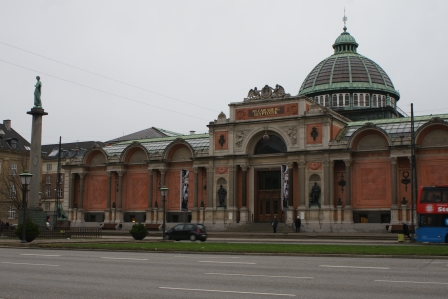
When the Danes some years ago toasted the impressive renovation and new extension of their most important museum, we could only hope they did so with beer, since the New Carlsberg Glyptotek was founded by the world-famous Carlsberg Brewery.
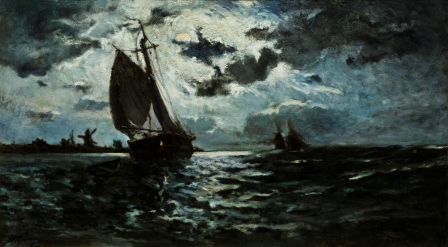
Bequeathed to the country a century ago by beer baron Carl Jacobsen (who also gave Copenhagen the statue of the Little Mermaid), the Glyptotek has grown to become northern Europe’s largest and most important repository of ancient statuary, and artifacts. It also owns an unrivaled collection of forty-nine works by Paul Gauguin (briefly married to a Dane), which now are on display in a dedicated room. The Glyptotek received the painting “Sailing Ship in the Moonlight”, an early painting by Paul Gauguin (1848-1903), as a gift from the New Carlsberg Foundation last summer.
Other areas display French and Danish masterworks by artists such as Manet, Monet, and Cézanne.
Monet: Lemon Grove in Bodigher
The Kiss by Rodin
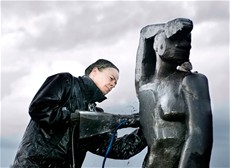
Adam by Rodin
Paul Cezanne: Self Portrait with Bowler HatAdam by Rodin
Part of the Rodin Collection
The museum also houses the largest collection of Rodin sculptures outside of Paris, and one of only three complete sets of Degas bronzes. The airy 1996 wing, designed by the esteemed Danish architect Henning Larsen, was unveiled during Copenhagen’s successful stint as Cultural Capital of Europe.
Contemporary and cool, it holds its own against the museum’s two original late-19th-century and early-20th century buildings with their great skylit galleries, decorative moldings, painted panels, and richly tiled floors.
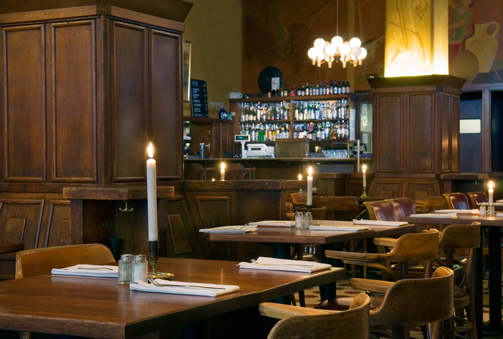
Part of the Cafeteria
In the city’s highly civilized and perfectly stylized manner, the buildings are linked by a lovely glass-domed winter garden and attractive café for the weary of foot.
You find the New Carlsberg Glyptotek just across the street from the Tivoli Gardens. Entrance at Dantes Plads 7.
The Swedish theme park has announced plans for Europe’s longest launch coaster and work is already underway, but you’ll have to wait until 2014 to give it a go. For 2013, Liseberg is celebrating its 90th anniversary season by transforming the old children’s area into Rabbit Land. With it comes new and redeveloped attractions, including another family coaster.
Liseberg is a pretty busy place. As well as the fun in the amusement park, there are gardens, a sculpture park, hotels, bars, and restaurants. And in winter Liseberg has its very own Icebar made of ice from Swedish Lapland. Actually, there’s not a lot you can’t do at Liseberg.
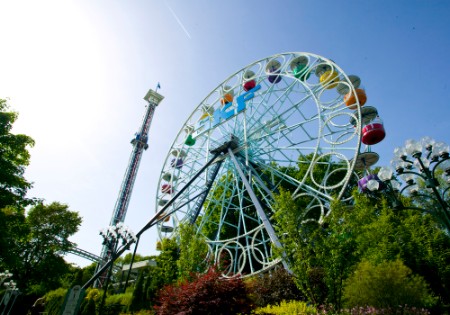
Rides Being one of Europe’s leading amusement parks, Liseberg really does offer a lot of rides. Try everything from flying teacups, bumper cars, the Ferris wheel, circular rollercoaster, and just about everything in between. The newest and most physical ride is AtmosFear – the tallest free fall attraction in Europe that subjects you to a g-force of 4 when you plummet 116m in 3 seconds at 110kp/h. Leave dinner until afterwards.
Entertainment Choose from three entertainment options in Liseberg: The Liseberg Theatre (Lisebergsteatern), the classic Rondo show venue, or the concert stage Stora Scenen which offers free rock, pop, jazz and classical concerts as part of park entry fee. And check out Polketten, a gazebo pavilion of sorts holding both old-time and contemporary dancing. This is also the spot for big band evenings, jive and salsa lessons.
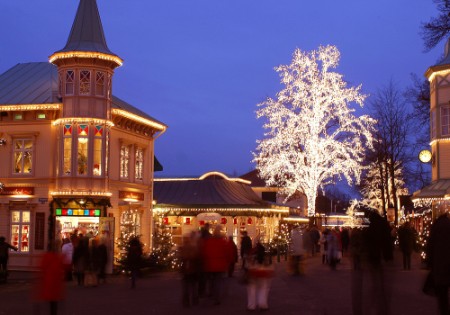
Tip At Christmas-time Liseberg becomes one huge Christmas market. Meet Father Christmas from mid-November and try Christmas smörgåsbord, called Julbord, at one of the restaurants. Very atmospheric what with Liseberg’s 5 million famous Christmas fairy lights.
When? End-April until mid-September, weekends September-October and Christmas-time mid-November until December 23.
South Floridians with ties to Scandinavia are gearing up to welcome new flights launching this weekend between Fort Lauderdale-Hollywood International Airport and the Nordic region.
Scandinavian low-cost carrier Norwegian Air Shuttle on Friday will launch service between Fort Lauderdale and Copenhagen, Denmark. On Saturday and Sunday respectively, the carrier will also begin service between Fort Lauderdale and Oslo, Norway and Stockholm, Sweden.
The three new routes, which will operate twice-weekly, are the first regular scheduled service between Scandinavia and Fort Lauderdale, airport officials have said.
For travel companies specializing in the Scandinavian market, Norwegian’s move to connect the destinations is good news.
“We’re ecstatic that Norwegian has taken this decision to add direct service between Fort Lauderdale and Scandinavia. It’s needed,” said Pia Dahlquist of Yellow Brick Roads, a full-service tour operator that helps Scandinavians plan trips to South Florida and other parts of the country. “Fort Lauderdale has been a Scandinavian stronghold for many years, but there’d only been charter flights before,” she added.
The new routes certainly bode well for tourism, many say.
“The six weekly flights [overall] will increase visits dramatically and will give [Scandinavian] people living here more options for connecting back to the old country,” said Per-Olof Loof, honorary consul of Sweden, based in Fort Lauderdale. “It’s also a great thing for people who want to come to Florida.”
Peter Hult, president of The Swedish-American Chamber of Commerce of Fort Lauderdale & Palm Beach said Scandinavian tourists tend to stay on average 15-16 days in the United States, compared with Europeans (Germans, French, Spanish) who stay 8-11 days.
Scandinavians also spend on average almost 25 percent more per day in the U.S. than tourists from these parts of Europe, he added.
In 2012, roughly 242,000 Scandinavian visitors (Sweden, Norway, Finland, Denmark and Iceland) spent $39.7 million on shopping, $44.8 million on rooms and $53.1 million on food in Broward County, according to the Greater Fort Lauderdale Convention & Visitors Bureau.
Norwegian’s new routes will also help foster and cement commerce between the destinations as interest in setting up businesses in the U.S. is already high in Scandinavia, particularly among Swedes, Hult said. “[The chamber’s] purpose is to make our region a very viable option for Swedes wanting to set up businesses in the U.S.”
The regular flights will enable entrepreneurs to commute weekly (which wasn’t possible before) and the ease of direct service, will entice more people from Scandinavia with “great disposal income” to start traveling to Fort Lauderdale, Hult said.
Sweden and Norway earn their first Top 20 list of hotels this year, according to a poll from the readers of Condé Nast Traveler Magazine.
Luxury creates discriminating critics. Nearly 80,000 readers took part in this year’s Readers’ Choice survey, casting 1,3 million votes. No destination was too remote. None was too small. And no hotel was too new. As always the readers praised quality where it thrives and found it where it emerges.
The two hotels on the Readers’ Choice survey Top 20 for North Europe were Grand Hotel, Stockholm, Sweden (13) above and Radisson Blu Royal Hotel, Bergen, Norway (18) below, and thus rank as the best hotels in Scandinavia.
Methodology The Condé Nast Traveler Readers’ Choice Survey begun in 1988 and is available through a secure Web site at concdenasttraveler.com/vote. This year’s tabulations of 79,268 responses were done by Equation Research.
Organization
The questionnaire contains lists of candidates in various categories (Cities, Hotels, etc.) Candidates must receive a required minimum number of responses to be eligible for a Readers Choice Award.
Evaluation Individual candidates are judged on a set of criteria relevant to their category based on a standard five point scale: excellent, very good, good, fair and poor. The percentage of excellent and very good ratings determines the final score published in the magazine.
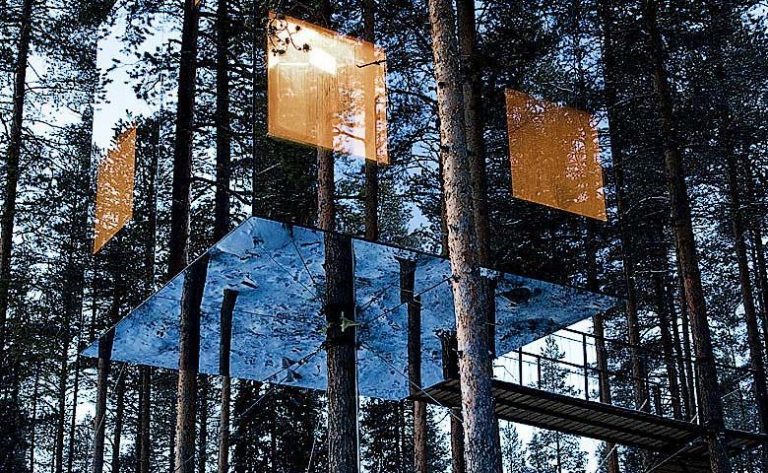
Tarzan would never leave the jungle if he were staying in a breathtaking, uniquely crafted room offered by the Treehotel, which opened in 2010 and is hidden in the tall pine forest of Harads in northern Sweden (approximately an hour by car from Luleå airport, near Kallax).
Bird’s Nest
A variety of leading Scandinavian architects designed the six rooms, each about 160 to 325 square feet, with views of the Lule River. Whether emulating a UFO, Lego blocks, a bird’s nest, a red brick house or (the most coveted) a cube of mirrors, reflecting the forest from any angle, rooms are situated in pine trees and are suspended from the ground between 13 and 20 feet.
The UFO
Accessibility can be challenging as a ramp, bridge or electric stairs might be your only option for entry. Specifically created to have a minimal impact on nature, rooms are environmentally friendly, with combustion toilets and water-efficient sinks. Consider fishing and kayaking in summer, or, in the colder months, snowshoeing or viewing the northern lights by dogsled. Edeforsväg 2 A, 960 24 Harads, Sweden. The ‘Five Leaf Clover’ room at Treehotel, near the remote northern Swedish town of Harads, 40 miles south of the Arctic Circle, opened in December last year. Weighing 20 tons and sleeping up to six people, it is attached to half-a-dozen pine trees and suspended above the forest floor. This is the largest treehouse hotel room in Sweden.
It offers spectacular views of the Lule River pine forests and even the Northern Lights
Many of us spent hours of our childhood playing in a treehouse – but how often did your parents allow you to sleep in it? Well, now you can make up for it, thanks to a unique hotel in Sweden.
The Treehotel, located near Harads, a town in the north of the country about 40 miles south of the Arctic Circle, is about to open its largest tree room yet. In fact, it will be the biggest in the world.
The Five Leaf Clover, designed by Finnish architect Sami Rintala, is 53 square metres and weighs 20 tons. It is attached to half-a-dozen pine trees six metres above the ground.
Inside, it can house up to six people in three bedrooms, and even comes with conference facilities for 12 people. Guests reach the room via a two-story high staircase.
The Five Leaf Clover, due to open on December 20, is just the latest tree room at the hotel, which boasts beautiful views of the tall pine forests around the Lule River.
The Treehotel is far enough north to offer spectacular glimpses of the Northern Lights at certain times of the year.
The Treehotel is located near Harads, a town in the north of the country about 40 miles south of the Arctic Circle
Other quirky rooms at the hotel include ‘The Bird’s Nest’ – a cabin completely camouflaged by thatch and branches only accessible by a retractable staircase.
Another one is ‘The UFO’, a space-age metal capsule on two floors which sleeps four people.
The Treehotel also has Pension serving breakfast, lunch and dinner in a 1930s-1950s setting, as well as offering internet, television, restaurant and bar.
Hidden in the forest is an eight-person ‘Tree Sauna’ complete with a hot tub and relaxation area.
Speaking about the new room, Treehotel CEO and co-founder Kent Lindvall said: ‘Treehotel always strive to push limits with our environmental work, architecture and engineering.
The Five Leaf Clover’ is clear evidence of this as nothing remotely similar has ever been done before.’
World’s Largest treehouse hotel room in Sweden, written by Tor Kjolberg
The Norwegian pop duo Madcon team up with the Norwegian tourism board, Visitnorway, when launching their new music video “All I Do” last week.
Shot in its entirety in Bremanger in Norway, Madcon’s latest music video got its world premiere on Visitnorway.com.
The Norwegian duo Madcon rank among Norway’s most well-known musicians and have gained fame for several major hit songs, as well as the song behind the Eurovision 2010 flashmob dance, “Glow”.
Now “All I Do”, the duo’s latest music video, is getting its world premiere on Visitnorway. Filmed in Bremanger in Fjord Norway, the video shows off some of the breathtaking views and attractions the region has to offer. Visitnorway now hopes crystal blue seas, beautiful fjords, steep mountains mixed with good beats and a Norwegian fairytale will make more people look to Norway for their next holiday experience.
-Bremanger and Fjord Norway looks smashing in the new music video, says director of tourism at Innovation Norway, Per-Arne Tuftin. He hopes the new video will help raise awareness of Norway as a tourism destination. -This is Madcon’s post card from Norway, says Madcon’s Tshawe and Yosef about the video greeting from Norway.
This is Madcon’s postcard from Norway.
– This is a unique opportunity for us to promote Norway as a tourist destination, says Per-Arne Tuftin. – Madcon is well known around the world, and we hope that in providing the inspiration for the backdrop to this music video, Norway will appeal to music fans and Norway enthusiast across the world.
Bremanger
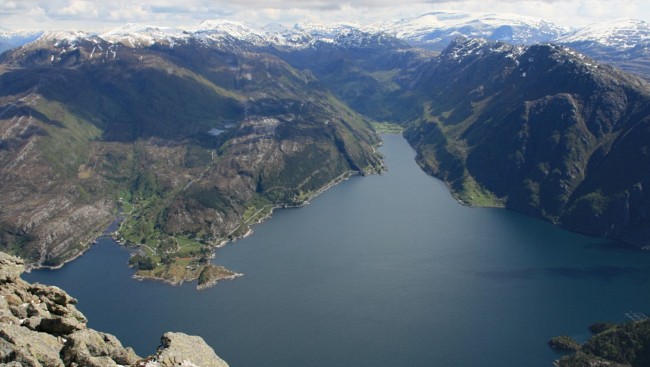
Bremanger is a small municipality in Fjord Norway with around 4000 inhabitants, situated between the open sea to the west and the fjords of Norway to the east and south.
The Bremanger area is where mountains meet the sea, often in a dramatic way. None more so than Hornelen, Europe’s highest sea cliff. In the music video, you can see a wingsuit-jump from Hornelen’s summit. Hiking to this 860-metre high point will take you around four hours each way. If that seems a bit too strenuous, there are many other options; Hiking trails abound in the entire region.
The Vingen rock carvings were discovered in 1912 and forms Norway’s second largest field of rock carvings with some 2000 individual petroglyphs. Up to 7000 years old, they show deer, other animals, abstract geometric patterns and even some human figures.
The music video
The music video “All I Do” by Madcon is produced by Svein Arild Vatsø and directed by Bjørn Myreze. It was financed by contributions from the Bremanger municipality and local businesses.
In Swedish Lappland, about 200 kilometer north of the Polar Circle in the small town of Jukkasjärvi, you will find the world’s largest hotel made solely by snow and ice. But don’t search for it during the summer season, since the sun, never going down, has melted the complete construction that runs out in the Torne river.
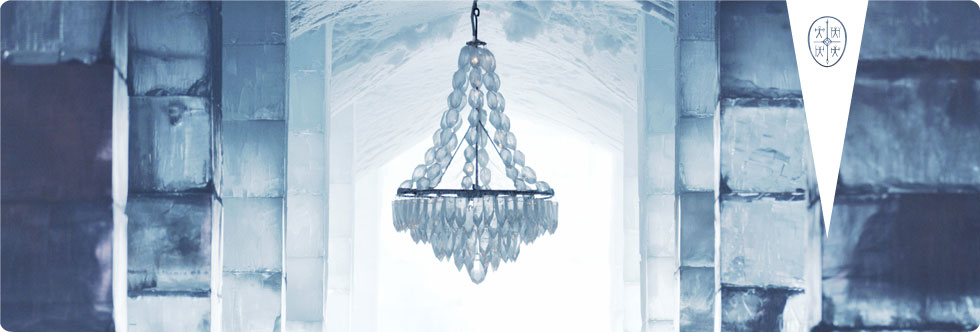
Entrance with crystal candelabra made of ice. ICE HOTEL Håkan Hjort.
Every year, by the end of October, a group of local and invited ice sculptors meet and starts building the Ice Hotel, to be finished once again for Christmas opening. The hotel completely changes from year to year, since the suites are built around different themes, and no construction is older than six months.
The guests arrive through doors covered by reindeer skin. In wintertime, when temperatures may be as low as minus 30 degrees Celsius, and the temperature inside shows minus 20, it’s wise to wear warm clothing. The night is spent in isolated sleeping bags on beds made from snow and ice and covered by reindeer fur. The family rooms have a bed which is wide enough for three persons.
The suites are decorated with art made from ice, and all sleeping rooms have baths and water closet. The hotel has also many different rooms providing a variety of accommodations. The chapel for instance is used for ceremonies, baptism and weddings. The art centre is a beautiful gallery with ice sculptures, where natural light is reflected in the carvings and creates surprising patterns when visitors walks around in specially made silver capes. The Ice Globe Theatre, inspired by Globe Theatre in London, provides first class shows and entertainment all season long. Anyway, this is the coldest hotel in Sweden.
Along with many, one of nature’s most fantastic attractions is the mystique performance of the famous Northern Lights.
The hotel’s unique restaurant, offers cuisine served on plates made from crystal clear ice. The delicious and rich selection of dishes from Lapland, for instance roasted reindeer, grilled moose, Lapland cheese, salmon, trout and whitefish, all from the area, spiced with local and imported ingredients and trimmings. As you may have expected, the hotel has its own Ice Bar where both alcoholic and non-alcoholic beverages are served in glasses made from crystal clear ice from the Torne River. In fact these ice glasses are known through all of Absolute Ice Bars in Stockholm, Oslo and Copenhagen. The vodka served is a wide selection of flavored and spiced Absolute vodka that makes conversation float merrily.
The mornings begin with a cup of red cowberry juice followed by a visit to the sauna before it’s time for an abundant breakfast buffet. Later during the day it is possible to take a sleigh tour with reindeer to the wildlife camp Sami, where lunch is served. The surrounding woods with natures crystal decorated trees may be explored with snowmobiles, dog sleigh or snow shoes. Minibuses drive to the coast of North Norway, where you may watch sperm whales or moose on winter tracking, if you’re lucky.
If you wish you may join lectures in ice sculpturing, but most of the guests choose to admire the beautiful art works with chattering teeth as the pieces evolve. All excursions are arranged by the hotel, preferably when booking.
The hotel is situated about 16 kilometers from Kiruna, about 90 minutes by plane from Stockholm. When booking, it is wise to ask for transfer from the airport to the hotel. It is normally by dog sleigh. http://www.icehotel.com/
Text: Tor Kjølberg. Photos: Icehotel
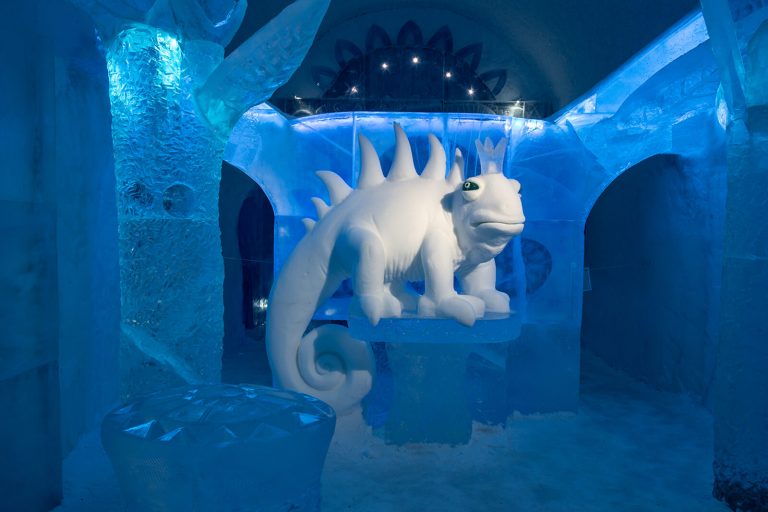
Feature image (on top): Dragon of snow ice sculpture by Kestutis Vytautas Musteikis Photo: Asaf Kliger
IKEA has supported UNICEF’s Play based programs for ten years and given more than ten million children the opportunity to schooling.
IKEA, the leading home furnishings retailer, and UNICEF partnered ten years ago on a new promotion, which celebrates the importance of playtime in a child’s life and demonstrates how a teddy bear can help make a big “bear hug” of a difference, a bear that gives.
IKEA stores in 46 countries have donating a certain percentage from the sale of each BRUM soft toy teddy bear – perfect for hugging – to benefit children living in poor countries. IKEA, together with its shoppers, has so far raised 57 million Euros, supporting UNICEF’s “Children’s Right to Play,” crucial outreach programs for children in need. IKEA shoppers can now again support this worthwhile cause through 4th of January 2014 and bring a smile to the faces of the children in their lives, as well as help improve the lives of other children, with each purchase of the new IKEA BRUM teddy bear.
“A teddy bear is a symbol for playfulness and security, and through the sale of the IKEA BRUM teddy bear we can help play a positive role in the lives of many children, making it possible for them to be exposed to constructive, healthy and fun play-oriented activities through UNICEF’s valuable programs,” said John Zurcher, Environment and Social Responsibility Manager, IKEA U.S. when the charity program first started. “At IKEA we know how important it is to enable children all over the world to grow up in a carefree and nurturing environment.”
“Millions of children in the world are denied play and never experience this vital aspect of their development because of war, disease and poverty,” said Charles J. Lyons, President, U.S. Fund for UNICEF. “We are grateful to IKEA for its ongoing support to help children reclaim their childhoods through playing and learning.”
Created by IKEA the Norwegian designer Ivar Ledang, the IKEA soft toy BRUM teddy bear is part of the new IKEA PS collection for children, which is available for purchase at IKEA stores, as well as via the IKEA catalog. The IKEA BRUM bear has flexible arms and legs that bring the cute playfellow to life. A child can use his or her imagination to make the bear sit, stand, walk, wave, nod, take a nap or give a big bear hug.
Designer Ivar Ledang
IKEA has supported UNICEF programs around the world for more than ten years, and in the United States alone IKEA has raised more than $1.75 million to benefit UNICEF programs for children.
Founded in 1946, UNICEF helps save, protect and improve the lives of children around the world through immunization, education, health care, nutrition, clean water and sanitation. UNICEF is non-partisan and its cooperation is free of discrimination. In everything it does, the most disadvantaged children and the countries in greatest need have priority. For more information, please visit www.unicefusa.org.
On a clear day in Stockholm, Swedens Crystal City, the air fills with light, and the city and sky glow with a crystal clarity reflected in the surrounding water. Water — it’s the main feature in Stockholm, which stands on 14 islands on Sweden’s east coast facing the Baltic Sea. The location has made it an important shipping and trade center since the 13th century.
When I go to Stockholm, Sweden’s crystal city, I relish those medieval days, walking the narrow stone streets of Gamla Stan, the Old City. Its quaint buildings now hold shops and cafes. Then I stroll the waterfront, admiring the dramatic setting and the most recognized building in Stockholm, the brick Stadshuset, City Hall, with a corner tower topped by a shiny cupola. This is where Nobel Prize banquets are held. Guided tours in English are offered here, as well as at the splendid Royal Palace.
They’re interesting, but if you can see only one thing in Stockholm, make it the Vasa Museum on Djurgården, a lovely green and wooded island. The Vasa was the mightiest warship in the world in 1628, carrying 64 guns and 300 soldiers. It sank even before it left the harbor, with all its elaborate carvings, and lay on the sea bottom for 333 years before it was pulled out. Cleaned and repaired, it now stands proudly on land, an amazing piece of the past.
Also on Djurgården is Skansen, an open air museum where people in period clothing demonstrate what life was like in past centuries. For a contrast, tour the Moderna Museet, one of Stockholm’s many museums and galleries. It shows a sampling of modern artists including Kandinsky, Picasso, Dali and Magritte.
In this expensive city, you can save kronor by purchasing the Stockholm Card, good for 24, 48 or 72 hours, which provides free public transportation and free entry to 75 museums and attractions. Dozens of stores sell souvenirs, some very well made, but if you’re looking for fine Swedish crafts, seek out the high-end stores or ask for help from Smart City Shoppers, a company that helps buyers find top quality clothing, textiles, crafts, glassware, and furniture.
Stockholm’s busy streets are full of shops and malls. Orrefors Kosta Boda is probably the best place for fine glass items. Design Torget displays contemporary crafts done by skilled artisans; the gallery has several branches. The Gallerian is a modern, two-level, glass-roofed complex with a huge array of goods in individual stores.
Since 1874, travelers have enjoyed the classic tradition and luxury of the Grand Hotel. The landmark hotel faces the water, opposite the Royal Palace, and is renowned for its superb service and rooms. In the Veranda restaurant, I’ve feasted on great seafood, especially the famous crayfish. It’s known, too, for a magnificent smorgasbord. Mathias Dahlgren is the noted chef in the hotel’s more formal restaurant.
Hotel Rival, also providing fine service and amenities, has a completely different atmosphere, with 99 sleek rooms on Mariatorget Square in the trendy Södermalm District. It has two restaurants, three bars, a gym, and a young, hip reputation.
Different from both hotels is the Rica Hotel Gamla Stan. Located in a charming 17th-century building near the cathedral, the 51 rooms are small but bright and fresh, with a few antiques. The conveniently located Clas På Hornet hotel offers friendly service and a restaurant serving seafood fresh from local waters.
For traditional Swedish dishes in this high-energy, international city, try the Pelikan. In the high-ceilinged pub you can order old favorites such as pickled herring, dilled potatoes, lingonberries, and beef with mashed turnips. At little Bakficken (“Hip Pocket”), part of an upscale restaurant by the Opera House, try the tiny, delicious meatballs.
Distinctive French cuisine is on the menu at the fairly new GQ. Here customers rave about pricy entrees such as wild duck with pumpkin puree and oxtail ravioli with portobello mushrooms. Edsbacka Krog is in a 17th century building a short taxi ride from the town center. The fresh fish is always perfectly prepared and the wine list excellent, and it’s all expensive.Gyldene Freden, supposedly Stockholm’s oldest restaurant, serves food that gets rave reviews.
If you can find a place to cook it, you can catch your own dinner with a fishing rod. People do fish for salmon from the bridges of downtown Stockholm. You need a permit for this; check with the tourist office.
Northern Europe is one of the most fascinating regions in the world. Perhaps best known as the place to see the Northern Lights, it also offers vast, raw landscapes and amazing architecture in addition to sophisticated cities.
With many areas still untouched by tourism, Northern Europe lends itself to the traveler who’s looking for a little solitude and a respite from the rest of the continent.
What to expect
If you’re planning a trip to Scandinavia expect efficient transport, stunning cityscapes both ancient and modern, unique cuisine, and amicable people, almost all of whom speak English.
While living costs in Northern Europe are among the highest worldwide, the historical and natural wonders make roughing it out part of the experience and well worth it. In fact, many of the attractions and museums are free. Don’t write off this region simply because you heard how expensive it is – there are ways to cut costs and enjoy your time in Northern Europe.
Planning your trip to Northern Europe
A lot goes into planning your trip to Northern Europe – how to get there, how to get around once you are there, best time of the year to go, which vaccinations you need, and what the visa situations are.
Getting around
Air: Norwegian Air Shuttle is the main budget airline in the region, offering cheap flights from major European cities. SAS also offers youth fares for flights in Europe.
Bus: While intercity and inter-country buses are available, routes and prices lose out to the extensive rail network.
Train: Trains run to almost all cities in Scandinavia and Finland, all clean and comfortable. High-speed trains and night trains are very popular, so make sure you reserve in advance.
Boat: Various ferry lines offer routes from Denmark to Iceland and Norway, as well as from Sweden to Finland. These are pricey but scenic (especially those crossing the Baltic Sea and along Norway’s western coast).
The Nordic countries are known for being expensive, but plenty of cost-cutting options exist. In fact, it’s possible to get by on US$70 a day if you really scrimp.
Free accommodation can be found in the way of couchsurfing or camping.
In Denmark there are official camping grounds, while Sweden, Norway, and Finland practice “Every Man’s Right”, the freedom to hike across or camp on uncultivated land (including private property). Hence, the best time to visit on a budget is during summer. If you need to stay indoors, consider hostels or rentals outside the city center. These are much cheaper and still convenient as the region boasts some of the most efficient public transport systems in the world.
Eating out will burn a hole in your pocket, so you may want to find a place where you can cook your own meals. A meal at a restaurant will set you back about $40USD, while a sandwich and coffee will cost around $10. Expensive as it is, food anywhere is almost always of excellent quality and freshness. Tap water in the Nordic countries is drinkable.
Vaccinations
According to the CDC, your routine vaccinations of MMR (measles, mumps, rubella), DPT (diphtheria, pertussis, tetanus), and polio should be up to date, but they aren’t required. Hepatitis A and B are also highly recommended. Rabies vaccination is also advisable if you’ll be coming in contact with wildlife.
To find more in depth information about vaccinations, check out these articles:
Denmark, Sweden, Norway, Iceland, and Finland are members of the Schengen Area, which means that Americans and citizens of most other countries can travel visa-free for 90 days in the region, including Greenland and the Faroe Islands. Travelers who require a visa only have to apply for a single visa for the Schengen Area, but will need to apply for a separate visa to visit Greenland and the Faroe Islands.
Denmark, Sweden, and Norway make up Scandinavia and will be the countries covered in this article While all these countries share close ties and a Viking heritage, you’ll know when you’ve traveled into a different country – they are all more culturally unique than you’d expect.
The region changes drastically from summer to winter, with enough activities to occupy travelers for at least a month. If you’re on a tight budget, don’t worry – seeing the highlights doesn’t cost much.
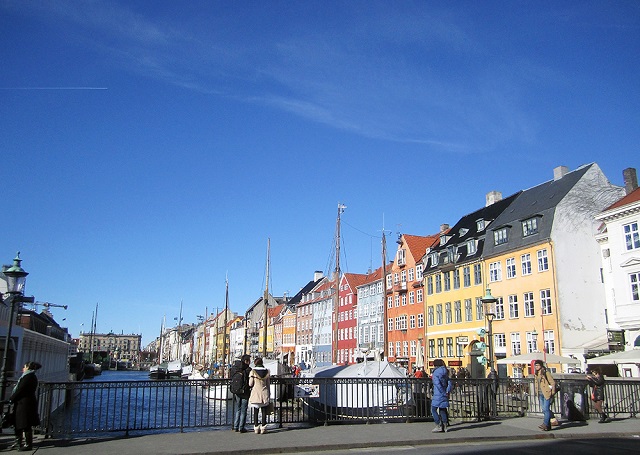
Nyhavn, Copenhagen
Denmark
When it comes to Denmark, most travelers focus on the capital city of Copenhagen for good reason – it’s where you can experience everything that Denmark is famous for, from design and architecture to beer. However, the country also offers notable world heritage sites, spectacular beaches particularly favored by their German neighbors, and legendary amusement parks for the young at heart.
To read more about Denmark, check out the following articles and resources:
Forests, lakes, nightlife, food, and fashion – Sweden has something for everyone. In Stockholm alone you’ll find tranquil lakes and forests just a stone’s throw from the nightclubs hiding in the basements of centuries-old buildings, while the Swedish Lapland promises diverse wildlife, alpine sports, and glimpses of the Northern Lights. More urbane than their neighbors, the Swedes still preserve an appreciation for simple joys – just look to traditions like fika and Pea Soup Thursday for proof.
To read more about Sweden, check out the following articles and resources:
Extending far into the Arctic Circle, Norway is perfect for adventure seekers with its majestic fjords, towering mountains, and weeks of midnight sun. That said, don’t let the fact that it’s so far north fool you – winter in much of Norway is more comfortable than in England or Montana, and cities like Bergen are slowly gaining prominence for their underground contemporary arts and music scene.
To read more about Norway, check out the following articles and resources: