
World’s largest treehouse hotel room in Sweden

Tarzan would never leave the jungle if he were staying in a breathtaking, uniquely crafted room offered by the Treehotel, which opened in 2010 and is hidden in the tall pine forest of Harads in northern Sweden (approximately an hour by car from Luleå airport, near Kallax).

World’s Largest treehouse hotel room in Sweden
Bird’s Nest

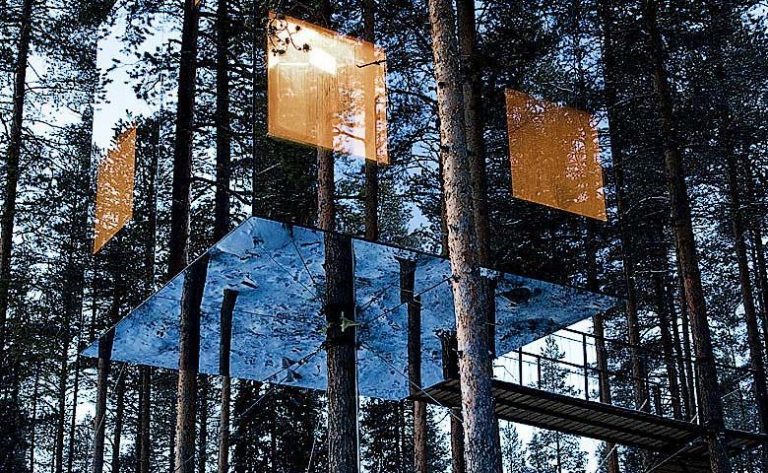
A variety of leading Scandinavian architects designed the six rooms, each about 160 to 325 square feet, with views of the Lule River. Whether emulating a UFO, Lego blocks, a bird’s nest, a red brick house or (the most coveted) a cube of mirrors, reflecting the forest from any angle, rooms are situated in pine trees and are suspended from the ground between 13 and 20 feet.

World’s Largest treehouse hotel room in Sweden
The UFO

Accessibility can be challenging as a ramp, bridge or electric stairs might be your only option for entry. Specifically created to have a minimal impact on nature, rooms are environmentally friendly, with combustion toilets and water-efficient sinks. Consider fishing and kayaking in summer, or, in the colder months, snowshoeing or viewing the northern lights by dogsled. Edeforsväg 2 A, 960 24 Harads, Sweden.

The ‘Five Leaf Clover’ room at Treehotel, near the remote northern Swedish town of Harads, 40 miles south of the Arctic Circle, opened in December last year. Weighing 20 tons and sleeping up to six people, it is attached to half-a-dozen pine trees and suspended above the forest floor. This is the largest treehouse hotel room in Sweden.

It offers spectacular views of the Lule River pine forests and even the Northern Lights

Many of us spent hours of our childhood playing in a treehouse – but how often did your parents allow you to sleep in it? Well, now you can make up for it, thanks to a unique hotel in Sweden.

The Treehotel, located near Harads, a town in the north of the country about 40 miles south of the Arctic Circle, is about to open its largest tree room yet. In fact, it will be the biggest in the world.
The Five Leaf Clover, designed by Finnish architect Sami Rintala, is 53 square metres and weighs 20 tons. It is attached to half-a-dozen pine trees six metres above the ground.

Inside, it can house up to six people in three bedrooms, and even comes with conference facilities for 12 people. Guests reach the room via a two-story high staircase.
The Five Leaf Clover, due to open on December 20, is just the latest tree room at the hotel, which boasts beautiful views of the tall pine forests around the Lule River.

The Treehotel is far enough north to offer spectacular glimpses of the Northern Lights at certain times of the year.


World’s Largest treehouse hotel room in Sweden
The Treehotel is located near Harads, a town in the north of the country about 40 miles south of the Arctic Circle

Other quirky rooms at the hotel include ‘The Bird’s Nest’ – a cabin completely camouflaged by thatch and branches only accessible by a retractable staircase.

Another one is ‘The UFO’, a space-age metal capsule on two floors which sleeps four people.

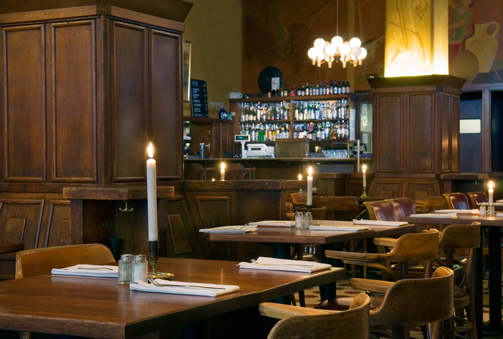
The Treehotel also has Pension serving breakfast, lunch and dinner in a 1930s-1950s setting, as well as offering internet, television, restaurant and bar.

Hidden in the forest is an eight-person ‘Tree Sauna’ complete with a hot tub and relaxation area.

Speaking about the new room, Treehotel CEO and co-founder Kent Lindvall said: ‘Treehotel always strive to push limits with our environmental work, architecture and engineering.

The Five Leaf Clover’ is clear evidence of this as nothing remotely similar has ever been done before.’

World’s Largest treehouse hotel room in Sweden, written by Tor Kjolberg

Watch Madcon’s postcard from Norway

The Norwegian pop duo Madcon team up with the Norwegian tourism board, Visitnorway, when launching their new music video “All I Do” last week.

Shot in its entirety in Bremanger in Norway, Madcon’s latest music video got its world premiere on Visitnorway.com.

The Norwegian duo Madcon rank among Norway’s most well-known musicians and have gained fame for several major hit songs, as well as the song behind the Eurovision 2010 flashmob dance, “Glow”.

Now “All I Do”, the duo’s latest music video, is getting its world premiere on Visitnorway. Filmed in Bremanger in Fjord Norway, the video shows off some of the breathtaking views and attractions the region has to offer. Visitnorway now hopes crystal blue seas, beautiful fjords, steep mountains mixed with good beats and a Norwegian fairytale will make more people look to Norway for their next holiday experience.

-Bremanger and Fjord Norway looks smashing in the new music video, says director of tourism at Innovation Norway, Per-Arne Tuftin. He hopes the new video will help raise awareness of Norway as a tourism destination. -This is Madcon’s post card from Norway, says Madcon’s Tshawe and Yosef about the video greeting from Norway.

This is Madcon’s postcard from Norway.

– This is a unique opportunity for us to promote Norway as a tourist destination, says Per-Arne Tuftin. – Madcon is well known around the world, and we hope that in providing the inspiration for the backdrop to this music video, Norway will appeal to music fans and Norway enthusiast across the world.

Bremanger

Bremanger is a small municipality in Fjord Norway with around 4000 inhabitants, situated between the open sea to the west and the fjords of Norway to the east and south.

261113_bremanger

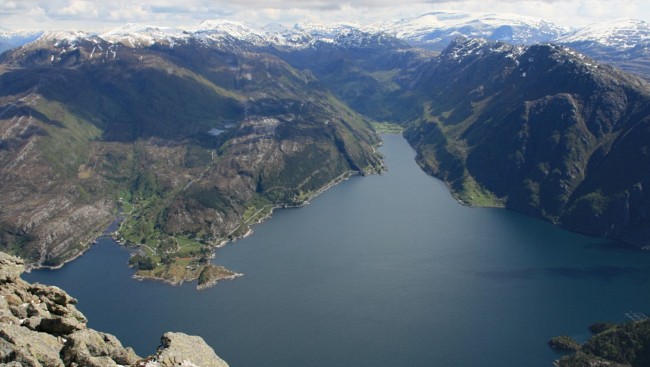
The Bremanger area is where mountains meet the sea, often in a dramatic way. None more so than Hornelen, Europe’s highest sea cliff. In the music video, you can see a wingsuit-jump from Hornelen’s summit. Hiking to this 860-metre high point will take you around four hours each way. If that seems a bit too strenuous, there are many other options; Hiking trails abound in the entire region.

The Vingen rock carvings were discovered in 1912 and forms Norway’s second largest field of rock carvings with some 2000 individual petroglyphs. Up to 7000 years old, they show deer, other animals, abstract geometric patterns and even some human figures.

The music video

The music video “All I Do” by Madcon is produced by Svein Arild Vatsø and directed by Bjørn Myreze. It was financed by contributions from the Bremanger municipality and local businesses.

The coldest hotel in Sweden

In Swedish Lappland, about 200 kilometer north of the Polar Circle in the small town of Jukkasjärvi, you will find the world’s largest hotel made solely by snow and ice. But don’t search for it during the summer season, since the sun, never going down, has melted the complete construction that runs out in the Torne river.

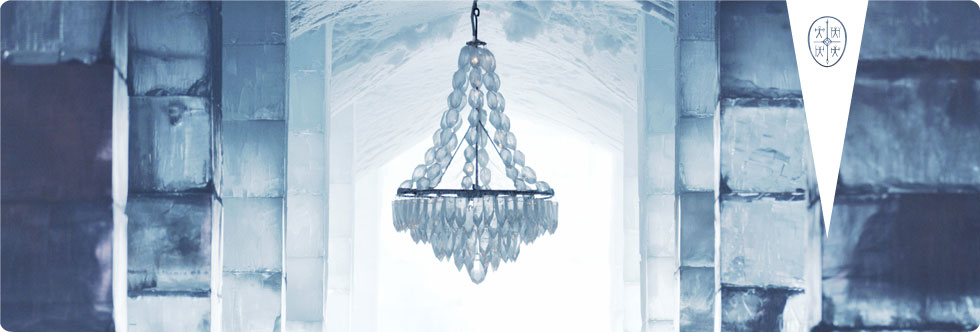
Entrance with crystal candelabra made of ice. ICE HOTEL Håkan Hjort.


Every year, by the end of October, a group of local and invited ice sculptors meet and starts building the Ice Hotel, to be finished once again for Christmas opening. The hotel completely changes from year to year, since the suites are built around different themes, and no construction is older than six months.

The guests arrive through doors covered by reindeer skin. In wintertime, when temperatures may be as low as minus 30 degrees Celsius, and the temperature inside shows minus 20, it’s wise to wear warm clothing. The night is spent in isolated sleeping bags on beds made from snow and ice and covered by reindeer fur. The family rooms have a bed which is wide enough for three persons.

291113_Icehotel_Sleep_well

The suites are decorated with art made from ice, and all sleeping rooms have baths and water closet. The hotel has also many different rooms providing a variety of accommodations. The chapel for instance is used for ceremonies, baptism and weddings. The art centre is a beautiful gallery with ice sculptures, where natural light is reflected in the carvings and creates surprising patterns when visitors walks around in specially made silver capes. The Ice Globe Theatre, inspired by Globe Theatre in London, provides first class shows and entertainment all season long. Anyway, this is the coldest hotel in Sweden.

Along with many, one of nature’s most fantastic attractions is the mystique performance of the famous Northern Lights.

The hotel’s unique restaurant, offers cuisine served on plates made from crystal clear ice. The delicious and rich selection of dishes from Lapland, for instance roasted reindeer, grilled moose, Lapland cheese, salmon, trout and whitefish, all from the area, spiced with local and imported ingredients and trimmings. As you may have expected, the hotel has its own Ice Bar where both alcoholic and non-alcoholic beverages are served in glasses made from crystal clear ice from the Torne River. In fact these ice glasses are known through all of Absolute Ice Bars in Stockholm, Oslo and Copenhagen. The vodka served is a wide selection of flavored and spiced Absolute vodka that makes conversation float merrily.

The mornings begin with a cup of red cowberry juice followed by a visit to the sauna before it’s time for an abundant breakfast buffet. Later during the day it is possible to take a sleigh tour with reindeer to the wildlife camp Sami, where lunch is served. The surrounding woods with natures crystal decorated trees may be explored with snowmobiles, dog sleigh or snow shoes. Minibuses drive to the coast of North Norway, where you may watch sperm whales or moose on winter tracking, if you’re lucky.

291113_Icehote_SculptorIf you wish you may join lectures in ice sculpturing, but most of the guests choose to admire the beautiful art works with chattering teeth as the pieces evolve. All excursions are arranged by the hotel, preferably when booking.

The hotel is situated about 16 kilometers from Kiruna, about 90 minutes by plane from Stockholm. When booking, it is wise to ask for transfer from the airport to the hotel. It is normally by dog sleigh.  http://www.icehotel.com/

291113_Icehotel_Dogshled

Text: Tor Kjølberg. Photos: Icehotel

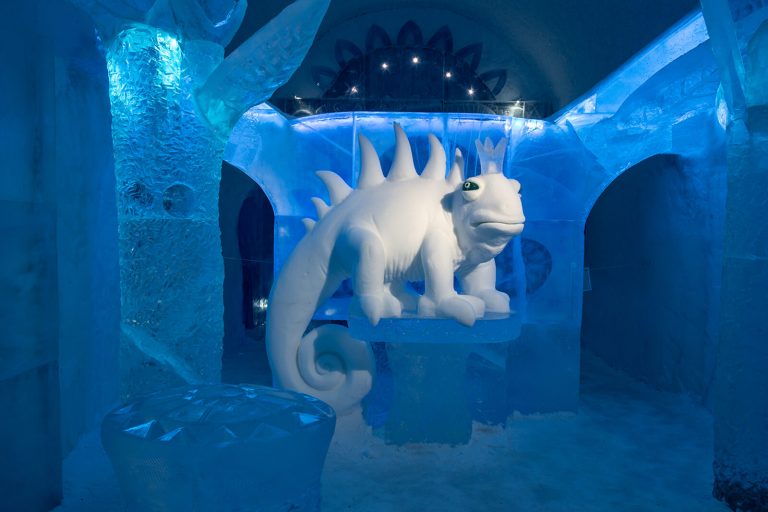
Feature image (on top): Dragon of snow ice sculpture by Kestutis Vytautas Musteikis Photo: Asaf Kliger

A BEAR THAT GIVES

0

IKEA has supported UNICEF’s Play based programs for ten years and given more than ten million children the opportunity to schooling.

271113_Ikea_Brum

IKEA, the leading home furnishings retailer, and UNICEF partnered ten years ago on a new promotion, which celebrates the importance of playtime in a child’s life and demonstrates how a teddy bear can help make a big “bear hug” of a difference, a bear that gives.

IKEA stores in 46 countries have donating a certain percentage from the sale of each BRUM soft toy teddy bear – perfect for hugging – to benefit children living in poor countries. IKEA, together with its shoppers, has so far raised 57 million Euros, supporting UNICEF’s “Children’s Right to Play,” crucial outreach programs for children in need. IKEA shoppers can now again support this worthwhile cause through 4th of  January 2014 and bring a smile to the faces of the children in their lives, as well as help improve the lives of other children, with each purchase of the new IKEA BRUM teddy bear.

“A teddy bear is a symbol for playfulness and security, and through the sale of the IKEA BRUM teddy bear we can help play a positive role in the lives of many children, making it possible for them to be exposed to constructive, healthy and fun play-oriented activities through UNICEF’s valuable programs,” said John Zurcher, Environment and Social Responsibility Manager, IKEA U.S. when the charity program first started. “At IKEA we know how important it is to enable children all over the world to grow up in a carefree and nurturing environment.”

“Millions of children in the world are denied play and never experience this vital aspect of their development because of war, disease and poverty,” said Charles J. Lyons, President, U.S. Fund for UNICEF. “We are grateful to IKEA for its ongoing support to help children reclaim their childhoods through playing and learning.”

Created by IKEA the Norwegian designer Ivar Ledang, the IKEA soft toy BRUM teddy bear is part of the new IKEA PS collection for children, which is available for purchase at IKEA stores, as well as via the IKEA catalog. The IKEA BRUM bear has flexible arms and legs that bring the cute playfellow to life. A child can use his or her imagination to make the bear sit, stand, walk, wave, nod, take a nap or give a big bear hug.

Designer Ivar Ledang

IKEA has supported UNICEF programs around the world for more than ten years, and in the United States alone IKEA has raised more than $1.75 million to benefit UNICEF programs for children.

Founded in 1946, UNICEF helps save, protect and improve the lives of children around the world through immunization, education, health care, nutrition, clean water and sanitation. UNICEF is non-partisan and its cooperation is free of discrimination. In everything it does, the most disadvantaged children and the countries in greatest need have priority. For more information, please visit www.unicefusa.org.

Stockholm: Sweden’s Crystal City

On a clear day in Stockholm, Swedens Crystal City, the air fills with light, and the city and sky glow with a crystal clarity reflected in the surrounding water. Water — it’s the main feature in Stockholm, which stands on 14 islands on Sweden’s east coast facing the Baltic Sea. The location has made it an important shipping and trade center since the 13th century. 

251113_stockholm-crystal_city

When I go to Stockholm, Sweden’s crystal city, I relish those medieval days, walking the narrow stone streets of Gamla Stan, the Old City. Its quaint buildings now hold shops and cafes. Then I stroll the waterfront, admiring the dramatic setting and the most recognized building in Stockholm, the brick Stadshuset, City Hall, with a corner tower topped by a shiny cupola. This is where Nobel Prize banquets are held. Guided tours in English are offered here, as well as at the splendid Royal Palace.

They’re interesting, but if you can see only one thing in Stockholm, make it the Vasa Museum on Djurgården, a lovely green and wooded island. The Vasa was the mightiest warship in the world in 1628, carrying 64 guns and 300 soldiers. It sank even before it left the harbor, with all its elaborate carvings, and lay on the sea bottom for 333 years before it was pulled out. Cleaned and repaired, it now stands proudly on land, an amazing piece of the past.

251113_Vasa_Muserum_Stockholm

Also on Djurgården is Skansen, an open air museum where people in period clothing demonstrate what life was like in past centuries. For a contrast, tour the Moderna Museet, one of Stockholm’s many museums and galleries. It shows a sampling of modern artists including Kandinsky, Picasso, Dali and Magritte.

OLYMPUS DIGITAL CAMERA

In this expensive city, you can save kronor by purchasing the Stockholm Card, good for 24, 48 or 72 hours, which provides free public transportation and free entry to 75 museums and attractions. Dozens of stores sell souvenirs, some very well made, but if you’re looking for fine Swedish crafts, seek out the high-end stores or ask for help from Smart City Shoppers, a company that helps buyers find top quality clothing, textiles, crafts, glassware, and furniture.

Stockholm’s busy streets are full of shops and malls. Orrefors Kosta Boda is probably the best place for fine glass items. Design Torget displays contemporary crafts done by skilled artisans; the gallery has several branches. The Gallerian is a modern, two-level, glass-roofed complex with a huge array of goods in individual stores.

251113_orrefors

Since 1874, travelers have enjoyed the classic tradition and luxury of the Grand Hotel. The landmark hotel faces the water, opposite the Royal Palace, and is renowned for its superb service and rooms. In the Veranda restaurant, I’ve feasted on great seafood, especially the famous crayfish. It’s known, too, for a magnificent smorgasbord. Mathias Dahlgren is the noted chef in the hotel’s more formal restaurant.

Hotel Rival, also providing fine service and amenities, has a completely different atmosphere, with 99 sleek rooms on Mariatorget Square in the trendy Södermalm District. It has two restaurants, three bars, a gym, and a young, hip reputation.

Different from both hotels is the Rica Hotel Gamla Stan. Located in a charming 17th-century building near the cathedral, the 51 rooms are small but bright and fresh, with a few antiques. The conveniently located Clas På Hornet hotel offers friendly service and a restaurant serving seafood fresh from local waters.

For traditional Swedish dishes in this high-energy, international city, try the Pelikan. In the high-ceilinged pub you can order old favorites such as pickled herring, dilled potatoes, lingonberries, and beef with mashed turnips. At little Bakficken (“Hip Pocket”), part of an upscale restaurant by the Opera House, try the tiny, delicious meatballs.

251113_Pelikan_Stockholm-the_bar

Distinctive French cuisine is on the menu at the fairly new GQ. Here customers rave about pricy entrees such as wild duck with pumpkin puree and oxtail ravioli with portobello mushrooms. Edsbacka Krog is in a 17th century building a short taxi ride from the town center. The fresh fish is always perfectly prepared and the wine list excellent, and it’s all expensive.Gyldene Freden, supposedly Stockholm’s oldest restaurant, serves food that gets rave reviews.

If you can find a place to cook it, you can catch your own dinner with a fishing rod. People do fish for salmon from the bridges of downtown Stockholm. You need a permit for this; check with the tourist office.

Written by the Daily Scandinavian team

Planning a Trip to Scandinavia

Northern Europe is one of the most fascinating regions in the world. Perhaps best known as the place to see the Northern Lights, it also offers vast, raw landscapes and amazing architecture in addition to sophisticated cities.

With many areas still untouched by tourism, Northern Europe lends itself to the traveler who’s looking for a little solitude and a respite from the rest of the continent.

What to expect

If you’re planning a trip to Scandinavia expect efficient transport, stunning cityscapes both ancient and modern, unique cuisine, and amicable people, almost all of whom speak English.

While living costs in Northern Europe are among the highest worldwide, the historical and natural wonders make roughing it out part of the experience and well worth it. In fact, many of the attractions and museums are free. Don’t write off this region simply because you heard how expensive it is – there are ways to cut costs and enjoy your time in Northern Europe.

Planning your trip to Northern Europe
A lot goes into planning your trip to Northern Europe – how to get there, how to get around once you are there, best time of the year to go, which vaccinations you need, and what the visa situations are.

Getting around

  • AirNorwegian Air Shuttle is the main budget airline in the region, offering cheap flights from major European cities. SAS also offers youth fares for flights in Europe.
  • Bus: While intercity and inter-country buses are available, routes and prices lose out to the extensive rail network.
  • Train: Trains run to almost all cities in Scandinavia and Finland, all clean and comfortable. High-speed trains and night trains are very popular, so make sure you reserve in advance.
  • Boat: Various ferry lines offer routes from Denmark to Iceland and Norway, as well as from Sweden to Finland. These are pricey but scenic (especially those crossing the Baltic Sea and along Norway’s western coast).

Search for airfare to Europe, read The First Timer’s Guide to Train Travel in Europe, and check out our Eurail site for more information on transportation in Northern Europe.

Costs

The Nordic countries are known for being expensive, but plenty of cost-cutting options exist. In fact, it’s possible to get by on US$70 a day if you really scrimp.

Free accommodation can be found in the way of couchsurfing or camping.

In Denmark there are official camping grounds, while Sweden, Norway, and Finland practice “Every Man’s Right”, the freedom to hike across or camp on uncultivated land (including private property). Hence, the best time to visit on a budget is during summer. If you need to stay indoors, consider hostels or rentals outside the city center. These are much cheaper and still convenient as the region boasts some of the most efficient public transport systems in the world.

Eating out will burn a hole in your pocket, so you may want to find a place where you can cook your own meals. A meal at a restaurant will set you back about $40USD, while a sandwich and coffee will cost around $10. Expensive as it is, food anywhere is almost always of excellent quality and freshness. Tap water in the Nordic countries is drinkable.

Vaccinations

According to the CDC, your routine vaccinations of MMR (measles, mumps, rubella), DPT (diphtheria, pertussis, tetanus), and polio should be up to date, but they aren’t required.  Hepatitis A and B are also highly recommended. Rabies vaccination is also advisable if you’ll be coming in contact with wildlife.

To find more in depth information about vaccinations, check out these articles:

Visas

Denmark, Sweden, Norway, Iceland, and Finland are members of the Schengen Area, which means that Americans and citizens of most other countries can travel visa-free for 90 days in the region, including Greenland and the Faroe Islands. Travelers who require a visa only have to apply for a single visa for the Schengen Area, but will need to apply for a separate visa to visit Greenland and the Faroe Islands.

Read How to Sort Out Visas for an Extended Trip

Where to go

Denmark, Sweden, and Norway make up Scandinavia and will be the countries covered in this article While all these countries share close ties and a Viking heritage, you’ll know when you’ve traveled into a different country – they are all more culturally unique than you’d expect.

The region changes drastically from summer to winter, with enough activities to occupy travelers for at least a month. If you’re on a tight budget, don’t worry – seeing the highlights doesn’t cost much.

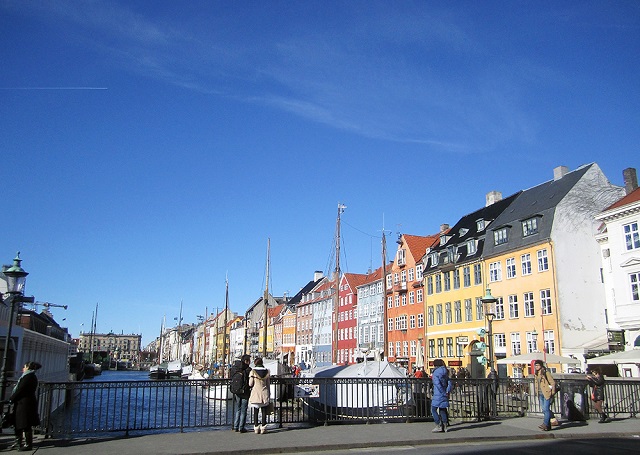
Nyhavn, Copenhagen
Nyhavn, Copenhagen

Denmark

When it comes to Denmark, most travelers focus on the capital city of Copenhagen for good reason – it’s where you can experience everything that Denmark is famous for, from design and architecture to beer. However, the country also offers notable world heritage sites, spectacular beaches particularly favored by their German neighbors, and legendary amusement parks for the young at heart.

To read more about Denmark, check out the following articles and resources:

Stockholm
Stockholm

Sweden

Forests, lakes, nightlife, food, and fashion – Sweden has something for everyone. In Stockholm alone you’ll find tranquil lakes and forests just a stone’s throw from the nightclubs hiding in the basements of centuries-old buildings, while the Swedish Lapland promises diverse wildlife, alpine sports, and glimpses of the Northern Lights. More urbane than their neighbors, the Swedes still preserve an appreciation for simple joys – just look to traditions like fika and Pea Soup Thursday for proof.

To read more about Sweden, check out the following articles and resources:

Lofoten, Norway
Lofoten, Norway

Norway

Extending far into the Arctic Circle, Norway is perfect for adventure seekers with its majestic fjords, towering mountains, and weeks of midnight sun. That said, don’t let the fact that it’s so far north fool you – winter in much of Norway is more comfortable than in England or Montana, and cities like Bergen are slowly gaining prominence for their underground contemporary arts and music scene.


To read more about Norway, check out the following articles and resources:

Written byBrooke Thio

Published with kind permission of BootsnAll Travel Network

Oslo’s the Place to be next Summer

This year all it takes is one up-and-coming neighborhood to make a city feel reborn, but in booming, forward-thinking Oslo, two areas are alive with everything new in art, food and design according to Condé Nast June issue. Oslo’s the place to be!

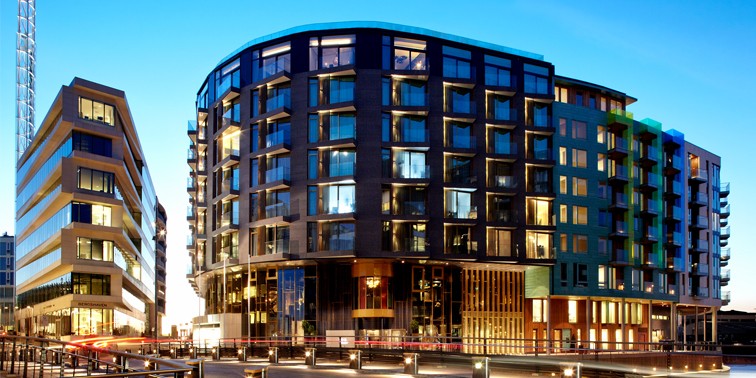
201113_The-Thief_Hotel_Oslo

The first is Thief Island, or Tjuvholmen, a former prison islet that’s now filled with glittering glass art galleries and restaurants – and the crown jewel, the Renzo Piano-designed Astrup Fearnley Museum of Modern Art, a beautifully mod vessel for works by contemporary all-stars including Jeff Koons and Olafur Eliasson. The Astrup has loaned some Richard Princes and Andy Warhols to The Thief, the sleek, granite- and-glass hotel next door that’s cozy inside thanks to its big fireplace and Marimekko-esque upholstery designed by young Norwegians.

201113_astrup-fearnley-Museum_oslo-norway

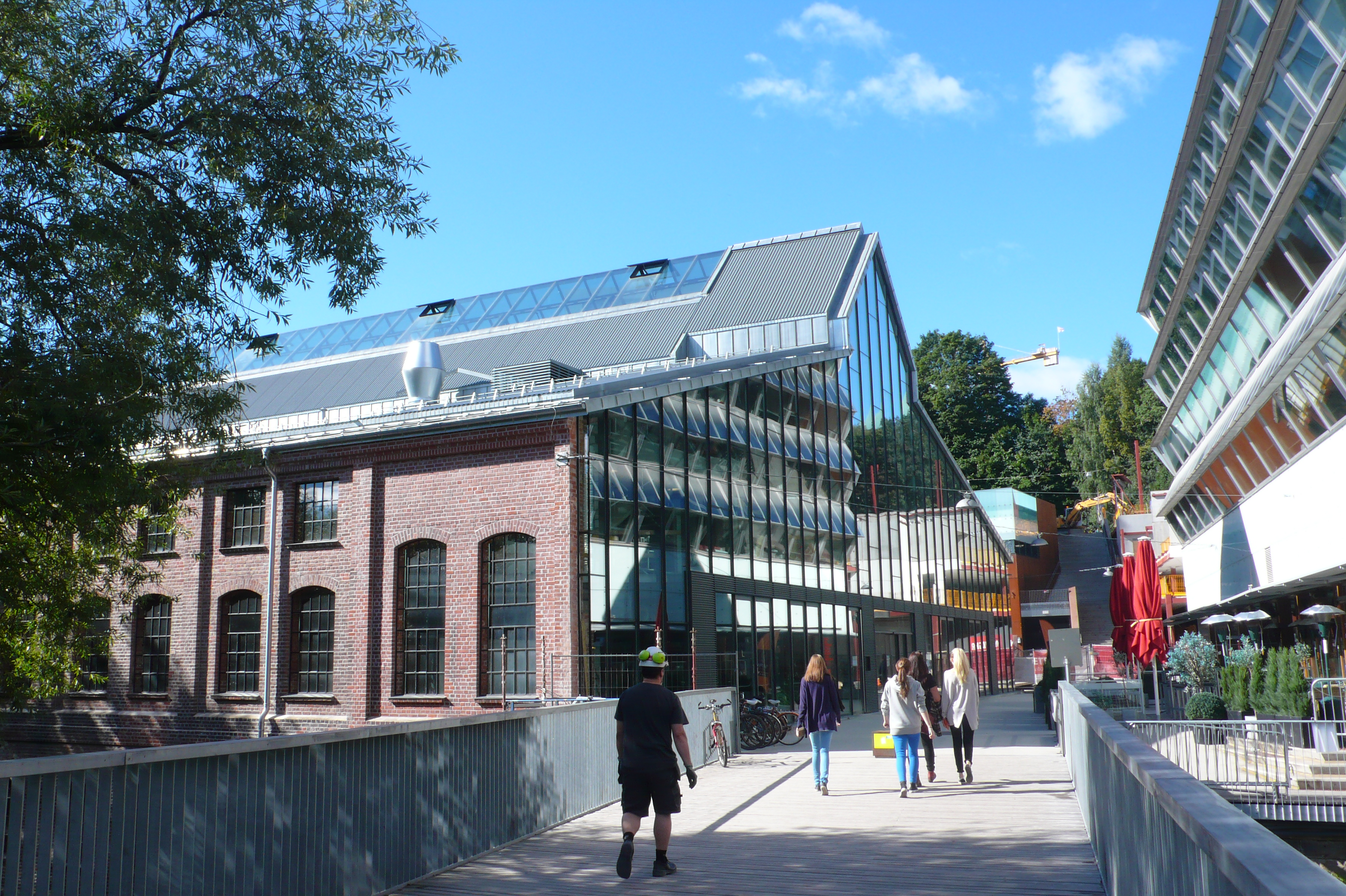
A 20 minuteswalk from Thief Island is the Vulkan neighborhood, whose industrial edge has made it the center of the city’s young creative scene. At its heart is Mathallen Oslo – a new food hall with stalls selling pies and fabulously fibrous Scandinavian bread.

201113_Vulkan_Oslo

But the area’s flash factor started with the opening of Bar Vulkan, an indoor-outdoor restaurant/club where the stylish eat burgers and drink rosé. Today Vulkan is so loaded with snob-approved clothing stores that on weekends it’s swarming with locals – they’re all looking for a hit of the city’s new brand of cool. Oslo’s the place to be.

201113_Vulkan_Bar_Oslo

Come out and play!

Rural tourism is starting to catch on in Sweden, Norway and Denmark. Tourists vacationing in the Scandinavian countries will increasingly away from everyday stress. That is good news for rural tourism in the region. 

201113_Downhill_skiing_Norway

Small-scale tourism is the new big in Scandinavia. Jämtland Herjedalen in Sweden is the region with the highest density in terms of small-scale producers of rural tourism and honored craft.

People will simply return to the roots, and are willing to seek it out and not least pay for the experience.

201113_Morten_Wikner– Interest in our region is noticeably larger, especially among food writers and journalists, who allows us to showcase our mathåndverk (food craft) . Everything from hardcore “foodies” to foodies tourists find their way to our region, says Mårten Wikner, project manager for Gastronomy Jämtland Härjedalen.

World-class cross-country ski tracks
A warm layer of undergarments, a pair of trousers – not too wide and not too tight – a jacket generous enough to permit full action, helmet or beanie on the head and a pair of gloves, or even better, mittens. On your feet ski boots and underneath them, a pair of skis, appropriate for the day’s activities. In the rucksack, a thermos filled with hot drink, sandwiches of local character, a bar of chocolate and most importantly, an orange. You are ready for a day in the snow!

201113_Cross-country-skiing_Scandinavia

Hjämtland Härjedalen has facilities for cross-country skiing of the utmost standard.  Funäsfjällen has the largest ski track system in the world with 180 miles of sheer delight. The tracks are prepared on a daily basis and the next waffles’ café is rarely far away.

Östersund has 55 miles of connected tracks within walking distance from the city centre.

Ski touring
Should you prefer gliding along with somewhat wider skis in fabulous open landscapes with the fresh mountain air on your cheeks, we recommend the marked trails in, for example, Lofsdalen, Årefjällen, Funäsfjellen or Vemdalen.

Summit tours and sun drifts
March and April are wonderful months for everyone keen on skiing while enjoying the sun. Above the three border the plateaus invite gliding and the snowdrift invite digging sunning holes. Go uphill with skins or snowshoes before setting off downhill in great sweeping turns down the sundrenched sorbet-like snow.

More and more small-scale Norwegian operators are investing in rural tourism. The organization Seterlandet, brought together farm tourism in the North Eastern Valleys, and the Røros region is among many which sees a growing trend among Norwegians who seek the genuine. The big attractions is the journey back to the origin to see how brunost (brown goat cheese) is made, how goats are milked, and experience the general life of the mountain farming life.

201113_Jämtland_Härjedalen.

– Sure it’s nostalgia , but at the same time it’s a desire to preserve a culture that takes care of the best in us, as one of the players, Oddveig Østgård Gjelten at Brattåsrovollen above Dalsbygda describes it .

The geographical locations are also contributing to create something unique. The element of the Gulf Stream with warm, westerly winds and unique growth conditions is equally important.

www.seterlandet.com

Öland, Sweden’s Enchanting Island

One of Europe’s longest bridges (6,072 meters) stretches from Kalmar, on Sweden’s southeastern coast, to the island of Öland. For good reason, the 87-mile-long island is a favorite vacation spot for Swedes. Shallow waters, sandy beaches, yachting and sailing harbors, and long days of sunshine make it appealing to any visitor, including us.

181113_Borgholm_Sweden

Low stone walls crisscross the landscape, dividing tidy farms. Lilacs and wild apple trees bloom purple and white in spring along quiet roadsides, and outdoor markets sell incredibly luscious strawberries, along with local cheeses, handicrafts, and weavings.
181113_Eketorp_Castle_Sweden

Because we’re drawn to history, the further back the better, I was fascinated by Eketorp. This immense fortress, on Öland’s limestone plain, dates back 1700 years and up through the Middle Ages. Excavations have uncovered pottery, arrows, locks and keys, primitive ice skates, and hoards of gold and jewelry that were stashed under the floors and in the walls. The reed- and sod-covered homes and stables and the stone walls that encircle them have been reconstructed using Iron Age methods and materials. Pigs, chickens and geese mill about the grassy grounds and roosters strut on the roofs.

181113_Museum_Oeland_Sweden

We saw a more recent past at the open-air Himmelsberg Folk Museum, a collection of red-painted farms and cottages typical of the 18th and 19th centuries. All over Öland, windmills, some 400 of them, form striking outlines against the sky. The picturesque wooden mills, now protected monuments, are the symbol of Öland. Some have been turned into cafes that sell the ever-popular waffles with strawberry jam and cream.
Bird watchers come to the island to see millions of migrating birds make their yearly flights. A Swedish woman told us her favorites are the cranes, flying through in September on their way to Africa. She said that once when she saw wave after wave of them, she stopped counting at 950. “A flock flew just in front of the full moon,” she said. “It looked as if their feathers were of silver.”  The birds fly above an immense heath, the Stora Alvar, covered with thyme and wildflowers in spring and summer (32 species of orchids alone). It’s a beautiful expanse of color scattered among low junipers and ancient rune stones and graves.

Speglad fyr

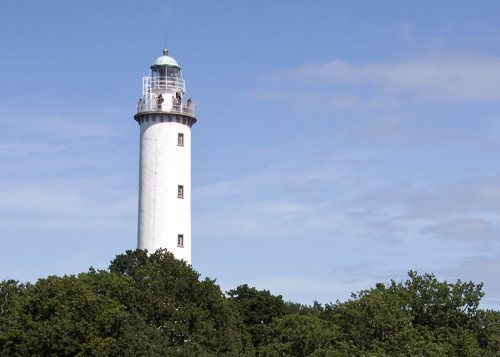
At the northern tip of the island you can climb to the top of the Långe Erik lighthouse for wide views of the land and sea, and then stop for coffee and pastries in the lighthouse cafe. Another lighthouse, the Långe Jan, is at the southern end by the Ottenby Nature Reserve. This is a great place for bird-watching. There’s more: On Öland you can camp, hike, fish, golf at any of 8 courses, take cooking classes, and ride bicycles. There are several bike rental shops.

181113_Oeland_windmills

The imposing ancient castle southwest of the main town, Borgholm, is open for tours, along with Solliden, the century-old manor house nearby. Solliden is the summer residence of Swedish royalty and is open to visitors on summer afternoons. It has a pretty garden and a small shop where you can buy products cultivated here. Solliden’s “Coffee Cottage serves hot dishes, sandwiches, Danish smorrebrod, beer and wine.

191113_Gastyronomy-Sweden

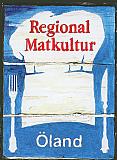
181113_Regional_Culinary_Heritage_SwedenIslanders take great pride in their cooking, which is based on local produce, meats, seafood and fruits. Every fall they hold a 3-day Harvest Festival, celebrating their traditions and culinary riches. There are cooking demonstrations, special menus at restaurants, art exhibitions, and a handicrafts market. A popular regional dish is kroppkakor, potato dumplings stuffed with pork and served with lingonberry jam. That jam is terrific, good with almost everything. To taste local specialties, look for the sign, Regional Matkultur Öland (Regional Culinary Heritage) on restaurants. It indicates that they follow the guidelines of the organization.

In our experience, the best food on the island is at Halltorps Gästgiveri, a country inn set back from the sea 9 kilometers from the main town of Borgholm. The menu features fresh fish from the Baltic, lambs that grazed on the heath, locally grown fruits and vegetables, and herbs from the inn’s garden. They bake their own bread and even spice their own aquavit. Our dinner consisting of salmon mousse, salad, lamb medallions, potatoes au gratin with rosemary, and strong dark coffee was truly exceptional.

The lodgings, too, were out of the ordinary. Halltorps Gästgiveri, among fields and trees full of nightingales, has 35 rooms, several furnished in the styles of different Swedish regions. Saunas, a jacuzzi, and spa treatments are all available. After a day of touring the island, we were happy just to relax on the terrace and admire the fabulous view of the sunset over Kalmar Sound.

This is indeed Sweden’s enchanting island!

Written by the Daily Scandinavian team

SeaDream boss quits

0

The chief executive of SeaDream Yacht Club, Pamela Conover, has announced she is stepping down from the role after less than a year at the helm.

141113_Pamela_Conover Conover’s departure follows the decision to consolidate the two-ship cruise company in Norway.

Atle Brynestad, chairman and owner of SeaDream, will once again assume the role of chief executive.

Conover will spend the next month working with Brynestad to ensure a smooth transition of duties.

Brynestad said he respected her decision to leave and thanked her for her contributions to the company.

SeaDream top rated by Berlitz 2013
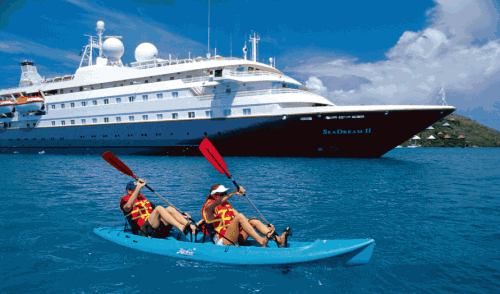
The 2013 Berlitz Guide to Cruising & Cruise Ships released last month, announced that the 112-guest mega yachts SeaDream I and SeaDream II have again achieved the top two ratings in the ‘Boutique Ships’ category (50 – 250 passengers). The Berlitz Guide, now in its 28th year, is researched and written by Douglas Ward, the world’s top authority on cruising and cruise ships. Having reviewed 284 cruise ships, Ward has named the top-rating ships for 2013, with the 10 most highly rated being officially ‘small’ or ‘boutique’. The SeaDream ships’ ratings out of a possible 2,000 points are: SeaDream II – 1,788 points and SeaDream I – 1,786 points.

141113_SeaDream