Christmas in Tivoli is a real Copenhagen tradition where authentic summer classics have been replaced by Scandinavian Christmas mood.
In November and December Tivoli in Copenhagen has been decorated with lightning, colors and Christmas trees, and music as well as entertainment create an sizzling Christmas mood for both children and adults.
Tivoli, Copenhagen in December
Here you can enjoy the whole day, or days, feeling you’re in a big Christmas wonderland.
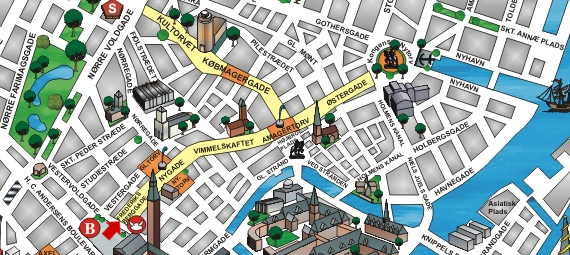
Christmas Shopping The area surrounding Strøget has a huge choice of specialty shops, ideal for shopping Christmas gifts.
In addition to chain stores like & Other Stories, Top Shop and Magasin, you should stroll into the small side streets, where you find Danish design, exciting shops, second hand shops and charming cafes. Explore Pilestrædet and Købmagergade.
Stroget, Copenhagen
Eateries and bars If you feel for real Danish open sandwiches, go to Sankt Anne and have them the Danish way – accompanied by a schnapps.
Sankt Anne restaurant
Do you want to experience Scandinavian gastronomy and cocktails, go to Geist. Personally we never forget to mention the fantastic service at No. 2.
No. 2 restaurant
Burger enthusiasts should visit Grillen Nørrebro or Halifax Burger.
The Scandinavian tradition is for salty, full-fat, firm or hard cheeses, often matured, some as long as two years.
The last few decades have seen production of a vast number of new soft cheeses, inspired by southern Europe, but even these are eaten in the traditional way – namely thinly sliced on bread.
Most cheeses are made from cow’s milk as milking ewes and goats is rare in southern Scandinavia. In Norway, goats and cows used to be kept inside in the long snowy winters and driven to the high mountains in summer. The milk was treated and made into cheese on the spot, and brought back to the valleys in autumn.
Norwegian gammalost (old cheese)
Cow’s milk was skimmed and made into Gammalost (‘old cheese’), a grainy, slightly crumbling, matured cheese, with a strong blue-cheese flavor. This is still a favorite cheese in Norway but virtually unobtainable outside the country. It is not necessarily very old, but it has extremely good keeping qualities without refrigeration.
Sliced goats cheese
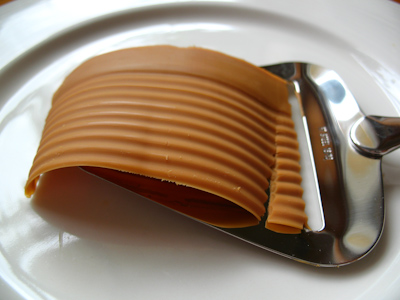
The whey from the summer milk was sweetened with cream and boiled in cauldrons for hours to evaporate. The resulting cheese is known as Geitost (‘Goat’s Cheese’), Mysost or Mesost after myse, meaning whey in Norwegian; even today, it makes up to 30 percent of the cheese eaten in Norway.
Brown cheese with marmalade
It is a true Scandinavian specialty, a brown, velvety, sweet cheese with a nutty, almost chocolate flavor as the milk sugars caramelize during cooking. It is somehow like peanut butter and tastes very good with jam. It’s eaten thinly sliced on crispbread, and used in cooking to add sweetness and body to sauce for game and venison. You can have a dark brown Mysost made solely from goat’s milk, and a lighter version made with both cow’s and goat’s milk. The pure goat’s milk version is much better, and much more expensive.
Norwegian Jarlsberg is a fine, full-fat, creamy type of Emmenthal, and rightly famous.
Västerbotten cheese
Sweden has a vast number of beautiful hard cheeses. The most spectacular is the Västerbottenost, the Scandinavian equivalent of Parmesan cheese, but quite Sweden’s own.
Västerbotten sandcich
Denmark has a great variety of both firm and blue cheeses, all worth a try, as well as specialty unique to Denmark, a smoked fresh cheese called Rygeost, made from drained junket.
Danish rygeost (smoked cheese)
Kaffeost (‘coffee cheese’), is a round flat, mild cow’s milk cheese and a specialty of Norrland in northern Sweden. The unusual name has resulted from the cheese being added in cubes to sweetened, hot coffee, and eaten after the coffee is drunk.
Danish Coffee cheese
Buying and storing With all these beautiful cheeses, you must choose a specialty cheese store to buy from, and a small producer rather than the huge dairy chains.
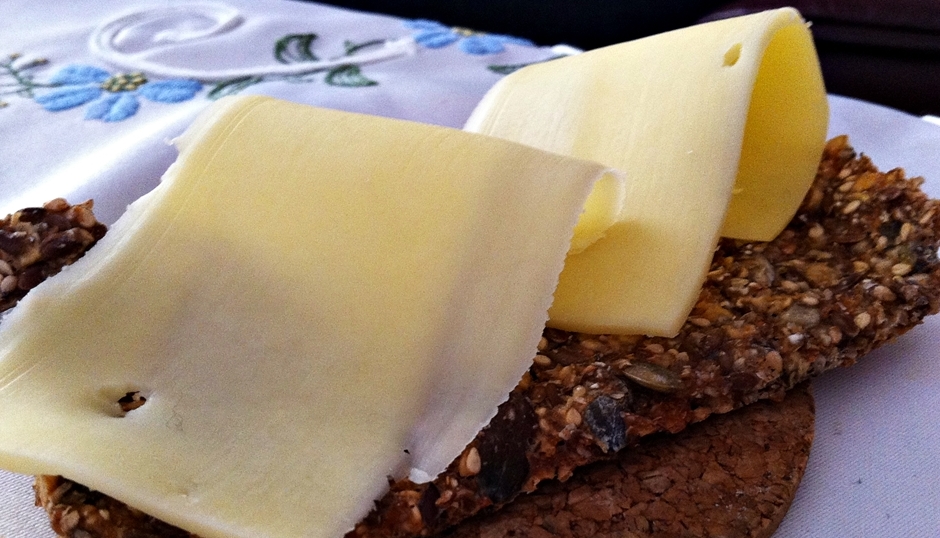
Crispbread with cheese
Culinary uses Scandinavians’ love for extremely old, matured cheeses is mostly incomprehensible to foreigners. Old cheese is eaten in very thin slices, on bread, often with meat jelly, sliced onion and a dripping of brown rum. Another sensational way with cheese is an open sandwich consisting of blue cheese topped with a raw egg yolk and onion rings.
Photo: Visit Sweden
Besides these specialties, we love open cheese sandwiches, which are eaten around the clock; on rye bread, which is best for matured cheeses; on white bread, preferred with yellow cheeses; or on crispbread, which is good for Mysost and hard cheeses.
Scandinavian soft cheeses
And we absolutely love to eat open sandwiches topped with jam – one with some nerve, e.e. blackcurrant, blackberry, rosehip, cloudberry or raspberry, or orange marmalade.
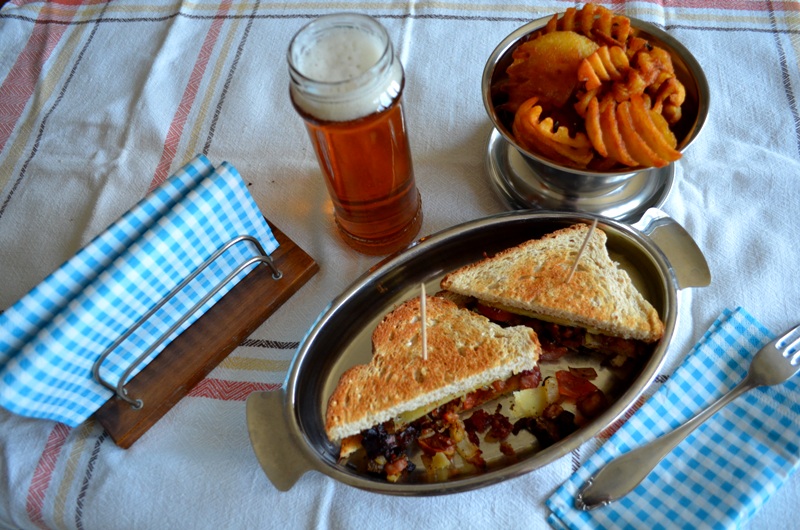
A Northern specialty is a sandwich made with Swedish Västerbottenost melted between slices of toast with cloudberry jam. It is absolutely delicious!
Potkäse with rum
Potkäse (‘pot cheese’) is an extremely old-fashioned but quie delicious way to use up odds and ends of cheese. The cheese is grated or cubed, then added to a clay pot with a dash of rum or schnapps. This is blended onto a potkäse. If it is too dry, you can add cream, and season with salt and even sugar. It’s long-lasting, pungent, but quite mellow if it’s made right. Eat it as a spread on rye bread, with beer and schnapps.
Norwegian painter and illustrator Vanessa Baird (52) has received the prestigious 2015 Lorck Schive Art Prize.
The Lorck Schive Art Prize (NOK 500,000/$60,000) is held biennially at Norway’s Trondheim Art Museum and is Norway’s biggest art prize. The artist won the prize for a series of large scale wall drawings, which she has titled “I don’t want to be anywhere, but here I am”.
This year’s international jury – Lithuanian curator Raimundas Malašauskas, Norwegian artist Eline Mugaas and Ikon Gallery director Jonathan Watkins – tapped Baird for the top prize, citing her unabashed frankness as a factor, although all the four finalists received a substantial stipend towards creating the work for the exhibition.
The aim of the Lorck Schive Art Prize is to generate debate and interest around contemporary art by honoring excellent artists.
Vanessa Baird exhibited at Gothenburg Art Museum, Sweden
Vanessa Baird’s drawings are intriguing and repulsive all at once with subject matter and scenery running the gamut of entrails and furniture to refugees lost at sea. One portion of the mural contains bears an uncanny resemblance to a widely circulated photograph of a drowned Syrian child. “Entirely coincidental”, Baird explains, “as the work was created before the tragic image went viral.” But poignant nonetheless.
The drawings decorate the walls in one of the rooms in the old Christiania Sparebank’s building, which will soon become Oslo’s new House of Art and Culture.
“For a long time I went early to bed”
At first sight, when looking at the artist’s watercolors, you might generate a sense of fairy tale charm of children’s illustrated books. But looking closer, you soon realize that her drawings are hardly suitable for young children. She has just finished illustrating the book “In Autumn” (Om høsten) by Karl Ove Knausgaard.
Her intensely detailed pastel drawings are a colorful eruption of chaos, and Vanessa Baird often works with watercolor and pastel, creating a mix of intimate and large scale works. A previous work (The light fades – if only we close our eyes) was taken down from the Ministry of Helath building in 2013, after associations were made with the bombings of 22 July in Oslo.
Baird’s watercolor tableaux are both sensual and grotesque at the same time.
“To everything there is a season”
The artist has at present an exhibition in Trondheim Art Museum, and will later exhibit in Artists’s House in Oslo and at The Munch Museum in Oslo.
When the magazine Wallpaper asked Baird if Norway inspired or lead her work in any way, she answered: “As I don’t have any other experience than being born and brought up in Norway I wouldn’t know”.
Norwegian Artist Wins Prestigious Award, written by Admin
The Happiness Institute in Copenhagen have recently published a research report, The Facebook Experiment, in which they question if social media affect the quality of our lives.
The conclusion is that we are influenced by social comparisons when we evaluate our lives. Can staying off Facebook make you happier? Apparently so.
Since social media is a constant flow of great news for people in general, the institute wanted to conduct an experiment with a randomized trial group of 1,095 daily Facebook users. They split the participants into two groups; one was allowed to access Facebook and use it as normal, while the other group was forced to quit cold turkey.
Participants, who were between the ages of 16 and 76, filled out a survey answering questions about the quality of their social lives, their ability to concentrate, and how often they compared themselves to others.
Researchers found that 88% of those who were forced to give up Facebook felt “happy,” compared with 81% of those who were still on the site.
The group not on Facebook enjoyed life more, was less angry, and more enthusiastic. The group also saw an increase in their social activity and their satisfaction with their social life. The group that still regularly used Facebook was 55% more likely to feel stressed.
While some participants found it a challenge to give up use of the site at first—citing anxiety about losing touch with the world and their friends—by the end of the week, a majority found that they experienced higher levels of productivity and concentration, as well as more satisfying experiences in their social lives.
However, the results are based on self-reported answers; while researchers found a link between happiness and quitting Facebook, it’s not a causal relationship. Researchers hope to further investigate whether the positive feeling participants felt after quitting Facebook could last more than a week.
Earlier this month, an Australian teenager with more than half a million followers on Instagram quit social media, describing it as “contrived perfection made to get attention”.
Danish Study on Facebook Dependency, written by Tor Kjolberg
The Norwegian artist Anna-Eva Bergman (1909-1987) lived and worked primarily abroad, but it was a trip to Northern Norway in 1950 that would come to have vital importance for her development as a visual artist. Now her works are exhibited at the Museum of Contemporary Art in Oslo until summer of 2016.
Anna-Eva Bergman’s art is inspired by nature. The exhibition at the Museum of Contemporary Art in Oslo has been set up according to her own categorization in her note “Les Themes”.Recognized during her lifetime, and nevertheless held in a marginal position, her work raises renewed interest, artistic as well as critical.
Black Mountain 1957
Anna-Eva Bergman is among the significant Norwegian artists of the past century, and her position has been consolidated through exhibitions and acquisitions sponsored by the leading public institutions. Nevertheless, in many ways she has remained an outsider in the Norwegian art milieu.
Anna Eva Bergman
Bergman used metal foils to create an illusion of light in her prints and paintings. By glazing the surfaces at various levels and using a palette knife to scrape the surface, she produced vivid effects of depth and relief. She also polished the foils in order to make the pictures flicker with a «magic» light.
Anna Eva Bergman and Hans Hartung (Menorca 1936)
Following artistic studies in Oslo and in Vienna, Anna-Eva Bergman came to Paris in 1929 where she followed for some time André Lhote’s courses. She met Hans Hartung (1904-1989) whom she married only a few months after their meeting. Through her German husband, she was introduced to a sophisticated international art milieu, and was gradually influenced by movements such as Surrealism, automatism and spontaneous painting.
El mon
She separated a first time from Hans Hartung in 1937, and then returned to live in Norway.
But their love remained, and they reunited in 1952 in Paris and remarried in 1957.
1950
Impressions from two journeys to Northern Norway in the summers of 1950 and 1964 had a lasting influence on her prints and paintings. From the deck of the Hurtigruten coastal steamer, she observed the rugged Northern Norwegian nature and its deep fjords, steep mountains, vast ocean waters, midnight sun, and endless horizon. She became particularly fascinated by the Arctic light.
The Galerie de France consecrated a first one-woman show to her work in 1958.
Drawings
From the end of the 60s Anna-Eva Bergman began to work in larger formats and an additional simplification of the idiom occurs; one can interject that towards the end of her career she reverts to a certain degree to an elegant and ingratiating style, which causes the paintings to tend to lean toward design.
On several occasions during the 1960s, Bergman met the American artist Mark Rothko in both Paris and New York. She exhibited in Europe and participated in major group exhibitions worldwide.
From Foundation Hans Hartung and Anna Eva Bergan in Antibes
In 1966 she was represented at Kunstnernes Hus in Oslo and in 1967 at the Galleria Civica in Turin. In 1969 she represented Norway in the Sao Paulo Biennale. A retrospective in 1977-1978 at the Musée d’Art Moderne de la Ville de Paris crowned her career however modest with regard to the uniqueness and the importance of the work.
Bergman and Hartung purchased a large estate in Antibes, where they built a functionalist villa and two studios that were completed in 1973. The creation of the Foundation Hans Hartung-Anna Eva Bergman in 1994 furnished exceptional material for research, rich with thousands of works and archives enabling the study of the impact and originality of her work.
Anna Eva Bergman and Hans Harting with Sapone (right) mid 60s
In addition to a number of monographic exhibitions organized in Norway, Germany, Sweden or in France (Musée Picasso in Antibes in 1995, Musée des Jacobins in Toulouse in 2000, etc.), exhibition curators such as Michael Tarentino (Event Horizon, Irish Museum of Modern Art, 1996) confronted her work to that of contemporary artists, pointing out its universal and timeless strength, and thus opening new perspectives through which one can discover her work today.
The Fondation Hartung Bergman has donated 154 graphic works by Anna-Eva Bergman to the National Museum.
Her first major solo exhibition in Norway took place at the Henie Onstad Kunstsenter outside of Oslo in 1979.
Feature image (on top): Vague Baroque (1073)
The exhibition has proved so popular that it has been extended until summer of 2016.
Graphic Universe Inspired by Northern Norway, compiled by Tor Kjolberg
Nathan Heller took a closer look at the Scandinavian Model in The New Yorker Magazine February Issue this year, and asks if Scandinavians have it all figured out.
He begins by describing a Swedish couple; he a retired artist wearing fancy clothes and receiving his pension, his wife, a neurosurgeon who never have paid a krona in tuition. The government gives them, among other welfare benefits, a combined four hundred and eighty days of maternity and paternity leave for every child.
Swedish welfare
When it comes to design and innovation Heller mention Danish lamps and wind power, and IKEA, while Norway has been No. 1 on the Legatum Prosperity Index for years.
Gender equality in Norway
Sweden, once known for ABBA and dispiriting blue films has turned into the homeland of H&M and literary mysteries.
In 2012 Denmark took first place in the United Nations’ inaugural World Happiness Report, having topped similar surveys for decades. It prompted Michael Booth to write his book “The Almost Nearly Perfect People”. Daily Scandinavian interviewed him in Copenhagen just days after the American release of his book..
Michael Booth by Tor Kjolberg
Scandinavia’s current social model is new. Denmark began offering a state benefits program to old people only in 1891. Norway launched insurance for industrial accidents a few years later, and by the postwar years the modern Nordic welfare state had its distinctive form. The model, crucially, interprets “welfare” to mean not just financial capacity but well-being.
Gunnar Myrdal
In his 1957 study “Economic Theory and Underdeveloped Regions” the Swedish Nobel laureate Gunnar Myrdal suggests that the Scandinavian-style model is not only good social policy but smart economics. Myrdal’s thinking was shaped by years he spent studying the plight of black people in the United States. His best-known work is “An American Dilemma” (1944).
The per-capita divorce rate in Scandinavia is notably high, which, depending on your notions about marriage, is either a healthy or an unhealthy sign. Gender equality in Denmark is so deeply rooted that it startles even some enlightened American women.
Rich vs poor test by activist group on city bus in Sweden
In recent years, however, a strange thing has been happening in Nordic countries: they’ve been getting more unequal. Inequality has risen in Sweden. Something has been leaking through a system that’s supposed to be the tightest in the world.
Of all the complaints that non-Scandinavians have about their northern cousins, perhaps the most persistent is the idea that they are beset by sameness, but much of Scandinavia has been getting less homogeneous in recent years, while its inequality has been increasing.
Henning Finseraas
On paper, however, the model stands – so far. A recent study by the Norwegian political scientist Henning Finseraas tried to correlate immigration politics in Europe with stances on inequality policies and found no obvious relationship; some people resented immigrants, but they didn’t necessarily see that as cause to scale back welfare.
Christer Gerdes
Eskil Wadesjö
“Integration” has become a watchword in Scandinavian ethnic politics more generally. It underscores the social and economic pressures to join the Scandinavian pack, the common turf where its supportive, all-embracing system thrives.
Nathan Heller questions if the Nordic model is adaptable to the US conservative social ideals.
“Like many Enlightenment-born nations,” he writes, “we declared our principles at the start—liberty, equality, the pursuit of happiness—and trusted that any friction among these ideas would be sorted out, eventually, in the churn of civic life. The trust continues. Progress is slow. While Nordic people have made the best of what they have, Americans persist in gambling on something better, and yet settling for something worse”.
Nordic life falls short of the Americans’ most vaunted ideals, yet in the end draws very close. “It is almost nearly perfect,” to cite William Booth again, and perhaps that’s good enough.
The two Norwegian counties of West and East Agder are often simply referred to as the Southland. Although West and East Agder have much in common, they are in many ways two very different counties.
West Agder is not one of the larger counties in Norway. It borders on Rogaland and East Agder, but in the south there is only the sea. You find continental Norway’s most southerly point here – Lindesnes.
West Agder, Norway
There are many interpretations of the name Agder, but most of them are related to the sea; the country by the “troubled sea”. Heavy sea was in old Norwegian called “agi”. West Agder was probably one of the very first places in Norway where people settled. The glaciers there were the first to melt, leaving behind a landscape of cliffs, islets and reefs.
From West Agder
Within the shoreline there are valleys with coniferous and deciduous trees, heather and bare rock. Our Norwegian forefathers came to this area and lived from what nature could offer them. A rich flora grew up along the southern coast and later towns grew to become cities. In the Hollender period (1500’s and 1600’s), when southern Norway actively traded with Holland, the area experienced a powerful resurgence, and becoming quite wealthy through trade with the rest of Europe.
From Flekkefjord. Photo: Tor Kjolberg
Large scale export oriented enterprise with timber, stone, moss, salmon, trout, lobster and more was established. In the second half of the 18th century, Flekkefjord was the country’s main center for herring exports. Many benefited from this, as shipping companies were built up, along with shipyards and barrel factories.
Hollender Quarter in Flekkefjord. Photo: Tor Kjolberg
Farsund was another town which grew considerably, largely due to the Lund family’s efforts. The Lunds were descendants of a Danish skipper who was stranded on the shore in the area.
Darsund. Photo: Fjordtours/Tore/Haus
Mandal was also a town well known by traders – and by pirates. By the 1500’s Mandal was prosperous with plenty of work possibilities and a lively trade. Salmon from Mandal was known and popular throughout Europe.
From Mandal. Photo: Wikipedia
Kristiansand (Photo on top) was founded by decree of Kristian IV in 1641, and was one of eight locations in Norway which had status as market town in the 1660s. Here, as in the other towns, it was the trade – exports and imports – which constituted the actual basis of existence, timber being especially important.
Costumed guide at West Agder Museum
The area which today is known as West Agder was an important part of the Kingdom of Norway. As a result of the extended contact with the rest of the world, it is of no surprise that many innovations came to be in the idyllic Southern Norway.
Food traditions have also had a cultural impact here too. You’ll find dishes inspired from Southern Europe as well as Norwegian traditional specialties, recipes that housewives could conjure up – using limited means. The people here are fond of fish, and many Norwegian poets from the region have honored the gold of the ocean.
Norwegian fish soup
Fish Soup from South Norway (Serving 4 persons)
2 ½ tablespoons butter
2 ½ tablespoons plain flour
4-5 cups fish stock or 4 cups vegetable stock
1 medium carrot, finely chopped in strips
1-2 cup leek, finely chopped in strips
1-2 potato, peeled and cut into small cubes (optional)
1 (14 ounce) can chopped tomatoes (optional)
12 peeled raw shrimp (approx.)
12 mussels (approx.) or 12 small scallops (approx.)
4-6 ounces catfish (or fish of your own choice)
½ cup heavy cream
¼ cup chopped fresh parsley
salt and pepper
2 tablespoons sour cream (optional)
2 teaspoons lumpfish caviar (optional)
Melt 2 tablespoons of the butter, add the flour, stir for about 2 minutes without browning the flour.
Add the fish stock at intervals, stirring all the time, let it boil gently for 5-10 minutes.
Melt the rest of the butter and sauté the carrots and leek and potatoes, if using, for approx 10 minutes.
Add the tomatoes (if using) and simmer for another 5 minutes, then add the shrimps, mussels, fish and the cream.
Simmer for another 5 minutes, or until the fish and shellfish are tender.
Add the parsley and salt and pepper to taste.
Serve garnished with sour cream and the lumpfish caviar.
Norway’s Countryside of Smiles, written by Tor Kjolberg
Feature image (on top) Grom Kristiansand. Photo VisitNorway
If you’re a hard-core aviation fan, you should definitively try a stay in a converted Boeing 747 at Arlanda Airport in Stockholm.
True, the rooms are small, but they’re perfectly formed with all the facilities you’d expect from a modern hotel.
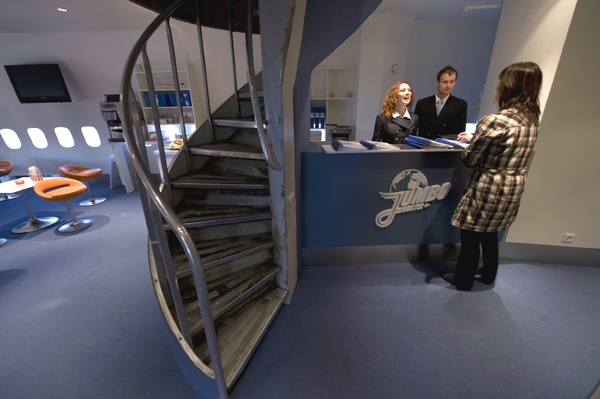
Reception in Jumbo Jet Hostel
You’re probably not thinking of an aeroplane when you’re looking for a good night’s rest but this jumbo jet-turned hostel is actually an aircraft you can sleep on.
JumboStay is located at Stockholm Arlanda Airport, and a night at this unique property gives you an idea of what it’s like to sleep at a one-of-a-kind airport hostel.
One TripAdvisor reviewer summet it up perfectly: ‘Kitch, but great, if you are a plane geek’. And others agree that it’s a cool experience, but not a place for long stays.
The former airplane has swapped engines for bedrooms and offer visitors a unique stay they will never forget.
In the summer, visitors can walk along the observation deck and stand right on top of a Jumbo Jet’s wing. It will certainly give you a different perspective from the one we normally get sitting inside the plane.
The Jumbo Jet underwent a complete overhaul after she was grounded at Stockholm Arlanda Airport in November 2002.
The brainchild of barmy businessman, Oscar Dios, the entrepreneur spent over USD 2.3million (€2million) over six months to transform the huge plane into the aptly named Jumbo Stay Hotel.
There is only one private suite (from $210/night), so be sure to book early. The suite is located in a converted cockpit and offers a panoramic view of the airport through all of the windows in the front of the plane. A few rooms have a private toilet and shower, while others have a shared bathroom with rates starting at around US $50 per night.
The Lounge in Jumbo Jet Hotesl
If spending the night is not for you, the plane has a chic cafe serving coffee, cookies and sandwiches. Stop in for a quick visit to see this unique hotel up close.
The Jumbo, which once was part of the Pan-Am airline fleet between 1984 and 1991, was towed and relocated to its new permanent location at the entrance to Stockholm Arlanda Airport, and has since become quite the landmark.
JumboStay is offering several amazing packages that let you experience other unique places to stay in Sweden.
A Plane Geek’s Dream Stay in Stockholm, written by Tor Kjolberg
During the late 1960s and early 70s, the economies of Norway and Denmark were given another welcome leg-up – they struck oil.
Denmark had become adept at exploiting niche markets (think Lego, Bang & Olufsen, Carlsberg, and selling streaky bacon to Britain), but this was the first time the country had enjoyed the luxury of natural resources since the 14th-century herring shoals.
Tyra field, Denmark
According to OilGasDenmark, 48 billion DKK or 9 percent of Denmark’s export is the amount that Oil and gas contribute with yearly.
15.000 people are employed in the Danish oil and gas sector, including employees in the service and supplier sector.
8 billion m3 natural gas is annually brought ashore from the fields in the North Sea through the 200 km long high-pressure transmission lines.
Ironically, Denmark’s North Sea windfall arrived in the first middle of its first experiments with wind farms.
Measured against population the prize in Norway was much bigger and triggered lavish expenditure on road tunnels and other infrastructure investments. Norway is the world’s second biggest exporter of natural gas and the fifth biggest exporter of oil.
Barcode seen from Sorenga
By the 1990s Norway had paid off its entire foreign debt; and in 1995, it began to stash away the cash for a rainy day, creating a sovereign wealth fund with the surplus petroleum money.
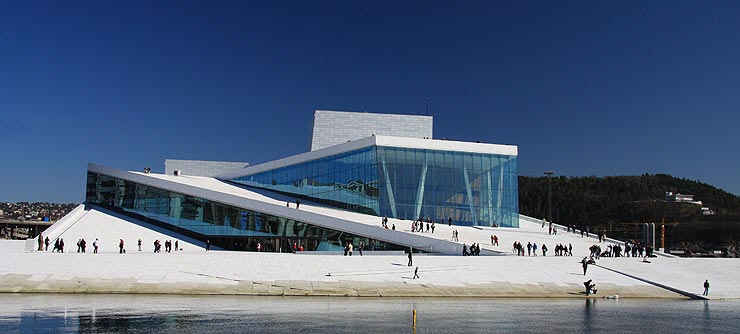
Oslo Opera House
Oslo began its transformation from quiet town to Europe’s fastest-growing city: within 40 years, oil-money had created a futuristic harborside, new financial district and world class buildings like the Opera House.
The New Oil-rich Scandinavians, written by Tor Kjolberg
A true tale set in civil wat-ravaged Norway, produced by Oscar-nominated director Nils Gaup, The Last King, is ready for the US market. Magnolia Pictures has acquired the North American rights.
“The Last King” is a tale set in 1206 when Norway was in the midst of brutal civil wat between the Norwegian king and the church. It follows the journey of two Norwegian warriors who escape across the mountains in order to take their dying king’s infant son to safety. It stars Jakob Oftebro (Kon-Tiki), Kristofer Hivju (Game of Thrones), Nikolaj Lie Kaas (The Keeper of Lost Causes) and Thorbjørn Harr (Vikings).
Niels Gaup
“Nils Gaup has crafted another sweeping adventure with ” The Last King,” said Magnolia president Eamonn Bowles to the Hollywood Reporter. “The thrilling performances and high-stakes of this incredible true story will really resonate with audiences everywhere.”
Nils Gaup credits include the Oscar-nominated Pathfinder (1987) and local box-office hit The Kautokeino Rebellion (2008).
The Last King was written by Ravn Laneskog and produced by Stein B. Kvae and Finn Gjerdrum for Paradox Film 3 AS, co-produced by Nordisk Film, Newgrange Pictures Ltd. and Proton Cinema+Theatre with support from Norwegian Film Institute, Irish Film Board and Eurimages. It was developed in collaboration with The Media Programme, Film3 and Midtnorsk filmsenter.
Norwegian title: Birkebeinerne (The Birchlegs).
Previous announced deals include sales to Germany, Austria and Switzerland (Koch Media Deutchland), Italy (Minerva Pictures Group), Czech Republic (Film Europe Media Company) Middle East (Gulf Film), India (Pictureworks) and Estonia (Estinfilm).
Norwegian release is set for February 12th, 2016.
Feature image (on top) by Ian Brody
Norwegian action-adventure drama, written by Tor Kjolberg