What Makes Scandinavians So Happy?

In many countries, authoritarian governments speak only of prosperity in terms of economic wealth. 

If they are the governments of oil-rich countries, they speak of how the country is becoming wealthier as exports increase. And they reject any notion that citizens have the right to be unhappy with autocratic rule because, the officials claim, restiveness just slows economic development.

071014_Happy_Scandinavians
For regimes ruling resource-poor countries, the logic remains the same. Only a strong guiding hand, they say, can construct a better future. So, stop complaining.

But if that argument is commonly heard from Moscow to Baku to Central Asia, there is a growing body of evidence that only the authoritarians themselves believe it. In countries around the world, polls show, people define prosperity and happiness in much broader terms than simply economic growth.  

A group of economists and sociologists gathered near London to discuss how to better understand what makes people consider their own countries as successful and their own lives as happy.

The host of the conference was the London-based Legatum Institute, which annually publishes a Prosperity Index that ranks 110 countries according to what the countries’ own citizens tell pollsters. The polling data itself comes largely from surveys conducted by the Gallup Organization, which each year interviews 1,000 people in every country of the world on a host of subjects.

One of the things that intrigued the social scientists is the way Scandinavian countries have consistently topped the Prosperity Index since it began four years ago. That suggests that the Scandinavian countries — which indisputably have large GDPs — might hold the key to understanding what conditions in addition to wealth must be present for people to report a high sense of well-being.

What makes Scandinavians so Happy? Some of the conditions might seem obvious. For example: good health care, good education, and good safety and security. So, too, might economic opportunity and the freedom to start one’s own business in an environment free from predatory officials and corruption.

But other conditions that lead people to report they feel their life is worthwhile might be less self-evident. And those are often the very same ones that authoritarian regimes claim are unimportant or which they themselves undermine.

Those things include enjoying the personal freedom to speak, read, vote, and worship as you want. And they include enjoying a sense of social trust — that is, a sense that those around you trust in the society and are themselves trustworthy.

The Importance Of  Trust
The sense of trust is so high in Scandinavia that to some researchers it seems to be the most mysterious and potentially important factor of all for explaining why Scandinavians lead the world in considering themselves prosperous.

The Prosperity Index, published in 2010, showed 74 percent of Norwegians believe other people can be trusted, the highest such rate in the world. Last year Norway maintained the top position. Denmark came in second in 2010, with 64 percent finding others trustworthy (number 6 in 2013) and Sweden sixth in 2010, with 56 percent (number 4 in 2013).

Economist Andreas Bergh: “The honest answer is we don’t know where trust comes from.”

071014_Andreas__Bergh
Andreas Bergh, an economist with Lund University and the Research Institute for Industrial Economics, explains just what Scandinavians mean when they say they trust others and what advantages — both economic and psychological — that gives their societies.

“By that, I mean the widespread belief in the population that most people can be trusted,” Bergh says. “And the fact that most people can be trusted refers to things like obeying agreements, trading as they say they are trading, behaving in an honest way and, of course, behaving in a trustworthy way, so that you trust people and they are trustworthy in return.”

The benefits, he says, run all the way through society, from speeding business deals to reducing the need for official regulations and oversight, to enabling people to agree on social benefit programs.

In Sweden, which is famous as a welfare state, the high level of trust even means people are willing to pay high taxes to support government social services because they believe their fellow citizens will not abuse the system.

“There are several benefits,” Bergh says. “One of the most obvious is the fact that when two people trust each other they can more easily engage in trade that benefits them both. They don’t have to worry that the other one will cheat or run away from the agreement and they don’t have to, perhaps, write contracts and spend resources to enforce the agreement, because they basically trust each other. So, all trade agreements go much more smoothly with trust and trustworthiness.

“The second big benefit is that you can also trust government to behave in a non-corrupt way, which means that you are able to create social insurance schemes that benefit everybody and they can be trusted not to take unfair advantages or to misuse these benefits schemes. So it makes it easier to have a big government sector, and it probably decreases the negative impact that taxes have on the economy.”

How Did It Happen?
But how did Scandinavians develop such a high level of trust in their institutions and in each other?

That, Bergh says, is a much more difficult question to answer.

“Well, that is indeed a difficult question and there are many theories,” he says. “Some say that [the high level of trust] comes from the fact that Sweden used to be a homogenous country. That is no longer true and yet we are still highly trusting. Others say it comes from the fact that the climate was cold so you needed to cooperate with others to survive in a cold climate. But then again there are countries with high trust that are very warm, so that might not be a good explanation.

“Others say that trade causes trust. When you meet other people and you decide to trade with them rather than engage in violent conflicts, this might foster a mutual attitude that we might actually achieve something together if we both trust each other, and that might also be true. But the honest answer is we don’t know where trust comes from.”

One reason it may be so hard to know where trust in other people and in institutions comes from is that the two clearly reinforce each other, but nobody knows which comes first.

Do trustworthy institutions create a trusting citizenry? Or does a trusting citizenry create trustworthy institutions?

The answer for Sweden no longer matters. The country already has a trusting population that enjoys the fruits of having an efficient government elected to look after the society’s interests and not its own.

But for other countries struggling under authoritarian regimes, the question of how to foster social trust remains an important part of finding the way to both material wealth and a high sense of personal well-being.

Social scientists who gather information about what makes people consider their lives most worthwhile are still only at the point of exploring these difficult questions. But already they can conclude and — as the recent conference showed – prove that economic growth alone is not enough. And that can only encourage the millions of people who still struggle under autocratic regimes to keep fighting to make governmental institutions honest, to curb corruption, and to win greater personal freedom.

Source: Radio Free Europe

Related articles:
Happy ever after
Thank you for the music, ABBA
10 years younger in 1o weeks
Don’t miss Dawid: Ex

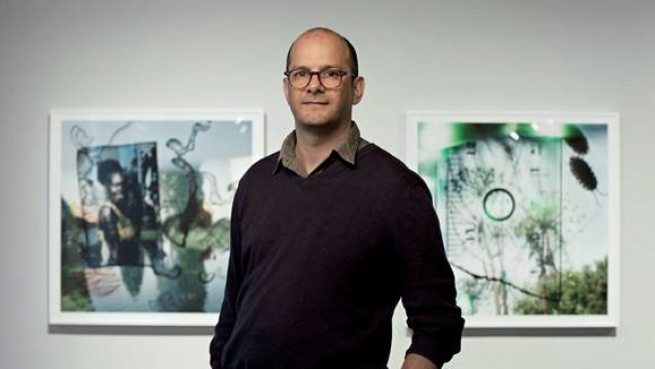
Until October 25, Oslo’s first private gallery devoted entirely to Fine Art Photography, Shoot Gallery, presents the exhibition ”Dawid: Ex.” Dawid (Björn Dawidsson) is one of Sweden’s most respected and well known photo based artists.

0110_Sculpture
The exhibition ”Dawid: Ex.” gives a broad presentation of Dawids work all the way back to the early 80`s. The main body of work are rare Vintage Silver Gelatin Prints but he also shows us recent work where he has utilised the possibilities of digitalisation proving his continous experimentation with both ancient and modern techniques and equipment. Dawid does all the framing himself with self designed frames as he regards the whole piece as an object.

011014_from_ROSTDawid has been called Sweden´s first post-modern artist and has for over thirty years been making series of photographically based artworks examining the nature of the medium and exploring issues of perception.

He began photographing in the late sixties, documenting incongruous moments with a wry sense of humour, until he established his signature style of stark graphic illustration, initiated by the seminal Rost series. His work often balances on a tight rope between the graphic and the photographic and reflects, criticises and parallels the chequered history and changing status of photography.

A photographic alchemist, intellectual and scientist with a long list of solo exhibitions, group exhibitions, more than 30 personal photobooks and a collectors choice with his work in prestigeous collections like The National Museum of Art Oslo, Moderna Museet Stockholm and the Hasselblad Collection to mention a few (Please find lists in the press section) as well as a wide range of private collections.

At Eye Level
About Dawid
Dawid was born in 1949. He lives and works in Stockholm, Sweden. 

With the exhibition ”Nobody loved me” at Liljevalchs in Stockholm in 1973, Dawid claimed – in opposition to the prevailing documentary ideals – photography as an artistic medium. He experimented early with large negative format and the exhibition RUST on the Photographic Museum of Modern Art in 1983 shook the Swedish photographic scene.

Through a constantly challenging and an important element in Dawid oeuvre is experimentation with photography done without a camera in the form of photograms and others often proprietary methods.

Dawid has since the 1970s been exhibited at leading galleries and institutions in Sweden and internationally, including the Museum of Modern Art and Thiel Gallery in Stockholm, Galleri Riis Oslo, Folkwang Museum in Essen and Galerie Priska Pasquer in Cologne, Germany. He has published numerous books and catalogs, and in 2001 appeared in Beautiful Frames on Steidl with lyrics by Michael Mack. He is at the moment working on a large format retrospective book, published by Art and Theory Publishing, which will be released in 2015.

Year 2009 awarded Dawid the Swedish Arts Grants Committee’s Grand Prize for ”His artistic achievements and significance in the present”.

For more information visit : http://www.dawid.nu.

You find Shoot Gallery in Uranienborgveien 5

More articles about Scandinavian photography:

Pictures from above
Nordic Light International Festival of Photography
Nocturnal Norwegian Ice Climbing

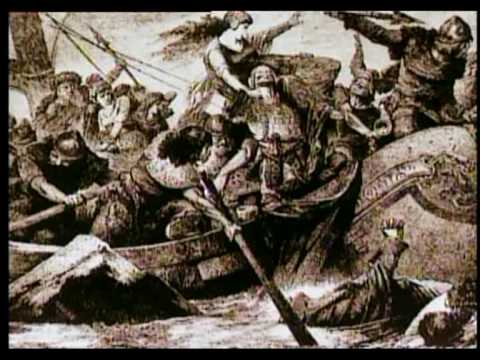
Viking Ship Design

A Viking’s ticket to foreign parts was the latest evolution of the ship design first shown in Bronze Age rock carvings.

VIKING LONGSHIP - ILLUSTRATION
The drakkar

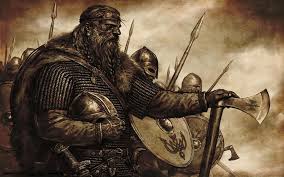
was called a dragon ship by its enemies. The drakkar was a warship designed to carry fearless Viking warriors on their raids across Europe over a millennium ago.

300914_viking-ship
The prows at either end were the extremities of a keel made out of a single oak. It could twist like a tree in the wind, hence its immense strength.

300914_Viking_Age
The prow, or bow, was sometimes tipped with a very ornate carving of a snake or dragonhead, thus earning it the nickname “dragon ship”. The prow ornament was removed while the ship was at sea. Replacing such a finely carved piece would be expensive and losing it might be a bad omen.

The Vikings named their longships according to the number of pairs of oars they carried and the purpose the ship served.

300914_viking-raiding-party
The most common drakkar had thirty rowers and were the pride of Vikings earls and kings. These were the best built in the Viking fleet. These appeared only in the biggest wars during the last years of the Viking age.

300914_Gokstad_Viking_longship
A fighting ship of the type found in Gokstad in Norway was 25 meters (82ft) long, 6 meters (19ft) wide, and carried a crew of 70, Clinker-built, caulked with tarred animal hair or wool.

The clinker  Viking ship design used two-centimeter thick oak boards, which were overlapped slightly and then nailed together with iron nails. The spaces in-between the boards were caulked with tarred wool or animal fur to make the ship watertight. The planks were also nailed to support ribbing that ran from the gunwale to the keel.

The keel, which ran the full length of the ship, was made of one solid piece of oak. It added stability and made the ship travel straight through the water

The average length of a longship was 28 meters. The largest ever excavated was seventy meters long.

The drakkar could hold around 400 warriors, and there were about 300 longships in a Viking fleet
which were owned by a king who could afford to build it.The ships could also travel inland via rivers.

300914_model-of-drakkar
It had a hinged steering oar that swung out of the way so the ships could be aimed at a beach at full speed. An important innovation was the use of sail.

The sail was very expensive, costing more than the ship itself. It was made of wool from sheep or linen from the flax plant. Viking women made the sails

First, small diamond-shaped pieces were woven and then trimmed with leather. The leather helped the wool or linen pieces to keep their shape, especially when wet. All of these diamond pieces were then carefully sewn together to make one large square sail, the leather strips giving them the crosshatched pattern. Red dye was added to the leather trim to give the sail the vivid crosshatched pattern. Sometimes the whole sail was dyed a solid red color. The color was supposed to strike fear in their enemies.

The sails of Viking ships were usually as wide as half the ship’s length. The sail was held on the center mast with ropes likely made from walrus hide. Once it caught a steady breeze the sail could move the ship at a steady 12 knots.

If the winds were calm twenty or thirty oarsmen could move the ships briskly through the sea at around 5 knots. Viking ships could cross the North Sea to England in 72 hours.

Read more about Viking ships here.

Oktoberfest in Scandinavia

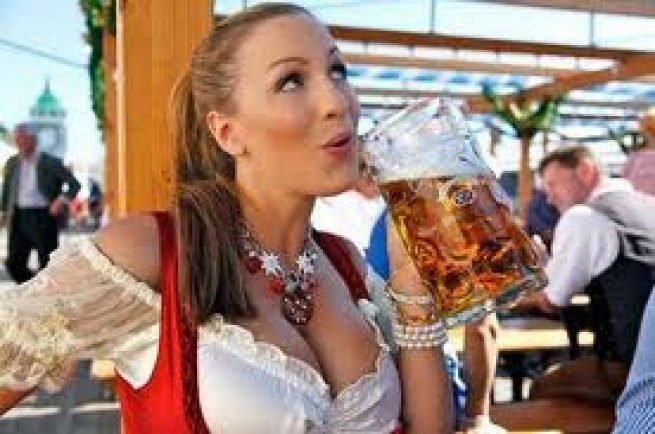
The Oktoberfest events in Scandinavia are very popular, and not only among local beer lovers! A Scandinavian Octoberfest is a great way to celebrate the annual beer event in the dwindling mild weather in September and October.

Let’s find out where these German-style Octoberfests in Scandinavia take place. You’ll be surprised how popular they are here…

290914-norwegian-beer
Oktoberfest in Norway:
Despite the name “Oktoberfest”, most Oktoberfest events start in September. The Oktoberfests in Norway are no exception, and there are several Norwegian locations for the annual “beer mania”, e. g. Oslo and Lillestrom.

290914-swedish-beerOktoberfest in Sweden:
The last two weekends in September are when Oktoberfest-Fans visit Stockholm, Sweden. Officially named the Beer & Whisky Festival (but known as the Stockholm Oktoberfest), this Oktoberfest-event can definitely hold its own amongst the international Oktoberfests! Takes place in the Congress Center in Stockholm.

290914-copenhagen_beer_carlsberg
Oktoberfest in Denmark:
There are two! Each mid-September, the old Carlsberg site at Valby in Copenhagen will be the venue for Europe’s largest beer festival, appropriately named the “European Beer Festival”!

Tuborg J-dag
A different kind of Oktoberfest, the Copenhagen Beer Days (Københavnske Øldage) are Denmark’s biggest beer festival. Unfortunately, this annual event is the only one that takes place in spring. But don’t despair, a good alternative is the Christmas brew. The Copenhagen Beer Days are renowned to have more different beers available for tasting than any other beer festival.

Enjoy Oktoberfest in Scandinavia!

Related posts:
The Bridge between Copenhagen and Oslo

Brondums Hotel in Skagen – A Living Museum

Brondums Hotel is deeply embedded in the history of Skagen, Denmark’s northernmost settlement.

The Danish painter Anna Ancher (1859-1935), associated with the Skagen painters, was born at the inn, which was then owned by her father, Erik Andersen Brondum, a merchant and landlord, who started running it around 1840.

????????
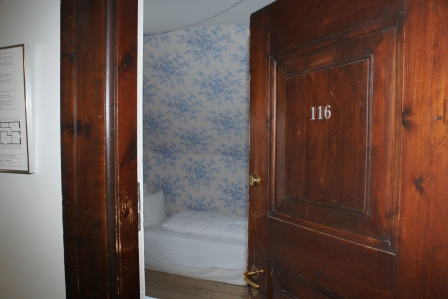
Prominent guests through the years included Hans Christian Andersen and Karen Blixen. Blixen stayed for several months in 1936 in room 116, where she wrote part of her book Out of Africa.

????????

????????
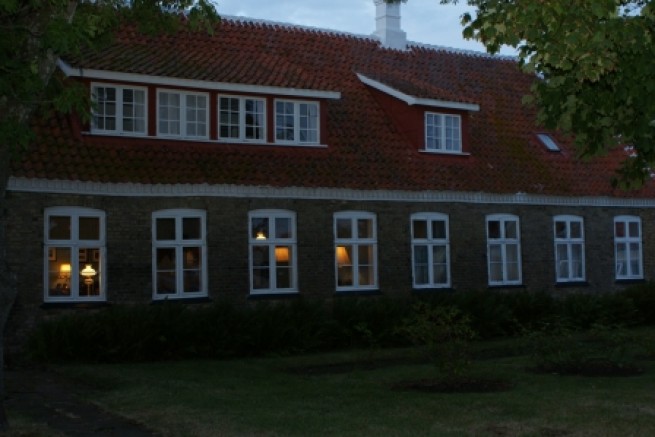
After the inn burned down in 1874, a new building was erected with a long low wing of grey bricks. This wing is the oldest part of the hotel.  Around 1890 the famous Danish architect Ulrich Plesner came to Skagen to inspect the lighthouse at Hojen.  At that time it was felt that  the inn needed to be enlarged,  so the son of Erik Brondum, Degn Brondum, seized the opportunity to commission Ulrik Plesner to supervise the construction of an extension to the inn which was then completed in 1892.  More space was needed, so Ulrik Plesner designed and built considerable extensions in his favorite red brick style.

As a result of Plesner’s extensions the inn became a hotel and remained as such until parts of it burned down in 1954 and 1959.

????????
Perhaps most significant, Brondums was a regular hangout for members of the Skagen school of painters from 1880s to the turn of the century. Many of their works are displayed in the hotel’s public rooms and were literally payment for the artists’ food and lodging, a fair trade for pleasurable living on the edge of two seas. The artists met in the blue room, and declared, “here is where we’ll meet.” (painting above)

????????
The famous dining room, adorned with paintings of the artists, was moved from the hotel to the Skagen Museum in 1940. The museum was built in 1928.

????????
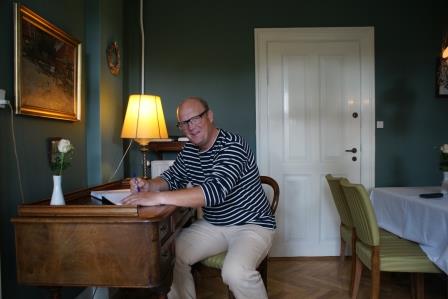
Maître d’hôtel, Kresten Skeel Langvold (55) informs us that people visiting the hotel today are seeking originality, which no longer can be bought for money. (Photo above at Degn Brondum’s desk). “Everyone from Skagen knows of the artists and their paintings, and all Danes are familiar with and love them. This has helped to spread the word about how fantastic it is here. Tourists have been coming for more than a hundred years,” says Langvold and continues, “Comfort or coziness is the motto of the Brøndums Hotel. From the moment you enter until you walk out the door again, you are surrounded by ‘hygge’, the Danish word for coziness”.

The professional staff does its utmost to ensure that everyone has a pleasant time here; the furnishings are elegant yet informal and candles are always burning on the tables, regardless of the time of day or year. “Our philosophy is that one should feel at home even when not at home.”

????????
Yes, you feel at home at Brondums hotel. Some guests may be surprised that when they enter their rooms, they find neither toilet nor shower. The truth is that Erik Brondum wanted rooms without water at all (there are sinks with hot and cold water in all the rooms and shower and toilets on every floor). His view was that there was enough water in the sea nearby, so that guests could just go there and bathe.

????????
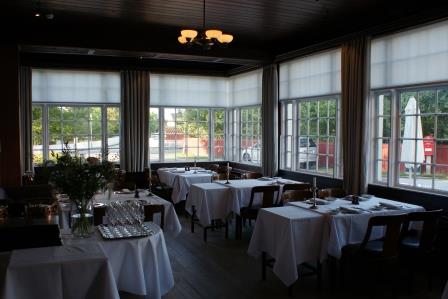
We enjoyed an excellent dinner at Brondums hotel, with a selection of delicatessen accompanied by Grand reserve champagne André Cloet as starter and Skagen sole as main dish.

????????
The staff was very friendly, but not quite as professional as one might expect at a place like this.

????????

They served for instance two big pieces of fish on the plates – not very elegant. And since the serving pantry was next to our table, there was disturbing traffic passing our table during our meal.

Text and photos: Tor Kjolberg

Decisive Dates In Scandinavia

During the most recent glacial period the entire Scandinavian peninsula was under a sheet of ice. As the ice cap began to withdraw, about 12,000 years ago, hunter-gatherers moved north in pursuit of reindeer. Here are some decisive dates in Scandinavian history.

Early history:
10,000 BC – AD 800

Hunter-gatherer tribes follow the melting ice northwards, establishing settlements in Southern Scandinavia.

110814_Scandinavian_Early_History
1500 BC
Trade routes are forged through the rivers of Eastern Europe to the Danube.

500 BC – AD 800
Iron Age Grauballe Man and Trollund Man are buried in peat bogs in Denmark.

110814_Grauballe_Man
AD 100
The historian Tacitus mentions the Fenni (The Sami) in his Germania and describes the Sveas who inhabit what is now called central Sweden.

110814_Tacitus
AD 400
Sweden’s influence over its “eastern province” begins.

The Viking Age
800 – 1060
Vikings earn a reputation as sea warriors. Swedish Vikings (Varangians) soon control trade routes to Byzantium.

110814_Vikings
830
A Bebedictine monk, Ansgar (801-65), lands on Björklö in Sweden and founds a church.

110814_Bendixen_Ansgar
861
Vikings sack Paris

866
Vikings raid and plunder, eventually controlling most of England and Normandy.

940-95
Harald Bluetooth brings Christianity to Denmark; Olav Trygvason uses force in his attempt to convert the Norwegian Vikings.

110814_Olav_Trygvasaon_Statue_Troindheim_Norway_Daily_Scandinavian
1001
Leifur Eriksson discovers Vinland (America).

110814_leifur-eriksson_Statue_Daily_Scandinavian
1050
Harald Hardrada of Norway found Oslo.

110814_Harald_Hardrada_window_in_Kirkwall_Cathedral
1066
Defeat in England brings the Viking Age to an end.

Middle Ages , 1100 – 1500
1070
Building of Nidaros Cathedral begins in Norway

SONY DSC
1155
King Erik of Sweden launches a crusade into Finland: further Swedish invasions take place in 1239 and 1293.

110814_King_Erik_of_Sweden
1319-43
Inter-Scandinavian royal marriages produce a joint Norwegian-Swedish monarchy.

1362
Finland becomes a province of Sweden.

1397
The Kalmar Union unites the kingdoms of Norway, Denmark and Sweden.

1417
Eric VII of Denmark makes Copenhagen his capital and builds a palace at Helingoer.

110814_Kronborg_Slot_Helsingor

Wars and reformation
1520
Kristian II of Denmark invades Sweden and massacres the nobility in the “Stockholm Bloodbath”. Gustav Vasa drives him out and the Kalmar Union is disbanded.

1523
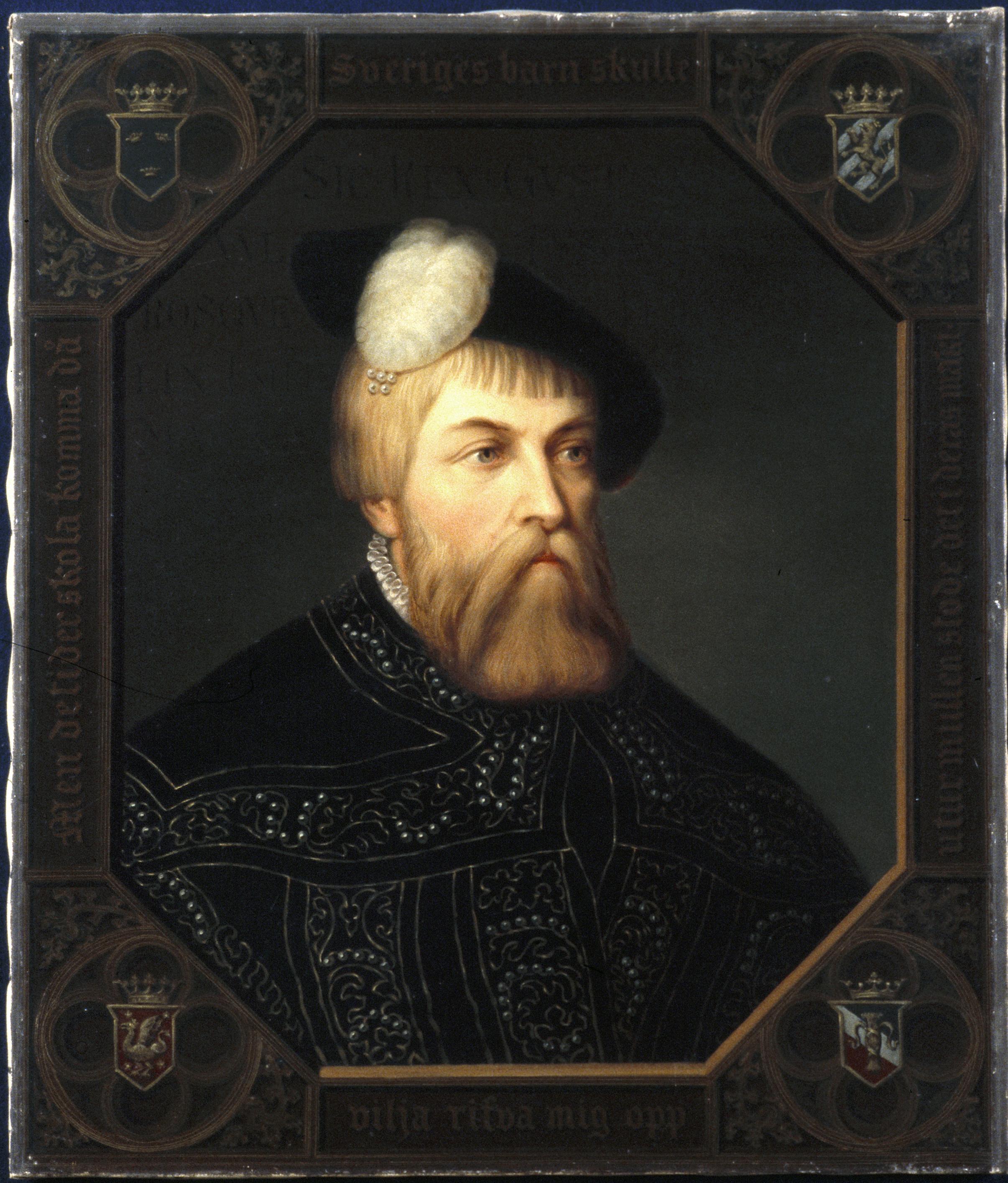
In Sweden, Gustav Vasa ascends the throne, marking the start of the Vasa dynasty (1523-1720), which also holds power in Finland.

110814_GustavVasa
1530
The Reformation; the Lutheran faith is introduced.

1536
Norway ceases to be an independent kingdom as the Danes take control.

1588-1648
Denmark flourishes under Kristian IV (1577-1648)

110814_Kristian_IV_aof_Denmark,_painted_by_Pieter_Isaacsz_1611-1616
1625-57
The Thirty Years War launched by the Danish king, Kristian IV, to check Swedish expansion ends in defeat for Denmark.

1714-41
Russia and Sweden battle over Finland. Under the Treaty of Turku (1743) Russia moves its border westwards.

Nineteenth Century
1801-14
During the Napoleonic Wars, English fleets twice bombard Copenhagen. Denmark sides with Napoleon and suffers defeat. Norway is ceded to Sweden.

1814
The Constitution of Norway was signed at Eidsvoll on May 17 this year. The constitution declared Norway to be an independent kingdom in an attempt to avoid being ceded to Sweden after Denmark–Norway‘s devastating defeat in the Napoleonic Wars.

1815-1907
In Sweden, Jean-Baptiste Bernadotte, French marshal of Napoleon, succeeds to the throne as Karl XIV Johan (1818-44). The great exodus to the United States takes place.

110814_King_Karl_Johan_of_Sweden_Norway
1864
Denmark and Prussia at war. Denmark loses Schlesvig-Holstein.

Modern Times
1905
Referendum in Norway leads to the end of the union with Sweden. The Danish prince Haakon VII is King of Norway.

110814_norway-haakon7
1930s
Denmark and Sweden establish welfare states.

1939-48
Sweden remains neutral in World Wars I and II. Norway proclaims neutrality in World War II, but is attacked by the Germans, who also occupy Denmark.

1949
Denmark becomes a founding member of NATO.

1960s
Norway begins oil exploration.

110814_Oil_platform
1973
Denmark joins the EEC (EU).

1986
Olof Palme, Swedish prime minister and international peacemaker, is assassinated.

110814_Olof-Palme
1995
Sweden join the EU. Norway votes against joining (1972 and 1994).

2000
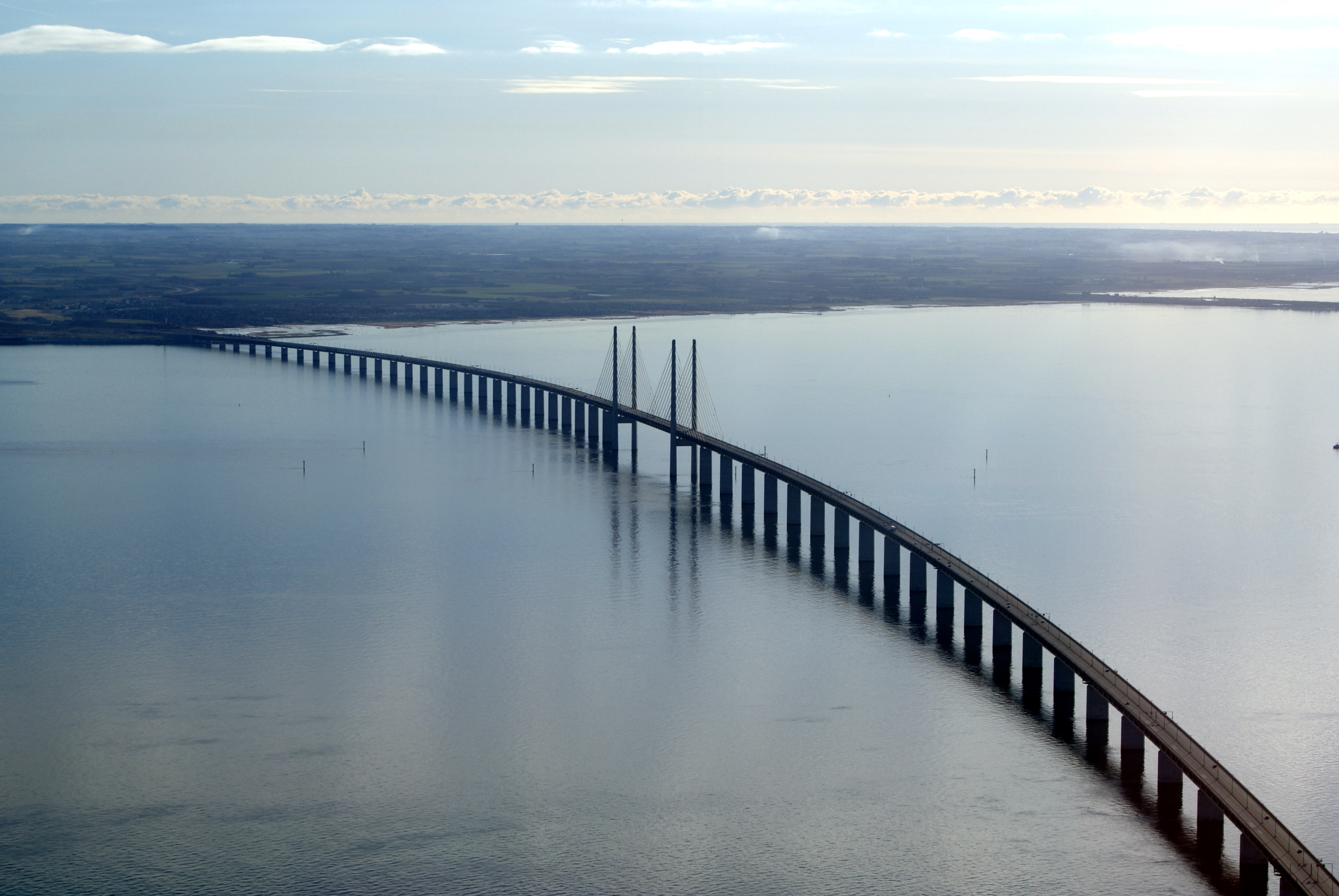
Oeresund bridge opens between Denmark and Sweden.

SONY DSC
2009
UN climate change conference held in Copenhagen.

2011
A bomb in Oslo and shooting on Utoya island kill 76 people. The gunman, a right-wing Christian extremist, accuses Norway’s Labour government of failing on immigration.

2013
September 24, first article in Daily Scandinavian  published.

The dates above are our selected decisive dates in Scandinavia.


Two New Danish Sites Inscribed on the UNESCO’s World Heritage List This Summer

0

These inscriptions bring the total number of sites on the World Heritage List to 1007.

230914_Sevns_klint_Photo_Visit_Denamrk

The geological site Stevns Klint in Denmark comprises a 15 km-long fossil-rich coastal cliff, offering exceptional evidence of the impact of the Chicxulub meteorite that crashed into the planet at the end of the Cretaceous, about 65 millions years ago.

Researchers think that this caused the most remarkable mass extinction ever, responsible for the disappearance of over 50% of all life on Earth. The site harbours a record of the cloud of ash formed by the impact of the meteorite – the exact site of the impact being at the bottom of the ocean off the coast of Mexico’s Yucatán peninsula.

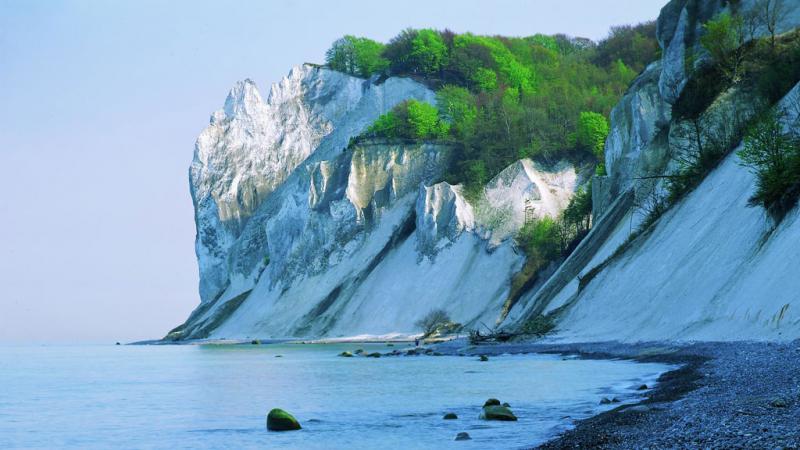
230914-moens-klint-denamark

The asteroid impact that many researchers claim was the cause of the dinosaur die-off was bad news for marine life at the time as well. But new research shows that microalgae – one of the primary producers in the ocean – bounced back from the global extinction in about 100 years or less

An exceptional fossil record is visible at the site, showing the complete succession of fauna and micro-fauna charting the recovery after the mass extinction.

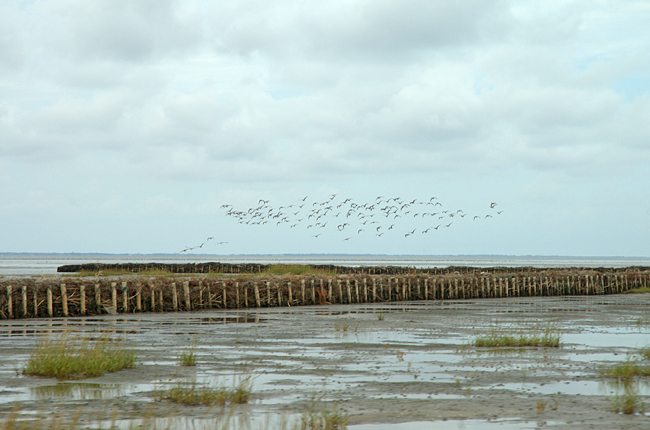
230914_Wadden_sea-migratory-birds

The Wadden Sea (Germany/Denmark). This is an extension of the Dutch and German Wadden Sea site, inscribed on the World Heritage List in 2009.

The Wadden Sea is the largest unbroken system of intertidal sand and mud flats in the world. The complete extension now covers most of the Danish Wadden Sea maritime conservation area, as well as a maritime extension of the Dutch Wadden Sea Conservation Area and the German Wadden Sea National Parks of Lower Saxony and Schleswig-Holstein.

230914_Vadehavet_Denmark_Photo_Mikkel_Barker_National_parks-of-denamrk

Wadden Sea National Park (Nationalpark Vadehavet) was named a Danish national park on 17 January 2008. Since June 2014 it contributes the Danish part of the UNESCO‘s World Heritage of the Wadden Sea. Prince Joachim of Denmark is Patron of the Wadden Sea Centre.

The Wadden Sea National Park is by far the largest of Denmarks national parks and covers the Danish part of the Wadden Sea from Ho Bugt to the German border, and includes the islands of Fanø, Mandø and Rømø, as well as Skallingen, Varde Å valley and many of the marshlands of Tjæreborgmarsken, Ribemarsken, Margrethekogenand De ydre diger i Tøndermarsken.

The Wadden Sea is known for its large number of migratory birds and for the large flocks of European Starlings which fly in formations known as the Sort sol. (Wikipedia)

An Evening of Norwegian Folk & Gospel in Nashville

Christ Church Cathedral, Nashville, Tennessee kicks off the season with a special performance by Norwegian musicians Solveig Leithaug on guitar and Alexander Rybak on violin October 1.

240914_Solveig_Leithaug
Ms. Leithaug, who is known for singing Scandinavian folk music as well as gospel, has 14 solo recordings and three best-selling children’s CDs to her credit. The Dove Award-winning recording artist has served as a guest artist at official Parliament functions, national and international conferences, television broadcasts, and inner-city and prison outreach events.

240914_Alexander_Rybak
Alexander Rybak displayed prodigious musical talent at an early age. After emigrating with his parents from Minsk, Belarus, to Norway, he studied violin and piano; by the time he was a teenager, he was performing on the violin with orchestras around the world. His breakthrough came in 2009, when he won the Eurovision Song Contest with his original composition “Fairytale”, which went on to top the charts all over Europe. At 28, he has released four albums and continues to tour throughout the world.

The performance of Norwegian folk & gospel is free and open to the public.

Re-unification of Iceland and Norway

0

A group of Icelanders have started a campaign to have the country brought under the administration of the Norwegian government as “Norway’s 20th county”, writes grapevine.com.

The group, Fylkisflokkurin (“The County Party”), already has just over one thousand members. In their mission statement, the group administrator writes that they aim for “the re-uninfication of Iceland and Norway”, wherein “the Norwegian government would constitutionally protect and promote Icelandic culture while Icelanders would enjoy all the same rights as Norwegians.” – Iceland is just too small to raise up talented politicians. It is also too small to raise and nurture properly talented people, says the group founder and director of the National Center of Addiction Medicine (SÁÁ), Gunnar Smári Egilsson, reports Nettavisen.

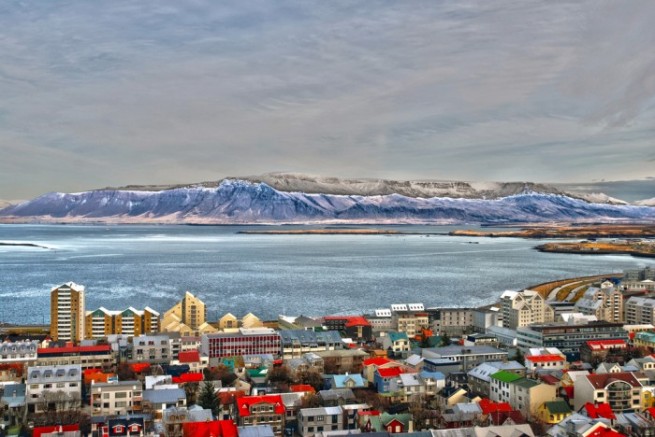
220914_Reykjavik_Pind_with_City_Hall
Iceland was colonized in medieval times, mainly by Norwegian people. The first wave probably started in 860, and saw its heyday from about 870 to 930, according to historian Per Norseng. Iceland and Norway formed a common Norse cultural area in the North Sea, and much of Norway’s history was chronicled by Icelandic writer Snorri Sturluson.

Iceland was brought under Norwegian rule around 1262. This lasted until the Kalmar Union in 1380, which united the three kingdoms of Denmark, Norway (with Iceland, Greenland, Faroe Islands, Shetland and Orkney), and Sweden (including some of Finland) under a single monarch. In the union, Denmark was the stronger country, and eventually gained rule over both Norway and Iceland (as well as Greenland and the Faroe Islands). Norway left this relationship in 1814, and Iceland in 1944.

Source: The Nordic Page
Feature image (on top): Allen Watkin | Reykjavik skyline

Making Oslo More Social

0

Living abroad in a foreign country is definitely a great intercultural experience, but typically brings up a lot of questions, for instance, how to find new friends and do something together?

????????
Oslo is a fast growing capital and several events and things are happening. However, sometimes it is hard to find the interesting ones. There are already a number of groups on Facebook, but they are often too big and messy.

That’s why Christopher Bach (31), when he came to Oslo, Norway from Germany in 2007 and decided to stay, wanted to establish a group for expats and other people interested in multicultural issues. Together with his Norwegian friend, Per Kristian Haakonsen (35) he decided to create a Facebook group, Oslo Social Network.

The group was established in July last year and has already nearly 2,000 members, mainly expats but also some locals.

“Our group wants to make Oslo more social. The idea is to connect, find events and make new friends in Oslo,” explains Christopher.

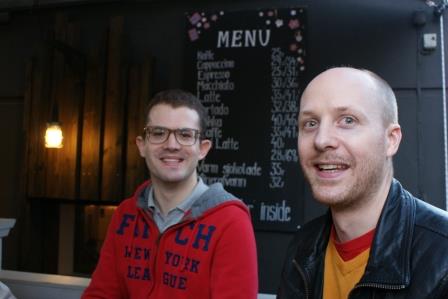
Christopher Bach (left) and Per Kristian Haakonsen

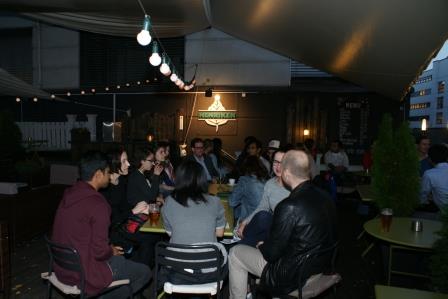
Daily Scandinavian joined the group at one of their social coffee meetings at Henriken across the honorary artist’s residence Grotten (“The Cave”).

“Oslo Social Network focuses on events that make it possible to meet new people,” says Per Kristian. “When members spot an interesting event or hear from a friend about something they think will fit, they are invited to post the information to the group. That might be cultural events, art exhibitions, concerts, parties, flea markets or hints on good cafés or places to eat. Even if someone just want to go hiking or just want to meet for a coffee (tea is fine, too) they can post it.”

The only requirement is that the activity should be open to all the group’s members.

“We always welcome newcomers to the events!” says Christopher Bach.

These events do not necessarily have to be “Facebook events”. Sometimes the most interesting things are happening outside of Facebook. Therefore, members just post it as a good old status message (“Let’s meet tomorrow by the tree”) or link to a website that has more information.

Christopher emphasizes that this group is special because it is all about finding events and social things to do in and around Oslo. The group is open to everyone; it is an inclusive group and anyone can join.

“Sometimes we do our own gatherings and have coffee hours, like tonight, or pub nights or hikes.”

Thee coffee hours are popular, and several multicultural friends had gathered this late summer evening in Oslo. It was easy to get in contact with the members. They told us that two or three events are planned for the dark season, in addition to the coffee meetings. Actually we eyewitnessed more people drinking beer than coffee.

????????
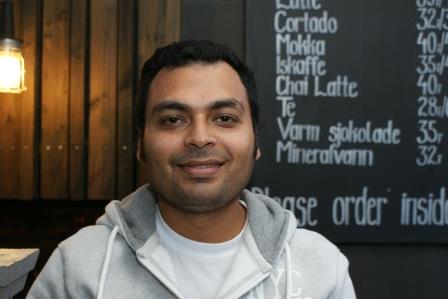
It was second time Waquas Ahmed (37) from Pakistan joined the coffee hour. “It is nice to meet international people,” he said. He likes to discuss Oslo and Norway as well as his home country. “I want to do new things,” he said.

????????
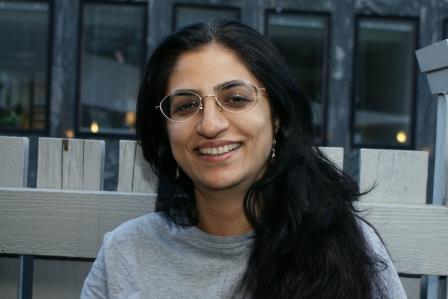
Shaz Bilal (31) from India has been a member for some months. “I like to meet new people,” she said and added that she is looking forward to some unique events.

We know that Christopher Bach and Per Kristian Haakonsen have some great ideas, and it will be interesting to follow the group – not only on Facebook.