Swedish Spruce May Be World’s Oldest Living Tree

The spindly trunk of a Norway spruce reaches above the lichen-covered rocks. Nothing about the tree is remarkable aside from it being the only thing to reach more than a few feet off the ground on a windswept plateau. Yet Rachel Sussman traveled the roughly 3,500 miles from her Brooklyn studio to western Sweden to photograph it.

240714_Rachel_Sussman_Book

Its age is what drew Sussman to it. At 9,550 years old, this Norway spruce is the single oldest known tree on the planet. But it’s not just the age of the tree that matters, it’s what the image reveals.

“This 9,550-year-old tree is like a portrait of climate change,” she said.

The mass of branches near the ground grew the same way for roughly 9,500 years, but the new, spindly trunk in the center is only 50 or so years old, caused by warming at the top of this mountain plateau in Western Sweden.

Feature photo (on top): Rachel Sussman

240714_Rachel_Sussman_Photo_
The image Sussman took graces the cover of her new book, “The Oldest Living Things in the World,” in which you also can read about the world’s oldest living tree, which hit bookstores today on Earth Day. The project has taken her across the globe over the past 10 years in an effort to capture images of the oldest species in the natural world. Her work shows both how they have developed and persevered over thousands of years while shedding light on how present human activities are changing those rhythms and endangering their very existence.

Sussman defined “old” as 2,000 years. The Declaration of Independence, the Mona Lisa, and the Magna Carta are all in their infancy compared to some of Sussman’s subjects. Many of them have been around for much longer, including a yucca plant in the Mojave desert in California that’s 12,000 years old and a sea grass meadow near Ibiza, Spain, that has been around for an incredible 100,000 years.

Longevity is about the only trait they have in common. Sussman’s subjects are spread over all corners of the planet, from California to Greenland to the Antarctic to the Atacama Desert in Chile. They include giant baobab trees and diminutive lichens and mosses. The 30 subjects in her book took her across thousands of miles covered by plane, taxi, helicopter, foot, Zodiac boat, and scuba diving. What kept her going through long layovers, missed contacts, and arduous treks was a belief in the power of the project to inspire people to ponder the deep issues the images raise.

“There are only so many times you can talk about facts and figures,” she said in an interview at her Greenpoint studio. “This project is about climate change, art, science, and philosophy. It’s about allowing people to connect with things. And part of it is also just about being wowed.”

There’s certainly something wow-worthy about a 9,550-year-old spruce growing on a chilly plateau in Sweden. But the deeper climate change message can be seen in its trunk, which only shot up in the past 50 years. For the millennia prior to that, its branches grew slowly outward and crept close to the ground, an adaptation to the cold harsh winds that sweep across the mountain.

Biologists at Umea University in Umea, Sweden, who have studied this tree, which they nicknamed Old Tjikko after one of their dogs, believe that warming temperatures are one of the main reasons for the sudden upward growth. In this light, Sussman’s photo captures what climate change looks like in the early 21st century. The tree’s future growth is still uncertain, though, as researchers expect regional differences in increased warming and precipitation changes will have different effects on Norway spruce across Scandinavia.

Bristlecone pines are also featured in Sussman’s book and like the spruce, they have an obvious climate change connection.

The pines grow in pockets in high mountains of the western U.S. and the oldest ones are around 5,000 years old. Bristlecones grow very slowly and take on a gnarled and knotty appearance that seemingly befits their age. Even their needles can last up to 40 years.

Like many of Sussman’s subjects, theirs is a story of survival by taking the slow road. Scientists have been using tree ring samples taken from these trees for years to gain a better understanding of past climates. The samples reveal that in the past 50 years, bristlecones have been growing about 30 percent faster than at any other time in the past 3,700 years. According to a 2009 study of the tree rings, the growth is “unmatched in millennia and is suggestive of dramatic environmental changes, most likely linked to increases in temperature.” It’s possible that the increased rate of growth could have unintended consequences and could weaken the tree’s natural defenses that aid in its longevity.

Warmer temperatures are also disrupting other parts of the pines’ ecosystem. The most notable impact is the spread of mountain bark beetles into the high elevation zone the pines inhabit. The bitter cold acted as a barrier that protected the pines from beetles, but as temperatures have warmed, bark beetles have been spreading to the pines’ habitat.

For some of Sussman’s subjects, local human actions can be a more present danger. A 3,500-year-old cypress Sussman had photographed for the project met a sudden end in January 2012 when a group of people inadvertently set it on fire. Habitat loss due to deforestation, local air and water pollution, and the introduction of invasive species can all snuff out the long strands of time these species represent.

The reality is climate change is likely to affect many of the species in Sussman’s book, but it’s not always clear exactly how. A patch of 5,500-year-old moss was discovered in Antarctica in 1987 and was so off the beaten path that nobody had likely visited it since. Its location is just around the corner from the landing spot of a more famous Elephant Island visitor, Ernerst Shackleton who was marooned there in 1915.

Yet Sussman wanted to find the moss and photograph it for her collection. Located somewhere on Elephant Island, Sussman said her odds of landing on the island and finding it were in the “single digits” in a New York Times blog post. Yet in February 2012, she found herself dropping from the decks of the sleek National Geographic Explorer into a Zodiac then skimming white knuckle over the frigid Southern Ocean waters toward the island. She became the first person to visit the moss in a quarter century yet could only spend 25 minutes photographing it before returning to ship. It’s unlikely anyone will visit the moss again in the near future so understanding the impacts of climate change on it are likely to remain vague at best.

What we can say is that current greenhouse gas emissions have the planet on a trajectory to warm by as much as 9°F over the next century. The last time the Earth saw such rapid warming was around 55 million years ago, long before Sussman’s subjects laid down their roots. This century is likely to represent a break with the dozens of centuries of adaptations they’ve accumulated unless greenhouse gas emissions are slowed.

In that light, it might be easy to view Sussman’s work as an elegy, but that’s not her goal.

“It lets people see these as global symbols, as symbolic of the planet we live on,” she said. “(This is an) act of environmental conscience, but it’s not prescriptive.”

The prescriptive part is up to viewers and how they interpret and react to these symbols.

Photograph of Sara Sussman: Laura Holder

Article syndicated from Climate Central

Journey to the Top of the World

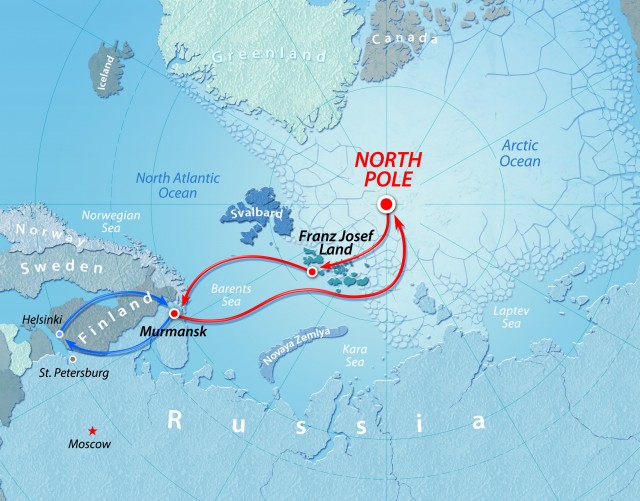
Just a century ago, no man had ever stood at latitude 90 degrees north. Today the North Pole, a spot that fascinated generations of explorers, is a tourist destination, albeit a rarefied one, and officially part of Norway.

230714_Map-North-Pole-Cruise-Daily-Scandinavian
Sailing from the mountainous, heavily glaciated Norwegian island of Spitsbergen or from Murmansk, Russia’s northernmost port, special nuclear-powered icebreaker ships negotiate the Arctic. Basin’s ever-changing panorama of wind-polished ice, navigating at speeds of up to 20 knots.

Aboard ship, a series of lectures and presentations by on-board specialists punctuate days when the sun never sets on the top of the world, and passengers stay on the alert for sightings of polar bears, seals, walruses, and Arctic birds.

230714_Ice_Bear_Daily_Scandinavian
Inflatable expedition boats and helicopters are used for the reconnaissance essential to icebreaker navigation, and also give passengers the chance to experience the area up close. When the ship reaches 90 degrees north it finds a suitable parking space, lowers the gangway (ice conditions permitting), and allows passengers to descend for a walkabout, a barbecue, and, for the truly hardy, a quick plunge into the Arctic Sea.

230714_Arctic_Journeys_Daily_Scandinavian
Champagne flows, dancing and celebrating begin, a crew member rides his bike across an ice floe, another begins a game of Arctic golf (using Day-Glo golf balls), and everyone remembers the great names who came to this place through so much adversity.

230714_Icebreaker_Daily_Scandinavian
The Pole at last!
wrote Robert E. Peary on April 6, 1909. “The prize of three centuries, my dream and ambition for 23 years. Mine at last.”

Explore the North pole with:
Cruise Norway
Fjellborg Arctic Journeys
North Winds
Polar Cruises
Polar Explorers
Polar Expeditions
Quark Expeditions
Sphere

Forbes Billionaire’s Off-piste Hotel Launch

International hotel tycoon Petter Stordalen teamed up with Olympic alpine medalists Lasse Kjus andOle Kristian Furuseth last spring to make the opening video for his new flagship hotel, « Clarion Hotel The Edge», in Tromsø, Norway.

Forbes Billionaire's Off-piste Hotel Launch
“From his previous hotel openings I knew he was quite the daredevil, but I just never anticipated that he would actually participate himself. I mean, this is some serious off-piste skiing, and the other guys are our Olympic alpine heroes,” says director Sindre Kinnerød of Flash Studio, who shot the video of Stordalen’s breathtaking stunt.

The 75 million USD off-piste hotel, located in the waterfront of the midnight sun capital of the world, Tromsø, was opened in the regular style of the hotel mogul, with world-renowned electronica duo Røyksopp DJing.

“It is really fantastic. This is probably the biggest party in Tromsø, and the North of Norway in more than 10 years,” said Road Dons, chairman of the board at Pellerin, one of the investors in the unique 287-room hotel, which also boasts a restaurant by Michelle Obama’s favorite chef, Marcus Samuelsson.

Watch the video here.

If there was ever a rock star in the global hotel industry, it would be Petter Stordalen – owner of Scandinavia’s largest hotel chain, Nordic Choice Hotels. Named “the flashiest Scandinavian on the planet” by Forbes Magazine, the 51-year-old billionaire has completed an Iron Man race, chained himself to a bridge to protest against a UK nuclear treatment plant, and did a double arabian flip when invited on stage at a Prince concert.

Forbes Billionaire's Off-piste Hotel LaunchBut even for him, this latest promotional activity was pushing the limit.

“We were seven people ascending the top of the breathtaking Lyngen Alps by foot with our skis on our backs. Our two guides set off first, then me, then Lasse and Ole Kristian. It was a humbling experience, off-piste skiing in one of the world’s most beautiful areas with two of the world’s best skiers. We went from 1800 meters and all the way down to sea-level – it was a rare treat for a ski aficionado like myself,” says Stordalen.

The whole idea of the video was to show Stordalen and his Olympic friends move «on the edge» as the promotional video for his new hotel « Clarion Hotel The Edge » in Tromsø – an hour’s drive away.

“This part of Norway is all about the nature and the midnight sun. Everyone who has ever been to the North ofNorway will want to return, especially now that we have created a hotel to match the experiences this area delivers,” says Stordalen.

The Forbes billionaire is known for spectacular hotel openings (and for driving the world’s first biofueled Ferrari): In 2012 Stordalen opened his 200 million dollar Clarion Hotel Post in Gothenburg, Sweden, descending from the ceiling inside a giant disco ball rigged out with drums, which he was playing. Three months later he opened Clarion Hotel & Congress in Trondheim, Norway, driving through the audience on his 2200 cubic custom built motorbike, before parking it onstage and giving his speech. He topped off the year by Australian abseiling – head first – down the 57 meter facade of Clarion Hotel Arlanda Airport in Stockholm.

All photos: Nordic Choice Hotels/Flash Studio

SOURCE Flash Studio AS

Swedish company wants Öresund bike path

With an ever-growing population in the Öresund region, a Swedish construction company wants to improve cross-country commuting with a speedy new metro line and “super bike tunnel” to Copenhagen.

210714_Oresund_Super_Bike_Tunnel

It’s currently forbidden to cycle across the Öresund bridge, a part-bridge, part-tunnel connection between Malmö and Copenhagen, which was made famous by the hit television show The Bridge.

But if new proposals by Sweden-based construction company Skanska and Swedish consultancy firm Sweco come into effect, the dream for commuting cyclists could become a reality.

The report proposed six new connections across the Öresund strait, including tunnels between Helsingborg and Helsingör that would shave forty minutes off trips from Helsingborg to the Danish capital, a metro between Malmö and Copenhagen, and a high speed connection from Malmö to the Copenhagen airport.

The Öresund Bike Path, referred to as a “super cycle path” (supercykelväg), would run in separate tunnel above the cars on the Öresund Bridge.

A report from the two companies explained that growth is expected to skyrocket in the Öresund area, meaning an increase of an estimated one million people by the year 2070.

To keep the region internationally competitive, the report suggested building 500,000 new homes as well.

210714_pierre-olofsson-skanska
“The goal of our our work is to start discussions between the business sector and both the public and non-profit sectors about how we can realize the potential of the region,” Pierre Olofsson, CEO of Skanska Sweden, said in a statement.

Never Stop Skiing

Jens-Martin Johnsrud (29) from Oslo, has lived a stressful but rewarding life for some years now. He has successfully founded the company Stereo Skis, which is the first company to introduce the twin combination water and winter skis.

180714_Jens_Martin_Jonsrud– Stereo Skis is a company that provides ski to the most modern forms of skiing, namely twintip and freeride, both summer and winter. Joy of skiing all year round is the driving force, and its slogan is therefore “Never Stop Skiing “. Stereo Skis is known as the pioneer of wakeskis , twin-tip skis for water, or the ski version of wakeboard, if you prefer.

– Today, this is the only Norwegian ski producer which makes twin-tip and free ride skis, and the only brand in the world selling twin-tip skis for both summer and winter, says Martin Johnsrud.
Johnsrud has been skiing since he was eleven years old, and says he is now living his dream with his ski manufacturing company. Furthermore, he explains why he founded the firm.

– Stereo Skis started with an idea of twin-tip skis on water. This has become the new trend in the resorts and it was natural that this could become a hit on water. First I made some skis to test, and the concept worked well. This eventually led to the company being started.

180714_stereoskis

– I have always been interested in making things and want to put a mark behind me. That’s why I grabbed this opportunity and started my own company instead of taking a job as a engineer, says Jens-Martin Johnsrud . At the same time he admits that there were problems to be solved in the beginning.

– There has been a lot of trial and error. Just to start a business is a struggle, but the biggest challenge was without doubt to develop wakeski as sports and explore the market. To take something from concept to the market and meet lots of new and interesting people along the way has been a great experience, says the entrepreneur.

So never stop skiing.

10 Years Younger in 10 Weeks

I make a living by making women feel more beautiful, more healthy, and by making them fall in love with themselves.

170714_10Weeks_coverThorbjörg Hafsteinsdottir is Scandinavia’s Anti-Ageing queen. Aged 54, her best-selling book, 10 Years Younger in 10 Weeks reached cult status in Scandinavia by advocating a natural approach to health and beauty for women of all ages. Whether you’re in your thirties wondering how to future-proof your body, or in your 40s or 50s, worrying that bikinis and flirty fun are over for ever, you’ll find inspiration in 10 Years Younger in 10 Weeks, now available in English for the first time.

Thorbjörg, a trained nurse and nutritional therapist, offers fresh advice, backed by hard science. Vitality comes from the inside out, she says.  She aims to help her readers understand how the body works, and how to work with it. Her anti-age programme includes delicious recipes, invigorating exercises and clear guidelines on nutritional supplements. It provides natural alternatives to injectables and advice on skin care, and describes cleansing and relaxation as the sources of eternal youth. And being Scandinavian, there’s also a section on the anti-ageing effects of sex!

Full of inspiring case studies, 10 Years Younger in 10 Weeks gives you the secrets to avoiding sagging skin, flabby bits and mood swings. Better still, it demonstrates how menopause needn’t be hell; by understanding our hormones better, women can avoid many of the symptoms.

In 2012 Thorbjörg tested her programme publicly on Danish TV. On ‘Botox versus Broccoli,’ Thorbjörg coached the broccoli team with her programme of nutrition, lifestyle and exercise (the other team went under the needle). After a mere 8 weeks the broccoli team matched the botox team for looking youthful – and far outreached them in health, vitality, and well-being. They had a lot more fun, too.

Thorbjörg’s own interest in health and vitality began in her thirties when she realised how dependent she’d become on sugar – especially Danish pastries. Hit by mood swings and energy dips, she resolved to learn more about nutrition. Her personal interest became a professional one, and she has coached thousands of women through her system – and her books have sold over 200,000 copies in Scandinavia. She has three daughters, and has worked in Danish schools for children with learning difficulties, helping to improve their diet and well-being – and with it their social and educational performance.

10 Years Younger in 10 Weeks is a demanding programme – but an inspiring one too. Full of Nordic common sense and humour, Thorbjörg’s message is that women of all ages can take their health and vitality into their own hands, and live life on their own terms. It will be followed by a video course. Try her free test to test your biological age.
170714_The_quiz

I followed Thorbjörg’s 10 Years Younger Program, and was truly delighted with the results. Her deep understanding of nutrition, as much as her motivating personality, made the experience a complete success; and I am certainly not alone in my belief that Thorbjörg’s work has the power to make a huge impact on today’s culinary and fitness culture.

– Tamara Rappa, Senior Accessories Editor, Oprah Magazine

About Thorbjörg
The 54-years-young, Icelandic Thorbjörg and her magnetic personality and ideas have spread across Scandinavia, engaging women in a naturally healthy and beauty-filled lifestyle. She is a trained nurse, nutrition therapist and certified coach with 25 years of experience in nutritional therapy.  Thorbjörg is an expert in lifestyle changes and specialises in anti-ageing and how it’s hot to be vital for life.  She is a sought-after lecturer and teacher working in hospitals, sports academies, and with national health projects in Iceland and Denmark.

10 Years Younger in 10 Weeks was released in English on April 1st 2014 in US and April 21st 2014 in UK. It is also available on Amazon, kobo, iBookstore and all other major e-book platforms. The e-book ISBN is 978-0-9912609-3-5, price £5.99 and ISBN for the printed version is 978-0-9912609-2-8, price £24.99.

The book is the second book in the ‘Your Best Self’ Series coming out of the global-minded Scandinavian Publishing House Pine Tribe.

Thorbjorg has changed the lives of people (particularly women) around the world, motivating them to transform their lifestyles to achieve a true and lasting sense of well-being.

– Anne Catherine Faergemann, Clinical Dietician, Nordic Clinic

I have witnessed lifestyle coach and writer Thorbjörg leave a mark on the international scene as one of Scandinavia’s most trusted and beloved authors and television personalities, and can recommend her in the strongest possible terms.

– Loreen Stevens, CEO Bel-Espit Creative

Q&A with Thorbjörg

1.  That’s a provocative title!  Can you really look and feel 10 years younger in 10 weeks? I feel like I’ve aged that over Christmas…

Is it? Yes you are right; some people might walk away from the book because they mistake it for being just about looking young forever. Of course that’s not the case, as they would realize, if they just were curious about the content and “the how”. But I’m glad that many women think the title is inspiring because becoming 10 years younger in 10 weeks is possible, if you follow my instructions in the book! It will take about three months for the body cells and organs to renew themselves and that is what it is all about. To give the body the very best tools to fix itself and optimize natural function. My tools are not botox or fillers because they will not fix anything in the long run, but the right food will, along with some supplements, of course exercise and the right mindset.

Winter is a wonderful time, because we have some days off and are with family, resting and eating. Unfortunately the winter food does not make you younger! All the sugar and carbs and unhealthy fats do add some years to your body and you feel tired and confused when it’s all over and you have to go back to work. Many of my followers, who know and live the 10 Years Younger lifestyle, do week 5 and 6 after the holidays. Those are the detox weeks. They give you a new start.

2.  You look amazing at 54, but I’m only 30. Surely I can enjoy some more party years first?

Well thank you! I feel good because I take care of myself, most of the time very well. I was once 30, and maybe it is a cliché, but it feels as if it were yesterday. When you are in the thirties you never think that you will get old someday and you don’t think about how you want to feel when you are 50 or 60. Perhaps that is natural and one should not give it too much thought but live in the present. But on the other hand, today we plan everything in advance: work, education, pregnancy, holidays etc. So why not include your health? That is what I did some 25-30 years ago, when I was partying, eating junk and sugar and all “that fun stuff”. I pictured myself 20 and 30 years ahead and asked myself a very good question: if I just keep on doing what I am doing now, eating what I eat now, where will I be in 20 years? How will I feel and what will I think of myself? The answers to those questions were actually very scary. So I changed my life.

3.  Hmmm, I think it’s a bit too late for me. Okay so I’ve given up smoking now but I still like a drink. Surely I’m beyond redemption?

It is never too late, and never too early! It is a great thing to give up smoking! Give yourself some credit for that. To quit smoking is a tough thing to do. If you can do that you can do anything! And what is wrong with liking a drink or two – as long as it is within reasonable control. It is the other things that really matter: The food you eat during the week, exercise habits etc. To be healthy is not about becoming a saint! It’s about being aware and taking responsibility. And that feels good, and is a part of being 10 years younger 🙂

4. It looks an awful lot of trouble.  I’m not sure I can handle chopping up all these vegetables…

It is much easier than you imagine. Of course it depends on where you are. If you have never chopped or cooked it is going to be a challenge, there’s a risk that you might actually like it! But if not, there is always a way. Not loving to cook cannot stop you from being 10 years younger! I’m sorry! That excuse doesn’t work :). You can buy chopped vegetables. You can even buy healthy fast food. It’s going to cost you a bit more, but you can do it. Just make your own breakfast, take your supplements, do the exercise and let local healthy catering do the rest, if need be.

5. My friends would think I’ve gone completely dotty if I start doing all this!

Yes, maybe they will. And then they just have to deal with that, won´t they? I mean, that can´t be your problem! On the other hand, they might just think that you are cool and responsible. They might also become a bit jealous, because they want to start themselves but they just don’t have your guts and will power. I have always found that a smile and compassion is the best weapon against jealousy.

6. You’re the first health guru to advocate going to a male strip show…

Hah! Well I am an advocate for doing the unexpected and for changing perspectives.  A male strip show is just one of many more or less crazy things I´ve done with my friends. It makes me happy, makes me laugh and that is good medicine. So is diving with sharks, and skydiving!

7.  Okay, you’ve convinced me. How should I start?

Good! Read the book. Take the biological age test. It´s kind of scary but that is a part of it. To be courageous you have to be a bit scared, realizing that your body is much older than your chronological age. But that is just fine. You are exactly where you need to be-just start with the first week.

8.  I’ve got teenage daughters. How can I get them interested in healthy eating and having a good body image?

By being their role model. It is as simple as that. Don´t preach! Just do! And stop having all the junk food and sugar in the house. Replace it all with better and healthier alternatives.

9.  What are the 5 most important things I could do today to improve my health and vitality?

1. Eat a clean protein for breakfast, no bread.

2. Drink 8 ounces of waterat day

3. Eat cabbage in your salad

4. Make your own snacks with almonds, coconut flakes and cocoa beans. The recipe is 1 cup coconut flakes (can be roasted), 1 cup chopped almonds, 1/2 cup cocoa beans / nips, 1/2 cup goji berries or dried blue berries (no added sugar) or just plain raisins. Blend 1/2 tsp cinnamon powder. Enjoy!

5. Go to bed early so you will get 8 hours’ sleep.


The World’s Longest Art Exhibition

The Stockholm subway system is often described as the world’s largest art museum — for the price of a Metro ticket, you can enjoy impressive works of art spanning from the 1950s to the 2000s.

160714_Stockholm_Subway_Art_2_Daily_Scandinavian
The city is so saturated with art that even subway stations look like little museums. I am relaxed and captivated as I navigate colorful tunnels.

160714_Stockholm_Subway_Art_Daily_Scanidiavian
Plans for my four-day visit are sealed after I e-mailed the Stockholm Metro.

I am armed with stacks of value propositions for Stockholm. I have read that the 110km Stockholm Metro is “the world’s longest art exhibition”. Out of 100 stations, 94 are emblazoned with paintings, mosaics and installations. For the price of a subway ticket (44 Swedish krona), tourists can take a free hour-long tour of four to five stations from June to August.

160714_stockholm-subway-art-2-Daily_Scandinavian
Since I am visiting the city ahead of the summer months, SL (Stockholm Public Transport, www.sl.se) arranges a complimentary tour.

160714_stockholm-subway-art-Daily_scandinavian
The Metro spans more than 110 kilometers, and 90 of the 100 stations in the system have been decorated with world-class murals and sculptures from 150 different artists.

The T-Centralen station — the city’s central subway station — which was designed by Per Olof Ultvedt in 1975, is perhaps the most iconic of them all, and it features massive blue-and-white paintings on its cave-like ceilings; contemporary frescoes of blue vines soothe commuters at the busiest stop of the subway.

The rainbow colours of the Olympic Rings at Stadion seem to bring the sky underground.

Most eye-catching of all is the Kungstradgarden (King’s Garden) station in the city centre. The ceiling has a design of harlequin diamonds in a burst of colours at the Arsenalsgatan exit and it features the remains of Stockholm’s old Makalös palace.. In the same station is a little walled archaeological dig artfully strewn with statues, gas lamps and marble columns. Children have peepholes in the wall to peer at the artefacts.

And in another corner, an artist has fashioned a replica of a tree trunk to remember greenies who chained themselves to trees on the subway site before the Kungstradgarden station was built in 1971.

I must say Swedish public transport providers are unafraid of a little whimsy and activism. Peepholes at the base of the wall are created for even smaller ones – mice.

With its bright red walls and ceiling, the Solna Centrum station looks otherworldly. The Kungsträdgården subway station has been designed to look like an archaeological dig, And the Östermalmstorg stations features art by Siri Derkert that focuses on themes that include the environment and women’s rights.

160714_Solna_Center_Metro_Station_Stockholm_Daily_Scaninavian

In summer, guided English-language tours start at 3pm on Tuesdays, Thursdays and Saturdays from the SL Centre at the Sergels Torg exit of the T-Centralen station. Art beautifies the subway, certainly, and helps to orientate commuters, children included. Art gives each station its own identity too and makes the subway feel safer, according to SL, which has supported subway art by 150 artists since the 1950s.

Visit the world’s longest art exhibition in Stockholm, Sweden.

Midnight Sun

0

Like Scandinavians, the sun in summer shows no indication to sleep. From within the Arctic Circle, it appears to observe that the “midnight sun” never sets, but simply travels around the horizon in a circle.

150714_midnight_sun-never-sets
The further north you go, the more days of midnight sun there are – in Svalbard, it shines for a steady 126 days.

The phenomenon is caused by the tilt of the earth as it orbits the sun. This lopsided angle ensures that the North Pole always faces sunwards in summer…and sits in darkness all winter long.

On the Blooming Banks of Queen of Fjords

Of the countless fjords that create Norway’s lacework coastline, Hardanger – the Garden Fjord – is generally considered one of the most beautiful.

140714_Hardfangerfjord_Norway_Daily_Scandinavian

Terraced fruit orchards cover its fertile banks as it stretches 113 miles inland. Particularly gamed as a destination during apple and cherry blossom time, it transforms into a undulating blanket of pink and white blooms in the late spring when visitors flock here in annual pilgrimage not unlike Washington, D.C.’s.

140714_Hardanger_Folk_Museum

The perfect base for exploring this exquisite corner of western Norway is found at the foot of the steep banks of the Hardangerfjord, the queen of fjords: the small Utne Hotel, accommodating guests from all over the world since 1722. The inviting inn was run by the same family for five generations before being purchased by a cultural  foundation on 1996, thus ensuring that its beautiful historic furnishings and textiles (not to mention its hospitality and charm) would continue uninterrupted well into the future.

140714_Utne_Hotel_Hardanger_Norway_Daily_Scandinavian

Its ever-present amiable innkeepers keep it cozy and country-fresh. The traditional Norwegian interior of painted wood and decorative arts is the simple, airy backdrop for family antiques and photos and works left behind by the artists who have favored this spot since the late 1800s.

Nearby is the Hardanger Folk Museum, the town’s excellent open-air cultural attraction, featuring a cluster farm made up of 19th century buildings.

Norwegian Cooking in the Hamar Region

50 minutes from Gardermoen Oslo Airport)  or 1 1/2 hour from Oslo on Route E6, you can experience a region with a rich cultural heritage and welcoming hosts.

Domkirkeruinen ved Hedmarksmuseet
Groups from 20 to 40 persons can learn how to cook Norwegian dishes based on local produce from scratch. Make your own lunch buffet at Simenstad farm and your own Norwegian dessert buffet at Rica Hotel Hamar. During the day you will also get to know the medieval Hamar at the Hedmark Museum.

TOUR DESCRIPTION

New Scandinavian CookingDAY 1: Departure from your hotel in Oslo or Gardermoen after breakfast.

10.30 Arrival at Simenstad farm.
Simenstad is one of the big farms in the Hamar region. It´s 18th century buildings with lots of character and atmosphere are perfect for food courses. The hostess is passionate about food, and invites you to cook your own lunch buffet, based on local seasonal ingredients. The fresh herbs, vegetables and fruits are from the farm´s organic gardening. The lunch will also be vegetarian friendly.

14.00 Arrival at the Hedmark Museum/Hamar Cathedral
The ruins of old Hamar Cathedral are situated on the Domkirkeodden promontory. Get a sense of medieval Hamar by listening to beautiful song at the cathedral ruins and by tasting the monks’ herbal drink made from medieval herbs from the own garden.

15.00 Rica Hotel Hamar
This hotel enjoys a quiet location on the outskirts of Hamar town centre, and offers newly refurbished and tasteful hotel rooms in every category. The hotel is renowned for its first-class kitchen with menus inspired by Norwegian food traditions and local produce, and furthermore, all guests enjoy free access to the hotel’s new fitness suite, excellent swimming pool. The hotel has been awarded the environmental certification “Nordic Ecolabel”.
110714_Rica_Hotel_Hamar_Swimminpool
As a perfect ending to your stay, learn how to make a traditional Norwegian dessert buffet. The buffet will feature layered cream cake, flan, puddings also based on the nationally acknowledged ecological thickened milk from Røros etc. Local fruit and berries will be used in most of the desserts.

DAY 2: Departure after breakfast for Gardermoen or Oslo.

SEASON:
August – September – October

SUITED FOR:
Groups 20-40 persons. Interests: History and regional cuisine.

PRICE LEVEL:
Approx. NOK 2 200 per person, including cooking course at Simenstad farm, lunch buffet, guided tour on site, medieval tour at the Hedmark Museum, Gregorian song in the Glass Cathedral, herbal drink. One night accommodation (double room) at Rica Hotel Hamar, breakfast, two course dinner, cooking course, Norwegian dessert buffet at Rica Hotel Hamar.
Bus transport from / to Gardermoen or Oslo.

For more information contact the Hamar Tourist Board.

Extend the stay for one night at Rica Hotel Hamar. Price NOK 695 and enjoy cooking in the Hamar region.