The fruit of the common sea buckthorn is a wonderberry, prized for its rich medicinal properties. Read on to learn more about Scandinavian Sea Buckthorn.
The fruit is high in polyunsaturated oils and carotene and contains 1.2 times as much vitamin C as oranges; you can almost taste it in the juice, busting with antioxidants.
In Scandinavia Sea buckthorn grows primarily on dry, windy ground in coasted areas and is tolerant of salt spray from the sea. Photo: Wikipedia
How it grows
Common sea buckthorn (Hippophae rhamnoides ) is found all over Europe and right across Asia as far as China. In Scandinavia it grows primarily on dry, windy ground in coasted areas and is tolerant of salt spray from the sea. It is called tindved in Norwegian and havtorn in Denmark and Sweden.
*******************************
You may also like to read: Scandinavian Raspberry
*******************************
Sea buckthorn bushes are huge, resembling olive trees, with silvery green leaves and masses of bright orange berries in autumn. The sprays of berry-laden branches are a flower-arranger’s dream. There are male and female plants (the latter bearing the berries) so if you grow sea buckthorn, you will need both to get the berries.
The easiest,way of harvesting the berries is to cut the berry-laden stems and put them in the freezer. Photo: Solberg & Hansen
Sea buckthorn berries are the most time-consuming and difficult berry to pick: the berries do not drop off willingly and the ripe berries are very soft. The ‘thorn’ in the plant’s name is no joke. The easiest, but rather destructive way of harvesting the berries is to cut the berry-laden stems and put them in the freezer. Once frozen, the berries come tattling off.
*****************************
You may also like to read: Cloudberry from Scandinavia
*****************************
With their smooth, golden skin, they look great too. Illustration: Norsk flora
Appearance and taste
Health-giving though they are, the best thing about sea buckthorn berries is their astringent but interesting fruity taste. With their smooth, golden skin, they look great too.
The berries make a lovely, rich, almost tropical tasting jam and cordial, and are even finding their way into baby food. You can make the jam just as you would raspberry jam. You can also use the berries to flavor schnapps by steeping them in the unflavored spirit for a couple of months, then diluting to taste when serving. The berries are very good in cream, and in sauces for fish and venison.
Scandinavian Sea Buckthorn, written by Tor Kjolberg
After a short ferry ride across the Trondheim’s fjord, you arrive in Rissa on the Fosen peninsula where you can visit Rein Abbey, a Viking heritage abbey in Norway.
Once Rein Abbey was a Roman Catholic religious house for women located in Rissa to the northwest of Trondheim. Reins monastery was apparently an aristocratic convent pin for women from the nobility, who had remained unmarried, or wanted to devote to learning. There were many abbeys in Europe. In Scandinavia, however, nunneries were the only institutions in which women were able to acquire education.
Reins monastery was apparently an aristocratic convent pin for women from the nobility. Photo Wikipedia
Harald Fairhair (ca. 860 – 933) was the Viking king who started the series of kings who used Rein as a royal court. King Olav Kyrre had the estate of his closest advisors Skule Tostesson, transfered to the son of Toste Godwinsson. Duke Skule Bårdsson inherited the farm from his father’s family and built a nunnery, whose church was dedicated to the Apostle Andrew around 1230.
There is no definite information on what order it belonged to, but it may well have followed the Rule of St. Augustine. It seems to have been a collegiate foundation, or community of secular canonesses, for noblewomen. The buildings were struck by lightning and burnt down in 1317, but quickly repaired.
Inger til Austråt (Lady of Austraat) became matron of the monastery in 1531. After the Reformation, the monastery was transferred as crown property. Sigrid Undset’s novel character Kristin Lavransdatter spent her last years there.
Hans H. Horneman (60) runs Reins Abbey as the tenth Horneman in the line.
Since 1704, the estate has been associated with the family of Trondheim merchant, Henrik Hornemann (1644-1716).
Today, Hans H. Horneman (60) runs Reins Abbey as the tenth Horneman in the line.
After he finished secondary school, he had a desire to become a photographer. But he was too young to enter the studies. The choice was therefore to go to the United States.
At the age of 17, he went to Colorado as an exchange student. He moved back to Norway and has since lived in both Bergen and Oslo.
In 2000, he returned to Rissa and took over the farm. After he took over Reins Abbey, he built a new barn and switched to organic farming. At that time, his father’s cows produced 6,500 liters of milk each. In 2004, after the farm was rearranged, his cows produced 8,000 liters.
he property was completely protected in 2014. Photo: Reins Abbey
“I hope Reins Abbey can be a positive spark for others, and therefore I feel it is important to run my farm organically,” he once said in an interview with the local paper Fosna-Folket.
The first ice cream from Reins Abbey went on sale in 2009. The beer in 2014. Reins Abbey was Norway’s first organic beer brewery. In 2009, the estate had 1800 hectares, of which 57 are farmed arable land and 320 managed forests.
Once Hans H. Horneman was a dairy farmer. In recent years, he became a producer of award-winning ice cream and organic beer and aquavit. However, the production of both ice and beer was shut down in 2021. They’re still producing organic aquavit.
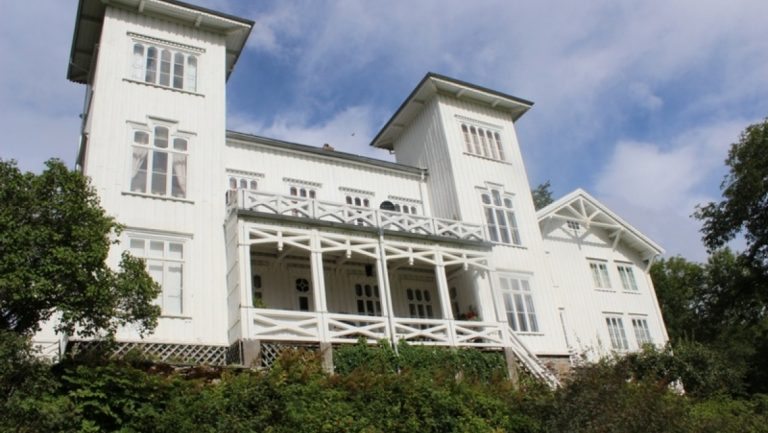
The property was completely protected in 2014. Today, the wooden white main building still shines like a diamond in the sun placed on a staggering height in the otherwise flat and undulating Rissa landscape.
The wooden white main building shines like a diamond in the sun. Photo: Wikipedia
The monastery grounds and garden are open all year round. Parking at the church.
Kårhuset (housing for retired farmers) at Reins Kloster has 2 apartments that can be rented through airbnb. The largest has 3 bedrooms while the smallest has one bedroom.
Viking Heritage Abbey in Norway, written by Tor Kjolberg
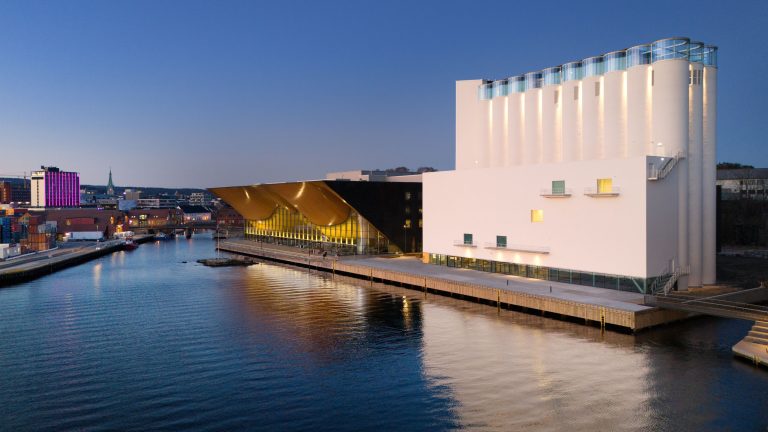
A grain silo from 1935 located on the archipelago of Odderøya in Kristiansand has been transformed to a powerhouse for arts and culture. It has given inhabitants and visitors new ways of experiencing art in Kristiansand, Norway.
The Kunstsilo art gallery has been converted by Barcelona studios Mestres Wåge Arquitectes, BAX and Mendoza Partida and become home to the world’s largest private collection of modern art from the Nordic region, with more than 5,500 artworks, The Tangen Collectuon.
Nicolai Tangen believes that the new museum will make Kristiansand a more interesting place to live.
Beyond fish restaurants, wine bars and ice-cream parlors lies what is putting Kristiansand in southern Norway of nearly 112,000 people on the map. The new quayside museum, Kunstsilo, houses the Sørlandssamlingen (the South Collection), The Christiansand Picture Gallery and the Tangen Collection.
In addition to the permanent collections, there will be international digital contemporary art, temporary exhibitions, and expanded offers with lectures, concerts, food experiences, workshops, function rooms and events.
The Kunstsilo art gallery has been converted by Barcelona studios Mestres Wåge Arquitectes, BAX and Mendoza Partida.
The goal for Kunstsilo was to preserve and celebrate the architecture of the former grain store, completed by Norwegian functionalist architects Arne Korsmo and Sverre Aasland in 1935.
The Tangen collection takes its name from Nicolai Tangen, the manager of the Norwegian Sovereign Wealth Fund, who bequeathed his collection of Nordic art to Kristiansand, his hometown, in 2015.
The project was fully financed in 2019 and construction work began the same year.
The project was fully financed in 2019 and construction work began the same year. Kunstsilo, whose location is right in the middle of the new cultural hub situated by the sea in Kristiansand’s city center, opened its doors to the public in May this year.
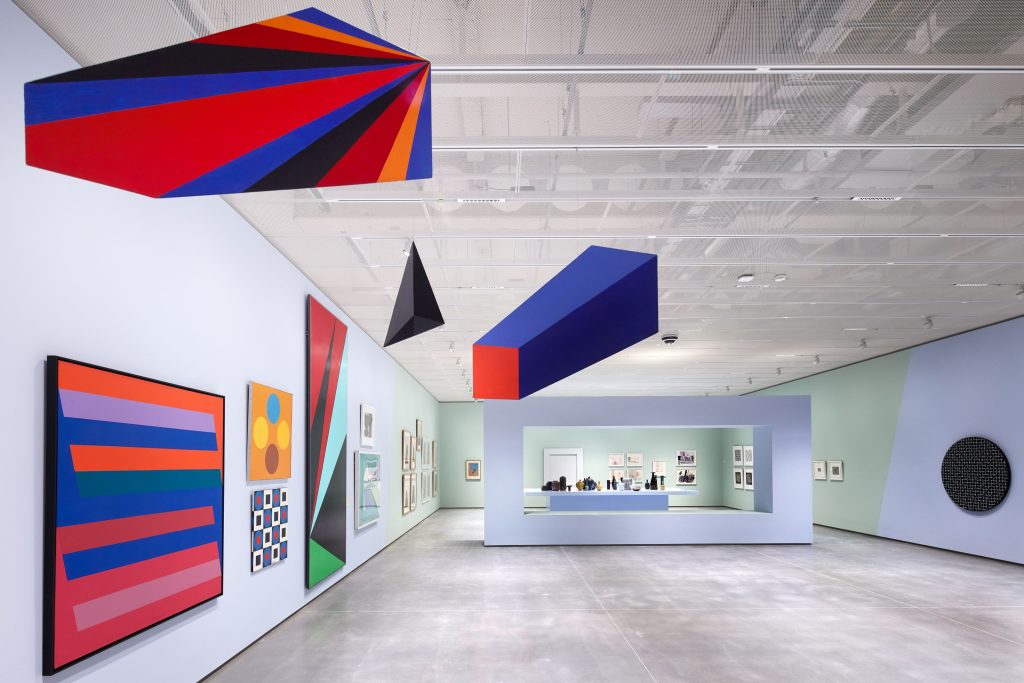
The opening exhibition, Passions of the North, comprises 600 works from the Tangen collection and was curated by Asmund Thorkildsen, who previously worked with Drammen Museum in Norway. He collaborated with Norwegian art hirtoran Steinar Gjessing. The exhibition showcases significant pieces of Nordic modernism, including Swedish impressionist Isaac Grünewald and Danish surrealist Rita Kernn-Larsen.
The interior of the 37-meter-tall structure has been carved out, creating a grand, “basilica-like” atrium and circulation core that stretches to 21 meters in height.
Around it are the galleries, the majority of which are housed in two adjoining extensions. One of these extensions is a replica of an original volume that had to be rebuilt due to deterioration.
The opening exhibition, Passions of the North, comprises 600 works from the Tangen collection.
As custodian of the donation from Tangen, Kunstsilo received more than 3,000 ceramics, paintings, photographs, installations and conceptual works. Tangen believes that the new museum will make Kristiansand a more interesting place to live.
Kunstsilo comprises 25 galleries across three storeys, encompassing 3,300 square meters. Across them are works by more than 300 artists from across Finland, Denmark, Iceland, Sweden and Norway dating from the 1910s to 1990 – many from Tangen’s own collection.
New Ways of Experiencing art in Kristiansand, Norway, written by Tor Kjolberg
Visit Oslo’s latest tourism campaign comes in the way of a hilarious take on life in the Capital of Norway, claiming “Never visit Oslo, Norway. Is it even a city?”
“I wouldn’t come here.” That’s the opening of a new ad of the campaign that promotes the relative ease of Norway’s capital as a tourist destination.
The new anti-advertisement for the Norwegian capital has spread all over the world. Humor and irony are supposed to attract more tourists to Oslo. The video, which has gone viral follows a 31-year-old on a day around the city and he tells you everything ‘wrong’ with Oslo, but as a matter of fact, he perfectly captures the charm of the city.
“Everything is just so available.” He shares that there are no lines at museums and no waits at restaurants. At a time when several European cities are experiencing tourist boom queues and chaos, Oslo is trying to sell itself in a slightly different way.
Littered with comedic takes on things like the ability to walk from one side of the city to the other in half an hour or not needing to wait in line for hours to get into a gallery, the ad incorporates the dry humor Nordic countries are known for. Last year, Visit Sweden launched a campaign ad reminding viewers to stop confusing it with Switzerland. In 2021, Visit Iceland launched an ad that parodied the Metaverse.
“The inspiration for the ad is Oslo’s position as an underdog as far as city break destinations go,” said Anne-Signe Fagereng, director of marketing for Visit Oslo.
“The inspiration for the ad is Oslo’s position as an underdog as far as city break destinations go, both in Europe and in the Nordics,” says Anne-Signe Fagereng, director of marketing for Visit Oslo.
“This is not exactly ‘Mona Lisa”, says the 31-year-old with a sigh in front of the painting of Edvard Munch’s “The Scream”.
“I wouldn’t come here.” says the 31-year old locasl. Screenshot
“The fact that it’s not as famous and crowded as some other capital cities is something we should start highlighting as a benefit. Oslo has been through an incredibly positive transformation over the last few decades, so it’s time our confidence in our capital catches up with reality.” says Fagereng.
It’s an appealing message, especially now. The world’s most popular tourist destinations, with some like Japan, Venice and Barcelona being struck with overtourism.
He tells you everything ‘wrong’ with Oslo. Screenshot
Oslo’s new campaign has caught the eyes of the marketing world with many taking to Linkedin to praise the video which runs for just under two minutes. Visit Oslo has paid for campaign screenings in Sweden, Denmark, England and the Netherlands. But the response has been enormous from several destinations around the world, among them Australia and the USA.
The sarcasm and irony seem to have worked. As of this writing, some of the results are
* 1.4 million views on TikTok
* 63,000 views on YouTube
In 2021 ‘The Munch’ opened in Oslo, a museum dedicated to artist Edvard Munch who painted The Scream. 2022 saw the opening of Norway’s National Museum and in 2027 The Museum of the Viking Age will open.
Oslo’s new campaign has caught the eyes of the marketing world. Screenshot
Oslo saw an upsurge in international arrivals this past quarter. International arrivals in the Norwegian capital are up 26% from 2019 levels, according to ForwardKeys.
Never Visit Oslo, Norway, based on a press release from Visit Oslo
The InterNations Expat Insider survey 2023 has commented on the so-called ‘Nordic Paradox’ in which Scandinavian countries score high while not so highly on the Expat Insider Survey.
Scandinavian nations and Finland score highly on the World Happiness Index, but not so highly on the Expat Insider Survey. This is because both surveys use different metrics. Whereas expats might enjoy local culture and high wages, for instance, ease of settling in can be a factor which brings down ratings in some surveys. InterNations says that according to their results, Panama, Mexico, Kenya, Brazil and the Philippines are the friendliest countries in the world, whereas Denmark, Austria, Kuwait, Norway and Germany score lowest.
Photo: ConvertKit/Unsplash
The most powerful passports in 2024
France, Germany, Italy, Japan, Singapore, Spain (194 destinations)
Belgium, Luxembourg, Norway, Portugal, United Kingdom (191 destinations)
The latest Henley Global Mobility Report, generated by the Henley Passport Index, based on IATA data, assigns rankings based on how many countries your passport allows you to visit without a visa. If you have a Japanese passport, for instance, you can now visit 194 nations out of 227 without a visa.
In second place come Finland, South Korea and Sweden. Austria is now in third place, sharing the spot with Denmark, Ireland, Netherlands, France and Luxembourg. If you have a passport from these countries, you will be able to visit 192 nations visa-free. US-passport holders can access 184 countries. However, they do not fare as well as their British counterparts – a UK passport facilitates entry into 191 countries. The UK and USA, who held the top position in 2014, have been going down in the rankings.
The general trend over the history of the 18-year-old ranking has been towards greater travel freedom, with the average number of destinations travelers are able to access visa-free nearly doubling from 58 in 2006 to 109 in 2023.
Henley Passport Index states:
“The general trend over the history of the 18-year-old ranking has been towards greater travel freedom, with the average number of destinations travelers are able to access visa-free nearly doubling from 58 in 2006 to 109 in 2023. However, the global mobility gap between those at the top and bottom of the index is now wider than it has ever been, with top-ranked Singapore able to access 165 more destinations visa-free than Afghanistan.”
You can check out your own passport’s access power here. The index will also give you access to 18 years’ worth of historical data, allowing you to analyze how visa entry has changed over nearly two decades.
Translation systems are becoming easier and better.
Translation challenges
As anyone who has used an online translation device, such as Google Translate, will be aware, the results of these systems can be somewhat mixed, but machine translation is becoming increasingly commonplace and sophisticated. The market size is estimated to have been around USD1,060 million in 2022, and Forbes estimates that it will reach USD325 billion in 2025. Look out for an increase in systems like the machine at Seibu-Shinjuku in transportation throughout the world.
With an increase in the number of foreign visitors to Japan post-pandemic, the nation’s train services have responded by installing an automatic translation window in one of Tokyo’s busiest stations, Seibu-Shinjuku. The system has been trialed at Kansai International Airport and allows passengers to communicate directly with an operator: the screen automatically translates Japanese into 11 other languages.
With its diverse and sometimes extreme weather, Sweden can be challenging for expats to adapt to. Understanding the Swedish climate is crucial for a smooth transition and enjoyable stay. This guide aims to provide detailed insights and a guide for navigating Swedish weather as an expat.
Whether relocating to Sweden or having already moved, being prepared for the weather can significantly impact your experience.
Understanding Sweden’s Climate
Sweden’s climate is characterized by distinct seasons and varying temperatures. Depending on the region, the country experiences temperate and subarctic climates. Summers are generally mild to warm, while winters can be harsh and cold.
Caption: Summers in Sweden are filled with activities like hiking, swimming, and attending festivals, making it a vibrant season. Photo: Efrem Efre/Pixels
There are also some distinct regional differences to be mindful of:
Southern Sweden: This region enjoys milder winters and warm summers, making adapting relatively easy. Cities like Malmö and Gothenburg experience temperatures ranging from -1°C in winter to 20°C in summer.
Central Sweden: Here, the seasons are more pronounced. Winters can be quite cold, with temperatures dropping to -10°C, while summers are pleasantly warm, averaging around 17°C.
Northern Sweden: Known for its harsh winters, northern Sweden, including Kiruna and Umeå, experiences temperatures that can plummet to -30°C. Summers are short but can reach up to 15°C.
The Gulf Stream significantly influences Sweden’s climate, moderating temperatures and preventing them from being as extreme as other northern countries. This ocean current brings warmer waters from the Gulf of Mexico, making Swedish winters less severe than expected at such latitudes.
Understanding these climatic variations is essential for planning your activities and lifestyle as an expat. By being well-prepared, you can conquer challenges as an expat in Scandinavia and make the most of your time in this beautiful country.
Seasonal Weather Patterns
Navigating Swedish weather as an expat involves understanding the distinct seasonal patterns. Each season brings unique weather conditions and activities. Here’s what to expect throughout the year in Sweden.
Winter (December – February)
Winters in Sweden can be quite challenging due to the cold temperatures and limited daylight hours. The polar night occurs in the country’s northern parts, where the sun does not rise above the horizon for several weeks. It’s crucial to be prepared with appropriate clothing and home heating solutions. Winter activities such as skiing, ice skating, and dog sledding are popular, providing opportunities to embrace the season.
Spring (March-May)
Spring transitions from the cold, dark winter to milder and brighter days. The weather can be unpredictable, with sudden changes from cold to warm spells. This season is characterized by melting snow and blooming flowers. Spring festivals and outdoor activities become more frequent, and it’s an excellent time to explore Sweden’s natural beauty.
Summer (June – August)
Summer is the warmest season in Sweden, with long daylight hours, particularly in the north, where the midnight sun can be experienced. Temperatures range from 15°C to 25°C, making it a perfect time for outdoor activities like hiking, swimming, and attending music festivals. Swedish summer is also a time for celebrating Midsummer, a significant cultural event marked by traditional foods and dances.
Autumn (September – November)
Autumn in Sweden brings cooler temperatures and shorter days. The foliage turns into beautiful shades of red and gold, making it a picturesque time of year. This season is also a time to prepare for the upcoming winter by ensuring homes are well-insulated and have the necessary supplies. Fall activities include foraging for mushrooms and berries, which are abundant in Swedish forests.
Navigating Swedish Weather As an Expat: How To Prepare for Swedish Weather?
Dressing appropriately for the weather is vital in Sweden. Layering is key to staying warm and comfortable during the cold season. Essential items include thermal underwear, woolen sweaters, waterproof jackets, and boots. It’s advisable to invest in high-quality winter gear to withstand the cold. During summer, lighter clothing is sufficient, but having a waterproof jacket on hand for unexpected rain is always good.
Knowing how to dress appropriately is key to navigating Swedish weather as an expat, ensuring comfort throughout the year. Photo: Efrem Efre/Pixels
Next stop—getting your living quarters ready. Preparing your home for the weather involves proper insulation to keep the cold and warmth out. That ensures comfort and helps save on energy bills. It’s also important to deal with snow and ice promptly in winter to avoid accidents.
At the same time, it’s a good idea to put some clothes in storage during summer, especially bulky seasonal items you won’t need until winter, to free up space in your living area. Using long-term storage for these items frees up valuable space, helps protect them from damage, and keeps your living space clutter-free, promoting a more organized and functional home environment.
Lastly, let’s not forget that maintaining health during the long winter months can be challenging. Seasonal affective disorder (SAD) is common due to the lack of sunlight. To combat this, get outside during daylight hours, even if it’s cold. Staying active with indoor exercises or winter sports can also help. Ensure you get enough vitamin D through diet or supplements to maintain overall health.
Leverage Weather Forecasts and Resources
Staying informed about the weather is crucial in Sweden. Several reliable sources for weather forecasts include the Swedish Meteorological and Hydrological Institute (SMHI), which provides detailed and accurate updates. Mobile apps like Yr.no and Klart.se are also popular for real-time weather information.
Using weather forecasts to plan your daily and long-term activities can help you avoid unpleasant surprises. Whether planning a weekend trip or deciding when to do your grocery shopping, staying informed about weather conditions is key. Joining local community groups and forums can also provide valuable insights and tips from fellow expats.
Navigating Weather-Related Challenges
Driving in winter conditions requires special preparation and adherence to safety regulations. Make sure your car is equipped with winter tires and carry emergency supplies. Public transportation in Sweden is generally reliable, but delays can occur due to severe weather. Always check schedules and plan for extra travel time during the winter months.
Outdoor activities are a great way to enjoy Sweden’s natural beauty, but it’s essential to do so safely. Always check weather advisories before heading out and dress appropriately for the conditions. Whether skiing in the winter or hiking in the summer, understanding the local weather patterns can help you plan better and avoid potential hazards.
Caption: Being prepared for driving during winter in Sweden includes having winter tires and understanding safe driving practices. Photo: Gaith Shalan/Unsplash
Running errands and managing daily tasks can be more challenging in extreme weather. Stock up on essentials before a severe weather event and plan your outings during the warmer parts of the day. Adapting to local customs, such as using snow tires and winterizing your home, can also help you manage better. Building a network with other expats can provide valuable support and tips for dealing with the weather.
A Guide to Navigating Swedish Weather As an Expat – Final Thoughts
Living in Sweden offers a unique experience, and by moving to Scandinavia, you open yourself up to new adventures and a rich cultural exploration. Navigating Swedish weather as an expat may seem daunting initially, but with the right strategies, it becomes an enriching part of your expat journey. So, embrace the weather, stay connected with local communities, and take advantage of the resources available to you. This approach will help you adapt and thrive in your new environment. Enjoy your new life in Sweden!
A Guide to Navigating Swedish Weather As an Expat, written dedicatedly for Daily Scandinavian by Hugo Myers. Hugo is a seasoned blog writer specializing in cultural adaptation and travel guides. He is passionate about exploring new climates and environments and offers practical insights and tips for navigating life abroad
On Monday June 17, 2024, Danish King Frederik X inaugurated the first element of a future 18-kilometer (11-mile) rail-and-road tunnel under the Baltic Sea linking southern Denmark to northern Germany
The Fehmarn Belt tunnel construction site at Roedbyhavn will contribute to the transport sector’s green transition. Work on the construction pit for the tunnel portal on the Danish side started in 2020 and on the German side the following year. Work on the tunnel portal itself started in 2022.
The direct link between northern Germany and Danish Lolland will be the world’s longest road and rail tunnel
The direct link between northern Germany and Danish Lolland will be the world’s longest road and rail tunnel and a major connection between central Europe and Scandinavia.It will shorten the travel time between Lolland and Fehmarn from 45 minutes by ferry (excluding waiting and boarding time) to 10 minutes by car and seven minutes by train. The electrified high-speed rail line will be capable of reaching 200 km/h (125 mph).
A factory casting the tunnel elements will produce a standard element approximately every second week for some three and a half years. Production of 79 standard and 10 special elements will be required in total, and the Fehmarn link is expected to open in 2029.
**********************************
Read also: Bridge to the Future
**********************************
Sund & Baelt, the company building the Fehmarn link, claims it will be the longest submersible tunnel, including an electrified train track.
The project’s cost was initially estimated at €5.5 billion. By 2010, when Denmark and Germany signed the treaty to build the bridge, this had grown to €7.4 billion. The tunnel will be financed by Denmark, which will collect a toll from the crossing. Germany will pay a further €800 million to connect the crossing to its motorway network.
Sund & Baelt, the company building the Fehmarn link, claims it will be the longest submersible tunnel, including an electrified train track. Each special element of the tunnel will include a ‘basement’ area for technology. This will make the construction process and maintenance of the finished tunnel easier. The tunnel elements are manufactured using industrial series production, which makes the construction process considerably more efficient.
*******************************
Read also: Over the Öresund Bridge
*******************************
The tunnel will replace a heavily travelled ferry service from Rødby and Puttgarden, currently operated by Scandlines, a route known in German as the Vogelfluglinie and in Danish as Fugleflugtslinjen.
Cross section of a standard element
The Fehmarnbelt link is an important component in the future European transport network and will make an important contribution to the green transition of the transport sector. Enabling traffic to use the shortest and fastest route will reduce CO2 emissions and free up capacity on roads and railways. Switching the transport of freight from lorries to environmental-friendly electric trains will also be more attractive.
Future Road and Rail Tunnel Linking Denmark to Germany, written by Tor Kjolberg
Thinking about moving abroad and eager to embrace a green lifestyle? You’re not alone! These days, more and more expats are tuning into the importance of climate change and environmental sustainability. Let’s look at green living in Copenhagen.
A frontrunner when it comes to adopting sustainable solutions, Copenhagen has one of the world’s most ambitious climate policies with a goal of being the first carbon-neutral capital city by 2025. With swimmable waterways, more cyclists than cars and giant wind turbines on the horizon serving as a constant reminder of this goal, Copenhagen is surely on track.
In Copenhagen you can go for a dip in the harbor’s 10 public bathing zones. Photo: Daniel Rasmussen/Visit Copenhagen.
Considered one of the most sustainable cities in the world, Copenhagen has in total 546 km of bicycle paths, a fleet of electric harbor ferries and a majority of the hotel rooms around town are eco-certified.
Copenhagen is often touted as the world’s most eco-friendly city. Copenhagen’s approach to sustainability is comprehensive, involving not just government and businesses but also the active participation of citizens. Through their commitment to reducing CO2 emissions, they have encouraged eco-friendly lifestyles.
From one of the many eco-friendly hotels in Copenhagen. Photo: Tripadvisor.
Copenhagen has a long-standing tradition of pursuing green solutions. As a result, the Copenhagen of today has founded a range of sustainable development initiatives and continues to do so and the locals believe in it too. In a survey from Time Out in 2021, 27,000 city dwellers voted on how sustainable they thought their own city was, and Copenhagen came out on top. The Arcadis Sustainable Cities Index (2022) placed Copenhagen in fourth place. They rank 100 of the world’s cities under three pillars of sustainability: Planet, people, and profit.
Various policies support Copenhagen’s green initiatives, such as tax incentives for green businesses, renewable energy mandates, and building regulations encouraging energy efficiency. The city’s urban planning strategies, focusing on sustainability, have led to the development of eco-friendly communities. The district of Ørestad is one example of this, designed to minimize energy consumption while maximizing green space.
The green roof policy has led to the creation of living roofs across the city. Photo: Architectural Digest.
Copenhagen’s investment in cycling infrastructure is a primary reason for its eco-friendly reputation. There are more than 375 kilometers of designated bike lanes and numerous bike-friendly policies. You can find out more about the city’s bike-wide scheme through the Copenhagenize Index. The city has implemented various bike-sharing programs, encouraging even tourists to utilize bikes. Such systems have made bicycles accessible to everyone, further reducing the city’s carbon footprint. With the development of bicycle highways, cycling in Copenhagen has become not only environmentally friendly but also a quick and safe mode of transportation.
‘Green wave’ traffic lights for cyclists – with digital countdowns and footrests at junctions contribute to better commuting for bikers. Photo: Martin Heiberg/Visit Denmark.
Green initiatives in Copenhagen include offshore wind turbines in the Øresund Strait between Denmark and Sweden, an increasing number of electric busses, waste-removing initiatives and ‘green wave’ traffic lights for cyclists – with digital countdowns and footrests at junctions.
Finally, Copenhagen’s devotion to providing green spaces within the city has not only made it beautiful but has also had positive effects on the health and well-being of its residents. With parks like Frederiksberg Gardens and the Botanical Gardens, residents have access to abundant green spaces, offering opportunities for recreation and relaxation. Community gardens foster social cohesion, enabling citizens to grow their vegetables and herbs. This practice further strengthens the bond between urban living and nature. In Copenhagen, the green roof policy has led to the creation of living roofs across the city. These roofs not only reduce heating and cooling costs but also increase biodiversity.
Green Living in Copenhagen, written by Tor Kjolberg
Sweden has the world’s highest percentage of factory built wooden houses in the world, mainly using closed wall panels. So, Sweden is leading the world in prefab houses.
The U.S. also once looked to modular construction as an efficient way to build lots of housing at scale, but Sweden picked up the idea and put it into practice. Among the myriad influences that have led to Sweden’s dominance of the offsite space in terms of skills, expertise and industry structure, the most frequently cited factors are the country’s abundance of slow growing, premium quality timber and its uniquely challenging climatic conditions.
The most remarkable difference between the United States and Sweden is regulatory. Building codes in the U.S. try to make buildings safe by prescribing exactly what materials must be used and how (a prescriptive code). In Sweden, the government does this by setting goals and letting builders come up with a way to achieve them (a performance code).
The Lindbäcks Bygg facility in Sweden can build apartment buildings that are 16 stories and can be assembled in a matter of days.
From the Västhusstugan plant.Summer house by Västkuststugan.
“In Sweden we have a long tradition of prefab housing, about 80 years,” confirms Leif Litzell, of VästkustStugan AB, one of the 10 largest and oldest housing companies in Sweden, which specializes in compact single dwellings across three sub-brands: VästkustStugan, VästkustVillan and Borohus.
“It is a safe way to build in order to protect details from rain and moisture. Prefabrication means that within a couple of days, we have everything assembled and protected under the roof of the building. Since windows and outer doors are mounted in the factory, the house is rapidly weather protected and secured from uninvited visitors. A prefabricated house still can be very flexible. Everything you can build is possible in prefab, and consumers in Sweden are aware of that.”
At the Lindbäcks factory in Sweden, one unit of volumetric housing is created every half an hour. Sweden is currently undergoing a major building boom; with skills shortages in traditional construction trades placing further pressure on the sector, prefab houses are in high demand.
Residence house by BoKlokHouse by Eksjöhus.
Sweden’s prefabricated housing market size is estimated at USD 4 billion in 2024, and is expected to reach USD 5.70 billion by 2029, growing at a CAGR of 7.01% during the forecast period (2024-2029).
Suppliers are rising to the challenge of meeting this demand. BoKlok is a joint venture between two Scandinavian behemoths, construction specialist Skanska and furnishings giant IKEA. It supplies homes that benefit from the inherent economies of scale offered by standardization while offering price accessible variation across around four to five models.
BoKlok homes are built primarily from wood, using a smart, industrialized and efficient process. Homes are completed off-site in a safe and dry environment using modern methods of construction. This enables predictability, high quality and low costs.
To date, BoKlok has developed about 15,000 homes. BoKlok is currently operating in Sweden, Norway and the UK.
Björkenes by Eksjöhus.
Another operator, Eksjöhus, offers panelized homes that are designed to be both beautiful and impressively rapid to build; the time frame from slab being finished to lock up can be a matter of days. The company’s origins date back to 1941; it has its own sawmill, manufacturing operation and transport capabilities.
Timber from Dertome.
It seems that Sweden’s timber and construction industry have evolved to be ideally structured to produce housing efficiently. Vertically integrated company, Derome Timber exemplifies this. Derome owns forests, a sawmill and hardware stores. It also builds residential schemes.
***************************************
You might also like to read Cool Scandinavian Looks
**************************************^
Houses from BoKlok
The company takes forest stewardship as seriously as the houses it builds, investing significantly in state-of-the-art timber processing technology. Evident at its sawmill was computer driven quality control of timber, leading edge scanning equipment for cutting and sorting, drying furnaces and more.
The overall market has, however, some limitations, such as durability issues and a need for appropriate financing options for prefabricated living spaces. Sweden’s prefabricated houses are mostly timber-framed, which means they are not radically different from most mid-grade structures design-wise. However, when it comes to production, the process is different from the current industry standard of crews erecting stick-built houses piece by piece. For production, measurements and specifications are planned by computer.
Sweden – Leading the World in Terms of Prefab Houses, written by Tor Kjolberg
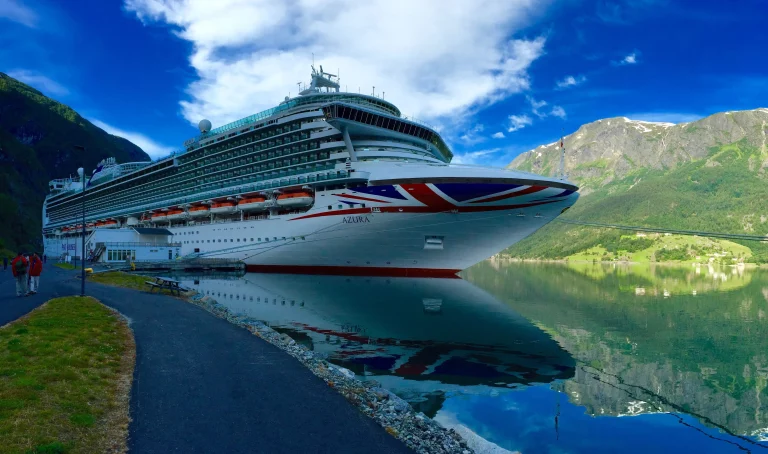
No tourism industry is growing faster than the cruise industry. The local population in Skjolden, in the heart of Norway’s longest fjord, numbers only around 300 inhabitants. And Skjolden has become a romantic and popular port for giant cruise ships in Norway.
When “MS Braemar” and “Saga Rose” opened Skjolden as a cruise destination in 2007, there was no pier there. However, it should be the beginning of the future.
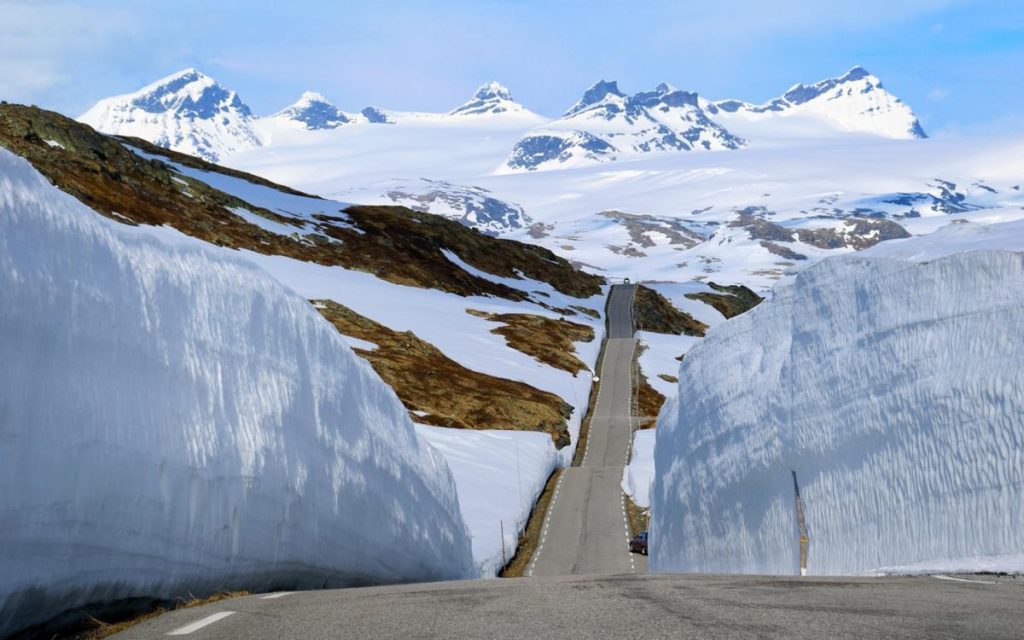
The charming village of Skjolden is called the “Gateway to the national parks” due to the short distance to no less than three of the most iconic national parks in Norway – Jotunheimen, Breheimen and Jostedalsbreen. The village is a 30-minute drive from Northern Europe’s highest mountain pass, the Sognefjellet Mountain Road (1434 m.a.s.l.). From there, you can enjoy stunning views of Breheimen and Jotunheimen – including the 20 highest peaks in Scandinavia.
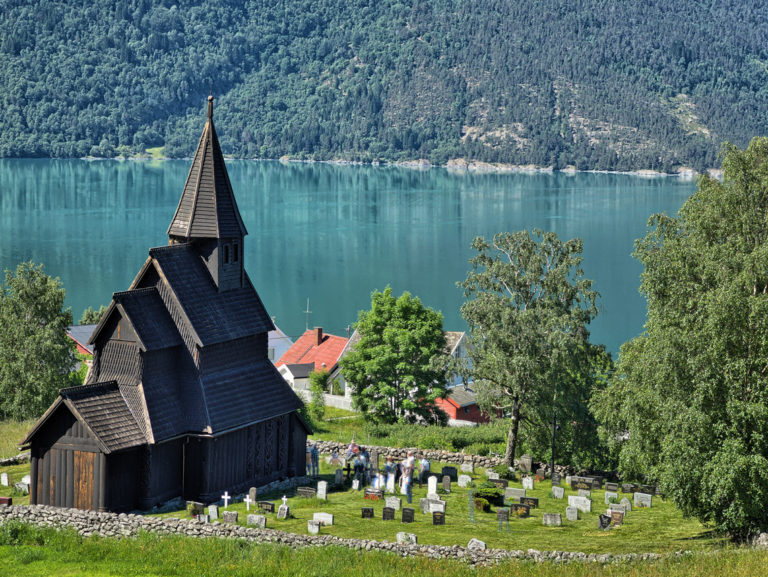
Urnes Stave Church, a Viking Age church dating back to 1130 and a UNESCO World Heritage Site,
Visitors can admire the rolling farms and the greenery. Evidently, it’s no surprise this was a popular destination with Norwegian artists, who came here for inspiration in the 19th century. Visit the old Urnes Stave Church, a Viking Age church dating back to 1130 and a UNESCO World Heritage Site, 30 kilometers to the south. The narrow road there passes through idyllic villages — its picturesque vistas are called the Romantic Route.
In 2009, the Norwegian investor Oddvar Røysi invested in a new cruise dock and 200 new berths along the entire shoreline at the bottom of the world’s longest navigable fjord. It was his gesture to the municipality from where he had his roots. The price tag is said to be around NOK 150 million.
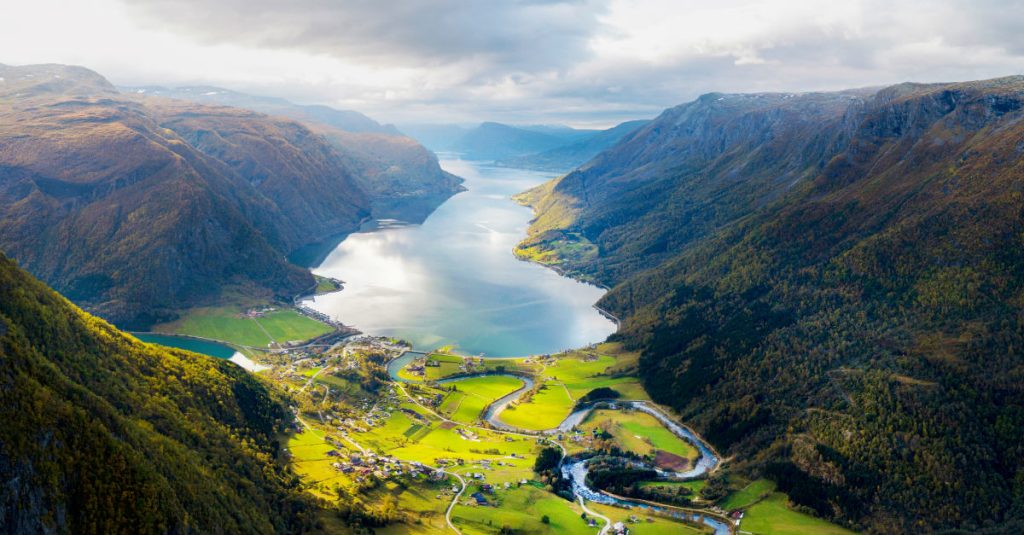
The pier is buit by the picturesque Lustrafjord, the innermost branch of Norway’s longest and deepest fjord – the Sognefjord. The fjord has a distinct emerald-green color owing to melting water from the glaciers. Along the shoreline, you will see beautiful villages and lush cultural landscapes.
The Sognefjellet mountain road. Photo: Western Norwegian Fjords.
In 2006, National Geographic named the Norwegian fjords on the West coast the best unspoiled destination in the world. The Nærøy fjord and the Geiranger fjord had just entered Unesco’s world heritage list. The same year, the four western counties accounted for 88 per cent of the overall growth in the tourism industry.
However, the increasing cruise traffic has made the area less pristine, and many are critical of the large tourist flows that invade the fjord landscapes. “We have the world’s most beautiful country, we don’t have to follow the cruise operators’ terms,” say critical voices. But many people want to experience this beautiful western nature.
And cruise operators state that “breathtaking nature-based experiences and proximity to some of Norway’s most iconic attractions are our biggest strengths as a cruise destination. This makes Skjolden suitable for those who visit Norway to experience the amazing fjord scenery and enjoy nature-based attractions.
Our main cruise ship pier (127.5 m) can take medium to large cruise ships, while small vessels can easily anchor and use the tender pier closer to the town center.”
The main attractions are the Sognefjellet Mountain Road, Jostedal Glacier and Urnes Stave Church, part of Unesco’s World Heritage List. The church was built around 1130 A.D., but the distinctive carvings on the north portal are from an even older church. The so-called stave churches are among Norway’s most significant contributions to world architecture.
Skjolden Cruise Port. Photo: Ole Gudnmund Bjørk/Fjord Norway.
In the small factory Safthuset, the Juice House museum, between Skjolden and Urnes, you can enjoy some delicious local berry juice. It opened its doors in 1909 and is today Norway’s leading jam- and juice-producing company, Lerum. Most of the original equipment is still in use. Groups can visit by arrangement.
Only one hour’s drive from Skjolden, you can marvel at the Nigardsbreen glacier’s ice, one of the most accessible glaciers in Norway. You can either walk along the turquoise lake up to the glacier itself or take the boat across the lake.
A report from Western Norway Research Institute stated that both “Flåm and Geiranger are approaching a capacity limit. It can be an alternative (…) and rather appear as a ‘quiet’, exclusive and somewhat less mass tourism-influenced cruise destination.”
Romantic Port for Giant Cruise Ships in Norway, written by Tor Kjolberg
Feature image (on top): Skjolden, Port-No Fly Cruises