




The human brain is hardwired for narrative. While an online brochure or a sterile list of hotel amenities appeals to our logic, it is the story that captures our imagination. This is the anatomy of a story designed for a group of people who have the time and money – the adult part of our population.
Introduction: The Catalyst in the Armchair
The house is quiet, save for the rhythmic tick of the grandfather clock in the hallway. Outside, the afternoon sun casts long, amber shadows across a perfectly manicured lawn. On the coffee table rests a stack of glossy magazines, a few historical biographies, and a freshly opened memoir. For decades, this room was a sanctuary from the relentless pace of a demanding career and the beautiful chaos of raising a family. Now it is something else: a launching pad.

You open a page and are instantly transported. You are no longer sitting in a comfortable armchair; you are navigating the mist-shrouded foothills of the Japanese Alps. The writer describes the crunch of gravel underfoot along the ancient Nakasendo Trail, the scent of cedarwood smoke wafting from a wayside minshuku, and the profound, bowing gratitude of an elderly innkeeper handing you a cup of steaming matcha.
Suddenly, a profound realization hits you. Retirement was never meant to be a long pause at the end of a long sentence. It is a completely new stanza.
For a generation that has spent forty years accumulating assets, meeting deadlines, and fulfilling obligations, the greatest luxury of retirement is not leisure—it is time. Yet time without direction can easily become routine. This is where the power of a deeply moving travel story comes into play. It serves as an emotional catalyst, transforming passive wanderlust into active, purposeful exploration.
Inspiring travel narratives do far more than offer a checklist of global monuments. They unlock a threefold transformation:
- The Catalyst for Movement: They turn financial freedom and open schedules into concrete travel plans.
- The Cultural Bridge: They replace abstract global news with the warm, human faces of local communities.
- The Internal Mirror: They offer a deeper perspective on life, resilience, and what it means to grow older with curiosity rather than complacency.
Part I: From Narrative to Navigation – The Spark of Action
The human brain is hardwired for narrative. While an online brochure or a sterile list of hotel amenities appeals to our logic, it is the story that captures our imagination. For a retiree with the financial means to go anywhere on earth, the paradox of choice can be paralyzing. When you can book a flight to Paris, Patagonia, or Perth with equal ease, how do you choose? You look for a story that mirrors your inner desires.

Case Study: The Call of the Silk Road
Consider the real-world impact of travel writers like Colin Thubron or the enduring legacy of Robyn Davidson. When a retired executive reads an account of traversing the ancient Silk Road—not through the lens of a luxury tour, but through the intimate details of navigating the bustling, spice-scented bazaars of Samarkand—something shifts.
The story strips away the intimidation of remote travel. It replaces fear of the unknown with an intoxicating sense of mystery.
“Reading about another person’s journey reveals that the world is not a dangerous puzzle to be solved but a tapestry waiting to be touched.”
When travel stories spotlight peers exploring the world in their sixties, seventies, and beyond, they dismantle the societal myth that adventure belongs only to the young. They prove that physical vitality is secondary to intellectual curiosity. Platforms dedicated to authentic narratives, such as World Nomads Travel Stories, consistently show that the most profound journeys occur when travelers stop viewing the world as consumers and start engaging with it as participants.
The Financial Shift: Investing in Experience over Belongings
For decades, success was measured by what was added to the property ledger. Travel storytelling fundamentally rewrites that definition. It reframes travel not as an expensive indulgence but as the ultimate investment in one’s intellectual capital.
When a story vividly captures the profound peace of watching the sunrise over Angkor Wat, or the exhilarating camaraderie of learning to cook traditional dishes from a local chef in Tuscany, it highlights an undeniable truth: experiences appreciate in value over time, while material goods only depreciate. Inspired by these narratives, retirees willingly downsize their physical footprints to expand their global horizons.
Part II: The Cultural Bridge – Deconstructing the “Other”
We live in an era of unprecedented connectivity, yet true global understanding remains elusive. Media outlets often distill vast, complex nations into sound bites about conflict, economic disparity, or political tension. This institutionalized bias breeds caution, prompting many wealthy travelers to isolate themselves in sterile, all-inclusive luxury enclaves that shield them from the very cultures they came to see.
A truly masterful travel story serves as the ultimate antidote to this cultural isolation. It humanizes the map.

Case Study: The Shared Table in Morocco
Imagine a narrative that takes the reader deep into the labyrinthine alleys of the Fes Medina in Morocco. The writer isn’t focusing on the architecture; instead, they recount getting hopelessly lost in the rain, only to be invited into a modest home by an elderly carpet weaver. The author describes the warmth of the brazier, the sweet tang of mint tea poured from a height, and the universal, nonverbal language of grandmothers comparing photos of their grandchildren.
For a retired reader, this story completely shatters the abstract concept of geopolitical division, replacing it with a deeply relatable human reality. When that reader subsequently books their own trip to North Africa, they arrive without defenses. They arrive with an open mind, eager to find their own shared table.
The Power of Vulnerability
The most inspiring travel stories are rarely about flawless itineraries where everything goes perfectly. Instead, they celebrate moments of beautiful vulnerability, such as the awkward, laughter-filled attempts to speak a language using only hand gestures, the humbling kindness of a stranger who guides a lost traveler back to their train station, or the profound realization that beneath the external differences of dress, religion, and custom, our core human desires remain the same.
For those in their post-career years, this realization is incredibly liberating. It fosters a unique form of global citizenship. It allows travelers to approach new cultures not as wealthy patrons looking down from a tour bus, but as humble students eager to learn from teachers who have lived completely different lives.
Part III: The Internal Mirror – A Deeper Perspective on Life
Perhaps the most significant impact of travel storytelling is its ability to spark an internal revolution. When we step outside our comfort zones, our long-held assumptions about success, time, happiness, and mortality are instantly called into question.

Case Study: The Slow Time of the South Pacific
Consider the impact of reading about the concept of “Island Time” or the philosophical framework of Ubuntu in Southern Africa. A retired professional—someone who has spent forty years living by the dictates of Outlook calendars, quarterly earnings, and strict efficiency—reads a story about a community in Fiji where time is measured not by hours but by tides, seasons, and social connections.
The writer describes how the village elders sit in the shade of a banyan tree, completely unbothered by the lack of a schedule, fully invested in the conversation unfolding right before them.
For the reader, this narrative becomes a powerful mirror. It compels an existential inventory:
- Why am I still rushing through my mornings?
- What am I rushing toward?
- Have I sacrificed the joy of the present moment on the altar of productivity?
By traveling to these destinations, inspired by these narratives, retirees can actively practice a slower, more deliberate way of being. They learn to trade the frantic pace of the Western world for a lifestyle centered on presence, community, and deep listening.
Rewriting the Narrative of Aging
In many Western societies, aging is subtly associated with retraction—a shrinking of one’s world, a retreat into predictable routines, and a focus on physical decline. Yet travel stories from around the globe offer alternative, inspiring paradigms.
| Culture / Region | Core Philosophical Concept | Impact on the Traveler’s Perspective |
| Japan | Inishie (Veneration of the Old) | Shifts perspective from seeing age as a liability to viewing it as a crown of accumulated wisdom. |
| Latin America | Intergenerational Living | Highlights the joy of vibrant, loud, multi-generational households over isolated retirement communities. |
| India / South Asia | Vanaprastha (Forest Dweller Phase) | Frames retirement not as a useless void, but as a sacred time for spiritual seeking and global exploration. |

When a retiree reads a beautifully crafted essay on platforms like BreatheDreamgo that highlights soul-searching expeditions across the Indian subcontinent, they see firsthand how later life is celebrated as a period of profound spiritual and philosophical expansion. The travel story provides the blueprint; the journey itself provides the transformation.
Part IV: Practical Application – How to Craft Your Own Chapter
If you are standing on the shore of retirement, looking out at a vast ocean of unscheduled time, let travel stories be your compass. Here is a structured approach to turning the inspiration you find on the page into a tangible, life-changing journey.
- READ & RECORD –> Identify recurring themes in your favorite travel memoirs.
- DEFINE THE WHY –> Choose journeys that challenge your perspective, not just your passport.
- EMBRACE BOLDLY –> Opt for independent, slow travel over highly insulated tour packages.
- Curate Your Reading List for Intentionality
Stop reading standard commercial travel brochures that focus exclusively on luxury consumerism. Instead, seek out long-form travel literature, personal memoirs, and in-depth cultural essays. Look for stories in which the author’s primary goal is to understand a people rather than check off a tourist bucket list.

As you read, keep an active journal. Note the specific sentences, cultural customs, or geographical landscapes that evoke a strong emotional reaction. If a story about a train journey through the Scottish Highlands or a walking pilgrimage in Spain makes your heart beat a little faster, pay close attention. Your intuition is mapping out your next destination.
2. Seek Out the “Friction”
When planning your travels, consciously resist the temptation to make every aspect of your trip effortless. While five-star hotels and private drivers certainly have their place, excessive comfort often acts as an insulating barrier, completely blocking authentic cultural immersion.
Instead, intentionally build opportunities for real human connection into your itinerary:
- Hire local, independent guides who can take you into their neighborhoods.
- Stay in boutique, family-run guesthouses where you can interact directly with the owners.
- Use local public transportation, such as trains or ferries, to sit side-by-side with residents going about their daily lives.
Remember: the mishaps, the confusing moments, and the unexpected detours are almost always the chapters of the story you will remember most fondly for decades to come.
- Travel with a Purpose
Use your retirement to align your global travels with your deepest personal values. If you read a story about marine conservation efforts in the Galapagos Islands or archaeological preservation in Peru, don’t just visit as a passive tourist. Explore high-end, reputable philanthropic travel organizations or educational alumni groups that let you contribute your time, resources, and career wisdom to local initiatives.
By shifting your travel objective from self-indulgence to contribution, you ensure that your journeys remain deeply fulfilling, intellectually stimulating, and profoundly purposeful.

Conclusion: The Unwritten Page
The ultimate value of a great travel story is that it never truly ends with the final sentence on a page. It serves as an open invitation. It coaxes you out of your comfortable armchair, nudges you past lingering hesitations, and gently guides you toward the front door.
You possess the two most valuable resources on earth: the financial freedom to explore any corner of our planet and the unhurried time to truly sit and savor the experience. The world is not a sequence of images to be viewed on a screen from afar; it is a living, breathing classroom filled with millions of fascinating individuals waiting to share their stories with you.
Close the book on your desk. Turn the key in the front door. Step out into the waiting world. It is time to stop reading other people’s masterfully written adventures, pack your bags, and start writing your very own unforgettable chapter.
 Take-away
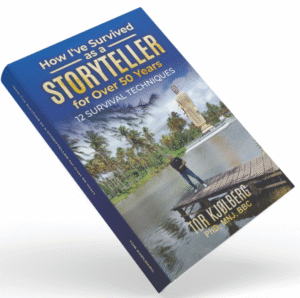
If you learned something from this article, I believe you’ll also enjoy my recent book, “How I’ve Survived as a Storyteller for Over 50 Years: 12 Survival Techniques.” Get your FREE e-book copy by sending me your name and e-mail address, and including “Storytelling” in the subject line. Thank you for reading!
The Anatomy of a Brand Story for Destinations, written by Tor Kjolberg.
More articles on Storytelling by Tor Kjolberg you may like:
Why Organizations Are Turning to Storytelling to Win Public Attention
Brand Masters of Storytelling 3
Stop Chasing Case Studies: Build a Living Library of Customer Stories
The Anatomy of a Brand Story for Destinations
Brand Stories Are Boring
Travel Stories Designed for the Adult Part of Our Population, written by Tor Kjolberg