



Those who manage stories within an organization should first inventory the stories currently available. Most companies have plenty of stories not properly categorized and/or sorted. A brand’s in-house storytelling library is therefore an asset that the marketing department should establish.
Most organizations maintain a large archive of narrative assets: customer anecdotes, founder lore, internal milestones, failures, product moments, support interactions, employee and customer experiences, etc. However, these stories are often fragmented, uncataloged, and inaccessible.
Companies do not primarily suffer from a lack of stories
They suffer from story disorder. “Story poverty” is more often false or an excuse. Most branding and PR conversations assume the organization needs more stories. But in reality:
• Stories exist across departments
• Employees repeat them informally
• Sales teams use them ad hoc
• Founders retell certain narratives repeatedly
• Customer service hears emotional moments daily
• Internal culture contains mythology
• Product teams accumulate “origin decisions”
• None of this is systematically managed.
 The hidden archive problem
There are two types of storytelling organizations:
| Weak Storytelling organizations | Strong storytelling organizations |
| Create stories occasionally | Maintain narrative systems |
| Depend on campaigns | Depend on archives |
| Use anecdotes randomly | Retrieve stories strategically |
| Treat stories as content | Treat stories as assets |
Story Inventory Before Story Creation
A company should conduct a story inventory audit before launching any brand storytelling initiatives. They already record financial data, products, patents, customer data, content assets, and knowledge bases. But they rarely inventory emotionally resonant experiences, symbolic moments, institutional memory, customer transformations, or cultural narratives. Planning helps ensure that the stories you pursue and create truly support your objectives.
 HOW to Find Stories
I would avoid generic advice like “talk to employees.” Instead, build a systematic methodology organized into categories. Many stories are never used to their full potential.
You might follow the categories and questions below.
A. Founding Stories
Questions:
Why was the company started?
What frustration existed?
What early sacrifices were made?
What nearly failed?
What belief contradicts the market?
B. Customer Transformation Stories
Look for before-and-after states, moments of relief, emotional turning points, unexpected use cases, and high-stakes outcomes.
Support tickets and customer success calls are gold mines.
C. Internal Culture Stories
These reveal organizational character through moments when employees rallied together, made difficult decisions, showed unusual care, experienced recurring funny incidents, observed symbolic traditions, and handled crises well.
Culture becomes believable through stories, not value statements.
D. Product Origin Stories
Every meaningful product feature includes a conflict, a trade-off, a customer pain point, an internal debate, and a breakthrough moment.
Engineering and product teams often hold underused narrative capital.
E. Failure Stories
This is important because it adds sophistication. Credible brands do not tell only success stories.
Failures communicate learning, realism, resilience, transparency, and maturity.

How to Collect Stories Systematically
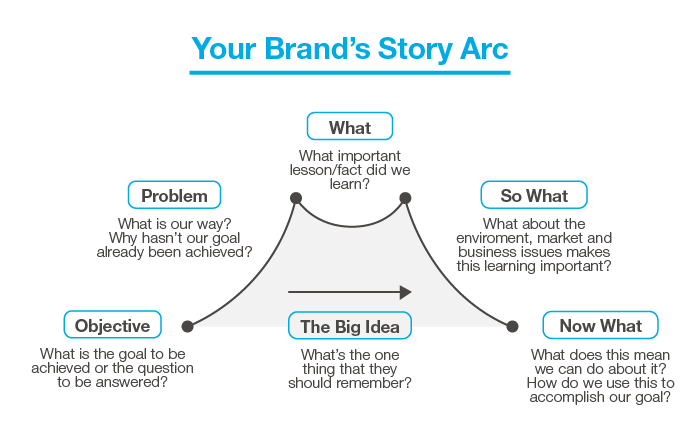
Stories should be captured continuously, not only during campaigns. Those who manage stories within an organization should first inventory the stories currently available. I recommend that organizations establish a story-collection process. Research indicates that most customer content is not compelling and, in most cases, is not used effectively, if at all. The problem stems from failing to align story development with actual company needs.
Ask current customers who within their organizations helped make buying decisions and what factors influenced them.
How to Categorize Stories
A single story typically fits into multiple categories. Create a plan for how you will use each story. Most organizations fail not at storytelling but at retrieval.
Here’s a useful framework:
| Category | Purpose |
| Founder stories | Mission & legitimacy |
| Customer stories | Trust & proof |
| Employee stories | Culture & recruitment |
| Failure stories | Authenticity |
| Product stories | Innovation |
| Community stories | Belonging |
Then add metadata such as emotional tone, audience, strategic use, brand value represented, business unit, media format, and confidentiality level.
Now you are treating stories as a searchable narrative infrastructure. This is intellectually stronger than conventional “brand storytelling” articles.
 During my career, I have had the privilege of working on several successful storytelling campaigns. I have worked in several businesses, from fashion and cosmetics to construction and tourism.
If you want a free copy of my new book, just contact me. The only thing you have to do is to write your name, your email address, and Storytelling in the subject line.
A Brand’s In-House Storytelling Library – Conclusion
A company without a story archive becomes dependent on constant content production. A company with a narrative system compounds meaning over time.
A Brand’s In-House Storytelling Library, written by Tor Kjolberg.
Other articles on storytelling by Tor Kjolberg:
Rethink How Destinations Are Experienced
My 12 Survival Techniques as a Storyteller
Brand Masters of Storytelling
How to Use Humor in Storytelling to Break Through Advertising Clutter
Leaders Who Shape Stories Shape Markets