On December 1, 2016 The Finn Juhl Hotel in Hakuba, Japan opened for business in a former lodge and is entirely decorated with furniture by the Danish modern design master Finn Juhl.
The boutique hotel is nestled at the base of one of the most popular skiing destinations in Japan, surrounded by the Japanese Alps. The suave hotel combines Scandinavian design sensibilities with Japanese elegance.
Finn Juhl Boutique Hotel in Nagasaki
The founders of One Collection, Ivan Hansen and Hans Henrik Sørensen were granted the rights to produce Finn Juhl’s designs in 1990 by the designer’s widow, Hanne Wilhelm Hansen. Since then, Onecollection has helped protect and carry on the legacy of Finn Juhl. That is why stores with an explicit focus on displaying and selling Finn Juhl has opened around the world in recent years.
Living room in Finn Juhl Hotel
Later Hansen and Sørensen purchased a vintage ski chalet in Nagano and outfitted it completely in the Danish furniture master’s creations.
Everywhere the hotel, which makes up six double guest rooms, each named after a Juhl piece (the Chieftain, the Poet, the Japan, the Pelican, the 46 and the France), exudes a sense of downplayed elegance, from the soft bedlinen and organic toiletries to the cozy lighting. There are several shared lounge areas, a dining hall and a basement bar. The hotel also acts as a showroom for OneCollection.
As for the interiors, they are characterized by simple white walls, exposed beams, hardwood floors, and an open layout in the common areas.
Hakuba Happo One mountain ridge
Nagano has more than 100 ski runs and features mountain heights up to nearly 10,000 feet. The hotel is located just steps from the ski-jumping hill used during Nagano’s 1998 Winter Olympics.
Chieftain door sign
Onecollection already has deep ties to Japan, as part of the Finn Juhl range of furniture is produced there in the company’s Japanese workshop.
Funn Juhl sofa in Finn Juhl Boutique Hotel, Nagano
Just now, through 22 December there’s a Finn Juhl furniture exhibition at A. Petersen in Copenhagen
One Year Anniversary for Danish Design Hotel in Japan, written by Tor Kjolberg
Whiskey made from desalinated Arctic sea water, matured under the Midnight Sun and the Northern Lights will soon be on sale at the Norwegian Wine Monopoly.
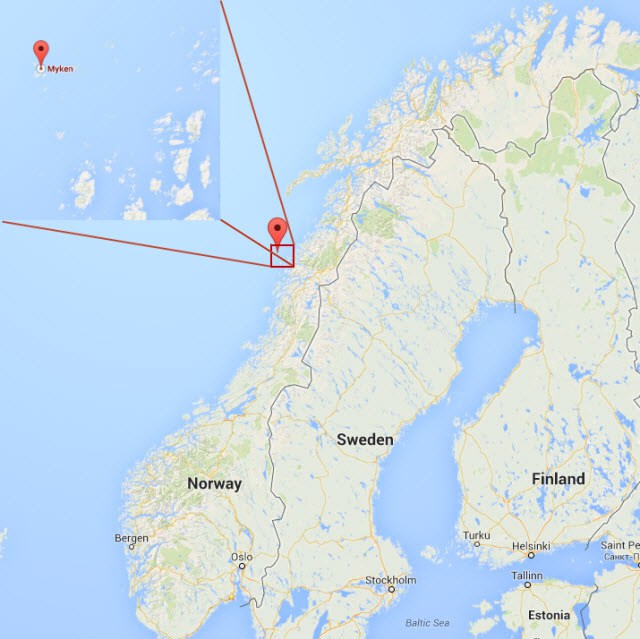
In 2013 a group of six enthusiastic amateurs established the world’s first Arctic whiskey distillery on the tiny island of Myken 32 km off the coast of far-northern Norway.
Myken Disrtillery
Roar Larsen with years of passion for whiskey purchased an old fish factory to house the distillery and applied for a distillation permit after he quit his day job as the chief scientist at Trondheim’s prestigious Sintef institute.
Map of Norway showing Myken
The very special energy of the blurred and almost displaced Myken far into the sea just north of the polar circle has fueled a new life and touch – and strength – in the form of spirits. It began with gin; Myken Arctic Gin is already on sale, and soon also Arctic whisky.
Myken. Photo: Roar Larsen
Myken is Norway’s only dedicated whiskey distillery, and also the world’s northernmost and first Arctic whiskey distillery. “We believe we have a unique opportunity to be recognized in the market as the first whisky distillery in the Arctic,” Larsen told Norway’s NRK news channel.
“Safety, optimism and enthusiasm are what characterize people on Myken,” says Jan Hellstrøm
Jan Hellstrøm and his wife together with five other couples with more or less loose ties to the island community are enthusiastic ambassadors to Myken. They founded the distillery together. “Safety, optimism and enthusiasm are what characterize people on Myken,” says Jan Hellstrøm. “We fell immediately in love with the unique atmosphere on the island,” adds Kjerstin Hellstrøm.
Myken Whisky
The ocean waves are almost washing over the distillery and the warehouse. The enthusiasts believe this is going to be noticeable in the finished product. The distillery uses desalinated sea water straight from the Vestfjorden. The ocean itself delivers plenty of cooling water for optimal processing
From left: Jan Hellstrøm, Trude Tikle, Roger Melander, Trygve Lundheim and Helge Eriksen
So far, the distillery has only used unsmoked malt of barley (light German Pilsner malt), but is now experimenting with other types of cereals and not least smoked malt. So far, they buy the smoked malt (35 ppm) since it gives a more controlled smoke character to the distillate than if it was smoked on a small scale with, for example, local peat.
Roar Larsen (left) and Trygve Lundgeim (right)
However, the desire is to use Norwegian malt, but Norwegian malt is protein rich of so-called sixth grade. For whiskey production, the two-grade structure with its lower protein content is preferable, but it is not cultivated in Norway, except at the experimental farm at Tjøtta in Nordland. From next year, in cooperation with Innovation Norway, they will therefore attempt to cultivate their own malt. This might create ripple effects for beer breweries which are increasingly looking for local produce.
The World’s First Arctic Single Malt Whisky Distillery, compiled by Admin
Group picture: Jan Hellstrøm, Trude Tokle, Roger Melander (Box Whisky), Trygve Lunheim og Helge Eriksen
Here are 6 of the best new Scandinavian Indie acts that are currently rocking out in Scandinavia. Zac Green, chief editor of popular music blog ZingInstruments.com believes that music isn’t just a thing you do – it’s a mindset, an attitude, a way of life.
Are you a fan of indie music? Do you love listening to music from bands you’ve probably never heard of? Read on, because here are 6 of the best new Indie acts that are currently rocking out in Scandinavia.
Lykke Li Li from Sweden isn’t the newest act on this list. Her act has been around for a few years now, but has been predominately in Scandinavia. Her music is a great mix between the elements of Indie and dream pop; with a little bit of electric blended in for good measure. Very different, but her songs have a strange hypnotic way about them.
Siv Jakobsen Hailing from Norway, this artist is already making waves with over 2 million streams on Spotify. She has produced two albums, both of which include dreamy sounds with beautiful lyrics. The strings, quite prominent in her songs, are a perfect complement to her voice.
Her music can be considered quite mellow and has been compared to a cozy night in.
Elliot Elliot has created a very different sound. If you like a weird, dreamlike music that sounds like something David Lynch would like; this is for you. Again from Sweden, this artist was chosen by JaJa as one of the musicians to watch in 2017. His strange music is ideal for any indie lover who really wants a change from the mainstream pop that often dominates the charts.
Hater Sweden certainly can produce music. Hater has a beautiful sound, full of sad but often romantic lyrics. The guitar is the main instrument used in their music to a great effect. Her voice is dreamy and complements their sound perfectly. Not exactly rocking Scandinavia, but is akin to grabbing a warm coffee and sitting next to the fire.
Jacob Faurholt This Danish artist makes the list as one of the best new musicians to keep a look out for. His song ‘A Lake of Distortion’ has a very unique sound that is not heard often in mainstream pop. His melancholy lyrics are often at conflict with upbeat sounds, but amazingly; it works.
Efterklang This indie band from Copenhagen produces some truly stunning music. Mixing dream pop, electronic and dark wave; they have created a wonderful sound that is easy listening for any night. They have three core members but keep their music interesting by constantly adding supporting or guest members to add to their sound. A great band to look out for.
There you have it; 6 of the best newish indie musicians that are rocking Scandinavia. Some have enjoyed success in various countries; all are fantastic musicians that deserve to be heard.
Feature image (on top): Jacob Faurholt (Photo: You Tube)
Per Inge Bjørlo and Lena Cronqvist are two of the most pivotal artists in the Nordic region. Their meeting with Munch results in a powerful exhibition, Head by Head, at the Munch Museum in Oslo. The exhibition studies and illuminates the loneliness, the fragility and sorrow within human existence.
The exhibition’s title, Head by Head, has been taken from a painting by Munch. This work depicts a woman’s head leaning in to the head of a man. Trustfully, the woman closes her eyes, whereas the man’s cold gaze stares somewhat aloofly ahead.
Painting by Edvard Munch
The imbalance in the expressions of the two heads says much about the complex relationship between human beings and depicts how difficult it can be to achieve mutual trust, security and affinity. This psychological tension can be seen as a metaphor for the entire exhibition, as Bjørlo and Cronqvist explore and render visible the loneliness, fragility and sadness that is present in our modern existence.
Since the 1980s, the often-painful existence we have as human beings has been the driving force behind Bjørlo’s art, and he himself has stated that life is a question of keeping alive a “scream within ourselves”.
Lena Cronqvist with wind in her hair
Cronqvist became a pioneer with the way she incorporated her own private experiences in to her work in order to expose her own sorrow and pain.
In the exhibition, the work of the two artists is placed together with a selection of works by Edvard Munch. The result is an exhibition that invites us to reflect upon the deepness and universality of loneliness and impermanency.
The exhibition consists of paintings, graphic works, drawings, sculptures and a full-room installation created by Bjørlo especially for the occasion. As we enter, we meet Munch’s painting Anxiety (1894), which, like Bjørlo’s room, thematizes human despair.
The exhibition’s central room serves as an important meeting point between Munch, Bjørlo and Cronqvist. Here, Bjørlo’s abstract sculptures meet Cronqvist’s cast-bronze girl figures. On the end wall you can see Cronqvist’s well-known paintings of young girls with their grotesque dolls.
Madonna, ny Lena Cronqvist
The meeting of works highlights the similarities, both in terms of artistic style and motif, with Munch’s Four Girls in Åsgårdstrand (1903) and Two Girls with Blue Aprons (1904-5). Never before have the works of Cronqvist been exhibited in Norway to such an extent as in the exhibition Cronqvist/Bjørlo/Munch.
The exhibition is on display through 28 January 2018
Lena Cronqvist (b. 1938) grew up in Karlstad, and lives and works in Stockholm and on Koster.
For one year, she attended Konstfack in Stockholm. She then chose to transfer to the Royal Academy of the Art in Stockholm.
The Ice, by Lena Nordqvist
Cronqvist made her breakthrough in the 1970s. Since then her exhibitions in the Nordic region and abroad have attracted great interest. Her most recent major solo exhibition was in Liljevalchs Konsthall in Stockholm in 2013.
Per Inge Bjørlo (b. 1952) grew up in Spjelkavik, and lives and works in Hønefoss. Bjørlo is regarded as one of Norway’s most important living artists. He studied at the Bergen School of Arts and Crafts and the National Art Academy. Bjørlo made his breakthrough in 1984 at the Henie Onstad Art Centre. He represented Norway at the Sao Paulo Biennale in 1985 and the Venice Biennale in 1988. Since then he has exhibited to wide acclaim at home and abroad. In 2011 he won the Critics’ Award for his solo exhibition at the Henie Onstad Art Centre.
Curator for the exhibition is Kari Brandtzæg
Installation, by Per Inge Bjørlo
Head by Head with Edvard Munch in Oslo, source: Munch Museum, Oslo
The present Royal Palace (Kungliga Slott) was built in the site of the Tre Kronor Palace, which burnt down in 1967, some say not without the help of Nicodemus Tessin the Younger, who had already built a new northern wing and who obviously relished the glory of rebuilding the palace to his Renaissance designs.
His father, Nicodemus the Elder, had been architect to the old Tre Kronor Palace, and the grandson, Carl Gustaf, was responsible for supervising the completion of the new palace many years later. The palace comprises 608 rooms. Various suites are open to the public – the stunning Royal Apartments are what most people go to see – and the sprawling palace houses three museums. Lovers of military uniforms and marching can watch the 40-minute Changing of the Guard ceremony in the outer courtyard.
The Royal Palace in Stockholm. Photo: Dick Norberg
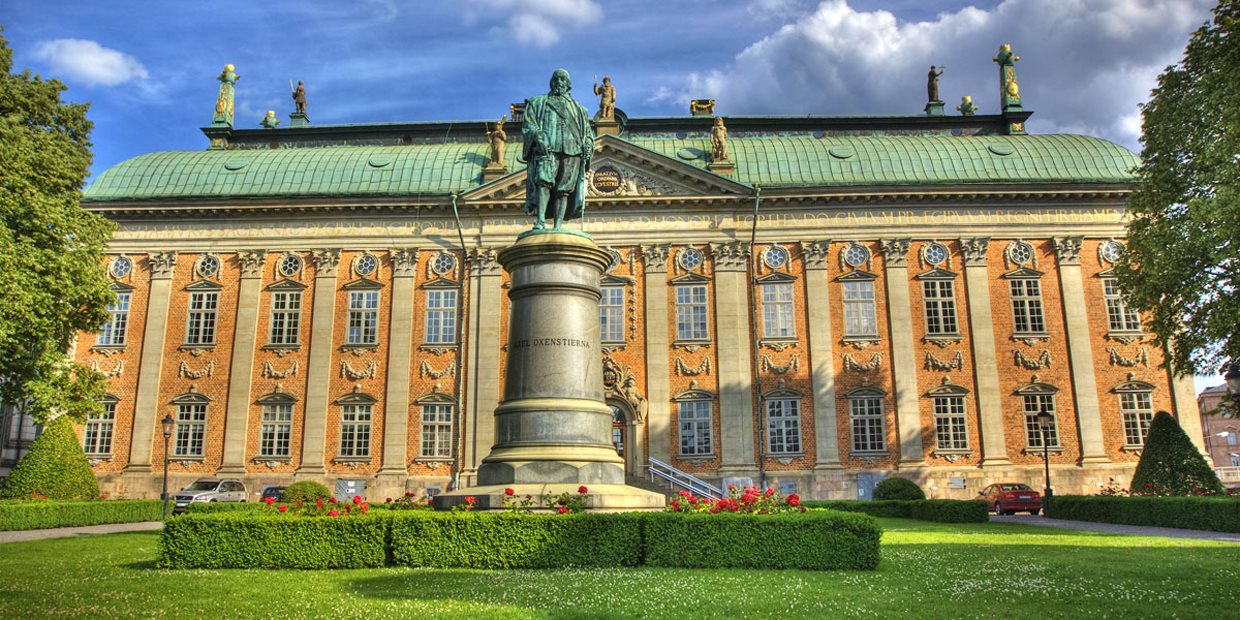
For more of Sweden’s aristocratic heritage head for the House of Nobility (Riddarhuset) on the nearby island Riddarholmen, built 1641 as a meeting place for the nobles. It is arguably the most beautiful building in Gamla Stan, with two pavilions looking out across the water.
House of Nobility, Etockholm (Photo Visit Sweden)
Inside, the nobles deliberated in the grandeur of the Main Chamber, watched from above by a painting of Mother Svea, who symbolizes Sweden.
Riddarholmskyrkan, Stockholm (Photo: Wikimedia commons)
On the opposite side of Centralbron is Riddarholmskyrkan, an iron-spired 13th century monastery church (the oldest in Stockholm) that serves as the burial place for Sweden’s monarchs.
Royal Residences in Stockholm, written by Tor Kjolberg
Feature image (on top): The Blue Room, House of Nobility, photo: Henrik Sundholm (Flickr)
Norwegian regional airline Widerøe is the first airline in the world to use the Embraer E-Jet E2 family on commercial flights. This is also a milestone in international aviation history.
Widerøe will then connect Western Norway with Northern Norway in a more efficient and fast way. On 24 April next year, Widerøe’s new family member, LN-WEA, takes off from Bergen Airport Flesland to Tromsø Airport Langnes. This flight is getting International attention as Widerøe is making its 114-seat regional jets available to the public for the first time.
The 114-seat cabin in Embraer E190-E2
The E190-E2 is the next generation environmentally friendly aircraft and will contribute to a sustainable future for Norwegian aviation and for Widerøe. Through the investment in new aircrafts, Widerøe takes greater responsibility in the climate challenge and creates the prerequisites for continued growth.
The delivery of three E190-E2s with an option for additional 12 aircrafts is a massive accreditation of Widerøe and a big leap in the company’s long history of turboprop operations. The first aircraft is to be delivered March 2018.
Widerøe CEO Stein Nielsen
“We believe that the link between the fjord and mountains in western Norway and the exciting nature in northern Norway with northern lights and midnight sun will be one of the strongest tourism products in Europe in the next few years,” says Widerøe CEO Stein Nilsen.
Flight-deck in Embraer E190-E2
CEO of Embraer, John Slattery, and his team visited the Widerøe facilities on several occasions before the decision was taken. The fact that one of the biggest aircraft manufacturers in the world selected Widerøe as their launch customer is a huge honor to the organization.
Embraer is the leading manufacturer of commercial jets up to 130 seats. The company, headquartered in Brazil, maintains industrial units, offices, service and parts distribution centers, among other activities, across the Americas, Africa, Asia and Europe. Since the company was founded in 1969, Embraer has delivered more than 8,000 aircrafts. All images: Widerøe/Embraer
Norwegian Air Carrier’s World Premiere of New Generation Aircrafts, written by Tor Kjolberg
The Swedish start-up company Northvolt said last week it had selected the coastal town Skelefteå north-east in Sweden for its electric car battery factory.
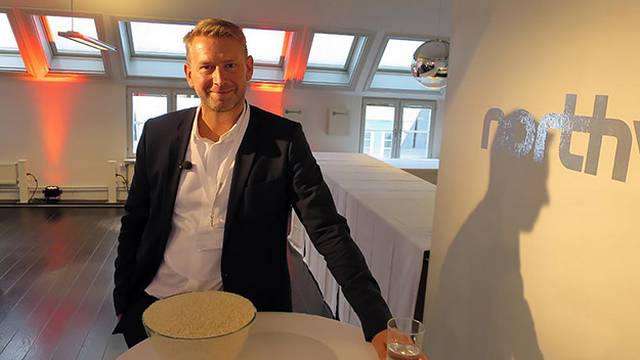
The two people behind the startup company are two Tesla Motor veterans, CEO Peter Carlsson and chief operating officer Paolo Cerruti. Skelefteå is a perfect site for such a plant due to its access to key raw materials, such as nickel, cobalt, lithium and graphite.
Map of Sweden
Northvolt will then be a rival to Tesla’s U. S. ‘Gigafactory’ and South Korea’s LG Chem’s proposed site in Poland. However, the company continues to seek the billions of euros needed to finance the scheme. Carlsson admitted in an interview with the Financial Times, that funding would be “the most challenging” issue.
CEO Peter Carlsson
The aim is to be capable of making 32 gigawatt-hours of battery packs a year by 2023, at a cost of just over 4 billion euros. The batteries will be aimed at electric cars and other new energy vehicles (NEVs), renewable energy producers looking for electricity storage, as well as industrial companies.
Green transport
Europe is making 20% of the global vehicle market, 18 million units a year, and the increase in EV penetration increases the incentive for large-scale battery-production for the close markets.
Electric car battery
The plant located in Skelefteå will eventually employ 2,000-2,500 people while the research and development operations will be set up in Västerås, west of Stockholm.
The proposed Northvolt site
“If environmental processes and other permitting moves as planned, we will be able to put the shovel in the earth during the latter part of 2018,” Carlsson told a news conference. It is planned to raise production gradually between 2020 and 2023.
Europe’s Largest Battery Factory for Electric Cars to be Built in Sweden, written by Tor Kjolberg
One of Norway’s greatest Olympians and winter sport athletes, Aksel Lund Svindal, promotes the best spots to enjoy Norway’s ski season in a new video.
The Olympic winner and skiing athlete will show the world the fantastic skiing opportunities in Norway. In a video launched by Visit Norway, he takes viewers on a personal journey, from the Lyngs Alps in the north to the mountain areas of Eastern Norway.
Aksel Lund Svindal
“I was lucky to have been born into a family that took me skiing from an early age (3), and I’m grateful to have realized many of my dreams and have experienced great victories at big competitions,” says Svindal.
Aksel Lund Svindal in the slopes (Photo: Red Bull)
“Aksel enjoys great respect in the field of skiing, and few, if any, have greater credibility than him when he says ‘When it comes to skiing, Norway has everything’. We believe this video, with such a well-known ski profile will bring people’s attention to everything Norway has to offer as a ski destination, says Bente Bratland Holm, Director of Tourism Norway in Innovation Norway.
Aksel Lund Svindal, offpiste in Loppa
It’s been said that Norwegians are born with their skis on and no one can make the skies run faster than Aksel. He’s not just a winner, but also a gentleman and a great role model.
“In terms of skiing, Norway has actually absolutely everything. The possibilities for skiing in Norway, both when it comes to the ski resorts and the people and culture you meet, are what’s made me the Alpinist I am today,” says Aksel Lund Svindal to Visit Norway. “I’m still having lots of fun skiing mountains around the world and hope to keep doing so for several years to come,” he adds.
Aksel Lund Svindal is also a gentleman and a great role model
Now, as a part of an international ski campaign, the personal ski video is launched by Visit Norway. The film, promoting skiing in Norway, gives an insight into Svindal’s first experiences in the downhill fields and how this made him a world champion and Olympic winner a few years later.
The slopes in Geilo
The film also shows the great diversity of Norwegian Alpine products, and hopefully gives viewers inspiration in addition to some goosebumps’ moments. “We hope this video will give our destinations and resorts the visibility they deserve,” says genral manager at Norske Fjell AS, Camilla Sylling Clausen.
The video takes viewers skiing along snowy mountains in Geilo, Kvitfjell, Varingskollen and the Lyngs Alps. The destinations were chosen to show the diversity of Norwegians ski resorts.
Downhill in Kvitfjell
Come Follow My Path to Skiing in Norway, is based on a press release from Visit Norway
Scandinavian people have a predilection for anything with fish eggs, something that we share with the Russians. We love the roe from lumpfish, cod and all its relatives, and also from vendace and powans which are inhabitants of primarily Swedish lakes and produce particularly delicious and expensive roe.
Like the rest of the world we also enjoy the shine, orange beads from sea trout and salmon, though while they are lovely as a garnish they are a bit too oily to eat on their own.
Boiled cod roe
Maybe we have become too conservative in our choices, and eating roes from a wider variety of fish certainly makes good sense, given the ongoing problem of overfishing in our seas and oceans. Already some of the most popular roes, including from cod, have moved from everyday staple to luxury.
While roes vary in texture and color, they all share a breezy sea taste – un the same way oysters and mussels do – and a sweet, mineral-rich flavor.
Hot smoked cod’s roe
Buying and storing Roes are seasonal treat, to be eaten fresh in early spring.
They can be bought fresh and unsalted (sometimes in the membrane), salted or smoked, depending on the type. Cod’s roe, flatfish roe and herring roe are usually bought fresh, to be cooked at home, while other types of roe are often bought salted and are eaten raw.
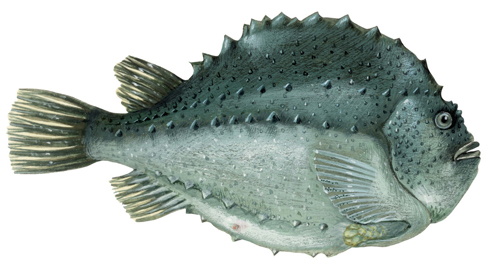
Cyclopeterus lumpus (lumpfish)
Salmon, trout and lumpfish roes can be bought either salted and cleaned, or come in a whole membrane, to be cleaned and salted at home. Preserves of roes are not worth the cost and will deprive you of the seasonality and taste of fresh roes.
As with all other food from the sea, roe must smell invitingly fresh. You should generally steer clear of frozen roes, except for those of the vendace and powan – they are so small that they are not really affected by freezing. Canned roes (of cod or salmon, for example) are not to be recommended; they are too oily and salty, without the fresh sea taste of the real stuff.
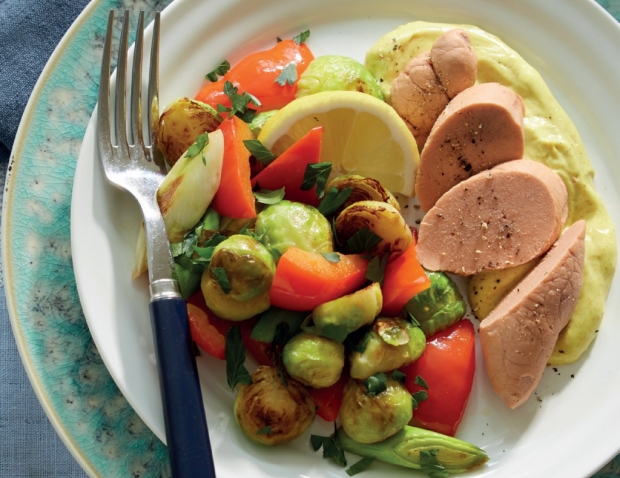
Cod’s roe dish
Health benefits Fish roe is rich in minerals, vitamins and omega 3 fatty acids.
Culinary uses Cod’s roes, flatfish roes and herring roes are boiled or fried whole and eaten hot for dinner with a rich sauce and potatoes – if fried alongside, or baked inside, the fish, they have a very different soft and creamy consistency – or eaten cold on an open sandwich.
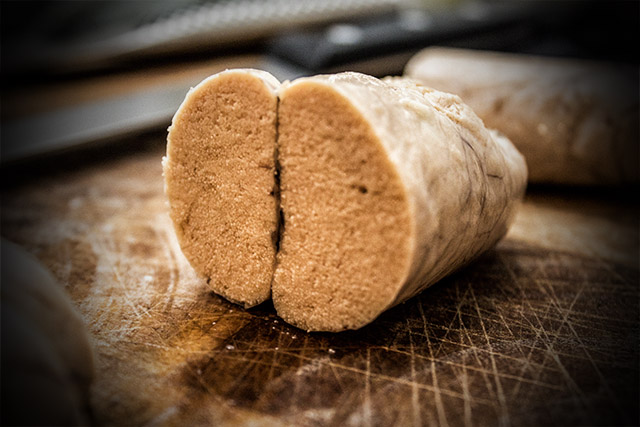
Cooked cod’s roe
Salted salmon, trout, lumpfish and vendace roes are never heated, but eaten as a topping on open sandwiches, or as garnish for all kinds of dishes with fish, as a starter with blinis or potato pancakes, lemon, crème fraiche and sharp sweetness from the onions is just perfect.
Cod’s roe All over Scandinavia, cod’s roe – and of the cod’s many relatives, often sold as cod’s roe – is very popular. It is also versatile, and can be eaten either fresh (boiled or fried) or smoked. But while eating cod’s roe used to be an everyday experience, since strict fishing quotas have been imposed ut has become very expensive.
Canned cod’s roe
Fresh cod’s roe is in season in early spring. Try to buy small roes, about the size of two fingers, as they are by far the most delicious, creamy and sweet; the large cod’s roes can be rather coarse and grainy, mainly because the eggs are too mature. The eggs must have intact membranes, or the roe will be impossible to prepare, whether it is to be boiled, fried or smoked. No cleaning is required.
Boiled whole cod’s roe is delicious served plain and hot for dinner, with potatoes and lemon and a rich sauce, such as egg sauce or the hollandaise. The boiled, cooled roes can also be sliced, fried in butter until crisp, and served with same accompaniments. Boiled and cooled, cod’s roe makes a classic open sandwich, sliced on rye bread with a lemony mayonnaise or remoulade, fresh dill and lemon. This is seasonal food at its very best.
Egg and roe sandwich
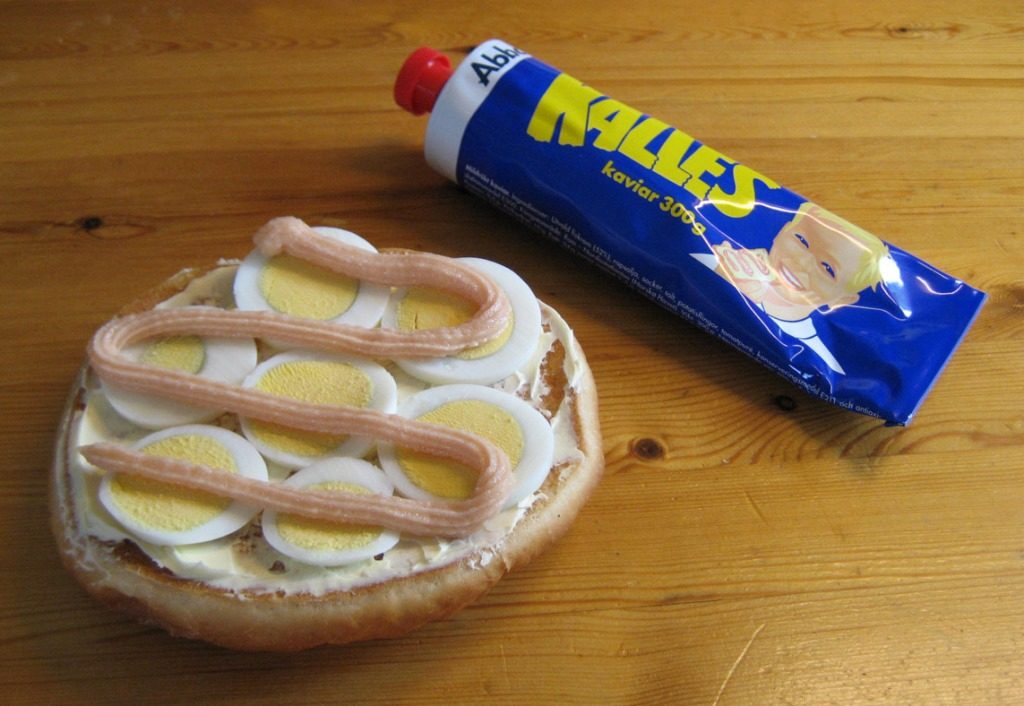
Smoked cod’s roes, and roes from many of its relatives often sold as cod’s roes, are a delicious topping for open sandwiches, either hot or cold smoked. The hot-smoked version is browned on the outside and firm inside, and is easy to make at home; it is delicious on rye bread with a homemade mayonnaise and lemon. Cold-smoked cod’s roe looks like amber and is soft. It’s either spread on toast or rye bread as it is, or made into a Nordic version of taramasalata, with crème fraiche and/or mayonnaise, dill and black pepper, to beaten, preferably, on crispbread. This is the real thing compared to the ever-popular Nordic industrial spread sold in tubes in every supermarket. This is eaten in crispbread often with hard-boiled egg and cucumber, and I must confess it vis actually rather good, even if purists enjoy disliking it.
Cooking cod’s roe
Boiled cod’s roes Wrap the roes in separate parcels of parchment paper, making sure the packages are even in size; you can put several small roes together in one parcel. Arrange them tightly in a pan and cover with cold salted water (allow 1 generous handful of salt per 2 liter of water). Bring slowly to the boil.
Small roes need to cook for 3 minutes from boiling point, huge ones 10 minutes. Take the pan from the heat and let the roes cool in the water. If you aim to eat them as they are, let them steep in water for 15 minutes. Remove the outer membrane before eating.
Cod’s roes must be boiled the day they are bought, after that, they will keep for 2 days in the fridge.
“Caviar” in tube
Herring roe The eggs of herring roe are large, and a little gritty, and must be fried or baked. It was once common to eat herring roe but now very few people do, maybe because many regard fresh herrings with disrespect as poor man’s food. As a result, it can be hard to find herring roes, but they are delicious.
Lofot caviar
Flatfish roe Personally, I like creamy, pale roes from flatfish such as sole and turbot; these are usually fried or baked alongside or inside the fish they come from, and are eaten as a bonus with the fish.
Vendance and powan roes Several fish in the Coregonus family, part of the salmon family, yield the most expensive and delicate of all the Scandinavian roes. It is usually called løjrom, no matter what the fish. The Kalix løjrom, from Sweden, is a protected name, and is always from the Coregonus albula, or vendace, a small, silvery fish living in the Baltic. It is eaten as it comes, raw, but salted, in small quantities, like real sturgeon caviar. It’s delicious just served on plain toast with a little lemon, dill and crème fraiche, and onion or chives; as a topping for boiled, baked or fried fish; or with potato pancakes.
If you buy frozen vendace or powan roes, open the package and let is thaw in the fridge, if large; however, very few people can afford a package too large to be thawed on the kitchen worktop in an hour. Eat within 2 days, as long as correctly stored in the fridge.
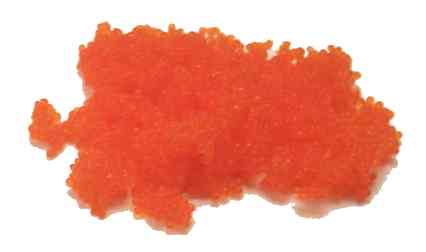
Frozen salmon roe
Salmon and sea trout roe You can buy these large beaded beauties fresh when they are in season, in early spring; or you may be lucky enough to buy (or even catch) a whole fish with the eggs inside. Salmon roe can be bought fresh, already cleaned and salted, but it’s not difficult to do it yourself, as with lumpfish roe.
Lumpfish roe
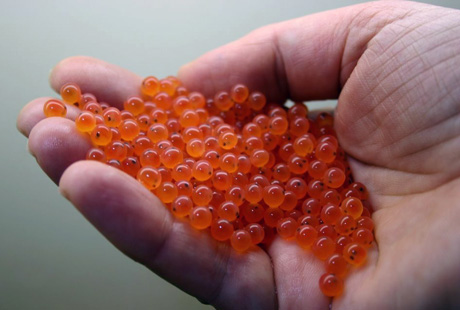
Lumpfish roe Fresh lumpfish roe can look like a weird glow.in-the-dark toy, the spooky fluorescent sheen caused by unharmful algae. In Scandinavia, roes from the female lumpfish are abundant in spring (the fish itself is extremely ugly and flabby and is not eaten), rather expensively, or not cleaned, very cheaply; or you may be lucky enough to catch or buy a whole fish with the eggs inside. It is not difficult to clean the roes yourself, but it’s not a job for the faint-hearted as the giant bag filled with millions of rosy beads looks positively monstrous. When salted, the roes will keep for 3-4 days in the fridge.
Lumpfish roe is rosy by nature, and we unfortunately have a bad habit of dying it dark grey, black or very red (to imitate sturgeon roes) and marketing it as ‘caviar’ sold in glass jars. It’s a mess on the plate, is too salty and has a strange chemical taste. In short, it is disgusting in every way and should be avoided.
Lumpfish roe is eaten like løjrom, with blinis or crisp potato pancakes, or just plainly on rye bread or toast. It’s often paired with crème fraiche, lemon juice and red onion.
Pressure treated fish eggs
How to clean and salt roes Salmon, trout and lumpfish roes must be cleaned and salted before use.
Put the whole roe, inside its membrane, in a large bowl with a handful of coarse salt. Add cold water almost to cover. Whisk with a balloon whisk until the non-edible parts cling to the whisk; you amy have to clean the whisk several times. Rinse through a fine sieve and clean under the cold tap, then leave to dry off any excess moisture. Adjust the salt – yoy ant enough to bring out the falvour, bit not too much. Eat within 3 days.
Bang & Olufsen’s new Beolab 50 speakers delivers truly exceptional performance with innovative sound controls and a uniquely unfolding design. The Danish Hi-Fi company let us listen to the future of sound now.
First time we listened to the Beolab 50 we were literarily floored by the sound, and we were impressed by the trickle-down tech. Bang & Olufsen is known for their tasteful design, and the Beolab 50 speakers are no exception. If you can afford five figures on a pair of floor speakers – then you should consider a switch.
Bang Olufsen’s Beolab 50 – a Danish audio heaven
In our opinion these high-end speakers combine advanced sound technology with elegant, aesthetic and meticulous craftsmanship.
Beolab 50 in a living room
$20,000 per speaker is indeed a massive price tag, but if you’re a sound nut they may be worth at least a test drive. And best of all, the beautifully designed centerpiece device will certainly stand out in a room rather than be hidden away in a corner.
The BeoLab 50 speakers originates from the ground breaking Beolab 90, which raised the standards for state-of-the-art speakers when they were released by the end of 2015. Each of the speakers is equipped with seven drivers with individual 300-watt built in amplifiers, and reads a room’s acoustics and modifies the sound output to suit its needs.
“From the magical moment when the acoustic lens majestically rises up and slowly opens towards its audience, you have no doubt that you can expect a sound experience out of the ordinary,” is rightfully described in Bang & Olufsen’s own promotion for the products.
For our tech nerds readers we will point out that a pair of the powered speakers can be linked up into a master-slave configuration to source wired audio directly, but each individual speaker also features WiSA technology for high-resolution wireless connectivity.
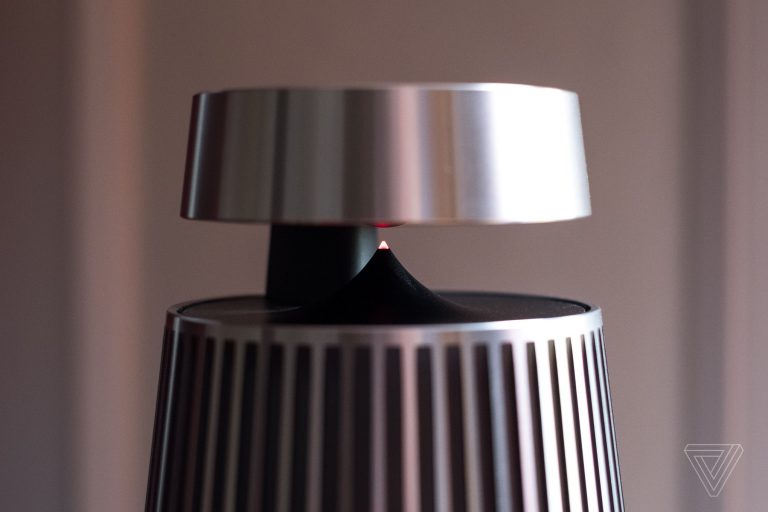
Beolab 50 “acoustic lens”
As a nice touch, hidden on top of the device is a three-fourths-inch tweeter that the company calls an “Acoustic Lens” that rises out of the speaker when you turn it on. The Bang & Olufsen engineers and designers have not unexpectedly done it again!
Listen to the Danish Future of Sound, written by Tor Kjolberg






 Per Inge Bjørlo (b. 1952) grew up in Spjelkavik, and lives and works in Hønefoss. Bjørlo is regarded as one of Norway’s most important living artists. He studied at the Bergen School of Arts and Crafts and the National Art Academy. Bjørlo made his breakthrough in 1984 at the Henie Onstad Art Centre. He represented Norway at the Sao Paulo Biennale in 1985 and the Venice Biennale in 1988. Since then he has exhibited to wide acclaim at home and abroad. In 2011 he won the Critics’ Award for his solo exhibition at the Henie Onstad Art Centre.