What Happened on 10 December, the Date That New Laureates Received Their Nobel Prize?

The banquet began with the royals and other guests of honor entering the banquet hall in procession. Before that, the guests of honor had been introduced to the royal family in the Prince’s Gallery. Read on and learn more about what happened on 10 December, the date that new laureates received their Nobel Prize.

Since 1901, the Nobel Prizes have been presented to new laureates at ceremonies on 10 December, the anniversary of Alfred Nobel’s death. At the banquet, for which a formal dress code exists, a multi-course dinner is served and entertainment provided. After the dinner, a dance is held in the Golden Hall. The event is broadcast live on Sveriges Television (SVT) with generally high ratings.

What Happened on 10 December, the Date That New Laureates Received Their Nobel Prize?
From the Golden Hall. Photo: Wikipedia.

The award ceremony in Stockholm has, almost without exception, taken place at Konserthuset Stockholm (the Stockholm Concert Hall) since 1926. In Oslo, the ceremony was for many years held at the Nobel Institute. From 1947 to 1990, the setting was the University of Oslo auditorium. In 1990, the event moved to the Oslo City Hall. At the Nobel Prize award ceremony in Stockholm, speeches are presented by the laureates and their discovery or work, after which His Majesty the King of Sweden hands each laureate a diploma and a medal.

Guests are welcomed into the Blue Hall and requested to take their seats around 30 minutes before 19:00, when the guests of honor march in procession to an organ and trumpet fanfare. Three minutes after the guests of honor have taken their seats, a toastmaster or toastmadame (a Swedish university/college student) calls for two ceremonial toasts: a toast for the Swedish monarch made by the chairperson of the Nobel Foundation, and a toast made by the monarch in memory of Alfred Nobel.

What Happened on 10 December, the Date That New Laureates Received Their Nobel Prize?
The Nobel Prize medal.

Soup and turbot on the menu

When all 1,300 or so guests had toasted last Wednesday, a festive menu was served on fine china in the Blue Hall. Chefs Pi Le and Tommy Myllymäki prepared the meal. The menu included porcini mushroom soup and turbot stuffed with scallops.

For dessert, pastry chef Frida Bäcke created Swedish sloe sorbet.

Composer Jacob Mühlrad was responsible for the music at the Nobel Banquet. In addition to newly written music, he also offered an interpretation of “One” by Swedish House Mafia.

Artist Alexander Wessely created the light show during the banquet. He has previously collaborated with Jacob Mühlrad and with artists such as Swedish House Mafia and The Weeknd.
What Happened on 10 December, the Date That New Laureates Received Their Nobel Prize?
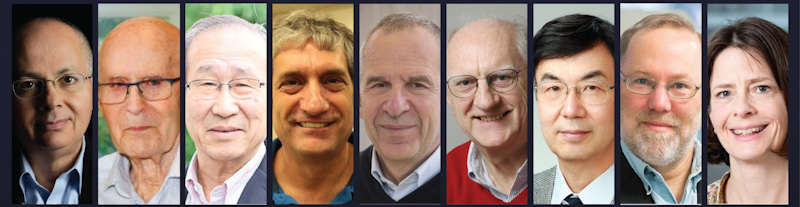
The Nobel Prize Winners 2025.

***********************************************
You may also like to read Danish Nobel Winner Foiled the Führer

***********************************************
The banquet hosts approximately 1,300 guests. Up to 88 guests of honor (including the laureates and their spouses or partners, together with the Swedish royal family) are seated at the table of honor, located in the middle of the Blue Hall and decorated with flowers provided by the Italian municipality of Sanremo (where Alfred Nobel spent his final years of his life); the other guests sit across multiple tables surrounding the table of honor and throughout the City Hall.

During the banquet, artistic interludes called divertissements (French for ‘diversions’ / ‘entertainments’) are performed by Swedish performing arts talent, and can range from music and dance performances to theatrical presentations and (in the case of the 2002 banquet) even circus acts; these performances (and the floral arrangements of the banquet) are connected by a unique theme or narrative that defines the banquet each year. After the banquet, guests can dance inside the Golden Hall.

From the royal family, King Carl Gustaf, Queen Silvia, Crown Princess Victoria, Prince Daniel, Prince Carl Philip, Princess Madeleine, and her husband Christopher O’Neill attended. Princess Sofia, however, announced early last fall that she would not be attending.

This year, Crown Princess Victoria sat between the two chemistry laureates Susumu Kitagawa and Omar M. Yaghi. Thomas Perlmann, Vice Chairman of the Nobel Foundation Board, had the Queen at the table, and the King had Nobel Foundation Chairwoman Astrid Söderbergh Widding as his lady-in-waiting.

One of the guests was former German Chancellor Angela Merkel.

What Happened on 10 December, the Date That New Laureates Received Their Nobel Prize?
The Nobel Peace Prize Ceremony takes place in Norway. Here, from the Town Hall in Oslo.

As stipulated in the will of the Swedish-born inventor and international industrialist Alfred Nobel, which was opened after his death in 1896, the Nobel Prizes in physics, chemistry, physiology or medicine, and literature are awarded in Stockholm, Sweden, while the Nobel Peace Prize is awarded in Oslo, Norway. Since 1969, an additional prize has been awarded at the Stockholm ceremony: the Sveriges Riksbank Prize in Economic Sciences in Memory of Alfred Nobel, established in 1968 to mark the Riksbank’s 300th anniversary.

***********************************************
You may also like to read Controversial Nobel Peace Prize Winners

************************************************
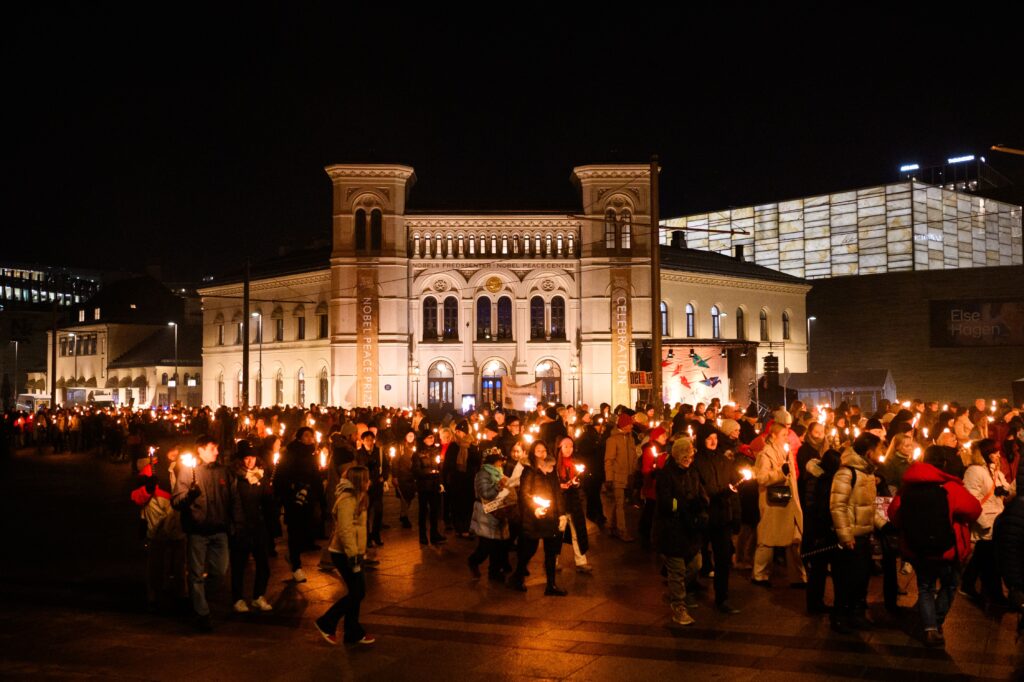
What Happened on 10 December, the Date That New Laureates Received Their Nobel Prize?
The Nobel Peace Center in Oslo.

In Oslo, the Nobel Peace Prize is presented by the chairman of the Norwegian Nobel Committee in the presence of Their Majesties the King and Queen of Norway, the Government, Storting representatives, and an invited audience. Several hundred seats are reserved for individuals with special reasons for attending the ceremony. Later the same day, the Norwegian Nobel Committee hosts a banquet in honor of the laureate or laureates, with special guests. The Nobel Peace Prize 2025 was awarded to Maria Corina Machado “for her tireless work promoting democratic rights for the people of Venezuela and for her struggle to achieve a just and peaceful transition from dictatorship to democracy.” She arrived too late to attend the ceremony due to the complex logistics from Venezuela, but arrived the next day.

What Happened on 10 December, the Date That New Laureates Received Their Nobel Prize?
Nobel Peace Prize winner 2025 Maria Machado. Photo: Al Jazeera.

The 2025 Nobel Prize winners, announced in October 2025, include John ClarkeMichel H. DevoretJohn M. Martinis (Physics); Susumu KitagawaRichard RobsonOmar M. Yaghi (Chemistry); Mary E. BrunkowFred RamsdellShimon Sakaguchi (Physiology or Medicine); László Krasznahorkai (Literature); Maria Corina Machado (Peace); and Joel MokyrPhilippe AghionPeter Howitt (Economic Sciences) for their significant contributions in their respective fields.

What Happened on 10 December, the Date That New Laureates Received Their Nobel Prizes? Tor Kjolberg reports.


A Guide for Adult Children Caring for Their Parents

Caring for a parent as an adult child rarely starts all at once. It usually creeps in. A forgotten appointment here, a repeated story there. You help with groceries. Then paperwork. Here’s a guide for adult children caring for their parents.

Suddenly, you are the one quietly checking the calendar, the medication bottles, the way the house feels at night.

It can feel strange. Tender, even. Also heavy in ways you might not have expected. You are still their child, after all. But now you are also a steadying hand in the background, figuring things out as you go. This guide is not about doing it perfectly. It is about doing it mindfully, with some room to breathe.

Start With Conversations That Feel Human

Before checklists and schedules, start with conversations. Not the big dramatic sit down if you can avoid it. Smaller, gentler ones tend to land better.

Ask how they feel about specific changes. What worries them. What they want help with and what they would rather keep handling themselves. You may hear things you did not expect. You may listen to the same concern twice. That is okay.

These talks are less about solutions and more about trust. When trust is there, decisions later feel a little less sharp around the edges.

A Guide for Adult Children Caring for Their Parents
It helps to remember that dignity is part of care.

Respect Independence While Offering Support

One of the most complex balances is helping without taking over. Parents often fear losing their independence more than they fear aging itself.

Look for ways to support without rewriting their routines. Maybe it is organizing documents rather than handling every phone call. Perhaps it is setting up reminders instead of daily check-ins. Sometimes, safety tools like a Life Assure medical alert can quietly bridge that gap, offering reassurance without hovering. It helps to remember that dignity is part of care. So is patience. Both take practice.

Make Space for the Practical Stuff

At some point, practical matters need attention. Medical appointments, insurance paperwork, legal documents, household logistics. None of it is glamorous. All of it matters.

Try not to do everything in one push. Small chunks are more manageable and easier to revisit. Lists help. So do shared folders. So does admitting when you do not understand something yet. You are allowed to learn as you go.

A Guide for Adult Children Caring for Their Parents
Pay attention to your energy, your mood, even your patience.

Watch for Role Strain, Including Your Own

It is easy to focus entirely on your parent and miss how the role is affecting you. Caregiving can stretch quietly. One more task. One more call. One less evening to yourself.

Pay attention to your energy, your mood, even your patience. These are signals, not failures. When something feels heavier than usual, it usually is.

Building a small support circle matters. A sibling, a friend, even a professional who understands caregiving dynamics. You do not have to carry everything alone to be doing a good job.

Allow the Relationship to Change Without Losing It

The relationship will shift. That can feel uncomfortable. Sometimes it feels sad. Other times, it opens up moments of closeness you did not expect.

Try to preserve space for a connection that is not about care. Talk about everyday things. Watch something familiar together. Laugh when it shows up. Those moments matter more than they seem.

Caring for a parent is not a straight path. It loops. It pauses. It doubles back. You will do some things well and some things imperfectly. That is not a flaw in the process. That is the process. And showing up, even in the messy parts, is already doing something meaningful.

A Guide for Adult Children Caring for Their Parents, written for Daily Scandinavian by Jeremy Bowler. Jeremy is a full-time copywriter with 5 years of experience, specializing in business and finance. Jeremy graduated from the University of Chester with a 2:1 in business accounting and finance in 2005. He’s an avid traveler, has taught English in Nepal, Malaysia, and Japan, and has produced copy for Neil Patel, Entrepreneur, and Metro, among many other high-end publications.

Feature image (top) © Matthias Zomer/Pexels

Healthcare in Denmark

0

Denmark’s healthcare system is a high-quality, tax-funded, universal system providing free care to all residents, organized across national, regional, and municipal levels, with GPs acting as gatekeepers to specialist and hospital care. However, patients pay for certain services, such as dental care and certain medications. Read on and learn more about healthcare in Denmark.

At the national level, the state oversees the regulation and supervision of health and elderly care services.

The country’s five regions manage hospital care—including emergency services and psychiatry—as well as healthcare provided by general practitioners (GPs) and private specialists.

Your first point of contact is a General Practitioner (GP). They provide basic treatment, preventive care, and referrals to specialists or hospitals.

The regions operate public hospitals that provide specialist consultations, advanced diagnostics (E.g., X-rays), and complex treatments.

GPs act as gatekeepers, controlling access to most secondary care services and ensuring efficient resource use.

Healthcare in Denmark
Healthcare in Denmark – an overview.

Danish government healthcare expenditures amount to approximately 10.4% of the GDP, of which around 84% is funded from regional and municipal taxation redistributed by the central government. Because necessary healthcare is taxpayer-funded, personal expenses are minimal and typically limited to copayments for certain services. Those expenses are usually covered by private health insurance.

Meanwhile, Denmark’s 98 municipalities are responsible for a range of primary health and social services, including elderly care, rehabilitation outside hospitals, home nursing, child dental and nursing services, and physiotherapy. Municipalities also co-finance regional rehabilitation services and training facilities.

*****************************************
Related: Nordic Healthcare: Why Scandinavians Are So Healthy?

*****************************************

Healthcare is mainly free of charge, but you pay for things like:

  • Most prescription medicines (though subsidies exist).
  • Dental care (for those over 21).
  • Physiotherapy, psychology, and some other therapies.

Use of electronic health records is widespread, and efforts are underway to integrate these at the regional level.

Healthcare in Denmark
Danish government healthcare expenditures amount to approximately 10.4% of the GDP, of which around 84% is funded from regional and municipal taxation redistributed by the central government. Photo: VIA University Exchange.

For every 1,000 people in Denmark, there are about 3.4 doctors and 2.5 hospital beds. Hospital facilities account for 43% of total health care spending, above the OECD average, despite a considerable decrease in the number of beds. Child vaccination coverage is over 90%. Mortality from heart disease declined through 2015, while life expectancy increased.

**********************************************
Related: Comparing Nordic Healthcare Systems: Similarities and Differences

**********************************************

Performance of Danish healthcare

Life expectancy in Denmark

Denmark has made dramatic advances in reducing heart disease mortality, according to the Euro Health Consumer Index.

Life expectancy in Denmark has increased from 77.9 years in 2005 to 81.3 years in 2019. Danish women have a higher life expectancy (83.2 years in 2019) than Danish men (79.3 years in 2019).

For guidance on health insurance and access to services, the Danish Patient Safety Authority acts as a central resource. As part of the Ministry of Health, it offers general information about the healthcare system and helps patients navigate their options.

Each region also has a patient office, where advisers can provide guidance on available treatments. Both the Danish Patient Safety Authority and regional patient offices serve as National Contact Points for cross-border healthcare in Denmark.

Healthcare in DenmarkFor International Residents
  • You must register in the Civil Registration System (CPR) and get a health insurance card (yellow card) to access full benefits.
  • EU/EEA:Your European Health Insurance Card (EHIC) covers necessary care for short stays.

Healthcare in Denmark, compiled by Tor Kjolberg.
Feature image (top): © University of Copenhagen.

Killing Time on Flights

A long flight might appear dull. By following proven methods, the flight may be more comfortable than you expect. Learn more about killing time on flights.

I routinely walk laps around the plane or do squat exercises in some of its more open areas. This helps break up the time and prevents soreness from prolonged sitting in the same position. You will feel much better by getting up and moving around during a long flight.

Congregating in the galley or restroom is usually discouraged on shorter flights, but flight crews are much more forgiving on longer international flights. If a crew member says you stand for too long in one of these areas, try going to the restroom to brush your teeth or splash some water on your face. You will usually be left alone if you are moving around and appear to be heading back to your seat or the bathroom. This can give you much more standing time without being bothered by flight attendants.

Killing Time on Flights
Congregating in the galley or restroom is usually discouraged on shorter flights, but flight crews are much more forgiving on longer international flights.

My journalist colleague Christian Borch has written a witty blog post about flying in contemporary times (in Norwegian only).

Many fellow travelers have asked me how I break up the time on a long flight. I am lucky that many international flights from OSL depart at 5 p.m. or later. This makes it easier to sleep at the normal time to kill a few of those monotonous flight hours. We all know that getting a good sleep on a plane is all but impossible. I consider it lucky to get four to five hours of sleep, even if it is not a deep sleep. The trade-off is that I will be tired enough to go to bed sooner, allowing my body to adjust to the new time zone as quickly as possible.

Killing Time on Flights
I split the rest of the time on a flight between music, movies, and books. Photo: Chase Yi/Unsplash.

I split the rest of the time on a flight between music, movies, and books. Music is the big winner for me as it lets me enjoy my favorite entertainment even when flying. And sometimes I even get a nap while listening. But I usually read for an hour before sleep and listen to music after – if I can help it.

Since the entertainment is complimentary, I use the time to check out movies with no other intention than to pass the time.

Killing Time on Flights, written by Tor Kjolberg. Feature image (top) © OHLA Schools.

The Hidden Infrastructure That Supports Successful Retail Operations

Most people walk into a retail store and see the obvious things. The shelves, the lighting, the displays arranged in a way that feels intentional. But underneath the visible parts is an entire unseen world doing the heavy lifting. Read on and learn more about the hidden infrastructure that supports successful retail operations.

The funny thing is, when the world described above is working well, nobody notices it at all.

It’s almost like retail has two layers. The one customers interact with, and the one quietly humming beneath everything else. This behind-the-scenes layer makes the difference between chaos and calm, between long lines and smooth flow, between frustration and that surprisingly pleasant shopping trip you didn’t expect.

And honestly, a lot of business owners don’t think about it either until something breaks.

Systems That Keep the Floor Running Smoothly

People tend to assume retail magic happens. As if products appear on shelves and employees just know what to do. But there’s an entire structure supporting those moments.

Inventory systems that track what’s selling faster than expected. Ordering tools that prevent embarrassing out-of-stock glitches. Scheduling platforms that coordinate who is on shift at the busiest times.

None of this looks flashy, and none of it feels like the glamorous part of running a store, but these systems keep the gears from grinding to a halt. When they work, the customer never feels a hiccup. When they don’t, well, everything gets harder.

Even employees feel the weight of missing infrastructure. A shaky system creates stress, and stressed staff can’t deliver good experiences. It’s all more connected than people think.

The Hidden Infrastructure That Supports Successful Retail Operations
There’s something about the checkout experience that sticks with customers. Photo: Mageshop.

The Checkout Moment That Shapes Perception

There’s something about the checkout experience that sticks with customers. You can offer incredible service all the way through, but if the checkout is slow or confusing, that’s often what people remember.

This is where having a reliable POS system makes a bigger difference than most store owners realize. Even minor improvements here ripple outward. Faster transactions. Fewer errors. Clearer receipts. Payment methods that feel modern instead of clunky.

It’s a tiny window of time, but a powerful one. There’s almost a psychological release when the transaction finishes cleanly, and customers feel like their time was respected. It’s subtle, but those are the things that shape loyalty.

Communication Tools That Hold Everything Together

Retail moves quickly, and information moves even faster. Teams need clear ways to communicate across departments, roles, and even aisles. When that communication breaks down, customers sense it in the hesitations, the delays, the awkward moments of “let me check” that drag on too long.

Simple messaging systems, shared notes, shift handover tools, and even how tasks are assigned all shape how well a store functions. These things don’t feel emotional at first glance, but they absolutely affect the emotional tone of the space.

Customers feel the difference between a team that’s aligned and one that’s scrambling.

The Hidden Infrastructure That Supports Successful Retail Operations
Predicting demand before shelves empty. Photo: The Food Institute.

Infrastructure That Prevents Problems Before They Start

One of the biggest secrets in retail is that success comes from prevention more than reaction. Predicting demand before shelves empty. Fixing workflow bottlenecks before foot traffic spikes and updating systems before they slow down.

The stores that feel effortless are usually the most prepared. They’ve built a foundation that catches problems before the customer even knows there was a potential issue.

And yes, all of this is invisible. But invisible things can still shape real experiences.

The Hidden Infrastructure That Supports Successful Retail Operations – Final Thoughts

Retail success isn’t only about presentation or customer service smiles. It’s built on a hidden infrastructure that makes everything work the way it should: the systems, the tools, the processes, the preparation.

When these pieces function quietly and consistently, customers feel a sense of ease the moment they walk in. The store feels stable and trustworthy.

It may not be glamorous work, but it’s the backbone of every smooth, successful retail operation.

The Hidden Infrastructure That Supports Successful Retail Operations, written for Daily Scandinavian by Jeremy Bowler. Jeremy is a full-time copywriter of 5 years specializing in business and finance. Jeremy graduated from the University of Chester with a 2:1 in business accounting and finance in 2005. He’s an avid traveler, has taught English in Nepal, Malaysia, and Japan and has produced copy for Neil Patel, Entrepreneur and Metro amongst many other high-end publications in the past.

Feature image (top) © ThorstenF/Pixabay

Copenhagen’s Modern American Steakhouse has Gotten Fatter

0

The name MASH might be associated with the old 70s TV series about an army hospital. It is, however, an abbreviation of Modern American Steak House. And that is precisely what it is. Throughout the years, since 2009, Copenhagen’s Modern American Steakhouse has gotten fatter.

A group of highly acclaimed Danish restaurateurs came together in 2009 to create the definitive interpretation of a steakhouse in Copenhagen. There is no doubt that this is the place to go for steak! The décor is red and velvety, the staff professional and courteous, and the meat is outstanding.

Copenhagen's Modern American Steakhouse has Gotten Fatter
Everything in Mash is American, including the lion’s share of the extensive wine list.

Outside the dining room, you’ll notice rows of dry-aged sirloins hanging. Inside, Sinatra fills the speakers. Everything in Mash is American, including the lion’s share of the extensive wine list.

The first Mash steakhouse opened on Bredgade in Copenhagen in 2009. In 2012, a Mash restaurant opened in a building owned by Crown Estates on Brewer Street in London’s Soho neighborhood. In April 2013, The Daily Telegraph commented that the team behind Mash had “set the London steakhouse scene on fire” with their restaurant, which won Restaurant of the Year at the 2013 London Lifestyle Awards. (Mash closed their London restaurant in 2019).

MASH has chosen to carry both American hormone-free beef from Nebraska and Danish beef dry-aged for 90 days. Both are excellent, although surprisingly different.

Copenhagen's Modern American Steakhouse has Gotten Fatter
When an ingredient was to play such a central role, it had to be of the highest quality.

Before sommeliers Jesper Boelskifte and Erik F Gemal, together with Francis Cardeau, opened Mash at one of Copenhagen’s most expensive addresses in the midst of the financial crisis, they traveled the world in search of the best meat. When an ingredient was to play such a central role, it had to be of the highest quality.

MASH also serves a selection of starters (Lobster, Foie Gras terrine, Caesar salad, etc.) and a great choice of classic American side dishes (e.g., Macaroni & Cheese, Mashed potatoes, Green Beans).

************************************************
You may also like to read A Taste of Scandinavia: An Exploration of Local Culinary Traditions

************************************************

Copenhagen's Modern American Steakhouse has Gotten Fatter
A MASH restaurant. Photo: Martin Dyrlov Madsen.

Although there was great skepticism about the restaurant, it was an immediate success. Today, there are 8 MASH restaurants in Denmark, and 2 in Germany. The first Mash restaurant in Germany opened on Große Elbstrasse in Hamburg in August 2015.

Danish, Canadian, Australian, Japanese, and American meat are on the menu, but the breed is only Black Angus or the rare Wagyu, which is raised on beer and with massage.

Copenhagen’s Modern American Steakhouse has Gotten Fatter, reported by Tor Kjolberg.  All images © MASH.

The World’s Most Beautiful Museum – in Kristiansand

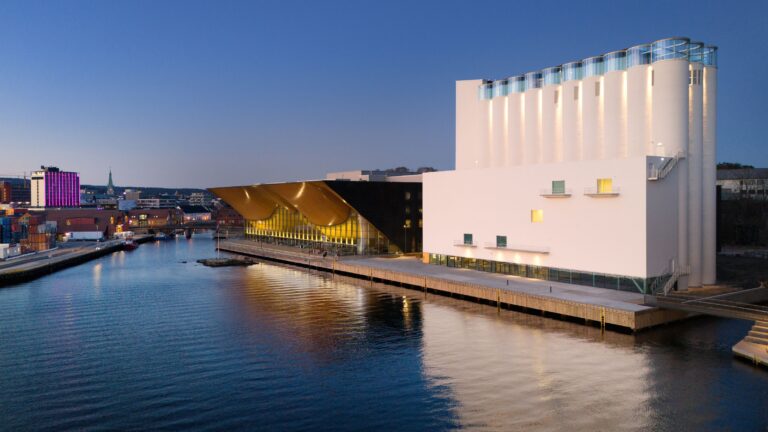
An old grain silo in Odderøya, Kristiansand, Norway, has been converted into a cultural icon. Kunstsilo Kristiansand has become one of Northern Europe’s most exciting centers of art and culture. Now, it has been voted the world’s most beautiful museum.

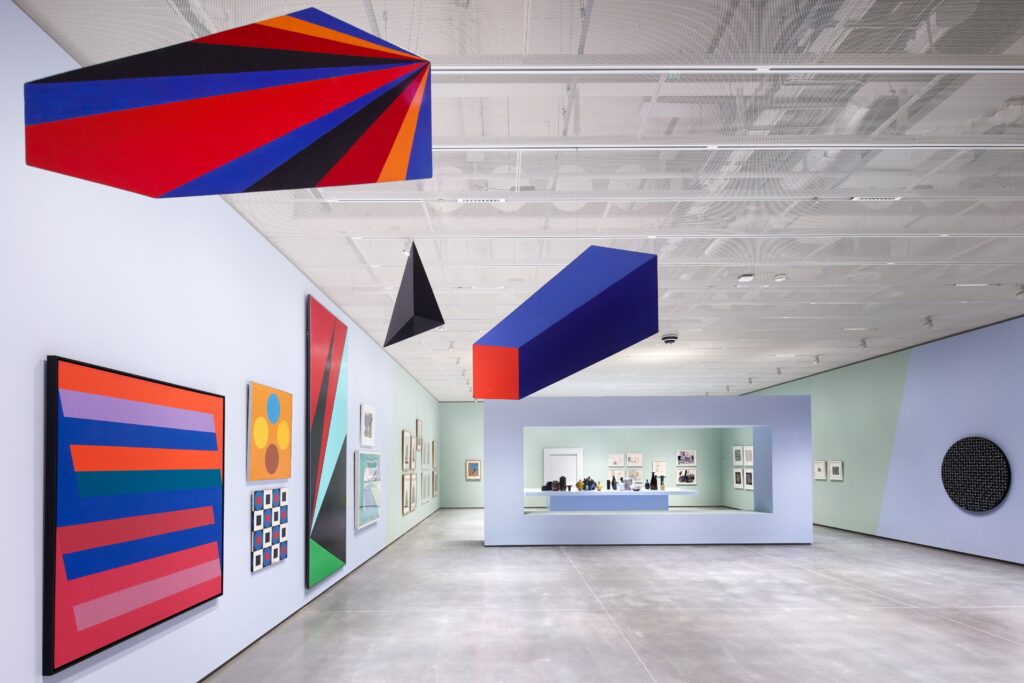
The old grain silo from 1935 has been transformed into a spectacular museum that puts Southern Norway on the world map. Kunstsilo opened on May 11, 2024, and is a continuation of the Southern Norway Art Museum, now with a new name, new location, and a significant expansion of the art collection. Kunstsiloen in Kristiansand aims to become the Nordic region’s best museum of modernist art.

The architecture prize is awarded at UNESCO’s headquarters in Paris and is intended to highlight the world’s best contemporary projects. Museum director Maria Mediaas Jørstad is delighted with the award.

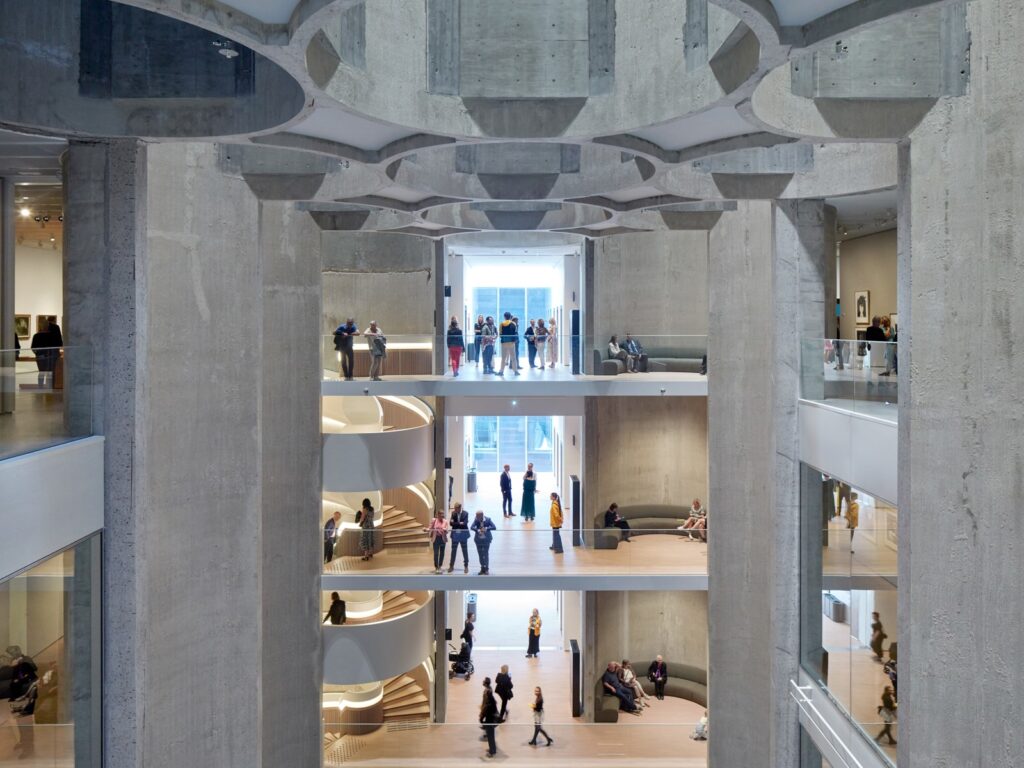
The World's Most Beautiful Museum – in Kristiansand. Photo: Caroline Roka, Nordisk Kulturfond.
Museum director Maria Mediaas Jørstad.

The spectacular museum Kunstsilo in Kristiansand has received international attention and won one of the world’s most prestigious architecture awards – Prix Versailles 2025. Kunstsilo is the only museum from Scandinavia to be included on the prestigious list and was competing for the title of the world’s most beautiful museum, alongside museums from France, Indonesia, South Korea, Saudi Arabia, and the USA, among others.

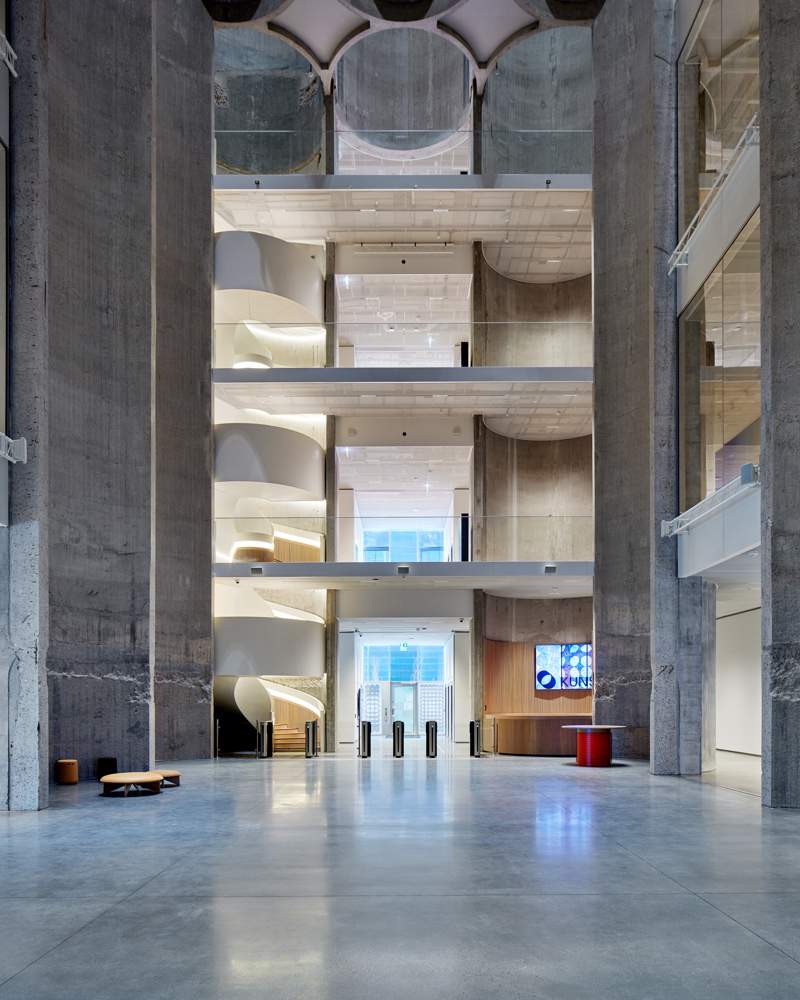
How to maintain the patrimonial value of the grain elevator from 1935, and at the same time develop it into a contemporary Museum of Art?

The World's Most Beautiful Museum – in Kristiansand.
The project strikes an elegant balance by combining respect for the qualities of the silo building with an imaginative attitude to the inherently sculptural and special experiences it offers., according to the jury.

The original silo was designed by Korsmo and Aarsland Architects, leading figures in Norway’s functionalist movement. Today, Kunstsilo, together with the Kilden Performing Arts Centre and Knuden Cultural School, is part of the new cultural quarter of Kristiansand, with strong local, regional, and international ambitions.

“We are overwhelmed with joy and very proud of this recognition! It is great to be in Paris, and we are delighted that the architects of Kunstsilo, Mestres Wåge Arkitekter,
Mendoza Partida and BAX Studio are celebrating tonight. This is their award,” said Museum director Mediaas, according to NTB.

The Tangen collection, included in the Kunstsilo, is named after Nicolai Tangen, the manager of the Norwegian Sovereign Wealth Fund, who bequeathed his collection of Nordic art to Kristiansand, his hometown, in 2015.

The World's Most Beautiful Museum – in Kristiansand.
Instead of building new, it was decided to rebuild the existing grain, which is a clear example of the circular economy and reuse of materials and buildings. Photo: Arkitektur.

Instead of building new, it was decided to rebuild the existing grain, which is a clear example of the circular economy and reuse of materials and buildings. By reusing existing buildings, the need for new material production and energy-intensive construction processes is reduced, resulting in a lower climate footprint than a new building.

The World's Most Beautiful Museum – in Kristiansand.
Photo by Alan Williams/Kunstsilo-Arkitektur.

From the Jury report in the competition: “The Kunstsilo proposal harnesses all the expressive power of a silo (an existing heritage building) to generate a diverse and complex urban space with a variety of spatial, programmatic, and climatic characteristics. The proposal includes a new museum, a performing arts school, a hotel, and an incubator for artistic start-ups. The project strikes an elegant balance by combining respect for the qualities of the silo building with an imaginative attitude to the inherently sculptural and special experiences it offers. With a few cuts into the interior of the silo, an understated yet monumental volume is opened up with controlled top-lighting that gives the future museum a strong and unique character.” (Translation- the architects)

1st Prize: Building of the Year, Norway, 2025
1st Prize: Spanish Architecture Award, 2025
1st Prize: Concrete Award, Norway, 2025
1st Prize: ADF Design Award 2025
Nominated: Mies van der Rohe Award 2026
Winner: World’s Most Beautiful Museums, by the Prix Versailles.
Notable Mention: TIME’s list of the World’s Greatest Places of 2024.
Notable Mention: The New York Times’ list of 52 places to visit in 2025

The World’s Most Beautiful Museum – in Kristiansand, reported by Tor Kjolberg

Merry Christmas Denmark

0

Until 1770, the Christmas holidays in Denmark included the 2nd day of Christmas and Epiphany on 6 January (celebrated on the eve of 5 January). Afterwards, only the 1st and 2nd Christmas Days are holidays, and 6 January is now a celebration day. We wish you a merry Christmas, Denmark.

The first Christmas tree in Copenhagen was lit in Ny Kongensgade in 1811. Christmas trees became popular among the middle class from about 1820, and hence spread to all levels of society.

Merry Christmas Denmark
Many enjoy visiting Christmas markets to buy gifts, decorations, and food like gløgg (mulled wine). Photo: Rolands Varsbergs.

Jul

Jul, the Danish Jule and Christmas, is celebrated throughout December, starting either at the beginning of Advent or on 1 December, with a variety of traditions. Christmas Eve, Juleaften, the main event of Jul, is celebrated on the evening of 24 December, the evening before the two Christmas holidays, 25 and 26 December. Celebrating on the eve before Christmas is also used for most other holidays in Denmark.

Some people in Denmark give and receive extra Advent presents on the four Sundays of Advent.

Merry Christmas Denmark
Christmas dinner in Denmark.

Christmas in Denmark centers on Christmas Eve (December 24th), featuring a large family dinner with traditional dishes like roast duck or pork and caramelized potatoes. The traditional dessert is risalamande, a cold rice pudding with whipped cream, vanilla, almonds, and cherry sauce. A single whole almond is hidden in the pudding, and the person who finds it wins a small gift (mandelgave).

After the meal, families dance and sing around the Christmas tree before opening presents. The celebration is a culmination of a festive season that often includes Advent calendars, Christmas markets, and holiday parties.

Merry Christmas Denmark
Throughout December, various confectionery, fruits, cakes, beverages, and other Christmas sweet treats are widely available on the streets, in shops, cafés, and homes. Photo: OH Danish Bakery.

Old Norse tradition

Jul is originally an ancient Old Norse tradition related to the Germanic Yule celebration of Northern Europe, but was mixed with the overlapping Christian tradition of Christmas when Denmark was Christianized during the 11th century. The traditions related to Jul have evolved over the centuries, with many pagan practices still carried on today. In the 19th century, the tradition of bringing a Christmas tree into the home was gradually introduced, inspired by Germany.

Merry Christmas DenmarkKalenderlys

Different types of Advent candles and calendars are popular in Denmark. A Kalenderlys (calendar candle) is an Advent candle, and most people have one. A Pakkekalender (gift calendar) is also a fun way to count down to Christmas Eve. There are 24 small gifts for the children in the calendar, one for each day until Christmas Eve.

Merry Christmas Denmark
Screenshot: The Julekalender TV-series 1991.

Julekalender

Julekalender (Christmas calendar) is a television series with 24 episodes. One episode is shown each day in December, with the last airing on Christmas Eve. The first Julekalender was shown on Danish TV in 1962. The two main Danish TV channels, DR and TV2, both show different versions of Julekalender each year. The stories in the Julekalender typically follow a similar storyline: someone tries to ruin Christmas, and the main characters save it!
As in Norway and Sweden, the 1958 Disney special “From All of Us to All of You” airs on TV in the afternoon on Christmas Eve.

Merry Christmas Denmark
Roskilde Dome. Photo: Visit Denmark.

Church visits

In Denmark, there is a tradition of going to Church on the afternoon of Christmas Eve, the 24th. The text is Luke 2, but since the 24th is not an official Christmas holiday, there was no official ritual for that day until recently.

Most churches have Christmas services on both official Christmas holidays, 25 and 26 December, with well-defined rituals.

Going to church on Christmas Eve has become very popular. The services on 24 December are the most heavily attended of the year in some areas, with around a third of the population attending. There are no statistics of attendants at services in Denmark.

Charity

You can also support Julemærkefonden when you send Christmas Cards in Denmark. Every year, a set of Christmas stamps/stickers/seals called julemærket is sold in December to help raise money for the charity. You use a standard postage stamp as well, the julemærket stickers make the post look more Christmassy! You can find out more about julemærket on https://www.julemaerket.dk.

Christmas markets
Many enjoy visiting Christmas markets to buy gifts, decorations, and food like gløgg (mulled wine).

Merry Christmas Denmark
Julebord table Christmas at Quality hotel Waterfront. Photo: Strawberry.

Christmas lunches

Throughout the Yule period, a range of Yule dinners or lunches is arranged. Before 24 December, most workplaces, unions, schools, football teams, or extended groups of friends arrange a Julefrokost (Yule Lunch), but sometimes they are delayed until January. This typically involves plenty of food and alcohol, and often takes place on a Friday or Saturday night.

Two out of three working Norwegians are invited to an Office Christmas party, but not everyone looks forward to the annual tradition.

Merry Christmas DenmarkChristmas Hearts

Another popular Christmas decoration in Denmark is ‘Julehjerter’, woven Christmas hearts which are traditionally made from red and white paper. Julehjerter typically feature a chequered board pattern and usually have a handle/loop at the top so they can be hung on the Christmas tree. They can also be opened and used as a little basket for goodies!

No one is sure when the custom of making Julehjerter started. The oldest known Julehjerter were made by the famous author Hans Christian Andersen in 1860, and one of his Julehjerter is on display at the Hans Christian Andersen Museum in Odense, Denmark.

Christmas cookies and baking

Baking traditional Christmas cookies is an everyday activity in the lead-up to the holiday.

Christmas confectionery and sweet treats

Throughout December, various confectionery, fruits, cakes, beverages, and other Christmas sweet treats are widely available on the streets, in shops, cafés, and homes. This includes nuts (mostly hazelnut, walnut, and almond), dried fruits (apricots, figs and raisins), oranges, clementines, mandarins, pigeon apples, brændte mandler (sugarglazed almonds), glazed apples on a stick, pancakes, æbleskiverpebernødderklejnerbrunkager , and other types of småkager (Danish cookies), gløgg of various recipes, and a variety of marzipan treats, some of which include chocolate and Danish nougat.

Christmas decorations

Homes and offices are adorned with handmade paper hearts, stars, and flags.

Merry Christmas Denmark
The annual St. Nicholas bathing at Bellevue strand. Photo: Bakken.

Christmas vacation

Because of the high concentration of holidays at the end of December, it is possible to have a vacation between Christmas and New Year without missing many days at work. This holiday is usually named “Juleferie” or Yule Vacation, and is generally considered to be in the date range from 24 December until approximately 1 January.

Merry Christmas in Denmark, compiled by Tor Kjolberg

Helsinki’s First Grand Hotel with a Spectacular Upgrade

Hotel Kämp Helsinki is undergoing a significant renovation and expansion, including a new extension that adds 22 suites and rooms, as well as a restored main entrance in the historic building. Learn more about Helsinki’s first grand hotel with a spectacular upgrade.

One of the Nordics’ most iconic and well-known institutions, Hotel Kämp in Helsinki, is getting a complete facelift. The grand hôtel of the Finnish capital will be renovated and upgraded to the highest possible standard in the luxury segment. The result will be a completely renovated hotel that can meet the increased demand for a wide selection of luxury hotels.

Helsinki’s First Grand Hotel with a Spectacular Upgrade
The Sibelius suite in Hotel Kämp.

There are hotels, and there are institutions, and Kämp in Helsinki is among the latter. Since opening in 1887, the country’s first grand hotel has been a discreet stage for diplomats, composers, artists, and statesmen. Kämp didn’t just offer comfort: it introduced Finland to an entirely new vision of civil society and cosmopolitan life.

The refurbishment also includes updated rooms and the opening of new restaurant and bar concepts. The whole project is expected to be completed by summer 2026, with phases being completed throughout 2025, and the hotel remains open during the process.

Helsinki’s First Grand Hotel with a Spectacular Upgrade
The Mirror Hall, Hotel Kämp.

**********************************************
You might also like to read One of the World’s 100 Most Incredible Places – In Helsinki

**********************************************
“Hotel Kämp is a crown jewel in the Nordic range of hotel experiences. The hotel is widely known and appreciated for offering its guests amazing experiences. Now is the time to give the hotel a proper facelift to continue meeting and exceeding guests’ expectations. The renovation underway is being carried out with great respect for the building’s history,” says hotel owner Petter Stordalen.

Helsinki’s First Grand Hotel with a Spectacular Upgrade
The renovation underway is being carried out with great respect for the building’s history,” says hotel owner Petter Stordalen. Photo: Wikipedis.

Beneath its soaring chandeliers, Helsinki’s society gathered in the Mirror Room. Kämp housed one of Finland’s earliest cinemas; its American-style bar brought cocktail culture to the nation; and its suites were the backdrop to cultural breakthroughs and political meetings that changed the course of history, including the founding of the newspaper of record and serving as HQ for resisting the Soviets.

Helsinki’s First Grand Hotel with a Spectacular Upgrade
Rooms have been refurbished to blend classical elegance with modern technology.

Key aspects of the upgrade

  • New extension: The historic Helander House next to the hotel has been integrated, adding 3,100 square meters of new space, including 22 new rooms and suites.
  • New and updated rooms: Rooms have been refurbished to blend classical elegance with modern technology. The new rooms in the extension feature marble bathrooms and intelligent climate control.
  • Relocated and restored entrance: The main entrance has been moved back to its original spot, with a new reception area.
  • Elevated lobby: The lobby has been redesigned and “elevated to new standards”.
  • New dining and bar concepts: Two new concepts, À La Kämp and Kämp Bar, have opened in a new space that combines the restaurant and bar.
  • Wellness club: A new, large wellness club has been opened as part of the expansion.
  • Sustainable design: The renovation emphasizes sustainability, with high-quality materials and the restoration of historical features like ornate ceiling moldings.

The property owner, Ilmarinen, has signed an extended lease agreement with Nordic Choice Hotels. The deal means Nordic Choice will continue to operate the properties for at least another 20 years.

More than two decades since its last overhaul, Kämp is preparing for its next act. The €100m renovation isn’t simply a matter of upgrading rooms or adding floor space (though it will do both). “This is about staying relevant without becoming a museum,” says Tuomas Liewendahl, Kämp’s general manager.

Helsinki’s First Grand Hotel with a Spectacular Upgrade
Tuomas Liewendahl, Kämp’s general manager.

Timeline

  • The project began in late 2023 and is planned to be fully completed by summer 2026.
  • Various components have been completed in phases, with a focus on revealing new rooms and facilities throughout 2024 and 2025.
  • The hotel has remained open to guests throughout the renovation.
Helsinki’s First Grand Hotel with a Spectacular Upgrade
The restored main entrance in the historic building.

“The collaboration between us as a property owner and Nordic Choice Hotels has a long-term perspective and security to continue developing the operations and properties in the coming years. Sustainability naturally plays an essential role in hotel renovations. Both hotels will be connected to a carbon-neutral district cooling system. Heat recovery devices will be replaced with modern ones. Building automation systems also work according to hotel guests’ needs to avoid unnecessary energy consumption,” says Ville Laurila, Letting Manager at Ilmarinen.

Helsinki’s First Grand Hotel with a Spectacular Upgrade
Ville Laurila, Letting Manager at Ilmarinen. Photo: Mikael Ahlfors/ KEKSI

It’s the setting, not the story itself. But, for it to serve people today and tomorrow, it needs a facelift and a bit of modernization.

Helsinki’s First Grand Hotel with a Spectacular Upgrade, written by Tor Kjolberg

This Is How the New Norwegian Weather Will Be

0

A new book, “This Is How the New Norwegian Weather Will Be,” offers insight into the changes in Norwegian weather and how climate change will affect everyday life in the country.

Since 1980, precipitation in Norway has increased by more than 20 percent. Climate models indicate that by the end of this century, rainfall and snowfall will be 10 to 20 percent higher than now. That is an increase of perhaps 50 percent during this century. More and more of this rain will come as torrential rain.

This Is How the New Norwegian Weather Will Be
In the book, the authors have selected 21 places in Norway.

In July 2024, Bø in Telemark was hit by heavy rain for several days. Several hundred people had to be evacuated from their homes, roads and bridges were destroyed, and fields were flooded.

On July 29, 2021, 78.5 mm of rain fell within one hour from an intense rainstorm over Tjøme. That is as much as the norm for the entire month of July.

On August 16, 2011, the heavens opened up over the municipality of Holtålen in Sør-Trøndelag, and the Gaula River overflowed its banks. Large amounts of water flooded into buildings, destroying much of the infrastructure, the shops, and the brand-new artificial turf pitch that was to be opened that day. There will be many such episodes in the years to come.

What we can expect in the years to come

What the future Norwegian weather will look like and how it will transform the way we live is the theme of a new book that offers thought-provoking insight into what we can expect in the years to come.

This Is How the New Norwegian Weather Will Be
Ole Mathismoen, leading environmental writer and long-time journalist at Aftenposten. Photo: Paal Audestad.

“This is what the new Norwegian weather will be like where you live, go on trips and have holidays” is written by Ole Mathismoen, leading environmental writer and long-time journalist at Aftenposten, together with meteorologist and climate researcher Hans Olav Hygen at the Meteorological Institute. In the new book, the two explain what is happening to our weather and why. In addition, they present regional forecasts for winter, spring, summer, and autumn.

How the weather will change where you live

This Is How the New Norwegian Weather Will Be
Climate researcher Hans Olav Hygen at the Meteorological Institute. Photo: Cappelen Damm.

“We explain why and how different weather phenomena will occur more frequently. Heavier rain, warmer heat waves, and more snow in the mountains. And most importantly, we try to give the reader answers to how the weather will change where you live, where you like to go hiking, and where you have a cabin. There is a lot of uncertainty, but researchers are becoming increasingly sure about the trends,” say Hans Olav Hygen and Ole Mathismoen.

“In the book, we have selected 21 places. Some on the coast, some inland, some in the mountains. If you imagine a large enough circle around these 21 places, the whole of Norway is covered. Together, they represent the new Norwegian weather. The book also gives a taste of trends we are in the midst of, and which are changing Norway. Climate change affects us in countless ways, from the permafrost at Galdhøpiggen thawing to moose struggling with more insect bites and parasites.”

Norway is experiencing more extreme weather

Climate change is affecting the everyday lives of all Norwegians. What were once stable and predictable seasons are being replaced by shorter winters, early springs, stronger storms, wetter rainy periods, and hotter summers. Norway is experiencing more extreme weather, with regional variations already evident.

This Is How the New Norwegian Weather Will Be
Storm clouds. Photo: Uri Bershadskiy/World Meteorological Organization (WMO).

With global warming, for example, Bergen will be wetter than Oslo, while Oslo’s weather will increasingly resemble Bergen’s weather today. Weather patterns are changing. People in Southern Norway will have to get used to weather patterns common in northern France, while those living in Central Norway can expect the weather southerners have had up until now. The extreme rain “Hans” in August 2023 caused record flooding. Rain replaced snow in February, and many are experiencing poorer skiing conditions. A near-record warm July meant many people in Trøndelag could enjoy real summer weather. At the same time, Europe experienced the warmest March ever, accompanied by an almost global heat wave.

This Is How the New Norwegian Weather Will Be
, translated by Tor Kjolberg from a press release by Cappelen Damm.
Feature image (top) © wisconsinacademy.com