
Young Norwegian Fashion Design Award Winner

0

Winner of the 2017 Bik Bok Runway Award (BBRA) will be announced tonight at the Marble Room at Sentralen in Oslo. Five nominees will present their new collections.

For the second year, The BBRA is acknowledging young design talents.  The award ceremony is a collaboration between Bik Bok, a part of the Varner Group, and Oslo Runway, who replaced Oslo Fashion Week in 2015.

The winner is awarded a cash prize of 100,000 NOK (appr.12,500USD) to be used for production of a new collection and materials. The winner will also have her/his own show at Oslo Runway in February next year.

Young Norwegian Fashion Design Award Winner
BBTA nominees 2017

The nominees for the 2017 Bik Bok Runway Award are:

Young Norwegian Fashion Design Award Winner
Edda Gimnes. Photo: Yoo Sun

Edda Gimnes
Edda has a Bachelor degree from London College of Fashion and was one of ten Fresh-Out-of-School Designers to Watch in The New York Times. Edda won the BETA Saga Fur competition award in London 2015 and recently the Designer for Tomorrow Award in Berlin with Alber Elbaz as her patron. Edda Gimnes combines print, fur and embroidery in an aesthetic and eclectic way.

Edda Gimnes is looking forward to present her latest collection in Oslo tonight.

Young Norwegian Fashion Design Award Winner
Kit Wan.Photo: Felix Glasmeyer

Kit Wan Studios
Kit Wan studios is a newly established design studio based in Oslo. Designer Kit Wan is originally from Hong Kong with a Master degree from Oslo National Academy of the Arts and a Bachelor in “Knitwear Specialism” from Hong Kong Polytechnic University. All of his design shows a strong reference to his Asian background.

His design is bold and colorful. «To be nominated to the Bik Bok Runaway Award is an honor a proof of the fact that fashion is embracing cultural differences» says Kit Wan.
Young Norwegian Fashion Design Award Winner
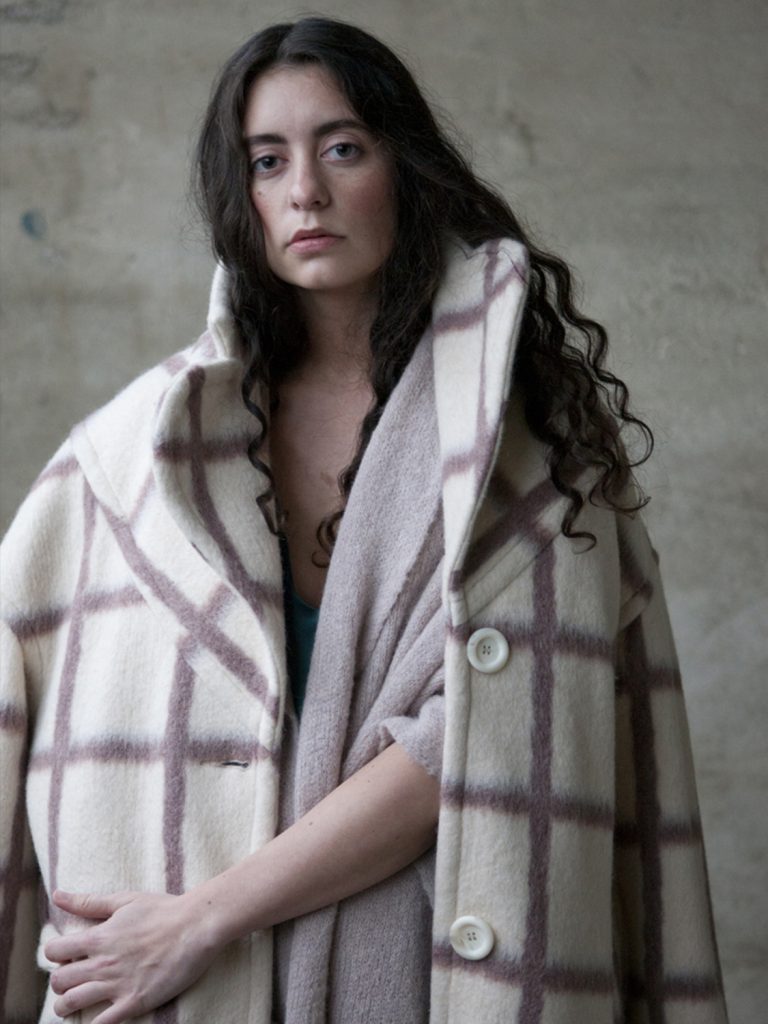
Michael Olestad. Photo: Alexander Norheim

Michael Olestad
Michael Olestad Nybråten has a Foundation Diploma from The London College of Design and a Bachelor degree from Middlesex University. He launched his first collection last year, and it was an immediate success.

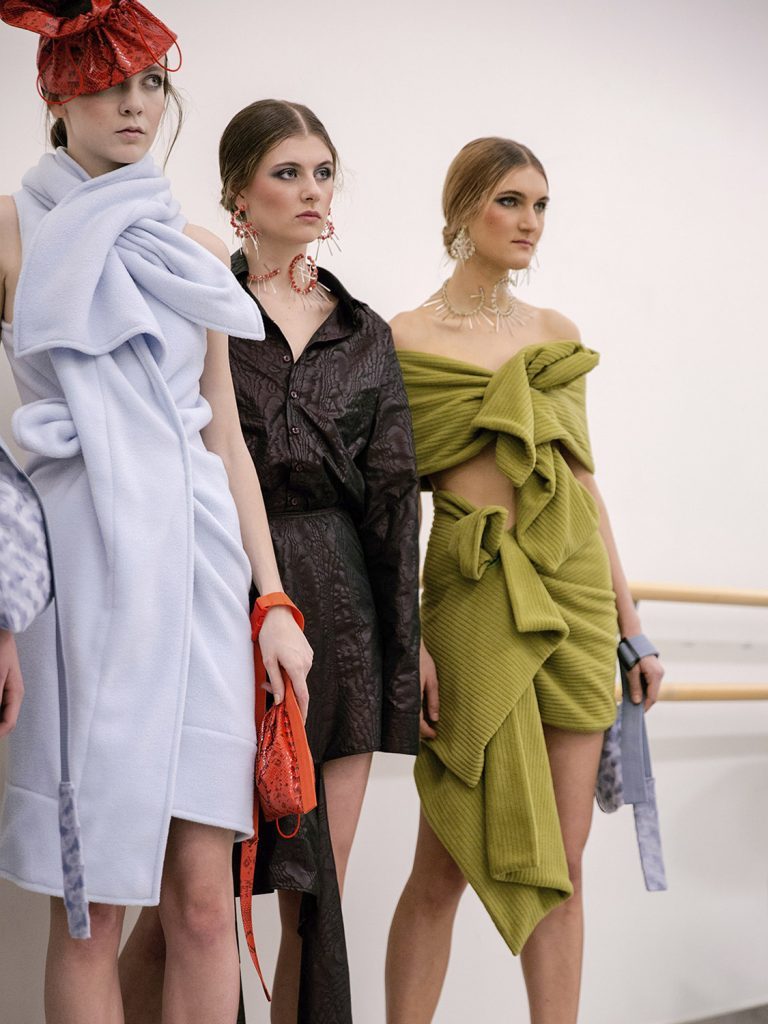
Michael has been a designer for the Stockholm based Acne Studios as well as for Ann-Sofie Back and Meadham Kirchoff. His design is recognized for his use of color, textiles and drapes.

“My aim is always to do something better,” says Micael Olestad Nybråten.
Young Norwegian Fashion Design Award Winner
Moiré. Photo: Therese Fische

 Designstudio Moiré
Mouré was established in 2013 by Charlotte Fische and Linn Brevik-Riberio. Both have a Bachelor from The Arts Institute at Bournemouth. Their own label was founded last year. Moiré focuses on tailoring, unique details, timeless cuts and high quality fabrics. Some describe their fashion as “a maximalist version of the Scandinavian, feminine minimalism.”

“The nomination gives us the chance to develop our collections,” say Charlotte Fische and Linn Brevik-Riberio.

Young Norwegian Fashion Design Award Winner
Raske Rever. Photo: Solveig Aksnes

Raske Rêvêr
The brand was established in 2013 by the designer duo Lise Kristindatter Mortensen and Solveig Aksnes. They have a Bachelor and a Master in design respectively from Oslo National Academy of the Arts. The duo is outspoken politically in their work (focus on animal welfare and environmental protection). The result is somewhere between technical sportswear and fashion.

They are participating tonight with their 2018 collection “Jouer toute la Journée”, which they call a tropical riding/rolling/bathing collection.

The winner the of the 2017 Bik Bok Runway Award (BBRA) was Michael Olestad

Young Norwegian Fashion Design Award Winner, compiled by Admin

Copenhagen’s Post War Nyhavn

The seaside and harbor front venue around Nyhavn is a part of Copenhagen’s cultural soul. The many colorful houses and exclusive buildings surrounding the Nyhavn canal on the “shady” and “sunny” side are nearly 350 years old.

We have dived into the Danish photo archives and collected some interesting black and white photos, which our contributor Lars Andersen has colorized with the help of colorize-it.

Colorize-it uses the Colorful Image Colorization algorithm that’s being developed by a team at UC Berkeley led by PhD student Richard Zhang. You simply paste a URL to a photo into their website and press the purple “Colorize It” button. After some processing and a short wait, the page displays a side-by-side comparison of the B&W and colorized photos that you can switch between.

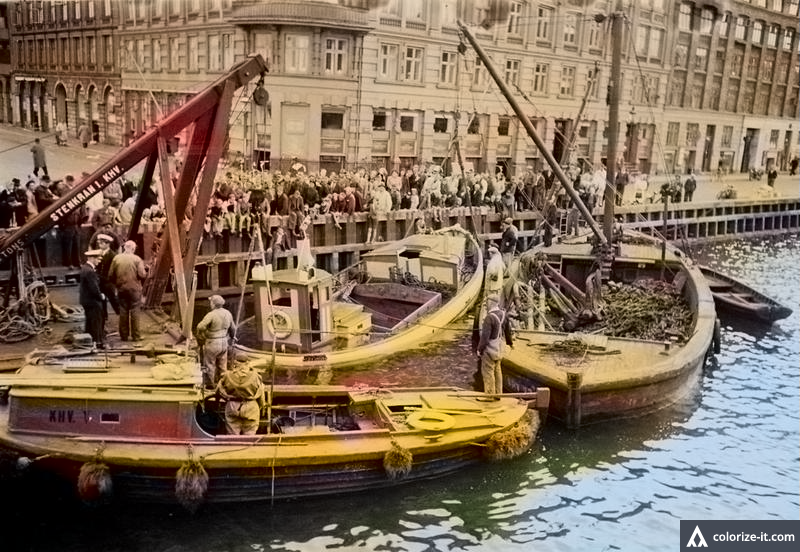
Here’s an image in black and white, showing a sunken fishing vessel being raised from the bottom of the Nyhavn Canal. (Year unknown). Photo: Kurt Nielsen

Copenhagen’s Post War NyhavnAnd the colorized version:

Copenhagen’s Post War Nyhavn
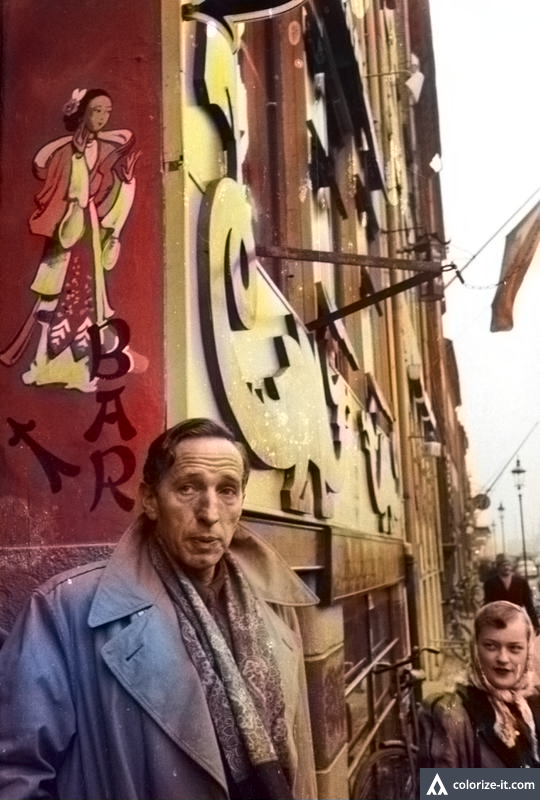
Nyhavn 37
No 37 was a very nice building which was enlarged with one floor in 1791. In the basement was Tattoo Jack, displaying colorful tattoos on his signs and in the window, consisting of butterflies, naked women, flowers, and the seaman’s grave as well as snake and daggers.

Copenhagen’s Post War Nyhavn
Tattoo Jack Nyhavn, Copenhagen 1950. Photo: Vittus Nielsen

The artist Jens Ferdinand  Willumsen (1983-1958)  was associated with the movements of Symbolism and Expressionism. His sculpture The Great Relief (completed 1928) is one of Denmark’s cultural masterpieces. Here he is photographed in Nyhavn together with Madame Michelle Bourret in 1951. He met the French dancer and painter in 1928 and they stayed together until his death.

Copenhagen’s Post War Nyhavn
Artist J F Willumsen together with Madame Michelle Boirret 1951

The celebrated Danish actor Dirch Hartvig Passer (1926 – 1980) was greatly renowned for his improvisational skills and one of Denmark’s most prolific actors, with a filmography comprising 90 movies, He arrives at a birthday party in Nyhavn carrying Danish film actress Judy Gringer.

Copenhagen’s Post War Nyhavn
Dirch Passer carrying Judy Ginger arriveses at a birthday party in Copenhagen 1961. Photo: Jorgen Bonfils

Danish poet Jens August Schade (1903-1978) posing in Nyhavn in 1955. His debut was the 1926 poetry collection Den levende violin, “The Living Violin”. In 1963 he received the grand prize of the Danish Academy.

Copenhagen’s Post War Nyhavn
Poet Jens August Schade in Nyhavn 1955. Photp: A. E. Andersen

Today the charming Nyhavn area is an authentic local melting pot, mixed with history and culture, – and placed right at the humming and eventful seafront of Copenhagen.

Feature image (on top): Two young boys watching a sailship in 1955. Photo: Allan Moe

Copenhagen’s Post War Nyhavn, compiled by Admin

Norwegian Dancer’s Dream Comes True

Norwegian dancer Gina Storm-Jensen (21) was promoted to First Artist in the Royal Ballet, London last month. She trained at Royal Ballet Upper School and entered the Company in October 2013.

Norwegian Dancer’s Dream Comes True
Gina Storm-Jensen

Storm-Jensen began her training at the Norwegian National Ballet School in Oslo and was a finalist at the 2011 Prix de Lausanne. After winning the 2013 Gailene Stock Prize for Most Promising Student, she went to train at The Royal Ballet Upper School.

Norwegian Dancer’s Dream Comes True
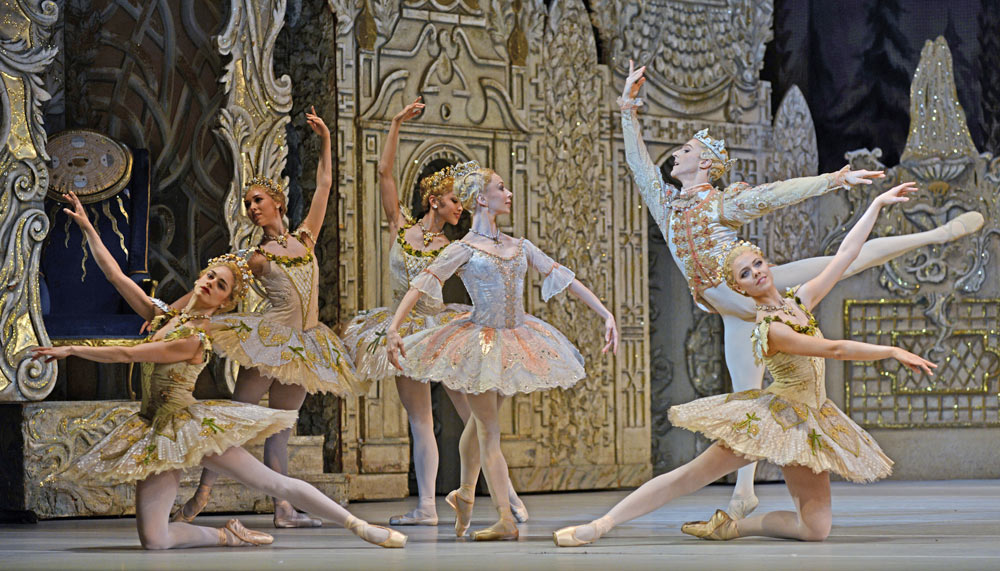
Gina (far right) dancing in the Nutcracker

From a Norwegian perspective, this is a ballet-historical event. Norway is just a tiny little ballet nation, so this is quite impressive. The fact that a Norwegian dancer stands out in one of the world’s leading ballet companies is extraordinary.

Like many of the Royal Ballet School students, Storm-Jensen worked regularly with the company. Mostly in corps de ballet and extra roles but last year, unusually for a second year, she got her chance to dance in Balanchine’s Symphony in C.

Norwegian Dancer’s Dream Comes True
Gina (in the middle) dancing in Swan Lake, 2013, Photo: Johan Persson

Storm-Jensen’s performances with the Company have included Lilac Fairy (The Sleeping Beauty), Arabian dance (The Nutcracker), Mercedes (Carmen) and in ‘Rubies’ (Jewels). She has created roles in Woolf Works and Meta.

“Artist Gina Storm-Jensen gives energetic, skillful performances,” wrote Manual Muños in Theatre (April 6, 2017).

A Norwegian Dancer’s Dream Comes True, written by Tor Kjolberg

Stockholm – The Vasa Capital

Stockholm’s history starts at Gamla Stan (Old Town), which still has the character of a medieval city. Its narrow lanes follow the same curves along which the seamen of former times carried their goods.

The best place to start a tour is Stortorget, the center of the original city, from which narrow streets fan out in all directions.

Stockholm – The Vasa Capital
Stortorget, Gamla Stan. Photo: Wikipedia

In medieval times, Gamla Stan’s Stortorget was a crowded noisy place of trade, where German merchants, stallholders, craftsmen and young servant girls and boys jostled and shouted. In the cobbled square today, people laze on benches or sit at one of the outdoor cafés, and it is hard to visualize that in 1520 the cobbles ran with blood during the Stockholm Bloodbath.

Stockholm – The Vasa Capital
Danish King Kristian II (The Tyrant)
Stockholm – The Vasa Capital
King Gustav Vasa

Despite a guarantee of safety, the Danish King Kristian II, known as The Tyrant, murdered 82 people, not only nobles but innocent civilians unlucky enough to have a shop or a business nearby. This gory incident triggered the demise of the Kalmar Union, which had united Sweden with Denmark and Norway.

Three years later, Sweden’s first heroic king Gustav Vasa, put an end to the union and made Stockholm his capital.

From the square, it’s a short walk to the Cathedral (Storkyrkan). The awesome Gothic structure is the oldest building in Gamla Satan, in part dating ty the 12th century. It has high vaulted arches and sturdy pillars stripped back to their original red brick. Its most famous statue is St. George and the Dragon, the largest medieval monument in Scandinavia, a wooden sculpture carved by Bernt Norke in 1489, which has retained its original coloring.

Stockholm – The Vasa Capital
The rectangle, Stockholm Cathedral

The cathedral was the setting fot the June 2010 royal wedding between Crown Princess Victoria and commoner Daniel Westling; crowds of around half a million lined the streets to watch the procession.

Stockholm – The Vasa Capital
Västerlänggatan by night

Västerlänggatan is a favorite shopping street for locals and tourists alike. Here and on nearly every other cobbled lane in the Old Town you will find shops, restaurants and cafés to suit every taste. Particularly enjoyable are the cellar restaurants with their musty smell and stone walls. It’s easy to imagine the Swedish troubadour Evert Taube (1890-1976) raising a beer stein to his compatriots as he composed yet another lyric to the Swedish way of life.
Stockholm – The Vasa Capital Hint: See more and pay less with a Stockholm Card, available from the Stockholm Tourist Center. It offers free travel, free admission to museums and sights, discount and guidebook.

Stockholm – The Vasa Capital, written by Tor Kjolberg

Read also:
Waterfront Oslo
City Hall Square in Copenhagen

Swedes to Open the London Museum of Photography

Stockholm-based Fotografiska will open its first overseas gallery in east London. It will be an ambitious new photography venue due to open in the UK capital close to the Whitechapel Gallery.

Fotografiska runs the world renowned privately-run photography museum  on the waterfront in Stockholm and this is their first gallery outside Stockholm and will add another important cultural and leisure hub to the fast improving Whitechapel area.

Swedes to Open the London Museum of Photography
Derwent’s White Chapel Building

The center for contemporary photography will take the ground floor of the new building in Whitechapel due for completion in 2018.

Swedes to Open the London Museum of Photography
John Burns

John Burns, Chief Executive Officer of the property investment company Derwent London, who owns the building, said: “We are very excited to welcome Fotografiska – The London Museum of Photography to The White Chapel Building. We believe their arrival will be a major benefit to the area and Fotografiska’s character endorses the Group’s focus on good design.”

Related: Fotografiska, Stockholm, celebrates its 5 Year Anniversary

The original Fotografiska was created in a restored 1906 customs building on the Stockholm waterfront, and has become an important center for exhibitions of photography, with changing shows in four large galleries.

Swedes to Open the London Museum of Photography
Tommy Eönngren

Tommy Rönngren, chairman of the Fotografiska board, says in a statement: “Fotografiska has for a long time been searching for suitable facilities in London, one of the world’s most dynamic cities when it comes to photography. Whitechapel, which is one of London’s most dynamic areas, will be a perfect location. Derwent is a developer with great creative vision and we chose to work with them because of the combination of the building itself and the creative heritage of Derwent.”

Related: World’s Best Photographic Museum

The Stockholm-based 5,500 sq. m Fotografiska center for contemporary photography was founded by brothers Jan and Per Broman. Exhibitions in Fotografiska have featured the work of Annie Leibowitz, Robert Mapplethorpe David LaChapelle and Guy Bourdin as well as new photographers like Nick Brandt, Helena Blomqvist, Klara Kallstrom and Johan Wik. It also houses an award-winning restaurant.

Swedes to Open the London Museum of Photography
Fotografiska, Stockholm

Fotografiska is no ordinary museum
Fotografiska is an international meeting place where everything revolves around photography. Located in the heart of Stockholm, the museum has an exhibition space of 2,500 square meters, and features four major exhibitions per year and approximately 15-20 minor exhibitions.

Its exhibitions are among the city’s most popular attractions. In addition to visiting the exhibitions you can listen to concerts, eat, drink, take a photography course or even arrange an event or a conference in a creative environment. Exhibitions are the foundation of Fotografiska. Its ambition is to exhibit world-renowned photographers, many who have never been shown in Sweden, as well as those who are not yet established.

Swedes to Open the London Museum of Photography, written by Tor Kjolberg

Scandinavian Flatfish

Flatfish are plentiful and extremely popular in Scandinavia. They live all over the north Atlantic and Baltic and are caught in vast numbers, even if the population of the most popular fish have diminished.

Some flatfish, such as sole and turbot, are madly expensive, but the less well known species, such as flounder and dab, are even cheap.

Scandinavian flatfish
Flatfish are almost indistinguishable from the sea bottom

Flatfish hatch as ordinary-looking swimming fish, with an eye on both sides, and live like this for a long time, until they gradually lose the swum bladder, one of the eyes wanders on to the other side of the fish, and it sinks to live the rest of its life on the bottom of the sea.

Scandinavian flatfish
Brill

Some species have both eyes on their left others on the right, and as some species interbreed, there are lots of exceptions to the rules. Flatfish are almost indistinguishable from the sea bottom, and some have the ability of a chameleon to alter their coloring; when bathing it’s not uncommon to step accidentally on a brill or flounder.

Related: Scandinavian monkfish

Flatfish have beautiful, firm, moist and sparkling white flesh, except flounder, whose flesh is grey-tinged. They are usually lean, except for Greenland halibut.

Scandinavian flatfish
Norwegian turbot

Turbot and brill
These luxury fish are stars and need no fancy preparation to take away the attention. Turbot (Psetta maxima) is celebrated all over the world, but the turbot from the Scandinavian waters is the best. The cold makes the fish grow more slowly, and the brilliant white meat is dense, lobster-like and flavorful. Its close relative, the brill (Scropthalmus rhombus) is almost as good, and at a quite different price.

Don’t be put off by a very large brill or turbot; luckily some people believe that they become coarse with age, but this is not true, and it keeps the price of giant turbot at a more accessible level than of smaller fish. Brill is best in autumn.

Turbot and brill need particularly gentle treatment. Often they are baked in the oven with a knob of butter, until the flesh is almost done. If you cook them too much, the delicateness is gone and they will be dry. Cook them at 200C/gas mark 6 until the meat is still pink at the bone. Let them sit on the counter, covered in foil for a few minutes, and the heat from the pan will cook them gently through. Take away the skin and serve them simply, or with a topping of horseradish or chervil cream, caper or hollandaise sauce and horseradish.

Scandinavian flatfish
Oetter Skudal and his 25kg halibut (Troms, Northern Norway) 2009

Halibut
There are two types of halibut, both giants of the north Atlantic. Halibut (Hippoglossus hippoglossus) can grow to an impressive ping-pong table size. The meat is delicious and meaty. Halibut is best eaten in winter.

Related: Scandinavian Garfish

The Greenland halibut (Reinhardtius hippoglossides) is small by comparison – up to 20kg, but usually weighing 1 – 2kg. It is not bottom-of-the-sea-bound like other flatfish, so both sides of the fish are usually colored. The flesh is fatty and lends itself beautifully to cold smoking ore home smoking. As with all fatty fish, you need to be very precise when you cook it – too long and it will be bone dry. The fish is fine all year round, but most exquisite in winter.

Scandinavian flatfish
Greenland halibut

Plaice
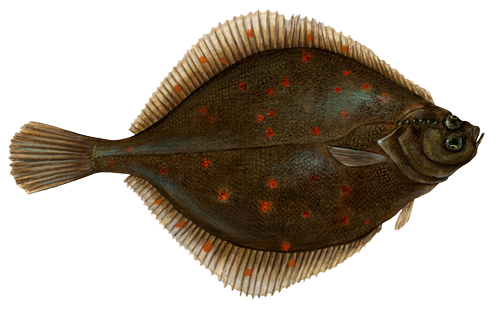
Speckled like a ladybird, with red spots on grey skin, plaice (Pleuronectes platessa) is the most loved fish for everyday meals all over Scandinavia. But it is not as plentiful as before and is quite expensive. The flesh has a tender sweetness to it, and is quite firm when cooked. Plaice is often served with rye flour and fried whole, on the bone, in butter. The fish is most delicious in late summer and autumn.

Scandinavian flatfish
Plaice (pleuronectes platessa)

Other flatfish
The flounder is similar in appearance to plaice, but with a knobbed back and no red spots, though the two species interbreed and it can be very difficult to know which is which. Inside, however, the flounder has dark, succulent flesh, with a taste quite different from plaice.

Scandinavian flatfish
Flounder

The with (a member of the flounder family) can grow to an impressive size, and is rarely eaten, but delicious.

Scandinavian flatfish
Dab (limanda limanda)

The dab, not unlike a flounder in appearance, is normally what you get if you buy frozen flatfish fillets; it’s thin-fleshed and not too interesting.

At the other end of the scale, the delicious and expensive soles and lemon soles are mostly eaten in restaurants, and most of the catch is exported; their prices are simply prohibitive for private eating.

Scandinavian flatfish
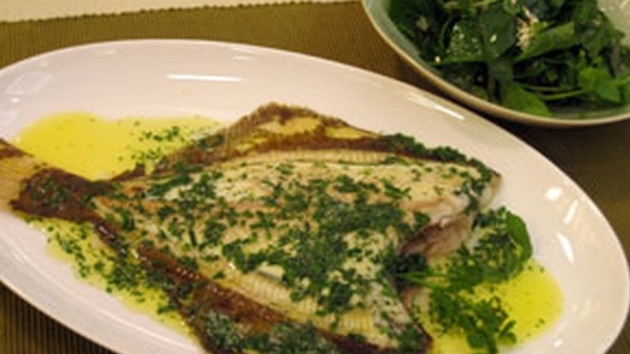
Fried flatfish

Culinary uses
Flatfish cooked on the bone are much more succulent than fillets, but the latter are much easier to fry, simply coated in rye flour and sizzled in browned butter for a few minutes. Serve them hot on buttered rye bread with lemon and remoulade for a beautiful lunch dish. Other accompaniments might be potatoes and a variety of sweet-and-sour pickled things such as cucumber salad, raw lingonberry jam, and either just melted butter or a parsley sauce; but remember that the smaller flatfish, such as place and flounder are best in the summer, so don’t serve these with anything too substantial.

Larger flatfish, such as halibut and turbot, are wonderful if baked whole and served with a chervil cream, butter hand horseradish or a caper sauce.

Scandinavian flatfish
Baked flatfish

The bones and heads of all flatfish are pure gold for fish stocks and fish soup. Keep them in the freezer until you have enough for a stock.

Scandinavian Flatfish, written by Tor Kjolberg

New Korean Restaurant in Copenhagen

Say cheers to soju and enjoy Korean highlights at Ssam Restaurant at Vesterbro in Copenhagen

Food in Korea consists of a cascade of gastronomic gimmicks and special traditions.

New Korean Restaurant in Copenhagen
If you’re not familiar with the Korean food lingo, you have a lot to learn
New Korean Restaurant in Copenhagen
Distilled vodka-like Korean alcohol based on rice

When drinking from small glasses you must for instance cover the glass by hand. You must never pour wine or water into your own glass yourself.  You must receive everything using both hands if an older person than yourself is serving you, and you NEVER drink alone. Always say cheers.

Drinking and saying cheers in Korea, however, is frequently being done. Korea has actually the world’s  largest alcohol consumption per capita. Therefore, they have invented the concept of anju.

Read also: New Restaurants in Copenhagen

New Korean Restaurant in Copenhagen
From Saam Food Bar in Copenhagen

The Korean term anju means in fact ‘eating food and drinking alcohol’. The alcohol may,however, be a glass of soy.

You may never have heard of Soju, but it’s actually the world’s most-selling spirit.

New Korean Restaurant in Copenhagen
Grace in London

It is a distilled vodka-like Korean alcohol based on rice. Because it’s sweet, round and pure flavor, it’s popular with food. It is available in extremely many versions – pure as well with added flavors – but always bottled in the characteristic green bottles.

Done right, soju must be served in a so-called hurricane, shaken with a special technique, so that a spinning malfunction occurs within the bottle, and according to tradition sends away the evil spirits. Mixed with beer you get a so-called somaek.

If you’re not familiar with the Korean food lingo, you have a lot to learn. But, don’t worry. At Ssam you can learn all about all the unique rules, traditions and food dogmas.

Read also: Copenhagen Gourmet

The owners of Vesterbro’s Korean restaurant Ssam, Jeff Larsen and Jeong Hwa want to teach the Western world, and especially Copenhagen, some of the Korean-based eating and drinking traditions, and therefore they have opened Ssam in Colbjørnsensgade just behind the main railway station.

New Korean Restaurant in Copenhagen
Ssam food-bar in Copenhagen has opened in Colbjørnsensgade just behind the main railway station.

Discover something you did not know about the vast land 8000 km to the east.

Jeff Larsen was adopted from Korea, and is educated engineer in Denmark. He worked for eight years in Korea, where he met his Korean wife and cook, Grace. She was always dreaming about opening her own restaurant, and Ssam has now become a reality.

The restaurant is located in Colbjørnsensgade among strip clubs and hotels on two floors and is completely refurbished by the couple in a modernistic style. The spiral staircase down to the high ceiling basement looks like something Arne Jacobsen could have designed, and there is a corner bar as well as a couple of tables. Upstairs there are more tables, divided into lots of cozy corners, exposed brick and pleasant lighting. In the restrooms there are colorful posters displayng Korean celebrities.

The menu consists of some of the most famous dishes – including bibimbap, kimchi and KFC (no, NOT Kentucky, but Korean Fried Chicken, which is an art in itself).  The waiters are very helpful in explaining about the food, culture and traditions.

New Korean Restaurant in Copenhagen
The menu consists of some of the most famous dishes

All of the team is from Korea, and love to tell you about food and traditions. Jeff speaks Danish, all others English.

Prices are for most dishes are below 100 kr, and there are also vegetarian options if you wish.

Enjoy soft as clouds brioche buns hugging bulgogi, ribeye meat with melted mozzarella and other heavenly dishes.

New Korean Restaurant in Copenhagen, reviewed by Tor Kjolberg

Circle Bridge in Copenhagen

The 28 meter long Circle Bridge designed by the Danish-Icelandic artist Olafur Eliasson is inking the area near Danisco with Christiansbro. It was officially opened in 2015.

According to the architect, ‘Cirkelbroen’ celebrates pedestrians. It’s supposed to reflect the daily life and intimacy that you find around the canal, its houseboats and sailing boats, the unique life on the ramparts.

Circle Bridge in Copenhagen
The Circle Bridge (Cirkelbroen) in Copenhagen is a piece of art designed by Icelandic/Danish artist Olafur Eliasson

It is now possible to bike, run or walk along the promenade all the way from Islands Brygge through the Inner Harbor (Innerhavnen) and watch the city from a very different perspective.

Circle Bridge in Copenhagen
About 5,000 people are crossing the bridge each day.

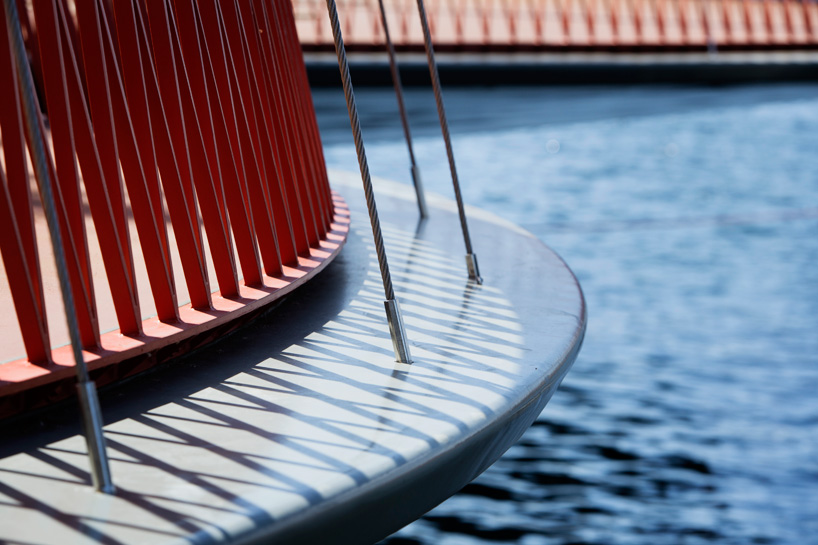
The footbridge consists of  five interconnected circular platforms in various sizes, each with a tall mast designed to resemble ship masts with reference to the boats that sail the Copenhagen waterways. Copenhagen’s harbor was once a center of maritime activity, and Cirkelbroen is a testimony to that history.

Circle Bridge in Copenhagen
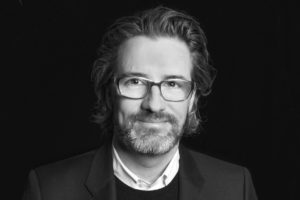
Olafur Eliasson on the Circle Bridge

Related article: Aarhus –European Capital of Culture 2017

More than 110 tensioned wires are threaded between the base of the bridge and the tips of five poles.

“While working on the bridge, I remembered the fishing boats I saw as a child in Iceland,” said Eliasson. “Fish cutters were often moored in the harbor right next to each other, and sometimes it seemed as if you could actually walk across the harbor by going from boat to boat.”

Circle Bridge in Copenhagen
Cirkelbroen was officially opened in 2015
Circle Bridge in Copenhagen
Olafur Eliasson, portrait.
© 2015 Olafur Eliasson
Photo: Heike Göttert 2013

About 5,000 people are crossing the bridge each day. . “But rather than offering the quickest possible passage across the canal, the bridge creates small changes in the way we observe the city and opens the way for a renegotiation of public space,” says Olafur Eliasson.

Related article: Playground of Contemporary Art in Denmark

The central platform is articulated to allow the bridge to swing back on itself, creating a nine-meter gap for passing boat traffic while smaller boats such as kayaks can pass below the elevated podiums.

Circle Bridge in Copenhagen
More than 110 tensioned wires are threaded between the base of the bridge and the tips of five poles.

I hope Cirkelbroen contributes to improving the quality of life and the development of a hospitable and inclusive city,” concludes Eliasson.

Circle Bridge in Copenhagen, written by Tor Kjolberg

Waterfront Oslo

The ideal way to arrive in Oslo is by boat, for then you get the most complete picture (though arriving by car from the south along the Mosseveien also offers some impressive views).

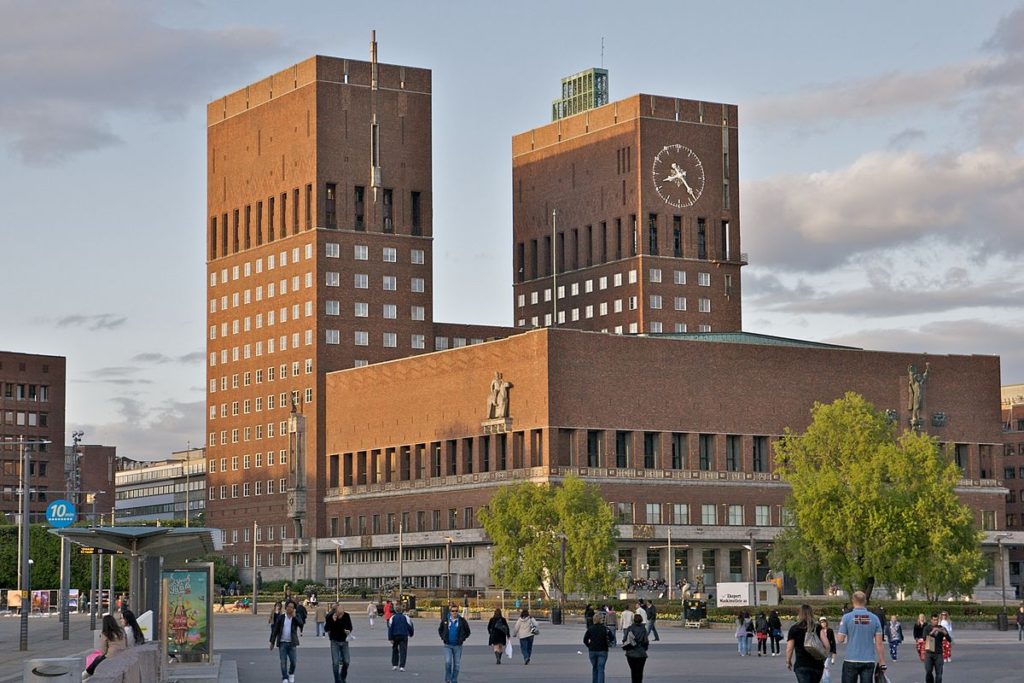
The view from the fjord is dominated by the City Hall, a large brick building topped by two square towers which overlooks the busy harbor. The imposing Modernistic structure took 20 years to build – it was begun in the 1930s, but with the interruption of war, wasn’t completed until the 1950s.

Waterfront Oslo
The imposing Modernistic structure of Oslo City Hall took 20 years to build

The cavernous main hall is decorated with murals of Norwegian history and mythology, and the courtyard is adorned with bronze statues, a fine carved wooden frieze and the swan fountain.

Related: Oslo – the Nordic City of Light

Every year on 10 December City Hall hosts the Nobel Peace Prize award ceremony.

Waterfront Oslo
Nobel Peace Center opened in 2005

On Rådhusplassen is the Nobel Peace Center (Nobels Fredssenter), which opened in 2005 on the site of the Vestbane building, a former railway station. Exhibitions staged here focus on former Peace Prize laureates and topics such as war, peace and conflict resolution.

Just north of the Nobel Peace Center, the Konserthus (Concert Hall), home of the Oslo Philharmonic, holds concerts most Thursday and Friday nights, except in July.

Waterfront Oslo
Oslo Concert Hall is home of the Oslo Philharmonic

Related: At the Edge in Oslo

Waterfront Oslo
Aker Brygge with Oslo Town Hall in the background

The last remnant of Oslo’s heavy industry, the Aker Shipyard, closed in 1982. In its place on the western side of the harbor are Aker Brygge and Tjuvholmen, vibrant complexes of shops, offices a hotel (The Thief) and apartments overlooking the fjord.

Waterfront Oslo
Astrup-Fearnley Museum designed by Renzo Piano

Tjuvholmen is one of Oslo’s newest boroughs. The area is characterized by an intriguing architectural diversity and unique outdoor areas. It plays host to several galleries and art installations, including the Astrup Fearnley Museum, designed by Renzo Piano, flanked by a sculpture park and a beach.

The seafront boardwalk lined with cafés and restaurants is one of Oslo’s most popular meeting places and teems with people in the summer months.

Waterfront Oslo, written by Tor Kjolberg

Feature image (on top): Tjuvholmen

Read also:
Stockholm – The Vasa Capital
City Hall Square in Copenhagen

Passionate Norwegian Singer/Songwriter

Pål Moddi Knutsen, known as Moddi, is a passionate Norwegian singer/songwriter from the island of Senja.

His collection of songs, Unsongs, have at one stage been banned, censored or silenced. The attempts to suppress them were as mild as an airplay ban or as brutal as a murder.

Passionate Norwegian Singer/Songwriter
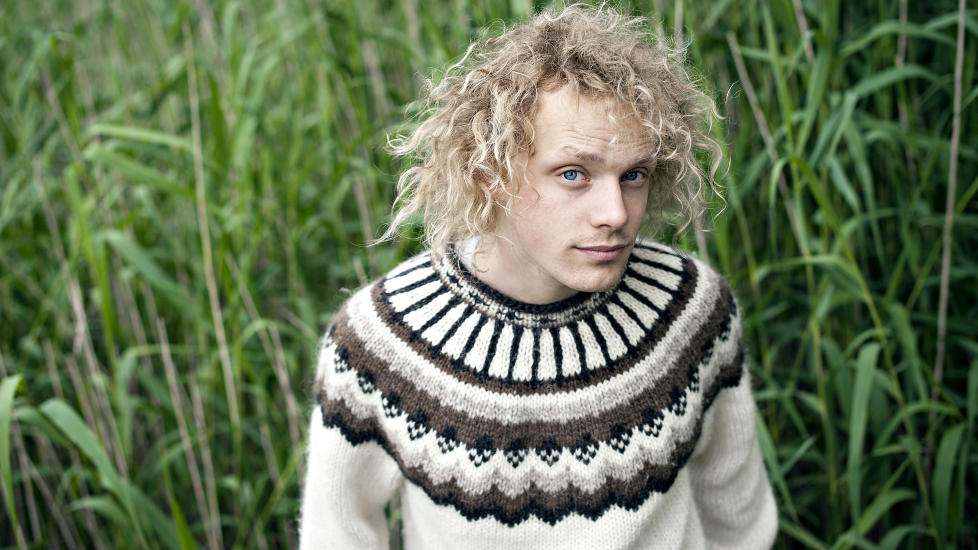
Norwegian singer/songwriter Pål Moddi Knutsen, known as Moddi

“Welcome proof of music’s continuing, if underemployed, power to confront authorities,” wrote The Guardian.

“Norwegian sensation Moddi is a perfect example of more artists doing interesting and creative things with the format of the solo artist than there are with the band format,” writes William Howard in Songkick.com.

Passionate Norwegian Singer/Songwriter
“Music is a huge part of my life,” says Moddi

Related: Norwegian Songwriters Conquer Asia

The young man has become a respected artist in Norway and received a double Norwegian Grammy nomination for his debut album Floriography in 2010. He has talen his music around the world’s festivals and toured with Angus and Julia Stone.

“All credit to the Norwegian singer and activist Pal Moddi Knutsen for unearthing so many songs that have run into trouble with the censors… a folk-pop list that roams from China to Israel,” wrote Thew Sunday Times.

Related: Internationally Acclaumed Norwegian Artist

Passionate Norwegian Singer/Songwriter
Modi outside his ‘studio – the cave’

“He may be an acoustic guitar toting troubadour but even when his music is stripped down to just him playing solo there is still something in the music that’s uniquely his,” says William Howard.

Passionate Norwegian Singer/Songwriter
Moddi, portrayed by Lamo Yak

Moddi was also one of four artists and band who received an impressive 1,000,000 NOK grant from a-ha before their final tour in 2010. Their goal was to help up-and-coming artists who wished to pursue an international career in music.

The idea for the album Unsongs came when Moddu learned about officer Eli Geva, who refused to lead his forces into Beirut during the Lebanon war in 1982. The song about Eli Geva, sung by the famous Norwegian songstress Birgitte Grimstad, had never been released due to being too provocative at the time. “I was amazed to discover that one short song could convey so much history – and still be unheard,” says Moddi.

“Music is a huge part of my life, but I am also studying sociology,” he says. “I’ve got a lot left to do, and I use music as a tool to ventilate difficult subjects, so you could say the two things belong together.”

 Listen to Unsongs here.

Upcoming concert:

17 – 20 August
Green Man Festival 2017
Brecon Beacons National Park
LD3 8NLBrecon Beacons, UK

Passionate Norwegian Singer/Songwriter, written by Tor Kjolberg