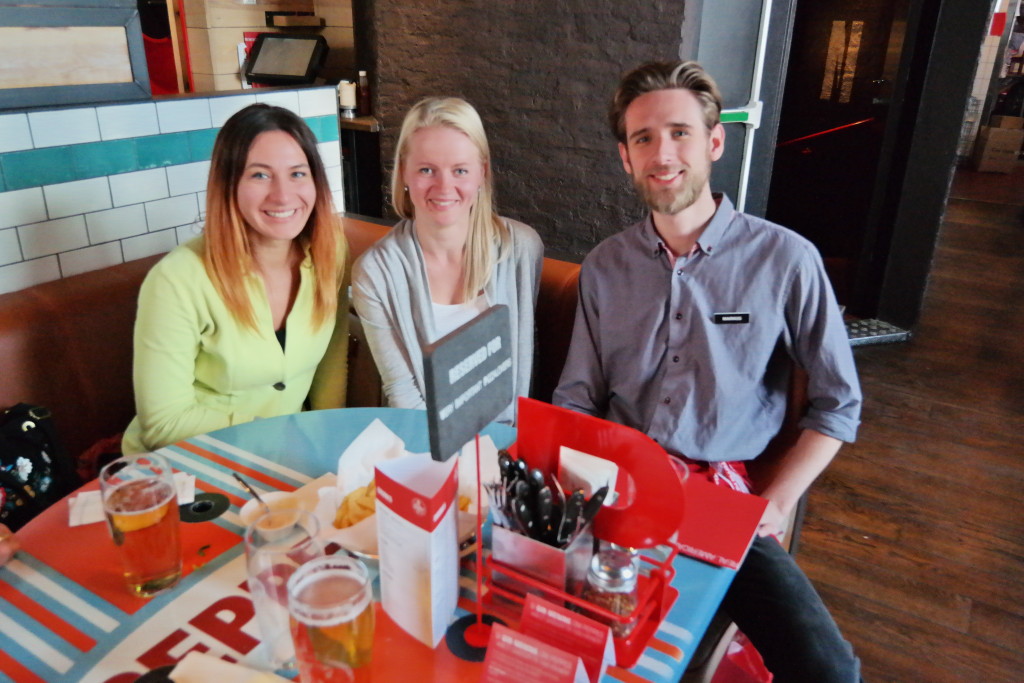
Two Estonian women, while working at a Norwegian company in Tallin, heard such great praise from their employer about Peppe’s Pizza in Norway , particularly about one item on the menu, the “Moby Dick”, that they decided to fly to Oslo – solely in order to sample this vaunted pizza.
The two women had followed all the customer complaints on Facebook regarding the removal of Moby Dick from Peppe’s menu and its subsequent reinstatement which brought on the decision to travel to Norway and taste it for themselves.
Kirke Hellamaa (left) and Helena Tammik (right), editor Tor Kjolberg in the middle
Last week Helena Tammik and Kirke Hellamaa visited Peppes Pizza on Oslo’s main street, Karl Johans gate. They smiled broadly when they finally were served their Moby Dick pizza with its curry and garlic marinated shrimps, leeks and fresh peppers topped with lime wedges. For more than a year customers had protested and struggled to get Moby Dick back on the menu, and now the two Estonian ladies finally were able to confirm that they fully understood why customers wanted it there again
“It is fantastic good and responds fully to our expectations,” said the two simultaneously. “We had a look at the dessert menu too, but now we are so filled up that we actually cannot have more food for a long while”.
Peppe’s Pizza is a Norwegian pizza franchise, established in 1970 by two Americans, Louis Jordan and his wife Anne from Hartford, Connecticut. Peppe’s, serving American and Italian style pizza, is the largest pizza chain in Scandinavia today and is part of the Umoe Catering Company.
Helena Tammik and Kirke Hellamaa were efficiently served by Markus
Peppe’s Pizza was one of the first restaurants to bring foreign foods to Norway, serving more than 9 million pizzas a year.
The best selling fiction book The Seducer by Norwegian author Jan Kjærstad documents an actual history of the pizza chain.
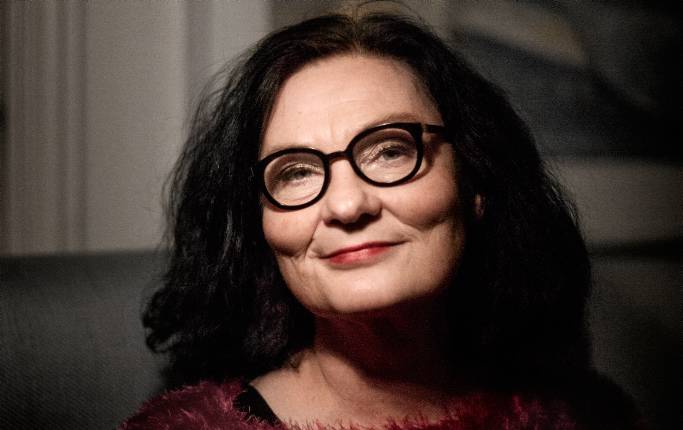
The Swedish feminist Ebba Witt-Brattström’s book Century Love War has by some been interpreted as a war against her ex-husband.
Witt-Brattström, however, claims that her war is not private but an intellectual war against what she calls the cultural man. At the same time it is a campaign for literary women.
“I consider all our choices in life as political,” she says. “I want women to stop being ashamed of themselves.”
The dialogue In her book Century Love War lets you hear the last, pounding heartbeats of a couple’s shared existence, a man and a woman who has lived together half a life. What was once great love has turned into a drawn out struggle.
“He said: If you desert me you will have only life-long hate ahead of you.
She said: I think either you or I must die.”
Ebba Witt-Brattström is an award-winning author and scholar in comparative literature. She is currently Professor of Nordic Literature at Helsinki University.
Last year Witt-Brattström was in dispute with the Norwegian author and cultural man Karl Ove Knausgard.
Witt-Brattström wondered in a confrontational way why literary men, such as him, can get away with being a male-chauvinistic pig who romanticize sexual fantasies about under-aged women.
Knausgaard evidently read her comment and promptly brought his counter-attack: “I’ve lived here so long that I’ve occasionally wondered whether the cyclops are right, and I’m wrong. Yes, that I actually am a literary pedophile, a latent homosexual Nazi mass murderer.”
Somewhat surprisingly he did not aim at Witt-Brattström. Maybe he considered her too small a target since his anger was on the Swedish people, the entire population, attacking them for their complete inability to deal with ambiguity.
Ove Knausgaard
“The book in which I described a grown man’s love for a 13-year-old girl is a novel about an assault, but also a book a book about regression and infantilism,” Knausgaard writes. “The infantile exists all around us. We live in a culture that worships youth, worships the simple and worships the childish.” A novel, on Knausgaard’s account, is the opposite: “It seeks complexity, it seeks ambiguity, it seeks truth in places other than where it formulated in slogans, or where it is framed, hard and unrelenting, rigid and unchangeable.”
Now Witt-Brattstström has written a chocking book about verbal and violent abuse in a relationship closely modeled on her own failed marriage to Horace Engdahl, a literary historian and critic, being a member of the Swedish Academy since 1997. Century Love War is Ebba Witt-Brattström’s literary debut and is influenced by Märta Tikkanen’s classic novel The Love Story of the Century from 1978.
Straight from her education at Oslo National Academy of the Arts, Jeanette Lafontine (b. 1981) had a six months Residency Unlimited stay in New York City. Her first solo exhibition in the metropolis attracted attention, and several of her paintings sold right away.
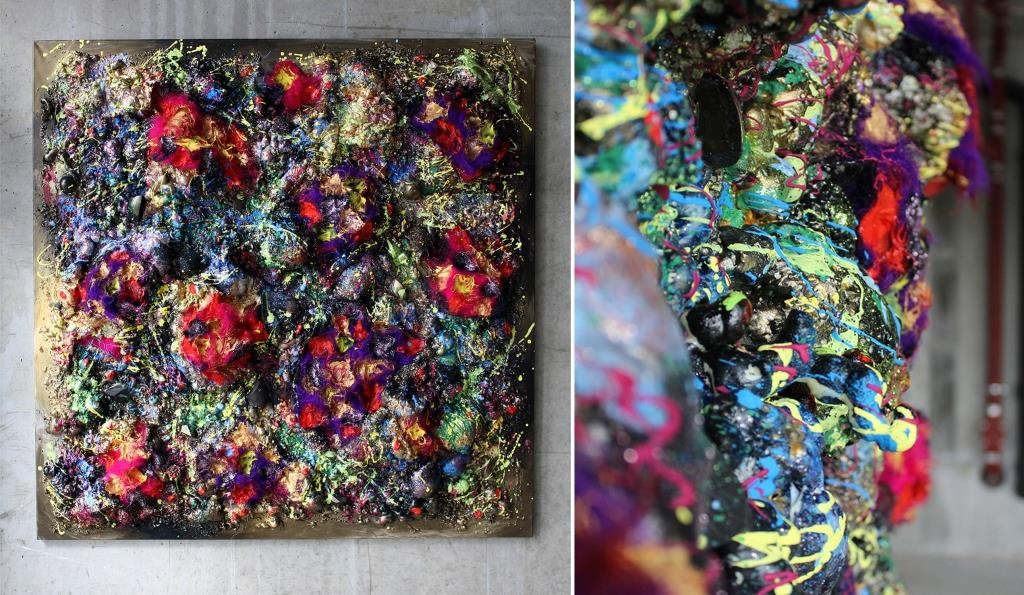
ROTATIONS, mixed media, 120×120 cm (right: close-up photo)
I visited the young artist, who for a short period this summer has a showroom at her disposal in Oslo’s new residential development area, Sørenga, next to the new bathing area, Sørenga sjøbad.
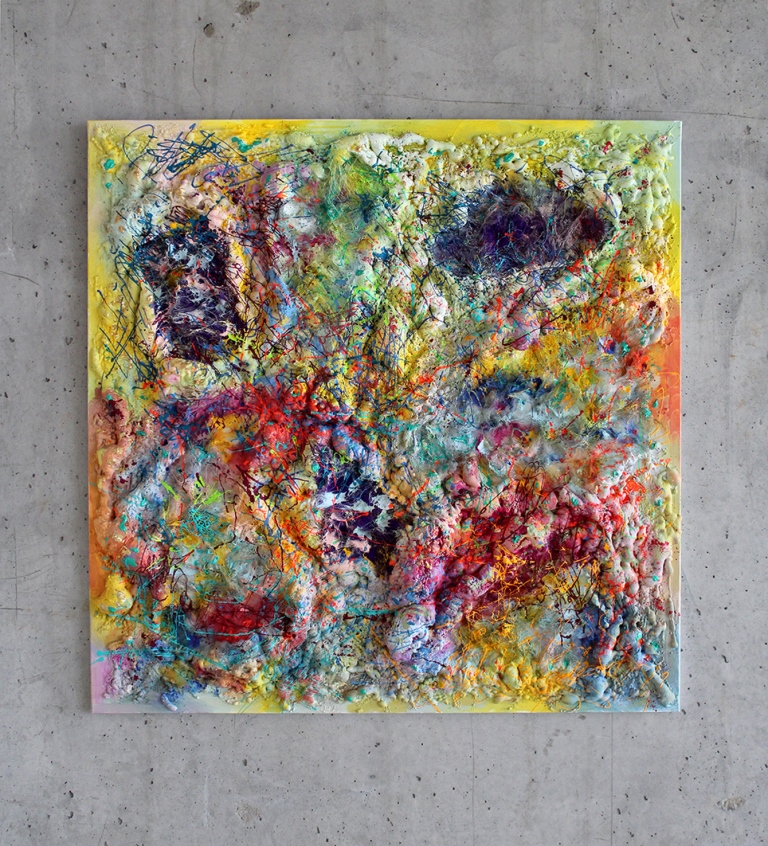
Jeanette’s paintings are characterized by her experimental three dimensional expression, where she, in addition to acrylic colors is using different kinds of materials, such as plastics and metal. She says that she began her art studies as a jewelry designer, where she made sculptures in small scale. Later she began to make larger sculptures in bronze, but now she has found her way of expression in what she calls sculptural paintings.
BLOSSOM PAINTINGS, acrylic on canvas (right: close-up photo)
“I’m working on dividing the surface I’m working on so that the background and subject mingle,” she says. “I read a lot and relate to the history of painting,” she continues, “But I do not work from one era or a specific artist as a source of inspiration. It is a flowing process. Inspiration comes in many forms. I like beauty, and beautiful things. I have a love for materials: texture, color, weight, smell and tactility. I allow myself to add whatever I want, being comfortable with gesture – not having to explain every move. Each gesture contains an importance of its own realization. No editing, just adding, like memory and our unconscious – layers of information.”
E N T I T Y #4, acrylic on canvas, 100×100 cm (right: close-up photo)
Her idea is that art should bring forth thoughts outside of the object itself, whatever art form. Today she creates paintings in which she uses the painter’s color tubes like brushes, which produces a different three-dimensional effect than if she were building up the motifs with other materials.
AFTER THE ICE STORM, mixed media, 120×120 cm (right: close-up photo)
“It is a natural consequence of my three-dimensional work,” she says. “I’m constantly seeking new expression techniques. Civilizations, cities, myths, imaginable realities and fictional landscapes have been some of the themes that have inspired my process. I have been interested in human imagination and our ability to fantasize, and the idea of a collective unconsciousness, creating abstract mythological landscapes and compositions that hover between something familiar versus the more incomprehensive. To me it is important to reinvent myself,” she concludes.
WHEN THE WINDS CARRY THE CLOUDS, mixed media, 120×120 cm
As a painter Jeanette relates to the history of painting. In passing, she mentions Cy Twombly as one of her favorite artists. Jeanette’s own body of work have concerned both scientific subjects and more fictional matters. It is perhaps not surprising that Jeanette Lafontine is interested in mythology, conspiracy theories and science fiction, since she is not so concerned about what is true or not. She finds the world a strange place to be, and through art she is trying to make sense of the
world around her. She is exploring imaginary landscapes and dreamlike places through abstraction; a process where the subliminal and the conscious meet.
MEADOW MEADOW #3, acrylic on canvas, 90×90 cm
Her manager says that Jeanette is a special artist with international potential. Many gallery owners, collectors and curators have already noticed the promising young Norwegian artist. After the brief exhibition at the tip of Sørenga she will go to Berlin for another six months artist-in-residence program.
ALIEN LAND #2, mixed media, 100×80 cm (right: close-up photo)
The exhibition “SOLID ILLUSIONS” at Sørenga in Oslo runs from 26 May through 5 June. Young Norwegian Painter with International Ambitions, Jeanette Lafontine, was interviewed by Tor Kjolberg
Beautiful, grass-fed, tender, fat-marbled beef is much sought after in Scandinavia and is the reason for all the lovely, rich stews that are a cherished part of the Scandinavian cultural heritage. But you can only buy this beef at markets, on farms and special dedicated butchers as good beef is not easy to get.
So at the moment, Scandinavians eat beef mostly as steaks and minced meat, and the long-simmered stews are not so popular as they should be. When you do find good beef, however, the potential for these lovely dishes is evident.
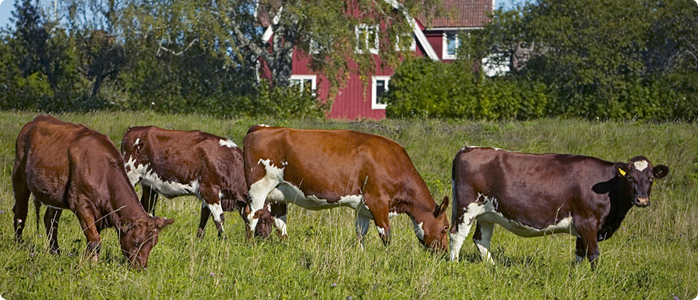
Cows in Sweden
We have to be truthful about the reasons for the decline in beef eating in Scandinavia. Perhaps this is partly due to the fact that Scandinavians don’t take the science of hanging meat very seriously; most Scandinavian beef is hung for 10 days, which is much less than is usual in the rest of Europe, and is not enough time to allow enzymes and lactic acid in the meat to work their magic.
Another reason is that people who are concerned with organic issues, and animal welfare, rarely eat meat, and even if they do, it’s not beef; so there is not a large body of people campaigning for better treatment for cows, more access to grazing, and so on, which surprisingly are not issues that most Scandinavians are much concerned about. As a result, the demand for high-quality beef remains small.
Host Andreas Viestad fries a piece of Arctic beef outdoors
Large parts of Norway and Sweden are too difficult to farm, and cattle are still kept in semi-wild areas, giving beautiful, richly marbled and tasty meat. Southern Scandinavia is a dairy country, and here the quality of the beef is not so interesting. This may very well be because somehow Scandinavians never go round to producing really prime-quality beef in their milk-producing regions.
Most of the beef is from milking cows or young steers, which are too old to be used for veal, and far too young to have the rich, deep mineral flavor of beef.
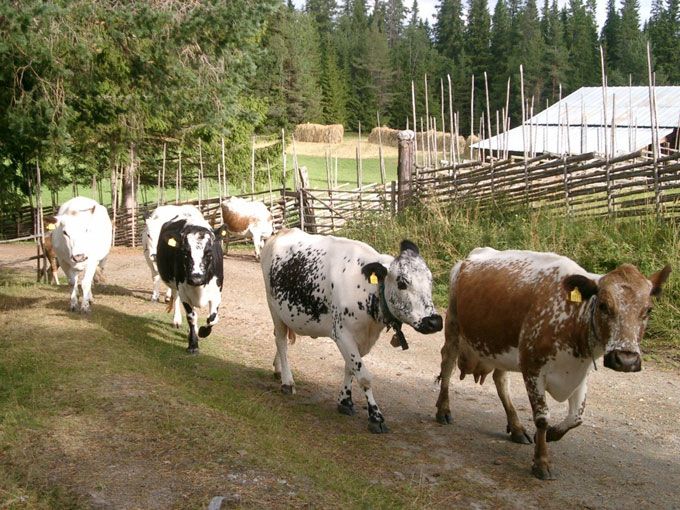
Norwegian mountain farm
However, there is small-scale production of beef cattle where the land is suited to permanent grass, and their meat is prized by people who know what they can expect from really good beef.
Veal used to be a much sought-after meat; the very young calves were always tender, and the meat a lovely pale color, with a milk and grass flavor. True, good-quality veal is very difficult to find nowadays, mainly because we are not willing to pay the price for it.
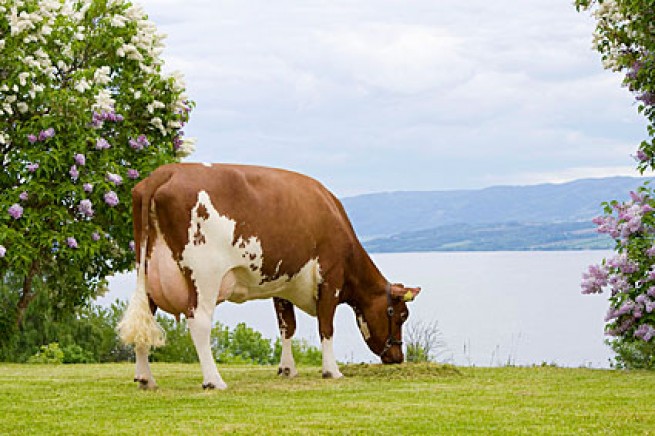
Norwegian red cow
History
Cattle have been very important to the Scandinavian economy since the early Middle Ages, when the population was dramatically decimated by the plague. There were so few hands left to farm that wheat and other grains became extremely expensive. Whereas cattle herding was relatively easy to manage, most herding was done by children, which left the surviving men free to work at other tasks. For a century or more the population ate more beef than at any other time in history.
Before effective refrigeration, cattle were slaughtered only in winter, when they could safely hang in cool conditions. With the invention of cooling, butchers could slaughter animals all year round, and tenderize the meat by hanging it for several weeks, making big roasts a possibility. Even so, most of the meat was tough, and suited only for salting, stews and soups. As a result, Scandinavians have a large and very old tradition of these dishes, which is well worth preserving.
Habitat
The cow has played a major role in creating what we now see as typical and unique Scandinavian landscapes. The high pastures in northern Scandinavia are kept lush and green by grazing cattle, and in the past grazing was the only way to prevent large areas being taken over by trees. In centuries gone by, it was common to keep the cattle in woods, where their grazing would keep down trees, thereby creating beautiful low-grown meadows both around and in the woods.
Lovely hay fields, studded with deciduous trees, provided winter fodder, and later the cattle were let loose to graze both the grass and the trees.
Buying and storing
You will have to trust your butcher, who should know about meat, and ask him which cuts he finds suitable for the dish you are going to make. The meat will have to be hung for at least three weeks to have the taste you are after, and it will be worth eating only if its grass fed and has access to year-round exercise.
Cuts of meat vary too much around the world to be precise, but as a general rule you will need dark, fat-marbled cuts from the front part of the animal, breast and neck, for stews. These take time to cook, and are comfortably cheap compared to the back cuts that are more tender, and much more expensive. The marbling will ensure that the meat will be amazingly tender and juicy, after long hours of simmering in the pot.
If it’s veal you’re after, you will also have to know and trust your butcher. You must buy proper veal, which comes from young calves, that are no more than 10 months old, slaughtered just before their meat develops into a nondescript beefy flavor, and has been hung for two weeks. Choose organic veal that will have the right, slightly acidic taste from wind-blown sun, warmed grass and milk, and nothing else. What you don’t want is veal raised under cruel conditions, fed on milk only, and slaughtered just before the animals’ legs collapse. The flesh may seem nice and pale, but it will leave a foul taste in your mouth.
Culinary uses
Scandinavian traditional beef dishes tend to be spicy and tender stews that need long, slow simmering. The slowness of the cooking means that these recipes are not particular popular at the moment, but the tide appears to be turning; young people are starting to realize the beauty of food that takes more care to cook, but is richly awarding and cheaper – much cheaper – than the steaks and roasts that are easy to make, but cost a fortune if you want proper meat.
Scandinavian Beef and Veal, written by Tor Kjolberg
Photographer, translator and writer Ben Love, originator of the popular Wild Guide books, has traveled to Scandinavia to explore its incredible hidden places. Over 800 adventures and wild experiences are covered in this spectacular photography guide with maps.
Follow Ben sea kayaking around Norway’s stunning Lofoten islands, or hiking to Sweden’s coziest mountain lodges and feasting on locally sourced regional specialties.
This book, published by WildThingsPublishing,is recommended for family explorers as well as romantic adventurers and includes informative descriptions and 24 detailed maps. Don’t miss it if you want to discover the best of Denmark’s golden sandy beaches.
Ben Love has been travelling from high above the Arctic Circle to the very south of Sweden and Denmark. He says, “The landscapes you will discover are as varied as they are idyllic.”
Gnesta Sodermanland, Sweden
Although not in Scandinavia, the book includes adventures on Iceland as well.
If you are an adventurous person, you are about to discover fantastic hikes and canoe trips as well as mountain train and boat adventures. You will also be able to find special and unusual accommodation, and Ben advises you on local food and foraging.
Vingelen mountain range, Roros, Norway. Photo: Ingrid Eide
This book is incredibly wild!
About Ben Love
Ben studied Scandinavian languages at university in London and Stockholm, spending his summers working as a river and canoe guide in Iceland and Sweden. He is a photographer, translator and writer, specializing in Scandinavia and the outdoors. Currently researching theSwedish right to roam, he is passionate about having wild adventures with his family and embracing the concept of friluftsliv (roughly translating as ‘open air life) – the Scandinavian philosophy of having a true connectedness with the outdoor environment.
Feature image (on top) Lofoten Islands by Kristin Folsland-Olsen
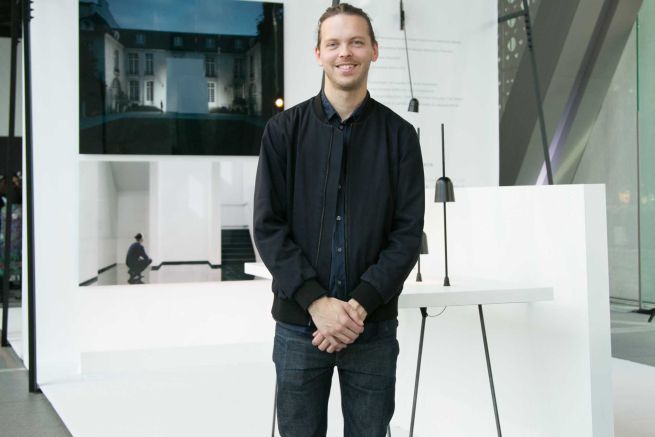
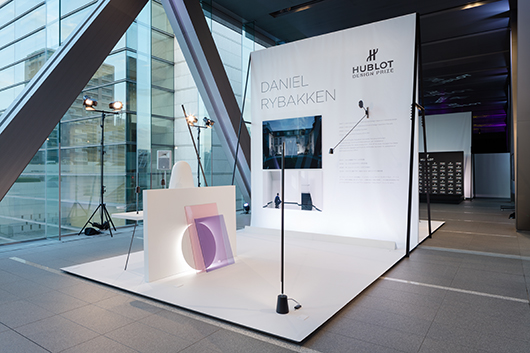
The Norwegian designer Daniel Rybakken (b.1984) has received numerous awards, including the ‘Best of the Best’ Red Dot Award in Singapore, 2007; the Anders Jahre’s Cultural Prize for Young Artists in Oslo, 2008; the Design Report Award for best designer at Salone Satellite in Milan, 2009; the Bruno Mathsson Award in 2011 and the XXIII Compasso d’Oro ADI in 2014. This year he and the Italian lamp company Luceplan received the prestigious design award from the Norwegian Center for Design and Architecture (DOGA).
“It is important for us to highlight Norwegian designers who really succeed abroad,” said Thea Mehl, project manager for the design awards at DOGA. “Daniel Rybakken is one of our foremost designers of his generation, and he deserves more attention in Norway.”
Daniel Rybakken studied at the Oslo School of Architecture and the School of Arts & Crafts in Gothenburg, Sweden. After graduating with a Master of Fine Arts in 2008, he started his own practice in both Oslo and Gothenburg.
The work of Daniel Rybakken occupies the area between art and design, forming limited editions, art installations and prototypes for serial production. His main focus has been to work with daylight and how to artificially recreate its appearance and subconscious effect.
The collaboration between Daniel Rybakken and the iconic Italian lighting manufacturer Luceplan has created lighting innovations as well as solid sales figures.
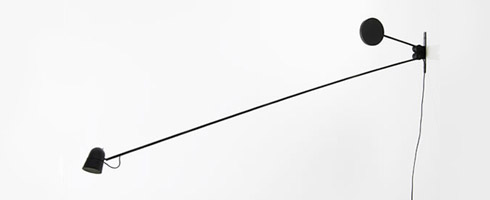
Counterbalance by Daniel Rybakken, produced by Luceplan
The wall-mounted lamp, Counterbalance, has since its launch in 2012 become one of the design icons of Luceplan, an object that seems to defy the laws of physics. The led lamp evokes the dynamic equilibrium of a sculptural mobile equipped with a fluid balancing system, making it possible to adjust the heavy lamp head with the little finger.
The lamp also earned him the London Design Medal in the category of Emerging Talent in 2013. “Once in a while a designer comes along who takes into account not just form and function but light and dark, graphics and mechanics, positive and negative space – the whole shebang,” said the jury.
“It is something completely different from what I have designed before,” says Rybakken.
Award Winning Norwegian Designer, written by Tor Kjolberg
Born and raised in Helsingborg, Sweden in 1906, Greta Magnusson Grossman represents a literal link between European design and California modernism. Grossman remained in her hometown until the late 1920s upon finishing a woodworking apprenticeship.
Awarded a scholarship, she attended Högre Konstindustriella Skolan (Konstfack) where she reportedly focused on furniture, textiles and ceramics. In 1933, having successfully completed her fellowship at the renowned Stockholm arts institution, she and classmate Erik Ullrich opened Studio, a combined store and workshop. The same year Grossman married jazz bandleader Billy Grossman. Here she took numerous commissions, including a crib for Sweden’s Princess Birgitta.
In 1934 she became the first woman to receive a prize for furniture design from the Swedish Society of Industrial Design. She traveled throughout Europe and filed reports of her observations on interior design and architecture for the “Women and Home” section of the Swedish paper Nya Dagligt Allehanda.
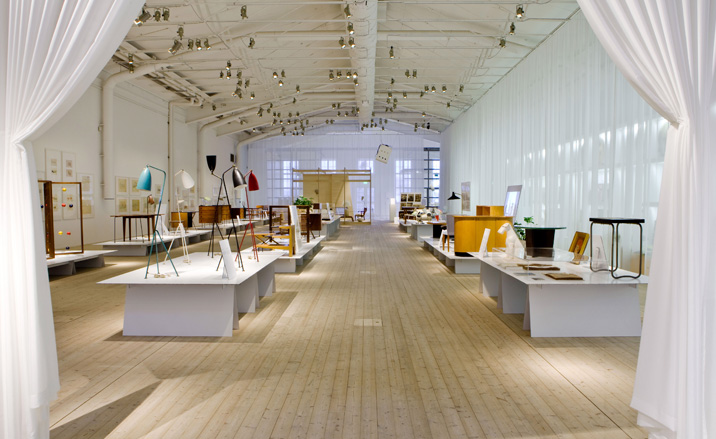
The Greta Magnusson Grossman exhibition in Stockholm
She rose to a level of prominence in her native Sweden, and In 1940 she and her husband, immigrated to Los Angeles, where she opened her second shop, Magnusson-Grossman Studio, on Rodeo Drive, which was popular with clients like Greta Garbo, Joan Fontaine and Gracie Allen. There she sold her designs as well as imports from her native Sweden.
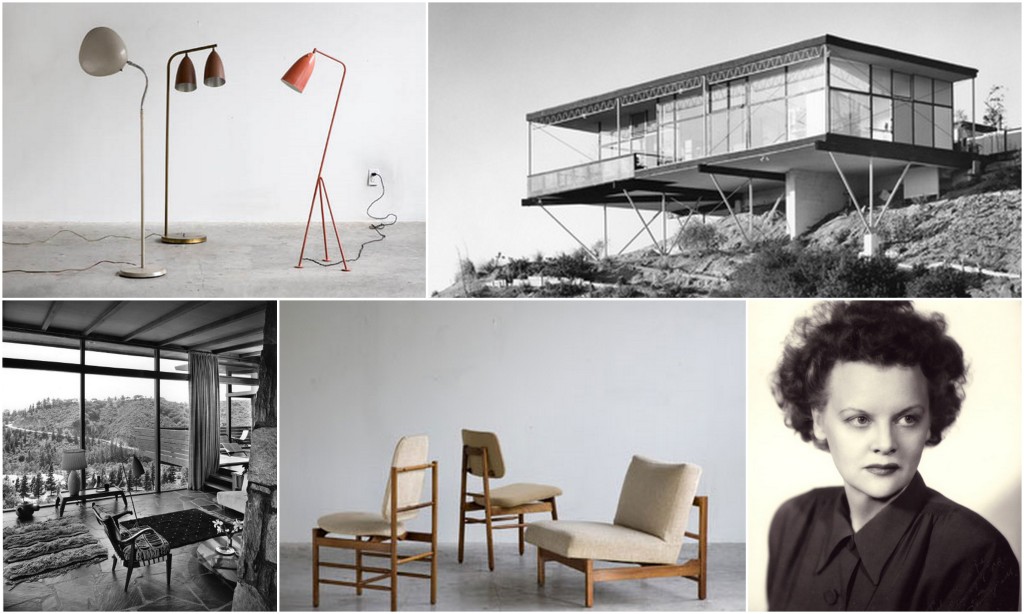
Bel Air Mid Century by Greta Magnusson Grossman
Greta began designing furniture and fixtures for Glenn of California, Sherman Bertram, Martin Brattrud, Cal-Mode and Modern Line Inc. When Barker Brothers’ Modern Shop launched in 1947, Grossman began designing exclusive pieces and taking interior design commissions.
Table Lamp by Greta Magnusson Grossma
Grossman’s compact, functional and visually lightweight modern aesthetic appealed to a previously ignored, but ever-growing demographic: single, savvy, career-minded women. Some of her pieces, like the Cobra floor and table Lamps, designed in 1950 for Ralph O. Smith (and recently brought back into production by Gubi) and her 1952 Desk with Storage for Glen of California, have become icons of California modern. In 1950, the Cobra lamp won the Good Design Award and was subsequently exhibited at the Good Design Show at the Museum of Modern Art.
Her achievements were many and encompassed industrial design, interior design and architecture. Through the 40’s and 50’s Grossman exhibited her designs at museums worldwide, including MoMA in New York and The National Museum in Stockholm.
Architectural design by Greta Magnusson Grossman
In an era where too few women garnered public acclaim for their design and architectural talents, Greta Grossman enjoyed the spotlight in a number of articles in publications that ranged from daily newspapers to sophisticated magazines and journals focused on her homes, furniture designs and her savvy. Her work was photographed by Julius Shulman, she appeared frequently in John Entenza’s Art & Architecture magazine and she received two prestigious Good Design Awards from MoMA.
Greta Magnusson Grossmans Mid-Century Masterpiece in the Hills hitting the market for the first time
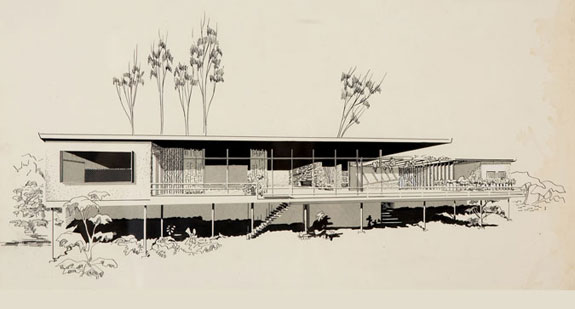
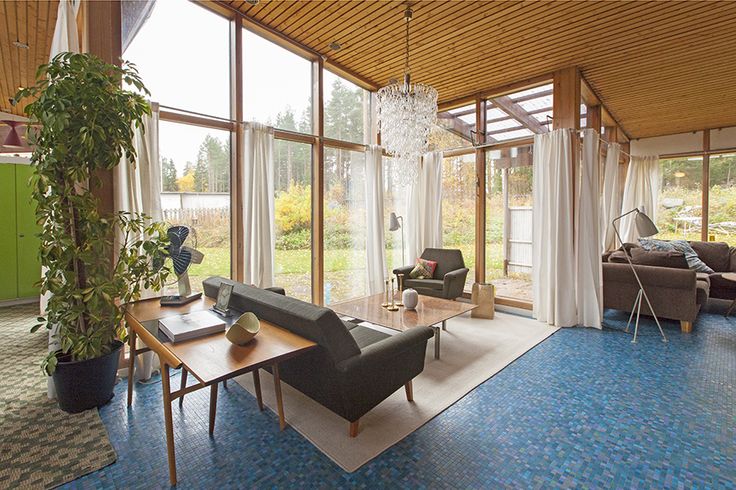
Grossman’s creativity and brilliance were also evident in at least fourteen homes she designed between 1949 and 1959. Often building them on spec and then living in them until she found a buyer, her residences were defined by their diminutive scale and lightness of form, frequently balanced perfectly on the edge of a hillside. Crafted of classic modern materials like steel and stone, Grossman also incorporated rich woods and natural light to create warmth. Unfortunately, many of these homes have since been demolished, though several do remain.
Rare occasional table by Greta Magnusson Grossman
In 2013 the Pasadena Museum of California Art (PMCA) arranged an exclusive behind the scenes tour of the Greta Grossman Exhibit, followed by a tour of homes by this talented designer.
Grossman was highly influenced by European Modernism, which had been imported to the US by influential architects, such as Walter Gropius (founder of the Bauhaus) and Ludwig Mies van der Rohe. Grossman, in turn, played a significant role in defining the aesthetic of mid-century Californian Modernism.
The Backus House by Greta Magnusson Grossman
In 1951, Grossman is quoted as saying that California design “is not a superimposed style, but an answer to present conditions. It has developed out of our own preference for living in a modern way.”
In the late 1960s she dropped out of site in moving to Leucadia. She ended up largely unknown and almost forgotten. Recently, renewed interest in this pioneering modernist has resulted in some of her pieces being brought back into production.
Interior design (Sweden) by Greta Magnusson Grossman
Today, Grossman’s product designs are highly collectible and are sold at auctions all around the world. Grossman’s products are unique, modern classic designs.
Stockholm-born photographer Helene Schmitz spent more than ten years exploring how nature is described and represented in science, art and literature. The mysterious Chinese killer climbing plant Kudzu has engulfed parts of southern USA, and there’s no way to stop it. Schmitz exhibition in Oslo runs through 11 June.
“Biological Invasion” is the correct term for the spread of a species in an area where it is not native, and it can have immense effects on the ecosystem of an entire region.
Kudzu (pueraria lobate) is the worlds most aggressive and invasive plant species. Helene Schmitz strives through her photographs to illustrate the contradictions and complexities within the concepts of nature.
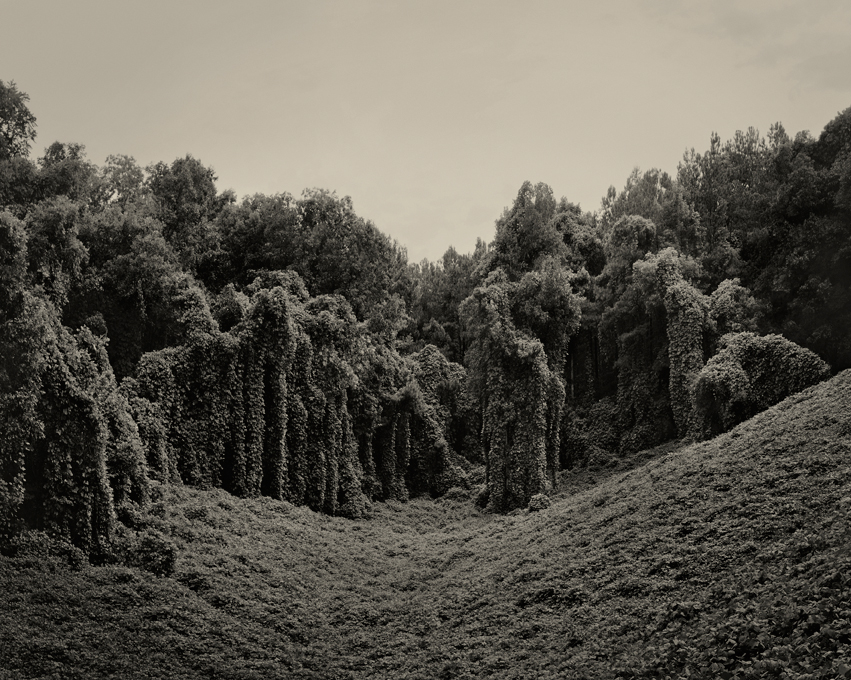
Alabama Fields by Helene Schmitz
With her “Kudzu Project” the Swedish photographer has documented such a so-called invasive plant in its new habitat in the United States. She spent the summer of 2012 traveling through the American south with her assistant Felix Bridell to capture the plant.
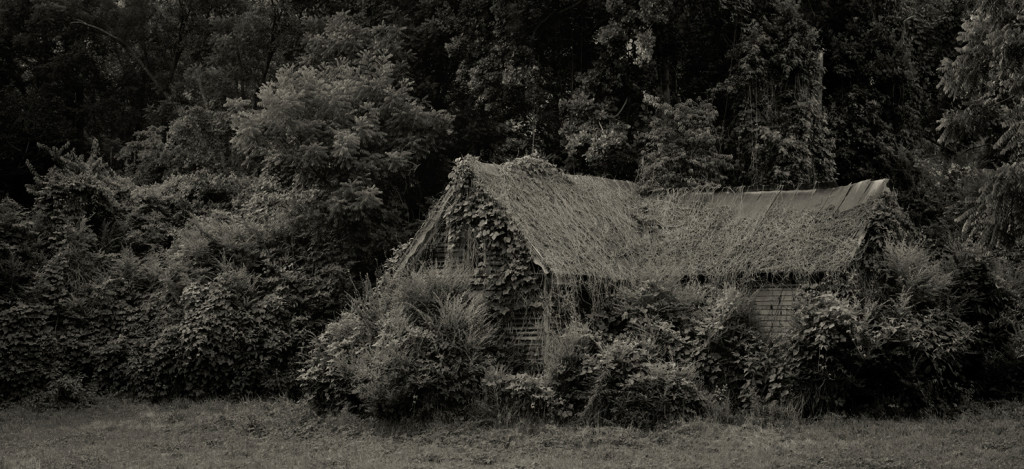
Georgian Backyard by Helene Schmitz
The natural circulation area of the Kudzu extends over Asia until North Australia. In the late 19th century Kudzu was introduced to the U. S. where it established itself as an ornamental and as a crop plant. But in the early 20th century botanists raised concerns regarding the invasiveness of the species. Schmitz was interested in the idea that a plant could be ‘invasive’ which is usually a term used to describe an act of war. Nowadays it is considered as one of the worst invasive species in the world.
Southern Landscape by Helene Schmitz
In Schmitz’ images there are a wonderful, mystical darkness. The viewer experiences a landscape, its history, and its character, almost as a mystical experience of nature. The created wondrous forms in their immense size rise majestically in their new environment. The dark vitality of this invasive plant implies downright a mood of doom.
The Swedish jazz singer Neneh Cherry is starring in the Mark Cousins-directed film “Stockholm My Love”, in which she also provides voice overs and five songs in the film’s soundtrack.
The film portraits the Swedish capital and Neneh Cherry plays a 47-year-old architect who loves buildings and the way they influence people’s lives.
In 1996 she released her album “Man”, which featured hits with the likes of Youssou N’Dour, and after that she stopped making solo alkbums, but got frustrated at the idea that she had suddenly “disappeared”.
Neneh Cherry isn’t necessarily making a “come back” since she has been here all the time. But in an interview in The Guardian last year, she was asked: “Where did you go for 18 years?”
“I knew my kids were growing up fast and I decided to catch those years. That’s an option, isn’t it?” she answered.
Neneh Cherry is 52 years old now and living in Stockholm, where she was born to a Sierra Leonean father and a Swedish mother. She is still making music and now also acting. Her breakthrough came with the hits “Buffalo Stance” and “7 Seconds”.
Some ad company bought a lot of air time during March Madness this year and filled it with a commercial featuring some generically pretty blonde woman, supermodel Natasha Poly, expressing her fun, sexy style with some of the hottest looks from a Spring 2016 collection, dancing around to “Buffalo Stance”.
Neneh’s daughter Mabel McVey is also a talented musician. “Cities have their own personalities,” she says. “They get into your head and influence your relationships. The city you live in can make you the happiest or the saddest person in the world.” Mabel, born in Malaga, Spain and raised in Stockholm, truly found her home in London after moving to England a couple of years back. “It’s quite straight and conformist in Sweden,” explains McVey, who studied music production in Scandinavia. “I felt as though I wasn’t able to admit to liking all the music I really love, like Destiny’s Child and Justin Timberlake. There’s more freedom in London.”
Mabel McVey
About “Stockholm My Love” says the Irish film maker Mark Couisins, who’s best known for the 15-part “The Story of Film: An Odyssey” documentary series 4 years ago. “Stockholm My Love” is his first feature-length fiction film, “We wanted to make a city symphony. Cities are noisy, messy, but teeming with life. Our story tries to capture this.”
Shooting “Stockholm My Love” in Stockholm
The story sees the architect (Cherry) still in shock after a traffic accident, and taking long early-morning walks through the city she loves.
Mark Cousins
It reads like a filmed love letter of sorts to the city – Stockholm – one of those seemingly plotless, quiet films that’s more about individual moments experienced by lead characters, however unrelated, with an entire city as a starring character.
Karl XII is a highly debated figure in Swedish history. One the one hand, he is seen as a national hero: courageous, faithful, and tolerant. On the other hand, he is criticized for being pigheaded and stubborn; a man who didn’t use diplomatic resources or listen to the advice of his councils and generals.
Karl XII coin
In 1716 the Swedish king, Karl XII, raised an army of 20,000 men to meet a planned invasion by Denmark. However, Denmark abondoned the offensive plans and Karl seized the initiative and invaded instead Norway in March 1717 with 8,000 troops. He thought probably he could win an easy victory and use Norway as a bargaining chip with his enemies.
Akershus fortress today
The Swedish king approached the Norwegian capital, then named Kristiania, and occupied the city. When it was clear that the city could not be held, the garrison of Akershus was reinforced and the rest of the Norwegian army withdrew to Lier, southwest of the capital. However, it did not come to a battle since the Norvegians were well prepaired to stop the Swedish army at Gjellebekk, so they turned back before the battle became a large tragedy. Only 39 people lost their life at Gjellebekk.
Norway was at this time in union with Denmark, so invading Norway was political also an attack on Denmark.
Karl concentrated his efforts on breaking through to the the west, but Akershus fortress was too strong to capture, and every road was stoutly held, the people rising en masse to defend their country and cautiously taking the offensive in several small actions. He began his return march to Sweden on 29 April and turned to the equally important task of capturing Fredriksten. This fortress, guarding the southeastern border, was a constant threat to any invader of Norway, and besides, the neighboring city Fredrikshald (now Halden) had a splendid harbor.
Fredriksten fortress with view of Halden beneath
After violent fighting Karl captured the city by a surprise attack but had to retreat because the people evacuated it, burning their homes, while the fortress opened fire on the city. He had slight hopes that he might still capture the fortress if his transport fleet lying in Dynekilen, a little inlet a few miles to the south, could reach him with supplies.
Peter Wessel Tordenskjold
The final nail in the invasion coffin was delivered by Norwegian Admiral Peter Wessel Tordenskjold, who on 8 July captured the Swedish supply fleet at the Battle of Dynekil. When the news reached Karl, he broke camp and two days later the last Swedish soldier left Norwegian soil.
Karl XII’s skull (from opening of the grave in 1917)
In the Autumn of 1718 Karl again attacked Norway. While on an inspection visit to the forward trenches on 30 November, the king was hit in the head by a Norwegian sharpshooter’s round fired from the fortress and was immediately killed.
The Durants write that “he died as he had lived, stupefied with bravery. He was a great general, and won unbelievable victories against great odds; but he loved wars to intoxication, never had victories enough…”
Oslo: Town hall to the left and Akershus fortress to the right
This precipitated an immediate retreat of his war-weary forces back to Sweden, effectively terminating the Norwegian campaigns.
Norway was at this time in union with Denmark, so invading Norway was politically also an attack on Denmark.
Sources: Karen Larsen: A History of Norway (Princeton Legacy Library)
Martina Sprague: Sweden – An Illustrated History (Hippocrene Books, Inc. New York)
We wish to thank Tor Elling Halvorsen for additional details.