Danish Nobel Winner Foiled the Führer

0

When Nazi-Germany swallowed Europe, the Danish physicist Niels Bohr fought back with the only weapon he had: chemistry.

Niel Bohr transformed into something like Oskar Schindler in a lab coat. From his Institute for Theoretical Physics in Copenhagen, the Nobel laureate aided and protected Jewish scientists, which landed him in hot water in 1940.

131015-University-of-Copenhagen's-institute-for-theoretical-physics
The Nazis had attempted to lock down Germany’s gold supply by making exportation of the metal a state crime. During the 1930s, two German physicists, the Jewish James Franck and the outspoken Hitler critic Max von Laue, smuggled their Nobel medals to Bohr’s lab for safekeeping.

Max von Laue
Max von Laue

The lab made a perfect hiding spot until April 1940 when the Nazis invaded and occupied Copenhagen. They are literally marching through the streets, and Bohr has just hours, maybe minutes, to make two golden Nobel Prize medals disappear. He knew the Germans would confiscate them, and they were not his medals.

Made of 23-karat hold, the medals are heavy to handle, and being shiny and noticeable. Clearly inscribed “Von Laue” (for Max von Laue, winner of the 1914 Prize for Physics) and “Franck” (for James Franck, the physics winner in 1925) — they were like two death warrants.

On the day that the Nazis arrived in Copenhagen, Hungarian radiochemist George de Hevesy was working in Bohr’s lab. They discussed how to hide the medals and thought about burying them at first.

“I suggested we should bury the medals, but Bohr did not like this idea of them being unearthed,” recalls de Hevesy in his autobiography.

James Franck
James Franck

“I decided to dissolve them. So while the invading forces were marching down the streets of Copenhagen, I was busy dissolving von Laue and Franck’s medals.”

But the medals would not simply disappear as von Hevesy recalled from his studies how gold is “unreactive and difficult to dissolve”. All the while, the Nazis were getting closer.

George Charles von Hevesy

Racing against the clock, de Hevesy saved the day by dissolving the bulky gold medals in aqua regia, which is made up of three parts hydrochloric acid and one part nitric acid. When the gold was dropped into the solution, the hydrochloric acid will separate the gold as long as the nitric acid loosens the metals’ atoms. And then it is left to the chloride ions to complete the process.

As you can see in this video from the University of Nottingham, dissolving gold is a slow business.

When the German soldiers pounded on the lab’s door, all which remained of the medals was an inconspicuous bottle of bright orange liquid.

131015-aqua-regia
The Nazis, without expertise on chemistry, left empty-handed.

In his book The Disappearing Spoon, the science writer Sam Kean writes:

“When the Nazis ransacked Bohr’s institute, they scoured the building for loot or evidence of wrongdoing but left the beaker of orange aqua regia untouched. Hevesy was forced to flee to Stockholm in 1943, but when he returned to his battered laboratory after V-E Day, he found the innocuous beaker undisturbed on a shelf.”

131015-nobel-flask

The flask was untouched.

In 1950, de Hevesy reversed the chemistry by separating the metal from the solution. He then sent the raw metal to the Swedish Academy in Stockholm. The gold was recast into two Nobel Prize medals that were re-presented to Franck and von Laue at reward ceremonies in 1952.

Bohr was also a winner of the Nobel Prize for Physics, but his medal did fortunately not need to be liquified. It had a month before the Occupation been put up for auction to raise money for Finnish Relief. The unknown bidder then donated the medal to the Danish Historical Museum of Fredrikborg, where it still remains.

Danish Nobel Winner Foiled the Führer, compiled by Tor Kjolberg

The Most Remote Hotel in Norway

0

In Canvas Hotel, in the deep, magic forests in the county of Telemark, the check-in point is a tent. You have arrived at a paradise for biking enthusiasts.

This niche hotel has been developed for mountain biking and offers miles of guided hikes with overnight stays in yurts (Mongolian portable tents).

170915-canvas-hotel-mapThe initiator, Øivind Lie, says he has been biking in the woods for quite a few years and has always talked to his friends about creating a place for mountain biking.

“We were looking for the best spot in our area and found the owner of a property who also was a mountain biker. We didn’t want to destroy the wilderness, so that’s how the idea of the yurts arose,” he says.

Beside mountain biking there’s plenty of alternatives. There is a gourmet chef, you may relax in the sauna and there are outdoor bathtubs at all tents as well.

The owners claim that their guests get the best accommodation available – since they deserve it.

170915-canvas-hotel-norway
Guests can choose between small routes ranging from about half an hour to two hours and big routes which are seven hours. In Norway you are by law allowed access anywhere in the forest, so it’s very easy to get on a bike and go wherever you want.

170915-canvas-hotel-norway-4
The Canvas Hotel also offers special training programs with all kinds of difficulty levels to accommodate anyone from beginners to experienced riders. This is far away from the busy fitness centers. It is all about enjoying nature and silence.

170915-canvas-hotel-norway-5
A typical day begins with a decent breakfast, like eggs and bacon and pancakes. After breakfast you ride on your bike for a few hours. Back to the hotel for lunch, and if you’re not of the most eager type, you may stay for the rest of the day and read books or listen to the birds. On day trips, the guide prepares a meal on open fire.

When guests arrive at the yurks after a good day of biking, they generally go directly into the sauna. If they prefer, there are also French vintage bathtubs that can be placed wherever the guests want to.

170915-canvas-hotel-norway-6
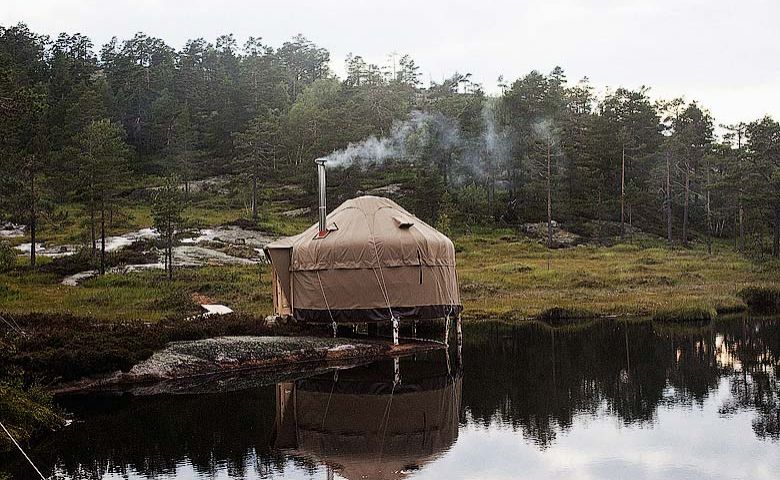
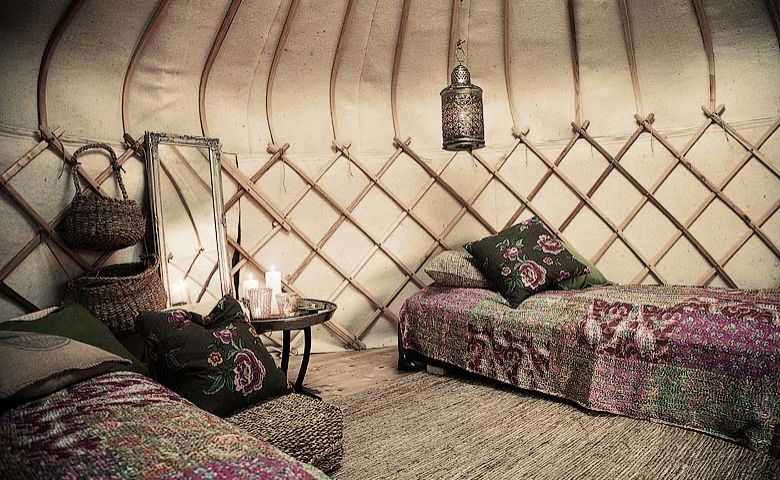
The yurts are standing on posts, and some are partly over the water. The yurts have wooden platforms and each has its own wood-burning stove. The tents are insulated with a layer of wool with canvas on the outside. They are cozy and warm and completely made of natural materials.

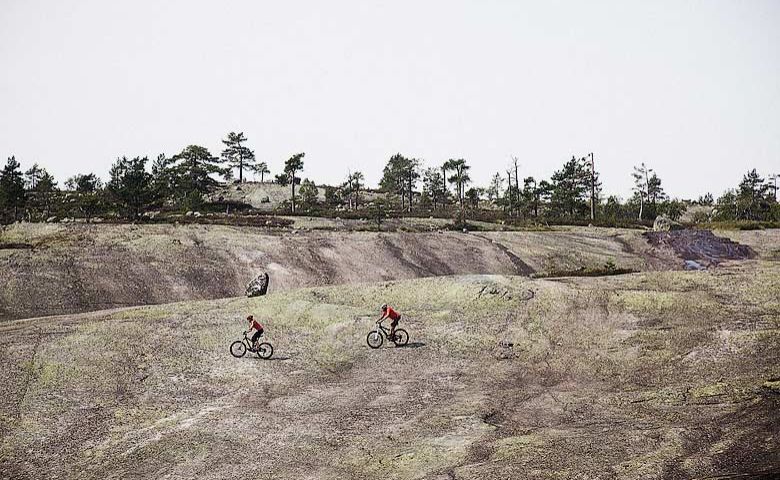
The area is perfect for biking since the ground consists of a thin layer of soil, basically a big area of rock, with many open areas and not many trees. Guests may enjoy hundreds of small lakes, rivers and streams.
170915-canvas-hotel-norway-3
The Canvas hotel is easily accessible and attracts private as well as corporate guests from all over the world, even if there’s no electricity or running water at the hotel, only a wood fire pit and propane gas.

Jan Fasting
Jan Fasting

To go there by car from Oslo:

Follow E-18 towards Kristiansand. Follow road 38 towards Skien/Drangedal, then road 358 at Bostrak towards Treungen.

The hotel opens around first of May and are closed during winter from first of November.

This year Canvas hotel was listed as one of the 100 best hotels in Europe by the German travel magazine Geo Saison.
The Most Remote Hotel in Norway, written by Tor Kjolberg

Talking Scandinavian Design

0

We’ve met up at the Broberg & Ridderstråle office, a fairly messy space with prototypes, sketches and odd pieces of furniture here and there, with no apparent structure.

091015-broberg-and-ridderstrale-swedenNone of the precise finish that is typically so prevalent in Broberg  & Ridderstråle’s interior design work is visible here. But this is not actually where the most important work takes place: that happens “anywhere at all”.

And what we talk about is how Mats Broberg and Johan Ridderstråle got a piece of mesh that Swedese’s then-CEO had found interesting, a kind of fabric that would shrink 30% when steamed.

Kite Lounge chair is designed to look like a traditional box kite trapped in flight, seemingly delicate and lightweight, but with a strong structural form.

“Then we got the actual foundation: a direct association with kites and the balsa airplanes we built as kids. We understood that we needed to find a frame, across which to stretch it,” remembers Mats as he talks about Kite, the surfer-inspired easy chair that launched at Il Salone del Mobile 2015 as a conference chair.

Kite conference chair

“We have an unstructured approach to work,” explains Mats Broberg, making it sound like an established work method. “We don’t sit here in the office and work. We go all over, often on walks to museums and exhibitions. Ideas have to come with happiness, a joy of discovery; otherwise, they’ll never be good.”

For that reason, they have no employees or interns; they are not bound to the office, nor are they influenced by finances when choosing assignments. “It gives us freedom.” And this approach has been very successful so far.

091015-Swedese_divido_table
Divido table

“I’m a little more zealous and have ideas more often, which Johan then scales down intellectually. He’s more structured than I am,” says Mats. Johan fidgets a little, but not disagree.

Mats and Johan met while studying interior architecture. They chose to work together immediately on both side projects and their school assignments. Given that they had made their degree project together, it felt natural to continue working together.

The company was launched in 2001 – “because we sold a candlestick and needed to send an invoice.” Since then they have won numerous honors and awards, not to mention that their products have appeared in rugs, outdoor furniture, grills, lamps, a rack for wood, an oil lamp and street poles, they also work as interior architects, designing environments in stores, offices, homes and at exhibitions.

For Swedese they also designed the Stella chair, a consistent solution for a company or institution’s comprehensive chair needs. At the desk, in the waiting room, lunch room, auditorium, or for the receptionist or CEO: a version of Stella exists for every conceivable function.

Srella chair
Srella chair

The very first product for Swedese was the Divido table, which so elegantly solves the meeting between the legs and table top that it is tempting to set the table beneath, rather than on top of Divido. It is brilliant – especially considering that the most aesthetically sensitive part of almost every table is precisely the space where the legs and table top meet.

The first seed of a product is usually a simple pencil sketch – which was the case when Kite armchair was to be transformed into a conference hair.

“We start that way so we can discuss, because we’re working together. Next we move over to digital material, which is the easiest way to communicate with the factory,” says Johan. “Then we try to go to the factory as early as possible to get a rough shape, something to look at. We want something we can get a feel for in terms of design, but also purely technically,” explains Mats. “Chairs made for offices are usually so incredible technical, with so many functions. But with Kite, we decided to make something basic, because that’s a way to compete as well. If you buy a chair that can do a thousand different things, you’ll be really satisfied when it arrives, but you’ll end up in a certain position that you like. It was a relief to think: no height adjustments. Instead, we let the shape decide.”

Kite is almost even better as a conference chair. “It’s great to have a non-upholstered chair, because it breathes. Especially if you’re sitting for hours in end,” points out Mats. Johan agrees. The construction characterizes the aesthetic. Because Kite is a little transparent, you can see through the chair. The similarities to a sail are particularly evident in the lighter version.

Kite Lounge Chair
Kite Lounge Chair

To summarize what distinguished Broberg & Ridderstråle, and Divido and Kite especially: it is a kind of meaningful excellence. An idea that is so uncompromisingly and consistently implemented that the furniture could have arrived by way of natural law. If you did not know before, now you do: a conference chair should always be made of mesh.

How else can you sit for long periods of time?

The article “Talking Scandinavian Design” was printed in the book, Swedese Portfolio and published by Swedese Möbler Ab, 2015.

All images: Swedese Møbler Ab.

Swedese was founded in 1945, in a world finally at peace, by two brothers with a passion for wood, beauty and craft.

Artistic Architecture in Norway and Newfoundland

0

Canadian-born, Norwegian-based architect Todd Saunders returned to Newfoundland to design a 29-room inn on tiny Fogo Island.

Therefore, in 2004, the Shorefast Foundation was established in order to revive the island and attract visitors who asides from their interest in various forms of art, are also looking to enjoy cultural and sustainable tourism. Later on, in combination with the idea behind creating a 29 room Fogo Inn as a meeting point for artists from all over the world, the Fogo Island Arts Corporation was established, so that the island’s local tradition would be preserved. The newly formed Corporation focused on taking the initial concept to the next level through providing visitors with not only a place to sleep but also a number of other amenities such as a library, spa & sauna, an art gallery, a small cinema and gourmet creations from one of Canada’s top chefs.

110915-fogo-island-saunders-architecture-long-studio
Fogo Island Studios are slowly becoming an urban myth. The imposing landscape of the North Atlantic heralds the setting for four exclusive studios, soon to be six, on the North coast of Newfoundland, Canada. With a population of 2,706, the economy of the island which was initially based on fishery rapidly changed along with the global economic background.

Tom Saunders and his border collie

The largest of the studios in the collection, its’ exterior surfaces are comprised of pre-finished rough-sawn painted pine planks. The left zone of the studio features mechanical equipment, storage areas, water tank, compost toilet, shower, kitchenette, wood-burning stove and a ladder that leads to the elevated sleeping loft. Built on stilts in order to take advantage of the exceptional views, its abundant natural light makes this space an ideal workplace for artists and designers.

110915-fogo-island-inn
Fogo Island Inn
A five star inn for the Shorefast Foundation on Fogo Island, Newfoundland, Canada. Using wood as the main material, Saunders designed the 29 room Fogo Inn as a means towards the island’s  economic and cultural survival, but also as a timeless piece of architecture, which would be ‘made just for Fogo’. The Inn includes a restaurant, directed by one of Canada’s best chefs, together with a lobby, a library, a small movie theatre and an independent art gallery on the ground floor; four floors of rooms above ground level; and a sauna and spa facility on the top of the building.

Credits: Todd Saunders with Ryan Jørgensen, Joseph Kellner and Attila Béres
Photographers: Iwan Baan, Alex Fradkin, Bent René Synnevåg

In Norway Tom Saunders has been responsible for artistic architecture all over Norway.

Aurland Lookout was designed by Todd Saunders and Tommie Wilhelmsen.

The architects won first prize to in an invited competition in 2002. This project is part of a national program on tourist routes commissioned by the Norwegian Highway Department. The pictures actually say more than a thousand words.

110915-aurlandsvangen-west-norway
Photographer: Bent René Synnevåg, Nils Vik
Credits: Todd Saunders with Attila Béres and Ken Beheim-Schwarzbach

Aurlandsvangen
This large multi-functional structure is located on the waterfront in Aurland, down in the valley from the Aurland Lookout on a site that overlooks the expanse of the Aurland Fjord which is a World Heritage Site. The brief was for a competence centre for the local environmental think tank, including business and conference space, publically accessible areas, as well as a financial centre.

Stokke Forest Stair designed for Sti for Øye (Visual Path) Sculpture Park
This sculptural installation was designed for the Sti For Øye Sculpture park in Stokke, set amongst the Vestfold oak forest to the West of Oslo, Norway. Working with landscape architect Rainer Stange in order to create the infrastructure for a woodland walk past a series of artists’ installations, Saunders proposed a series of steel and wooden walkways set at the highest point of the site, looking east towards a castle.

110915-stokke-forest-stair-oslo
Credits: Todd Saunders with Attila Béres and Ken Beheim-Schwarzbach

Solberg Tower & Parks
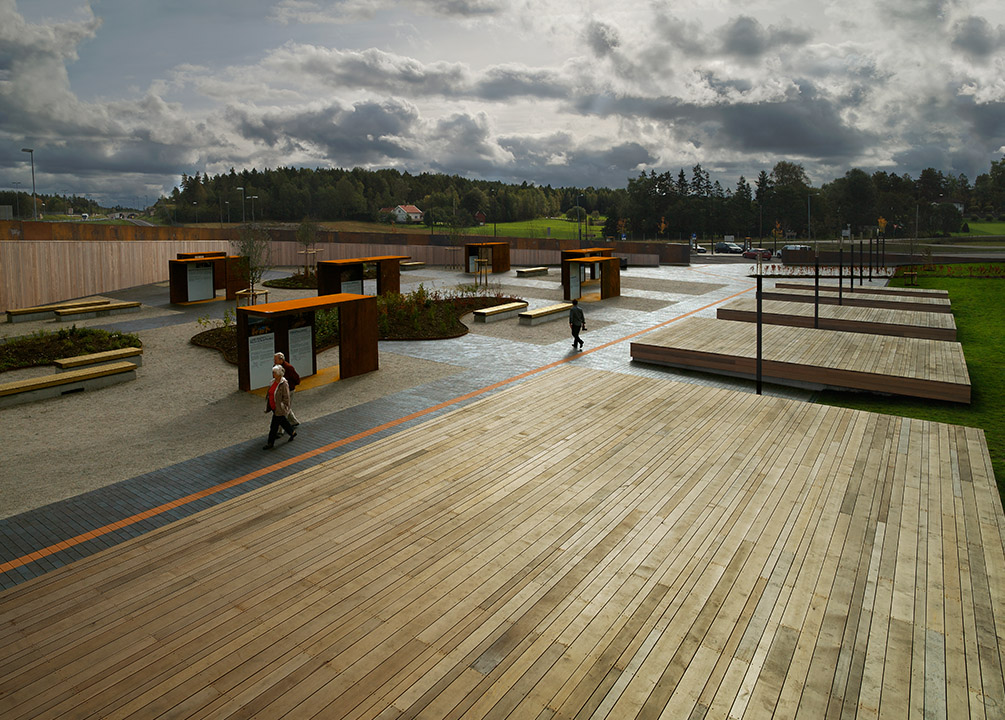
Saunders was commissioned to design a park at the entrance of Norway coming from Sweden. This park is one of the first places travelers will stop when entering Norway. The park is surrounded by a long wall composed of cortain steel on the outside and wood on the inside surface. The wall encompasses a 2000m2 space, making it into a quiet park. The wall continues to the surround the park and then rises 30m in the air to form a tower. The tower is just a simple stair. On top one will be able to see the Oslo fjord.

110915-solberg-tower-and-park
Artistic Architecture in Norway and Newfoundland, credits: Todd Saunders with Attila Béres, Inês Moço Pereira, Mats Odin Rustøy, Greg Poliseo, Mathias Kempton.

Feature image (on top): Fogo architecture Bridge on Fogo Island (Studio Bent Rene Synnevåg)

Source: Saunders and Yatzer

Ingmar Bergman’s Passion

In 1960 Ingmar Bergman finished his screenplay to “Through a Glass Darkly”. He wanted to screen the film on the Orkney islands, but the film company realized it would be too expensive, and did everything they could to persuade him to think otherwise. He was taken to the Swedish island Fårö, and fell in love with this windswept destination.

051015-bergman-estate-faaroe
But before his arrival on Fårö, Bergman was somewhat skeptical. His encounter with the island was, however, life-changing. He has said, “If one wished to be solemn, it could be said that I had found my landscape, my real home; if one wished to be funny, one could talk about love at first sight.” For 40 years, Ingmar Bergman lived, worked and found inspiration on Fårö and was to shoot six films and one television series there.

051015-bergman's-passion-feature-image
In 1965 Bergman returned to Fårö, this time to produce “Persona”. To do both outdoor and indoor scenes, a house was erected on a high platform. The view was so stunning that the director wanted to build a house right there. However, the cinematographer Sven Nykvist knew about an even nicer place, a few kilometer further south, and one night they visited the place where “beach and forest meet”.

Ingmar Bergman, Sven Nykvist, Erland Josephson and Liv Ullmann on Faro.

Subsequently he purchased the land and built a house on it. The house was finished in 1967. The architect was Kjell Abramson, who was involved in the rebuilding of the Dramaten theatre in Stockholm, where Bergman was the director. Bergman compared the job to a regular staging. “It’s like sitting with a scenographer, drawing.”

He stayed on Fårö as often as his Stockholm duties would allow until 2003, when he sold his apartment in Stockholm and moved permanently to the island. Since then he very seldom left his new home. In the 1970s Bergman almost realized his plans to build his own film production center there. But the trouble he had with the tax authorities at that time forced him to exile. However, he did build a fully functional studio there, where Scenes from a Marriage was filmed.

Fårö became Bergman’s haven, his creative wellspring and a central character in many of his films. Here he filmed movies twice a day in a converted barn. With its rocky beaches and weather-beaten pine forests, Fårö epitomized Bergman’s unsparing and unsettled internal world.

The Bergman Center on Faro

To Liv Ullmann, who starred in Persona, and was Ingmar Bergman’s girlfriend, it was the beginning of a new life.

Linn Ullman and Ingmar Bergman in the church on Faro

She describes a screening summer of happiness, where the two one afternoon stray away from the rest of the film crew to find a small hill of grey stones – and sat and watched the sea. “There he took my hand and said, ‘You and I are painfully connected’,” she writes.

The films which make the most expressive use of the distinctive Fårö landscape are Through a Glass Darkly, Persona, Shame and A Passion. The barren, stony landscape framed by the Baltic Sea, has often been regarded as a metaphor for some of his characters’ inner emotional states.

For his 70th birthday Bergman invited several of his exes to Fårö. His guest list included Liv Ullmann, concert pianist Käbi Laretei and former leading lady Bibi Andersson. According to Linn Ullmann, who was there, “These are women who know how to go out onstage and be fabulous. And they are fabulous. There was no bad acting. My father hated bad acting.”

Bergman died in his home on July 30, 2007, at age 89. His will, written in the 90s, instructed his heirs to strike the set – to sell off his houses, his cinema and their contents to the highest bidder. He wrote that he wanted no emotional hullabaloo. The proceeds should be divided among his nine heirs.
The question of how the properties were to be administered as the cultural legacy of one of the greatest directors in the history of cinema sparked off a debate that reached far beyond Sweden’s borders.

Bergman had often expressed the wish that these buildings should continue to be meeting places for people working within various types of artistic fields, also after his death. His youngest daughter, the author Linn Ullmann, lived on Fårö during her father’s illness in spring of 2007.

“My father and Fårö was a great love story,” said Linn on an overcast afternoon in July, pointing out the imposing trees he refused to cut back because he wanted to witness the effects of wind and time on them. And yet, rather than celebrate the panorama outside, Bergman contained and framed it, lining his rooms with small windows that allowed only glimpses of forest and sea.

“There has not been a day in my life where I have not been thinking of death, or when it has not touched me,” said Ingmar Bergman once. He chose the place where he would be buried, a corner on Fårö cementry. He wanted distance to the road because he was “so sensitive to sound”.

After Bergman’s death, the family committed the auction houses Christie’s and Bukowskis to sell the properties. The deadline was set to August 2009. The media speculated both in price and buyers. The Swedish government rejected that it would go in and rescue the legacy if the country’s greatest director.

051015-bergman-estate-faro-for-sale
A Norwegian inventor and archaeologist acquired Ingmar Bergman’s home and turned it into an artists’ retreat, to the relief of campaigners who had been fighting for mjust such a project.

Hans Gude Gudesen, who made his fortune in IT, paid an undisclosed sum for the property, which was valued at that time at between €3-4m.

“My father and Fårö was a great love story,” says Linn on an overcast afternoon in July, pointing out the imposing trees he refused to cut back because he wanted to witness the effects of wind and time on them. And yet, rather than celebrate the panorama outside, Bergman contained and framed it, lining his rooms with small windows that allowed only glimpses of forest and sea.

Hans Gude Gudesen became aware of Linn Ullman’s plans for the properties and contacted her. Under the leadership of Linn Ullmann and Brit Bildøen, and in cooperation with a dedicated Board of Diretors, the important and time-consuming work of developing and formalizing what was to become the Ingmar Bergman Estate.

Ingmar Bergman's grave
Ingmar Bergman’s grave

In May 2010 The Bergman Estate on Fårö welcomed its first guests.

Ingmar Bergman’s Passion, written by Tor Kjolberg

Related article: The Best of Bergman

Could a Norwegian Saved Greece From Drowning?

0

Secretly the disputed Greek Minister of Finance, Yanis Varoufakis, tested out the possibility of introducing a parallel electronic payment system. Behind the model is the Norwegian scientist Trond Andresen.

The premise for the proposal was that the Greek government had a breathing space of a couple of months. At the end of that period a parallel electronic currency could have been put into circulation.

Trond Andresen, ntnu

Trond Andresen, scientist at The Norwegian University of Science and Technology Department of Engineering Cybernetics, Trondheim, Norway, was the first to argue for this, and he has long been pushing for such payment systems. Several times in recent years he has published articles in which he explains in detail how Greece could go forward.

“Such a mobile-based transaction system may be implemented through one of the technically proven schemes already in successful operation in some developing countries, also recently put in operation by the central bank of Ecuador. The system may be implemented to work also with older models of mobile phones, since it may be SMS-based (but there will be apps for smartphones),” he writes in one of his articles.

“My argument has been that a parallel electronic currency will speed up the Greek economy and also strengthen Greece’s position in negotiations with the EU,” says Andresen to the Norwegian newspaper Aftenposten.

The advantages of an electronic payment systems versus bills and coins are among others that the system can be implemented fast, and adjustments that turn out to be needed can be implemented in software, therefore very easily and cheaply. In addition the system is very cheap to run, compared to a system with notes and coins. And forgery is impossible.

News agency Bloomberg has expressed doubt to the system, but Varouflakis has talked openly about his “Plan B” with his team.

GREECE FINANCE

The Greek paper To Visma printed a long article with the heading, “Yaris, Andresen’s Adventure and Trondheim Drachmas”.

Andresen met Veroufakis in Australia in 1997 and To Visma calls him “the visionary from Norway”.

“It’s fun that Veroufakis would test the model that I have written about and promoted for five years, but I’ve never been a part of Varoufaki’s secret team,” said Andresen to Aftenposten.

Could a Norwegian Saved Greece From Drowning? compiled by Admin

Scandinavian Omelet

0

Thick omelet with tomatoes, chives and bacon. Serve with toasted rye bread, which is a completely different thing untoasted.

The toasting brings out the caramel flavor. Leftovers are eaten the day after as a topping for open sandwiches.

In a thick iron pan, fry the bacon in the butter until crisp. Remove the bacon.

Beat the eggs and then add them to the pan and fry in the bacon fat and butter. As soon as the eggs start to get stiff, lift the edges of omelet and tilt the pan so more runny eggs goes underneath.

Arrange the tomato and potato slices on the omelet. Fry until the egg is still gooey and then let the heat from the pan do the rest of the cooking.

021015-scandinavian-omelette-2
Scatter with chives and serve immediately with the bacon.

12 bacon rashers
50g butter
12 eggs
3-4 tomatoes, sliced
Maybe a few sliced boiled potatoes
Large bunch of chives, finely cut

Serves 4

Scandinavian omelet: Enjoy! Greetings from Admin

The Royal Past of Lindøya, Oslo

0

Lindøya is a small island located in the Oslo fjord, just south of central Oslo. Administratively it belongs to the borough of Gamle Oslo (Old Oslo).

In 1920, Lindøya was the Oslo base for the pioneer Norwegian airline, Det Norske Luftfartrederi, and its seaplanes. The operation only lasted until the autumn of 1920. When regular seaplane routes were again established in 1927, the operation was moved to neighboring Gressholmen.

Lindøya, Oslo east side

Today Lindøya is connected to Oslo from Town Hall Pier #4 by means of two boat routes: line 92 which docks on the western side of the island, and line 93 which docks on the eastern side. Service is year-round although very limited during the winter season.

However, once the island was restricted to the conditioned and the Royal Family.

The 'Regulars' House' at Lindøya, Oslo
The ‘Regulars’ House’ at Lindøya, Oslo

There is a beautiful empire-house on Lindøya. The hipped roof between heavy trees suggests its ancient origins. It is the former inn Stamhuset (The Regulars’ House), originating from a time in the 1700s, when Mogens Broch had an inn there.

Christiania Hunters Club at Lindholmen, Oslo
Christiania Hunters Club at Lindøya, Oslo

Most people in Christiania, as Oslo was called at the time, considered Lindøya with awe, since the distinguished Christiania Hunters Club was housed there. Membership was reserved for men of the upper classes and professions, such as wholesalers, professors, lawyers and landlords under the motto “mutual comfort and entertainment.”

Cabins at Lindøya, Oslo

The association was proudl to have King Oscar II among its members. He stayed frequently at his cottage on the west side of Lindholmen. You may see his former somewhat elaborate cabin if you take the ferry to Nakholmen.
In the 1900s, however ordinary working people began to settle on the island and the upper class people’s desire to stay there disappeared. The only explicit reminiscence is the Regulars’ House down by the northern ferry pier.

Feature image (on top): King Oscar II’s hunting cabin at Lindøya.

The Royal Past of Lindøya, Oslo, written by Tor Kjolberg

Scandinavian Royal Line

Monarchy is alive and well in Scandinavia. Sweden, Norway and Denmark all have royal figureheads. Learn more about the Scandinavian royal line.

Monarchy could hardly be more entrenched than in Denmark. Queen Margrethe II is the 53rd in an unbroken line of sovereigns spanning more than 1,000 years. She became Queen of Denmark in 1972.

300915-Queen-Margrethe-II-of-Denmark
Sweden, too, has had more than 60 kings since 980. The present King Carl Gustav may be “XVI”, but his direct line begins with Jean-Baptiste Bernadotte, the French marshal who became heir apparent in 1810 and Sweden’s king in 1818.

STOCKHOLM, SWEDEN - MAY 22: King Carl XVI Gustaf of Sweden attends the christening of new Swedish heir to the throne Princess Estelle Silvia Ewa Mary of Sweden at The Royal Palace on May 22, 2012 in Stockholm, Sweden. (Photo by Chris Jackson/Getty Images)
Norway’s royal line ceased when Norway became a Danish province and the monarchy was only restored, after a referendum, following the dissolution in 1905 of the subsequent union with Sweden. The present king, Harald V, is the third of the modern line, the “V” notwithstanding.

300915-hmk-king-harald-v-of-norway
Not a little craft has gone into keeping the Scandinavian monarchies in good health. When Carl XVI Gustav ascended300915-swedish-king-2 the Swedish throne in 1973, the Constitution began with: “The King alone shall govern the realm…” Lest he got the wrong impression, this was hastily changed to: “All public power in Sweden emanates from the people…”

The king decided his own official motto ought to be: “For Sweden – in keeping with the Times.”

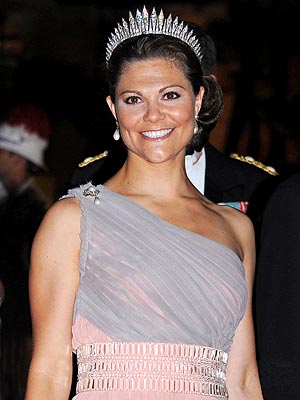
This was the cue for changing the rules of succession so that they no longer discriminated against daughters. Consequently, next in line is Crown Princess Victoria rather than her younger brother.

300915-crown-princess-victoria-of sweden
In 2010, the Swedish royal house had some dramatic highs and lows. Princess Victoria married her beau Daniel Westling in a ceremony that drew crowds of half a million onto Stockholm’s streets. But later that year, revelations about Queen Silvia’s father’s Nazi connection came hot on the heels of a best-selling biography about the king, which contained details of his wild sex life.

300915-king-of-sweden's-hats
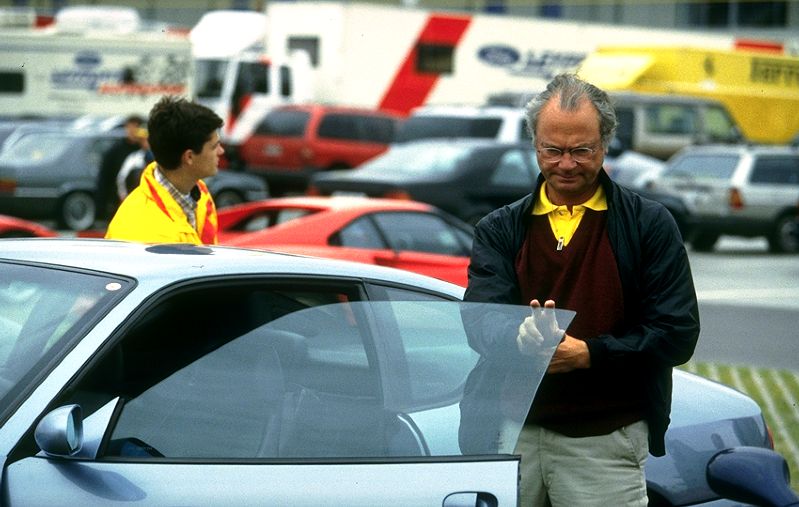
Carl Gustav is also not averse to tearing around in a Ferrari, and was reported to the police in Denmark for doing an alleged 250kph (155mph) on the Copenhagen expressway.

300915-king-carl-gustav-of-sweden-and-his-ferrari
In contrast, King Harald loves boats, representing Norway at the Olympic Games, and winning the European championship in 2005 – right after a heavy bypass. Unlike his Swedish counterpart, Harald would not be seen dead in a Ferrari. He uses public transport.

300915-sailing-champion-king-harald-of-norway
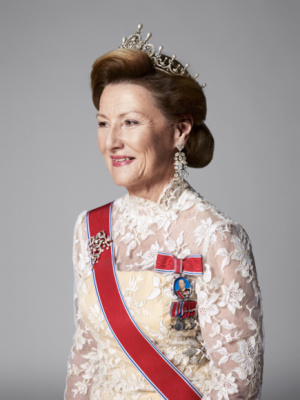
Queen Sonja is the daughter of an Oslo shopkeeper and their children went to state schools.

300915-queen-sonja-of-norway
Fittingly, the Crown Prince found himself a bachelor flat in an unfashionable part of Oslo, but let the side down, as it were, by sharing it with a waitress, and her three-year old son by a man who was in prison for drug offences; they are now married and have two children of their own. Despite her fear of flying, the crown-princess has travelled the world with her husband Haakon, and has made official visits to India, United Kingdom and the United States.

300915-crown-prince-haakon-of-norway-2011300915-crown-princess-mette-marit-of-norway


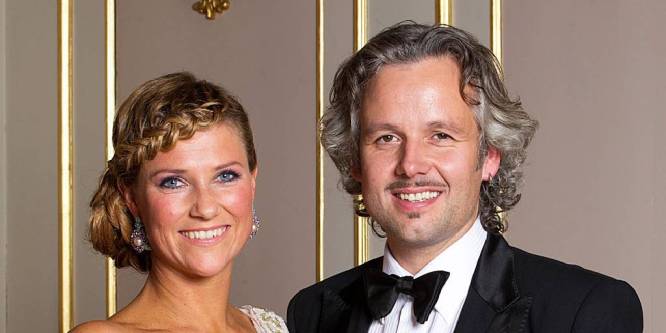
Daughter of King Harald and Queen Sonja, Princess Märtha Louise of Norway, married a Norwegian disputed author, Ari Behn in 2002. They divorced in 2017, and Ari Behn died in 2019. Later, she faced criticism from her own family after she collaborated with an American clairvoyant who contacts the dead.

300915-martha-louise-and-ari-behn
In August this year, Sweden’s Crown Princess Victoria, 38, and  Crown Princess Mette-Marit of Norway, 42, who had a busy schedule returning from a family holiday in France – and despite pregnancy rumors – joined force in the picturesque town Halden to promote UN’s global climate change campaign.

300915-Victoria-Sweden-Mette-Marit-Norway-UN's-climate-change-campaign-halden-norway-august-2015
If conscientious exercises in non-charisma go down well in Norway, Queen Margrethe could not hope to do the same in Denmark. She has been showered with academic honours from the likes of Cambridge, Oxford and the London School of Economics. While trying unsuccessfully to hide her distinguished output as a painter, writer and designer behind a string of aliases, she has at least persuaded her friends to call her Daisy. The Queen’s artistic works are represented at  Statens Museum for Kunst (National Gallery of Denmark), ARoS Aarhus Art Museum, , and Køge Art Gallery Sketch Collection (sketches for church textiles).

300915-Queen-Margrethe-II-of-Denmark-as-artist
Crown Prince Frederik, her heir, is not much better at disguise. Dressing down for a night on the town, he turned out so scruffy that the bar refused to let him in. As a trained soldier, no mean dancer and the leader of a husky-drawn expedition across Greenland, Frederik’s status as a dashing bachelor ended in marriage to Australian Mary Donaldson, with whom he now has four children.

300915-happy-crown-prince-frederik-of-Denmark
Scandinavian Royal Line, written by Tor Kjolberg

The Road to Norway

Today we proudly present the stunning photos taken by photographer Gianluca La Bruna and his comments on his visit to Norway a couple of years ago.

Born and raised in Italy, Gianluca rented a car and hit the roads of Norway. The following story, is Gianlucas own, accompanied by his stunning photos from the trip.

310815-Road-To-Norway_2-Gianluca-La-Bruna” I’m originally from Italy and my city is in front of the sea side. Summer to me has always meant warmth, sea, and beaches. I think most of the people that come from my town tend to avoid cold weather.

But in the summer of 2013 I just felt like I wanted to do something different. I felt like I needed nature, wilderness, breathless landscapes and silence, interrupted only by the echoes of the waterfalls. What I needed was a road trip. Away from the unbreathable hot air, away from everything I knew, away from everyone I know. I wanted to go to Norway!

As many people do before starting a travel to a new country, I started to read.
I swallowed some Norwegian books (Hamsun, Erlend Loe, Nesbø and some plays by Ibsen), while listening to Grieg, in order to be emotionally prepared for the trip.

I also saved some money, because the first thing everybody told me was that Norway was super expensive. For this reason, I decided to rent a car

in Sweden, fill it up with every kind of food, my tent, my backpack and a couple of cameras, and I took a ferry from Strömstad to Sandefjord.

310815-Road-To-Norway_03-Gianluca-La-Bruna
“Here I am”, I thought. I was in Norway with a map but with no clue where to go. According to my budget I had two weeks more or less. Two weeks to experience as much as I could. I decided to travel the South, to reach the West coast and to go back. Just a car and the road.

310815-Road-To-Norway_04-Gianluca-La-Bruna
I went to Risør, in Aust-Adger county. There, a nice young guy told me that I just missed the most important event in that city: a wooden boat festival that attracts many tourists. I didn’t care that much actually, because that white wooden town attracted me like no others. There, I really felt that I was in the North, far from everything, and I decided to forget my map. I just kept in mind that in three days I needed to be in Stavanger, then… whatever, I would have checked later.

310815-Road-To-Norway_06-Gianluca-La_Bruna
My travels through fjords had just started, I didn’t pay attention to the names of the little jewels I discovered, but I remember every single face I talked with, every food, every animal, every waterfall.

310815-Road-To-Norway_091-Gianluca-La-Bruna
I had to stop while heading to Stavanger, because I saw some crystal-clear water gushing from white rocks, and in the middle, a little rainbow! “You got to be kidding me!” I thought.

310815-Road-To-Norway_07-Gianluca-La-Bruna
When I got to Stavanger it was raining. A lot. Stavanger is in the Rogaland county, it has a famous university and its music scene is exciting. Here I met two girls, they played in a metal band (they talked to me about music in Stavanger) and with a pint in my hand, they told me about the Pulpit Rock (Prekestolen in Norwegian). They also told me about this tongue of rock suspended 600 meters onto a magnificent fjord. I am forever thankful to these girls for letting me know about this place!

310815-Road-To-Norway_08-Gianluca-La-Bruna
The morning after my destination was Forsand, a little town where the Pulpit Rock is located.

Well, at first I wondered how on earth I ended up in here? It was pouring rain, the parking lot was unbelievably expensive, and from where I was the Pulpit Rock appeared like an ordinary brushwood. I neither had proper clothes, nor proper shoes. After five minutes outside my car, I was soaked to the bones. Miserable, I decided to walk, not to throw away 100 NOK of parking fee.

310815-Road-To-Norway_16-Gianluca-La-Bruna
Maybe “walk” is not the appropriate word. At some points I had to climb, to jump, to fall, to clasp rocks, and so on, but after 2 km (it is 3.8 km to reach the top) it was not raining anymore, and I was actually flushed, striving for reaching the end of the path.

310815-Road-To-Norway_151-Gianluca-La-Bruna
And all of a sudden, there it was. The Pulpit Rock, and the Lysefjord that opens up in front of your eyes. It was really early in the morning, so there were not many people around, apart from some very nice Dutchmen that took a picture of me while I was lying on my stomach looking straight into the nothingness.

310815-Road-To-Norway_18-Gianluca-La-Bruna
Coming down was bittersweet, I wanted to stay the whole week on the top, but at the same time I felt the evil pleasure of seeing all the tourists who had started to flow panting for the scale.

310815-Road-To-Norway_111-Gianluca-La-Bruna
In the evening at my camp, I met an Australian guy who was on his way to Bergen to meet his Irish girlfriend, who was studying there for her Erasmus. We played guitar together, jammed in front of a bonfire, and he gave me his metal kazoo which I still have on my bookshelf.

Anyway, he asked me to follow him to Bergen. Bergen was a hell of a detour for me, but fair enough, we went to Bergen.

Bergen, in Hordaland, is the second-most populated city in Norway, and is truly amazing! I stayed two days there, which is the longest stay I had in one place in Norway. I, my new Australian friend and his girlfriend admired the remains of the quays, Bryggen, a World Heritage Site and (shame on us) we tasted whale meat. I know, one’s not supposed to do that, it’s bad. In our defense, I can say that we were on tourist frenzy, it was 4 or 5 days that the sun didn’t show up, and we needed to try new stuff. At the fish market, the nicest I’ve ever seen, I also met an Italian guy. He told us that with the money he earned from that job (which I think must have been a tough one) he could afford 6 months rent of a studio in Paris.

Well, now I had to head back, my money was running out.

Going towards Oslo, I wanted to pass through the county of Telemark, with its heterogeneous landscape (they say it’s like a small Norway itself, representing a heap of all Norwegian landscapes), full of stavkirker (stave churches) (typical Norwegian wooden churches) and stabbur (storehouse on pillars).

310815-Road-To-Norway_17-Gianluca-La-Bruna

Rjukan got my attention: a former industrial town that got its name after the close 104 meter waterfall Rjukanfossen. It’s famous for the Vemork hydroelectric plant. An old man there told me that in 1944 some Norwegian partisans sabotaged its machines, so that the Nazis were not able to make experiments with heavy water for the atomic bomb. It is really a powerful building.

There I also had a ride on the Krossobane, a cableway built to let the workers of the plant enjoy some sun now and then, since the valley is in the shade for the major part of the winter. Krossobanen was the first cable car to be built in Northern – Europe.

After Rjukan I meandered aimlessly through Telemark, meeting loads of people, eating the best salmon I’ve ever had (and also the worst food I’ve ever had: a cheap tin can of an already made reindeer stew), seeing beavers and even seeing a family of moose; two adults and a little dude. I almost set on fire a wooden bench, met a German couple that cooked on my grill (and err… destroyed it), caught by surprise by five rainbows one attached to the other, played guitar alone in the dark, walked barefoot on the grass while a creepy mist was rising from the ground. All of this and much more I left behind in Telemark.

When I finally got to Oslo, after a long trip accompanied by the sweet music of Kings of Convenience, I was kind of sad. I mean, I really liked Oslo, but I already missed my wandering into the wild. Luckily, I happened to be in Oslo during the year of the 150th anniversary of Edvard Munch’s birth. That meant that I had the chance to admire two exhibitions of this fantastic Norwegian painter completely for free.

310815-Road-To-Norway_Gianluca-La-Bruna
When I got back to the city I felt dazed, bewildered. I had the feeling that Norwegian nature had changed me, in some way.

After all, isn’t it good, Norwegian wood? ”

The Road to Norway, written by Gianluca La Bruna
All photographs: Gianluca La Bruna

310815-Gianluca-La-Bruna-on-twitterGianluca La Bruna
is an Italian photographer who has been working as a photographer, exploring several photography fields.

He is also a photojournalist, event photographer (music concerts, festivals, ceremonies, conferences), cinema and theatre photographer, food photographer, landscape photographer, portrait photographer and wedding and child photographer. He also shares his iPhone pictures on Instagram – exactly as you do!
This article has previously been printed in This is Scandinavia. We thank the publisher and Gianluca for their kind permission to republish the article with images.