



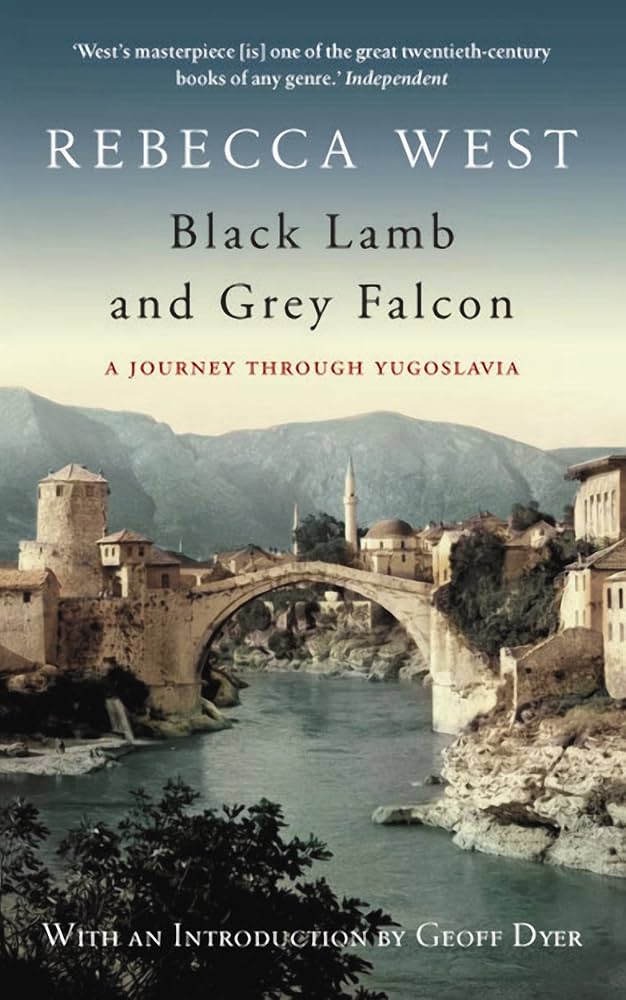
Historical Travel Books #11: Black Lamb and Grey Falcon: A Journey Through Yugoslavia, written by Dame Rebecca West and published in 1941 in two volumes by Macmillan in the UK and by The Viking Press in the US. This vast, complex book is more than a timeless guide to former Yugoslavia. It is one of the most neglected masterpieces of 20th-century travel writing.
The book is over 1,100 pages in modern editions and an in-depth exploration of the history of a country that no longer exists. It recounts Balkan history and ethnography during West’s six-week trip to Yugoslavia in 1937. West’s objective was “to show the past side by side with the present it created”. Publication of the book coincided with the Nazi Invasion of Yugoslavia, and West added a foreword highly praising the Yugoslavs for their brave defiance of Germany. The book’s epigraph reads: “To my friends in Yugoslavia, who are now all dead or enslaved”.

An ambitious project
What was West’s connection to this part of the Balkans? Nothing exceptional; it was merely a casual, personal interest that got massively out of hand until it became an interest intense and intellectual enough to cause her to dedicate four or five years of her life, whilst ill, towards creating one of the longest texts of all time, a book almost as long as War and Peace, a book that contains, in reality, about 7 or 8 normal-length books, a book that incorporates history, travel writing, memoir, essay and academic text.
This is a book that is, essentially, on and of everything. An ambitious project that achieves everything it sets out to do, a book with a focus both transient and tight, a focus that is the springboard for musings on every topic known to literature. In short, it is a great and hugely justifiable work of prose.
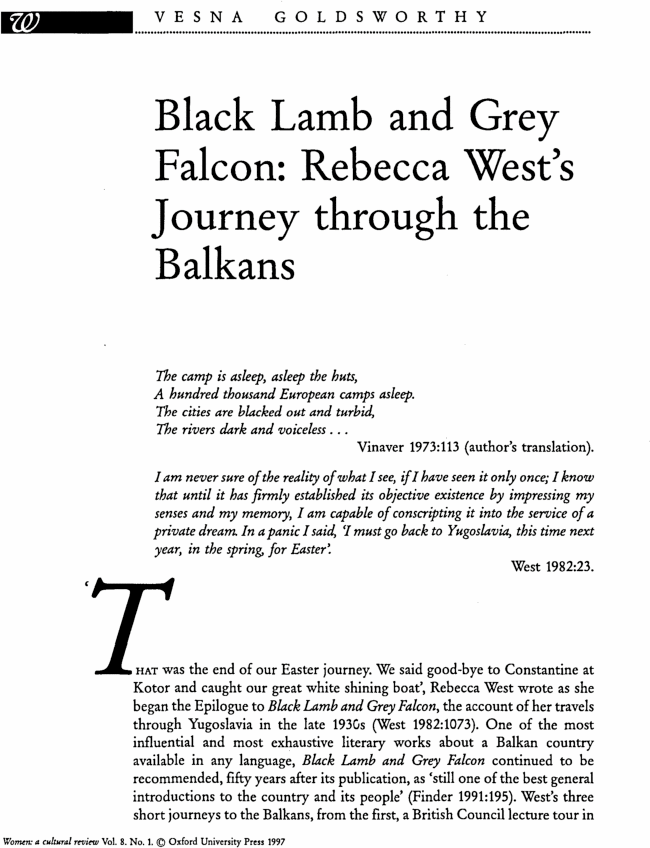
The character of “Constantine” is supposedly based on Stanislav Vinaver. Anica Savić Rebac, under the name Milica, appears not only as a new friend but also as the intellectual guide who eventually reveals to Rebecca West the rituals that would lead the author to the title metaphor of her vision of the Balkans.
A collage of poems and anecdotes and stories and reportage
Black Lamb and Grey Falcon is a collage of poems, anecdotes, stories, and reportage; a mosaic of fact and myth, first-hand experience and third-hand recounting. It is storytelling and journalism; it is serious and droll; it is painful to read and terrifying to consume; it is funny; it is painstakingly researched; and it is deeply informative.
During the trip, West and her husband traveled to Croatia, Dalmatia, Herzegovina, Bosnia, Serbia, Macedonia and Montenegro.
It provides a graphic account of the context of the assassination of Archduke Franz Ferdinand.
Patterns of thousands of years’ history
Rebecca West’s giant book traces the patterns of thousands of years’ history and how they lead to the terrifying, depressing reality of the war that West found herself writing within, trapped – like millions of European civilians – as an unwilling participant in a bomb-ravaged city.
West theorizes that the factors leading to the rise of fascism oscillated in and out of the world’s consciousness throughout Europe’s development, from the birth of civilization onwards. Nothing new ever exists; we merely repeat the mistakes and successes of our fore-parents.
The book’s title draws from historical symbols of the Balkans. The black lamb “is the symbol, seen in a gypsy rite in Macedonia, of false – and thus of impious – sacrifice,” while the grey falcon “is an enigmatic figure in a Slav folksong about a military defeat in the year 1389.” West originally intended to write the work quickly. It took five years to write, beginning in 1936. West’s biographer, Victoria Glendinning, called it “the central book of her life”.

A pessimistic and depressing ending
The book’s pessimistic ending is somewhat depressing, as West finishes the Epilogue of her manuscript from a London under assault from aerial bombardment, just one of tens or hundreds of European cities where this had become the new normal. What happened in the past matters, this book argues, but it means fuck all if we don’t pay attention to it.
It all feels familiar, relatable, prescient. And so much horror has continued to happen in the seventy years since, a lot of it – especially the Civil War in the ’90s and the way Yugoslavia splintered – directly predicted within this text. It’s brilliant, intelligent and important.
Black Lamb and Grey Falcon is widely considered one of the greatest works of travel writing. This is the kind of book that writers of today dream of writing; this is the kind of book, with its massive and ambitious scope, that great minds set out to make; this is a book that isn’t just a politicized description of Yugoslavia as West experienced it in the 1930s, nor is it just a history of the lands that became known as Yugoslavia as West believed them to be after extensive research, and nor is it just a casual travel book where West recounts some personal adventures she had traveling around a (still today) relatively obscure part of Europe. It is all three of these books, and it manages to be all three of them in a deeply satisfying way.
 Reviews
Reviewer Geoff Dyer described the book as “a work of literature”. Katherine Woods said the book “is carried out with tireless percipience, nourished from almost bewildering erudition, chronicled with a thoughtfulness itself fervent and poetic”. According to Dyer, a major theme was “the vexed relations of men and women”. He notes her frequent forays into history and other topics throughout the work:
“Something catches West’s attention; the incident – a Mozart symphony coming on the radio in a restaurant on page 507, say – is conveyed with vivid immediacy. As West articulates and processes this experience, she takes us on a discursive journey into the furthest reaches of speculative thought before returning us to the exact spot or occasion from which we started.”
As a novelist, West is clearly less important than James Joyce, Lawrence or EM Forster (“a self-indulgent old liberal with hardly a brain in his head,” as West sharply deemed him). Her best work is scattered among reportage, journalism and travel – the kind of things traditionally regarded as sidelines or distractions.
The Balkan Peninsula
The Balkan Peninsula is fascinating for many reasons, not just because it has historically been where the East meets the West, but because of its unique landscapes and hugely varied geography. Black Lamb and Grey Falcon makes plain that West – a hugely talented and gifted writer – had an obsession here for a reason. There is more than enough to fill a massive book, and I know I’m going to read a lot more about this region.
One of the Most Neglected Masterpieces of 20th-century travel writing, compiled by Tor Kjolberg.
Previous articles in our series of historic travel books:
Gulliver’s Travels
Travels with a Donkey in the Cévennes
Frigate “Pallada” – A Tour Around the World
Historical Travel Books #9: Journey Without Maps
One of the Most Influential Travel Books of the 1930s: The Road to Oxiana