



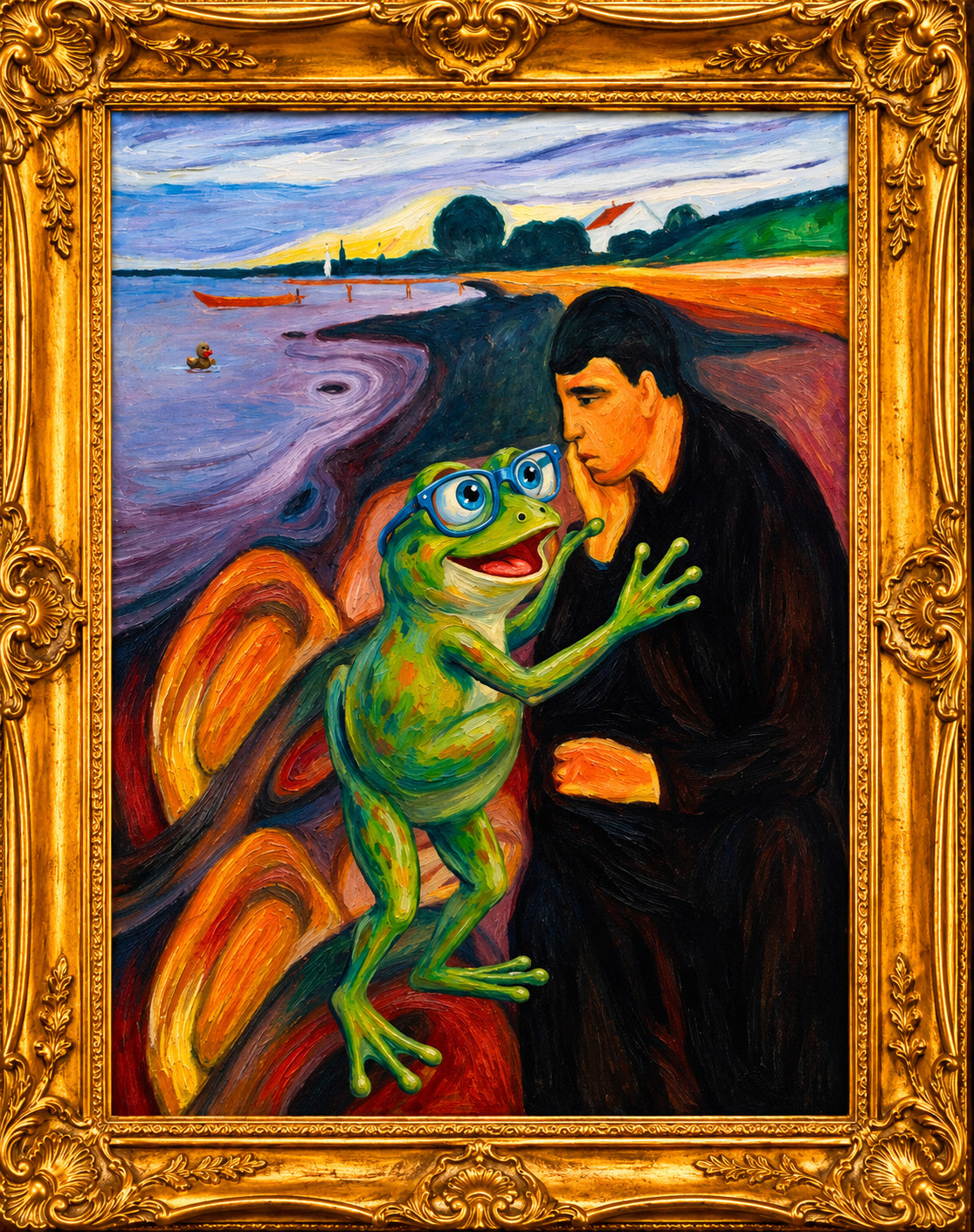
From a little game born in Italy to an international journey through art, artificial intelligence, and people relearning how to look at paintings. René, the frog who wanted to make the world dream, encounters Daily Scandinavian.
Some stories begin with grand plans, sizeable investments and strategies carefully mapped out in advance. Others begin almost by accident, in front of a screen, with a smile and an idea so simple that it seems unlikely to lead anywhere at all.
Mine is one of those stories.
I never imagined creating an international art project. I had no idea that people in so many countries would begin following the adventures of a frog and a little duckling. I didn’t know that one day my images would reach New York, Tokyo, London, Amsterdam, and other cities around the world.
At first, all I wanted was to play.
And perhaps that is the secret of the whole story: sometimes, the most beautiful things begin when we stop asking where we are going and simply give ourselves permission to invent something.
It all began with a frog
My name is Renato Basteri. I am Italian, I live in Tuscany, I am an artist, and I work as a support teacher in a lower secondary school.
Art has always been part of my life. I studied at the Academy of Fine Arts in Carrara, and I have worked in painting, stage scenery, materials, and anything that lets imagination take visible form.
Then, one day, a frog came along.
That frog was me.
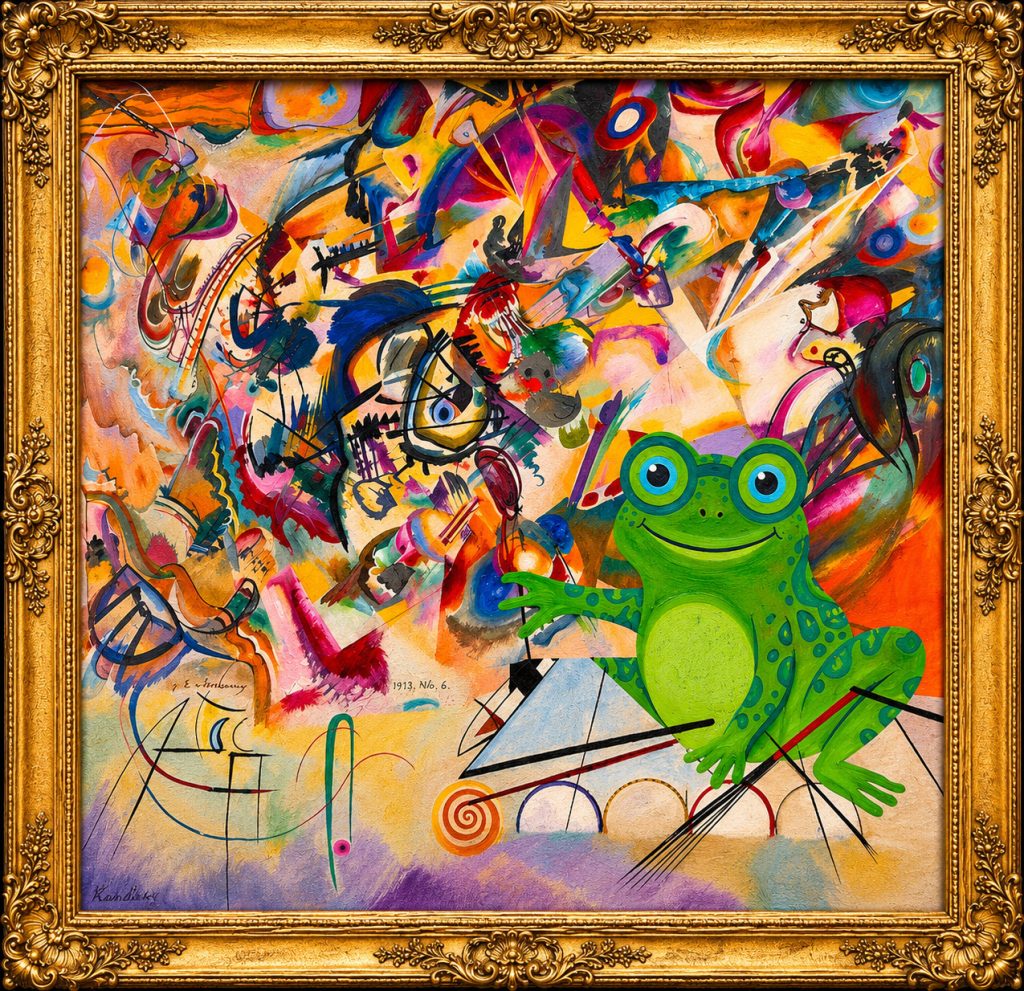
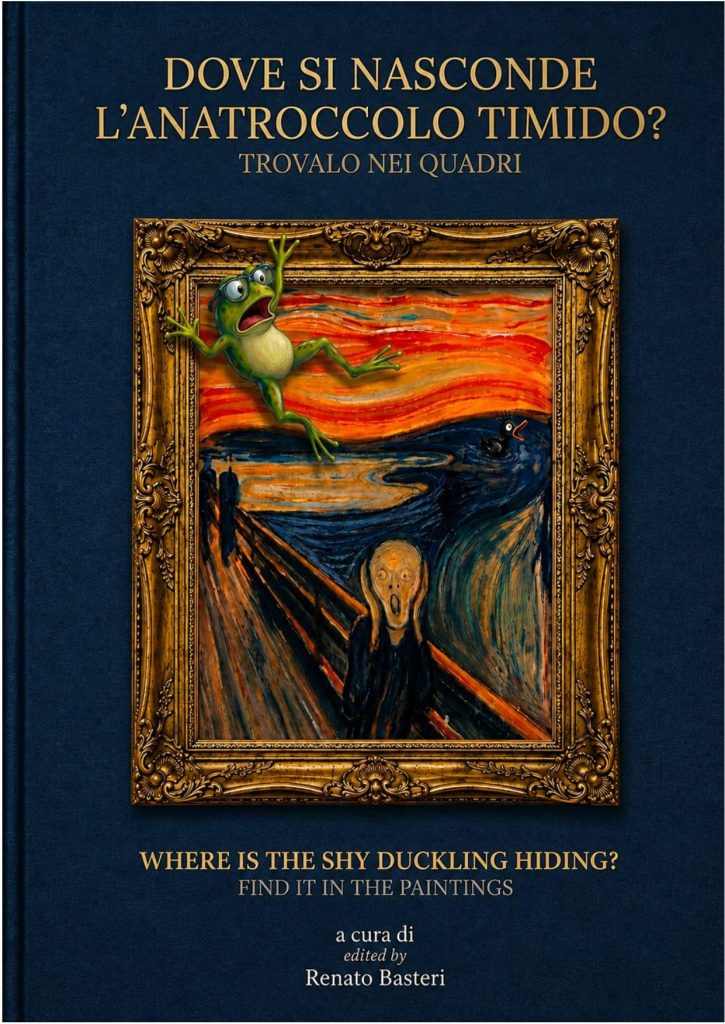
I had decided to turn Renato into René: a green character with large blue eyes, a contagious smile, and an inseparable pair of blue glasses.
But a frog on his own was not enough. He needed someone to share his adventures with, someone who could make each new day unpredictable.
And so Julie arrived.
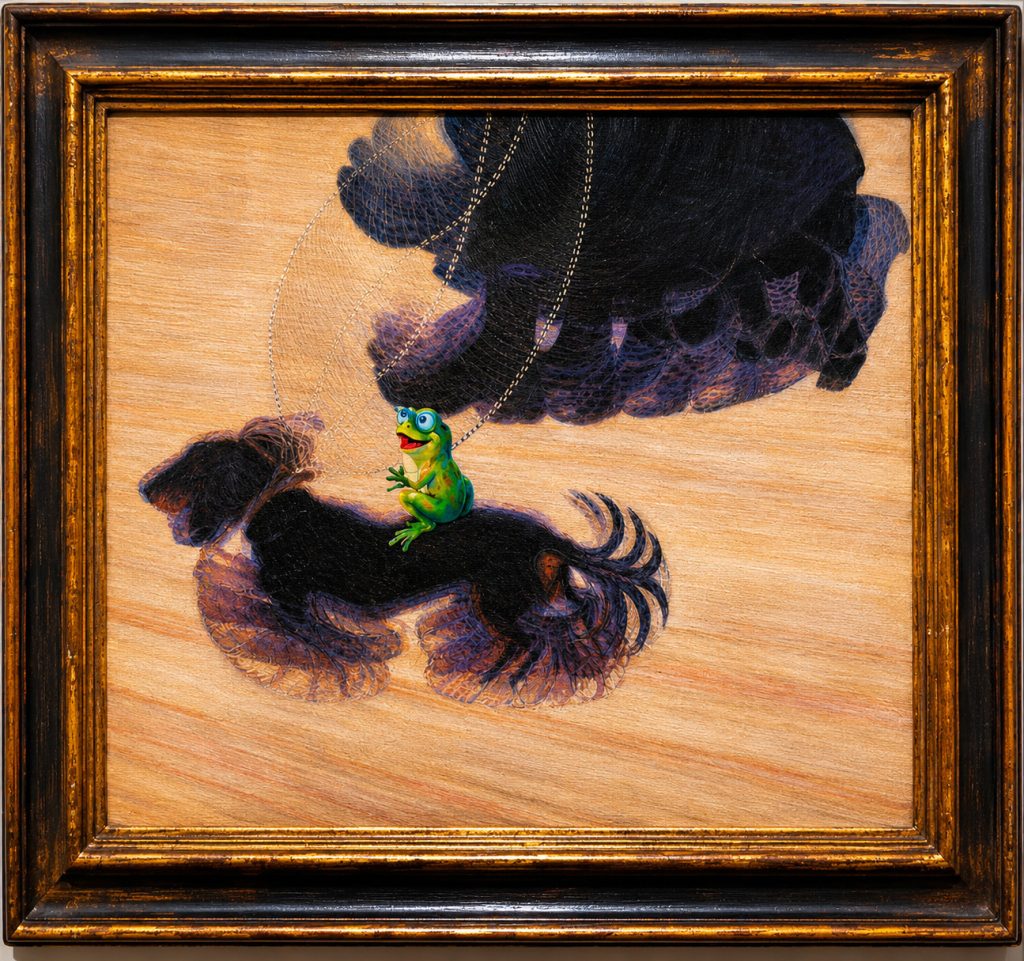
Julie is a little dark-grey duckling with an orange beak, rosy cheeks, and a very particular personality: she is terribly shy.
So shy, in fact, that whenever she sees somebody approaching, she would rather hide.
And where would a duckling who lives in the world of art choose to hide?
Inside paintings, of course.
That was how the game began.
A duckling hidden in a masterpiece
Imagine standing in front of a famous painting.
Perhaps it is a work you have seen dozens of times, in a schoolbook, in a museum, in a magazine or online.
You glance at it and think you already know it.
But this time something is different.
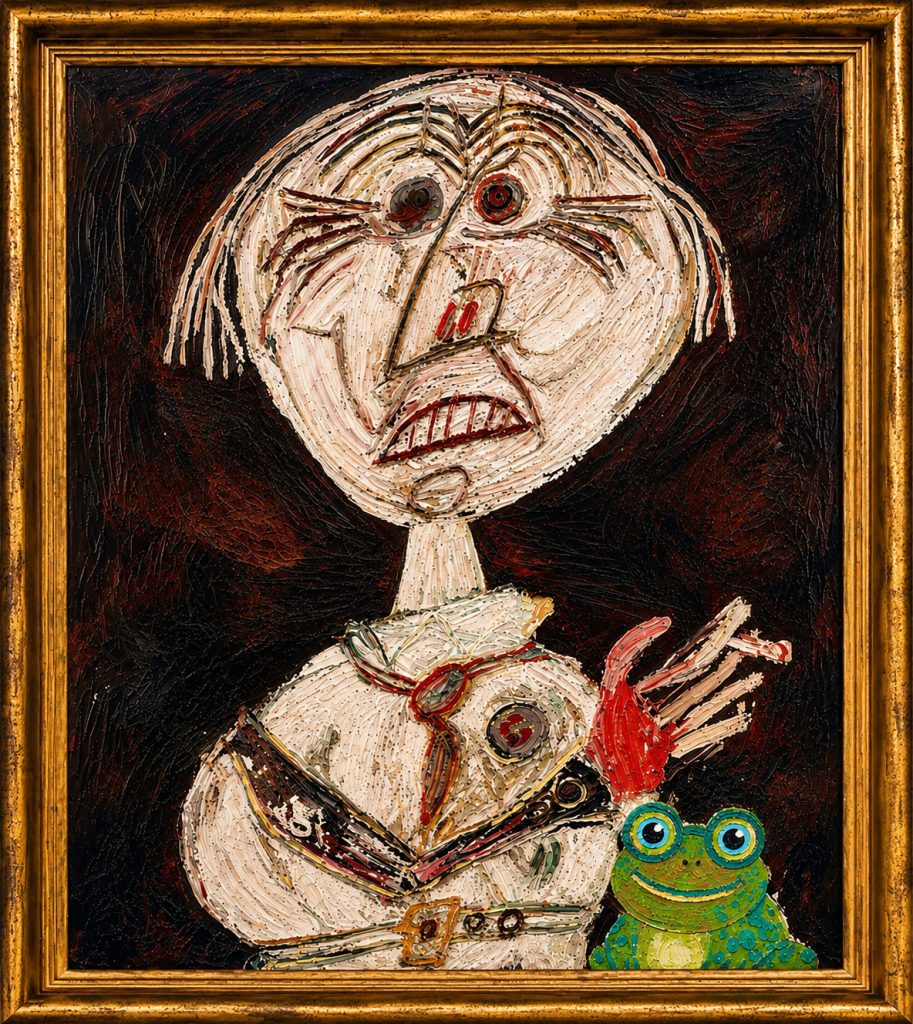
Julie is hiding somewhere inside the painting.
She might be tiny, camouflaged in the shadows, tucked behind an object or almost lost among the colors of the work.
René is looking for her.
And he asks everyone to help.
“Can you find our shy little Julie?”
That simple question has begun to change the way many people approach paintings.
Because to find Julie, you have to stop.
You have to look.
You have to explore the corners of the picture, study its colors, figures, objects, and smallest details.
You have to learn to look again.
It is extraordinary to think that, in a world where we scroll past hundreds of pictures each day almost without noticing them, a tiny duckling can persuade us to spend more time with a work of art.
The rules remain the same, but every day is completely different.
The first person to find Julie and post the correct answer in the comments wins a special prize: the chance to choose, from two proposed artworks, the painting that will feature in the next day’s game.
No one wins money. Nobody receives an expensive object.
The prize is something that, to me, is far more beautiful: the chance to help create the next adventure.
The small, wonderful rivalry among our friends
One thing moves me in particular.
As the days passed, our game became an appointment people looked forward to.
Some come back again and again to look for Julie. A few have become remarkably good at it. Others simply enjoy trying, getting it wrong and trying again.
Among our most loyal participants, a wonderful kind of competition has emerged: friendly, playful and good-natured.
Everyone would like to be first.
Everyone wants to win that little symbolic trophy, the right to decide which painting we will explore the following day.
And when someone spots Julie before everybody else, we celebrate.
Then we begin all over again.
It is a challenge that needs no grand prize, because the real reward is the game itself.
I watch it all with a mixture of joy and disbelief.
Sometimes I think how remarkable it is that people I have never met have decided to give part of their day to two little characters born from my imagination.
They are not merely taking part in a game. Over time, they have become part of its story.
They choose, comment, encourage, joke, and help this small universe grow.
And that is how VANFROG.ART began to become something bigger.
A community.
Or perhaps there is another word I like even more.
A family.
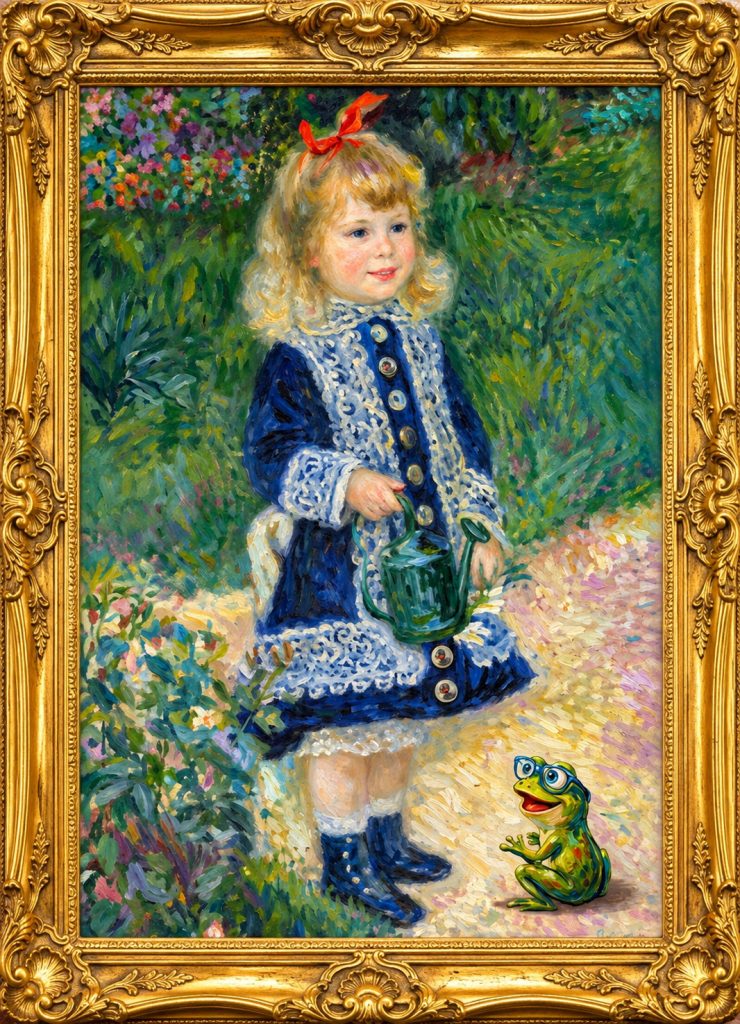
From two hundred people to a family that crosses borders
I remember when we had just two hundred followers.
Two hundred people.
To some, that might sound insignificant. To me, it already meant two hundred human beings had chosen to spend a moment of their lives with something I had created.
I thought it was wonderful.
Then there were five hundred, a thousand, two thousand.
The number kept climbing.
Within a few months, we passed 8,600 followers and 166,000 views over thirty days, and the community keeps growing.
But the number I care about most never appears in the statistics.
It is the number of smiles we may have inspired.
There is no way to measure it.
I do not know how many people have smiled at René struggling to find his way around a painting. I do not know how many have shown Julie to a child, a grandchild, or a friend. I do not know how many have discovered a painter because of one of our games.
What I do know is that every comment represents someone’s presence.
Behind every profile is a person.
And behind every person is a life, a day, a whole world of thoughts.
The thought that, even for a single second, someone might choose to interrupt all of that and step into our little universe moves me deeply.
It is a kind of trust.
And I never want to take that trust for granted.
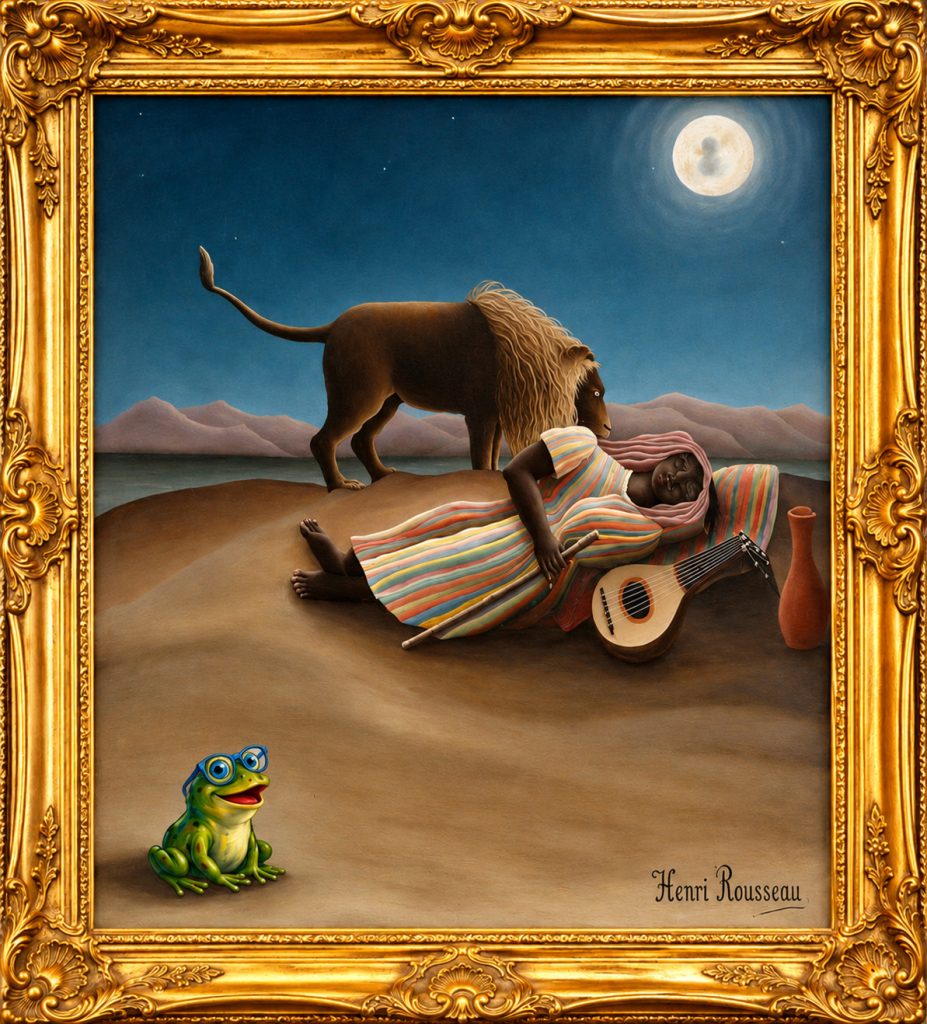
When artificial intelligence becomes a paintbrush
People often ask me how I make my images.
The answer is simple, though it comes from a continuous process of imagination, experimentation, correction, and artistic decision-making.
I use artificial intelligence as a creative tool.
I like to call it my digital paintbrush.
But a paintbrush does not independently dream up what an artist wants to express.
It can draw a line, mix a color, or open up possibilities. Ultimately, however, a person must choose which story to tell, which emotion to pursue and which result to seek.
AI lets me turn ideas and drawings into visual scenes, build settings, and bring René and Julie into conversation with masterpieces from art history.
But the ideas come first.
They come from imagination, memories, observation, the desire to make people smile, and the wish to tell a story.
I do not believe technology should replace human creativity.
Quite the opposite: I believe it can offer extraordinary new possibilities for creativity.
As long as we never forget who is holding the brush.
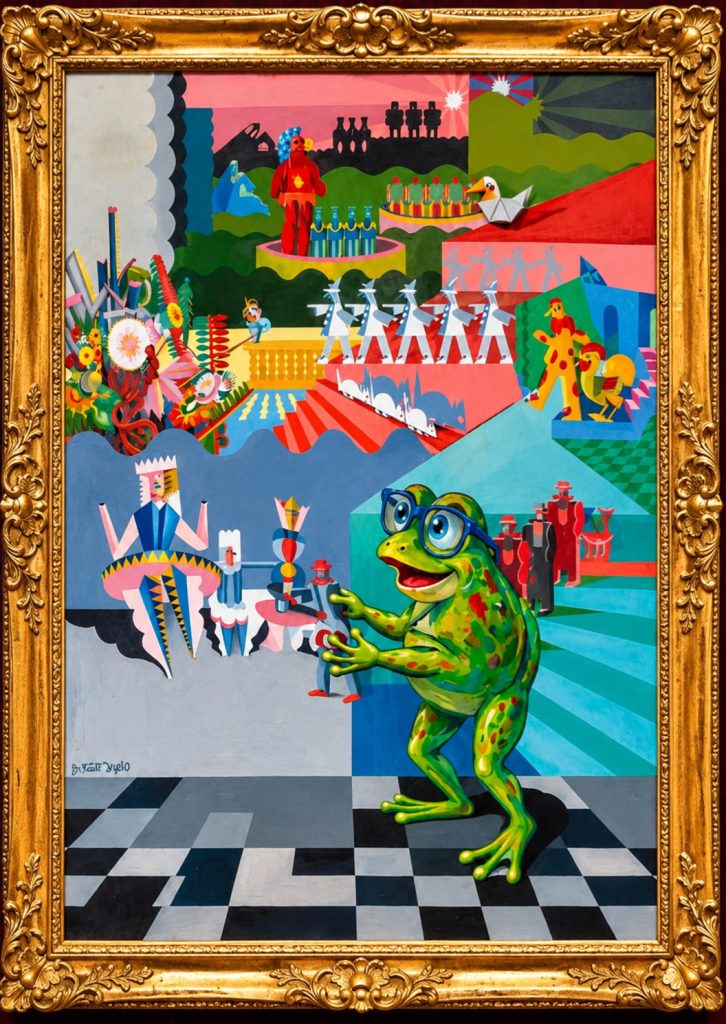
The same magic enters the classroom
My work as a teacher lets me observe young people’s relationship with new technology up close.
These are children who have grown up with screens, the internet and images that seem to appear from nowhere.
That is why, in some lessons I lead, I try to show them something different.
We do not start at a computer.
We start with a blank sheet of paper.
During the first part of the lesson, I ask pupils to draw a character entirely of their own invention.
It might be an impossible animal, a colorful creature or a superhero with extraordinary powers.
A flying cat.
A pink, striped dog.
A character who can walk on clouds.
I place no limits on their imagination.
Then, in the second part, we photograph the drawings and look at them on the classroom’s digital board.
Using tools such as ChatGPT and Gemini, I show how a character born from a pencil sketch can become a three-dimensional figure, adopt different expressions, and enter fantastic settings.
We also run an experiment I find particularly interesting: we use the same drawing and the same instructions with different AI tools, then compare the results.
Pupils discover that AI systems do not all work in the same way.
Above all, they discover how important the words we use are when explaining what we want.
Vague instructions often produce a result far removed from the original idea.
Precise instructions allow us to guide the transformation much more effectively.
The message I try to convey is always the same: technology can help us bring a project to life, but the project itself must first be born in our own minds.
That distinction is fundamental.
I would never want a child to learn only how to ask a machine to do something for them.
I would rather they learned to imagine things they had never even considered possible before.
And if these experiences help even one student realize that their imagination matters, that is already an important achievement for me.
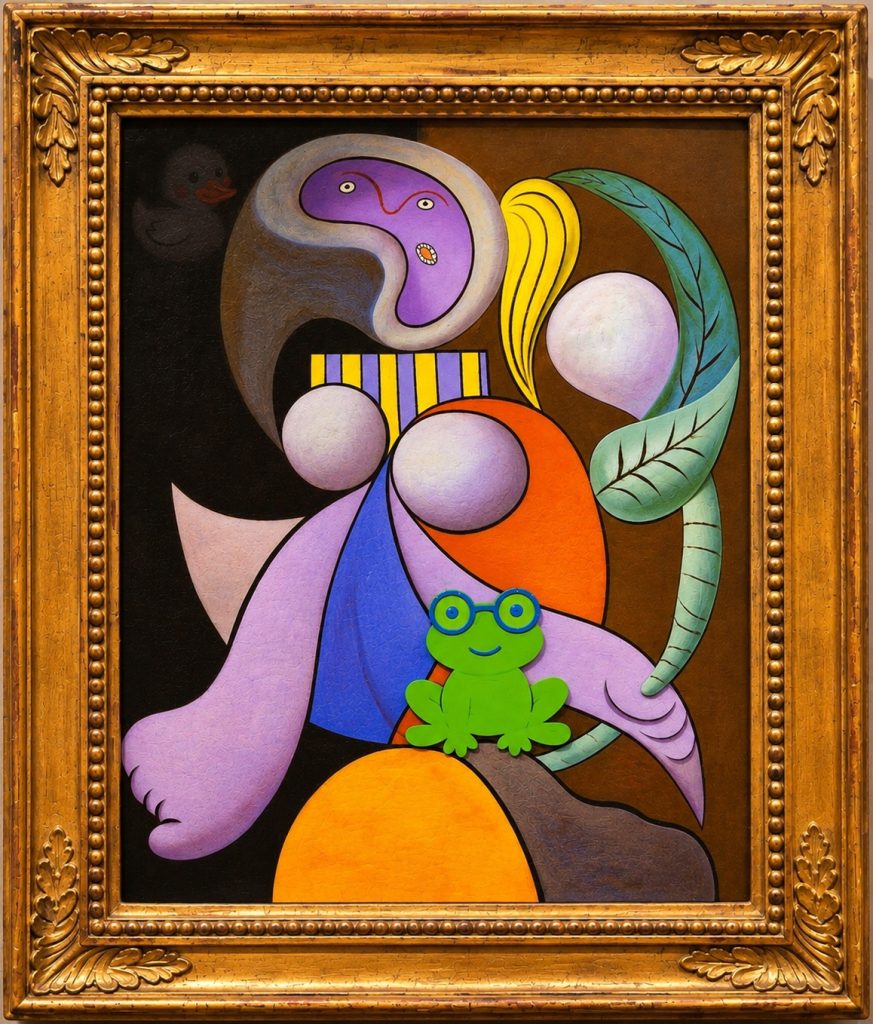
Then René and Julie began to travel
At a certain point, the world inside the paintings was no longer enough.
René and Julie began to travel.
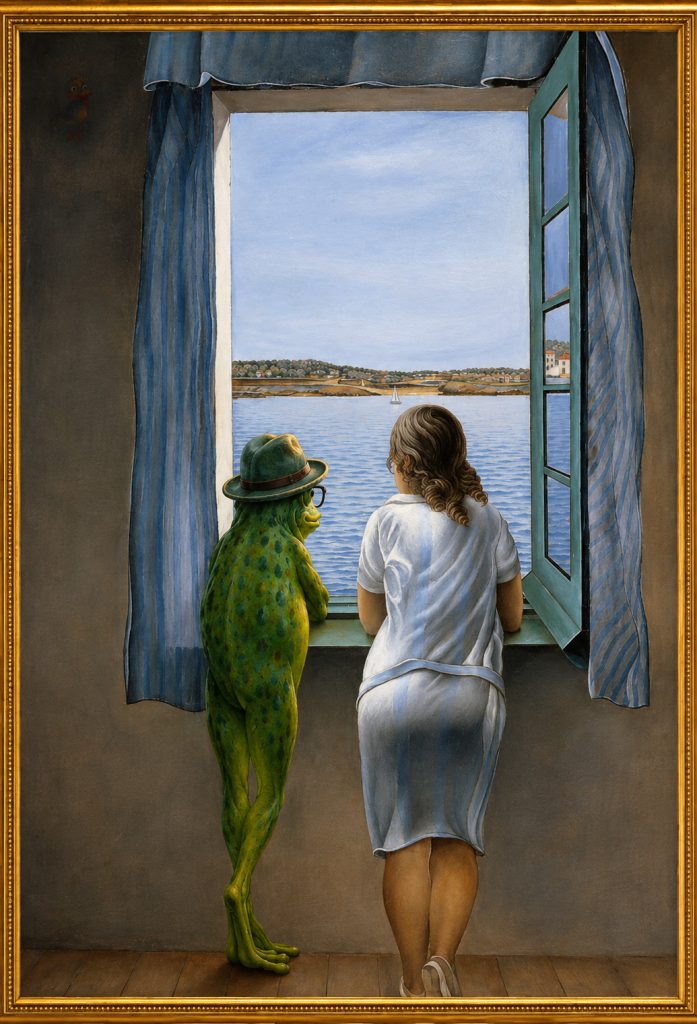
Other friends joined them: Alex, a fox; Stella, a cheerful beagle; and Crudy, a young giraffe.
Together they set off on an imaginary journey around Italy, discovering towns, monuments, traditions and celebrated figures.
These are fantasy journeys, of course.
Impossible encounters, digitally created and reworked images, playful scenes where reality and imagination meet.
Yet every town also becomes a chance to tell a little of its history, its culture and the people who helped make it famous.
Because behind the characters’ comedy there is always another wish: to spark curiosity.
To make someone want to know more.
To turn a funny picture into a doorway to a new discovery.
It is a little form of imaginary tourism.
And this new adventure keeps growing, too, thanks to the people who follow us.
When a dream begins to travel for real
Then something happened that I could never have imagined when I created René.
My work began to move beyond the phone screen and into international events and exhibitions.
In June 2026, images connected to the project appeared in scheduled digital displays at Times Square, in the heart of New York.
Even mentally, it was hard to connect those enormous screens with a little game that began in Tuscany.
Then came Milan, Tokyo, London and Amsterdam.
An exhibition in Madrid is scheduled for November; another opportunity in Paris follows in January 2027.
Places I once associated above all with great artists, museums and the dreams of people who love art.
In the meantime, newspapers and cultural magazines in several countries began taking an interest in our story.
Each time a new publication or invitation arrives, I feel something hard to describe.
Happiness, certainly.
Pride, too.
But above all, amazement.
Because I can still picture that very first day: that little green character in blue glasses, and the shy duckling looking for a place to hide.
They were not created to conquer the world.
They were created to make somebody smile.
And perhaps that is precisely why their story has traveled so far.
The most beautiful success cannot be hung on a wall
International exhibitions are exciting, of course.
Seeing your work appear in a magazine is immensely satisfying.
Knowing that people in other countries are talking about the project is wonderful.
But if someone asked me for the best moment of each day, I would probably describe a much simpler scene.
The moment I publish our game.
René is standing there, in front of a painting.
Julie is hiding.
And somewhere, in Italy or another corner of the world, someone is already searching.
I like to imagine those people in front of their screens, concentrating on some tiny detail.
Perhaps one smiles because they think they have found the answer.
Perhaps another looks a little more closely.
Perhaps someone discovers, for the first time, the beauty of a painting they would never have noticed otherwise.
That is when I feel that it all makes sense.
We are not simply an art project.
We are a daily appointment, a shared curiosity, a small moment of lightness.
We live in a world that often asks us to run, produce, achieve goals, and deliver results.
I created a frog who invites us to do the exact opposite.
To stop.
To look.
To play.
And perhaps to feel wonder again.
The dream is not over. Perhaps it has only just begun
I do not know where VANFROG.ART will go.
I do not know how many people will meet René and Julie over the coming months, how many new towns they will visit, how many paintings they will explore, or how many opportunities will arise.
I have so many dreams.
I would love to see the characters become the stars of more books, games, educational materials and, one day perhaps, an animated world of their own.
I would love to see more and more children and adults playing together, using imagination as a way into art.
I would love this project to keep demonstrating something I believe deeply: creativity knows no age limit, no border, and no single prescribed language.
A small idea can become something big.
A game can become an opportunity to learn.
A frog can cross continents.
And a shy duckling can persuade thousands of people to go looking for her.
But none of those dreams would mean as much without the people who accompany us.
That is why I want to end with a thank you.
Not the formal kind that is written out of habit.
A real one.
To everyone who believed in me when there were only a handful of us.
To everyone who has joined us recently.
To everyone who plays each day, leaves a comment, patiently looks for Julie, or follows our characters’ adventures with a smile.
To everyone who encourages us.
To everyone who shares our images.
And also to those who, without leaving a comment, simply stop for a few seconds to look at what we have made.
Because those few seconds are a part of their lives.
And knowing that they chose to give them to us is something I find precious.
I also want to thank the journalists, editorial teams, exhibition organizers, and everyone else who has chosen to listen to this story and give it a little space.
Each one reminds me that a dream can grow when it meets someone willing to believe in it.
VANFROG.ART began as my idea.
But today, in my heart, it no longer belongs only to me.
It also belongs to everyone who keeps dreaming with us.
And if René and Julie one day travel even further, I will always remember where they came from.
A little game.
A smile.
And wonderful people who decided to be there.
Thank you, from the bottom of my heart.
With love and gratitude,
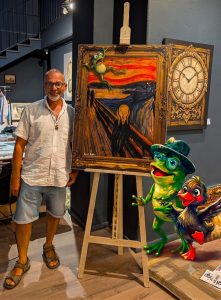
The Frog Who Wanted to Make the World Dream, written by Renato Basteri — Creator of VANFROG.ART. Renato is an Italian artist and support teacher at the Alfieri Bertagnini school in Massa, Tuscany. He is the creator of VANFROG.ART, an artistic and educational project born in April 2026 from a playful experiment with artificial intelligence. Its protagonists are René VANFROG, a curious green frog with blue glasses, and Julie, a shy duckling who hides inside famous paintings. Each day, audiences are invited to find Julie, discovering art through observation, storytelling, and play. Basteri develops the project independently, combining his experience in inclusive education with visual creativity and art history. What began as a small game has reached international audiences and exhibition settings in New York, Milan, Tokyo, London and Amsterdam, with Madrid and Paris on the project’s calendar. He has also published a bilingual Italian-English book inspired by René and Julie’s adventures. His aim is simple: to encourage people of all ages to stop, look closely and rediscover the joy of art. Instagram: @vanfrog.art
Feature image (top): Melancholy by Edvard Munch.
All images © Renato Basteri / VANFROG.ART.
“Renato Basteri’s creations are all about Storytelling. I hope one day René and Julie will discover some of the many untold stories from destinations around the world and share them with our readers in Daily Scandinavian and other media”. Tor Kjolberg, editor-in-chief.
Imagine René and Julie reviewing the following articles:
Stop Selling Postcards: The Real Definitions of Travel Brand Storytelling
How to Use Humor in Storytelling to Break Through Advertising Clutter
Tales of the Unexpected: The Hotel Detective Is on the Case
Stop Selling Perfect Destinations
The Odyssey