Kehler Verlah has issued a new book called “Slash & Burn,” which tackles a mostly faded culture on the border between Norway and Sweden. Slash and Burn is an artistic documentary by Norwegian photographer Terje Abusdal documenting the wolrd of the “Forest Finns” in Norway
Finnskogen – directly translated as The Forest of the Finns – is a large, contiguous forest belt along the Norwegian-Swedish border, where farming families from Finland settled in the early 1600s. The immigrants – called Forest Finns – were slash-and-burn farmers.
Throughout Slash & Burn, the conventional clarity of the photographic image is often blurred and obscured
Terje Abusdal became interested in documenting the culture when he was a student at the Danish School of Journalism. What began as his final project in school soon expanded, and he would eventually spend several years immersing himself in what was left of the culture.
History of the Forest Finns in Norway
This ancient agricultural slash and burn method of farming, burning down parts of the forested area. It yielded bountiful crops but required large areas of land as the soil was quickly exhausted. Population growth eventually led to a scarcity of resources in their native Finland and, fueled by famine and war, forced a wave of migration in search for new territories. They started settling in a forested area in southeast Norway near the border with Sweden. The families who were making their new homes there were farmers.
Why do we like documentary photography? Because it tells us stories, it shows us the human face of the unknown. We like it because it elegantly paves the way for us in the dark hoods of Norway, into the world of the “Forest Finns”.
Jan Oddvar Storberget is the only one person in Norway who is 100 percent Forest Finn
Magic and mystery
The Forest Finns had shamanistic roots and were often associated with magic and mystery. Today there is only one person in Norway who is 100 percent Forest Finn, trying to preserve some of their traditions and rituals. His name is Jan Oddvar Storberget.
Rituals, spells and symbols were used as a practical tool in daily life; that could heal and protect, or safeguard against evil. Abusdal’s project draws on these beliefs while investigating what it means to be a Forest Finn today, in a time when the 17th century way of life is long gone, and their language is no longer spoken.
The Forest Finns had shamanistic roots and were often associated with magic and mystery
Followed the Finns in the hood for three years
Over three years the photographer followed the Finns in the hoods, he knocked at their doors, talked to them, took their portraits. From Svullrya, the capital of the Forest of the Finns, he drove long hours to retrace the migration route of this people from Finland to Norway. When making the photographs, Abusdal tried to incorporate some of the mystery that has surrounded the Forest Finns.
Over three years the photographer followed the Finns in the hoods
Half staged half instantaneous, half posing half natural, half color half black and white, half graphically modified half not. Terje doesn’t follow any pre-conceived standard in his photography. Mainly self-taught, he defines his visual language as “free”.
Abusdal drove long hours to retrace the migration route of this people from Finland to Norway
Writer Aron Shuman on Slash & Burn – the World of the “Forest Finns” in Norway
In the book, writer Aaron Shuman addresses some of this: “Throughout Slash & Burn, the conventional clarity of the photographic image is often blurred and obscured — by smoke, mist, vapor, dust and darkness — which transform the solidity of the world we think we know into something much more ethereal and atmospheric….
Abusdal tries to incorporate some of the mystery that has surrounded the Forest Finns
And in a sense, when it comes to this field, Abusdal’s artistic approach is in itself a form of slash-and-burn cultivation, in that through various forms of photographic disorientation, deconstruction and destruction, he creates a new, fertile layer of information and meaning; photographic ashes which are rich with the nutrients needed for newfound notions of personal understanding and cultural identity to grow.”
Terje Abusdal
Slash and Burn is a timeless piece, refreshed by an enthusiastic storyteller. Terje Abusdal is winner of Leica Oskar Barnack Award and Nordic Dummy Award in 2017. He was also finalist at the Luma Rencontres Dummy Book Award 2017, at Unseen Dummy Award 2017 and Alec Soth’s Juror’s Pick at the Magnum Photography Awards, among others.
Several guides to climbing in the Lofoten Islands, Norway, have generated plenty of interest in this venue, and Lofoten has become a hip destination in recent years.
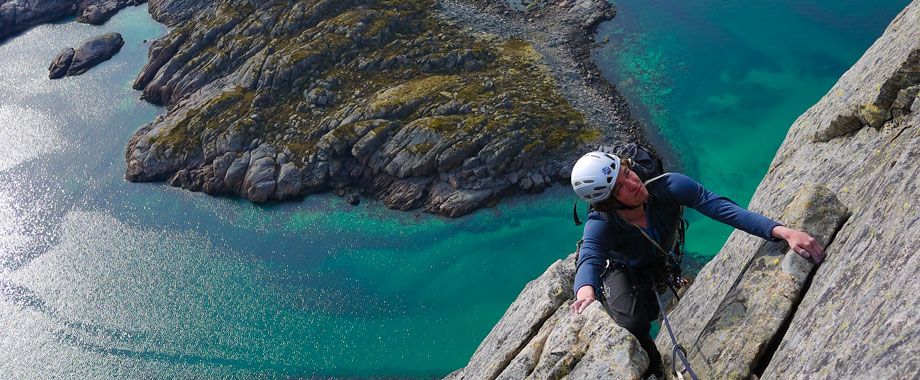
The Lofoten islands are said to be one of the most beautiful climbing areas on earth. Although the mountains there are not very high, and the highest peak, Higraftindan, reaches only 1161meters, the fact that they rise straight from the sea makes them spectacular and extraordinary.
Classic rock climbing in Lofoten
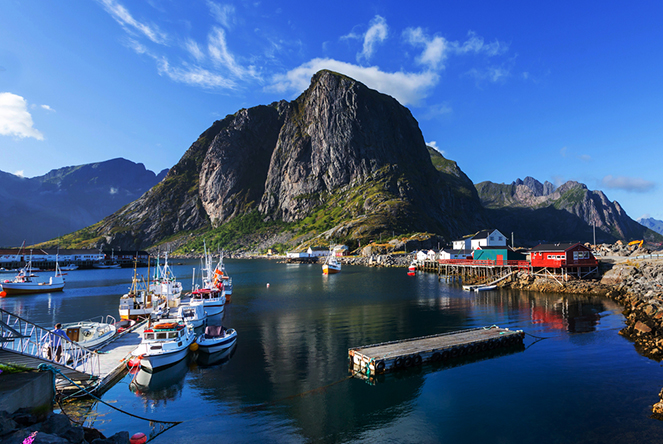
The Lofoten Islands are a rugged chain of five small, mountainous islands in the northern Norway, west of Narvik and around 200km north of the Arctic Circle. They are rising abruptly from the sparkling blue waters of the Norwegian Sea, and the extraordinary climate of the islands is caused by the warming effect of the Gulf Stream.
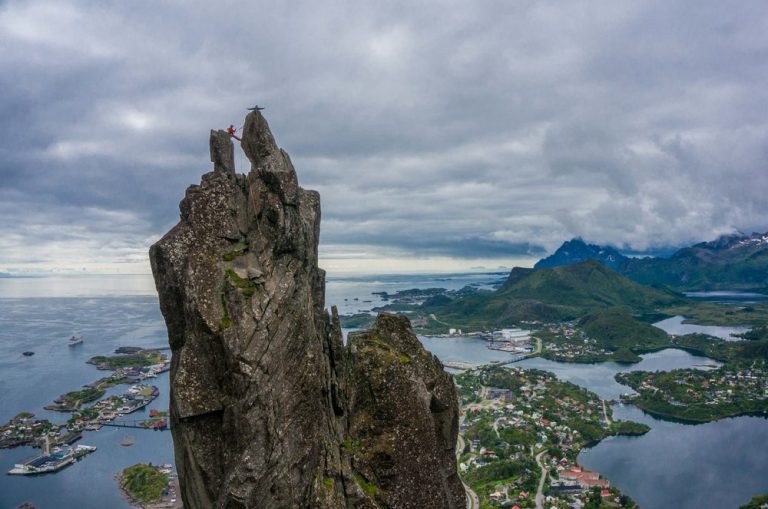
Climbing abovbe tje fjord in Lofoten with a view to the famous The Priest
It is a very special place, the locals are friendly, the cliffs are generally quiet and the scenery is world class. During the height of the summer climbing season (mid-June to mid-August) you can climb all day without a headlamp, sometimes in the direct rays of the midnight sun.
Bouldering in Lofoten
No signed trails
It can, however, be cold, so be prepared, but the heavily glaciated and granite rocks of the Lofoten offer lots of possibilities for rock climbing and mountaineering all over the year. You should be aware of the fact that the Islands do not have signed trails at all. The Norwegians prefer to experience the nature individually, therefore each hike has to be carefully prepared and the tourist has to be equipped with map and compass.
The islands do catch a lot of storms from different directions and some rain should be expected on any extended visit. That said, the weather can also be sunny and warm for extended periods of time, and most of the rock dries very quickly after rain. Still air seems to be rare – there is almost always anything ranging from a slight breeze to fairly solid wind – this also helps to dry the rock after rain.
the fact that the Lofoten islands rise straight from the sea makes them spectacular and extraordinary.
Climbing history on the Lofoten It is considered that climbing in the Lofoten started in 1889, when two local fishermen made the first ascent of Vagakallen (942m). The next important step was reaching the summit of the two-pronged tower above Svolvaer, called The Goat in 1910, by three climbers from Oslo.
In the first half of the twentieth century there were mostly Norwegians and British climbers visiting the islands. The ’60 were a decade of Arild Meyer and the Nesheim brothers from Tromso. Meyer did the first ascent of Presten via the West Pillar (one of the Lofoten’s most famous routes in the presence), and the islands’ hardest and longest route, The Great Pillar on Vagakallen.
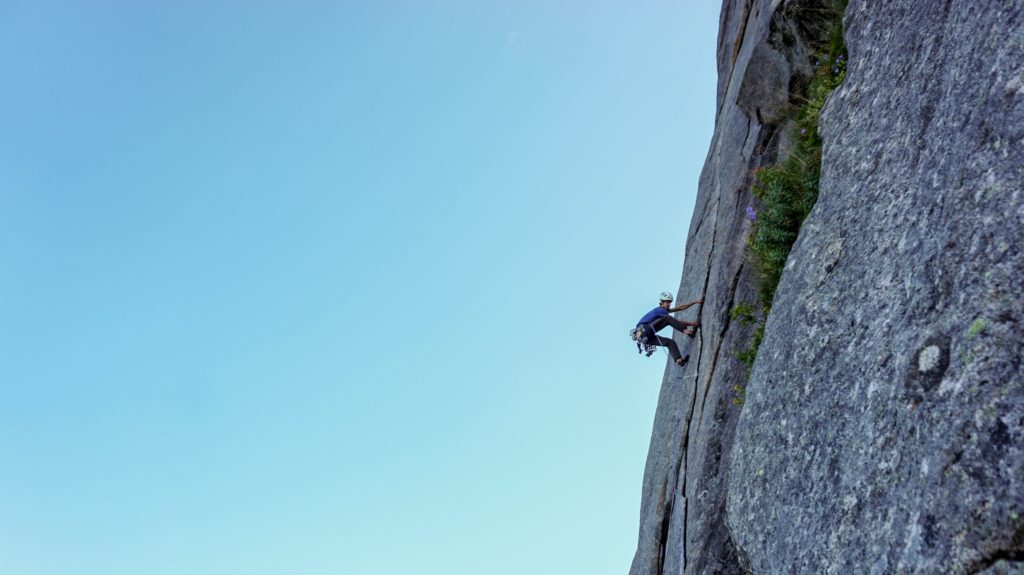
Midnight sun climbing in Lofoten
Hans Christian Doseth contributed to raising the standards of free climbing and made the first free ascent of Presten’s (The Priest’s) West Pillar.
The first in over 40 years climbing guide to the Lofoten, “Climbing in the Magic Islands”, was written in 1994 by Ed Webster.
There are several easy climbing routes in Lofoten
Equipment Experienced climbers advice newcomers to leave their electric drills and bolts at home. The Norwegians stand for natural climbing. That is why most of the routes are all-nut protected.
Bring a set of wired Rocks or Stoppers, several Hexentrics plus a good selection of Friends up to #3, although #4 Friends may also be helpful on some routes. Small wired nuts (brass, steel, or RP nuts) are also useful. As for the ropes, 50meter-long ones are a must, as most of the pitch lengths and a majority of the fixed rappel stations are 50meters long.
The clean 400-meter sweep of the Priest in Lofoten
Climbing in the Lofoten Islands, Norway The Lofoten’s labels are the Svolvaergeita (“Svolvaer Goat”) with its Classic Route 4+ (Norwegian), S 4b (British), and the Presten (“the Priest”). However the big minus of the first rock is a long way to get there and not very interesting climbing. What attracts the climbers most is an extraordinary top, a two-pronged tower with 50meter long precipice in between.
Contrary to the “Svolvaer Goat”, getting to “The Priest” takes only about 10 minutes, starting from the road. Another highly recommended place is Gandalfveggen on Lofoten’s Austvagoy. The routes are quite short there (from 80 to 100meters), but with some very nice views and the rocks are located nearby the road. The classic here is the Gandalf, a varied four pitch route up the right side of the wall, Guns’n Roses and Rasmusekspressen.
Rock climbing areas in Lofoten
Description
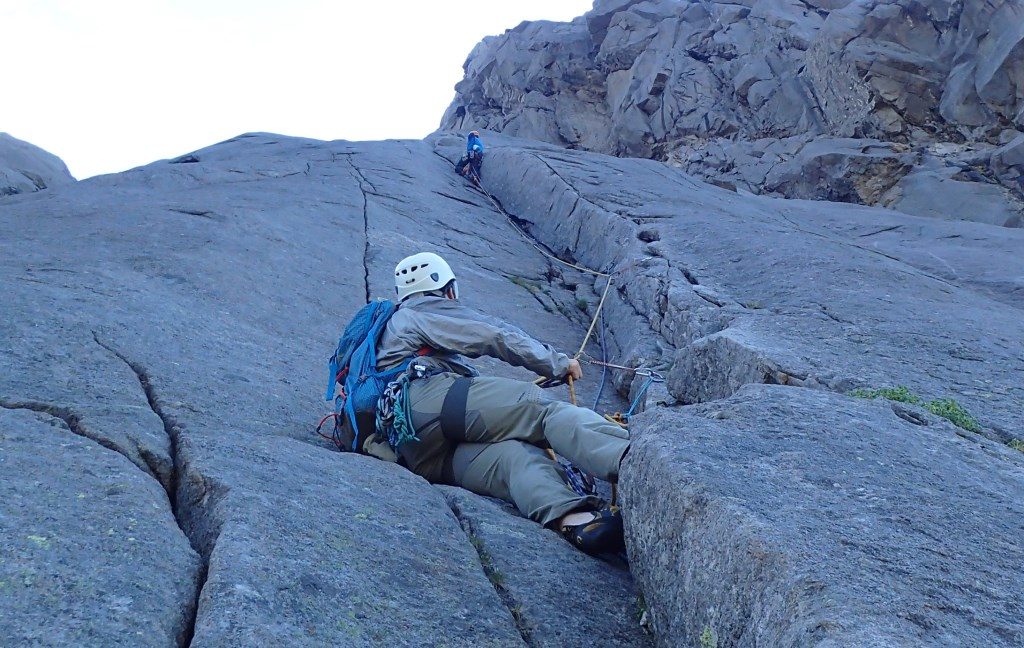
The rock is granite, but don’t expect the sort of granite that you might find in Yosemite. If I had to pick a place in the U.S., we’d say the rock reminds most of the more solid rock in Rocky Mountain National Park (which we know, is not granite). It is generally very solid, but even though it is at sea level, it is an alpine environment and you will encounter some occasional looseness. However, most of the popular routes are very clean. There are also pretty big alpine climbs which will offer a completely different experience. The climbing in Lofoten ranges from single pitch routes, to short multi pitch climbs (2-4 short pitches – a lot of the climbs fall into this category), long free routes like those on Presten, to moderate alpine ridges, to serious alpine walls.
Getting there
Lofoten is a long way from most places, which is part of its charm. In some locations on the islands, you really get the feeling that you’re at the end of the Earth. There are several ways of getting to the Lofoten Islands.
Lofoten beach
Flights to Oslo, the capital city of Norway, are available from almost every part of the world. Once in Oslo, you can take a train north, to Trondheim and Bodø. from where you can catch a ferry to Stamsunds, Moskenes, or Svolvaer.
If you have a car you just have to follow E6 from Oslo up to Fauske and then take off to Bodø and either catch the ferry (Bodø to Moskenes) or the high-speed catamaran (Bodø to Svolvær via Skutvik), both take between four and five hours.
There are also more possibilities to catch a ferry from the mainland of Norway to Lofoten. You can do it in Narvik, Skutvik and from Melbu to Sortland. This last connection is the shortest and the cheapest way, but it also requires a very long drive to Melbu.
Other option is getting to the islands by plane. There are three airports in Lofoten: to the northeast of Svolvaer on Austvågøy, in Leknes on Vestvågøy, and on Røst. All of them have daily connections. There are several other options, but the hardest part may be choosing a travel option that suits your budget and plan.
The Lofoten islands are rising abruptly from the sparkling blue waters of the Norwegian Sea
Seasons The Lofoten are not famous for a very nice weather. However, in the summer months of June, July and August the weather usually is stable and it is the best time for climbing. The extremely useful feature of having a sunlight 24 hours per day, makes it possible to start climbing whenever you want.
Where to stay
Norway is one of the few countries that have preserved the ancient law of free public access to all of their lands. Therefore, you are allowed to camp in any place as long as it is not in sight of a private home and providing that you don’t make any damages on the fields or crops by walking through them. The camping is the one part of your trip that will not put a strain on your wallet
The rock in Lofoten is granite, but don’t expect the sort of granite that you might find in Yosemite
Most climbers camp in the area off of the road beneath the Gandalf Wall near Henningsvaer, though it is a bit primitive. At Kalle beach you have the added luxury of a tap and a (smelly) toilet. A new and very plush toilet block has recently been set up in the main car park at Henningsvaer, though it is a bit of a trek in the morning if you are ‘in need’.
There are pleasant (and inexpensive) camp-grounds at Ørsvågvær, Sandvika and Lyngvær all within 10 minutes drive of the best of the climbing. All Norwegian camp-grounds have wooden camping cabins, that vary from basic (still with fridge and cooking rings) to plush (hot and cold running water plus a TV!).
Most campsites also have a covered area for cooking (with stoves and a few pans) and an indoor lounge for, well, indoor lounging!
Lofoten Climbs book-cover
Guidebooks and resources
The guidebook, “Lofoten Climbs” by Chris Craggs and Thorbjorn Enevold, is published by Rockfax (UK) and is very well organized and written entirely in English. Probably the best updated guidebook on Lofoten climbing.
There’s a nostalgic charm about Danish seaside resort hotels. They exude a holiday atmosphere reminiscent of the days when nobody had a cellphone and proceeded at a more leisurely pace. And you’re never further than 30km from the sea.Here are our recommendations so thatyou can experience this luxury by the sea in Denmark.
Dyvig badehotel
Dyvig Badehotel, Dyvik, Nord Als
This impressive award-winning seaside hotel has an air of having been built for the more well-to-do of 100 years ago, but actually only opened in 2010. It sits in an idyllic location with water in front and forest behind. Gourmet food and classic Danish cuisine. Named best Hotel and Restaurant by the Luxury Prize Awards in London in 2016 and preliminarily nominated for Den Danske Spiseguide 2017 (Danish Good Eating Guide).
Gilleleje badehotell
Gilleleje Badehotel, Gilbjerghoved
Spectacular seaside hotel in the beautiful green oasis of Gilbjerghoved near Gilleleje. Tasteful, summer romantic interior design with fantastic views over the sea. Hearth, good food and plenty of atmosphere in the restaurant and a gorgeous spa complex. Be sure to take a sunset stroll along the little path along the shore that takes you into Gilleleje.
Helenekilde
Helenekilde, Tisvildeleje This traditional Danish “badehotel” (bathing hotel) dates back almost a century, but is a picture of modern design inside. Rooms are painted in hues that mimic the Kattegat Sea outside. It is on the north coast of Zealand, in an area famed for dune-backed beaches.
Henne Mølle Å
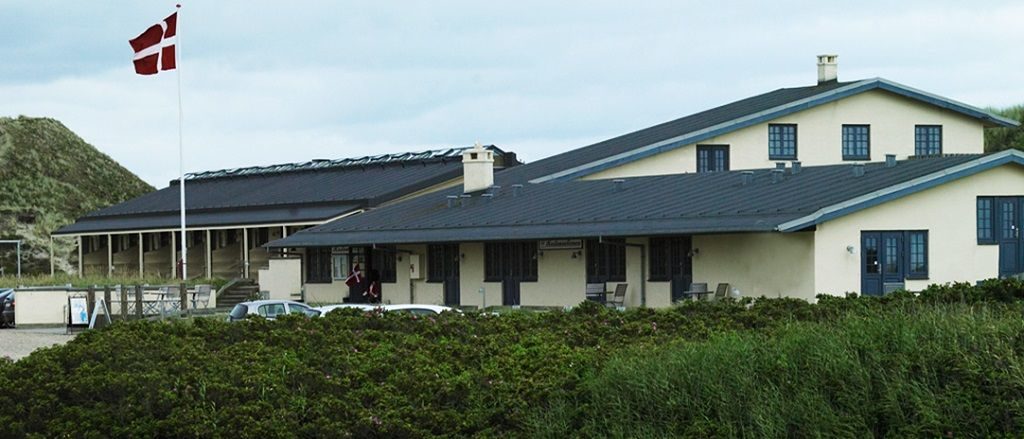
Henne Mølle Å Badehotel, Henne
The man behind this delightful dunes-hotel dating from 1936 was no less a figure than Poul Henningsen, a Danish author, critic, architect, and designer, and one of the leading figures of the cultural life of Denmark between the World Wars. The hotel is situated in a protected dunes area close to the endless North Sea sandy beaches. The interior design is simple yet stylish with plenty of PH lamps, and the restaurant serves well-prepared, organic Danish summer food.
Hornbækhus hotel
Hornbækhus Hotel, Hornbæk
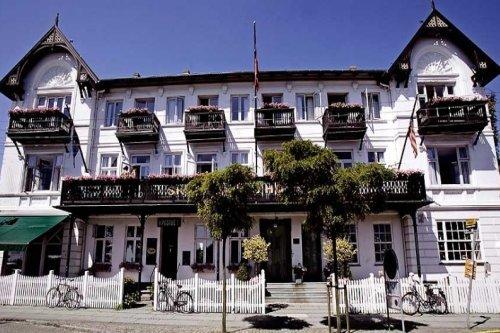
Hotel Hornbækhus from 1904 is a North Zealand treasure, that has attracted the cream of society and regular guests from all parts of Scandinavia for over 100 years. The hotel has delightful gardens and rooms in a pale and cheerful, Nordic manor house style. It’s located very close to the beautiful Hornbæk beach and Hornbæk Plantage with wild forest and an 8km running/walking trail.
Melsted badehotell
Melsted Badehotel, Gudhjem
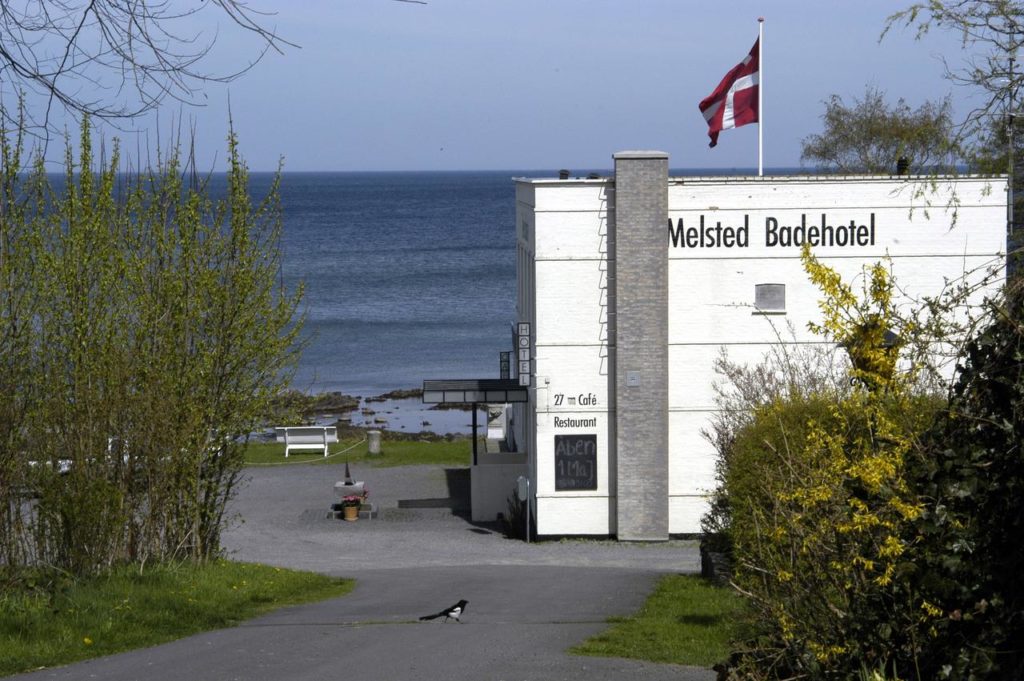
This Bornholm treasure first opened in 1932. Meticulously maintained green areas where you can play cricket and golf, blue water and beaches are just below the terrace. Melsted Badehotel offers delightful rooms in a luxury resort hotel style with Swedish Hästens beds and sea views, plus a stunning restaurant.
Nordlandet badehotell
Norlandet Hotel, Allinge Hotel Norlandet is set by a rocky inlet in Bornholm, the Danish equivalent of Swedish Gotland. Its 17 rooms have been edited back to the serene essentials. The food aims to balance innovation with classic Scandi ingredients.
Ruths hotel
Ruths Hotel, Skagen
Close to the village if Skagen is the famously beautiful peninsula of Grenen where the Baltic and North Seas merge. First opened in 1904, and still with plenty of picket fence charm, Ruths has expanded to 52 rooms plus a large spa and two restaurants.
Skovshoved hotel Chalottenlund
Skovshoved hotel, Charlottenlund
This seaside property, on the coastal road that trails north from Copenhagen, dates back to 1660. It is surrounded by fishermen’s houses of the same era. The hotel was brought up to date by its present owners in 2003, with classic Scandinavian style prevailing in the 22 bedrooms. The restaurant has gained attention for its seafood-focused menu and has a terrace for summer dining. A jetty offers the chance to cool off in the sea while the capital’s two sandy beaches and a nature reserve are a little further afield.
Stammershalle badehotell
Stammershalle Badehotel, Gudhjem Yet another amazing Bornholm treasure, this beautiful spa hotel from 1911 is located in the Bornholm archipelago with views over the foaming Baltic Sea. The hotel has a fantastic restaurant whose award-winning chef gets the very best out of local ingredients while adding a French twist.
Strandhotellet Blokhus
Strandhotellet Blokhus, Blokhus
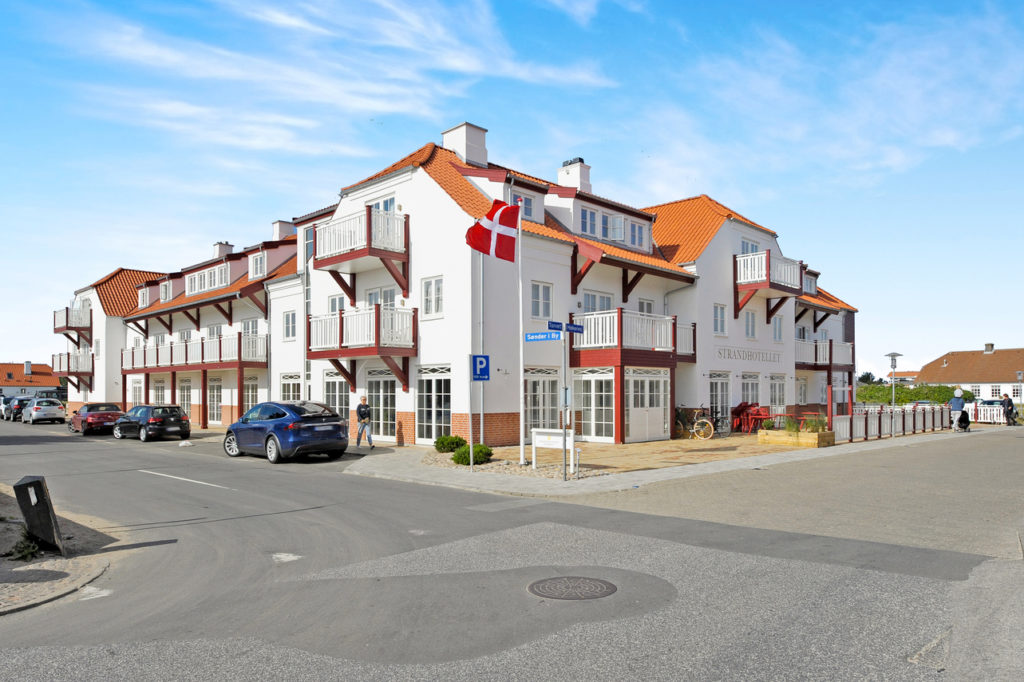
Sytandhotelle Blokhus opened late last year. Its 38 rooms, with French windows, uncluttered white-and-blue decor have a Cape Cod charm, while the restaurant offers casual Danish/French food. Jammer Bay offers 55km of white sand.
Luxury By the Sea in Denmark In recent years, the simple life at a resort hotel has enjoyed a huge renaissance in providing a relaxing break from hectic everyday life. Many seaside hotels are open all year round, and in the off season, you may want to seek refuge in front of a blazing fire to read a book after a bracing windblown walk along the shore.
Luxury By the Sea in Denmark, compiled by Tor Kjolberg
It’s a worthwhile journey to the north-eastern suburb of Tøyen in Oslo to visit the Munch Museum in Oslo. Dedicated to the life and works of Edvard Munch (1863-1944), the painter and graphic artist who fathered German Expressionism.
The gallery holds approx. 1 150 paintings, close to 18 000 prints depicting more than 700 different motifs, 7 700 drawings and watercolors as well as 13 sculptures. In addition, there are nearly 500 printing plates, 2 240 books, notebooks, documents, photographs, art tools, accessories, letters and pieces of furniture, which were bequeathed to the City of Oslo by his sister Inger Munch.
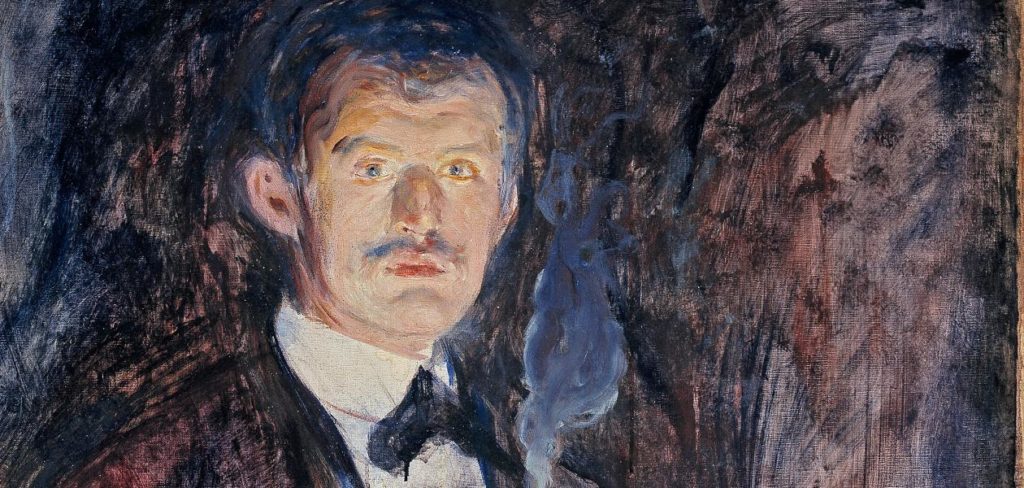
Edvard Munch selfportrait
The Much Museum in Oslo
Edvard Munch himself initiated a discussion about a future Munch Museum with Jens Thiis, the director of the National Gallery, back in 1927. In the mid-1950s the Oslo City Council decided to build the museum in Tøyen in eastern Oslo. In May 1963, a hundred years after the artist’s birth, the museum opened in architects Gunnar Fougner and Einar Myklebust’s – by contemporary standards – very modern building.
The Scream
His Skrik (The Scream) is Scandinavia’s most reproduced dork of art, famously stolen in 2004 then recovered two years later.
The Scream, by Edvard Munch
It was actually painted in two versions. The earlier, from 1893, is in the National Gallery of Oslo. What appears to be a somewhat later version hangs here. More important for the promoting and spreading the image was the lithograph version from 1895, which is on display in the graphic section.
The new Munch Museum (Lambda) and the Opera (Estudio Herreros)
The new Much Museum An increasing number of visitors come to the museum and additional space is needed in order to exhibit more of the collection. The Munch Museum has long outgrown its current premises. In May 2013, after years of debate, the Oslo City Council voted to build a new Munch Museum in Bjørvika in the Oslo’s harbor area, close to the Opera. Spanish architects Herreros Arquitectos won the design competition and the new museum will be completed in 2019.
Feature image (on top): The Sun, 1909 by Edvard Munch is perhaps the greatest achievement of modern mural painting. Symmetrically structured, it occupied the enormous front space of Oslo University’s assembly hall, dominating through size, unmitigated frontality, and power of imagery.
Winners at the red-carpet gala evening in Athens, Greece included Denmark’s leading boutique hotel, Nobis in Copenhagen, Norway’s leading business hotel, Grand in Oslo and Sweden’s leading hotel, Grand in Stockholm. The Scandinavian Travel Awards 2018 were revealed at World Travel Awards Gala in Athens.
World Travel Awards shield 2018
Hundreds of the leading figures of Europe’s travel and tourism industry attended the ceremony late last June, which was staged at the historic Zappeion Megaron Hall.
Graham Cooke, Founder & President, World Travel Awards, said: “What an evening it has been here in the incredible city of Athens, Greece. We have had the privilege of recognizing many of the leading hotels, airlines and hospitality providers from destinations across Europe and my congratulations to each of them.”
In the aviation sector, Norwegian Air Shuttle was voted “Europe’s leading low-cost airline” while DFDS was awarded “Europe’s Leading Ferry Operator”.
Scandinavia wins big at the 25th annual World Travel Awards
If you stroll around the center of Voss on a late June afternoon, nothing looks out of place. Coachloads of tourists in all shapes and sizes mingle with the locals who are going about their daily business. But this is the wild, wild Voss in Norway – at least for one week a year.
There’s a young woman whizzing past with a parachute in her bag on her way to the jumping ground. As a matter of fact, everything in Voss is quite normal.
The world’s largest extreme sports festival.
Or not? Aren’t there rather too many clapped out cars, with life-vests in the roof and crash helmets on the back shelf? Youngsters cycling past on large bicycles, while others wander in the direction of the cable car with huge rucksacks on their backs? A glance at the sky confirms the suspicion that they contain paraglider wings.
It all started 20 years ago, with four local enthusiasts
A closer look around reveals that something is definitely going on. In the lawn beside the beach promenade stands a large circus tent. What is going on is no less than the world’s largest extreme sports festival. which gather together well over a thousand participants from 30 countries.
Extreme Sports Week is probably only possible in Voss, both because of the natural arenas afforded by the surrounding landscape and the efforts of some extremely, possibility-oriented enthusiasts.
20 tears of madness It all started 20 years ago, with four local enthusiasts. They were each practitioners of their own specialist activity: parachuting, rafting, river kayaking and paragliding. They decided it would be good idea to hold a series of competitions within their individual sports in the same week, and maybe even have a chance to try out other activities.
Today there are a dozen or so sports on the program, and each year sees the staging of both national and international competitions during this week. Extreme Sports Week is constantly developing, with new complementary activities being added to the concept all the time. In 2005 where was so much snow up on the Vikafjellet mountain that a big jump competition for skis and snowboards was organized, as well as freeride on snow.
In 2007 more than 1000 competitors and more than 40,000 spectators attended the event. The festival was covered by more than 250 reporters from both the Norwegian media as well as the international media. “Veko” does not employ many people as they base the organizing and execution of the event mostly on volunteers.
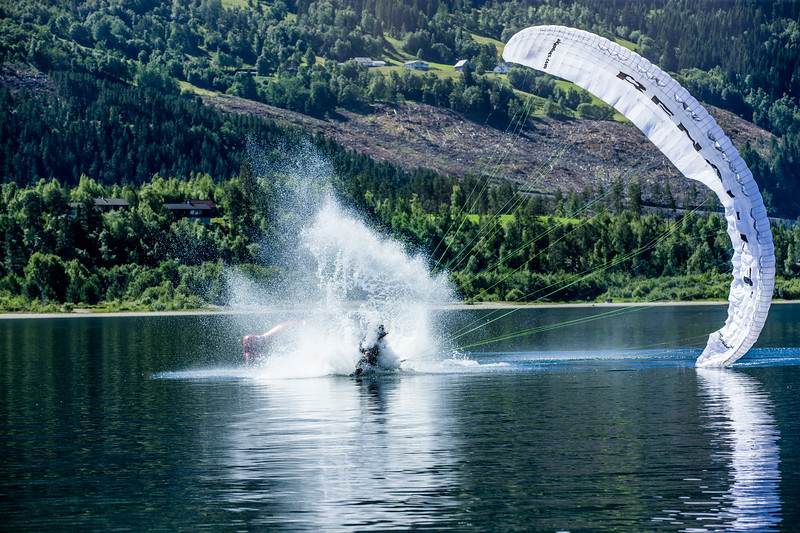
Kiteboarding works very well at the Vangsvatnet lake near the town center. In recent years the ski lift has become an Eldorado for cyclists who like jumps, drops and high speed along narrow woodland trails. While those with sufficient stamina can take part in the Multisport Competition, which is one of the relatively new events on the program.
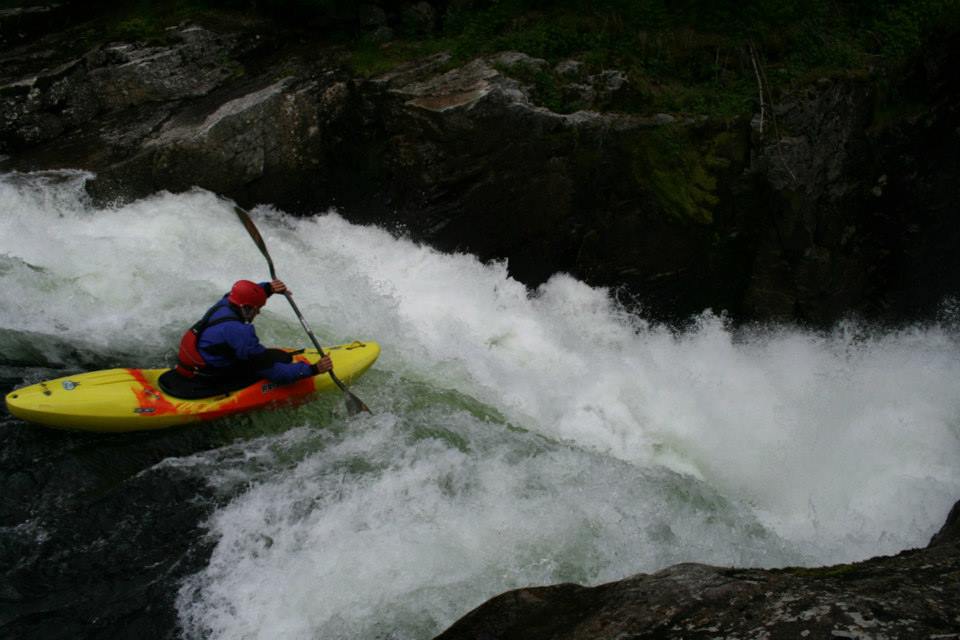
Downhill racing in a river kayak is one of the most popular competitions at Extreme Sports Week at Voss, Norway
Audience-friendly The participants themselves are the main focus of Extreme Sports Week, but the organizers do what they can to accommodate spectators, too. The aerial sports are a case in point. They show themselves to their best advantage over Vossevangen every evening, with exhibitions of parachuting, paragliding and hang-gliding.
If you want to feel the energy of Extreme Sports Week, all you need to do is look at the program and map pf events. Although the bulk of the events take place close to the town center, many of the participants stretch the radius from Voss by many miles.
If you fancy, you can take a tandem paraglider flight from Hanguren over Voss.
Downhill racing in a river kayak is one of the most popular competitions, and takes place well off the beaten track. One of the most spectacular events during the week is base jumping in the natural beauty of Gudvangen. To really feel the rush, you should take the steep hike up to the jumpers’ exit point.
Watching people like yourself jump off a mountain and be gone in seconds is in itself an extreme experience.
Entertainments have become an important part of the Voss experience
Music The concert side of the week gas grown big enough to make it worth the trip for those interested in music. With international celebrities like Kurt Nilsen and Røykopp on the program, the evening entertainments have become an important part of the Voss experience. And when the music in the big top has come to an end, club events continue through the pale mid-summer night.
Increasingly popular
The daily high point of Extreme Sports Week is the screening of the day’s video. Everyone who has been in action that day gathers in the circus tent to get an update on what has happened elsewhere during the day. It is a good opportunity to get a glimpse of one’s self and everyone cheers when spectacular stunts race across the screen.
Rafting at Extreme Sports Week, Voss, Norway
In recent years the Norwegian broadcasting company NRK has produced daily news bulletins, so that the whole country can get a shot of the adrenaline that is flowing about at Voss. With the national broadcasting company providing such first-class marketing for activities which would otherwise not get much public attention, more and more people turn up wanting to have a go themselves. If you want to take the plunge and take part in Extreme Sports Week, you can do it in many ways.
Try-it is a regular feature, tailor-made for those who want to make the most out of the various activities on the program. The event is so popular that you have to get your name down early if you want to be sure of a place.
At the start of the week anyone who wants to can try paragliding on a steep field – for free
Wild, Wild Voss in Norway
At the start of the week anyone who wants to can try paragliding on a steep field – for free. But you have to be prepared to fly. If that takes your fancy, you can take a tandem paraglider flight from Hanguren over Voss. And if that is not dizzying enough, you can take a tandem parachute jump. Voss Rafting offers ordinary rafting, gorge walking and river-boarding in the local rivers.
If you have brought your own bicycle you can also join one of the many guided trail rides, or challenge yourself on the downhill run at the ski center. There are also specially constructed jumps, scaffolding and other elements to test your nerve and your skills.
To keep a particularly good Extreme Sports Week tradition, though, you should not get yourself too badly hurt. For, incredibly, no one has died or suffered serious injury in all these years. Which shows that the organizers are in control and that there is method in the madness. That too could probably only happen in Voss.
The different sports You can see the complete program of the week 2018 here.
Music festival Extreme Sports Week also includes a music festival with several concerts and club events.
It is hard to think of a better trip anywhere in the world that can be completed inside a single day. It could be that the Norwegians, ever mindful of their high cost of living, feel that most tourists want to get their money’s worth. In just three days you can experience the spirit of Norway.
Several companies operate excursions that whisk you up mountain railways, along precipitous roads and then out to sea to experience Norway’s most famous feature, the iconic fjords.
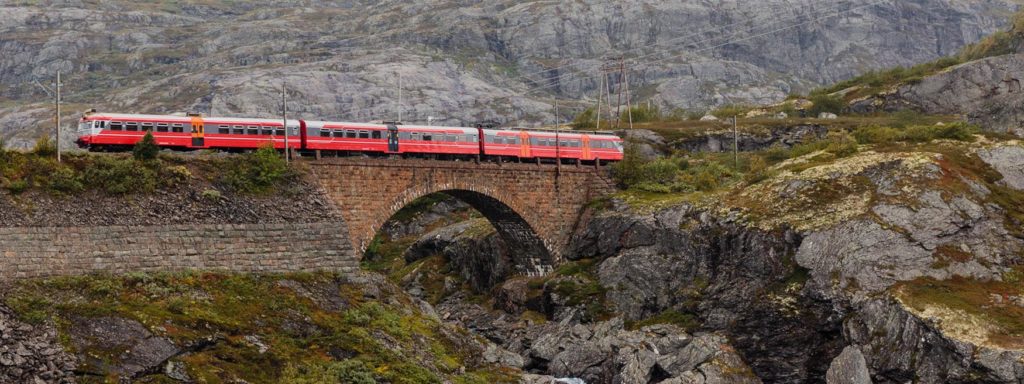
Northern Europe’s highest-altitude railway line, the Bergen Railway
The Bergen Railway
The typical journey starts with a ride on Northern Europe’s highest-altitude railway line, the Bergen Railway. Exposed to harsh Atlantic weather systems, it is a huge engineering feat just to keep the line open, but you will be glad they do.
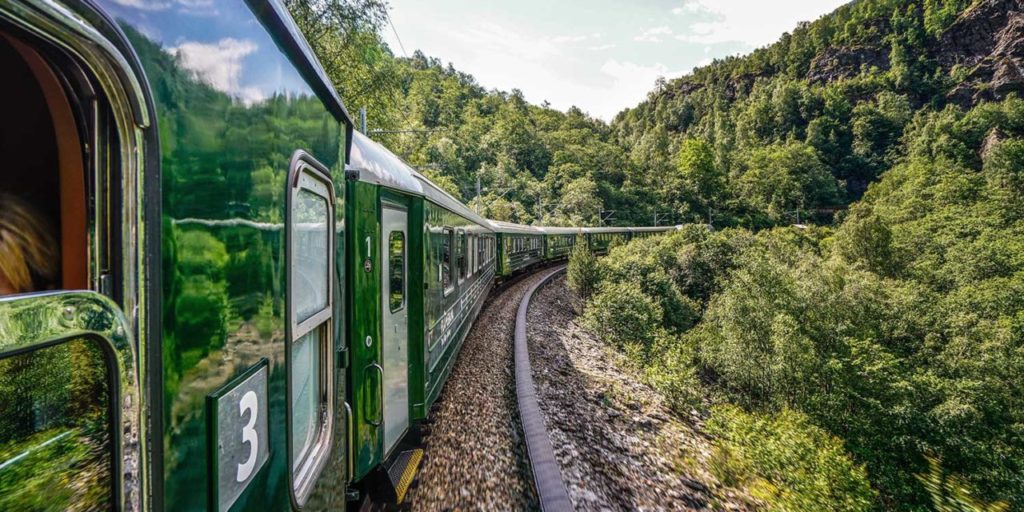
The Flåm Railway runs alongside magnificent mountain scenery and tumbling waterfalls
The Flåm Railway
The mountain views are stunning as the engine hauls you up incredible steep inclines. From there the rollercoaster ride continues as you transfer to the Flåm Railway, a 20-km (12.5mi) journey from the hill station of Myrdal, which runs alongside magnificent mountain scenery and tumbling waterfalls.
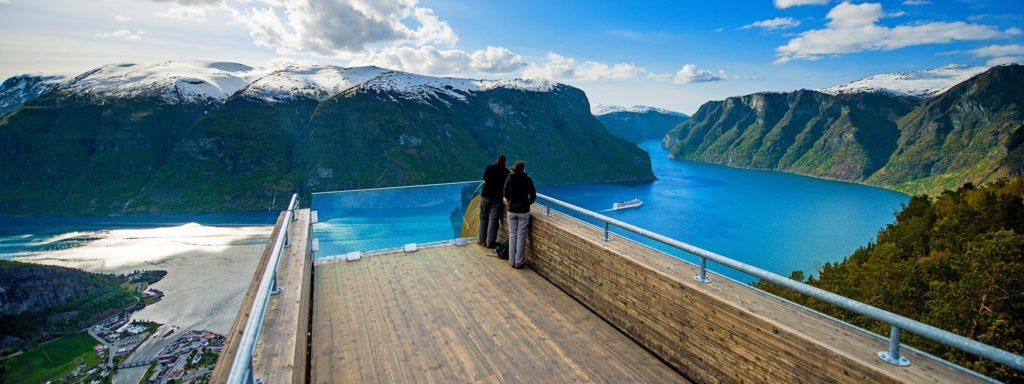
Aurlandsfjord – Stalheim
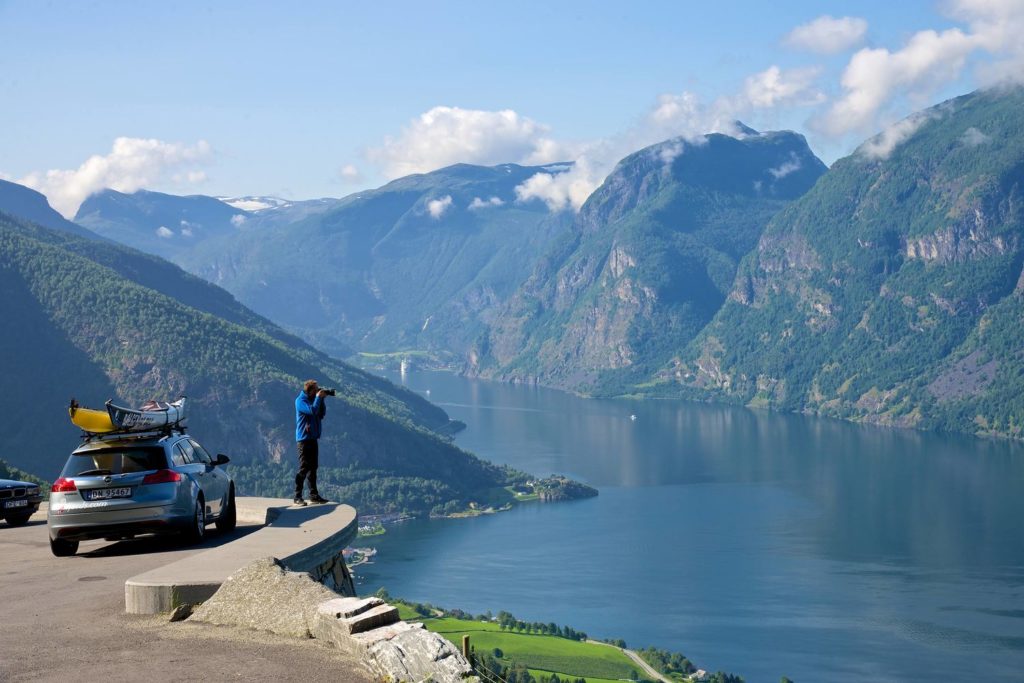
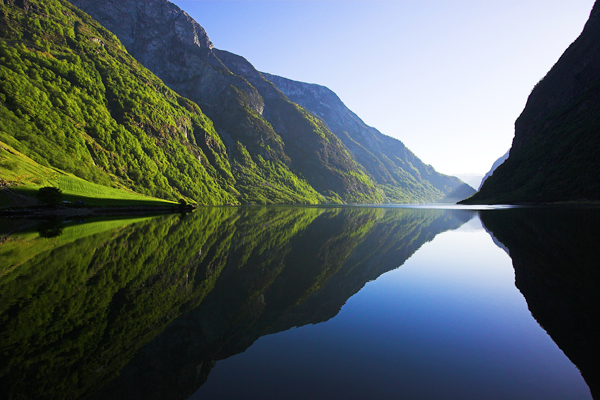
Beautiful though this all is, you quickly realize that it was merely the hors d’oevre. From Flåm the next leg of the excursion us completed by boat. Although the fjords are so obviously a symbol of Norway, one cannot tire of seeing them. These deep-sea gullies, carved by ice, take the breath away and the towering rock faces in both sides make it sometimes hard to believe that you are in water.
The Spirit of Norway
Legendary labyrinthine and starkly beautiful, a journey through the fjords leaves you with images that will stay with you for the rest of your life.
From Flåm
The last leg of this most fabulous of days out takes you by coach, along amazingly winding mountain roads to your final destination of Stalheim. From there it is possible to transfer by train back to Bergen.
You can do the trip all year round but best during the light Norwegian summer, May to July.
The improbably narrow Naeroyfjord
Three days or 16 hours?
Total trip takes 16 hours, but we recommend you to choose to stop and use three days. If I should mention some highlights it should be the picturesque village of Flåm, the mountains around Sognefjord, the improbably narrow Naeroyfjord and the Folk museum at Stalheim, a celebration of traditional Nordic life.
Norway can be very expensive, so there’s no shame in taking your own lunch with you. In fact, that is precisely what most locals do.
Spirit of Norway, written by Tor Kjolberg
Feature image (on top): From Flåm, photo: Visit Bergen
The Norwegian artist Hannah Ryggen spent six years as a painter’s apprentice before turning to weaving, and her renegade use of traditional rural techniques was just as attention-grabbing in 1930s Norway as it is now. Making tapestries almost exclusively for public spaces. The woven politics by the Norwegian artist has been known across Europe and America.
Hannah Ryggen (b. 1894, Malmö, Sweden – d. 1970, Trondheim, Norway) was one of Scandinavia’s most outstanding artistic figures of the 20th century. Ryggen remains an important artist, as she dealt with the pressing social and political concern of her time. Her art has enlightened issues from the rise of fascism and the Nazi occupation of Norway, to the proliferation of nuclear power and the Vietnam War.
From the Hannah Ryggen Center in Norway
Trained as a portrait painter
Born to a working class Swedish family in 1894, Ms. Ryggen trained as a portrait painter. On a trip to Dresden, Germany, as a young woman, she immersed herself in the work of Vermeer, Goya and El Greco. She was likewise versed in the art of her own time, making repeat visits to the huge 1914 Baltic Exhibition in Malmo, Sweden, at which paintings by Kandinsky and the German expressionist group Die Brücke were shown.
She later abandoned painting in favor of weaving, which became her area of expertise after having moved with her husband to a wind-blown farm on a remote Norwegian farming community Ørlandet near Trondheim. On this shore, with no running water or electricity, she learned the processes of treating wool, spinning and weaving from local tradition, and developed as an artist by experimenting with materials and techniques from the world around her.
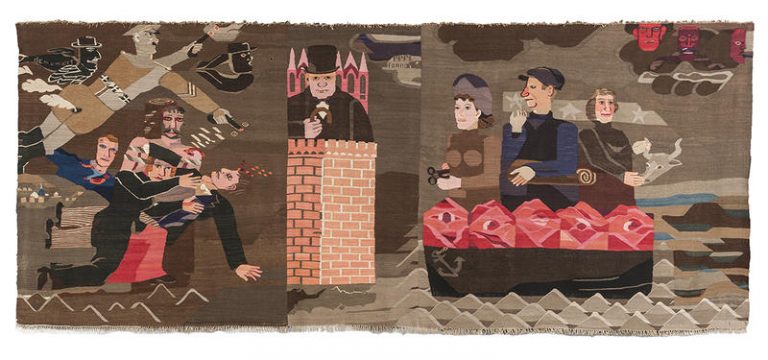
“The death of dreams”, 1936 by Hannah Ryggen
Anti-fascist tapestries
Hannah Ryggen worked utterly from scratch on her anti-fascist tapestries. Spinning wool from her sheep, she dyed it with things she’d found by foraging: birch leaves, bark moss and bog rosemary. Urine, too, was an essential part of this alchemical process, and visitors were asked to leave their donations in a bucket.
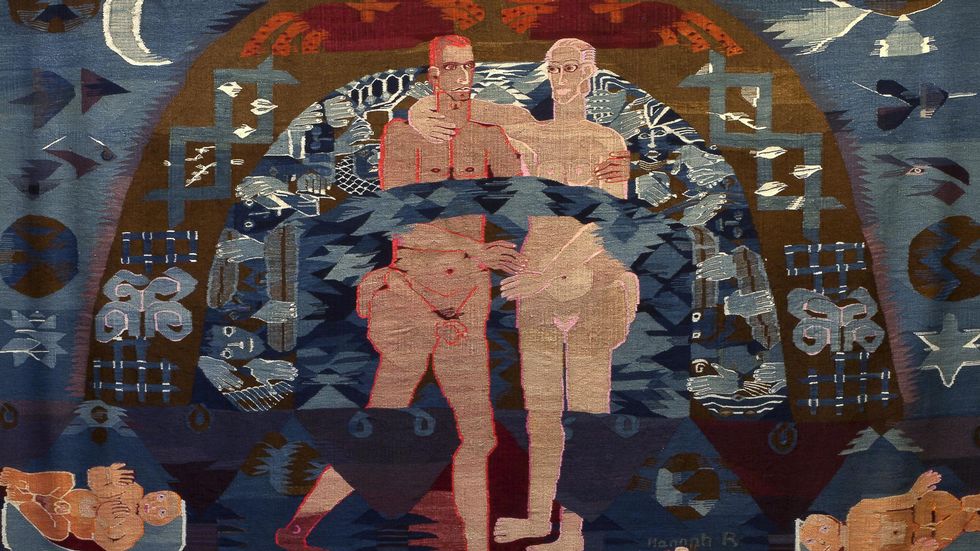
One of her earliest famous works is the frieze-like “Etiopia,” Ms. Ryggen’s furious response to the Italian occupation of Ethiopia in 1936. Portraits of the Emperor Haile Selassie and Italy’s King Victor Emmanuel III are set above a large geometrically patterned rug panel suggesting Ms. Ryggen’s kinship with African weavers. “Etiopia” was shown by Norway at the Paris Expo of 1937 in the pavilion adjacent to Spain, where Pablo Picasso’s “Guernica” offered a horrified response to the Nazi bombing of a Basque town during the Spanish Civil War.
Woven politics by a Norwegian Artist In one 1936 work, Hitler, Göring and Goebbels pop up like murderous glove puppets with blood-red faces and hands. Three decades later, Lyndon B Johnson’s beagle – for the artist a fluffy media distraction from the Vietnam war – becomes a similarly scarlet hound of hell.
Hannah Ryggen was one of Scandinavia’s most outstanding artistic figures of the 20th century
Since her death in 1970, the Swedish-born artist has remained a defining figure in Scandinavia, although she has only recently been rediscovered by the wider world.
Woven Politics by a Norwegian Artist, written by Tor Kjolberg
Feature image (pn top): Nazi occupation of Norway by Hannah Ryggen
Regarding culinary experiences, Copenhagen Airport has been considerably upgraded in recent years. Whether it is steaks or sushi, caviar or cinnamon rolls, the approximately 72,000 daily travelers at Kastrup are looking for, the culinary airport of Copenhagen has the world’s best offering of restaurants and coffee shops.
Eating in airports is more often than not a humiliating, expensive and unfulfilling experience. Not so at Copenhagen airport. In 2016 the airport was honored with the “Airport Food & Beverage Offer of the Year” award as the airport with the world’s best range of coffee shops and restaurants (the Oscars of the food and beverage industry).
In 2016 Kastrup was honored with the “Airport Food & Beverage Offer of the Year” award
Serving 29 million travelers annually
Passengers at Copenhagen Airport currently have a choice of more than 34 restaurants and coffee shops offering everything from quality snacks to fine dining. The airport’s strategy is to establish a good mix of internationally well-known restaurants and very good Danish names.
For an airport that serves more than 29 million people annually, the remarkable thing about Copenhagen Airport is how peaceful it feels. You never feel like herded cattle, the atmosphere in Copenhagen is deliciously serene.
With lots of different restaurants to choose from, we have selected a number of restaurants to give you an overview of where to eat in Copenhagen Airport.
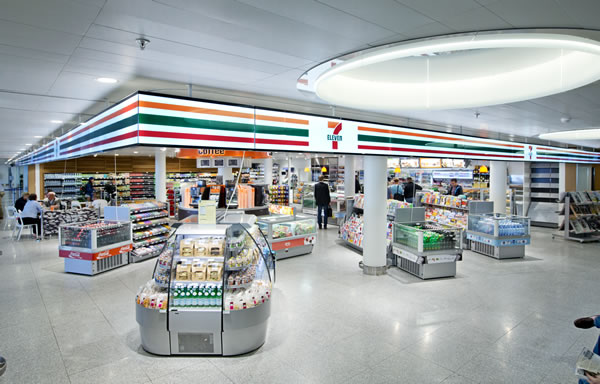
There are two 7-Eleven Deli at the airport
7-Eleven Deli
There are two 7-Eleven Deli at the airport. You might think that 7-11 is the worst American fast-food on earth. Maybe it once was, but the market has changed and so has the Deli chain. If you prefer, the food is wrapped up so you can take it with you onboard the plane. If you choose to eat it out in the C-pier – where the big international aircraft leave, you can also enjoy a supreme view – where all the 380’s are taxing by.
Gorm’s is located between piers B and C and is one of the airport’s largest restaurants
Gorm’s
Copenhagen Airport has succeeded in getting ‘local heroes’ into the restaurant scene – long lasting Danish concepts. This is also true of Gorm’s, although the restaurant chain hasn’t revamped the pizza, it has at least raised it to a level where eating pizza is fun. Gorm’s is located between piers B and C and is one of the airport’s largest restaurants. Good raw materials are treated the way they deserve, just to demonstrate Italian cuisine at its best.
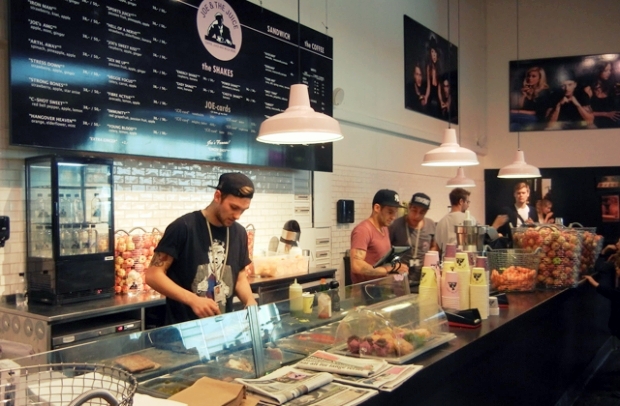
Joe & the Juice has three locations at the airport
Joe & the Juice
Joe & the Juice has in fact three locations at the airport. And in all three places, the music is loud and lively, while the tattooed bartenders squeeze one healthy glass of juice after another – if they’re not busy roasting one of their delicious sandwiches. Their tuna sandwich has taken the world by storm. Smart, young travelers are attending Joe & the Juice at all times of the day. Should you need an energy boast, a visit is recommended.
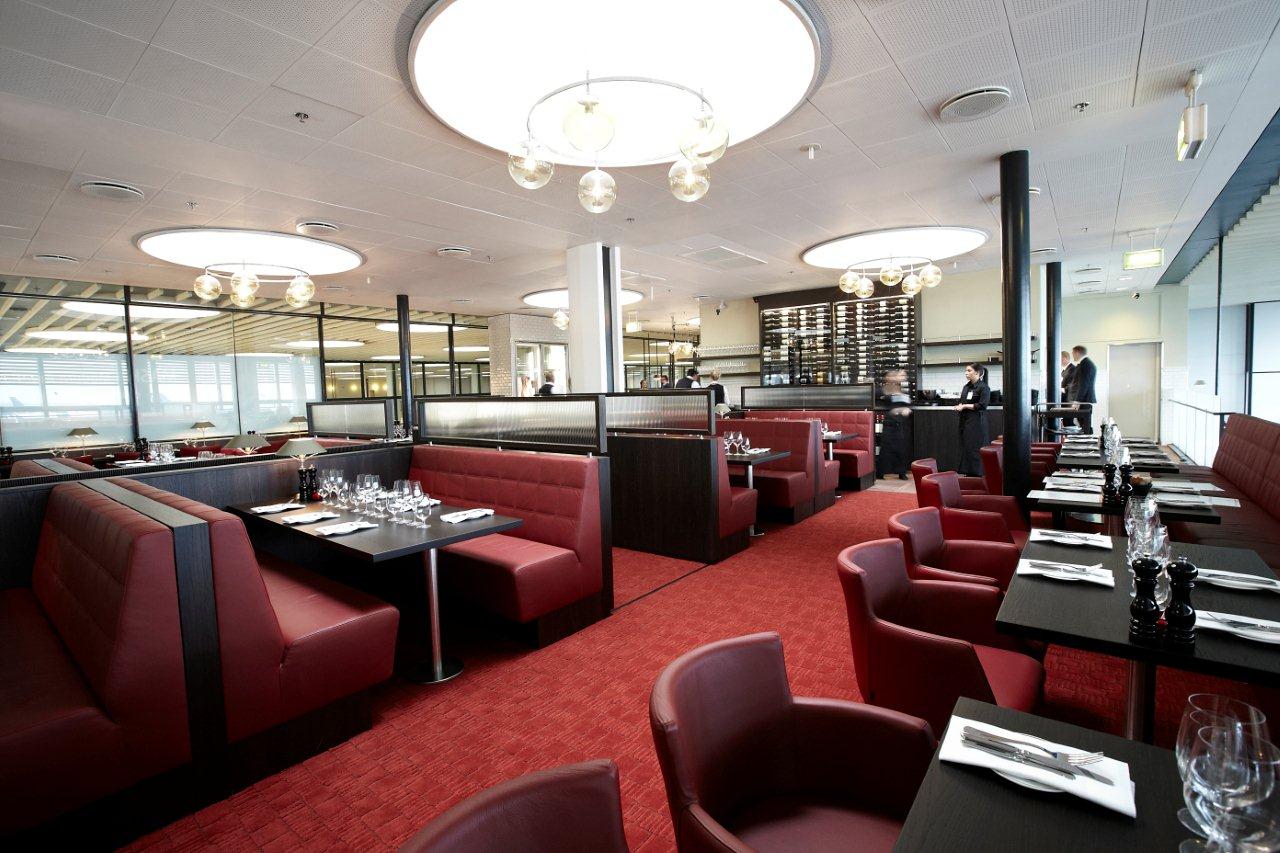
The Danish beef success MASH has already conquered many places in the world
MASH
The Danish beef success MASH has already conquered many places in the world – not least in Germany and England. Now the restaurant chain also has a department at the Copenhagen Airport. It is situated between the A and B piers, on the first floor. Like elsewhere, MASH at the airport offers red sofas, stalls and lots of proteins on the menu with the characteristic side orders. Therefore you don’t have to bother your belly with what the airlines are serving up in the air. Copenhagen Airport has made it a rule not to make calls over the speakers other than strictly necessary ones, so a visit to MASH is as pleasant as a normal visit to their other restaurants.
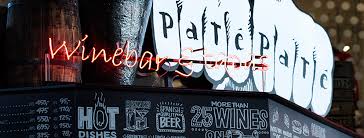
Kenn Husted, the wine king of Copenhagen, is in charge of Paté Paté at Kastrup
Paté Paté Winebar & Tapas
Kenn Husted is the wine king of Copenhagen. One of his most recent openings at the airport is the Paté Paté Winebar & Tapas. The emphasis on fresh ingredients, expedient service, and supporting “local hero” restaurants has been a strategic shift for Copenhagen Airport, one that is meant to increase the overall experience of every traveler. “Copenhagen’s gastronomy has strongly contributed to putting Denmark on the world map, and naturally, the New Nordic food culture must be reflected at the airport,” says Lise Ryevad, director of airport sales. “Sixty percent of passengers attach importance to food when traveling, and we want to give travelers a taste of Copenhagen on the go. It is important to us that you eat well—very well—at the airport,” she adds.
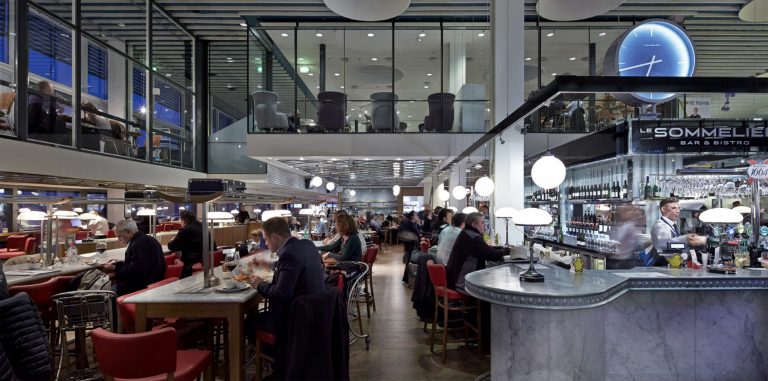
Le Sommelier was one of the first at Kastrup to really show what good airport food consists of
Le Sommelier Le Sommelier was one of the first at Kastrup to really show what good airport food consists of. They have also the best location at the entire airport, at pier B – where almost all SAS flights come and go. Guests are also coming to the large open restaurant, which has a basic rule stating that all food on the menu is served within a quarter of an hour – and in fact, usually faster, down to 12 minutes. Almost no matter how busy they are, you can always have a glass of good wine or a classic French bistro dish – or why not just a few oysters with caviar on top and a glass of champagne?
Aamanns is a gift to Danish gastronomy
Aamanns
Aamanns is a gift to Danish gastronomy and offers delicious warm open-faced sandwiches made with free-range beef and herring, as well as a signature beef tartare with capers and tarragon. The airport restaurant – located between the B and C piers – is divided into two – there is the bar facing the buzzing airport, and ‘inside behind’ it’s very close to the most authentic restaurant experience you’re able to find throughout the airport. Here you are relatively isolated, it’s cozy located near to a few panorama windows facing the planes, so you can sit and enjoy your sandwiches while watching different flights taxing back and forth from the runways. The food is so excellent that Aamanns is a must.
Kastrup- The Culinary Airport of Copenhagen
Many airports, especially the larger ones, will boast about how many food and beverage choices they have, but Copenhagen actually delivers exceptional-quality options as well. There are, of course, the crowd-pleasing fan favorites, a handful of foolproof Irish pubs, and, yes, even a Starbucks. But the real treat of flying through Copenhagen is experiencing what the airport refers to as its “local heroes”—the vendors showcasing Scandinavian cuisine, with many run by chefs with successful pre-existing restaurants in the city center.
Kastrup- The Culinary Airport of Copenhagen, written by Tor Kjolberg
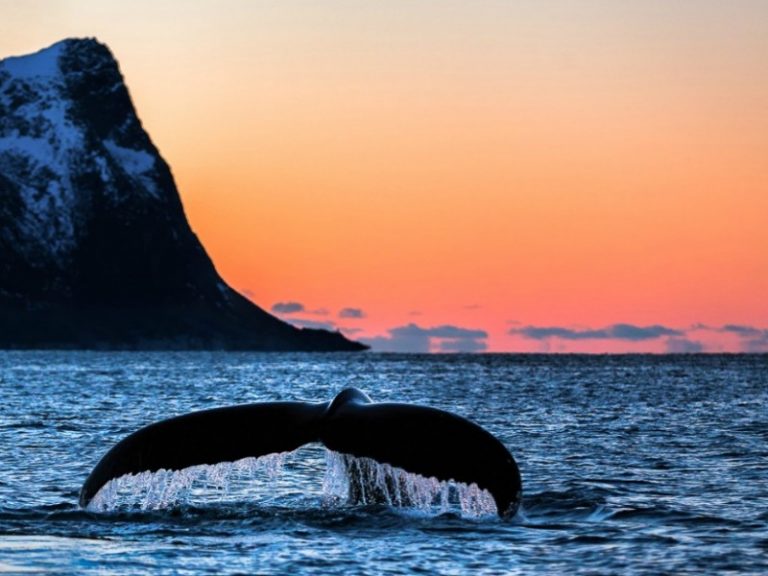
Several companies in Norway run boat trips on which there’s a good chance if seeing whales. While you’ll need to go in summer for a chance to see blue whales, winter is a good time to see killer whales and humpbacks. Welcome to Norway – the Kingdom of Whales.
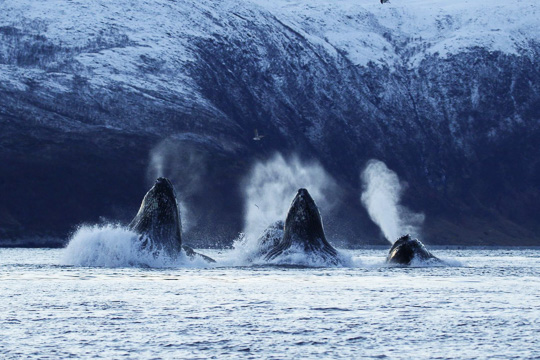
Every year thousands of tourists come to Norway to do some whale watching. No matter the season, there are all kinds of whales, not to forget the truly spectacular and epic landscapes. Sea scientists have never seen so many whales as in recent years, and outside the city of Tromsø, the sea is sometimes “boiling” with whales.
When can you go watching whales in Norway? But how and when can you go whale watching in Norway, and what’s the price? Tromsø, The Lofoten and Vesterålen, far north in Norway, are perfect places for whale watching all year round. While you can rely on seeing sperm whales in summer, orcas and humpbacks crowds the fjords full of fish in winter.
Killer whales in Andenes, Lofoten. Photo: Jesper Anhede
Going in winter, you can even watch world-class Northern Lights on the very same visit. And it never gets dark in summer, so both being perfect conditions to watch the most fascinating animals on our planet. With one of the most staggering, breathtaking coastlines as background, it will probably be an experience you’ll never forget.
Orcas and humpbacks
Norway – the kingdom of whales
If you believe it’s impossible to miss these giant marine mammals, you’re completely mistaken. The sea around Norway is vast and the animals don’t always feel like showing off. You should therefore definitely seek out one of the more experienced expedition operators.
During the winter months there is an enormous supply of plankton and krill in the northern waters, which attracts lots and lots of fish. And those fishes attract the whales back to Norway! From late October until mid-January you’ll have an almost 100% chance of seeing whales in Norway, often swimming right next to the boats.
The animals are spread out from the Lofoten to Andøya (Tromsø region). During these months there are a lot of whale watching safaris going on in Norway.
Do you remember Keiko? Do you remember Keiko from the films Free Willy? This world-famous, beautiful and friendly orca actually chose Norway after he was set free, and he stayed around the Tromsø region a couple of years, until he sadly died from pneumonia in 2003.
The best places for whale watching
During summer, the most important place is the little harbor town of Andenes in the north of the Vesterålen. Only 3.000 people live there but there are over 15.000 tourists in the city every year. They watch the sperm whales, which are full-time residents to the waters off Andøya, so encounters are very likely.
Lofoten and Vesterålen, far north in Norway, are perfect places for whale watching all year round
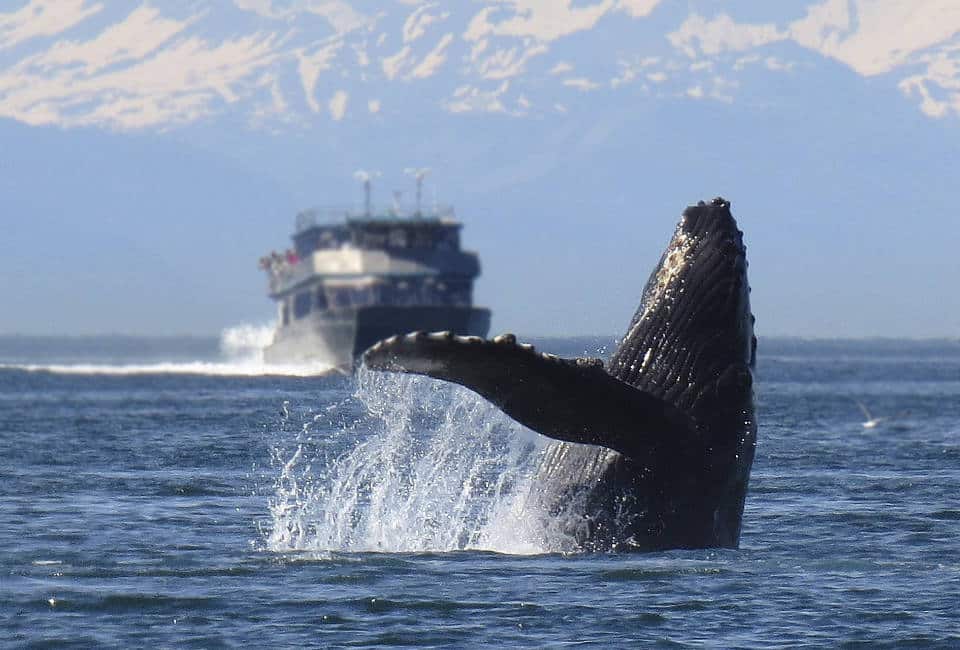
In open sea it’s very difficult to see whales and orcas. You’ll get the best chances in between the fjords where there are a lot of fish on which the whales can hunt. Most of the times you’ll get to see tails and backs, but still it is a magical experience to see these creatures from up close!
During summer, the most important place for whale safaris is the little harbor town of Andenes in the north of the Vesterålen
Summer and winter season About 50% of all Norwegian summer whale watching tours start from Andenes and its little neighboring town of Stø. In Andenes you can also find a very good and informative whale centre with life size models. Sperm whales are best spotted between June and August, occasionally also pilot whales, minke whales and various dolphins show up.
Tromsø offers some of the highest probabilities of whale sightings on earth in the winter. Scientists say that the whale activity in these fjords is quite unique. Tromsø city is situated among islands, breathtaking fjord landscapes and dramatic mountain peaks.
Many whale excursions are often fully booked for weeks in advance. If you’re sure that you’re going to Norway to watch the whales, we recommend that you book the safaris beforehand.
Norway – The Kingdom of Whales, written by Tor Kjolberg