10 Years On Norwegian Roads

0

The brown rooster, the sign symbolizing the term ‘rural tourism’, has been seen on Norwegian roads now for ten years. Rural tourism refers to accommodation and catering places, activities and farmers’ stores and freshwater fishing.

150715-Rooster-sign-300m
“Nearly 150 businesses in Norway have been approved to use the sign,” says general manager of Hanen, which is the Norwegian word for the Rooster, Bernt Bucher Johannessen. “More and more companies are now applying for membership, since this is an approval of quality goods and services. Our aim is to offer exciting adventures around rural Norway and make them more accessible.”

150715-Rooster-sign
“There is a growing interest in local food and various kinds of rural experiences,” continues Bucher Johannessen. “Therefore it is important to help members to spread the word to visitors being interested in Norwegian food and culture. The sign attracts attention and curiosity. Although the brown roster now is 10 years old, there are still many who wonder what this sign symbol means.”

150715-rooster-sign-activities
“Good and effective signage is also helping to improve road safety,” says marketing and media manager of Hanen, Ole Jonny Trangsrud. “Many exciting and popular destinations in rural Norway are found off the main routes and can be difficult to find. Many of these destinations till have no street address or road number. Drivers, not familiar with the destinations, might take a wrong turn and can easily create traffic hazard. He advices visitors to plan their trip, and they can do so by looking at their homepage.

Guest-room at member-farm in Voss, Western Norway. Photo Tor Kjolberg

10 Years On Norwegian Roads, written by Admin.

You might also like to read:

Your Guide to Rural Pearls in Norway

Tighter Immigrant Controls in Denmark

0

The new center-right bloc’s foreign minister Kristian Jensen has travelled to Germany to meet his counterpart and discuss the new border arrangements.

The new minority government in Copenhagen has acted immediately to appease an anti-immigration block in parliament and announced it will re-impose border controls on illegal immigration and smuggling, addressing an increasing Europe-wide issue.

290715-tighter-immigrant-control-in-denmark

Although the Eurosceptic, anti-mass-immigration Danish People’s Party (Dansk Folkpartei, DF) has declined to join the government coalition because of irreconcilable differences with the now ruling centre-right Venstre party, they are supporting the government by voting for their bills on the condition they tighten up the borders. Denmark’s only land border is with Germany, a 40-mile frontier that is presently completely open because of the Schengen agreement of free movement between European nations.

290715-denmark-map
“We will suggest something that is within the Schengen rules and there will be a dialogue with Brussels and the EU commission, but also with our neighbouring countries,” Kristian Jensen, told the news agency Ritzau.

Copenhagen
Copenhagen

Border security and limiting migration became a major election issue, and propelled DF into second place nationally as the largest right-wing party after the Copenhagen terror attacks in February this year. 22-year-old Omar Abdel Hamid El-Hussein, who was killed by police, attacked a freedom of speech event and a synagogue with an assault rifle stolen from the Danish Home Guard. He has already been imprisoned for a stabbing attack in 2014, but was released in 2015 – just weeks before he pledged allegiance to the Islamic State and committing his second atrocity.

Denmark is part of the 26-nation bloc belonging to the Schengen agreement, and once a migrant arrives on the continent they are free to move among the member countries, placing burden on smaller countries with more attractive welfare systems.

Tighter Immigrant Controls in Denmark, written by Admin

Only Filipina Who Has Reached the North Pole

0

Led by the Norwegian Polar explorer Børge Ousland, Filipina Samelene Bernardo Pimentel settled for and reached the Top of the World.

Børge Ousland, called  the “leading polar explorer of our time”, was last April leading a team of five on an expedition that required traversing the vast Arctic Sea on the Arctic Ocean that was 4000 meters deep, over constantly drifting ice. Add weight up to 40 kilos for equipment and provisions, in freezing minus 40° temperature and howling winds, for a distance of 111 kilometers, someone must have wondered, “Are we having fun yet?”

140715-Børge-Ousland
A Girl Named Sam
As a child, Samelene “Sam” Bernardo Pimentel had always been inexplicably drawn to the North Star. When she got older, she realized that she couldn’t reach that star. So she settled for the True North instead – literally the Top of the World, the North Pole.

On April 21, 2015, she became the only Filipina in a team of 5, who reached the 90° north.

140715-longyearbyen-to-north-pole
The takeoff point was at Longyearbyen, Svalbard. From there, the team flew to Ice Base Barneo, a floating base camp where a helicopter took them to the drop-off point at 89° Parallel. They were supposed to ski for 11 days, to reach the 90° Latitude North. They arrived there in 5.

The Philippine Marines prepared Sam for the expedition through 90-days of grueling endurance training. She also spent several days in Norway training for winter survival and learning to ski.

140715-polar-bear
Børge Ousland has crossed the Antarctic from coast to coast, followed the footsteps of Roald Amundsens and opened way to others. He is a climate advocate and exclusive member of National Geographic Society. He has been in close encounter with snapping polar bears and won, paddled in competition with unpredictable walruses – victorious again, and when he married he said “yes” on the North Pole and spent the wedding night in an expedition tent. You must be a tough guy to write books with titles as “Winter Without Mercy”, “A Man and the Ice” and “Ravenously Hungry”.

Why do people challenge themselves so such a degree? Regarding Samelene Bernardo Pimentel and Børge Ousland we are tempted to  paraphrase a famous old ad, supposedly used for Ernest Shackleton’s Endurance expedition in the 1900s, “Men and women wanted for hazardous journey. High costs, bitter cold, long hours of complete darkness. Safe return not guaranteed. Honor and recognition in event of success.”

Only Filipina Who Has Reached the North Pole, written by Tor Kjolberg

Source on Pimentel:  Rappler.com

Louisiana Museum of Modern Art

Half an hour by train northwards from Copenhagen Central Station (Hovedbanegården) brings you to Humlebæk and the museum and sculpture park of modern art, Louisiana, which is virtually mirrored in the sea of Øresund.

SONY DSC

SONY DSC


One of the main attractions this summer is art and architecture from the African continent. The exhibition presents a sensual architectural scenography and numerous installations where visitors can experience architectural space, scale and shape. Belonging and identity are two central themes.

The second main exhibition is devoted to the Scottish artist Peter Doig. He exhibits people and architecture in timeless landscapes in vibrant, glowing colors on large canvases. The artist from Edinburgh mat seem both quirky romantic and ultra-modern, and has received considerable attention internationally.

The view across the Øresund is a big bonus
For more than 40 years the mueseum has been built as a work in progress


As always, when visiting Louisiana, the art is just a part of the visit. The museum is constructed in a way so that art, architecture and environment ate closely linked and provide an overall experience. The view across the Øresund is a big bonus.

The main villa
The main villa
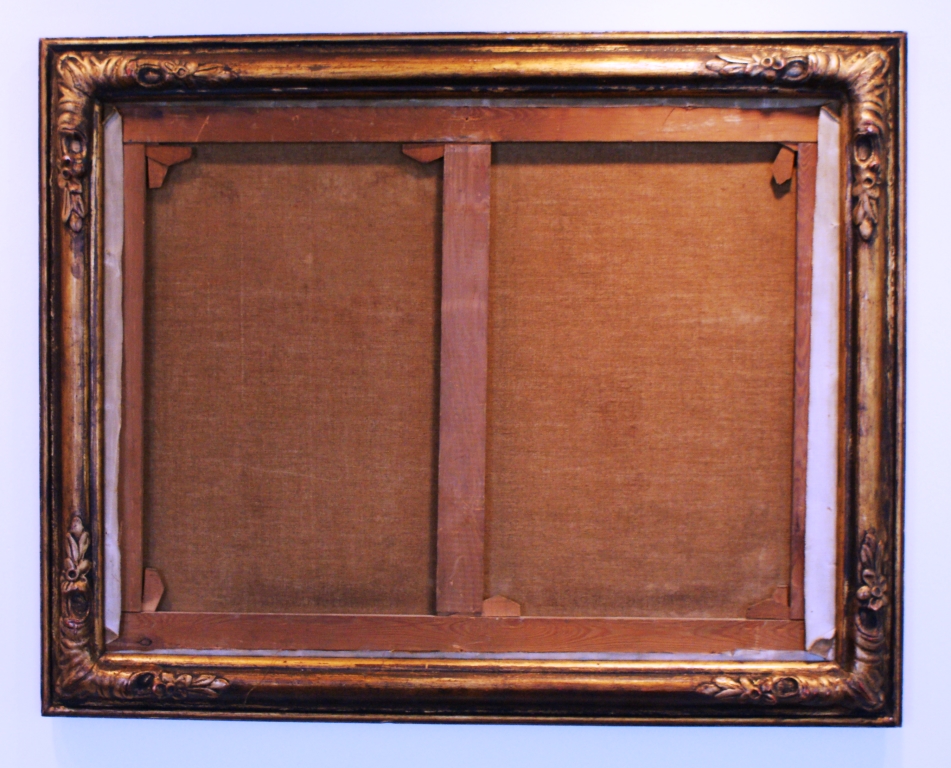
Framed backside
Framed backside


Louisiana was founded by Knud W. Jensen (1916-2000). He loved arts and culture and loved to watch things grow. This is why the museum for more than 40 years has been built as a work in progress.

Photo inspiration
Photo inspiration
Visitor watching photo


Why did Jensen choose to name his museum Louisiana? It’s a funny story. The original villa was named after Jensen’s marriages with no less than three women, all of which bore the name Louise!

Max Ernst, Germany, The large frog
The cafeteria
The cafeteria

Louisiana Museum of Modern Art, text and photos:  by Tor Kjolberg

Food on the Road in Norway

0

100715-Fjord-trout-photo-Kim-Holte

More than 2.5 million tourists were touring Norwegian roads in 2013, and the number is increasing. “To us it’s important to make the driving esperience  as pleasant as possible,” says Per Lauritz Lien in Utvalgte spisesteder (Selected eateries). “Resting places is a natural part of a road trip, and our aim is to increase the experience by offering quality food to our visitors.”

100715-Per-Lauritz-Lien
Honest Food
The association Utvalgte Spisesteder consists of 16 family restaurants situated along the main roads in Southern Norway. “The summer is our best season, and we typically have 300 – 400 visiting guests every day,” says Håvard Rustad, manager of Rustad Kafe in Sokna. “Vistors are not spoiled when it comes to food on the road, and they do appreciate it when we offer honest food made from scratch. Our signature courses are particularly popular,” he adds.
100715-selected-eateries-norwy-map
Spectacular resting places
Road trips in summer are often long distance, and drivers should be in a good mood and alert.

“Stops are important, and equally important are food and drink, which go a long way and stabilize the blood sugar,” advises Guro Ranes in Norwegian Public Roads Administration (NPRA). “There are many spectacular places along our national routes, and breaks should be a part of the driving experience,” she adds.

Free Meal
Ask for Fordelskortet (Advantage Card) when you visit the member eateries. Every tenth meal is free. Children may also enjoy an ice on the house. Ask for details.

Fjordtrout Photo Kim Holte
Fjord trout Photo Kim Holte

Feature image on top: Filet of mackerel

Food on the Road in Norway, written by Tor Kjolberg

Stockholm: Flowers and cowboys

The Swedish capital is blooming this summer.  A botanical art feast Beloved Blossoms goes on at Millesgården. Liljevalchs celebrates the ceramic innovator Hertha Hillfon and the women’s group DNK has turned the art hall in Gustavsberg upside down. The Mats Theselius exhibition Urban Cowboy at Artipelag may just be worth the bus trip.

Beloved Blossoms (through August 30)
In this year’s summer exhibition at Millesgården, the garden enters the Art Gallery. When the sculpture park is resplendent with flowers, the flourishing continues indoors where more than 60 works by 20 artists are presented, all featuring floral motifs.

230715-beloved-nloissoms-millesgarden-stockholm
Older still lifes hang side by side with works by prominent contemporary artists. In techniques ranging from painting and photography to moving images, there is an abundance of floral imagery that conveys everything from desire and pleasure, to death and transitoriness.

The exhibition brings forth the details in the seductive floral motifs. Which flowers have the artists chosen and why? In some of the works the flower world is depicted with scientific precision and in others we see plants that bloom only in the artist’s imagination. Deadly poisonous plants hide in sugary-sweet bouquets. In the works by contemporary artists there are flowers that grow, wither, are picked to pieces, form patterns and reemerge. Paintings, both minimal and monumental, are in dialogue with video art and photography. The exhibition texts present the secrets of the flower images from a plant grower’s perspective. They are written by Karin Berglund, author of several gardening books, including Bonniers stora bok om din trädgård, 1996 and Med fingrarna i jorden, 1999.

Karin Berglund, whose expert eyes are trained on both the living and the depicted vegetation, relates the history and status of different flowers and their place in borders and bouquets. She writes about flowers both edible and poisonous, and how they have been used throughout history in the production of medicines.

230715-millesgarden-lidingo-stockholm-sweden

Artists in the exhibition: Ivan Aguéli, Roger Andersson, Dick Beer, Saara Ekström, Sven X-et Erixson, Elsa Grünewald, Denise Grünstein, Agda Holst, Eugène Jansson, Gunilla Lagerhem-Ullberg, Henning Malmström, Heikki Marila, Maria Sibylla Merian, Olga Milles, Emma Mulvad, Jenny Nyström, Ewa-Marie Rundquist, Theodor Schröder, Andy Warhol and Frans Ykens.

Visiting address: Herserudsvägen 32
Public transportation
Subway to Ropsten and then bus 201, 202, 204, 205, 206, 211 or 212 to Torsviks torg. From Torsviks torg there is only a short walk to Millesgården, approximately 300 meters. Follow the signs.

Hertha Hillfon: Innovative Ceramist at Liljevalchs (Through August 16)

Hertha Hillfon (1921-2013) was a ceramic innovator who moved with ease between different fields of art: from abstract experiments and utility goods to symbolic sculptures and portraits. This generous retrospective allows us to experience the magic of her home and studio in Mälarhöjden, Stockholm.

A tribute to Hertha Hillfon’s art, the exhibition is a pleasurable biographical journey through her life and work, from her first beginnings to her mature pieces. In two of the galleries we present monumental images in an attempt to recreate the feeling in the artist’s conservatory and studio, designed by her architect husband Gösta Hillfon. It was here that Hertha Hillfon lived and created for more than five decades, until her death in October 2013.

In the foreword to the catalogue, Liljevalchs’ Director, Mårten Castenfors, describes her bohemian image:

“An exceedingly dramatic person, surrounded by innumerable stories, she was larger than life and leaves behind an oeuvre of symbolic dimensions. Large or small, always personal, these are works that tell stories of loved ones, works about everyday things, works filled with passion and mystery.”
230715-hertha-hillfon
Hertha Hillfon was born in 1921 in Härnösand, the fourth of fourteen siblings. In 2000, her younger brother, Lars Lennart Forsberg, made the Guldbagge Award-winning documentary “My mum had fourteen children”. In 1933, the family moved to Stockholm and in her late teens Hertha began to study nursing as well as painting. At art school she met her future husband Gösta Hillfon. After the birth of their two children, Curt and Maria, in the mid-1940s, they moved to Gösta’s parents’ home at Sexstyversgränd in Mälarhöjden where they remained for the rest of their lives.

Hertha Hillfon chose to be an artist late in life. As a mother of small children, she had always drawn and painted and garnered inspiration, impressions and knowledge on her study trips to Italy, where she felt a particular affinity with Etruscan art. At the age of 32, she began studying at Konstfack, the University College of Arts, Craft and Design in Stockholm, where she specialised in ceramics and learned her craft from scratch.

Her artistic breakthrough came in two stages. In the autumn of 1958 she participated in the group exhibition “Form i centrum” in Stockholm and was hailed as a sensation, a different and “exuberantly baroque” artist. Her debut solo exhibition in January 1959 drew further acclaim. The critics lavished praise on her rustic pots and hand-built sculptures which broke with the austere and toned-down design ideals of the 1950s.

After a few years, Hertha Hillfon turned her attention to everyday objects and gave ceramic life to that which was around her, the cat, a bread braid, a child’s shirt, her husband’s jacket… A round loaf of bread became a classic and was in production for many years. The plaster mould remains in the workshop.

Hertha Hillfon’s life and work were intertwined. “It was important to her to never lose contact with the domestic feeling and the daily life with the clay, the bread, the family,” Peter Eklund writes in an essay in the catalogue, which begins with a breakfast meeting at Hertha Hillfon’s blue house in Mälarhöjden and grows into a personal portrait of the artist.

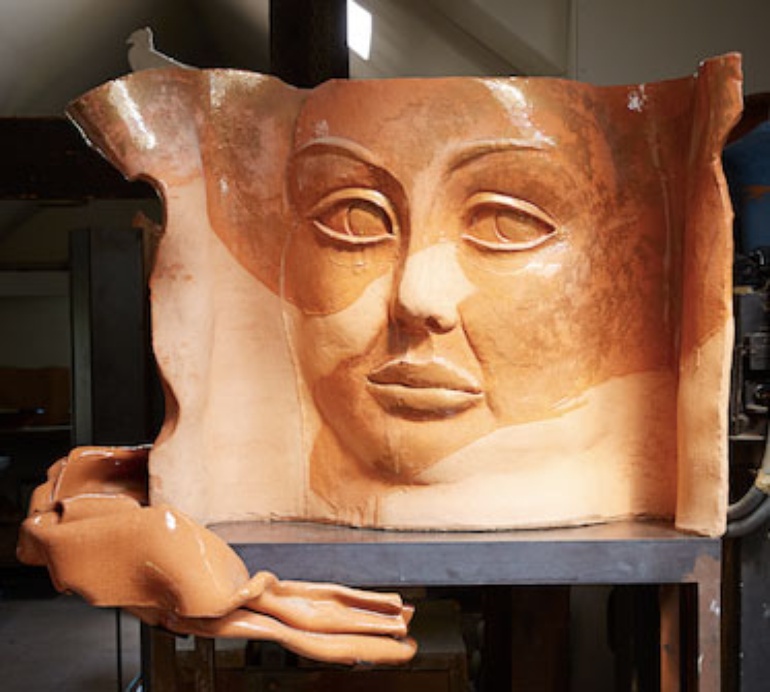
She soon received commissions to create public artworks. The Swedish Welfare State built new schools, hospitals, banks, libraries, town halls and theses environments would receive their share of beauty and cultural experiences. After her husband Gösta had designed the large studio in 1968, Hertha Hillfon was able to devote herself to monumental and grandiose works. including a tribute to the Walloon smiths on the Leufsta estate, a sculpture group with a ram and trees for the state-owned Karolinen in Karlstad, a wall on the Opera Terrace restaurant, where the mouth with the full lips appeared for the first time, portraits, often in full figure, of family and friends as well as famous people such as Astrid Lindgren, and large masks. It is no wonder that her annual consumption of Höganäs clay amounted to two tons!

“If you have seen Hertha’s ceramics but not seen her home or her studio then you haven’t yet seen or understood Hertha,” writes artist Dan Wolgers in the catalogue, emphasising how important architect Gösta Hillfon was for his wife’s creativity and identifies a number of lovingly executed architectural features that facilitated his wife’s work.

At Sexstyversgränd, a unique and coherent complex consisting of a studio, a workshop and a home was created. Hertha Hillfon’s works were everywhere, both indoors and outside in the undulating garden, maquettes, finished or damaged pieces, in boxes or storage. With the point of departure in Mattias Lindbäck’s images, we will attempt to recall – in Liljevalchs’ galleries – the atmosphere of this creative environment. The Friends of Hertha Hillfon association is now working to return artworks to Mälarhöjden and create Sweden’s first female artist’s home.

Designed by Patric Leo, the catalogue comprises, in addition to the texts mentioned above and Mattias Lindbäck’s rich visual material, five new poems by poet Eva Runefelt who has spent time in Hertha Hillfon’s studio and garden and discovered traces and memories.

Arne Leeb, a friend and neighbour of the Hillfon family, has curated the exhibition and compiled the texts in the galleries.

Address:
Djurgårdsvägen 60, Stockholm

Getting here:
Djurgården ferries from Slussen or Skeppsholmen, tram no 7, bus no 44.

RADICAL FRIENDSHIP at Gustavsbergs konsthall (Through August 30)
DNK – Den Nya Kvinnogruppen
The New Women’s Group

During the spring and summer of 2015 Gustavsbergs Konsthall will be showing a new exhibition produced by DNK – the New Women’s Group entitled Radical Friendship. DNK is a group of feminist artists and craftswomen founded in 2013 by Evelina Hedin, Hilda Hellström, Kakan Hermansson, Anna Nordström, Malena Norlin and Åsa Norman. The impulse to form the group came from the members’ reactions to what they describe as a patriarchal art and craft context. In order to promote and make room for an approach that encourages solidarity with other women, DNK initiates discussion and produces exhibitions and workshops embracing practical material-based activities. The group describes Radical Friendship, the title of the exhibition at Gustavsbergs Konsthall, in the following terms:

230715-radical-friendship
“Radical Friendship aims to encourage joint organization and solidarity in an increasingly individualistic world. We maintain that working together at the present time is radical in itself, and we hope to inspire others to reflect on subjects like sisterhood, solidarity and feminism. We see a strong need to politicize the craft context which is often experienced as introverted and unreflected.”

Odelsbergs väg, Gustavsbergs hamn

Mats Theselius – Urban Cowboy at Artipelag (Through August 23)

Urban Cowboy presents Mats Theselius’ extensive collections that function both as an inspiration and as a reference to his design process. The exhibition offers a unique insight into Theselius’ artistic practice.

230715-artipelag-stockholm
Mats Theselius (b. 1956) is one of Scandinavia’s most acclaimed but also most unique designers. He moves effortlessly between art and design, between utopia and practice, between exclusivity and popular expressions. No matter from which continent, time period, or cultural sphere that he gets his inspiration, the result is instantly identifiable.

Visiting address
Artipelagstigen 1
134 40 Gustavsberg

HOW TO GET HERE

By bus
SL 468 from Gustavsbergs Centrum to Hålludden
 (Artipelag main entrance)
From Slussen metro station, take bus number 474 to Gustavsbergs Centrum. Change to bus number 468 to Hålludden (main entrance).

SL 423 to Hålluddens Trafikplats (1,5 km from the main entrance)
On weekdays you can take bus number 423 from Slussen metro station to Hålluddens Trafikplats, which is about 1,5 km walk from the main entrance.

SL 474 to Värmdö Marknad (3,5 km from the main entrance)
From Slussen metro station, take bus number 474 to Värmdö Marknad which is about 3,5 km walk to the main entrance. When you get off the bus, take the road between COOP supermarket and INGO gas station and follow the signs towards Artipelag.

Artipelag bus
On evenings and afternoons you can travel by bus between Artipelag and Stockholm Central station (costs 50 SEK oneway) or between Artipelag and Värmdö Marknad for free.

By passenger boat
During the summer season you can travel by ferry from Stockholm City to Artipelag. The journey through Skurusundet and the very narrow strait Baggenstäket is an experience in itself!

Click here for the timetable

By private boat
We have a guest marina for private boats. Position: N 59° 18´ 04″, O 18° 20´ 07″.

By car
From Stockholm

A drive from central Stockholm takes about 20 minutes. Take route 222 towards Gustavsberg and follow the signs towards Hålludden/Artipelag. Artipelag has 350 parking spaces.

From Värmdö/Ingarö
Drive road 222, turn off towards Värmdö Marknad and keep to the right on Ingarövägen road. At the roundabout by COOP, turn left and follow the signs. Arriving from Gustavsberg turn right in the roundabout by COOP and follow the signs.

Parking
350 parking spaces. From 10-20 SEK/hour.

By taxi

Värmdö Taxi
In collaboration with our local taxi company, Värmdö Taxi, we offer fixed prices to and from Artipelag. To book a taxi, call +46 (0)8-570 357 00 and ask for the fixed price. Example: from Stockholm Central station 410 SEK, from Värmdö Marknad 110 SEK.

Feature image (on top) Ferry leaving to Artipelag

Stockholm: Flowers and cowboys, compiled by Admin

The World’s Biggest Elk Statue – In Norway

Halfway between the capital of Norway, Oslo and Trondheim, on route E3, you can now see a 10 meter tall Elk statue, 30 centimeter higher than its Canadian counterpart, Mac the Moose.

090715-big-elk-linda-bakke
The giant elk, created by Norwegian artist Linda Bakke, welcomes visitors traveling northwards from Oslo. Storelgen (The Big Elk) was created in conjunction with the Norwegian Public Roads Administration (NPRA) in an attempt to reduce traffic accidents. The beast will mark the halfway point on the road between the two cities, at Bjøråa resting stop,  and drivers are encouraged to break the monotony of their driving and get out of their cars to have a look.

Artist Linda Bakke says she also hope that motorists are reminded to be aware of the very real possibility of wildlife on the roads.

Big elk under construction. Photo Linda Bakke

The elk is a lifelike depiction and is made of shining polished steel that will reflect the natural scenery around.

Bakke adds that it was important that the elk was made higher than Mac the Moose, a fiberglass moose, built in 1984 in the Saskatchewan city of Moose Jaw, Canada, constructed by the artist Don Fould. He used a steel frame, covered with metal mesh and completed with four coats of cement.

The sculpture was erected in China, largely for cost reasons, but Bakke says that the Chinese were also the best in terms of craftsmanship, so it made perfect sense to do it there.

090715-linda-bakke
Linda Bakke
– Born 1973
– Education from Ringebu, Oslo and Bergen
– Several separate and collective exhibitions in Norway
– Contributed to public art throughout Norway

The World’s Biggest Elk Statue – In Norway, written by Tor Kjolberg

Modern Age Scandinavia

The world wars took their toll on the Scandinavian countries, but by the end of the 20th century they had emerged as sophisticated economic powers.

The 20th century dawned with not only the union of Sweden and Norway on the rocks but also the special relationship between Finland and Russia. While breakaway Norway recruited Håkon VII, né Prince Carl of Denmark, as its first independent king for 600 years, Finland was delivered into the hands of Nikolai Ivanovich Bobrikov.

Kong Håkon accepted the job only after a plebiscite indicated that three-quarters of the Norwegian population wanted him.

Scandinavia
Scandinavia

The three kings of Scandinavia met at Malmö in Sweden in December 1914 and declared their neutrality. However, putting their proclamation into practice was not so easy. After centuries of anguish over Schleswig-Holstein, Denmark was not Germany’s greatest admirer, but it was no position to defy the Kaiser’s order to mine Danish sea-lanes against the British navy.

210715-scandinavian-furniture-iner-war-years
Conversely, Norway received a warning from Britain that selling fish, iron pyrites or copper to Germany would not be tolerated, and Sweden was blockaded, eventually suffering acute food shortages, for trading too eagerly with Wilhelm.

The worst blow, though, was Germany’s declaration of unrestricted submarine warfare in 1916. Hundreds of Scandinavian ships and crews commandeered by Britain went to the bottom, with heavy losses.

On Russia’s withdrawal from the war after the Bolshevik revolution in 1917, Lenin appealed directly to sympathizers in Scandinavia, particularly Finland.

Ericsson-DBH15-telephone-1931

Sweden sailed through the post-war years on a wave of international demand from Swedish steel and ball bearings, Ericsson telephones and Electrolux vacuum cleaners.

210715-electrolux-vacuum-cleaner-1927
While also doing well, Norway and Denmark clashed over Greenland and the Arctic islands of Svalbard (Spitzbergen) and Jan Mayen, which raised issues rooted in Viking times. Asked to arbitrate, the international court at The Hague gave Greenland to Denmark, the islands to Norway.

200715-swedish-paper-scandinavian-inter-war-years
Scandinavia emerged from the second crisis of the inter-war years, the Great Depression, with improved political systems. Small parties with narrow interests – farmers’ parties being a prime example – were forced to remove their blinkers and join broader coalitions, the front runners generally calling themselves “Social Democrats”.

Modern Age Scandinavia, written by Tor Kjolberg

Largest Climbing Park in Scandinavia

0

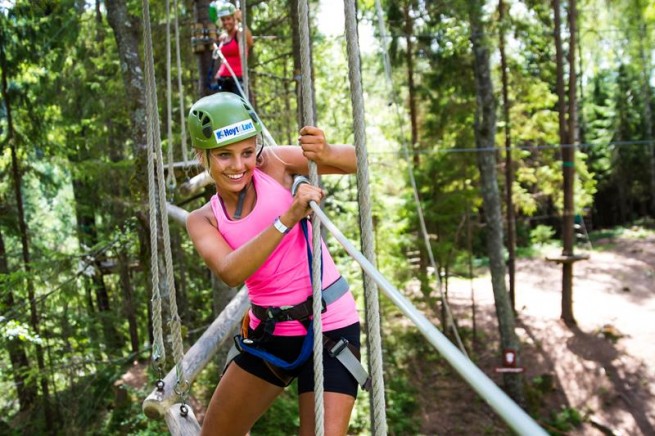
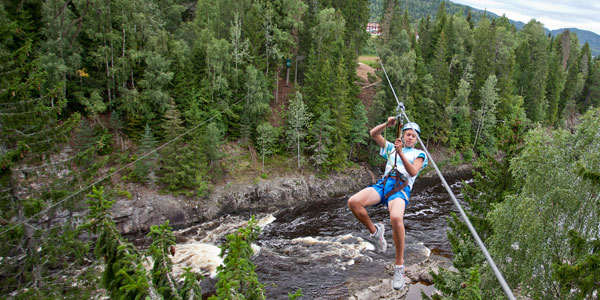
Do you fancy climbing in the trees on a 382 meters (418 yards) zip-line built into the beautiful natural terrain of Larvik, just a 90 minutes car ride from Oslo, the capital of Norway? At H&L Climbing Park (High & Low), you’re offered various types of trails with varying lengths and difficulties.

080715-H-and-L-climbing-park-vestfold-norway
“I was reading a report on the travel industry and realized that Europeans wanted more vacation experiences,” says Hans Christian Wilson, founder of Høyt & Lavt. “I have two kids and was fed up visiting amusement parks with junk food, queuing and passive activities. I wanted to give my children values connected to outdoor activities we could do together,” he adds.

His company was founded in 2009, and now he has seven H&L Parks in Norway, two in Russia and one in Finland, all with challenges of various degrees and for all ages.

The climbing park in Vestfold is situated in beautiful surroundings in Svarstad, Lardal in the river valley Lågendalen, close to the town of Larvik and other towns in the county.

The visitors are offered compulsory training before they continue to the color-coded trails, where they can experience an exciting world from high in the treetops. The courses have a start and an end, with many of them beginning in the main tower. In total there are 14 courses, 200 obstacles and 1900 meters (1.2 miles) of zip lines.

080715-high-and-low-climbing-park
The activities may be tailored to you or your friends and family members. For a real adrenaline rush, why not jump from the 30 meters Sky Fall? However, the climbing park for the youngest children is only 1 to 1.5 meters above the ground.

080715-high-and-low-climbing-park-vestfold-norway
Admission to the climbing park is free, but there’s a fee for activities.

Largest Climbing Park in Scandinavia, written by Tor Kjolberg

Swedish Daniel Ek Competing Against Apple

Last week Apple launched its streaming service in over 100 countries around the world. Daniel Ek, Swedish co-founder of Spotify, remains calm.

In 1999 Daniel Ek wanted to create a universal jukebox, which would revolutionize the music industry. At that time he was a 16 years old boy working from a cabin in the Swedish woods.  Today Spotify is the world’s dominant streaming service for music with more than 75 million listeners. In an interview with Financial Times Ek admits it has been a demanding process.

070715-daniel_ek_spotify
In 2014 Apple called his company a “grand experiment that doesn’t fairly compensate creators of music”.

However, to build his company, the Swede negotiated with reluctant record companies and skeptical investors. Today the users love Spotify even if some attack the company’s influence on the music industry.

How to use Spotify

Spotify functions like a jukebox in the cloud that provides legal, on-demand access to millions of songs, supported by paying subscribers and radio-style ads played only to nonsubscribers. The service debuted in the United States last year after three years of operation in Europe. In USA there are 15 million users, of which four million are paying subscribers. An estimated value of $4 billion, makes Spotify one of the hottest Internet companies in the world.

070715-Daniel_Ek-wiredEk admits he was disappointed when Thom Yorke from Radioheads in 2013 described Spotify as the “last, desperate fart from a dying body.”

According to Billboard, former U2 manager Paul McGuinnes claims that the record companies are moving against ‘free’ streaming in general, and Spotify in particular. “Artists worldwinde are aware that Apple’s iTunes store is honest and pays them real money, unlike Spotify, where the sums are trivial.”

Spotify continues, however, to extend its offers, and launched last month both videos and podcasts.

“We try to grow as fast as we can,” says Daniel Ek. The faster we grow, the faster the music industry grows, and more money comes Spotify’s way. We take losses today, since growth is expected to happen.”

Spotify lets users seamlessly share playlists and swap music on social networks like Facebook and Twitter. And Spotify makes it easy for others to build apps that work with its platform in order to give users yet more ways to discover and share music. “The trick was to think through the social aspect of the service from the very beginning,” says Ek. “We didn’t want it to be an afterthought.”
070715-Ek_Forbes-CoverEk claims that complaints are due to a system where it takes too long before the artists receive their royalties. Sometimes it takes several years before money is transferred.

Spotify’s users can access some 16 million songs. The service offers all those terabytes of music without revealing any of the licensing complexities involved in the process. Ironing out the needed deals with record companies while refining the service ate up two years of Ek’s time before he launched in Europe in 2008.

It took a team of software engineers—the company now has 250 of them—to make the service easy to use in spite of all the programming code that works in the background to prevent music from being illegally copied and distributed.

“The best thing about Spotify is that it works at all,” says Ek. “If you’re in Spain and you want to share your music with someone in the U.K., you don’t want to see how we take care of paying licensing fees in both places.”

Now Ek is trying to find ways to make it as easy to find and play music as it is to find and play videos on YouTube. This year the company introduced a radio service for computers and mobile devices, launched its first iPad app, and made it possible to embed a Spotify play button into any website. The Huffington Post, the blogging site Tumblr, and Rolling Stone’s website are among the many that now offer music that way.

Apple’s target is 100 million subscribers, and the giant has tried to squeeze both prices and royalty to artists and songwriters, without success. When the world’s independent record companies, and not least Taylor Swift, refused Apple’s offer, the company had to throw in the towel and pay like its main competitor Spotify.

Spotify
– Streaming service for music
– Launched 7 October, 2008
– Launched on mobile 2009
– Reached one million users in 2011
– Launched in USA 2011
– Today 75 million users, 20 million paying subscribers

Swedish Daniel Ek Competing against Apple, written by Tor Kjolberg