

How to Use Long Layovers as a Tool

So many travelers have condemned themselves to rotting in airports for five or ten hours, while waiting for their international connections, or they waste time in an airport hotel, thinking that a bed or TV will help the time pass more quickly. This article emphazises on how to use long layovers as a tool.

I choose to use my layovers as a bonus stop – a free pass to see an additional city or country on my way to a planned destination.

A layover is when you have to change planes part-way through your journey. For example, if you bought a flight from New York City to Los Angeles and it had a layover in Houston, you will have to get off the plane in Houston and transfer to a new plane at the airport there. You then board the next plane and fly to Los Angeles. Layovers, therefore, add time to your journey, but if your layovers are long enough, you can use that time to leave the airport and explore a brand-new city.

How to Use Long Layovers as a Tool
If you have a full day or overnight layover, try experiencing the city. Photo: Choice Hotels

If you have a really long layover, you could for instance investigate the possibility of exploring the city you’re in. Give this new locale a chance even if the location is far from the top of your bucket list of destinations. You may be surprised to discover a city you’d love to return to for longer.

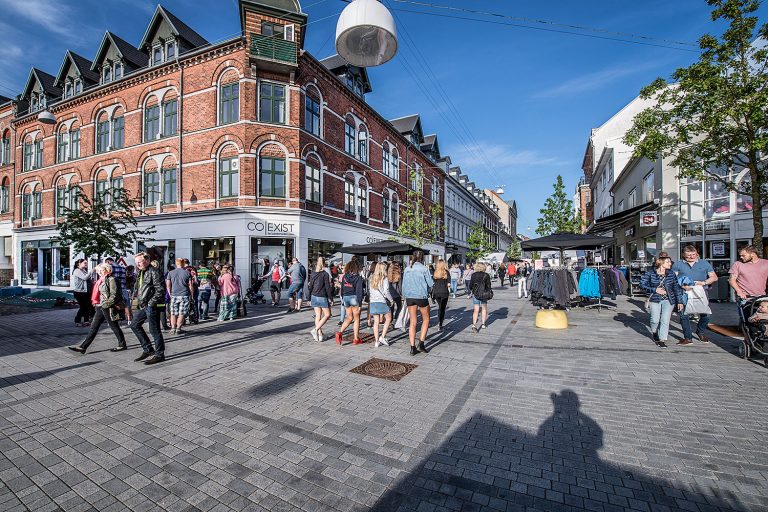
If you have a full day or overnight layover, try experiencing the city. You have many options to explore. I have done everything from simply enjoying a Calvados on Champs Elyssée in Paris to taking a tour on the canals in Amsterdam before heading back to the airport.

On an overnight layover in Rome, I had delicious food and wine at a restaurant before having a late-night visit at Trevi Fountain and the Pantheon. In the morning, I took a brief tour of the Vatican, which included the Sistine Chapel before heading back to the airport.

How to Use Long Layovers as a Tool
I had a layover in Athens. Photo: Visit Greece

I had a layover in Athens and had some amazing Greek food while watching patrons participate in Greek Dance. I marveled at some brightly lit ruins on my way to have a late-night ouzo in a local bar. I took some pictures at the Acropolis before catching a cab to the airport.

Some larger airports might even offer an organized tour of the city that departs directly from the airport itself. Research options and book the tour before you land if possible. You will still have to go through security and customs as usual, but the organized tour might save you time spent figuring out public transportation systems and directions to major sites.

For most people, layovers are unpleasant, but direct flights are often more expensive. For travelers who are budget-minded, layovers are a great way to save money. Airlines will usually lower the prices of flights with long layovers, making it easy to pick up a bargain. If you don’t need to get somewhere quickly, it’s worth picking up a flight with several stops to save money.

How to Use Long Layovers as a Tool
Try local food. Photo: EcoWatch

Your exploration can be simple; try local food, check out a few historical sites or just hang out at a café to take the city in as brief as it may be. If you would like a more organized experience, try taking a tour if you have enough time. It can be as long or short as you want. Sometimes you will have enough time for a group tour, and in other situations, you may want to pay for a tailored private tour that includes transportation to and from the airport.

Even if your layover isn’t quite long enough to get out and explore the city, you can still find plenty of opportunities to immerse yourself in local culture. Cuisine is often the most direct, and cheapest, way to experience a taste of a culture different than your own.

Seek out the local cuisine located inside the airport. You might be surprised by the immersive experience you can have without even leaving the terminal.

Layovers are something you should look for when booking a long flight, especially when traveling internationally. For example, both WOW air and Icelandair offer stopover programs, which allow Americans traveling to Europe a free layover in Iceland (for an unlimited amount of days).

Usually, you have to pass through immigration and check-in again if you want to leave an airport. Every country and airline have different rules on this, so it’s best to do some research beforehand if you’re unsure of how your layover will work. For the most part, though, following everyone else who gets off your plane is a safe way to know you’re doing the right thing.

How to Use Long Layovers as a Tool
Most major cities in the world offer a hop-on, hop-off bus tour

Most major cities in the world offer a hop-on, hop-off bus tour that stops by most of the major sights and landmarks in a particular location. Headphones are offered for pre-recorded information about each stop in eight different languages. These tours are a great way to see a city in a short amount of time on a layover. You can choose to stay at each attraction for a quick photo before you hop back on the bus or spend some time exploring and take the next bus once you are satisfied. If you have a shorter layover and do not have time to ride the bus for the entire loop, you can take a taxi to the airport from any point during the hop-on, hop-off bus loop according to your flight schedule demands.

Alternatively, use your long layover to treat yourself to a fast food meal or comfort from home that you’ve tried to avoid during your trip. Get the French fries. Find the Tex-Mex. Indulge in a treat that makes your long layover more comfortable.

We often think of airport lounges for first class passengers only, but those days are long gone. Now, you can purchase an airport lounge pass and enjoy free drinks, snacks, WiFi and sometimes even sleeping or showering facilities.

Besides experiencing a new culture for a few hours, taking advantage of your layover also allows you to decide if the city is worth coming back or not. It’s a lot like wine-tasting – if you like what you see, you buy the bottle. If not, you pour out your glass and move on to the next stop.

How to Use Long Layovers as a Tool
If you’re on the tail end of your travel journey, a great way to spend time during a long layover is to journal.

If you’re on the tail end of your travel journey, a great way to spend time during a long layover is to journal. Your travel stories are fresh in your mind, so make sure to document them while you can. In general, if you’re on a domestic flight, once you land for your layover, you’ll pass through a transfer area that will take you to the gate for your next flight without having to check in again. Your bags will automatically pass through to the next flight without you having to collect them.

This also often happens on international flights if you’re flying with the same airline. When you check in for your first flight, ask the person who is checking you in if your bags will be checked the entire way. If they are, you don’t need to worry about going to the baggage reclaim and can pass directly to your next gate, safe in the knowledge that your luggage will be making the journey with you.

How to Use Long Layovers as a Tool
Remember to keep careful track of time if you choose to leave the airport on a layover.

Remember to keep careful track of time if you choose to leave the airport on a layover. You must budget time to go through customs and verify in advance whether or not you need a visa to enter the country in which you have just landed. Nothing is more frustrating than the added time and expense of missing a flight, whether it be on a layover, at a planned destination, or on your way home. So be sure to research how much time it takes to get to the city center and back by taxi, bus, train or whatever form of transportation you choose. When time is tight, I prefer to use the more direct, yet more expensive choice of a taxi or Uber. There is no hassle with overshooting your train stop and the drivers usually know the best routes to the airport. If you do your research and manage your time properly, you have just added another stop to your itinerary – for free!

How to Use Long Layovers as a Tool, written by Tor Kjolberg

Feature image (on top): © JESHOOTS.COM / Unsplash

Achieving Cyber Resilience in Nordic Markets

As cybercrime has become more common, cyber risk education in the Nordics has lagged behind. The number of attacks is up, and their material impact on commerce is grave. It is no longer reasonable to expect to fend off all attacks in your environment. Learn more about achieving cyber resilience in Nordic markets.

It is important to adopt a more proactive approach to understanding cyber risks in financial terms that the executives and directors can understand. So, moving forward, it’s important that firms in the Nordics embrace a new way of thinking to build cyber resilience in a rapidly changing global landscape so they can develop their market and maintain value.

***************************************
You might also like to read: Scandinavia Among the Most Cyber-Secure Countries in the World
***************************************

Achieving Cyber Resilience in Nordic Markets
Global cyber-attacks reached a record high in 2023, and 2024 is set to see this trend continue, particularly in the Nordics.

Managing cyber risk requires a new approach

As bad actors continue to evolve, and increased internet connectivity exposes Nordic businesses to greater vulnerabilities from third-party bodies and partners, it is crucial to accept that there is no silver bullet for cyber risk.

Global cyber-attacks reached a record high in 2023, and 2024 is set to see this trend continue, particularly in the Nordics. Following the Covid-19 pandemic, 97% of Nordic organizations saw cyber-attacks increase, with incidences of cybercrime doubling between 2020 and 2023 in Sweden and quadrupling in Finland since joining NATO in 2022. With tools of cybercrime such as AI, deepfakes and methods such as scam emails and identity theft progressing at an alarming rate, it is increasingly clear that perfect loss elimination is unachievable.

Indeed, cyber investment and education in these regions are very low, with recent research by the European Union Agency for Cybersecurity (ENISA) suggesting that as much as 80% of data breaches are the result of human error and lack of education.

A new way of thinking is therefore necessary. Businesses need to focus less on trying to thwart every single cyber threat and more on limiting losses from cyber-attacks to ensure they lose as little capability as possible and can continue to operate. This may seem somewhat counterintuitive, but such a more realistic approach is the best way to deal with the fast-changing cyber-threat landscape.

At Resilience, this is the approach we advise clients to adopt, first conducting risk assessments to determine the degree which they can suffer a setback from a cyber-attack but still be able to trade, which then helps them understand their level of cyber risk.

Cybercrime is expected to cost businesses more than $10 trillion by 2025, yet cyber spending between 2022 and 2025 is predicted to be just over $1.5 trillion and capacity coverage from cyber insurance will only reach $900 billion by the same year. This indicates a significant gap between losses from cybercrime and investment in cybersecurity and cyber insurance coverage, highlighting the need for quantifying cyber risk through thorough risk modelling and prioritising a cyber resilience strategy that best suits one’s needs.

Achieving Cyber Resilience in Nordic Markets, article continues below the image.

Achieving Cyber Resilience in Nordic Markets
Cybercrime is expected to cost businesses more than $10 trillion by 2025.

*************************************
You may also like to read: Your Beginner Guide to Data Protection as an Expat in Scandinavia
*************************************

At Resilience, AI insights are used to inform our cyber-risk models, creating a financial and measurable picture of a client’s cyber risk. These models can then be utilized, with the help of expert risk managers, and dedicated third-party teams to help businesses, wider organizations and security leaders identify the most pressing threats and the most effective cyber risk management tools to protect them. This will help businesses and organizations maximize their return on investment and integrate cyber risk into their long-term strategies.

C-suite needs to be better informed

In order to execute an effective cyber resilience strategy, cyber security officers need to feel empowered to communicate risk transfer, mitigation objectives, and cyber control capabilities to the C-suite and work collaboratively to achieve cyber resilience. Parallel to this, C-suite leaders need to move on from today’s typically more siloed stance and be receptive to this fresh approach.

Achieving this requires much greater buy-in and awareness across senior leadership teams, from CROs and CISOs to CFOs. According to recent research, nearly 42% of Swedish CEOs do not believe cybersecurity belongs at the board level, despite the enormous operational damage that can be caused by a successful attack.

When C-suite leaders buy into cyber risk as a business challenge, organizations can ensure that it is managed as part of a wider business strategy, ensuring appropriate investment, and promoting education of employees on common cyber risks.

To do this, we need to ensure that cyber risk officers and CISOs are speaking the language of the board and discussing cyber risk in terms of real financial terms and potential losses. Dedicated risk officers who can translate cyber risks in terms of potential losses, mitigations and real financial risks are crucial to help translate the impacts of security decisions in financial terms for CFOs, CEOs, and boards of directors to evaluate and make informed decisions.

Achieving Cyber Resilience in Nordic Markets
C-suite leaders need to move on from today’s typically more siloed stance and be receptive to a fresher approach.

Cyber resilience is the way forward

In January, leading Finnish IT provider Tietovery was subject to an attack by ransomware group Akira, accessing the data of thousands of public sector institutions and citizens. This attack is only one of many to strike the Nordics this year and is symptomatic of a much wider, more dangerous trend.

With 131 publicly disclosed cyber-attacks against EU countries in December 2023 alone, cybercrime in the EU is on the rise: it is no longer a question of if you will be the target of cybercrime, but when. The Nordics’ lack of cyber education and investment, coupled with the region’s high interconnectivity and geopolitical pressures underscore the need for a new way of thinking on cyber risk. What businesses need now is to adopt a more proactive stance that emphazises education, a non-siloed, collaborative approach to risk management, and adequate investment to enhance cyber resilience.

Integrating cyber risk management into a broader business strategy and utilizing robust risk transfer mechanisms such as cyber insurance will help organizations in the Nordics prepare for, and anticipate, cybercrime in advance, and successfully navigate the evolving cyber threat landscape.

Achieving Cyber Resilience in Nordic Markets
Rehan Hussain

Achieving Cyber Resilience in Nordic Markets, written for Daily Scandinavian by Rehan Hussain. As the Head of Underwriting at Resilience, Rehan leads the underwriting strategy and operations for the international and UK & Europe regions, covering cyber insurance and risk management solutions for corporate clients. Rehan has over 15 years of experience in the insurance industry, with advanced qualifications in insurance and information security, and a track record of delivering profitable growth and client satisfaction.

Most Sold Electric Vehicle in Norway

Of 11,241 new electric cars sold in April, Volvo EX30 was the most sold electric vehicle in Norway.

Sales of Plugin EVs took 91% share in Norway in April. There are several types of electric vehicles out on the market, and understanding their differences is important, especially if you are considering purchasing one. There are three main types, and they are:

  • EV – Electric Vehicle, also known as a Battery Electric Vehicle (BEV)
  • HEV – Hybrid Electric Vehicle
  • PHEV – Plug-in Hybrid Electric Vehicle

BEVs alone took 89.4% market share in April, with Volvo EX30 ranking on top with 1,095 units sold. The Volkswagen ID.4 took the second place with 963 units sold and ID.3 came in third with 733 units sold. For the first time, Tesla Model Y was no longer the best-selling car.

Tax changes from January 1st have made PHEVs less appealing. But the market share of purely electric cars has increased significantly over the year; in April 2023, it was ‘only’ 83.2 per cent. It becomes even more apparent if you look back another twelve months: in April 2022, the figure was 74.1 per cent.

Most Sold Electric Vehicle in Norway
Volvo EX30 was ranking on top with 1,095 units in April 2024.

9,560 new electric cars were registered in the little kingdom of Norway in September 2020, and thereby accounting for 61.5 per cent of all new passenger car registrations.

10,620 new passenger cars were registered in Norway in September 2018. About 45% of them were all-electric vehicles and the number went up to 60% when including plug-in hybrids, according to official registration data.

Most Sold Electric Vehicle in Norway
Overall, the Volvo EX30 has already taken second place behind the Tesla.

However, the lack of affordable EVs is an issue everywhere in Europe, and in the US. Auto buyers in China and India are launching more cheap entry-level models to choose from. Western automakers, following Tesla’s lead, have chosen to electrify their high-end models first. Chinese companies are therefore eagerly filling the vacuum, ramping up exports of low-priced EVs.

Despite its relatively low volume in April, the Tesla Model Y is still hugely dominant in Norway over the longer term, and this is unlikely to change much this year. It almost matches the sales of the next three most popular models combined.

The Volvo EX30 has already taken second place behind the Tesla, and soon these two will be a good gap away from the followers.

Other popular EVs are the Toyota bZ4X, the Audi Q4 e-tron, MG4 and then a fairly narrow midfield consisting of the Hyundai Kona, Nissan Ariya, Ford Mustang Mach-E and Honda e:Ny1.

Most Sold Electric Vehicle in Norway
The cheaper EX30 have persuaded some customers to switch.

By contrast, models still well-placed in 2023, such as the Skoda Enyaq, Volvo XC40, or now EX40, are noticeably behind. In the case of the EX40, the market launch of the more compact and cheaper EX30 have persuaded some customers to switch.

Most Sold Electric Vehicle in Norway, written by Tor Kjolberg

A Norwegian Photographer and His Dog

The acclaimed Norwegian photographer Per Maning (b. 1943) captured images of his faithful friend Leo every day for three years. Read more about the Norwegian photographer and his dog.

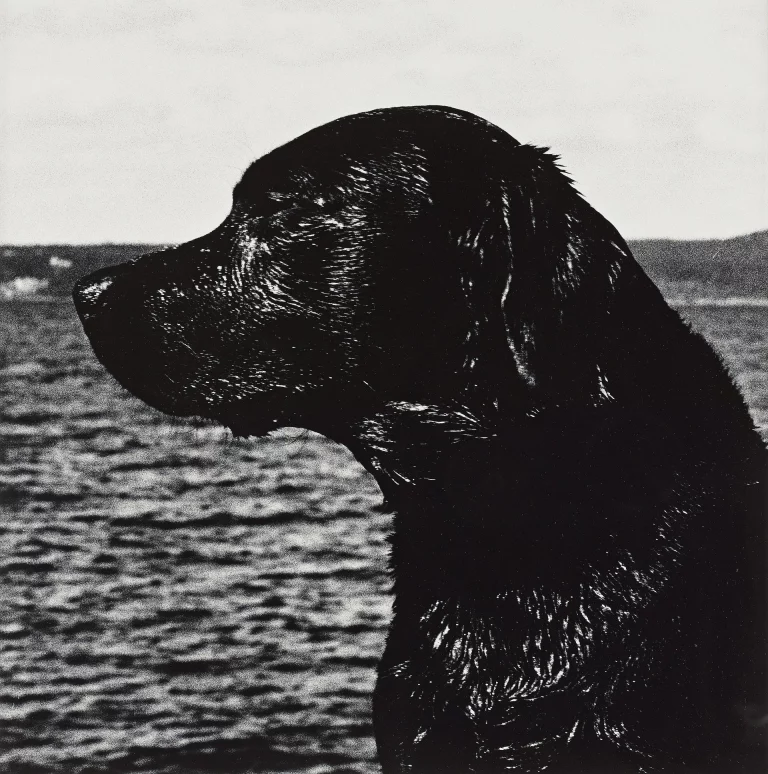
Per Maning‘s career as a photographer began with his labrador retriever Leo, which he photographed every day for three years and led him to leave the advertising industry in the 1980s to be a full-time photographer.

With the knowledge that Leo was unwell within his senior years and who was in declining health, Manning decided to take a photograph of Leo every day over a three year period, capturing his wonderful spirit and loyal character. The images of the last years of Leo’s life were never sentimental and often startling. The images did not document the dog’s physical decline, but revealed the dog’s identity, energy, and spirit. At the same time, it reflected the growth of Maning’s own self-awareness as a photographer.

A Norwegian Photographer and His Dog
Per Maning, self portrait. (National Museum, Oslo)

*******************************
You may also like to read The World of Ski Photography
*******************************

Maning is best known for his animal photographs and films. In an interview several years ago, he said that he has always been very interested in animals, but that it is easy to dwell on the subject artistically. He was looking for transitions to humans. “Through studying the animals, I feel that I have gained greater insight into our lives,” he said.

A Norwegian Photographer and His Dog
Maning photographed his labrador retriever Leo every day for three years .

In 1988, Per Maning began making regular trips to an aquarium on the west coast of Denmark to photograph a group of seals as a part of a larger project.

The images of Leo, however, reminds us all of our lives living with our own dogs, how they are so much part of our world and a big part of our family life. Maning has a knack for depicting the ‘human’ qualities the we recognize in animals, steering us to the realization that we only label these qualities as ‘human’ because of their familiarity.

A Norwegian Photographer and His Dog
The images of the last years of Leo’s life were never sentimental and often startling.

*******************************
You may also like to read Norwegian Photographer Loves Silence, Mystique and Unease
*******************************

A Norwegian Photographer and His Dog
The images of Leo reminds us all of our lives living with our own dogs.

In recent years, Maning switched from analogue to digital photography. The digital technology allows him to move in a completely different way, he claims. “I’ve always been concerned with black, make it really black. With the first analogue images of Leo, it couldn’t be black enough,” he adds.

A Norwegian Photographer and His Dog, written by Tor Kjolberg
All images © Per Maning

Best Open Sandwiches in Copenhagen

At Schønnemann in Copenhagen there’s an authentic atmosphere with memories of a better, bygone world – where you can enjoy the best open sandwiches in Copenhagen.

Before the arrival of New Nordic, Danish cuisine is pretty much defined by the humble open sandwich, and Schønnemann, near the central shopping district, is in my opinion the best place in Copenhagen for open sandwiches.

Before the 1970s and the early 2000s, the cellar restaurant was often at the point of closing down, even if it was temporarily managed by celebrated chefs like Søren and John Puggard.

Best Open Sandwiches in Copenhagen
Restaurant Schønnemann was founded in 1877. Photo from 1901.

Experienced restaurant couple Juliette and Thomas Gaarn Rasmussen bought the classic lunch restaurant, founded in 1877, in 2015. The couple went back to their roots, and smørrebrød became trendy again.

In the old days, the farmers from the surrounding suburbs came to town to sell their goods. When finished, they left their horses on the square in front of the restaurant and visited Schønnemann to get some freshly brewed beer, some schnapps and a little something to eat. Today, the clientele is different, but everything else is as it has always been. A mixed crowd of young and old, ladies and gentlemen, businesspeople and hedonists are meeting expectantly for a lovely lunch. The atmosphere is informal, and people raise their glasses frequently around the tables, where the specialties of Schønnemann are served in high pace.

Best Open Sandwiches in Copenhagen
Experienced restaurant couple Juliette and Thomas Gaarn Rasmussen bought the classic lunch restaurant in 2015.

I visited Schønnemann earlier this year. Apart from the food, what I loved the most was the unabashedly old-school décor with white tablecloths, the dark wooden furniture and the flickering table candles. Most of the diners there were locals, most of which were blue-collar workers in suits from the nearby business district.

******************** **************
Related: Tradishional Danish Smørrebrød Reinvented in Copenhagen
***********************************

Best Open Sandwiches in Copenhagen
What I loved the most was the unabashedly old-school décor.

The menu was brimming with classic Danish smørrebrød, warm dishes and exciting specialties – all made with the best ingredients and of course always freshly-made. According to its website, the food and the wonderful atmosphere have placed Schønnemann among the best lunch restaurants in the country, and they are constantly developing new dishes so that the seeds of tomorrow’s classics are laid.

Best Open Sandwiches in Copenhagen
The menu is brimming with classic Danish smørrebrød

I remember I was over-whelmed by the 110 choices of smørrebrød, including a staggering 21 types of herring. However, I had the feeling of being treated by ‘real waiters’ with time for their guests and went with the seemingly safe choice and ordered the Small Lunchset and a beer.

Best Open Sandwiches in Copenhagen
Restaurant Schønnemann today.

In my note-book, I wrote that its signature dish was ‘Madame Schønnemann’ consisting of calf tongue, chicken salad and mustard.

Best Open Sandwiches in Copenhagen
I was overwhelmed by the 110 choices of smørrebrød, including a staggering 21 types of herring.

The eternal question is how many smørrebrød to order for a lunch. The answer on the Schønnemann website is, “Two is a good base and three should be enough – but with four you leave with a smile.”

Best Open Sandwiches in Copenhagen, written by Tor Kjolberg

Modular Construction: Scandinavia’s Answer to Urban Housing Challenges

Modular construction offers an efficient, low-cost, low-waste alternative to traditional building methods. Companies that use modular designs, which are prefabricated before arriving at their intended location, can create more homes at a faster rate, too. Learn more about Modular construction: Scandinavia’s answer to urban housing challenges.

It should come as little surprise, then, that the region that gave the world IKEA is leading the charge on prefabricated homes. Today, plenty of Swedes, Danes, Fins, and Norwegians have already bought modular houses and lead happy lives in their small, well-designed homes.

Modular construction can be particularly powerful in urban areas, where limited space and high demand put real pressure on local government. These prefabricated homes provide affordable housing for many and can help city planners fill demand quickly.

Modular Construction: Scandinavia's Answer to Urban Housing Challenges
Photo: katus-eu

Modular Construction

Modular construction has been on the rise in recent years. This is largely thanks to technological breakthroughs, which now allow modular construction companies to design, assemble, and ship high-quality homes at a low cost. It’s not just homeowners that have jumped on the modular design bandwagon, either. Today, businesses are ordering pre-fabricated offices for their sites, and are embracing the benefits of modular design, which include:

  • Reduced Waste: Unlike production on building sites, most materials stay within the factory and any excess can be reused. It’s also in the best interests of the fabricator to produce minimal waste, as this will reduce costs associated with over-purchasing and storage.
  • Shorter Timelines: Scandinavian demand for housing is booming. Pre-fabricators can fill this need quickly as modular buildings can be assembled on a fast-moving production line. On-site constructors can work quickly at the same time by laying foundations and completing additional work like connecting plumbing.
  • Fewer Delays: Inclement weather can postpone timelines and cause costs to spiral. Modular design, however, occurs indoors and can be complete come wind, rain, or snow.

While modular design does face some challenges, the benefits are clear for folks who live in urban Scandinavian areas and want a home that will be delivered on budget and without delay. As modular construction grows, expect to see greater variety in designs, too. This is crucial, as some folks may be hesitant to order cookie-cutter-esque housing. Many cutting-edge modular designers already offer customization to overcome this issue and may be willing to work with prospective homeowners to make changes that better suit their needs.

Modular Construction: Scandinavia’s Answer to Urban Housing Challenges, article continues below image.

Modular Construction: Scandinavia's Answer to Urban Housing Challenges
Grey prefab Stockholm house features colorful walls and yellow wooden windows. Photo: Helgesson Gonzaga arkitekter.

Swedish Uptake

The potential of modular construction is huge. If leveraged correctly, prefabricated homes can help close the global housing shortage and may bring house prices back down to sensible levels. This is why Sweden is pioneering the pre-fab process and benefiting from off-site construction on multiple fronts.

Today, companies like Lindbäcks Bygg are capable of producing homes with a floor plan of up to 25,000 square feet with a quick turnaround. These homes aren’t pre-fab cookie-cutter buildings, either. Lindbäcks Bygg utilizes loose timber laws to produce semi-bespoke homes for private and public clients. This construction process is primarily driven by a blend of robotics and human builders, meaning each building is produced with a high degree of accuracy and is quality-assured.

Scandinavians who have embraced modular construction find that the designs align with their sense of taste and style, too. In 2011, “Lokki” — a 1,206-square-meter modular cabin — won the Log House of the Year Award thanks to its seagull-inspired design and hygge vibe. Similar pre-fabricated designs, like “Gapahuk” and “The Plus House”, are strategically designed to help folks lead full lives in small spaces.

Modular Construction: Scandinavia's Answer to Urban Housing Challenges
Shaped home officewith attached bookshelf. Photo: Design Cafe.

Home Offices

The rise of remote working has been a boon for folks who enjoy working from home. However, many urban dwellers may find that their living situation suddenly becomes cramped when they are forced to work from their kitchen table or bedroom.

Rather than squeezing themselves into nooks and crannies around the house, Scandinavians who WFH while living in the city can consider ordering budget-friendly prefabricated home office spaces. Pre-fab units are designed to fit in even the tightest of urban gardens and add a lot of value to the home. They have plenty of windows to let light in and give folks a chance to escape the chaos of their home during the workday.

Opting for a pre-fab home office may be the perfect solution for Scandivans who have recently accepted a remote working position, too. When choosing a place to work remotely, employees must consider factors like core work hours and proximity to family and friends, as well as the quality of life they’ll have in their new location. This may convince many remote workers to stay in the city, even though they could move to the countryside. If this is the case, a pre-fab modular home office will give folks the dedicated workspace they need to be successful in their new remote role.

Modular Construction: Scandinavia’s Answer to Urban Housing Challenges – Conclusion

Modular construction is on the rise in countries like Sweden — and for good reason. They offer low-cost, high-quality designs that can be completed with a quick turnaround and minimal waste. This makes prefabricated homes the perfect option for folks who live in urban areas and are looking for affordable, new housing. Pre-fabs are great for people who work from home while living in the city, too, as a small prefabricated home office provides the perfect sanctuary to work in peace without having to move to the countryside.

Modular Construction: Scandinavia's Answer to Urban Housing Challenges
Ainsley Lawrence

Modular Construction: Scandinavia’s Answer to Urban Housing Challenges, written dedicatedly for Daily Scandinavian by Ainsley Lawrence. Ainsley is a regular contributor to Daily Scandinavian. She is a freelance writer from the Pacific Northwest. Ainsley is interested in better living. through technology and education. She is frequently lost in a good book.

Feature image (on top): © Valentina Giarre / Unsplash

“Blue Food” in the West Swedish Archipelago

The sea on the Bohuslän coast is a goody bag of delicious ingredients such as mussels, seaweed, oysters, sea lettuce and monkfish! Read on and be tempted byBlue food” in the West Swedish archipelago

Restaurants in the region have really opened their eyes to the sustainable blue food, and knowledgeable entrepreneurs and chefs are actively working to entice more guests to try new species by creating innovative and exciting dishes. Here are our tips for blue and sustainable food experiences in Western Sweden.

‘Blue food’ refers to the raw materials that come from the sea, better known as seafood. Some of the more well-known examples of blue food are mussels, oysters, seaweed and algae. But there are also species that are not as widely known, such as sea cucumber, swimming crab and glass prawn.

********************************************
Related: Hunting the Black Gold in Sweden
********************************************

"Blue Food" in the West Swedish Archipelago
The blue raw materials found in the sea off the Bohuslän coast have great potential both when it comes to environmental considerations and taste experiences. Arial view from Evert’s Shöbod. Photo: Robert

Sustainable and tasty seafood

The blue raw materials found in the sea off the Bohuslän coast have great potential both when it comes to environmental considerations and taste experiences. Western Sweden has become a gastronomic center where local food traditions have a long history, and where raw materials from the sea are developed and used in new ways. Much food from the sea is significantly more sustainable and environmentally friendly than red meat. A mussel, for example, can filter up to five liters of water per hour. Seafood, which is not farmed, does not need feed production either, but it does require fishing in a gentle way – and several of the Swedish companies are at the forefront of this. Seafood also has a positive health effect, as it is low in fat, but at the same time rich in protein, vitamins and minerals.


"Blue Food" in the West Swedish Archipelago
Seaweed is a raw material with a lot of nutrients as it contains a lot of protein, fatty acids, fibers, antioxidants, vitamins and minerals. Photo: Wikimedia Commons.

Seaweed

In the Far East, seaweed has long been an important component of food, but in Nordic countries, the use of seaweed and kelp has been somewhat limited and a forgotten resource in cooking. In recent years, however, things have picked up somewhat, and this nutrient-rich plant species has had a renaissance. In West Swedish restaurants, such as VRÅ and the Michelin restaurant Signum, they use seaweed in various ways in their dishes, in addition to growing their own seaweed.

Seaweed is a raw material with a lot of nutrients as it contains a lot of protein, fatty acids, fibers, antioxidants, vitamins and minerals. Most of the species in the West Swedish waters are perennial (some can live up to 30 years), harvesting them carefully is therefore important, without pulling up attachments to the substrate. Seaweed is an incredibly sustainable raw material that benefits from the sea’s nutrients and at the same time counteracts the acidification of the water.

"Blue Food" in the West Swedish Archipelago
Seafood safari in Bohuslän. Photo: Jonas Ingman.

There are no poisonous seaweed species in Swedish waters, but some of them are better suited to cooking than others. They can be used as flavoring or boiled, fried, dried or pickled. Seaweed species that are suitable for food include sugar seaweed, finger seaweed, sea lettuce and bladder seaweed. When picking seaweed, you must be careful to choose exposed places facing the open sea, where the water is fresh and has movement in it. Always choose places far from harbors, bathing areas and industry. The seaweed tastes best when the water is cold.

Catxalot is a small company in Grebbestad that has put Swedish seaweed on the world map, and they are an important source of information about seaweed as food. Interest in cooking with seaweed has waned, and these green algae plants are a tasty, healthy and not least very environmentally friendly resource. Catxalot makes their own seaweed products, such as spices, salt and dried varieties. They also organize courses and events, hold lectures and train new seaweed entrepreneurs, and now they are also opening a branch in Grundsund.

Algblomman is another company that offers seaweed walking. They are based on Styrsö and they take you on a seaweed walk along the coast. Here you will get a demonstration of how to pick seaweed in a sustainable way and get tips on how to prepare it.

***********************************************
Related: Shellfish Safaris in West Sweden
***********************************************

“Blue Food” in the West Swedish Archipelago, article continues below the image.

"Blue Food" in the West Swedish Archipelago
In the beer brewed at Smögenbryggar, they use products from the sea such as seaweed, shells and sea salt.

Beer with a hint of the sea at Smögenbryggar’n

The Smögenbryggar’n brewery works for a vibrant coastal community and a sustainable marine environment. In the beer brewed at Smögenbryggar’n, they use products from the sea such as seaweed, shells and sea salt. They use algae (carrageenan) to clarify the beer naturally and the seaweed used, supplied by Nordic Seafarm, gives character to the beer when it comes to both color and taste.

"Blue Food" in the West Swedish Archipelago
The Bohuslän mussels are known to be some of the world’s best and have been given a protected designation of origin by the EU. Photo: Wikipedia

Mussels

Moules frites and steaming mussels are a classic for many, and in recent years the demand for the mussels has increased considerably in the restaurants along the Swedish west coast. The Bohuslän mussels are known to be some of the world’s best and have been given a protected designation of origin by the EU. The nutrient content, the salt content and the temperature of the water are some of the factors that make the mussels maintain a high quality. Mussels are also very lean food containing protein, vitamin B12, iodine and selenium.

The mussels feed themselves by filtering particles, and a single mussel can filter up to five liters of water per hour. The more nutrients there are in the water, the more plankton there is, which is the most important food for the mussels. The Skagerrak water is rich in nutrients and the mussels filter the water by absorbing growth plankton that contains nitrogen and phosphorus, which are found in large quantities in many coastal waters due to human emissions. The shells thus clean the water, which makes it clearer and creates a cleaner environment in the sea.

“Blue Food” in the West Swedish Archipelago, based on a press release from West Sweden Tourist Board

Turistrådet Västsverige is the official destination company for Western Sweden. They work with the sustainable development and marketing of tourism in Western Sweden. The region consists of the areas of Bohuslän, Dalsland, Västergötland and Gothenburg.

Feature image (on top): Seafood at Tanum strand.

Denmark’s Unique Meeting Destination

Danish West-Jutland has a sense of space and time different from the rest of the region. Esbjerg has become Denmark’s unique meeting destination.

By road the seaport city Esbjerg is 71 kilometers (44 mi) west of Kolding and 164 kilometers (102 mi) southwest of Århus. With an urban population of 71,921 (2023) it is the fifth largest city in Denmark and the largest in West Jutland.

The area has given visitors many positive unexpected experiences, for instance wild oysters hunting at the unique wetlands of the Wadden Sea where they can enjoy eating them with a glass of bubbles. The Wadden Sea National Park, created in 2010 to preserve important wetlands, is rich in bird and animal life. The national park is home to the spring and autumn “Black Sun” phenomenon, when up to one million starlings gather, their flight blotting out the sunset.

Denmark’s Unique Meeting Destination
he Wadden Sea National Park created in 2010 to preserve important wetlands, rich in bird and animal life.
Denmark’s Unique Meeting Destination
“The Black Sun”. Photo: Lars Krucov Detlef.

In the winter, the weather can be rugged, with storms blowing in off a turbulent North Sea. In summer, its sandy beaches are popular with holidaymakers.

Denmark’s Unique Meeting Destination
Esbjerg beach. Photo: Torben Meyer/Esbjerg kommune

Before a decision was made to establish a harbor (now the second largest in Denmark) at Esbjerg in 1868, the area consisted of only a few farms. Esbjerg developed quickly with the population rising to 13,000 by 1901 and 70,000 by 1970. In addition to its fishing and shipping activities, it also became an important center for agricultural exports. Esbjerg has also evolved to a hub for oil and gas exploration, wind-energy production and IT industry. The old fishing town has become Denmark’s energy metropolis as well as a unique meeting destination.

Over the years, many of the city’s visitors have arrived by ferry from Harwich and Essex in England, but this service closed in September 2014 having run since 1875. The harbor facilities are being expanded to answer the needs of the wind-turbine industry and container shipping traffic. Esbjerg is served by Esbjerg Airport with flights to Aberdeen, Scotland and Stavanger, Norway.

The town has several notable museums and entertainment venues, including Esbjerg Art MuseumEsbjerg Museum and the privately owned Fisheries and Maritime Museum. The Esbjerg Performing Arts Centre was completed in 1997 to designs by Jan and Jørn Utzon.

Denmark’s Unique Meeting Destination
From Ribe. Photo: Gitte Lindeborg

Within just 30 minutes from dynamic Esbjerg – which is a young city by Danish standards – you find its opposite, the charming and historic Ribe, which is actually Scandinavia’s oldest town with an almost 900-year-old magnificent cathedral. There are picturesque riverside restaurants and several heritage museums. Ribe is located right next to the Wadden Sea National Park.

At the open-air Viking center you can discover recreated Viking Age settlement. Costumed interpretive staff will introduce you to ancient crafts – and challenge your inner Viking with role plays, battle shows and family activities.

Denmark’s Unique Meeting Destination
From Fanø. Photo: Gode raad, Fanø.

A 20-minute ferry ride away from Esbjerg is the island of Fanø, a major shipbuilding center in the 18th and 19th centuries. Sønderbo village in the south of the island has colorful thatch-roofed cottages, an inn and Seamen’s Church (1782). The island is characteristic of west Jutland: a superb stretch of white sandy beach, dunes, heath and forest.

When you approach Esbjerg by sea, you’re met by the Man Meets the Sea, one of the prominent monuments, consisting of four 9-metre-tall (27 feet) white-colored men, overlooking Sædding Beach. The sculpture was designed by Svend Wiig Hansen and installed in 1995. Esbjerg hosts branches of the University of Southern Denmark and Aalborg University, and is increasingly recognized for its university facilities and sporting activities.

Denmark’s Unique Meeting Destination
Blåvandshuk lighthouse.

Back on the Jutland coast, 30km (19 miles) northwest, is Blåvands Huk lighthouse, a popular holiday spot with a nature reserve nearby. At the beach during low tide, you’ll often see people hunting for nuggets of amber, a golden-colored petrified tree resin that frequently washes ashore here.

Denmark’s Unique Meeting Destination
Henne Kirkeby inn.

Some 25km (16 miles) to the north, at Henne Strand, the restaurant Henne Kirkeby Kro is one of Denmark’s finest.

Denmark’s Unique Meeting Destination, compiled by Tor Kjolberg

Swedish Gripen Jets Joined NATO

0

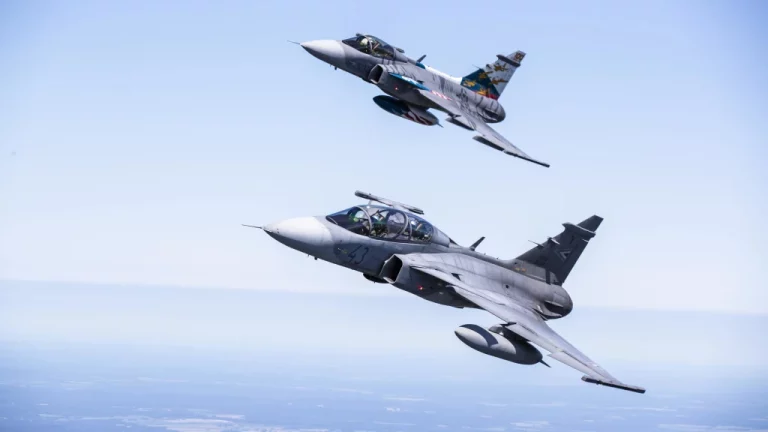
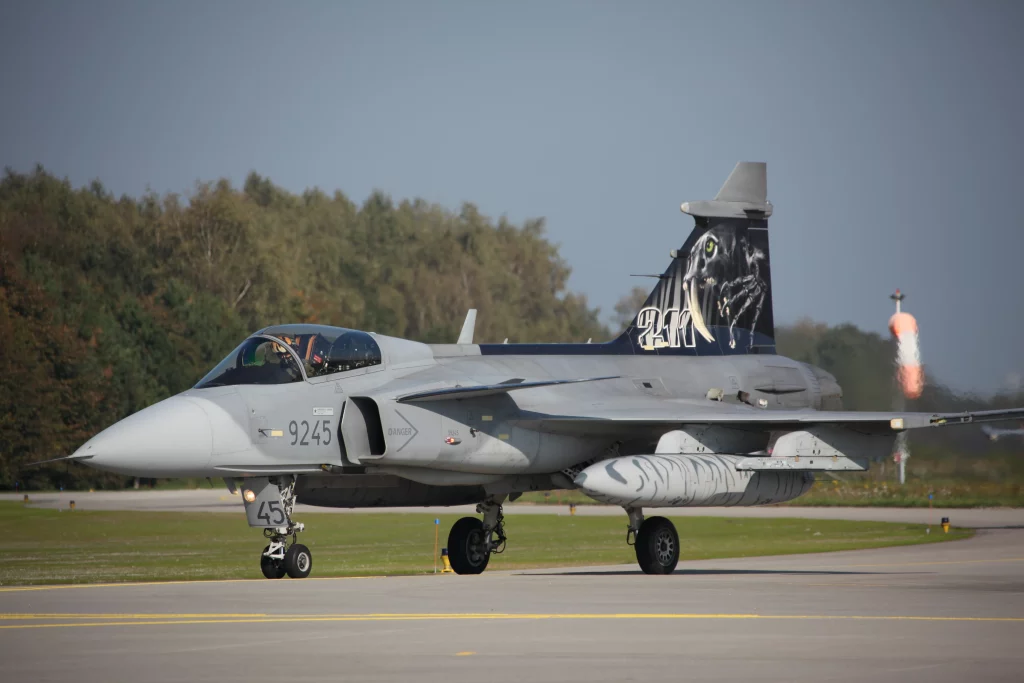
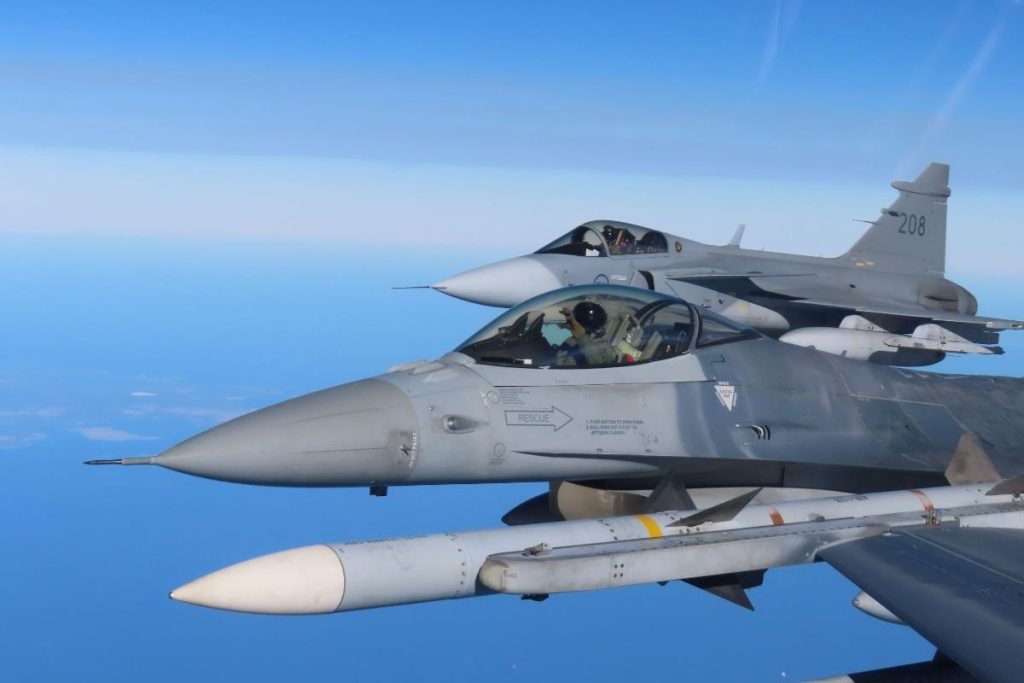
For the first time as a NATO member, Swedish JAS-39 Gripen jets were launched under NATO arrangements to safeguard the skies over the Baltic Sea flying with German and Belgian quick reaction alert aircraft. In the morning of March 11, Swedish Gripen jets joined NATO to visually identify a Russian Tu-134 that was not on flight plan.

Swedish Air Force (SwAF) Saab Gripen combat aircraft intercepted Russian aircraft for the first time since the country joined NATO the day before. According to the Air Force, two B-1 Lancers from Ellsworth Air Force Base joined up with Swedish JAS 39 Gripen fighters Feb. 26 and in the Arctic and Baltic Sea regions, training for surface attack, air interdiction, and close air support scenarios.

Swedish Gripen Jets Joined NATO
Swedish Air Force (SwAF) Saab Gripen combat aircraft intercepted Russian aircraft for the first time since the country joined NATO

********************************
Related: Poland Buys 2 Swedish Airborne Surveillance Systems
********************************

Later in the day, another track of a Russian An-26 showed on NATO’s radar screens and the CAOC alerted the German Quick Reaction Alert Interceptors at Lielvarde to launch and establish further details of the track. The Swedish JAS-39 Gripen jets were also launched and both Allies conducted a visual identification of a Russian military aircraft type An-26 and escorted the plane.

********************************
Related: Camp Lejeune Marines Join the NATO Nordic Response ’24: Exploring the Alliance of Two Military Powers
********************************

Swedish Gripen Jets Joined NATO
Swedish Gripen fighters prove they’re already integrated in NATO. Courtesy Belgian Air Force.

“Swedish Gripen fighter[s] prove they’re already integrated [in NATO], with their intercept today of a Russian An-26 and Tu-134 together with Belgian air force F-16[s] and German Air Force Eurofighters currently on [the NATO] air policing mission in the Baltics,” NATO Allied Air Command said, adding, “Across NATO the Swedish flag has been raised in honor of being the 32nd member of the alliance.”

Both Sweden and Finland are strategically located in Northern Europe. Joining NATO is a momentous step for Sweden, which has steadfastly avoided alignment over 200 years. But Sweden is not exactly a stranger to its new NATO allies, having regularly engaged in military exercises with NATO members and allies in recent years. Events such as the Arctic Challenge, a large-scale multinational training focused on air operations in the Arctic region, have previously seen U.S. aircraft, including bombers, training and operating with Swedish aircraft.

Swedish Gripen Jets Joined NATO, reporting by Tor Kjolberg
Feature image (on top): © SAAB

Declutter Your Life: How Swedish Death Cleaning Principles Can Enhance Every Aspect of Your Daily Routine

0

It’s only a matter of time before many of us learn that life is easier when we follow many of the core Scandinavian health philosophies, which include everything from spending more time outside to decluttering and having less. Declutter your life by learning how Swedish death cleaning principles can enhance every aspect of your daily routine.

If clutter and disorganization are your main concerns, you may need to look into the phenomenon known as Swedish death cleaning. This idea has taken the world by storm, and it involves the systematic process of prioritizing what’s important in life and eliminating the unnecessary stuff that gets in the way.

If you’re intrigued by this process, check out our guide to this novel concept and how to apply it to your life.

What Is Swedish Death Cleaning?

You’re not wrong, the term Swedish death cleaning can seem a bit scary at first, but there’s a method behind the name. While at the core, this is a mind frame for decluttering and organizing your space; it’s a bit more than that. The “death” part of the term points to the idea that this is a permanent form of organization. You’re creating a new system that you can follow day after day so you can cut out stress and streamline your life.

When you’re organized, everything has its place, and you can live with fewer distractions. You’ll likely be happier and less anxious, and you may even find new levels of personal success.

Swedish Death Cleaning And Home Organization

One primary way you can apply Swedish death cleaning to your own life is by organizing your home. Imagine if you passed away and your loved ones had to sort through your belongings. Would the organizational system you have right now make the task easier or harder for them? It’s a good question, and though it may seem daunting at first, ultimate organization can be easier by taking things one area at a time.

A Swedish death cleaning list could include the following:

  • Sort through your closet and eliminate and donate what you know you won’t wear again.
  • Look at your furniture, consider what takes the most space, and get rid of the items you never use.
  • Go through your less personal items. The knick-knacks and the stuff deep in drawers you haven’t used in years.
  • Sort through pictures and mementos and talk with loved ones about what they may want.
  • Rethink your purchases and buy less.

Swedish death cleaning is a good idea if you’re looking to simplify and declutter your own home, but it’s wise in various other situations, including if you plan to move with less. When a move is upcoming, start the cleaning process and donate or give away everything you don’t need. It’s the best way to end up with fewer items to transport from point A to B.

In addition to making the move less arduous, you’ll also save money by requiring fewer resources during your relocation and make money by selling unneeded possessions. Alternatively, look for upstanding organizations that can use your donations, such as the Salvation Army, which is well-known for helping people in need. With fewer items to manage, you’ll reduce an already stressful situation.

Declutter Your Life: How Swedish Death Cleaning Principles Can Enhance Every Aspect of Your Daily Routine, article continues….

How Swedish Death Cleaning Principles Can Enhance Every Aspect of Your Daily RoutineApply It To Your Profession

Whether you’re self-employed or employed by others, you can apply many of the principles of Swedish death cleaning to your work so you can be more productive. Start by eliminating negativity in your professional life. Try not to be offended by what could be perceived as negative feedback and use it as constructive criticism that you can use to improve your job. This is one way to declutter the stress in your work life.

There are other complementary and essential tricks to help you if you work from home. One of them is to clean up your schedule so you can focus on one project at a time. Multitasking is a good skill to have, but if you keep going back and forth, you could become stressed and take longer to accomplish all of the tasks. It’s also vital that you take breaks throughout the day. It’s the best way to split up your day, and you can set mini goals for what you hope to accomplish before each break.

Just be careful not to let breaks get out of control. It can be easy to take a break, head onto social media, and get lost for hours. You can declutter this aspect of life by tracking your screen time or setting reminders to get back to work. Focus on your tasks, and you can get done with work. Then, turn your attention to other important parts of life, like your family.

Declutter Your Life: How Swedish Death Cleaning Principles Can Enhance Every Aspect of Your Daily Routine, article continues below image.

How Swedish Death Cleaning Principles Can Enhance Every Aspect of Your Daily Routine
Clean finances will help you budget and plan for life.

Managing Your Finances

Many Scandinavian principles also encourage creating a balanced life, and that includes balancing your checkbook and finances. Clean finances will help you budget and plan for life.

You can death clean your finances by consolidating accounts so you’re juggling fewer cards or statements and limiting the chance of making mistakes. While you’re checking out some of those accounts, try to automate payments so you can get them off of your mind. It’s also wise to keep all of your records and essential documents in one place so you and your loved ones know where to look whenever necessary.

Declutter Your Life: How Swedish Death Cleaning Principles Can Enhance Every Aspect of Your Daily Routine – Conclusion

It’s possible to use Swedish death cleaning principles to declutter and enhance your life in many different ways, and it’s worth the effort to reduce some of the stress. Take this process one step at a time, and in the end, you’ll be happier and more productive.

Declutter Your Life: How Swedish Death Cleaning Principles Can Enhance Every Aspect of Your Daily Routine
Ainsley Lawrence

Declutter Your Life: How Swedish Death Cleaning Principles Can Enhance Every Aspect of Your Daily Routine, written by Ainsley Lawrence. Ainsley is a regular contributor to Daily Scandinavian. She is a freelance writer from the Pacific Northwest. Ainsley is interested in better living. through technology and education. She is frequently lost in a good book.

Feature image (on top): © Paico Oficial / Unsplash