The Rise, Fall and Rise Again of Denmark’s Favorite Fast Food

0

In Copenhagen, there used to be a sausage wagon on every corner, but suddenly the hot dog fell out of fashion. However, a new generation of pølsemænd (sausage men) has put sausages back on the Copenhagen map. Read about the rise, fall and rise again of Denmark’s favorite fast food.

Street hotdogs were popular in Germany during World War I and soon caught on in Sweden and Norway. However, it wasn’t until 1920 that Denmark got its first hotdog vendors. For various reasons applications to city councils to sell hotdogs from street wagons after restaurants closed until 2:30 were rejected.

In 1917, a municipal authority in Aarhus wrote, “It would be sad to see people standing on the streets eating sausages”.

The Rise, Fall and Rise Again of Denmark’s Favorite Fast Food
It wasn’t until 1920 that Denmark got its first hotdog vendors. Photo: Visit Denmark

Related: Best Street Food in Copenhagen

Early history
But in 1921, Charles Svendsen, a Dane who had been running a successful hotdog business in Oslo (at that time Kristiania), was granted permission to open his hotdog vans at several locations around Copenhagen. The sausages with mustard on the side, costing around 25 Danish øre (cents) was at that time a luxury meal. If you were to splash it out with a roll, you had to add another 5 øre.

Soon, the hotdog became an important part of Danish culture with the quality of being able to gather the people. It’s all about coziness, humor and conversation between people across social classes. It is informal and a part of the Danish popular culture.

“Try a Danish hot dog – simply the best you can get”
I have been to several Christmas markets in Copenhagen, and I must admit, buying a red hotdog from one of the pølsevogn (sausage wagons) was one of the highlights of the day. I was tempted by the poster, claiming “Try a Danish hot dog – simply the best you can get”.

The Rise, Fall and Rise Again of Denmark’s Favorite Fast Food
The hotdog became an important part of Danish culture. Photo: Stryhns, Copenhagen

Related: Breakfast in Copenhagen

It’s a classic (almost romantic) sight in Copenhagen to see a hotdog vendor calmly pulling his van behind him on a busy city road. Hotdogs, and the people who sell them, are adored in Denmark, and for good reason. Although hot dogs are eaten less and less frequently, a local pølsevogn still holds a place of affection for most Danes. Be you vegetarian or carnivore, it would be a shame to pass through Copenhagen without trying a traditional Danish hot dog.

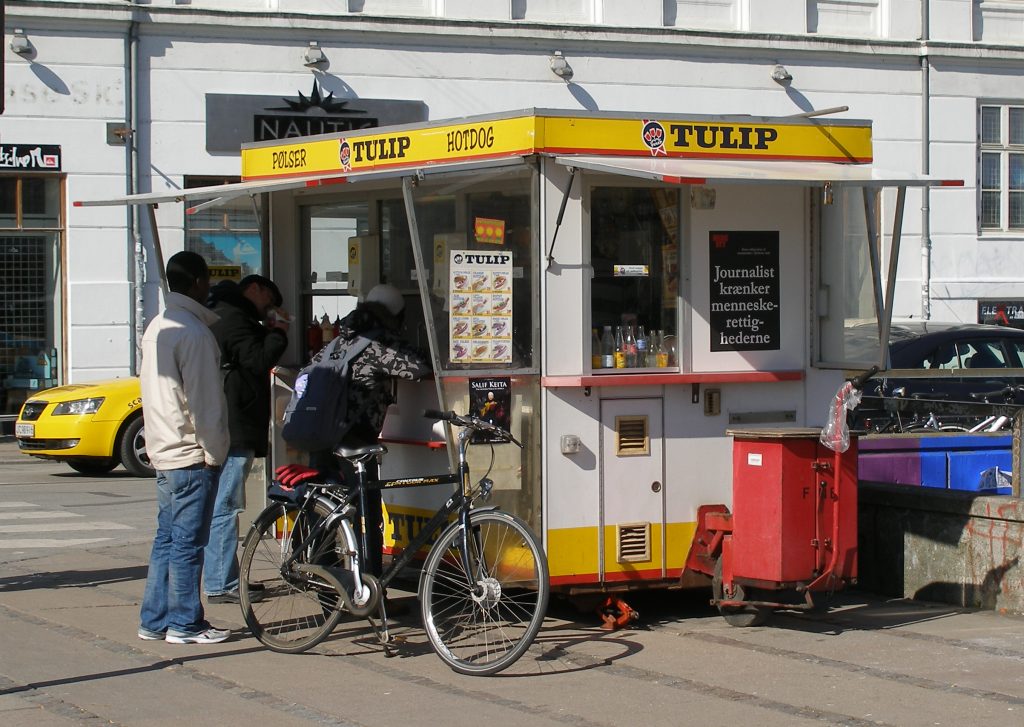
The first Danish hotdog vans were nothing like the ones we know today. They were small, wooden push carts with large wooden wheels, and only the fancier ones had a shelter for the vendor to stand under. A modern hotdog stand has wheels underneath and it is completely self-sufficient. This means that it doesn’t need fixed power and water supply and it can be charged up. It can have its own engine and the whole thing can be packed away in about 15 minutes.
The Rise, Fall and Rise Again of Denmark’s Favorite Fast Food
Pølsevogn at Nørrebro. Photo: Wikipedia

The decline of the Danish pølsevogn
Once there were around 800 pølsevogn in the Danish capital. Today, the number is closer to 75. The proliferation of the American fast food might be one of the reasons, but Big Mac isn’t entirely to blame.

Another reason might be that the mobile hotdog stands are being transformed into stationary stands, which give them the opportunity to expand their selection. The reason for the restructuring is that it’s difficult to survive merely on the sale of hotdogs.

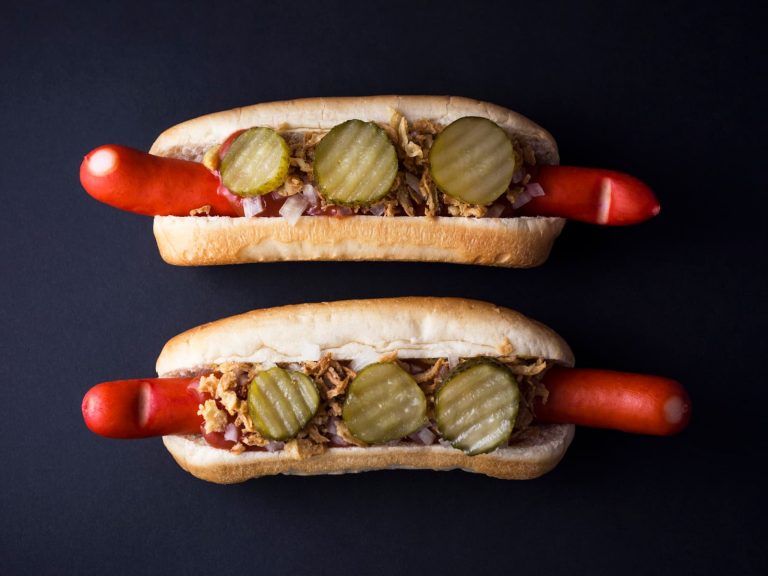
The classic Danish hotdog was a boiled red sausage (red Vienna sausage). Traditionally vendors painted the sausages red to indicate that the meat was a day old. But the dyed sausages became popular. At one point, all hot dog sausages in Denmark were red regardless of meat quality.
The Rise, Fall and Rise Again of Denmark’s Favorite Fast Food
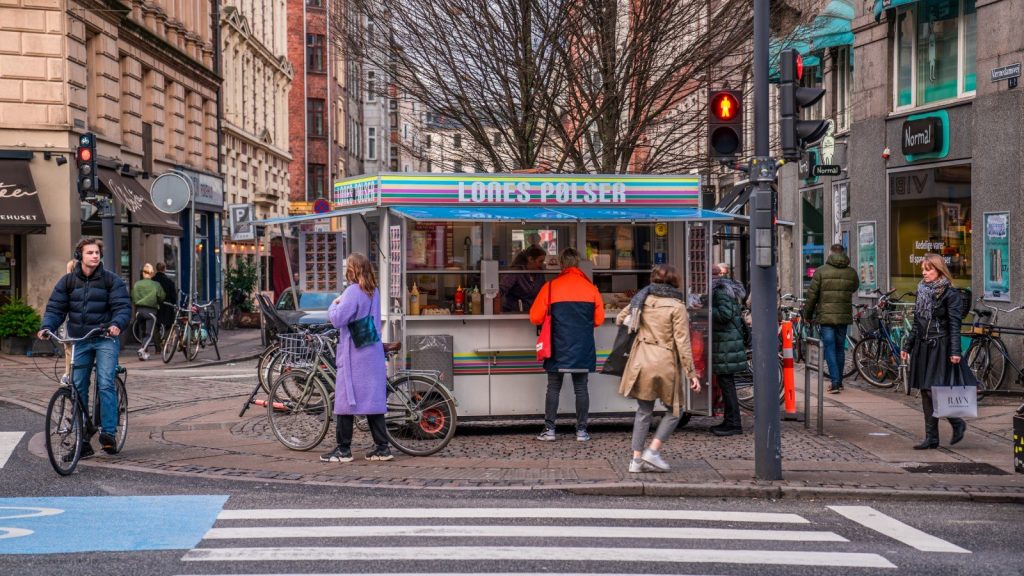
Lones pølser. Photo: Visity Copenhagen

On the wrong side of the gastronomic revolution
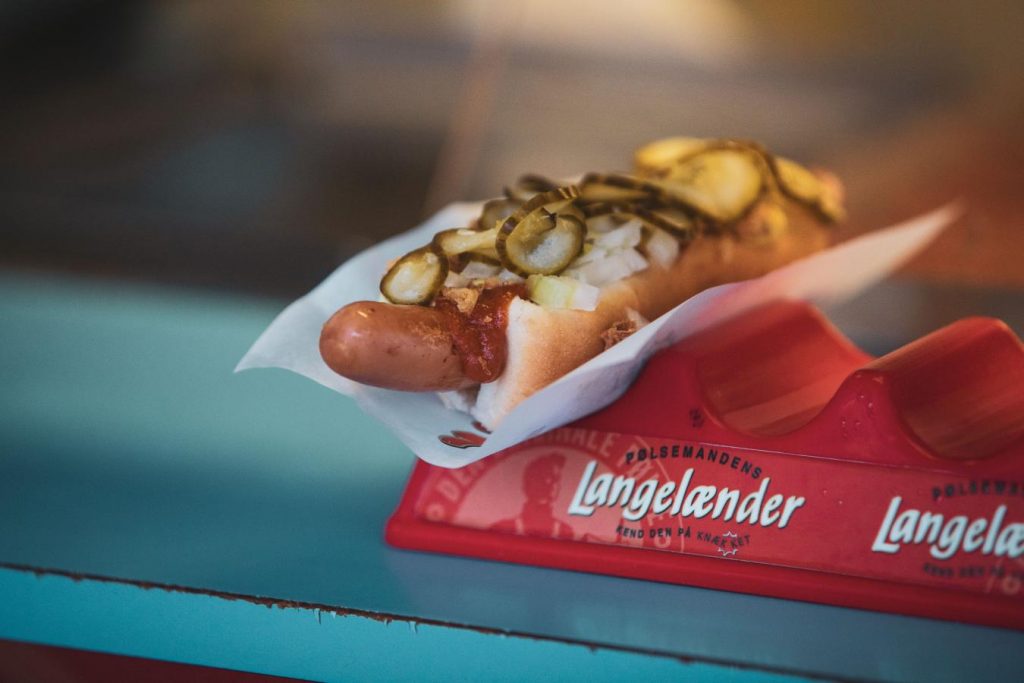
In later years, the hot dog found itself on the wrong side of the gastronomic revolution, although you can buy it with both ketchup, mustard, remoulade, raw onion, crispy fried onion, marinated cucumber salad and different dressings. As Copenhagen transformed from culinary backwater to serious food destination, with the world-beating likes of Noma preaching the virtues of local, seasonal and foraged produce, the hot dog, with its starchy, sugary buns and mystery meat, looked like pre-Enlightenment food, a relic from the 20th-century.
The Rise, Fall and Rise Again of Denmark’s Favorite Fast Food
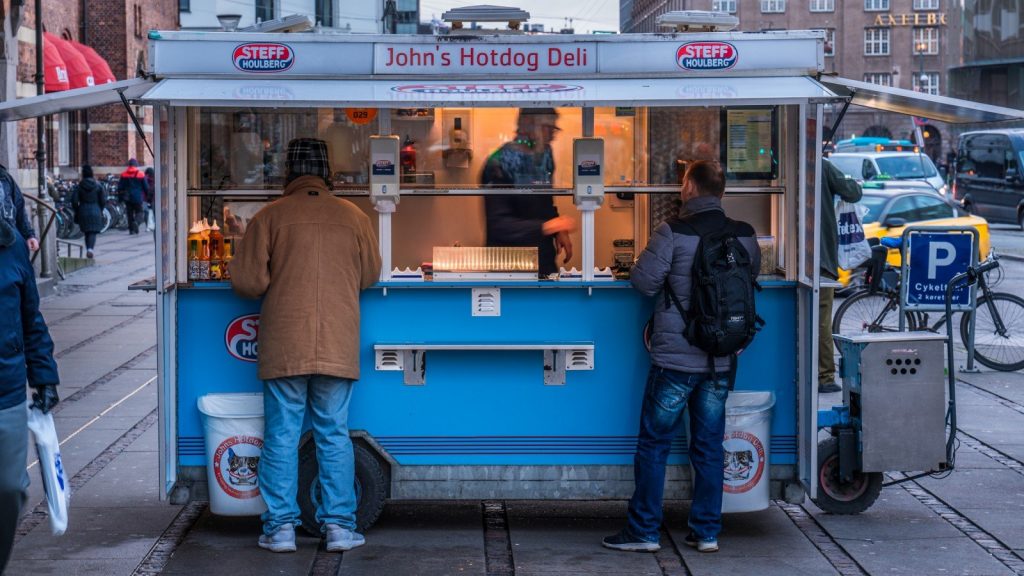
Johns Hit Dog Deli. Photo: Visit Copenhagen

Another thing that makes the hotdog stands disappear from the streets is the fact that the authorities won’t grant stalls the stands. A hotdog man in Aarhus lost his licence to keep his hotdog stand in the street because of city renewal. He had applied to be given a new place in Aarhus C, but was rejected by Aarhus municipality. As a result, he packed the hotdog stand away for the last time in 2002. And so, there are no mobile hotdog stands left in East Jutland.

The Rise, Fall and Rise Again of Denmark’s Favorite Fast Food
Hotdogs, and the people who sell them, are adored in Denmark. Photo: Asko

Tolerant sausage vendors
Nevertheless, almost everyone eats hotdogs and, therefore, the hotdog vendors of Denmark have a reputation for being not only kind, but also very tolerant people. For those looking for the full Danish experience today, order your hot dog with a Cocio (a Danish chocolate milk drink). Or double down on the meat with a bacon-wrapped sausage (ristet hotdog i svøb).

The Rise, Fall and Rise Again of Denmark’s Favorite Fast Food, read on….

A group of sausage-happy Danes are now updating hotdogs for the post-Noma era, while trying to hold onto its unique place in Danish society. The humble hot dog isn’t merely the food of childhood treats and late-night drunken snacking, a kind of culinary embodiment of Danish hygge. History shows, it also helped destroy the Copenhagen restaurant mafia and increase workers’ rights.

The Rise, Fall and Rise Again of Denmark’s Favorite Fast Food
The classic Danish hotdog was a boiled red sausage (red Vienna sausage). Photo: Asko servering

Post-war sausage vendors
in 1940s Denmark, in order to work as self-employed, applicants had to prove to the council that they was disabled or otherwise unable to work in a normal job. This changed the hotdog landscape in Copenhagen, and many other parts of Denmark, dramatically. Now that it was no longer just a job, hotdog vendors started putting more care into their business and into the hotdogs themselves. Selling hotdogs in Denmark became a very personal thing.
The Rise, Fall and Rise Again of Denmark’s Favorite Fast Food
In later years, the hot dog found itself on the wrong side of the gastronomic revolution. Photo: Visit Denmark

Introduced in Denmark in the 1970s, a French hot dog is a hollowed baguette, filled with a mayo-based French dressing and stuffed with a ristet wienerpølse. Lining the baguette evenly with sauce is the secret to making the perfect French hot dog. In fact, seasoned eaters know a trick or two to prevent the sauce from pooling at the bottom.

The Rise, Fall and Rise Again of Denmark’s Favorite Fast Food
. Selling hotdogs in Denmark became a very personal thing. Photo: Wikipedia

The comeback of the Danish hotdog
In 2012, Ole Trolsoe, food editor at the largest Danish business daily Børsen and with a soft spot for the old pølsevogn, established a Hot Dog Championship. His ambition was to save the mobile Danish sausage-stands, that was the only and the original vendors of Danish street-food.

These championships are now history. However, the breed of gourmet dogs that triumphed at these championships contributed to a new dawn for the Danish sausage tradition. Located in the gritty Meatpacking district, the affordable, fuss-free John’s Hotdog Deli is a dining institution. According to Condé Nast Traveler, “here, you won’t find fancy new Nordic plates; quite the opposite, in fact. This is a low-key hotdog joint where you can do what true fans of the delicacy love to do: build your own».

If Copenhagen’s sausage vendors move with the time, their future is as bright as rød pølse.

The Rise, Fall and Rise Again of Denmark’s Favorite Fast Food, written by Tor Kjolberg
The Cradle of Sweden

0

The region separating Lake Vänern from Lake Vättern offers rich pickings for visitors. This is the province of Västergötland and the cradle of Sweden.

In 1746, the indefatigable Swedish botanist Carolus Linnaeus said, “Truly no one could ever imagine such splendor as in Västergötland who had not seen it for himself.”

The Cradle of Sweden
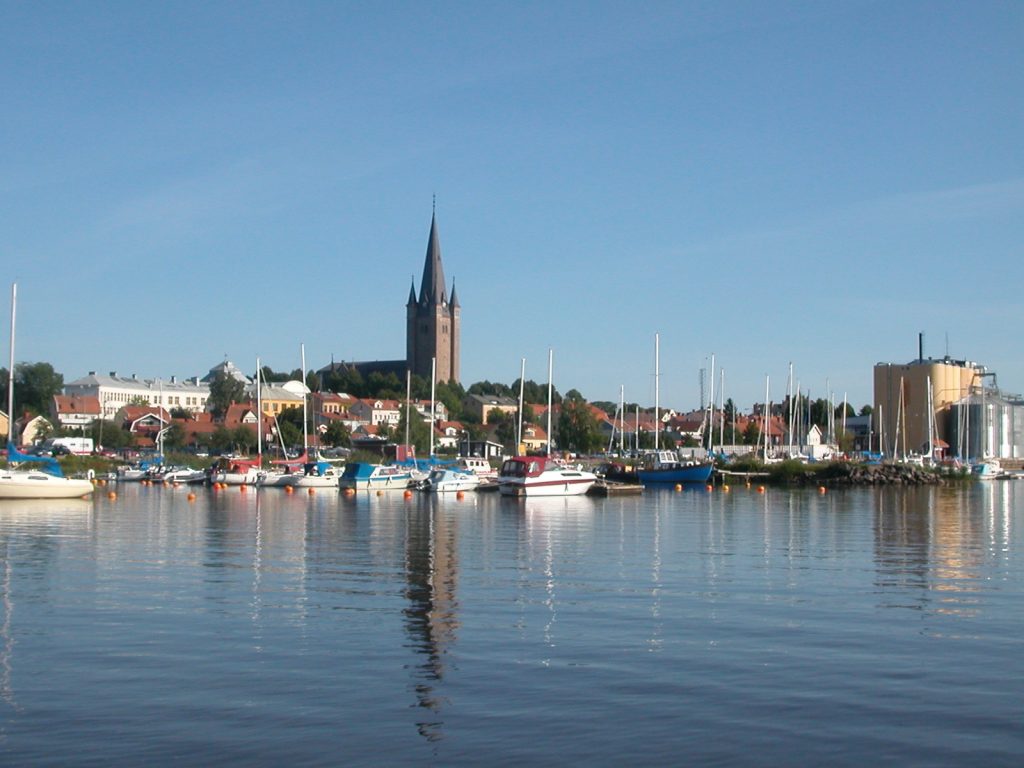
Mariestad skyline. Photo: Wikipedia

Mariestad
Heading south along the eastern shore of Vänern, you come to Mariestad, dominated by the spire of the 17th-century Renaissance-style cathedral, one of the few churches of this period remaining in Sweden.

Most Swedes learn in school that the king who first united Svea and Göta tribes, Olof Skötkonung (994-1022), was baptized in 1008 at Husaby Källa (Husaby Spring). True or not, Husaby is considered to be the cradle of the Swedish state.

Next to the spring, the 12th-century Husaby Church is an imposing three-spired edifice with beautiful ceiling-paintings inside.

Related: One of the Most Beautiful Rivers in Sweden

The Cradle of Sweden
Lidköping Town Hall. Photo: Wikipedia

Lidköping, the porcelain town
Nestled into Kinneviken (Kinne Bay) 51km (32 miles) south of Mariestad, is Lidköping, a town founded in 1446 and once renowned for its porcelain. Its most famous company Rörstrand, the maker of the Nobel china, no longer has a factory in Lidköping (its fine china is now manufactured in Hungary and Sri Lanka), but a new Rörstrand museum opened here in 2008, and there is a large factory shop. Lidköping has several fine cafés, including the renowned Garströms Konditori, established in 1859, on the main square.

The Cradle of Sweden
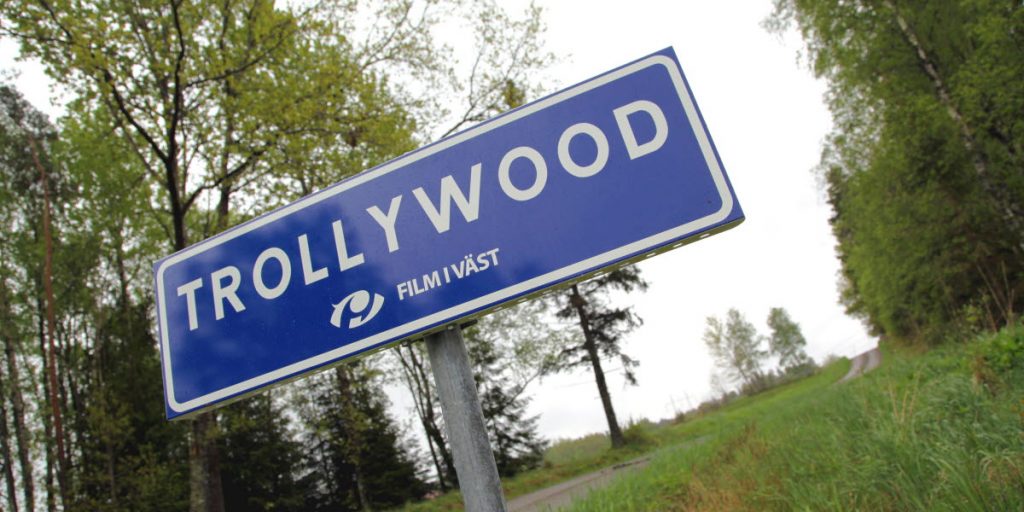
Photo: Västsverige

Trollywood
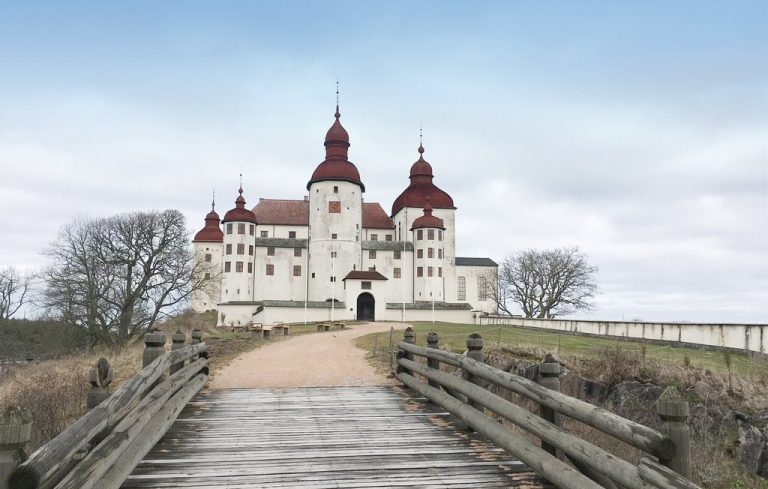
North of Lidköping on the Källandsö peninsula stands the restored Baroque-style 17th-century Läcko Slot, one of the most impressive castles in Sweden. In summer it holds cultural exhibitions and is a venue for outdoor concerts.

Related: Through the Heart of Sweden on the Göta Canal

Trollhättan, at the southern tip of Lake Vänern, was the hometown of Saab Automobile and has a rich industrial heritage: it’s also known as “Trollywood” thanks to its film production! The town has long been famous for the magnificent 32-meter (105ft) falls of the Göta River. Today, the river is diverted to generate electricity and the falls are silent. But during the annual Falls Festival in July it is released to follow the old course, providing an impressive spectacle.

The Cradle of Sweden
Läcko Slot. Photo Wikipedia

Heartland of Sweden’s textile industry
The southern part of Västergötland is still the heartland of Sweden’s textile industry, with the focal point at Borås, where there is a Textilmuseet (Textile Museum).

The Cradle of Sweden, written by Tor Kjolberg

Feature image (on top): From Lidköping. Photo © Novasol

Manor House Atmosphere Close to Aalborg City Center

Located in the outskirts of Aalborg, the four-starred Best Western Hotel Scheelsminde offers guests a historic stay in one of Denmark’s beautiful old manors. The historic building, which has been in the hands of the family Bühlmann for three generations, is a favorite location for weddings, conferences as well as weekend breaks. Learn more about the manor house atmosphere close to Aalborg city center.

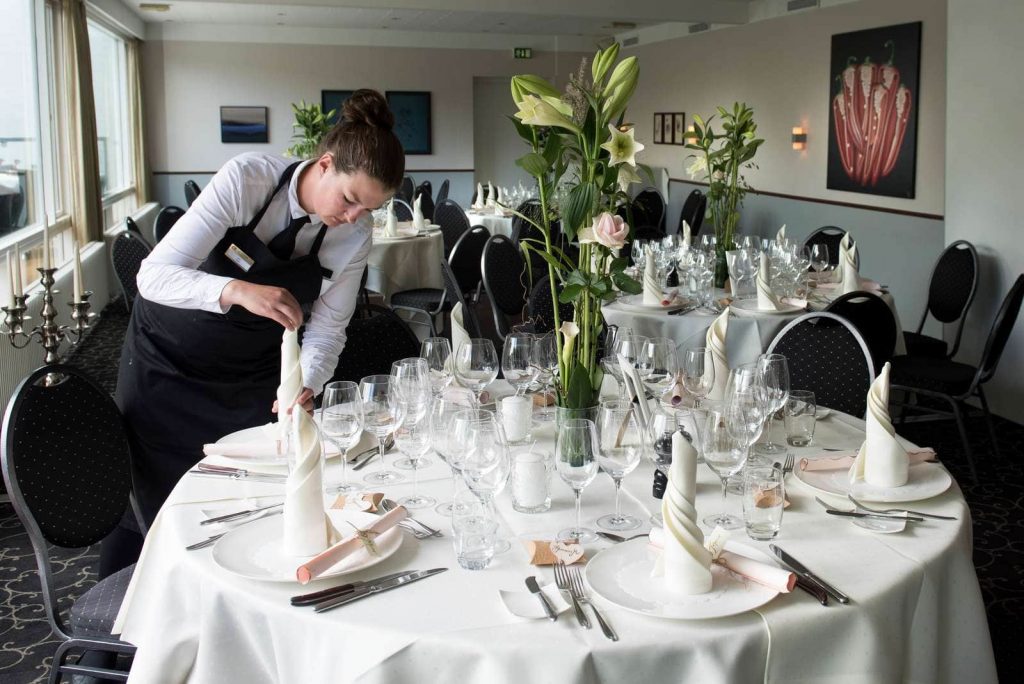
By means of the many facilities and opportunities, Scheelsminde is the perfect place for both couples, families, business people and others who want great experiences. The hotel offers a little bit of everything – from high-level gastronomy to party rooms, to relaxation with pool and spa.

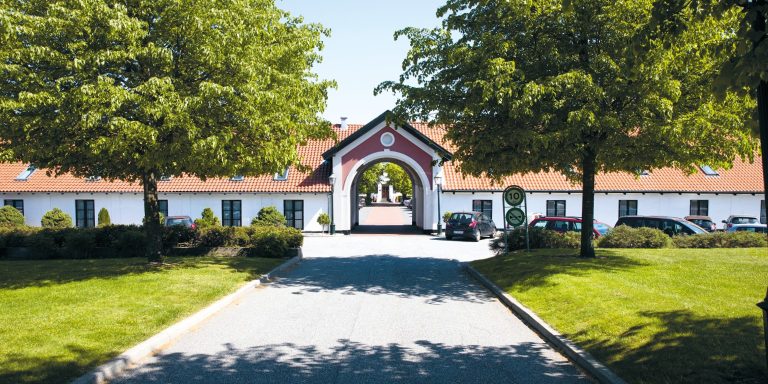
Manor House Atmosphere Close to Aalborg City Center
The hotel houses a total of 96 modern and cozy rooms

Related: The Spirit of Aalborg

Historic manor house
Built in 1808 by Christian Paul Scheel, a prominent member of the Judiciary, Scheelsminde manor was turned into a small hotel by the current owner Anemette Bühlmann’s grandparents in 1960. Since then, the hotel has been carefully extended, modernized and renovated. Today, the hotel houses a total of 96 modern and cozy rooms, as well as meeting rooms, conference and banquet facilities, swimming pool, spa and an international restaurant. Still, the manor’s special charm and atmosphere has been preserved.

A green oasis
Hotel Scheelsminde is located in a quiet residential area surrounded by a large park which is constantly being developed and updated to ensure that guests can both enjoy their stay while recharging their batteries for a new and effective work day.

Manor House Atmosphere Close to Aalborg City Center
The hotel offers a little bit of everything – from high-level gastronomy to party rooms, to relaxation with pool and spa.

Related: Fairytale Castles in Denmark

“What we try to do is create a small oasis in Aalborg with a quality-orientated service. We have a lot of regulars who tell us that they feel as if this is their second home and that’s exactly the feeling we try to create. We want our guests to feel that they are staying at a family-owned hotel and not just another corporate chain hotel,” says hotel director Anemette Bühlmann.

Several types of stays
The modern conference center can accommodate more than 100 guests and there are all imaginable facilities. However, the hotel offers several types of stays e. g. gourmet stays and golf stays. You have the opportunity to find what suits you. Whether it is to immerse yourself in the hotel’s library or a bike ride, or something else, the manor house offers a lot of exciting experiences.

Manor House Atmosphere Close to Aalborg City Center
“What we try to do is create a small oasis in Aalborg with a quality-orientated service,” says hotel director Anemette Bühlmann.

Related: Biking the Danish East Coast Route

The hotel is located no more than a ten-minute bus or car ride from the center of Aalborg. “A lot of our weekend guests come here just to relax and enjoy Aalborg. What we offer is a green oasis within a short distance from the city and the shopping center,” says Bühlmann.

Manor House Atmosphere Close to Aalborg City Center, written by Tor Kjolberg

All images © Hotel Scheelsminde

The Coworking Culture in Scandinavian Countries

The COVID-19 pandemic forced millions of us to start working remotely. That meant we got to spend more time at home, and less time stuck in traffic jams and crowded offices. Learn more about the coworking culture in Scandinavian countries.

Many employees found that remote working wasn’t all it was promised to be. Instead, working from home presented an entirely new set of challenges, as kids, dogs, and everyday distractions got in the way of our desire to work.

So, now that we approach the end of the pandemic, plenty of folks are ditching their kitchen-table-office setup, and are opting to work in coworking spaces.

While this idea is novel for most people, it should come as little surprise that Scandinavian countries already have a strong coworking culture — they always seem to be a step ahead! Here’s a quick intro into that vibrant culture, with some tips to help you fit in.

The Coworking Culture in Scandinavian Countries
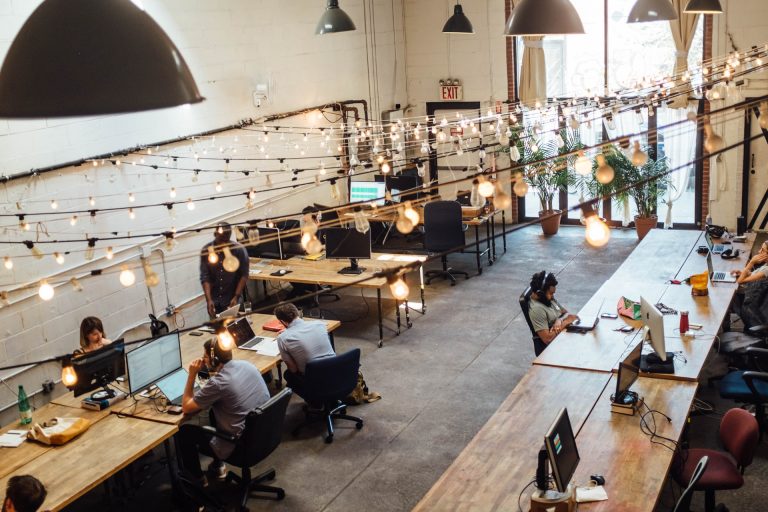
While this idea is novel for most people, it should come as little surprise that Scandinavian countries already have a strong coworking culture. Photo by Copernico

Coworking Spaces
Most folks who have fled their home office in search of a coworking space do so because they want to work in a clean, distraction-free environment where collaboration is possible. Booking these coworking spaces works somewhat like a hotel — in fact, the largest network of Scandinavian coworking spaces is run by the hotel chain Scandic.

You can expect to pay something around €19 per day, and for that fee, you will gain access to working spaces that suit your style. So, that means you can look to find spaces filled with other people who also buzz off busyness, or you can reserve a quiet, secluded nook or room so you can get your head down and work. Depending on the coworking space you choose, you might also gain access to other services like a printer and refreshments.

The Coworking Culture in Scandinavian Countries
You can expect to pay something around €19 per day, and for that fee, you will gain access to working spaces that suit your style. Photo by Copernico

Hoffices
Coworking spaces are great for getting out of the house and rediscovering your productive spark, but the peak of Scandinavian coworking culture is something known as “Hoffices.” Hoffices are “a self-organizing network for co-creating temporary workplaces.” Or, more simply put, they’re office spaces in someone else’s home.

At first, the idea of using a home office in someone else’s house sounds like an invasion of privacy — but how many times have you had “hoffice” envy in the past 18 months? Better yet, the idea of Hoffices is social and voluntary, meaning many folks who offer a Hoffice on Facebook aren’t looking to make a profit.

The Coworking Culture in Scandinavian Countries
The peak of Scandinavian coworking culture is something known as “Hoffices.” Photo by Helena Lopes

Improving Your Hoffice
You don’t necessarily need to have a Hoffice of your own to join a Hoffice network, but it is the norm. That idea might sound a little anxiety-inducing, particularly if your work-from-home setup is a blend of Albert Einstein’s desk and your children’s crayons. However, there are a few simple changes you can make to create the ideal gathering space:

Keep Private Things Private: first things first, exit your home and walk-in again with a set of “professional” eyes on. This will help you decide what can stay on display, and what should be stored away when coworkers visit. So, for example, the family pictures might stay out, but the towels you hang on the office door need to go.

Color and Lighting: no one wants to work in a busy, distracting environment. So, if you’re thinking about renovating your office, start by choosing soft colored paints or wallpaper, and opt for lighting that won’t bring on headaches.

Furniture: the key to hosting a hoffice space is in setting up your workspace so that other people feel “invited” in. The best way to ensure you cater to other workers is to offer a few workstations — one near your own workstation, one in a secluded spot, and perhaps one more in an “interesting” part of your home.

Outdoors: speaking of “interesting,” there’s nothing wrong with opening up your garden to the folks who come and work with you. Particularly if the weather is good, or if you take pride in gardening. This will be a great conversation starter, and being outside always brings on positive energy to guests.

The Coworking Culture in Scandinavian CountriesEtiquette
Coworking culture is fantastic, and it’s little wonder that more people are adopting this flexible, productive working option. However, for the uninitiated, there are a few basic pieces of etiquette to be aware of:

Introductions: making a good first impression is difficult at the best of times. However, when meeting new people in a coworking space you needn’t overthink it. Try to read the room, and see if the person you’re working next to wants to say “hello” first. Then, try to keep chatting to a minimum — after all, you’re both there to work and feel productive.

Zoom Meetings: if you know that you’ll be headed into remote meetings, you simply must reserve a quiet, private space. This will improve the quality of your call, as you won’t be drowned out by background noise, and will allow other people in the space to stay focused.

Food and Drink: stinky foods are a big “no” in any workspace, as it is nearly impossible to work when the stench of someone’s lunch is floating around.

Book: if possible, book your space ahead of time. There’s nothing wrong with showing up on the day, but people like to plan, and booking ahead will give everyone an accurate idea of how busy the coworking space will be that day.

The Coworking Culture in Scandinavian Countries – Conclusion
Coworking allows you to stay focused and recapture your love for work. It also allows you to take full advantage of the flexibility we now have due to remote work. This means you can travel to some of the best destinations for remote workers in Scandinavia while you embrace a flexible blend of travel and productivity.

The Coworking Culture in Scandinavian Countries
Ainsley Lawrence

The Coworking Culture in Scandinavian Countries, written exclusively for Daily Scandinavian by Ainsley Lawrence. Ainsley is a freelance writer from the Pacific Northwest. She is interested in better living through technology and education. She is frequently lost in a good book.

Other articles by Ainsley Lawrence:
How & Why to Startup a Business in Sweden
Examining the Gender Pay Gap in Scandinavian Countries
Swedish Weddings: Traditions and Trends

All images © Unsplash
Feature image (on top): Photo by Shridhar Gupta / Unsplash

The Kabul Boy Who Found Happiness, Cats And A Husband In Denmark

Danish film director Jonas Poher Rasmussen’s intimate, award-winning animated documentary Flee has helped his long-time friend — an Afghan, now a successful academic, who found refuge in Denmark as a child — by discussing his traumas. Learn more about the Kabul boy who found happiness, cats and husband in Denmark.

Before escaping to Denmark across the Baltic, Amin Nawabi (pseudonym) lived as a gay Muslim in Afghanistan. Eventually he found love and a new life, and Amin’s often harrowing story has turned out to be an uplifting, award-winning animation.

The Kabul Boy Who Found Happiness, Cats And A Husband In Denmark
Amin as a boy enjoying the music of A-ha

Prestigious awards and nominations
However, Danish filmmaker Jonas Poher Rasmussen has a confession to make: “I can’t draw at all,” he says with a big laugh. The only shot where his handi­work can be viewed is a scene late in the film as interview subject Amin and Poher Rasmussen are depicted in a New York hotel room. On the bed sits a scribble of a notebook barely to be seen in which the director’s character is recording the conversation. Poher Rasmussen drew the notebook. Animation director Kenneth Ladekjær wanted it in the shot.

Related: Danish Film About Surviving Drinking

The Kabul Boy Who Found Happiness, Cats And A Husband In Denmark
Nightclub scenes

Flee had its world premiere at Sundance Film Festival, was the official selection of the Cannes Film Festival, received the Crystal award as best feature at Annecy, an Annie Award nomination for Best Independent Animated Feature, Critics Choice and Golden Globe award nominations, and winner of both Best Documentary and Best Animated Feature at last year’s European Film Awards.

The Kabul Boy Who Found Happiness, Cats And A Husband In Denmark
Danish filmmaker Jonas Poher Rasmussen. Photo: YouTube

A documentary
Amin’s story is strong evidence of the high prices paid by poor people to brutal traffickers and corrupt police for the tough, cruel, and dangerous passages.

Jonas Poher Rasmussen says that almost all of the story takes place in the past and his aim was to show what Amin’s childhood back home looked like, what Afghanistan looked like in the 1980s, and Moscow in the ‘90s, when he was there. But even more importantly, Amin wanted to be anonymous, which made animation seem like the perfect way to tell the story as it allowed both Amin and the filmmaker to mask his identity and revive his memories.

The heartbreak summer
When Amin arrived in the little village in Denmark, Rasmussen, then 15, became the newcomer’s friend and confidant. Both were teenagers at that time – and their closeness endured into adulthood. When they both suffered bad break-ups in their 20s, Rasmussen went to stay with Amin. This period is now referred to as “the heartbreak summer”. Rasmussen still don’t know the whole truth about how his friend came to Denmark.

The Kabul Boy Who Found Happiness, Cats And A Husband In Denmark
Rasmussen interviewing Amin

Related: Famous Danish Film Directors

A story of memories and trauma
Rasmussen and Amin held the first interviews in 2014 and recorded up to 20 sessions over the next three to four years.  The interviews in the animation are real voices from those interviews, the only difference is the way the characters look.

Rasmussen may not be a great visual artist, but the director had been making radio, TV and theatrical documentaries for years when he took a short animation course at the Animation Workshop in Viborg, Denmark. He was then inspired to tell the story of his close friend Amin in the form of an animated documentary.

The Kabul Boy Who Found Happiness, Cats And A Husband In Denmark
Flee is made as a documentary.

Flee is very much a story about memories and trauma and the animation allowed the makers to be a lot more expressive visually than they could have ever been with a regular camera. Every time Amin talks about something traumatic or something he has a hard time remembering, the animation gets a lot more simplistic and graphical, telling the story in a way that feels a lot more honest to the feelings he goes through.

Related: A Danish Tragedy

A combination of interviews and dramatizations
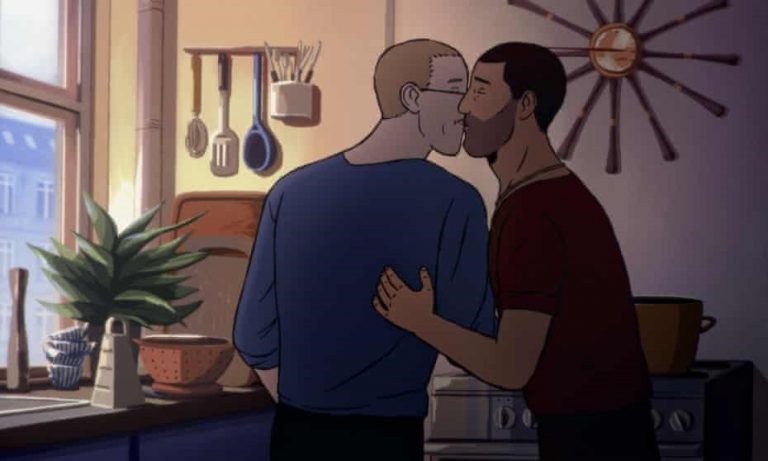
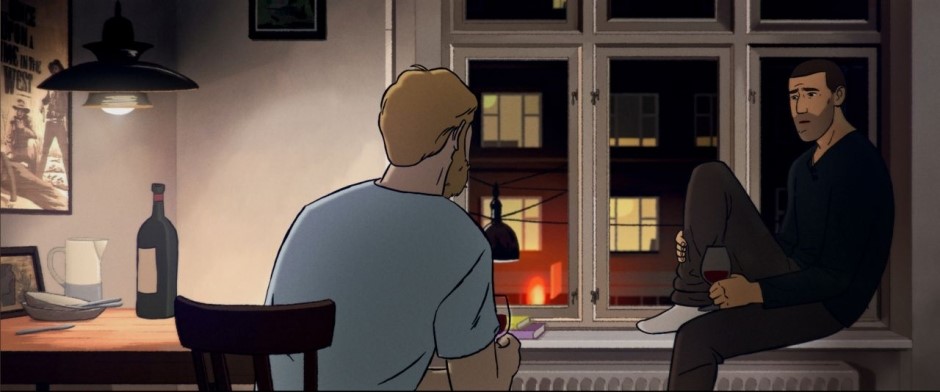
Flee alternates between scenes of Rasmussen interviewing his friend, dramatizations of Amin’s perilous journey to Copenhagen via Moscow, and present-day interludes showing him house-hunting with his boyfriend in which the concept of settling down presents unique challenges for someone who has spent his life running. Aside from the occasional excerpt of archive footage – the war-scarred streets of Kabul, the unruly waves seen from a boat smuggling people across the Baltic – every frame of the movie is animated, most of it in a simple, straightforwardly realistic fashion that matches Amin’s narration.

The Kabul Boy Who Found Happiness, Cats And A Husband In Denmark
Flee is very much a story about memories and trauma and the animation allowed the makers to be a lot more expressive visually than they could have ever been with a regular camera.

In its core Flee is a documentary, so it has been important to use archival shots throughout the film to remind people that this story is tied to historical events. Everything Amin goes through is because of factual things that happened in the same world we all live in. It’s not fiction.

Life of a refugee
When Amin frolics as a child in his sister’s dresses or bops happily to the sound of A-ha, the mood is bright and buoyant. In moments of trauma, the animation grows into a nightmare: faces appear without features, surroundings become scratchy and abstract.

“I wanted the film to show that being a refugee is not an identity – it’s a circumstance that can happen to anyone,” said Rasmussen in an interview.

The Kabul Boy Who Found Happiness, Cats And A Husband In Denmark, written by Tor Kjolberg

All images (except portrait of Rasmussen) by Cinephil

The Children Only Bookstore in Oslo – A Literary Lighthouse

0

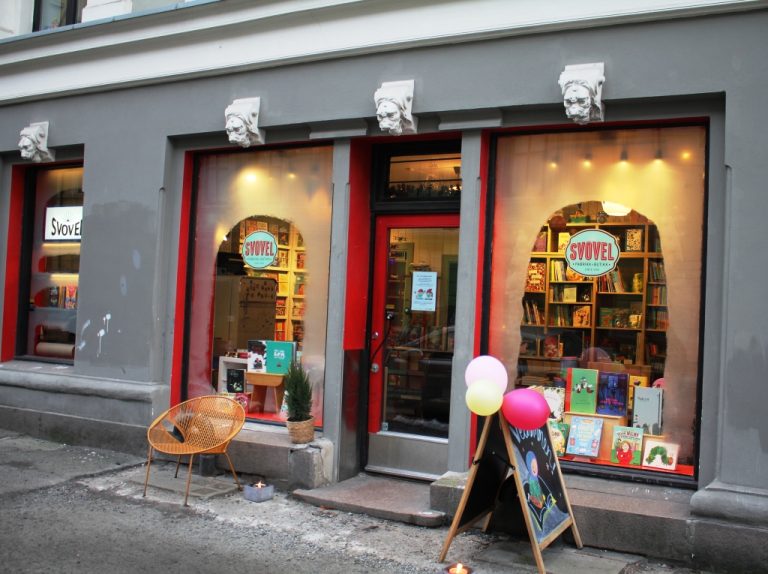
Share literary love with a great book in Svovel, located in Grünerløkka in the capital of Norway at a walkable distance from the public Deichman library. This is a place to share your love of reading with young ones – and where design is a crucial part of the storytelling process. Read more about the children only bookstore in Oslo – a literary lighthouse.

Shopkeeper Trine Louise Ween tells us that Svovel was established in 2006 as a pure illustration and design agency by Tora Marie Norberg and Anders Nederhoed. A year later Ellen Renberg joined them, and she is the owner today. In 2012, the book illustrators and designers decided to expand their business to not only illustrate and design books but also sell them.

The Children Only Bookstore in Oslo – A Literary Lighthouse
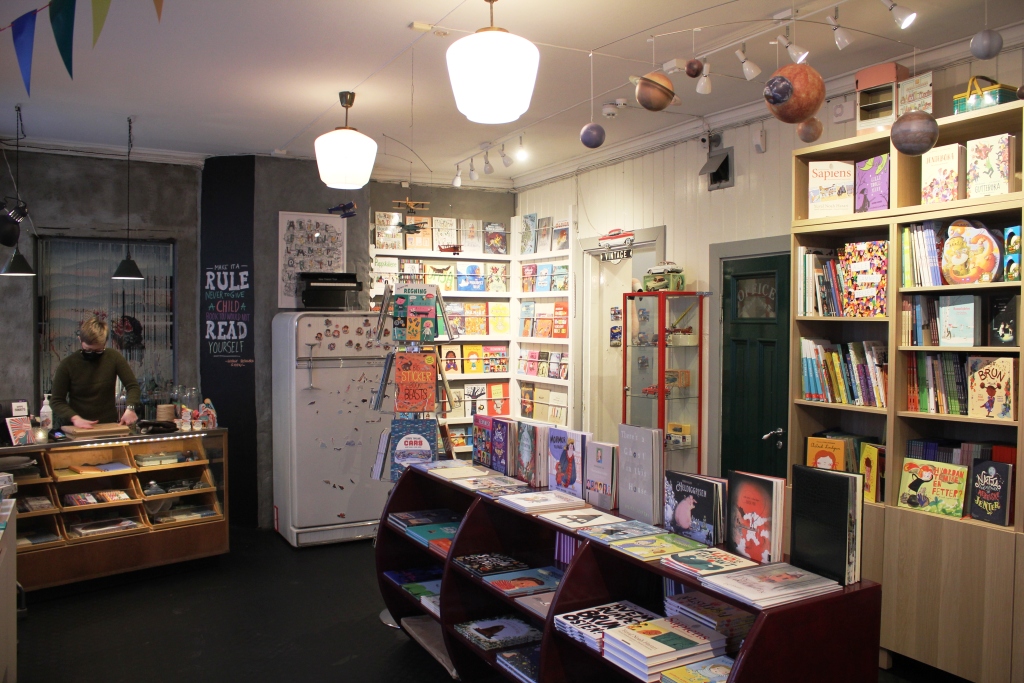
SVOVEL is full of handpicked, beautifully illustrated volumes filled with fantastic stories and creatures.

Related: Norway Fascinates Me

Full of handpicked, beautifully illustrated books
This independent specialized bookstore for kids only is full of handpicked, beautifully illustrated volumes filled with fantastic stories and creatures.

The Children Only Bookstore in Oslo – A Literary Lighthouse
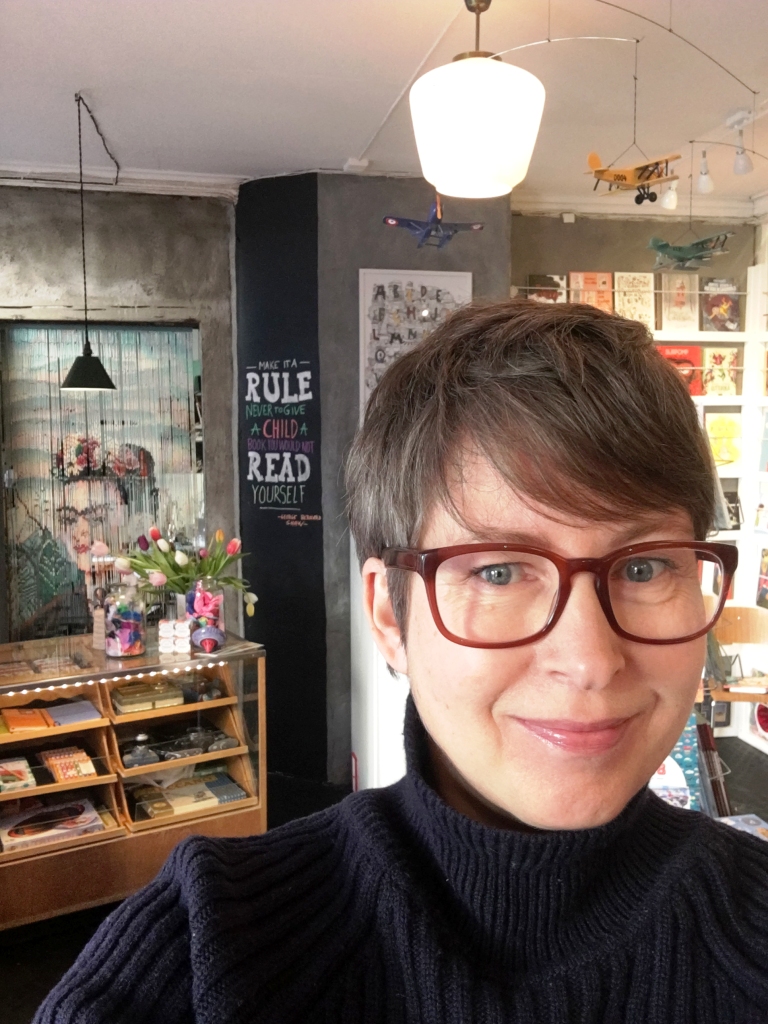
Today’s owner Ellen Renberg

Do you remember what it’s like to read a book as a child? We are in a golden age of children’s literature, and this love is felt most intensely in Svovel children only bookstore. The book selection focuses on some specialty publishers, so don’t come with a specific book in mind. Rather, let the knowledgeable shopkeeper pick something perfect for you.

The Children Only Bookstore in Oslo – A Literary Lighthouse
Shopkeeper Trine Louise Ween

Related: A Moderately Happy Norwegian Boy

Surprise your kids with a new bedtime story
The selection consists of books the owners like, some they have illustrated or designed themselves – as well as soft toys and equipment for toddlers produced by people in the neighborhood. “We select books based on quality,” says Trine Louise. We urge you to go and peek inside. Maybe you can surprise your kids with a new bedtime story, or maybe you are just looking for a beautiful high-quality gift.

The Children Only Bookstore in Oslo – A Literary Lighthouse
The book selection focuses on some specialty publishers

Related: The Coolest Library In The World For Kids – In Norway

If anyone can keep your kids busy for a few hours, this is a passionate (and patient) children’s bookseller.

The Children Only Bookstore in Oslo – A Literary Lighthouse
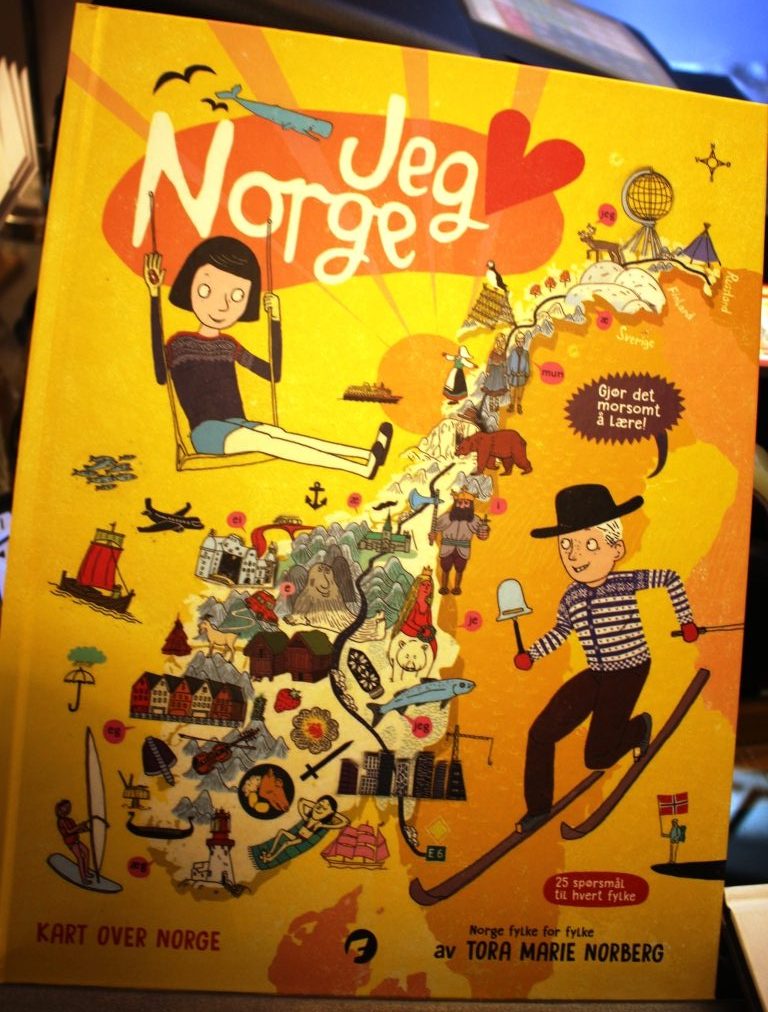
A book designed and illustrated by one of the founders.

Why did the owners chose the name Svovel, which means sulfur in English? Trine Louise tells me that the owners wanted a short name, a good available domain name which also was suitable for a logo design.

The Children Only Bookstore in Oslo – A Literary Lighthouse, written by Tor Kjolberg

All images (except portrait of Ellen Renberg) © Daily Scandinavian / Tor Kjolberg

Scandic Holmenkollen Park Hotel In Oslo Will Soon Shine Again

0

376 rooms, 1500 square meters fitness center and spa and conference department with a capacity of 1200 people. In the summer of 2022, the traditional Scandic Holmenkollen Park Hotel makes impactful reopening. Scandic Holmenkollen Park Hotel In Oslo Will Soon Shine Again.

The renovation of the hotel is under the auspices of Eiendomsspar, Rica Eiendom and Scandic, and when it opens in June 2022, both tradition and modern solutions will be combined and capacity will be significantly increased. In total, approximately 36,000 square meters are being renovated, and the number of beds will be increased by 304.

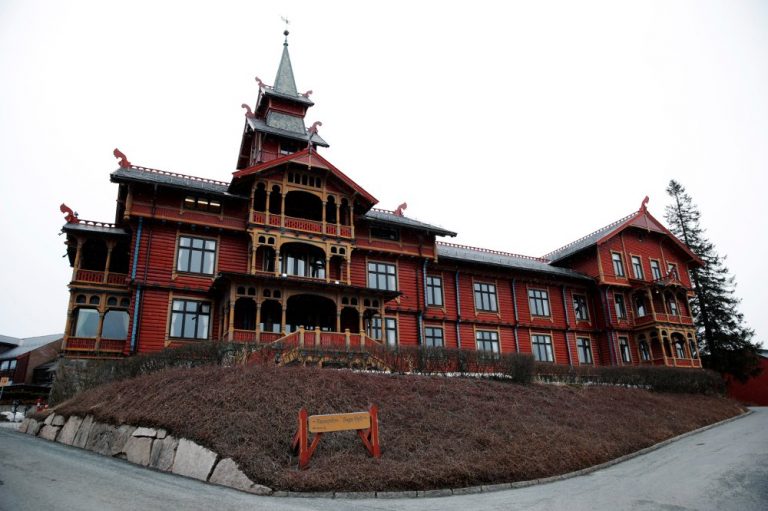
The hotel at the top of Oslo will consist of 376 fantastic rooms and suites, of which 27 will be located in the unique Dragon Building. The modern conference area will have a capacity of up to 1200 people, and in addition, the hotel will offer a new à la carte restaurant and bar, a well-stocked wine cellar and a spa area with swimming pool. Those who want to exercise can frolic on 1100 square meters of exercise facilities.

Scandic Holmenkollen Park Hotel In Oslo Will Soon Shine Again
The number of beds will be increased by 304. Here from one of the suites.

«There will be something for everyone here. The hotel is perfectly located for those who love nature, and the view of the city and the fjord is unique. Here you can exercise and make use of wellness facilities, or simply drop by for a bite to eat with friends or your partner», says hotel director Kristian Fredrik Mehus.

Related: Magnificent Mountain Hotel in Norway

Unique hotel
The hotel is located next to the national monument, Holmenkollen ski jump, and you can easily get there using the metro, which runs several times an hour. Scandic Holmenkollen Park has a unique and exciting history that extends over 127 years, and this will be cultivated and refined when the hotel now has a newer and more modern look.

Scandic Holmenkollen Park Hotel In Oslo Will Soon Shine Again
«There will be something for everyone here”, says hotel director Kristian Fredrik Mehus

«This is the city hotel in the forest, it is national history and it is the main hall at the top of Oslo. There is art history on the walls and great architecture. There are no other hotels like Scandic Holmenkollen Park, and now I am very much looking forward to opening the doors to the public», says Mehus – and adds that they are aimed at both local, national and international guests.

Scandic Holmenkollen Park extends over nine buildings, and one of those that is now undergoing an extensive “makeover” is the main building. The lobby and à la carte restaurant will form the center of the building, and with a large, open fireplace, this will be a natural gathering place for guests. The hotel’s unique history and many art treasures will also be highlighted.

Related: By Tramcar in Oslo

Scandic Holmenkollen Park Hotel In Oslo Will Soon Shine Again
From the spa area

City hotel by the forested and hilly areas surrounding Oslo
“Here you will find adventurous tapestries by Gerhard Munthe and paintings you would otherwise have to visit the National Gallery to experience. History and art will play an important role in the newly restored hotel, and tells the colorful story of a hotel that has been visited by some of the world’s greatest artists throughout the years”, says Mehus – and highlights Edvard Dirik’s picture “Seterhytte i Nordmarka” from 1888 .

“This is a unique picture that has been exhibited here for over 100 years, and before that at Holmenkollen Turisthotell. It represents in many ways the hotel’s DNA, and is one of the few objects that were rescued from the fire in 1895. It will have a prominent location in the main building, and in the same way as the cottage in the picture, Scandic Holmenkollen Park will be a comfortable and safe place to seek refuge», he continues.

Scandic Holmenkollen Park Hotel In Oslo Will Soon Shine Again
Inside the main building

There are also great expectations attached to the renovation of the Dragon Building, which is considered one of the main works in the Norwegian dragon style. The architectural gem will, in addition to accommodating state-of-the-art conference facilities, include 27 fantastic rooms and suites and a wine cellar. Together, the offer and all the various elements will contribute to making Scandic Holmenkollen Park a unique and continental metropolitan hotel right on the border with the countryside.

Scandic Holmenkollen Park Hotel In Oslo Will Soon Shine Again
Bedroom in one of the suites

The proximity to nature and the exceptional views give the buildings and the experience a very special setting. «Staying here should be an experience you do not get anywhere else. This beautiful and traditional hotel will shine again. We will make sure that guests will fall in love with the unique product we are about to create», says Mehus.

Scandic Holmenkollen Park opens in June 2022.

Scandic Holmenkollen Park Hotel In Oslo Will Soon Shine Again, a press release from Scandic Hotels Norway

All images © Scandic Hotels Norway

The Return of Copenhagen Fashion Week

0
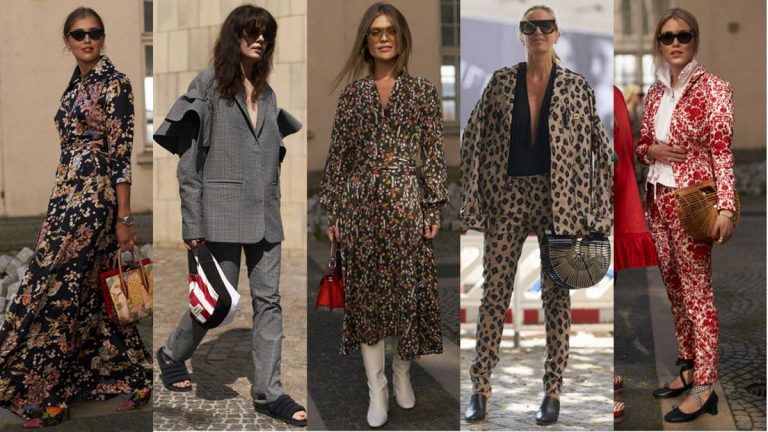
Once again has Copenhagen put Scandinavia on the fashion connoisseurs’ radars. Last week, fashion professionals from all over the world could again visit Copenhagen Fashion Week and experience international fashion houses and Nordic brands as well as emerging talents. The long-awaited return of Copenhagen Fashion Week this winter was finally a reality.

The Nordic countries’ most influential and fabulous fashion event could last week again present new collections on the catwalk by international fashion houses, Danish designers and the next big up-and-coming talent. Copenhagen Fashion Week is, as always, the place to spot who will be influential in the industry. Many visitors might also know what we will all be queuing to wear this autumn.

The Return of Copenhagen Fashion Week
Chief executive at Copenhagen Fashion Week Cecilia Thorsmark

Related: Interesting Up And Coming Norwegian Fashion Designer

For autumn/winter 2022 rising talents like A. Roege Hove and (Di)vision were showcased alongside internationally renowned Nordic brands like Ganni, Stine Goya, Holzweiler, Saks Potts and Marimekko.

Zalando Sustainability Award
A press release from Copenhagen Fashion Week announced that “The AW22 edition would also see a welcome return to the likes of Martin Asbjørn and Wood Wood. The event will also place sustainability at the forefront with the third season of the Zalando Sustainability Award. Finalists Iso.Poetism by Tobias Birk Nielsen, Fassbender, and Tomorrow Denim all presented their collections in the official Zalando venue, and the winner turned out to be Iso.Poetism by Tobias Birk Nielsen.

Related: Denmark’s Adored Fashion Designer

The Return of Copenhagen Fashion Week
TomorrowDenim (brand image)

With a focus on sustainability and a nod to getting rid of ‘fast fashion’, Copenhagen Fashion Week has been rethinking fashion and the core values of their shows and events since a 2018 metamorphosis. It’s a big ambition, but CFW aims to promote sustainability in fashion – something that has a huge impact on the environment as disposable fashion has taken hold of Europe and the US.

The future of Nordic fashion
Chief executive at Copenhagen Fashion Week Cecilia Thorsmark said in a statement: “As we continue to focus on the responsibility of our industry to incubate and strengthen the future of Nordic fashion, we are excited to welcome Jade Cropper as this season’s Talent and take the opportunity to introduce her exceptional vision to our international audience.”

Related: FASHION: Women to Women in Copenhagen

The Return of Copenhagen Fashion Week
Nenrik Vibskov’s Sustain was participating

Turning to menswear, the fashion week featured men’s looks with a curated selection from Schnayderman’s and (di)vision. And more well-known designers from Henrik Vibskov, Soulland, Wood Wood, Martin Asbjørn and Samsøe Samsøe included menswear in addition to womenswear.

The Return of Copenhagen Fashion Week, written by Tor Kjolberg

Short Stories by Scandinavian Artist Duo

After well over a year of lockdowns and restrictions, the dynamic Scandinavian artist duo known as Elmgreen & Dragset relished last year the opportunity to finally travel internationally again. And judging from their current projects, the two have been extraordinarily prolific over the course of the past year and a half. Read more about the short stories by the Scandinavian artist duo.

Based in London and Berlin, Michael Elmgreen (b. 1961, Denmark) and Ingar Dragset (b. 1969, Norway) have worked as a collaborative duo since the mid 1990s.

Well-known for siting a Prada boutique in a Texan desert in 2005, the artists have been commissioned to create a number of sculptures internationally within the public realm: in 2016, their large-scale work Van Gogh’s Ear, which takes the form of a displaced swimming pool sitting upright, transformed the Fifth Avenue entrance to the Channel Gardens at the Rockefeller Center, New York; A Greater Perspective, an oversized and non-functional bronze telescope, was installed on New York’s High Line from 2015 to 2016, simultaneously drawing attention to and disrupting a secret view of the Statue of Liberty.

Related: Scandinavian Artist-Duo Curated Politically Fraught Istanbul Biennial 2017

Short Stories by Scandinavian Artist Duo
Based in London and Berlin, Michael Elmgreen (b. 1961, Denmark) and Ingar Dragset (b. 1969, Norway) have worked as a collaborative duo since the mid 1990s. Photo: Ariel Reichman

A Space Called Public
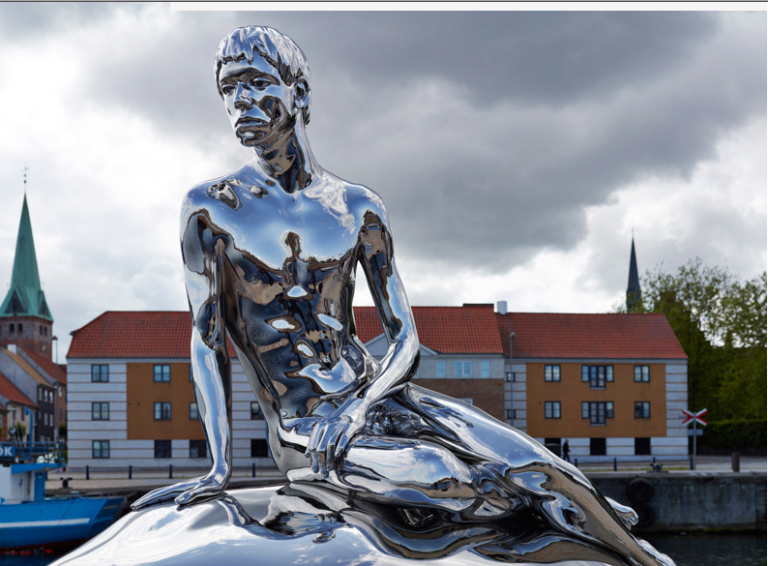
HAN, a contemporary revisioning of the Danish national icon The Little Mermaid, was installed permanently at Kultureværftet Helsingør, Denmark in 2012; Powerless Structures, the winning proposal for the Fourth Plinth Commission selected by the City of London, was on view in London’s Trafalgar Square from 2012 – 2013; and in 2012 the artists were commissioned by the Munich city council to create and curate a program of installations across Munich’s main squares.

The resulting year-long artistic project, A Space Called Public / Hoffentlich Öffentlich, included the artists’ own work as well as the work of a number of other contemporary artists.

Short Stories by Scandinavian Artist Duo
Bent Pool by Elmgreen and Dragset 2019. Courtesy by the artists. On permanent display at Pride Park, Miami Beach, USA © Elm Photography by Andrea Rosetti. 

Melancholy in New York
The duo’s last exhibition was in New York in December 2021. It was a melancholic exhibition, a cautionary message in a city that, at least until the arrival of the Omicron variant, has been dizzy with optimism. The show’s title, “The Nervous System,” was a sly reference to the widespread fear and uncertainty experienced by many during lockdown.

Related: Scandinavian Impressions by 9 Contemporary Female Artists

Short Stories by Scandinavian Artist Duo
The Painter

As Elmgreen & Dragset explain, ‘the artist’s role is to go against short-term memory. This is one of the few tasks we have.’

In a world that seemed swept away by promises of a brighter future post-pandemic, the duo wished to remind American citizens that there are longstanding problems to be dealt with: among them the climate emergency, gun violence and toxic masculinity.

The New York exhibition occupied the entire first floor of the 25th Street space, as “a surreal depiction of a dysfunctional home within the gallery’s walls.” In this mise-en-scène, an elderly, shirtless man snoozes in a wheelchair, not far from a marble fireplace which is engraved with block letters: “The Oracles Are Gone And Lost Are The Gods.” The artists made it clear that the works are open to interpretation: “Is the entire scene real or just in this man’s head?” asks Elmgreen with a playful smile.

“We’d be wise to tackle them head-on, lest we find ourselves left with a pair of perforated wellies when the waters rise,” said the organizers.

Related: Swedish Art History on Display in Denmark

Short Stories by Scandinavian Artist Duo
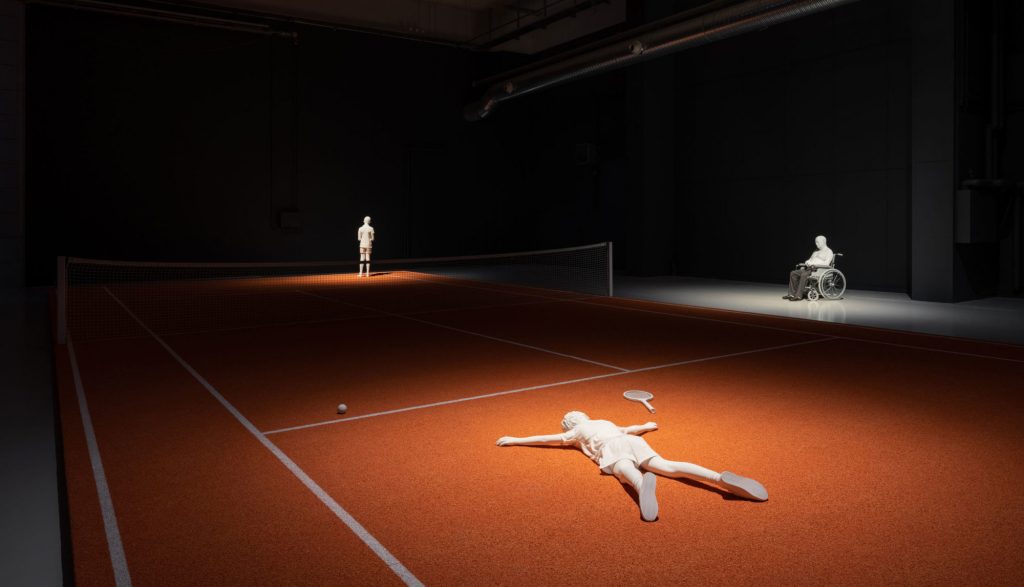
In April, Emgreen & Dragset transformed Copenhagen Contemporary’s Hall 2 into the setting of a tennis court. Photo by David Stjernholm

An older-model stationary Mercedes-Benz wagon white with Russian license plates in Switzerland
In September, Elmgreen & Dragset exhibited at Art Basel in Switzerland. The duo’s sculptures and installations broached consumer culture and sexual politics with mordant humor and unveiled a new piece at Art Basel’s Unlimited, the fair’s section devoted to oversized art—the first time a work from there had been shown outdoors.

Their outdoor art installation on the Messeplatz created a sensation. The Outsiders (2020) featured an older-model stationary Mercedes-Benz wagon, white with Russian license plates, that visitors wandered up to before curiously peering through the windows at two lifelike figures spooning and sleeping in their car amid packing tape, labels, installation tools and various empty bags of chips and snacks.

Short Stories by Scandinavian Artist Duo
The Agony and the Ecstacy, 2014

According to the artists, the story behind the work is of two financially strapped art handlers who drive to the fair for work but have to sleep in their car—as much an ode to love as to the hard work that goes into staging and putting together a spectacle like an art fair.

Short Stories by Scandinavian Artist Duo
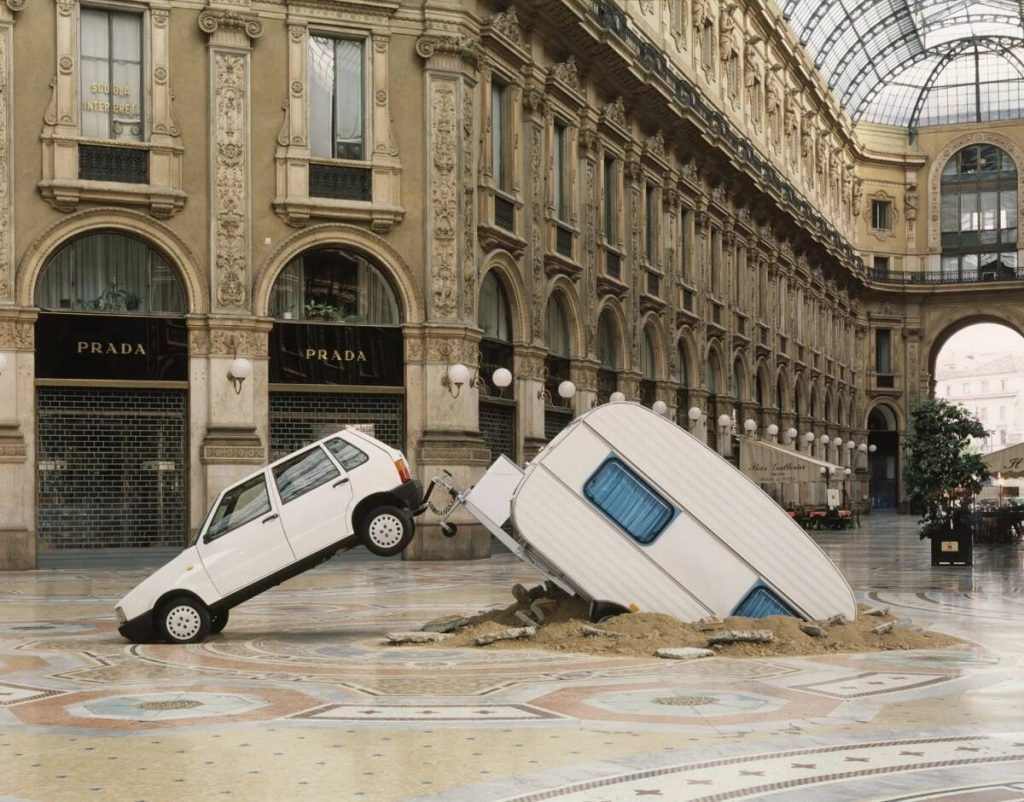
Short Cut 2003. Mixwd media installation, Milan – Italy.

The work also functions as a wry nod to the expense of accommodation in Switzerland. “We can hardly afford a hotel room in Basel if our gallery isn’t putting us up,” Ingar Dragset jokes. Moreover, it even draws partial inspiration from a real-life experience: Elmgreen recalls sleeping overnight in a car with the artist Olafur Eliasson during Documenta 9 in 1992, but “nothing happened, not even spooning. He’s open minded but maybe not in that way”.  “You know, we’re old rats,” says Ingar Dragset, referring to himself and his longtime creative partner, Michael Elmgreen.

Short Stories by Scandinavian Artist Duo
Dilemma. AInstallation at Ekebergparken, Oslo

Working in a 1920s Berlin water-pumping station
In June, the prolific duo worked in a 1920s Berlin water-pumping station resulting in some of the most evocative and smartly provocative art of their 25-year collaboration. In 2020, the duo marked 25 years of making art together as Elmgreen & Dragset, known for their witty, irreverent sculptures and installations that subtly subvert entrenched social codes and power structures using playfulness, beauty, even delightful absurdity.

Full-size tennis court in Copenhagen
In April, Emgreen & Dragset transformed Copenhagen Contemporary’s Hall 2 into the setting of a tennis court. When entering the gallery space, visitors encountered an almost full-size tennis court, slightly raised off the ground. The net and the painted lines marked the rules of play on the orange-brown court, framing a silent scene where three figurative sculptures Flo, Kev and Bogdan were the protagonists.

The Short Story in Copenhagen unfolds a battlefield, where the white-painted bronze sculptures of two young boys are positioned as if they’ve just finished a match. The boys look lonely and somehow lost on the large plane of the tennis court. Their bodies and faces are turned away from each other – the dialogue and play between them seems to have come to an end. Rather than joy, a discomfort seems to have arisen from the game, for both “winner” and “loser”. The sculpture Flo stands with his back to his opponent, Kev, and stares at the trophy he appears to have just won. But rather than seeming proud of his victory, Flo looks remote and pensive. Kev, who lies face down on the opposite side of the court, seems subdued by his defeat.

Short Stories by Scandinavian Artist Duo
The artists make it clear that the works are open to interpretation

Expanding the reality
“Many of our works are not only a comment on an existing reality,” says Elmgreen. “They are sort of an expanding of reality by making a magic moment, making our boring, everyday lives a little bit more mysterious.”

He adds, “Our mood board is always our upcoming exhibitions. The titles alone probably say it all: “The Nervous System” at Pace New York; “It’s Just a Phase” at Kjøpmannsgata Ung Kunst in Trondheim, Norway (until 13 February); and “Useless Bodies?” at the Fondazione Prada, Milan, spring 2022.

Short Stories by Scandinavian Artist Duo, compiled by Tor Kjolberg

The Scandinavian E-Commerce Market

For more than 50% of Scandinavian consumers, the cost of delivery is the major consideration when ordering online. In third place is the speed of delivery. So, the ability to choose where the shipment is delivered and the cost of delivery are important issues in the Scandinavian E-commerce market.

Scandinavia is a region in Northern Europe consisting of Norway, Sweden and Denmark. These countries, together with Finland and Iceland, also form the Nordic countries. E-commerce in Scandinavia has its own characteristics.

Prefer shopping from native eCommerce platforms
Unlike most of the regions in the world where giants like Amazon & eBay dominate the market, the Nordic & Scandinavians prefer shopping from the native eCommerce platforms. Such unique shopping trends make it simpler for retailers to sell on Nordic marketplaces. The top marketplaces in the region include – Cdon, Elgiganten, Fyndiq, Zalando, and Wish.

The Scandinavian E-Commerce Market
Top 12 countries in terms of their market share of European e-commerce

Related: Strong E-Commerce Growth For IKEA

When it comes to delivery methods, there are some differences between countries. 34% of Danish customers prefer home delivery, with signature. While this is not the favored delivery method in Sweden, Finland, and Norway. Delivery via mailbox is the preferred method for 31% of Swedes, and in Norway, it is even 44% of consumers.

Clothing, footwear and pharmacy most purchased products
Scandinavia is a bit of a remote area in Europe, surrounded by the Norwegian Sea, the North Sea, the Baltic Sea and the Gulf of Bothnia, so it is not a very easy region to quickly gain success with ecommerce company newcomers. However, there’s still a lot of unused potential.

For the past decade, eCommerce in Scandinavia is surging and has touched an all-time high. In fact, the total market spendings on online shopping have spiked to 13 billion US dollars in just Sweden. The region opens up infinite opportunities for retailers to build and scale small-medium-sized businesses. And the best part is that you need not be a native Scandinavian to set a firm foot in these commerce-rich grounds.

The Scandinavian E-Commerce Market
Debit and credit cards are the preferred payment methods. Photo: Pickawood/Unsplash

While clothing and footwear are the most purchased products online with over 50% in Denmark and Norway, in Sweden pharmacy products are the most purchased products online with 69%, followed by clothing and footwear with 61%. Home electronics are also popular products, and around two million Nordic e-commerce consumers bought CDs last year.

Related: E-commerce in Scandinavia

Monthly purchases from international websites
Figures from ecommerceDB show that Norwegian consumers spent about 7 billion US dollars in 2020. Travel was the largest market segment by sales value. Sweden has the biggest ecommerce industry in the whole of Scandinavia and even the Nordics. Ecommerce consumers in Sweden spent a total value of about 13 billion dollars in 2020, while Ecommerce in Denmark was approximately 6 billion US dollars.

The Scandinavian E-Commerce Market
Over one-third (36%) of online consumers in Scandinavia make monthly purchases from international eCommerce websites. 

Over one-third (36%) of online consumers in Scandinavia make monthly purchases from international eCommerce websites. r, followed by home electronics. Around two million Nordic e-commerce consumers bought CDs that year.

The Scandinavian E-Commerce Market
Clothing and footwear are the most purchased products online. Photo Hian Shop

Debit and credit cards are the preferred payment methods.

Related: Swedes Welcome Amazon

The Scandinavian E-Commerce Market – conclusion
eCommerce in Scandinavia is rapidly evolving and opens up ample opportunities for online sellers, in Scandinavia as well as in the rest of the world. Scandinavians love to shop and retail is shifting towards the online approach. Approximately1/3 of the Scandinavian population shop online.

The Scandinavian E-Commerce Market, written by Tor Kjolberg

Feature image (on top) © Photo by Andrew Neel / Unsplash