St. Moritz of the North

0

Once known as, ‘The St Moritz of the North’, Norway’s Geilo ski resort, has been a popular tourist destination since the late 19th century.

Here are some really great destinations for winter with beautiful winter scenery and great adventures awaiting you, some of them not even far away!

270116-Geilo-skiing
Norway doesn’t get enough attention as one of the top winter sports locations in Europe. The village of Geilo, located midway between Oslo and Bergen, is a true winter paradise.

Imagine: a nice hot cup of tea or coffee and a light breakfast, then bundle up and out into nature. It doesn’t always have to be the standard downhill or cross country skiing or riding a sleigh. Have you heard of snowkiting, ice diving or ice climbing?

270116-snowkiting-in-haugastol-norway
Boasting 39 downhill slopes, over 500 kilometres of marked cross-country skiing pathways, 5 snowparks and a dedicated children’s area, you’ll never want to leave once you arrive.

270116-geilo-map
Waymarked trails in and around Geilo are dotted with adorable little huts serving hot chocolate and other warming treats to keep you going as you ski your way around the area.

After getting active outside you then go home, light the fireplace, get into a hot sauna and let the day wear out. This sounds like the perfect combination, doesn’t it?

Geilo by night
Geilo by night

Geilo’s skiing really took off in the early 1950s when the first ski lifts were installed. This was the resort’s heyday, when international tourists were drawn by cheap prices and quality powder.

Today the area between Geilo and Haugastol is one of the best places in the world for snowkiting! The Hardengervidda plateau offers endless lakes and hills that are perfect for this sport. And plenty of wind of course! Standing on a snowboard or a pair of skis you are pulled along by your snowkite. Geilo is in fact one of the few places in the world where you can try out snowkiting!

Harakiri Snowkiting Trip to Geilo 2015

Depending on how skilled you are you can get pretty fast and can maybe even try a jump! Everybody can snowkite and it is a lot easier to learn than surfing on water if you are thinking about your own feeble attempts at standing on a surfboard. Still, it makes sense to visit a snowkiting school first to learn the most important tricks from a pro.

270116-snowkiting
Geilo is situated in the mountain region of Hallingdal, in south-central Norway’s Buskerud County. It is overlooked by the Hallingskarvet mountain range (the highest peak is the 1,933m/6,342ft Folarskardnuten) and bordered by Hardangervidda, the largest mountain plateau in Northern Europe.

270116-geilo-map
Geilo is a very pleasant resort, emphasized by its title as a ‘National Park Village’, due to its close proximity to the large national parks of Hardangervidda and Hallingskarvet. It is also easily accessible, located halfway along the main route between Norway’s two largest cities, Oslo and Bergen.

St. Moritz of the North, compiled by Admin

People and Trolls in Copenhagen

“Does humor belong in Art?” asks Sverre Følstad, an expert on the Norwegian artist Theodor Kittelsen (1857-1914). Of course, it does! Danish Robert Storm Petersen (1882-1942), better known as Storm P., has proved this by transforming his parody of ordinary life into fine art. Now you may experience the works of Theodor Kittelsen at the Storm P museum in Copenhagen. The exhibition opened yesterday, 21 January.

Self portrait
Self portrait

Who was Theodor Kittelsen?
Few artists have been more understood and loved by Norwegians than Theodor Severin Kittelsen, best known for his drawings of trolls, illustrating the collection of Norwegian fairy tales by Asbjornsen and Moe. As a young boy he was “discovered” and was given free lessons by the architect Wilhelm von Hanno at the School of Art in Christiania (today Oslo).

After two years with von Hanmo, Kittelsen was granted sufficient financial support to continue his studies in Munich.

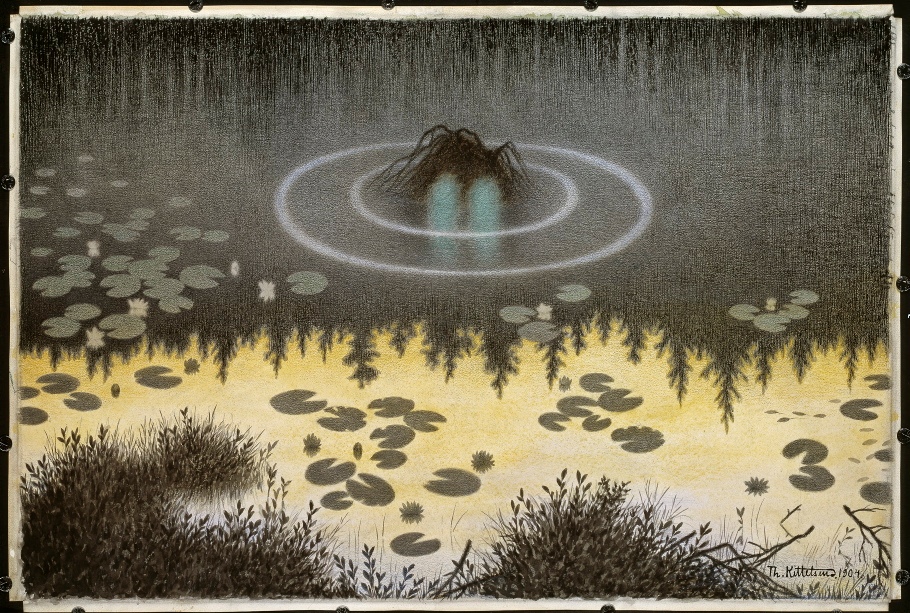
Water sprite
Water sprite

His first encounter with sea ghosts and the water sprite was when he joined forces with his sister and brother-in-law, who made their way north to tend a lighthouse on the wind-swept little island of Skomvær in Lofoten.

150216-troll-by-theodor-kittelsen
He wanted to make a book named “Troll Magic” together with the novelist Jonas Lie, who was to write the text. However, nothing came of this, and Kittelsen became responsible for both drawings and text.

In 1910 Kittelsen was a sick and broken man. The civil grant for his artistic achievement, voted him by the Norwegian Parliament in 1911, was a great source of encouragement.

Troll in Karl Johansgate (main street) in Oslo

In 1912 he purchased a property at Jeløya near Moss, with Edvard Munch at Grimsrød as his nearest neighbor, where he died January 21, 1914.

Some trolls may appear as fairly harmless, merely mischievous, or very tiny creatures. Others are huge, absolutely gigantic, frightening or downright terrifying.

According to some Norwegian fairy tales, trolls only come out at night. If exposed to the sun, they could turn into stone – like when they’re cursed. Theodor Kittelsen shows us what might happen when a mountain troll sees the sun.

Winter evening
Winter evening

The exhibition at the Storm P Museum  in Copenhagen, “Life and Death, People and Trolls”, consists both of original drawings to the fairy tales and his own series “Have animals got soul?” and “The Black Death”, drawings, wooden work and works in different techniques.

Kittelsen completed the illustrative work “The Black Death in 1896, and this his highest peak of achievement as a black-and-white artist.

The basis for the exhibition is borrowed from Blaafarveværket, with additional loans from other art galleries and private collectors.

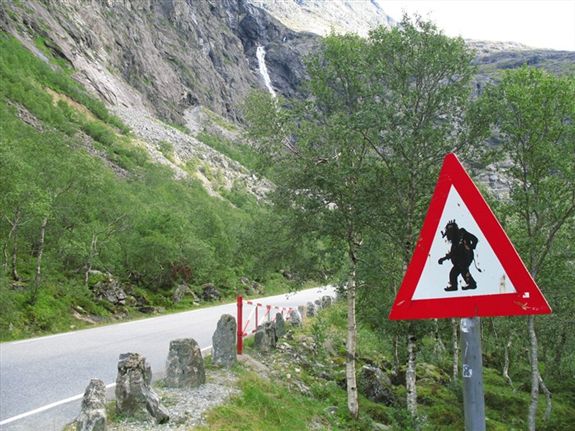
Maybe you don’t believe that trolls exist. But if you happen to be traveling on Norwegian roads, watch out. You just might see a “Troll Crossing” sign!

150216-troll-crossing-sign-in-norway
The exhibition runs through 17 April.

People and Trolls in Copenhagen, written by Tor Kjolberg

A Danish Furniture Icon

0

Børge Mogensen (1914–1972) started his career as a cabinetmaker in 1934. In 1936 he went on to study at the Copenhagen School of Arts and Crafts under Professor Kaare Klint before entering the Royal Academy of Fine Arts from where he graduated as an architect in 1942.

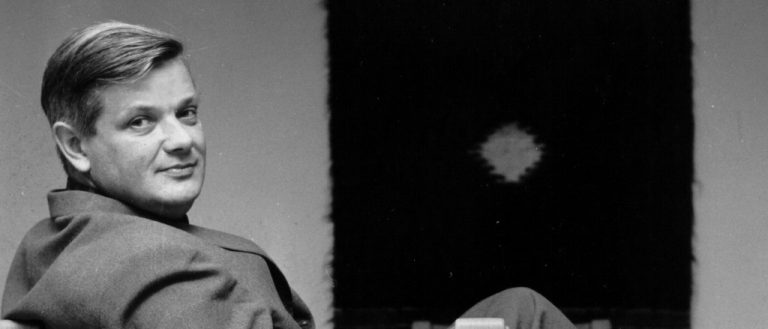
210116-borege-mogensen-portraitHe became head of design at FDB (the Danish co-op) in 1942 before establishing his own design office in 1950.

During his years at the Copenhagen School of Arts and Crafts the young Mogensen developed a close partnership with his mentor Kaare Klint and subsequently also assumed Klint’s approach to simple and functional furniture design. Later on Mogensen was to work as Klint’s teaching assistant at the Royal Academy.

Børge Mogensen was one of the most influential designers in shaping Danish Modern design and present day Fredericia’s founding designer from 1955 until his death in 1972. He found inspiration all over the world in his quest to create everyday objects that would endure for generations. Mogensen’s most recognised pieces were developed during his collaboration and friendship with Fredericia CEO Andreas Graversen.

Functional is the word which best describes Børge Mogensen’s design. The majority of his furniture was designed with industrial production in mind and is characterized by strong and simple lines. His true genius is to be found in his almost scientific analysis of the functionality of a piece of furniture.

Spanish chair
Spanish chair

A smaller but essential part of Mogensen’s work was the cabinetmade pieces, one of them being “the Hunting chair” from 1950 made by Erhard Rasmussen. A simple low easy chair with an oak frame from where the strong natural leather seat and back is stretched.

Fredericia oak sofa
Fredericia oak sofa

In 1948 Mogensen participated in MoMA’s international furniture competition ”low-cost furniture” together with his friend Hans J Wegner. Back home in Denmark, inspired by the exhibition, he experimented with plywood shells and fused the international modernist movement with his own design identity. Mogensen also found inspiration in ethnic arts & crafts, lithography and Japanese wooden carvings.

Shell chair 1949
Shell chair 1949

In 1950, the Copenhagen Cabinetmakers’ Guild’s exhibition presented furniture under the theme ”A Hunting Lodge”, in which Mogensen had, for the first time, designed furniture using a solid wood framework with saddle leather forming the seat and back. The methodology was inspired from medieval Spanish furniture construction, something that Mogensen would return to time and time again.

Sofa 1945
Sofa 1945

Other important pieces include “The Spokeback Sofa” designed in 1945, which with its lightness and simple, open construction differed from most sofas at the time, and “The Spanish Chair” from 1959, a low, robust easy chair.

Fredericia has had the rights to Børge Mogensen’s design since 2005.

Soborg Madklubben Vesterbro, Copenhagen

In 2014, Madklubben Vesterbro had 128.698 visitors, making the restaurant the most frequented in Denmark, according to the online booking portal, DinnerBooking. Søborg by Børge Mogensen was chosen as the dining chair for the popular restaurant.

Low chair
Low chair

The lacquered oak version of the chair with black steel frame lends an industrial expression, which fits into the rough, urban style of the restaurant. Most importantly, Søborg provides excellent seating comfort for enjoying a night out.

Feature image (on top): Photo Villy Lund

A Danish Furniture Icon, source: Felicia.com

A Room With a View

0

Norwegian photographer Knut Bry worked several years taking photos in Balestrand, a municipality and tourist attraction located by the Sognefjord in Norway. Writer Idun A. Husabø was working alongside Knut and has written a series of essays about people living in Balestrand.

The book was published by Skald (in Norwegian only).

260116-Balestrand-Norway-Knut-Bry-book-cover
One evening in the late 1990s Knut Bry photographed the view east from room 222 at Kviknes Hotel in Balestrand. After the photo was published in the column “A Room With a View” in the travel magazine Condé Nast Traveler, room 222 became especially popular.

260116-room-with-a-view-kviknes-hotel-balestrand-norway
“Relatively unchanged since the time of the Vikings, the country boasts some of the world’s most beautiful landscapes,” wrote Condé Nast Traveler.

260116-kviknes-hotel-balestrand-norway
Kviknes hotel is one of Norway’s largest tourist hotels. The hotel houses an extensive collection of artworks and antique and its view of the Sognefjord is mesmerising. So much so that the hotel has had its fair share of celebrity guests including several prime ministers, presidents, royal families and film stars.

It’s difficult to describe a place when you feel there are no words that do it justice. This is exactly the kind of effect Balestrand has on people.

260116-balestrand-map
Suzel, the managing director at Taber Holidays in Great Britain claims that “Balestrand is her favourite place in the world.” That’s a huge compliment from a woman who has travelled the width and breath of Norway, as well as all the other Scandinavian countries.

The mountains in the distance, the reflections of the sky and the water creating a special light have attracted artist from all over the world since the late 1800s. The paintings of these artists have been exhibited abroad and basically functioned as the first tourist brochures. In Kviknes Hotel you can experience historic photos and paintings og artists for whom Balestrand was the source of inspiration.

“Most people think the First World War broke out when Franz Ferdinand, the Austraian Crown Prince, was shot” Sigurd Kvikne, the hotel owner, told us, showing us a chair. “But it didn’t. It brought something in motion, there was an ultimatum and alliances were formed, so the tension grew over the weeks after the shooting. But where do you think the German Emperor, Kaiser Wilhelm II, was at the time the war broke out? He was here in our hotel, sitting on this chair.”

Even the threat of war did not stop this loyal and royal guest from going on his annual holiday to Balestrand.

A Room With a View, written by Tor Kjolberg

Scandinavian Borders and Migration

0

The Oresund bridge between Sweden and Denmark has been a towering symbol of European integration ever since it opened in 2001. New travel restrictions imposed by Swedish authorities are an example of how national boundaries are re-emerging.

The Finnish government has also decided to strengthen its border surveillance after several hundred illegal migrants have entered into Finland via Sweden.

 Anti-migration protesters attend a rally at the border town Tornio between Sweden and Finland, 03 October 2015.
Anti-migration protesters attend a rally at the border town Tornio between Sweden and Finland, 03 October 2015.

Previously the Scandinavian countries thought that refugees would come in a controlled fashion they have now awakened to the reality, and now Norway, as several other European countries, considers introducing passport control. Norwegian authorities have realized that a large part of those who come to Sweden will head to Norway, because Sweden is about to collapse under the massive migration.

Sweden received more than 160,000 asylum-seekers last year, mainly from Syria, Iraq and Afghanistan.

110716-Stockholm-Station-Migration
The idea of a borderless Europe, where you could pass borders from Spain to Denmark and the south of Norway has now been killed.

“The refugee situation in northern Finland is out of control,” says Minister of Interior, Petteri Orpo to the television station Yle.

Oetteri Orpo
Petteri Orpo

When Finland criticized the Swedish railway (SJ) for allowing illegal migrants to travel from Sweden to Finland, SJ justified this decision and claimed that the state railway wanted to “act kindly and humane”.

There has been large amounts of asylum seekers, everything from a dozen up to about one hundred per train,” said the Finnish railway’s Communication Director Mika Heihari to Yle.

Hundreds of thousands of refugees from the Middle East and Africa is now going through southern Europe with only one goal, Germany and Scandinavia.

Now Swedish politicians claim they will probably have to take up big loans to finance the hundreds of thousands of refugees and asylum seekers who are expected this and the coming years. The Swedish economy is simply not prepared for such enormous costs.

Øresund bridge
Øresund bridge

Andreas Orrefors, an associate professor in intellectual history, who lives in Lund, on the Swedish side of the Oresund Bridge, says that the clock has been turned back.  “We’re going back in time when the bridge didn’t exist,” he says. He’s studied on both sides and taught students from both Sweden and Denmark.

Closing the borders in Scandinavia is supposedly temporary but is likely to be extended if Europe’s migrant crisis continues in 2016.

Only in Finland 150 people have been assigned specifically to handle the migration chaos.

Mark Rhinard
Mark Rhinard

Refugees in Sweden, not satisfied with being housed in abandoned military camps, cottages and former manors, are heading for the neighboring country, Norway, where welfare benefits are even better and the system not yet broke.

“It’s basically every country for itself now,” said Mark Rhinard, an expert on the European Union at the Swedish institute of international Affairs.

Refugees crossing the border from Russia to Norway reached an unprecedented number, and an agreement between Russia and Norway has been settled to stop the traffic there.

“There is a clause in the Schengen Agreement which gives member states the option of introducing border and passport control if one fears for national security,” says Secretary of the Norwegian Justice Department, Jøran Kallmyr.

Jøran Kallmyr
Jøran Kallmyr

Both the Danish and the Norwegian governments have taken a series of measures to discourage migrants from going there, including a proposal to seize their jewelry to cover their expenses.

Paal Frisvold
Paal Frisvold

“There are 22 million Syrians, and this has put enormous forces in action,” says EU expert Paal Frisvold. “”It’s an intersection here between openness and generosity and being caught off guard. I think this is clearly a sign that the situation is out of control.”

The new ID checks between Denmark and Sweden mean there will be no more direct railway service from Copenhagen’s main station to Sweden. Travelers heading to Malmo will have to switch trains at Copenhagen Airport after going through the checkpoints there, adding an estimated half an hour to the 40-minute commute.

Scandinavian Borders and Migration, written by Tor Kjolberg

Related post:
Immigration Tensions in Scandinavia

The World Celebrates a Fine Old Gentleman

Henrik Ibsen (1828-1906) is still considered one of the world’s greatest playwrights. 110 years after his death, you can visit the Ibsen museum in Oslo’s Arbins gate 1, and get an insight into his life and works.

200116-Henrik-Ibsen-2
Henrik Ibsen, the man with the full white beard, round glasses and top hat, used his sparkling pen to put into words how people think, live and feel. His portrayal of the individual’s personal fate at that time is still something which touches us today. Ibsen lived in the apartment in Arbins gate 1, which has been reopened to the public, for the last 11 years of his life.

200116-henrik-ibsen-museum-oslo
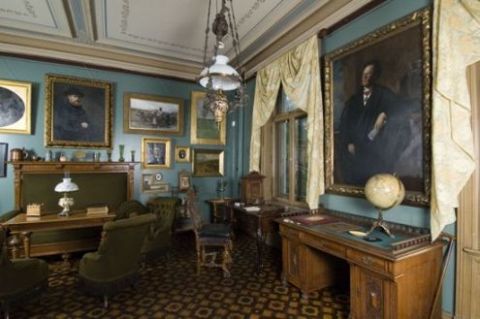
In connection with the Ibsen centenary celebrations ten years ago, the apartment was refurbished with the colors and interior details of Ibsen’s own day.

200116-henrik-ibsen-museum-oslo-interior-2
The workroom, where many of his plays were written, is still intact, and stands just as he left it.

200116-henrik-ibsen-museum-interior-oslo
John Gabriel Borkman (1896)and When the Dead Awaken (1899) are the last works Ibsen write in this room.

The World Celebrates a Fine Old Gentleman, written by Tor Kjolberg

You may also like to read:

In the Footsteps of Henrik Ibsen
(Please observe that Grand Café was closed down in September last year)

How to Save for Your Next Vacation…

0

Do you know how long habits take?

According to the University College London (UCL) on average it takes 66 days to change a habit.

But it all starts with the first step…

To break bad spending habits and start saving for your next vacation, here are four simple tricks:

1. Set up an automatic transfer to a savings account.  An automatic transfer of just $85 per month will save over $1,000 annually for your next vacation.

190116-Savings-Account
2. Skip the small stuff
like $5 coffees at Starbucks or $70 mani/pedis. Those small frivolous expenses add up fast and aren’t worth it.  Besides, it’s easy to make your own coffee and paint your own nails.
190116-skip-coffee
3. Keep a change jar in your kitchen as a daily reminder to control your spending.  Just before your trip, cash in the coins at a bank or coin machine.
190116-change-jar
4. Negotiate all the time.  I used to be a professional buyer and everything is negotiable, from groceries to cars. Simply ask “Is this price negotiable?” and you’ll be shocked at the number of “yes” responses you get.

190116-Negotiating
So why not try these new habits?  There’s nothing to lose.

How to Save for Your Next Vacation…, compiled by Admin

Internationally Acclaimed Norwegian Artist

0

Norwegian singer-songwriter Susanne Sundfør made headlines in international media, not least because of her latest album, “Ten Love Songs”.

“This is brilliant pop from Norwegian megastar”, wrote Alexis Petidris in the British paper The Guardian. “At its most straightforward, Sundfør’s songwriting can sound a little like Lana Del Rey without the cliched affectations and invented persona, but it’s hardly ever straightforward. Sometimes the contrast between Sundfør’s pop inclinations and her more avant garde impulses are as stark as the monochrome lighting”, he claims.
180116_Susanne_Sundfør_Ten_Love_Songs_Album_Cover Journalist Tim Jonze in the same paper wrote that Listening to Susanne Sundfør’s latest album, Ten Love Songs, made it tricky to predict what kind of artist you’re going to meet. But he concludes, “Ten Love Songs is one of the year’s best albums, and possibly one of the nerdiest, too”.

Journalist James Hall in the newspaper The Telegraph, puts it this way:

The 29-year-old Norwegian is a self-confessed pop nerd who loves Abba and Carly Simon along with Radiohead and Joni Mitchell. Yet she is also classically trained, as in thrall to Handel and Mozart as she is to Baroque music and Philip Glass.

180116-Susanne-Sundfør-poster
“Ten Love Songs, such an intriguing record. Released to much acclaim in February, the largely self-produced album comprises 10 ruminations on love,” he wrote.

She sees no inconsistency in these passions. It is the mingling of all these strands that makes her latest album, At the darker end of the spectrum are songs about bad relationships such as Kamikaze and Delirious. The latter includes the lyric “I hope you’ve got a safety net ’cause I’m going to push you over the edge”. The album also contains songs of yearning, such as the astonishing 10-minute Memorial, which starts as an epic ballad in the vein of Madonna’s Live To Tell before it veers off into an extended classical coda.

“Accelerate”, Official Music Video

About her sixth album, the Australian magazine DoubleJ wrote:

“While Norwegian singer-songwriter Susanne Sundfør is something of an unknown proposition in Australia, she’s practically a superstar in her home country. It remains to be seen whether her album Ten Love Songs will propel her profile elsewhere, but it certainly ought to.

180116-susanne-sundfor-ainger-songwriter
This is brilliantly crafted, mature pop music. Elements of dance music, prog-rock, synth pop and modern art/classical music combine to make perfect sounding dark pop songs that may seem uncomplicated on the surface, but pack plenty of sonic wonders when you delve in deeper.”

The magazine concludes that “this is a massive, beautiful sounding album and it has been shaped with laudable expertise. While it’s obvious that there’s enormous talent on show here, it’s easily accessible music too. We strongly doubt she’ll be an unknown around these parts for much longer.”

Internationally Acclaimed Norwegian Artist, written by Tor Kjolberg

Absolutely Scandilicious!

0

According to Norwegian chef, food anthropologist and author Signe Johansen, “people are tired of Italian and French, they are searching for something new and want to expand their spectrum.” In her book, “Secrets of Scandinavian cooking – Scandilicious”, you’ll find lots of food inspiration.

150116-Scandilicious-by-Signe-JohansenThe book contains more than 80 recipes with inspiring photography and we consider it the home cooking bible for those wishing to cook simple, easy and flavorsome Nordic cuisine without the Noma complexities.

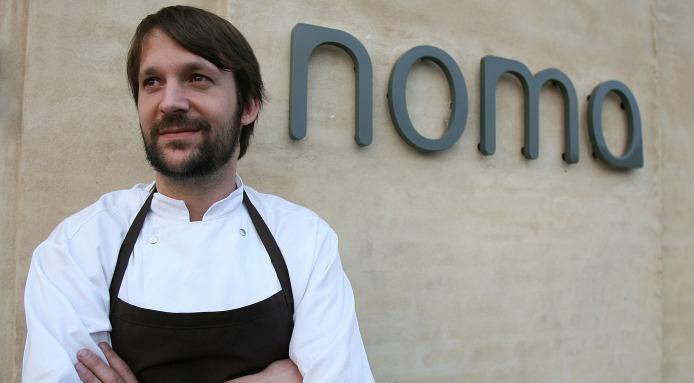
Signe Johansen reveals the skills and secrets behind Scandinavian cooking, a cuisine very much in the forefront since Norma opened people’s taste buds for Northern European vegetables and foraged goodies.

As the title promises, the book will reveal the secrets of Scandinavian cooking, from delicious healthy breakfasts and leisurely brunches to tasty suppers and plenty of stress-free crown-pleaser puddings. Signe Johansen will also teach you putting together the perfect smorrebrod for a speedy Scandinavian lunch and the best way to let cakes and biscuits accompany your afternoon cuppa.

150116-signe_johansen-book
According to Hip and Healthy, “the world of Scandinavian food is on the rise. The delectable combination of fresh seafood, delicious berries and whole-grains is enough to tempt healthy foodies across the globe.”

150116-signe-johansen-by-hip-and-healthy
The young cook, Signe Johansen, trained by the best British chefs, shows you that the Scandinavian kitchen not only consists of herrings and meatballs – although they are in here as well.

Rene Redzepi at Noma

The Danish acclaimed chef Rene Redzipi asserted that “if a “Nordic terroir” really exists, then it is firmly anchored in the wild, in foraging for local ingredients, in celebrating our maritime and hunting heritage and marrying that heritage with modern culinary techniques and flavors. Food in Scandinavia is perhaps best understood as a way of life, as an ecology, rather than a distinct cuisine. That philosophy of resourcefulness, a discreet frugality and a focus on provenance makes Scandinavian food distinctive but of course not unique.”

150116-scandilicious-cook-book
This book is fresh, light and surprisingly indulgent, this is food to lift your spirits – it’s quite simply Scandilicious! Measurements are metric.

150116-ultimate_student_cover
Signe Johansen, with a Norwegian father and English-American mother, is a food writer and cook who grew up in Norway and now lives in London. She trained at Leiths School of Food and Wine, and after graduating went to work for Heston Blumenthal in his Experimental Kitchen, at the Fat Duck in Bray. She co-wrote “The Ultimate Student Cookbook” with Fiona Beckett.

Saltyard Books published Signe’s first book Secrets of Scandinavian Cooking…Scandilicious. in 2011. Scandilicious Baking followed in 2013.

Absolutely Scandilicious!, written by Tor Kjolberg

A Wave of Nostalgia in Oslo

0

It is easy to forget how important typewriters were for the development of our modern society. Easy to forget what they meant for the development of the press and typography. And, not less, easy to forget how important they were for the entry of women into the workplace.

By learning “touch-typing”, a method which allows text to be written fast and accurately, the modern typist was born, indispensable in any modern office.

Veltman and Michelson 1842. Design by Russel G. Thompson

Touch or not, the arrival of the electric typewriter onto the market was a huge step forward. For that we can thank Russell G. Thompson, who invented it as far back as 1923.

We can also thank IBM, who launched the golfball typewriter in 1961, thereby putting an end to keys that were always getting jammed together. Ink cartridges also replaced ink ribbons. You know, the ones that were red at the top and black at the bottom.

281215-IBM-Selectric
I still have my first typewriter in my desk. But if you would like to see these old wonders, take a trip to the Museum of Science and Technology in Oslo and follow the rest of the story – from the first golfball machines to modern computer systems.

Rasmus Malling-Hansen 1887
Rasmus Malling Hansen 1887

Pastor Rasmus Malling- Hansen constructed this ‘typing ball’ to enable blind people to write more easily. It is one of the first typewriters to be mass produced. The machine cost USD 35, hugely expensive in its day. Although they were originally sold as a help for the blind, they were also bought by a number of companies for business correspondence.

Rasmus Malling-Hansen writingball

Malling Hansen was head of an institute for the deaf and mute in Copenhagen. His prototype was finished in 1867. The typewriter was  the first to be industrially produced (a total of 100 machines).


A Wave of Nostalgia in Oslo, written for Daily Scandinavian by Hans Helmersen

All photos Wikipedia