



The strongest brand stories are those in which customers become characters, contributors, and eventually storytellers. Read on to learn seven strategies for increasing customer participation in brand stories.
Two people buy the exact same running shoes. One simply owns another pair of shoes. The other becomes part of a worldwide community that shares training stories, celebrates personal victories, and inspires thousands of runners online. The product is identical. The story is not. The difference is participation. One customer purchased a product. The other joined a narrative.
Do you see why participation matters?
The most successful brand stories are no longer told to customers—they are co-created with them. Customer participation transforms storytelling from a one-way broadcast into a shared experience.
 Why participation changes everything
Traditional advertising positions the company as the hero. Modern storytelling positions the customer as the hero. People rarely tell friends about ads. They often share stories about experiences they helped create. Participation creates ownership. Ownership creates advocacy.
At Amdocs, a $4.5 billion provider of customer-experience software and services, showcasing marquee customers’ success stories is central to its marketing and PR efforts. “If we want to do something we think the press might also pick up, or for awards submissions, the bigger the name, the better,” said Stephanie Porter, Director of Relationship Marketing.
Seven strategies for increasing customer participation
- Invite customers into the story early
Don’t wait until after a purchase. Ask questions before customers buy, such as “Why are you looking for this?” “What problem are you hoping to solve?” or “What adventure are you planning?”
People enjoy talking about themselves, and their answers may become story material.
- Make customers the heroes
Instead of saying: “Our company has fifty years of experience,” tell the story of: “Maria finally climbed her first mountain after years of believing she never could.”
Customers remember people far more readily than corporate achievements.

- Collect stories continuously
Many companies gather testimonials once a year. Great storytellers collect stories every day. Potential sources include customer service, sales staff, support teams, social media, events, newsletters, and online communities.
Think of every employee as a story scout.
- Build communities rather than audiences
Audiences listen. Communities participate. Create opportunities for customers to exchange ideas, solve problems together, celebrate successes, and inspire newcomers.
When customers start talking to each other, the brand story grows on its own.
- Reward storytelling—not just purchasing
Many loyalty programs reward spending. Imagine rewarding customers for sharing experiences, mentoring new customers, submitting ideas, contributing photos, creating videos, writing travel journals, or helping other customers.
You reward contribution rather than consumption.
- Leave room for customers to add their own chapters
Don’t over-control the message. The strongest brand stories evolve. Encourage customers to adapt the story to their own experiences. Think of your story as an open book rather than a finished novel.
- Celebrate customer achievements
The customer’s success should be the headline. Instead of saying:
“Our software increased productivity,” tell the story of the entrepreneur who finally had evenings free to spend with family.
Stories about transformed lives resonate more deeply than stories about product features.
 The psychology behind participation
Incentives are a tricky topic when it comes to offering them in exchange for endorsements of your product or service. To both sides, it can feel like the customer’s endorsement is being “bought,” even if customers are genuinely happy with your solution. In fact, few large companies offer discounts in exchange for customer stories or other forms of reference activity.
Pure participation satisfies several fundamental human motivations. People want to belong and be recognized. They like to influence others, share experiences, leave a legacy, and learn from peers.
When brands support these motivations, storytelling becomes meaningful rather than promotional.
 Practical ideas for brand managers
Encourage readers to ask themselves:
- How many customer stories did we collect this week?
- How many customers became visible heroes?
- How often do customers create content without being asked?
- What percentage of our marketing comes from real customer experiences?
- Are we building conversations or simply broadcasting messages?
- Which employees are uncovering the best stories?
- What prevents customers from participating more actively?
These questions shift storytelling from a creative exercise to an organizational capability.
Seven Strategies for Increasing Customer Participation in Brand Stories – Conclusion
Brands do not own stories. People do.
Every customer arrives with a personal history, dreams, challenges, and ambitions. The most successful companies understand that their role is not to write the entire script but to provide a stage where customers can become the heroes of stories worth telling.
When customers share those stories with friends, family, and colleagues, marketing evolves into something far more powerful: a community of authentic voices. That is where brand storytelling reaches its greatest potential—not when a company tells its story, but when customers choose to tell it for the company.
 The Customer Story Participation Ladder
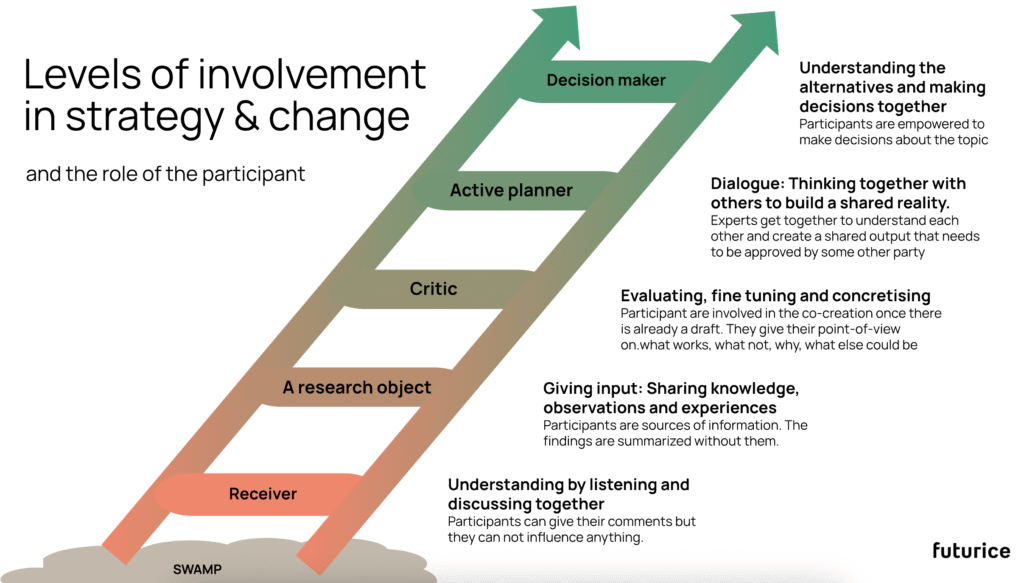
The Customer Story Participation Ladder shows that participation develops in stages rather than occurring all at once:
- Observer – Reads or watches the brand’s stories.
- Engager – Likes, comments, or responds.
- Contributor – Shares photos, reviews, or ideas.
- Co-creator – Helps shape campaigns, products, or events.
- Advocate – Voluntarily tells the brand’s story to others.
- Ambassador – Becomes a trusted voice whose experiences inspire new customers.
This framework provides brand managers with a practical way to assess where their customers are today and to identify initiatives that move them toward deeper participation. It also reinforces a key message: successful brand storytelling is not just about producing better content—it’s about creating more opportunities for customers to become active participants in the narrative.
 Take-away
If you learned something from this article, I believe you’ll also enjoy my recent book, “How I’ve Survived as a Storyteller for Over 50 Years: 12 Survival Techniques.” Get your FREE e-book copy by sending me your name and e-mail address, and including “Storytelling” in the subject line. Thank you for reading!
Seven Strategies for Increasing Customer Participation in Brand Stories, written by Tor Kjolberg.
More articles on Storytelling by Tor Kjolberg you may like:
Brand Masters of Storytelling 3
Stop Chasing Case Studies: Build a Living Library of Customer Stories
The Anatomy of a Brand Story for Destinations
Brand Stories Are Boring
Travel Stories Designed for the Adult Part of Our Population
Seven Strategies for Increasing Customer Participation in Brand Stories, written by Tor Kjolberg.
Great article, Tor. Your Customer Story Participation Ladder made me think less about the stages themselves, and more about what happens in the relationship as people move through them.
If participation is genuine, it may do more than create stronger brand stories. It can create experiences of influence, contribution, ownership and belonging — and that may change the relationship between people and the brand itself.
That led me to explore a slightly different question: not only how brands can increase customer participation in stories, but what participation needs to feel like for people to actually want to stay involved.
In other words, the story may be what invites people in, but the experience of participating may be what makes them stay.
I explored that perspective further here: https://hohoy.no/customer-participation/
Thanks for the inspiration, Tor.