



Not long ago, I read about a 19th-century narrative structure called Freytag’s Pyramid, used to plot emotional tension in plays and novels. Having used the AIDA formula in my brand storytelling for years, I began wondering whether and how the Pyramid might be applied to my storytelling mission. In this article, I elaborate on the difference between creative storytelling and direct marketing.
I realized that marketers, copywriters, and communication theorists often compare these two concepts. At their core, Freytag’s Pyramid and the AIDA formula both guide an audience through a progression, but they serve entirely different purposes—creative storytelling versus direct marketing.
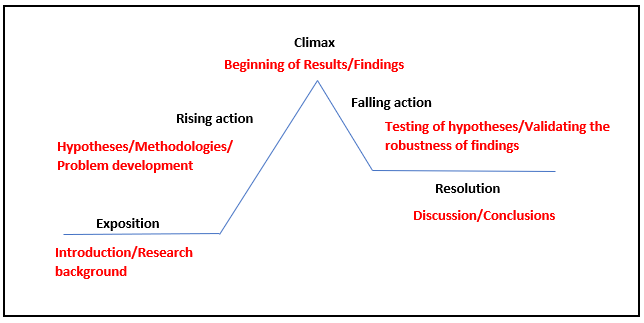
The Frameworks at a Glance
- Freytag’s Pyramid (The Narrative Arc): A 19th-century dramatic structure by Gustav Freytag used to plot emotional tension in plays and novels. It has five parts: Exposition, Rising Action, Climax, Falling Action, and Resolution/Catastrophe.
- AIDA (The Marketing Funnel): Created in 1898 by advertising advocate E. St. Elmo Lewis, this classic copywriting and sales formula guides prospects through the purchasing process. It stands for Attention, Interest, Desire, and Action.
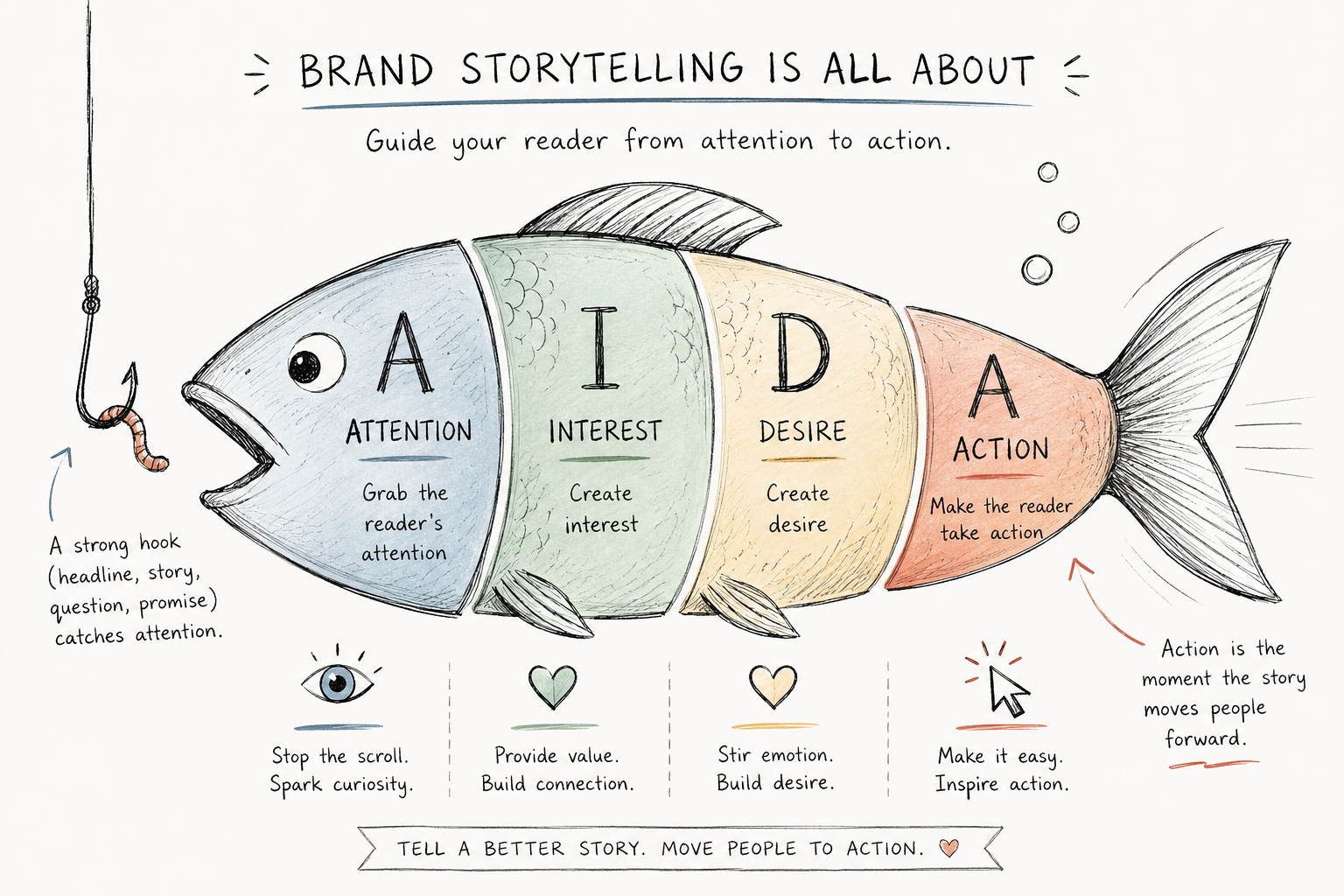 Key Differences
| Feature | Freytag’s Pyramid | AIDA Formula |
| Primary Goal | To entertain, build emotional stakes, and evoke empathy or catharsis. | To persuade, convert, and drive a specific commercial or marketing intent. |
| Audience Role | Passive observer / empathetic participant. | Active buyer who needs to be moved to a definitive decision. |
| The Pacing | Slower build-up of conflict, peaking in a major revelation or turning point. | Immediate, punchy flow designed to overcome shrinking attention spans. |
| The Final Stage | The story wraps up, and unresolved tension is settled. | The consumer makes a purchase, signs up, or completes a transaction. |
Because both models agree on the fundamentals of engaging an audience, they often overlap in content marketing and digital ads. The overlap lies in how human psychology processes information:
Both models require an engaging “hook” right out of the gate to stop a scroll or keep someone reading. In fiction, this is where the stakes rise. In marketing, this is where you agitate a pain point, establish value, and make the prospect want your solution.
In a story, the climax is the emotional payoff; in AIDA, the payoff is a clear, decisive Call to Action (CTA) or a conversion.
While Freytag is meant to captivate the mind with an arc, AIDA serves as a conversion checklist for your Sales and Marketing Strategy.
Many creators combine them by framing an advertisement as a micro-story, thereby satisfying both emotional connection and sales intent. A micro-story marketing campaign distills a brand’s message or value proposition into a bite-sized, highly emotional narrative (5-30 seconds or 1–3 sentences). Rather than listing features, it leverages relatable moments—such as a customer’s transformation or a founder packing an order—to build instant, memorable connections.
 The Anatomy of a Micro-Story
Effective micro-campaigns rely on brevity and impact. They typically follow a simple three-step arc designed for today’s shrinking attention spans:
- The Hook: Introduces the character or situation immediately.
- The Shift/Conflict: Shows a problem, change, or a feeling that matters to the reader.
- The Payoff: Provides closure or hints at how the brand solves the issue, all in a matter of seconds.
Common Formats & Mediums
Because they are designed for social media and quick consumption, micro-stories appear in several formats:
- Vertical Video (TikTok/Reels): A 10-second slice-of-life showing the before-and-after of using a product, or a quick behind-the-scenes look at the people behind the business.
- Text & Image Carousels: A 3-sentence narrative on LinkedIn or a brief caption over a photo on Instagram that turns an everyday problem into a relatable feeling.
- Micro-Drama Series: Multi-part, serialized short-form “episodes” (similar to content on apps like ReelShort) that are funded or sponsored by brands to naturally weave a story into entertainment.
Why Brands Use This Strategy
Audiences are overwhelmed by traditional ads. A micro-story feels like an organic social media post or a moment of entertainment, lowering consumer resistance.
People remember feelings, not facts. Micro-stories focus on sentiment (humor, shock, awe) to drive brand recall and require a lower production budget than traditional commercials. This allows brands to quickly test multiple stories to see what resonates.
 Take-away
If you learned something from this article, I believe you’ll also enjoy my recent book, “How I’ve Survived as a Storyteller for Over 50 Years: 12 Survival Techniques.” Get your FREE e-book copy by sending me your name and e-mail address, and include “Storytelling” in the subject line. Thank you for reading!
The Difference Between Creative Storytelling and Direct Marketing, written by Tor Kjolberg.
More articles on Storytelling by Tor Kjolberg you may like:
Leaders Who Shape Stories Shape Markets
A Brand’s In-House Storytelling Library
Brand Masters of Storytelling 2
How Smart Brands Republish Content Without Repeating Themselves
Why Organizations Are Turning to Storytelling to Win Public Attention