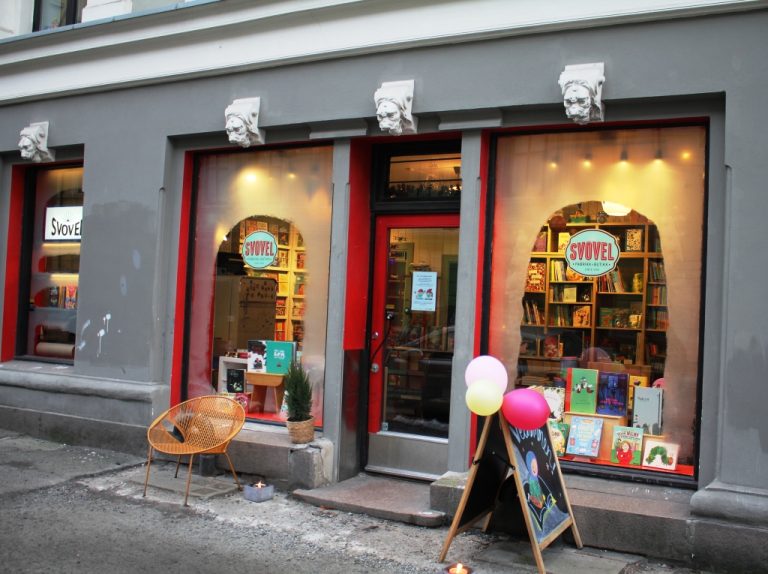
Share literary love with a great book in Svovel, located in Grünerløkka in the capital of Norway at a walkable distance from the public Deichman library. This is a place to share your love of reading with young ones – and where design is a crucial part of the storytelling process. Read more about the children only bookstore in Oslo – a literary lighthouse.
Shopkeeper Trine Louise Ween tells us that Svovel was established in 2006 as a pure illustration and design agency by Tora Marie Norberg and Anders Nederhoed. A year later Ellen Renberg joined them, and she is the owner today. In 2012, the book illustrators and designers decided to expand their business to not only illustrate and design books but also sell them.
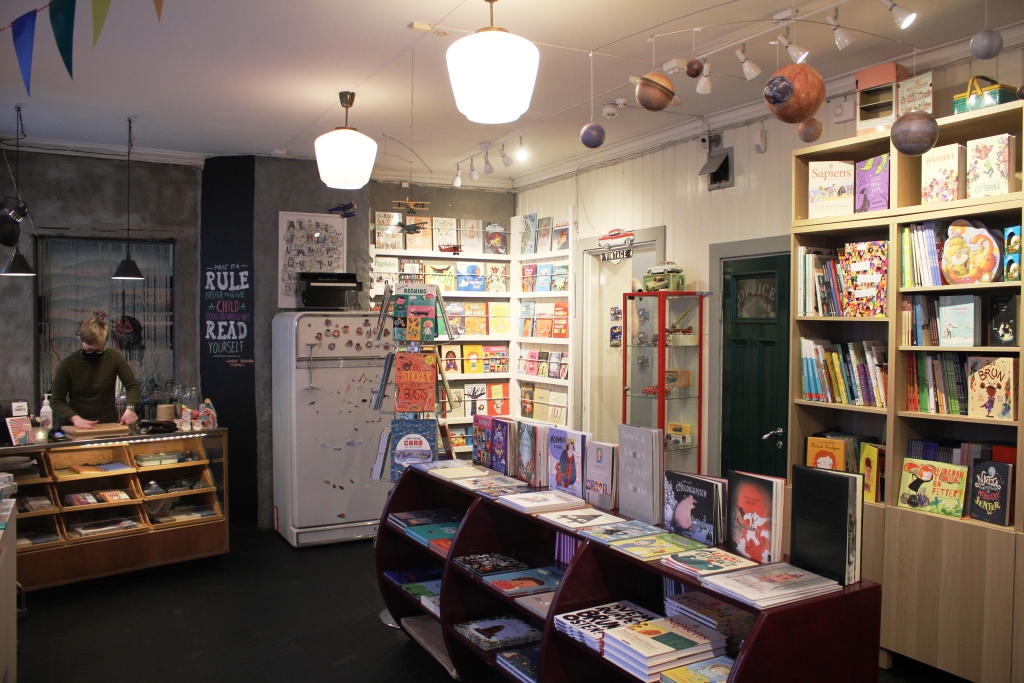
SVOVEL is full of handpicked, beautifully illustrated volumes filled with fantastic stories and creatures.
Full of handpicked, beautifully illustrated books
This independent specialized bookstore for kids only is full of handpicked, beautifully illustrated volumes filled with fantastic stories and creatures.
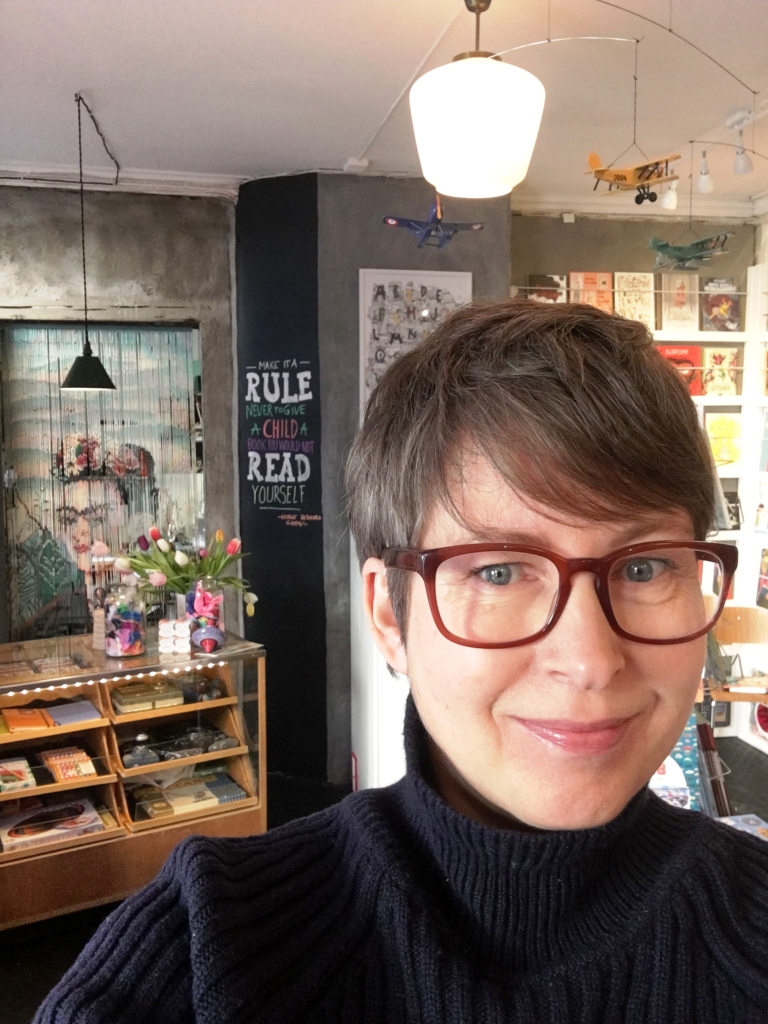
Today’s owner Ellen Renberg
Do you remember what it’s like to read a book as a child? We are in a golden age of children’s literature, and this love is felt most intensely in Svovel children only bookstore. The book selection focuses on some specialty publishers, so don’t come with a specific book in mind. Rather, let the knowledgeable shopkeeper pick something perfect for you.
Surprise your kids with a new bedtime story
The selection consists of books the owners like, some they have illustrated or designed themselves – as well as soft toys and equipment for toddlers produced by people in the neighborhood. “We select books based on quality,” says Trine Louise. We urge you to go and peek inside. Maybe you can surprise your kids with a new bedtime story, or maybe you are just looking for a beautiful high-quality gift.
The book selection focuses on some specialty publishers
If anyone can keep your kids busy for a few hours, this is a passionate (and patient) children’s bookseller.
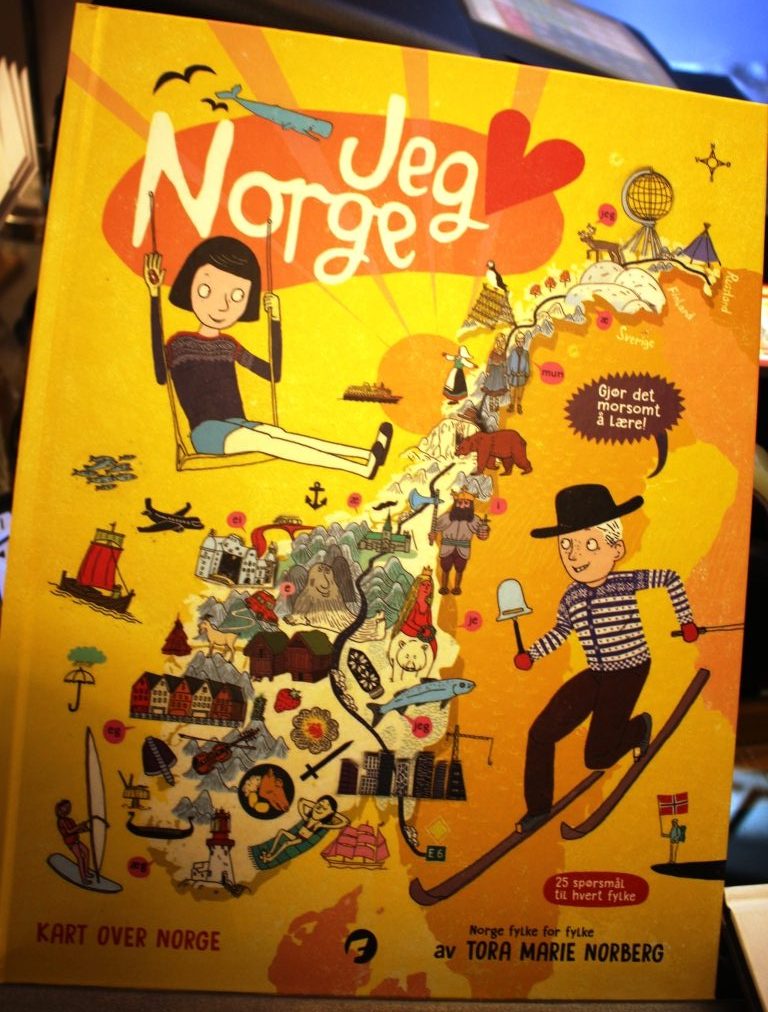
A book designed and illustrated by one of the founders.
Why did the owners chose the name Svovel, which means sulfur in English? Trine Louise tells me that the owners wanted a short name, a good available domain name which also was suitable for a logo design.
The Children Only Bookstore in Oslo – A Literary Lighthouse, written by Tor Kjolberg
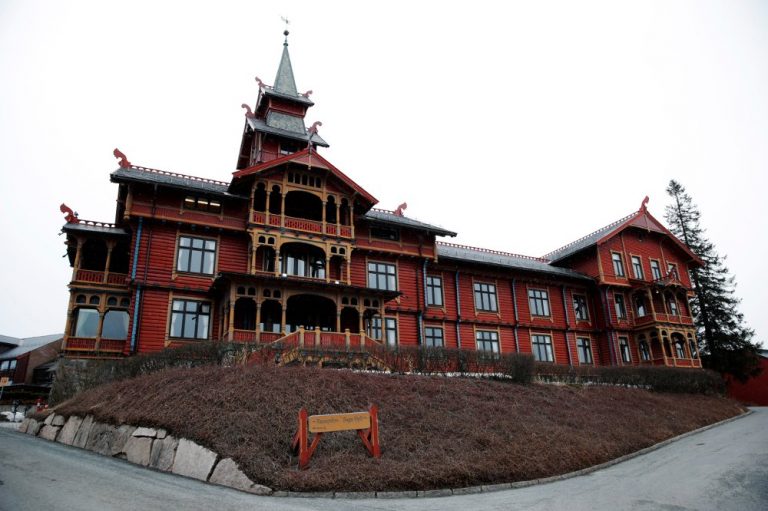
376 rooms, 1500 square meters fitness center and spa and conference department with a capacity of 1200 people. In the summer of 2022, the traditional Scandic Holmenkollen Park Hotel makes impactful reopening. Scandic Holmenkollen Park Hotel In Oslo Will Soon Shine Again.
The renovation of the hotel is under the auspices of Eiendomsspar, Rica Eiendom and Scandic, and when it opens in June 2022, both tradition and modern solutions will be combined and capacity will be significantly increased. In total, approximately 36,000 square meters are being renovated, and the number of beds will be increased by 304.
The hotel at the top of Oslo will consist of 376 fantastic rooms and suites, of which 27 will be located in the unique Dragon Building. The modern conference area will have a capacity of up to 1200 people, and in addition, the hotel will offer a new à la carte restaurant and bar, a well-stocked wine cellar and a spa area with swimming pool. Those who want to exercise can frolic on 1100 square meters of exercise facilities.
The number of beds will be increased by 304. Here from one of the suites.
«There will be something for everyone here. The hotel is perfectly located for those who love nature, and the view of the city and the fjord is unique. Here you can exercise and make use of wellness facilities, or simply drop by for a bite to eat with friends or your partner», says hotel director Kristian Fredrik Mehus.
Unique hotel
The hotel is located next to the national monument, Holmenkollen ski jump, and you can easily get there using the metro, which runs several times an hour. Scandic Holmenkollen Park has a unique and exciting history that extends over 127 years, and this will be cultivated and refined when the hotel now has a newer and more modern look.
«There will be something for everyone here”, says hotel director Kristian Fredrik Mehus
«This is the city hotel in the forest, it is national history and it is the main hall at the top of Oslo. There is art history on the walls and great architecture. There are no other hotels like Scandic Holmenkollen Park, and now I am very much looking forward to opening the doors to the public», says Mehus – and adds that they are aimed at both local, national and international guests.
Scandic Holmenkollen Park extends over nine buildings, and one of those that is now undergoing an extensive “makeover” is the main building. The lobby and à la carte restaurant will form the center of the building, and with a large, open fireplace, this will be a natural gathering place for guests. The hotel’s unique history and many art treasures will also be highlighted.
City hotel by the forested and hilly areas surrounding Oslo
“Here you will find adventurous tapestries by Gerhard Munthe and paintings you would otherwise have to visit the National Gallery to experience. History and art will play an important role in the newly restored hotel, and tells the colorful story of a hotel that has been visited by some of the world’s greatest artists throughout the years”, says Mehus – and highlights Edvard Dirik’s picture “Seterhytte i Nordmarka” from 1888 .
“This is a unique picture that has been exhibited here for over 100 years, and before that at Holmenkollen Turisthotell. It represents in many ways the hotel’s DNA, and is one of the few objects that were rescued from the fire in 1895. It will have a prominent location in the main building, and in the same way as the cottage in the picture, Scandic Holmenkollen Park will be a comfortable and safe place to seek refuge», he continues.
Inside the main building
There are also great expectations attached to the renovation of the Dragon Building, which is considered one of the main works in the Norwegian dragon style. The architectural gem will, in addition to accommodating state-of-the-art conference facilities, include 27 fantastic rooms and suites and a wine cellar. Together, the offer and all the various elements will contribute to making Scandic Holmenkollen Park a unique and continental metropolitan hotel right on the border with the countryside.
Bedroom in one of the suites
The proximity to nature and the exceptional views give the buildings and the experience a very special setting. «Staying here should be an experience you do not get anywhere else. This beautiful and traditional hotel will shine again. We will make sure that guests will fall in love with the unique product we are about to create», says Mehus.
Scandic Holmenkollen Park opens in June 2022.
Scandic Holmenkollen Park Hotel In Oslo Will Soon Shine Again, a press release from Scandic Hotels Norway
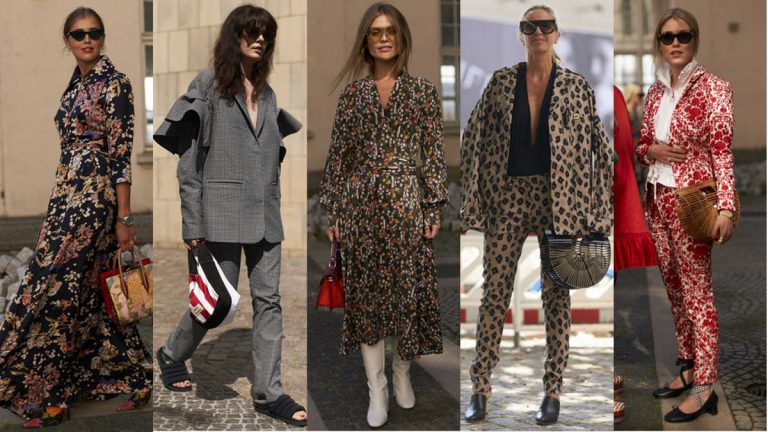
Once again has Copenhagen put Scandinavia on the fashion connoisseurs’ radars. Last week, fashion professionals from all over the world could again visit Copenhagen Fashion Week and experience international fashion houses and Nordic brands as well as emerging talents. The long-awaited return of Copenhagen Fashion Week this winter was finally a reality.
The Nordic countries’ most influential and fabulous fashion event could last week again present new collections on the catwalk by international fashion houses, Danish designers and the next big up-and-coming talent. Copenhagen Fashion Week is, as always, the place to spot who will be influential in the industry. Many visitors might also know what we will all be queuing to wear this autumn.
Chief executive at Copenhagen Fashion Week Cecilia Thorsmark
For autumn/winter 2022 rising talents like A. Roege Hove and (Di)vision were showcased alongside internationally renowned Nordic brands like Ganni, Stine Goya, Holzweiler, Saks Potts and Marimekko.
Zalando Sustainability Award
A press release from Copenhagen Fashion Week announced that “The AW22 edition would also see a welcome return to the likes of Martin Asbjørn and Wood Wood. The event will also place sustainability at the forefront with the third season of the Zalando Sustainability Award. Finalists Iso.Poetism by Tobias Birk Nielsen, Fassbender, and Tomorrow Denim all presented their collections in the official Zalando venue, and the winner turned out to be Iso.Poetism by Tobias Birk Nielsen.
With a focus on sustainability and a nod to getting rid of ‘fast fashion’, Copenhagen Fashion Week has been rethinking fashion and the core values of their shows and events since a 2018 metamorphosis. It’s a big ambition, but CFW aims to promote sustainability in fashion – something that has a huge impact on the environment as disposable fashion has taken hold of Europe and the US.
The future of Nordic fashion
Chief executive at Copenhagen Fashion Week Cecilia Thorsmark said in a statement: “As we continue to focus on the responsibility of our industry to incubate and strengthen the future of Nordic fashion, we are excited to welcome Jade Cropper as this season’s Talent and take the opportunity to introduce her exceptional vision to our international audience.”
Turning to menswear, the fashion week featured men’s looks with a curated selection from Schnayderman’s and (di)vision. And more well-known designers from Henrik Vibskov, Soulland, Wood Wood, Martin Asbjørn and Samsøe Samsøe included menswear in addition to womenswear.
The Return of Copenhagen Fashion Week, written by Tor Kjolberg
After well over a year of lockdowns and restrictions, the dynamic Scandinavian artist duo known as Elmgreen & Dragset relished last year the opportunity to finally travel internationally again. And judging from their current projects, the two have been extraordinarily prolific over the course of the past year and a half. Read more about the short stories by the Scandinavian artist duo.
Based in London and Berlin, Michael Elmgreen (b. 1961, Denmark) and Ingar Dragset (b. 1969, Norway) have worked as a collaborative duo since the mid 1990s.
Well-known for siting a Prada boutique in a Texan desert in 2005, the artists have been commissioned to create a number of sculptures internationally within the public realm: in 2016, their large-scale work Van Gogh’s Ear, which takes the form of a displaced swimming pool sitting upright, transformed the Fifth Avenue entrance to the Channel Gardens at the Rockefeller Center, New York; A Greater Perspective, an oversized and non-functional bronze telescope, was installed on New York’s High Line from 2015 to 2016, simultaneously drawing attention to and disrupting a secret view of the Statue of Liberty.
Based in London and Berlin, Michael Elmgreen (b. 1961, Denmark) and Ingar Dragset (b. 1969, Norway) have worked as a collaborative duo since the mid 1990s. Photo: Ariel Reichman
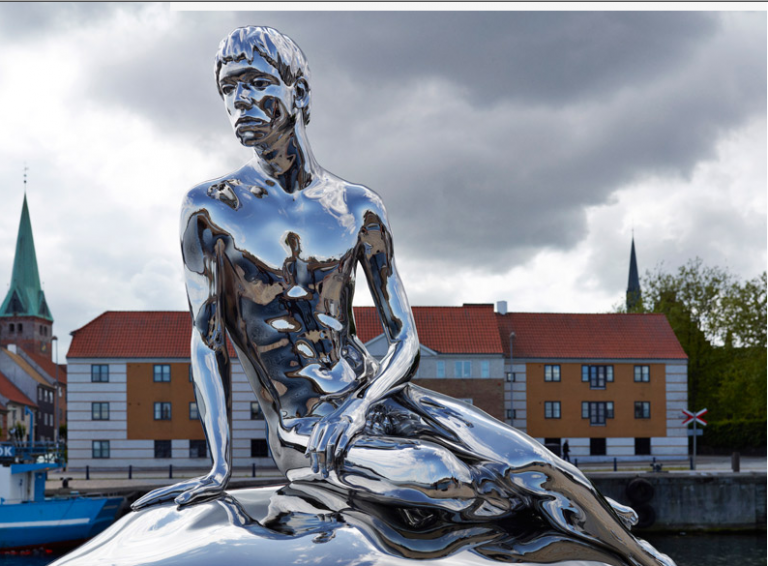
A Space Called Public HAN, a contemporary revisioning of the Danish national icon The Little Mermaid, was installed permanently at Kultureværftet Helsingør, Denmark in 2012; Powerless Structures, the winning proposal for the Fourth Plinth Commission selected by the City of London, was on view in London’s Trafalgar Square from 2012 – 2013; and in 2012 the artists were commissioned by the Munich city council to create and curate a program of installations across Munich’s main squares.
The resulting year-long artistic project, A Space Called Public / Hoffentlich Öffentlich, included the artists’ own work as well as the work of a number of other contemporary artists.
Melancholy in New York The duo’s last exhibition was in New York in December 2021. It was a melancholic exhibition, a cautionary message in a city that, at least until the arrival of the Omicron variant, has been dizzy with optimism. The show’s title, “The Nervous System,” was a sly reference to the widespread fear and uncertainty experienced by many during lockdown.
As Elmgreen & Dragset explain, ‘the artist’s role is to go against short-term memory. This is one of the few tasks we have.’
In a world that seemed swept away by promises of a brighter future post-pandemic, the duo wished to remind American citizens that there are longstanding problems to be dealt with: among them the climate emergency, gun violence and toxic masculinity.
The New York exhibition occupied the entire first floor of the 25th Street space, as “a surreal depiction of a dysfunctional home within the gallery’s walls.” In this mise-en-scène, an elderly, shirtless man snoozes in a wheelchair, not far from a marble fireplace which is engraved with block letters: “The Oracles Are Gone And Lost Are The Gods.” The artists made it clear that the works are open to interpretation: “Is the entire scene real or just in this man’s head?” asks Elmgreen with a playful smile.
“We’d be wise to tackle them head-on, lest we find ourselves left with a pair of perforated wellies when the waters rise,” said the organizers.
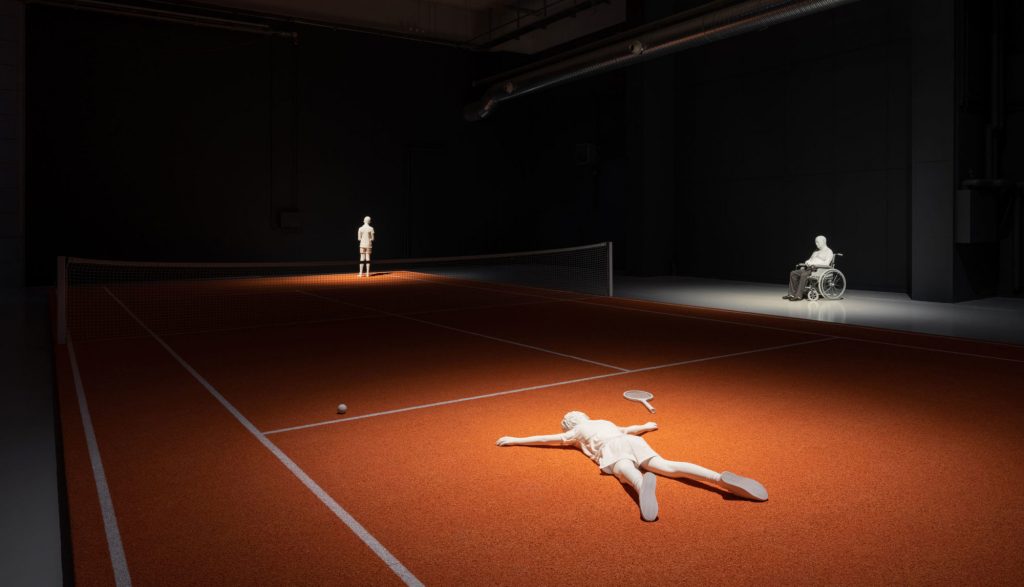
In April, Emgreen & Dragset transformed Copenhagen Contemporary’s Hall 2 into the setting of a tennis court. Photo by David Stjernholm
An older-model stationary Mercedes-Benz wagon white with Russian license plates in Switzerland
In September, Elmgreen & Dragset exhibited at Art Basel in Switzerland. The duo’s sculptures and installations broached consumer culture and sexual politics with mordant humor and unveiled a new piece at Art Basel’s Unlimited, the fair’s section devoted to oversized art—the first time a work from there had been shown outdoors.
Their outdoor art installation on the Messeplatz created a sensation. The Outsiders (2020) featured an older-model stationary Mercedes-Benz wagon, white with Russian license plates, that visitors wandered up to before curiously peering through the windows at two lifelike figures spooning and sleeping in their car amid packing tape, labels, installation tools and various empty bags of chips and snacks.
The Agony and the Ecstacy, 2014
According to the artists, the story behind the work is of two financially strapped art handlers who drive to the fair for work but have to sleep in their car—as much an ode to love as to the hard work that goes into staging and putting together a spectacle like an art fair.
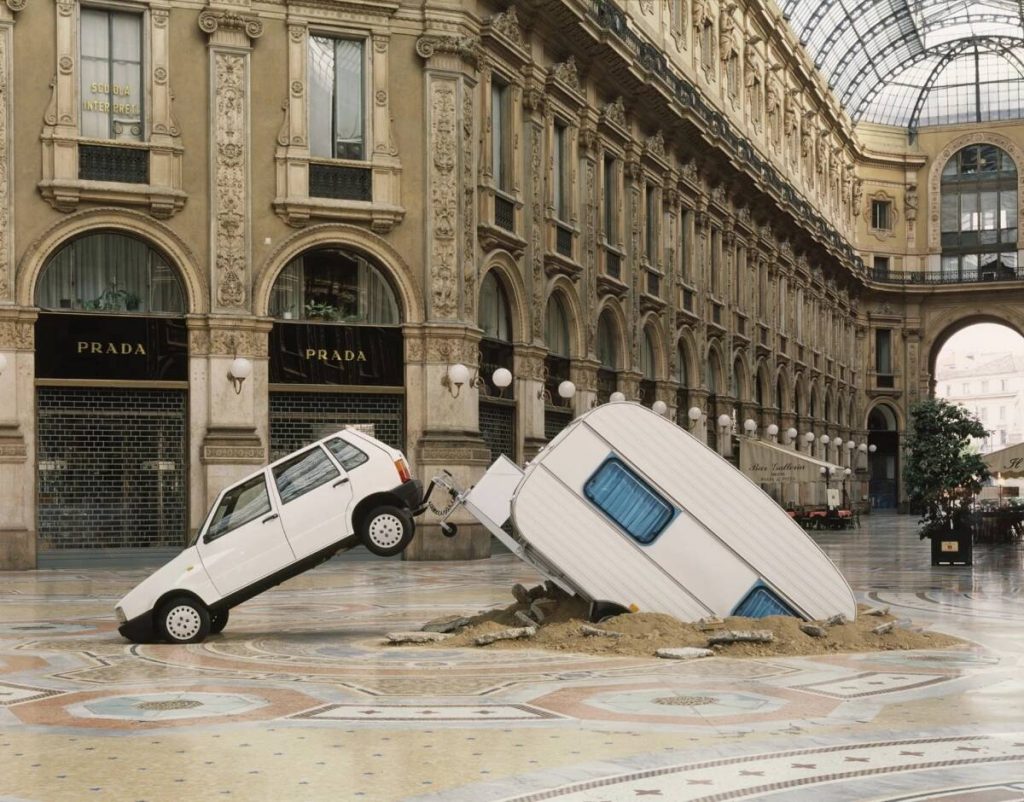
Short Cut 2003. Mixwd media installation, Milan – Italy.
The work also functions as a wry nod to the expense of accommodation in Switzerland. “We can hardly afford a hotel room in Basel if our gallery isn’t putting us up,” Ingar Dragset jokes. Moreover, it even draws partial inspiration from a real-life experience: Elmgreen recalls sleeping overnight in a car with the artist Olafur Eliasson during Documenta 9 in 1992, but “nothing happened, not even spooning. He’s open minded but maybe not in that way”. “You know, we’re old rats,” says Ingar Dragset, referring to himself and his longtime creative partner, Michael Elmgreen.
Dilemma. AInstallation at Ekebergparken, Oslo
Working in a 1920s Berlin water-pumping station
In June, the prolific duo worked in a 1920s Berlin water-pumping station resulting in some of the most evocative and smartly provocative art of their 25-year collaboration. In 2020, the duo marked 25 years of making art together as Elmgreen & Dragset, known for their witty, irreverent sculptures and installations that subtly subvert entrenched social codes and power structures using playfulness, beauty, even delightful absurdity.
Full-size tennis court in Copenhagen
In April, Emgreen & Dragset transformed Copenhagen Contemporary’s Hall 2 into the setting of a tennis court. When entering the gallery space, visitors encountered an almost full-size tennis court, slightly raised off the ground. The net and the painted lines marked the rules of play on the orange-brown court, framing a silent scene where three figurative sculptures Flo, Kev and Bogdan were the protagonists.
The Short Story in Copenhagen unfolds a battlefield, where the white-painted bronze sculptures of two young boys are positioned as if they’ve just finished a match. The boys look lonely and somehow lost on the large plane of the tennis court. Their bodies and faces are turned away from each other – the dialogue and play between them seems to have come to an end. Rather than joy, a discomfort seems to have arisen from the game, for both “winner” and “loser”. The sculpture Flo stands with his back to his opponent, Kev, and stares at the trophy he appears to have just won. But rather than seeming proud of his victory, Flo looks remote and pensive. Kev, who lies face down on the opposite side of the court, seems subdued by his defeat.
The artists make it clear that the works are open to interpretation
Expanding the reality
“Many of our works are not only a comment on an existing reality,” says Elmgreen. “They are sort of an expanding of reality by making a magic moment, making our boring, everyday lives a little bit more mysterious.”
He adds, “Our mood board is always our upcoming exhibitions. The titles alone probably say it all: “The Nervous System” at Pace New York; “It’s Just a Phase” at Kjøpmannsgata Ung Kunst in Trondheim, Norway (until 13 February); and “Useless Bodies?” at the Fondazione Prada, Milan, spring 2022.
Short Stories by Scandinavian Artist Duo, compiled by Tor Kjolberg
For more than 50% of Scandinavian consumers, the cost of delivery is the major consideration when ordering online. In third place is the speed of delivery. So, the ability to choose where the shipment is delivered and the cost of delivery are important issues in the Scandinavian E-commerce market.
Scandinavia is a region in Northern Europe consisting of Norway, Sweden and Denmark. These countries, together with Finland and Iceland, also form the Nordic countries. E-commerce in Scandinavia has its own characteristics.
Prefer shopping from native eCommerce platforms
Unlike most of the regions in the world where giants like Amazon & eBay dominate the market, the Nordic & Scandinavians prefer shopping from the native eCommerce platforms. Such unique shopping trends make it simpler for retailers to sell on Nordic marketplaces. The top marketplaces in the region include – Cdon, Elgiganten, Fyndiq, Zalando, and Wish.
Top 12 countries in terms of their market share of European e-commerce
When it comes to delivery methods, there are some differences between countries. 34% of Danish customers prefer home delivery, with signature. While this is not the favored delivery method in Sweden, Finland, and Norway. Delivery via mailbox is the preferred method for 31% of Swedes, and in Norway, it is even 44% of consumers.
Clothing, footwear and pharmacy most purchased products
Scandinavia is a bit of a remote area in Europe, surrounded by the Norwegian Sea, the North Sea, the Baltic Sea and the Gulf of Bothnia, so it is not a very easy region to quickly gain success with ecommerce company newcomers. However, there’s still a lot of unused potential.
For the past decade, eCommerce in Scandinavia is surging and has touched an all-time high. In fact, the total market spendings on online shopping have spiked to 13 billion US dollars in just Sweden. The region opens up infinite opportunities for retailers to build and scale small-medium-sized businesses. And the best part is that you need not be a native Scandinavian to set a firm foot in these commerce-rich grounds.
Debit and credit cards are the preferred payment methods. Photo: Pickawood/Unsplash
While clothing and footwear are the most purchased products online with over 50% in Denmark and Norway, in Sweden pharmacy products are the most purchased products online with 69%, followed by clothing and footwear with 61%. Home electronics are also popular products, and around two million Nordic e-commerce consumers bought CDs last year.
Monthly purchases from international websites
Figures from ecommerceDB show that Norwegian consumers spent about 7 billion US dollars in 2020. Travel was the largest market segment by sales value. Sweden has the biggest ecommerce industry in the whole of Scandinavia and even the Nordics. Ecommerce consumers in Sweden spent a total value of about 13 billion dollars in 2020, while Ecommerce in Denmark was approximately 6 billion US dollars.
Over one-third (36%) of online consumers in Scandinavia make monthly purchases from international eCommerce websites.
Over one-third (36%) of online consumers in Scandinavia make monthly purchases from international eCommerce websites. r, followed by home electronics. Around two million Nordic e-commerce consumers bought CDs that year.
Clothing and footwear are the most purchased products online. Photo Hian Shop
Debit and credit cards are the preferred payment methods.
The Scandinavian E-Commerce Market – conclusion
eCommerce in Scandinavia is rapidly evolving and opens up ample opportunities for online sellers, in Scandinavia as well as in the rest of the world. Scandinavians love to shop and retail is shifting towards the online approach. Approximately1/3 of the Scandinavian population shop online.
The Scandinavian E-Commerce Market, written by Tor Kjolberg
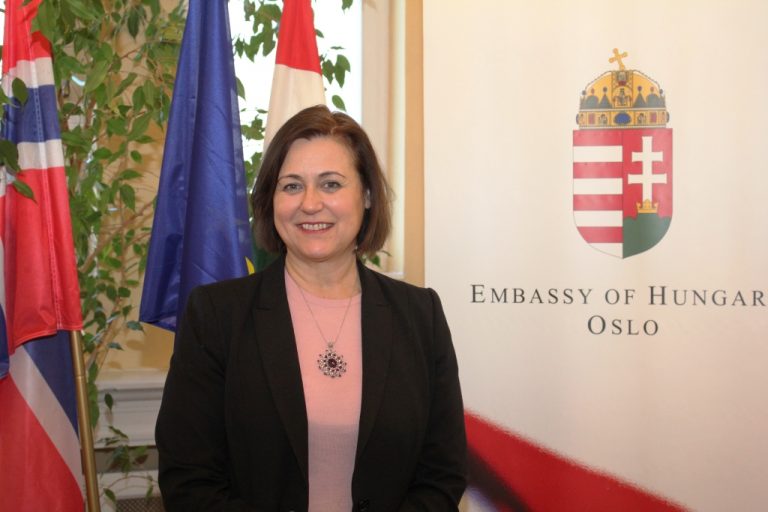
When the Embassy of Hungary in Oslo organized the open air exhibition “Natural Treasures of the Viserad Group”, we were invited to a conversation with the Hungarian ambassador to Norway, Mrs. Eszter Sándorfi.
The ambitious project “Natural Treasures of the Visegrad Group” was an impressive initiative from the Embassy of Hungary. The exhibition was organized and coordinated by the Hungarian nature Art, the Association of the Hungarian Nature photographers and realized in close cooperation with the largest nature photographers’ association of the Visegrad countries.
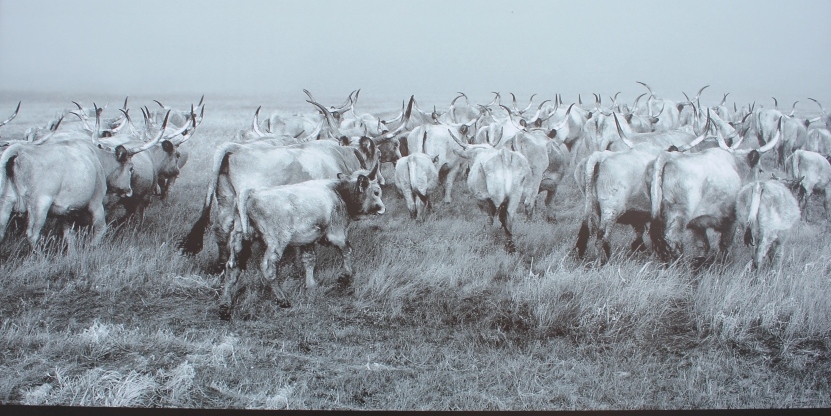
Photo from the exhibition: Steppe cattle, by Laszlo Meszaros
In the period December-January, 40 of the nature photographers’ impressive works were exhibited along the fence outside the Hungarian Embassy building in Oslo to the delight of both ordinary passers-by and visitors to the Embassy – a view certainly worth a stroll.
40 of the nature photographers’ impressive works were exhibited along the fence outside the Hungarian Embassy building in Oslo
We were honored to be invited to a conversation with the Hungarian ambassador Mrs. Eszter Sándorfi. Her Excellency handed over her credentials to HM the King Harald V of Norway on May 6, 2021.
“There’s a lot of potential and possibilities. Our countries are getting closer and closer, and we also have to find joint answers to upcoming new challenges, like climate change, energy security, the future of Europe,” says Ambassador Mrs. Eszter Sándorfi
“The development of our economic and trade relations and the growth of mutual interest are shown by the Norwegian companies present in Hungary or the Hungarian companies appearing in Norway. At the same time, there are still plenty of undiscovered opportunities in many areas of trade and tourism in our countries. Together with the Hungarian-Norwegian Chamber of Commerce (HNCC), established in 2016, one of my important objectives is to facilitate that Norwegian and Hungarian companies find each other in order to implement successful business projects,” the Ambassador underlined at the beginning of our conversation.
During our meeting with the ambassador, she tells us that she studied in the Diplomatic Academy in Vienna after the fall of the Iron Curtain. She used to work in Brussels between 1994-1999 dealing with the Partnership for Peace Program, a member of the team preparing Hungary’s accession to NATO in 1999. During her carrier she also served as special advisor to NATO relations with Eastern Europe then became security policy director before she was appointed ambassador to Greece.
In the period before she was appointed Ambassador to Norway and Iceland, she served as Director for the North American Department.
What knowledge did you have about Norway before arriving in our country? From the professional point of view we are both members of NATO so I naturally followed our relations related in the context of our security policy cooperation. Although Norway is not a member of the EU but part of the European Economic Area. I actually remember the disappointment of some Norwegian friends in Brussels because of the outcome on the referendum.
As for the country, I knew of course, that Norway offers a beautiful landscape with breathtaking nature. Besides, I am very fond of the music of Edvard Grieg, and Henrik Ibsen is probably the most famous author in the world after Shakespeare.
I also watched several Norwegian films and TV series, like «State of Happiness» (Lykkeland) and Lillyhammer. A book I really appreciate is “Out Stealing Horses” by Per Petterson. Now, I don’t have the time to such pleasant activities anymore.
What would you say are the most important characteristics for a diplomat? First of all, I would say a talent for networking and a willingness to engage with people. However, the Covid-19, which has been the reality most of my time as the Ambassador to Norway, has prevented me from a lot of activities I otherwise would have liked to take part in or initiate. So, when working as a diplomat, you must always have a willingness to redefine and change. Most small countries are only able to employ specialists to a limited extent, so you must be able to successively focus on new challenges. The Hungarian Norwegian Chamber of Commerce is an important association and B2B meetings are important. I also want more people to visit Hungary, as tourists as well as to do business or to study.
“We travelled up to Svalbard to deposit for the first time electronic copies of significant documents of Hungarian culture and history in the Arctic World Archive,” says the Ambassado. Photo from Svalbard. AWA Sebastian Moss
I am happy that in spite of the Covid difficulties we managed to realize a very interesting cultural project. The Director of the Hungarian National Széchenyi Library visited Norway last September. Apart from having consultations with the Director of the National Library and the Deichmann Library in Oslo, we travelled up to Svalbard to deposit for the first time electronic copies of significant documents of Hungarian culture and history in the Arctic World Archive, based on the collection of the National Széchényi Library. Located in one of the closed coal mines in Longyearbyen, the northernmost inhabited settlement in the world, the facility aims to preserve the cultural and historical heritage of different nations for posterity.
What are the biggest challenges for a diplomat in Norway or Scandinavia? What used to be called consular assistance that was considered more an “administrative routine” became increasingly central during the Coronavirus pandemic. Embassies had to be able to organize repatriation, bringing people home, to their families and or back into their jobs. We received and still receive plenty of questions related to the pandemics. As for the business relations, although Norway is part of the EEA, one could not characterize it as a completely open market, like the EU-members. In addition, there are some ideological issues, which is more reflected in the media.
Does a conflict area like Hungary formally loosing access to over €200 million in grants from Norway, Iceland and Liechtenstein last year amid growing concerns about the country’s democratic backsliding affect your role as the Hungarian ambassador to Norway? Your question is interesting as our Norwegian partners never argued with the wording of “democratic backsliding” in this context, a wording used by the media and some politicians, and which I absolutely refuse with regards to my country. The Norway Fund Financial Mechanism is an important tool to strengthen cohesion within the EEA community. To put an ideological pressure and conditionality on this process is very controversial, and serves the opposite purpose what it was originally meant to be: deepen division instead of helping cohesion. Flexibility and compromise might have been the key here because it is a pragmatic issue that has now a negative impact on a lot of good projects, like helping green economy, disadvantageous regions, people-to people contact, with the participation of companies and different organizations of Norway and Hungary.
What do you think about the relationship between Hungary and Norway?
There’s a lot of potential and possibilities. Our countries are getting closer and closer, and we also have to find joint answers to upcoming new challenges, like climate change, energy security, the future of Europe. I think it is important to concentrate on those issues which strengthens cooperation, the positive agenda. We already have many common interests, like business, tourism, culture and education. I am also open for the media and public relations; it is very important to understand each-others’ history and culture better.
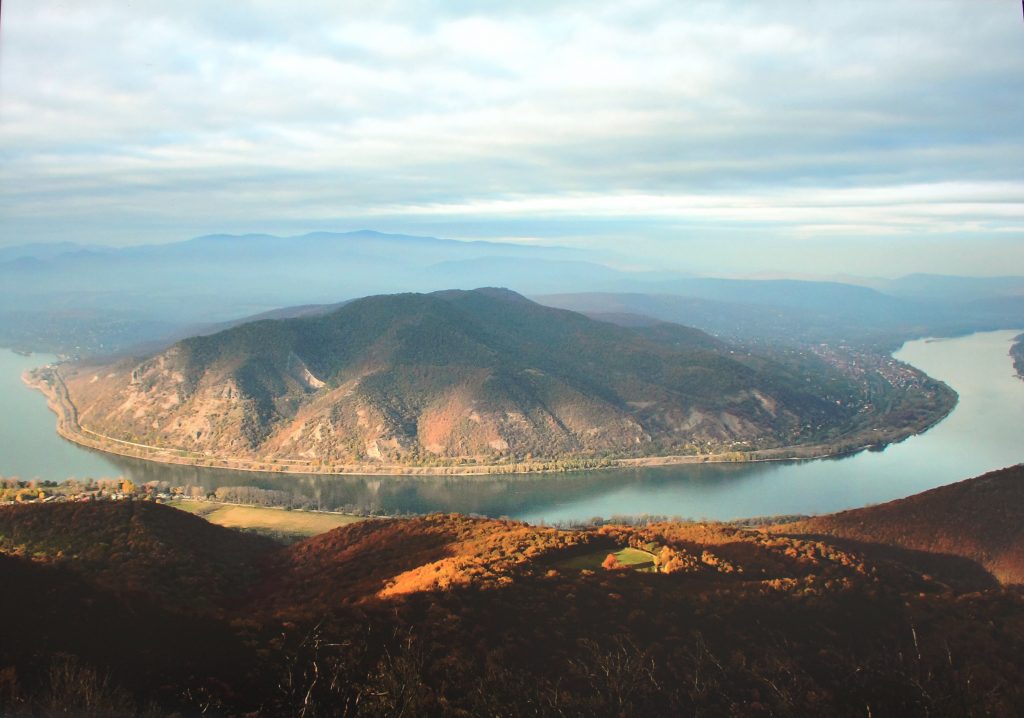
From the exhibition: The Danube Island, photo by Katalin Nagy
Is there something an ambassador must pay more attention to today than before?
This is a complex question. A lot has changed. Today, communication is so much faster than before. Now, you have to act very fast but you cannot compete with new agencies and it is not your job as a diplomat. High-level meetings can be organized very quickly and – apart from COVID – take part quite frequently in different formats, so an ambassador has definitely a different role than 50 years ago. I think that diplomacy in practice has become more similar to other “business like” international activities.
Has digitalization changed diplomacy – what are your views on that? With digitalization, work processes have certainly changed very substantially, even for the most senior diplomats. I think also that social media and other new forms of communication, as well as the additional time pressure this creates, have affected the job profoundly. And I think that our most recent – forced – experience with videoconferencing will also lead to very substantive changes in the way we work.
However, diplomacy is very much about developing personal relations and building personal trust, and a lot of that can only be done in person.
What does diplomacy mean to you? This is a very intricate question. As I have said before, diplomacy has become very similar to other international activities. However I am a Hungarian diplomat so I work primarily for Hungary. On the other hand, we are part of regional cooperation as the Visegrad Four, NATO, the European Union, OSCE, UN etc. Modern technology and communication, far-reaching economic relation produced a very strong interlink in the globe. I think the most important role of diplomacy is to work for a more stable, secure and livable world for the next generations.
Thank you so much, Mrs. Ambassador.
The Hungarian ambassador to Norway, Mrs. Eszter Sándorfi, was interviewed by Tor Kjolberg
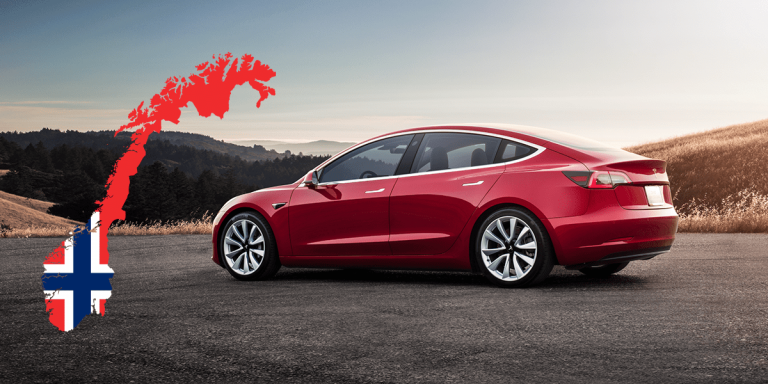
The Norwegian success story is first and foremost due to a substantial package of incentives developed to promote zero-emission vehicles into the market. The incentives have been gradually introduced by different governments and broad coalitions of parties since the early 1990s to speed up the transition. Learn more about the Norwegian electric vehicle success story.
In 2020, Norwegians actually bought more electric cars than any other types of cars altogether. A country far north, stretching way above the Arctic Circle, with long driving distances, rugged mountains and a very cold climate is not the most likely place to start a transportation revolution, but electric vehicles (EVs) are suddenly the new normal here. How did it happen?
In 2020, Norwegians bought more electric cars than any other types of cars altogether.
Local governments allowed to decide incentives
Since 2017 it has been up to the local governments to decide the incentives regarding access to bus lanes and free municipal parking. The Parliament has agreed on implementing a 50 % rule, which means that counties and municipalities cannot charge more than 50 % of the price for fossil fuel cars on ferries, public parking and toll roads.
80% of new cars sold this year will probably be EVs
“In 2020, 54% of the new cars that were sold in Norway were EVs. And it is important to note that when we talk about EVs, we mean fully electric cars. Plug-in hybrids aren’t part of that number. If we included those like they do in many other countries, we would get to a whopping 74 per cent!” says Christina Bu, secretary general of the Norwegian Electric Vehicle Association.
Christina Bu, secretary general of the Norwegian Electric Vehicle Association
Almost 65% of new passenger cars sold in Norway in 2021 were electric; in addition, 22% were plug-in hybrids. EVs are purchased all over the country. It took only 10 years to move from 1% to 65%, and this year the number will probably pass 80%. The Norwegian Parliament has decided on a national goal that all new cars sold by 2025 should be zero-emission (electric or hydrogen).
“But the maybe strongest incentive is that we heavily tax the purchase of polluting petrol and diesel cars”, Christina Bu explains. Most cars are purchased secondhand, and people in the secondhand market are dependent on the choices made by new-car buyers. The government therefore taxes the sales of new polluting cars heavily but does not tax EVs at all, making EVs, which are more expensive because of their production costs, a competitive and appealing option.
The VAT exemption for zero-emission vehicles in Norway has been approved by the EFTA Surveillance Authority (ESA) until the end of this year.
NIO sedan will be launched in Norway later this year
Electric cars are cool
Another important aspect is that electric cars are cool! They don’t smell bad. They are silent. And you can drive them for several hundred kilometers before you need to charge them. Not that charging is a problem in Norway – there are more than 16,000 charging stations, including 3,300 fast chargers, all over the country. So, no need for range anxiety.
Economical beneficial to choose zero and low emission cars The overall signal from the majority of political parties is that it should always be economically beneficial to choose zero and low emission cars over high emission cars. This is obtained with «the polluter pays principle» in the car tax system. High taxes for high emission cars and lower taxes for low and zero-emission cars. Introducing taxes on polluting cars can finance incentives for zero-emission cars without any loss in revenues.
You can easily get around with an EV – even in cold climate
“Even in the northernmost parts of Northern Norway – an area with huge distances, more reindeer than people, and really low temperatures in the wintertime – you can easily get around with an EV”, Christina Bu claims.
The Norwegian Electric Vehicle Success Story, written by Tor Kjolberg
In spring, ramsons (or wild garlic) covers the floors of deciduous forests in Scandinavia, and they can be detected from miles away. Their permeating garlic smell is pungent in the warm May air. Learn more about Scandinavian ramsons.
You should collect and eat them while you can, as the darkening canopies of beech leaves will soon make them wither. You can grow ramsons yourself in a woodland area of your garden, but beware – they must be planted where they can be allowed to follow their rampant nature.
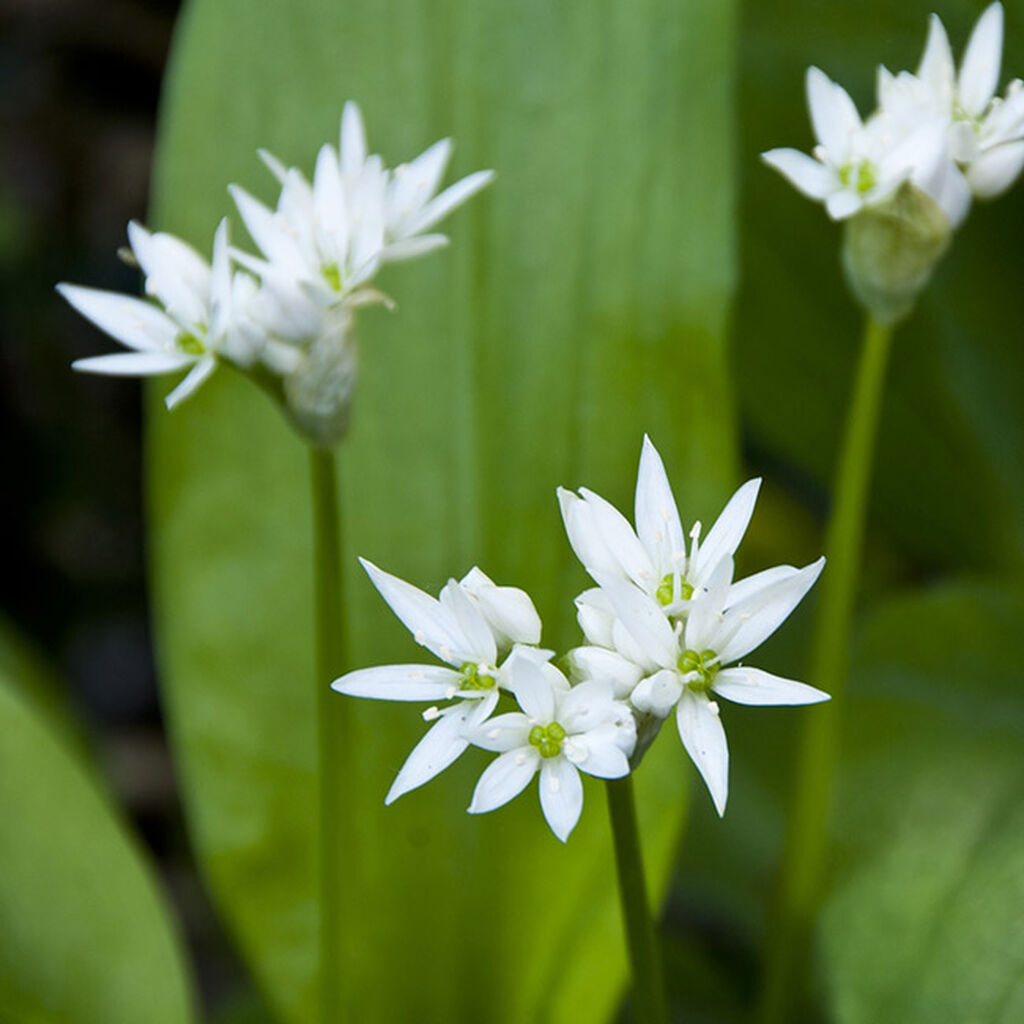
The bulbs themselves, the broad, soft leaves and the white, starry flowers are very much edible. Photo: Store norske leksikon
Appearance and taste The bulbs themselves, the broad, soft leaves and the white, starry flowers are very much edible. Perhaps surprisingly, the flowers tend to have a stronger flavor than the mildly garlicky leaves.
Perhaps surprisingly, the flowers tend to have a stronger flavor than the mildly garlicky leaves. Photo: Plantasjen
Culinary uses Ramsons are so abundant in spring that they can be eaten and cooked like spinach, in soups, omelets, as an accompaniment for everything nice and light, for a pesto, or in salads. The mild garlicky taste and softness of the leaves mean that they lend themselves to anything that you might associate with spinach and garlic.
There are several secrets behind making a good omelet. Photo: melk.no
Omelet with ramsons and other herbs
There are several secrets behind making a good omelet as is often the case when cooking very simple seeming dishes. Firstly, add no salt before the omelet is finished. Also, omelets need a very high pan, with lots of butter or olive oil to make the eggs fluff up. And always use very fresh eggs, from decently raised and fed birds. You do not need to consider all the lore about expensive omelet pans washed by mermaids in the moonlight. A heavy pan, preferably iron or copper, is fine (Tefal pans do not work very well at high temperatures). Mozzarella is not, admittedly, very Nordic, but the consistency amidst the soft eggs is beautiful. Eat the omelet with rye bread, and maybe a tomato salad. Leftovers taste lovely in a sandwich, especially with smoked fish – ideally as part of a picnic.
100ml extra virgin olive oil
200g mixed fresh herbs, finely chopped: choose from ramsons, sorrel, chervil, tarragon, chives, dill, parsley and blanched nettles.
8 large organic eggs
1 buffalo mozzarella, cut into thin slices
Salt and pepper
SERVES 4 for lunch
Heat a heavy frying pan until very hot, then pour in the oil and heat again. Meanwhile, whisk the herbs into the eggs.
Pour the eggs into the hot pan and let them fluff up wildly into a bubbly light thick omelet. Add the mozzarella slices.
As soon as the eggs are solid around the edge, lift with a palette knife and tilt the pan, so that the more uncooked egg runs underneath. When the omelet is no longer fluid, but still very soft in the middle, remove it from the heat. Scatter with salt and pepper, and fold into a half moon.
Due to current restrictions in Sweden, the Stockholm Furniture & Light Fair 2022 has been postponed to September. However, the much-appreciated Stockholm Design & Architecture Talks will run digitally February 8 – 10 with the overall theme “Being a Game Changer”. So, although Stockholm Furniture & Light Fair 2022 has been postponed to September, the week 7 – 13 February will be filled with inspiring design news and events. Read on.
This year’s fair in September with the theme “Being Scandinavian” explores the typically Scandinavian beyond obvious conventions. One of the news for 2022 is a new fair layout making the experience for the visitors more dynamic. There are also a number of new concepts like The Library, a curated exhibition space where you can book a space to show only one or two new launches instead of booking an entire stand.
September 2022 is the 72nd Stockholm Furniture & Light Fair. Photo: Dezeen
Explore Scandinavian design during Stockholm Design Week February 7-13
Design news and launches will take place digitally in the organizers’ social media channels and will be a week filled with inspiring design news and events.
Both Stockholm Furniture & Light Fair and Stockholm Design Week are scheduled to run again in September this year. The launch of the interactive app pushing events and exhibitions in Stockholm will also be postponed until it’s safer to meet in larger numbers again.
“Being a Game Changer” is the overall theme of this three-day event
Stockholm Design & Architecture Talks On February 8-10 the digital seminar program Stockholm Design & Architecture Talks will be broadcasted. With “Being a Game Changer” as an overall theme this three-day event focus on the most important issues facing the industry right now.
Stockholm Design & Architecture Talks is a leading platform for discussing and exploring architecture and design, and has been part of Stockholm Furniture & Light Fair since 2013. The program for 2022 has a strong focus on sustainability and innovation and is designed to promote knowledge and to spur discussion and development within the field of design and architecture.
Dezeen founder Marcus Fairs and British journalist Katie Treggiden will moderate several of the panel discussions during the digital seminar program.
Dezeen founder Marcus Fairs will moderate several of the panel discussions during the digital seminar program, as will the British journalist Katie Treggiden, author of the recently released book Wasted: When Trash Becomes Treasure (Ludion, 2020). Tregidden also runs successful podcast Circular with Katie Treggiden, which explores craft’s potential role in the transition to a more circular economy.
Stockholm Furniture & Light Fair 2022
September 2022 is the 72nd Stockholm Furniture & Light Fair. For more than half a century, the fair has been Scandinavia’s display window for design. Since the Stockholm Furniture & Light Fair was held for the first time in 1951, it has evolved from being a local furniture fair, only featured Swedish manufacturers and furniture retailers, to have become the world’s leading event for Scandinavian design, welcoming visitors and exhibitors from all corners of the world.
Over the years, countless business deals have been created there, contacts have been established, new products have been launched, and both design classics and celebrated designers have been presented.
Stockholm Furniture & Light Fair 2022 Postponed to September, compiled by Tor Kjolberg
If you want to apply for a loan and compare different offers, you can either apply yourself through several lenders or use a loan intermediary. More and more people are using loan intermediaries because these make it easier to compare loans and the road to finding a loan that best suits their financial needs shorter. Learn how a loan intermediary in Scandinavia can help you find the best offer.
With that said, a loan intermediary makes it easier to obtain an overview of the loan providers that offers loan. The application process is also faster if you want many offers to get the best possible basis for your loan comparison. Here is what you need to know about a loan intermediary and how they can help you find the best offer.
A popular operator for loan intermediation in Sweden and the rest of Scandinavia is Loanscouter. Photo: Tierra Mallorca/Unsplash
How a loan intermediary works In short, a loan intermediary’s job is to obtain offers for private loans on customers behalf. When someone send an application to the intermediary, they forward their application to all the lenders they work with. So instead of sending applications to various lenders and/or banks, the loan intermediary does this for you.
Due to a high demand for consumer loans recently, the number of lenders in the market has increased, and so has the number of loan intermediaries. A popular operator for loan intermediation in Sweden and the rest of Scandinavia is Loanscouter, who you can LoanScouter to more easily find a cheap loan that suits your needs.
Loan intermediaries should not be confused with lenders themselves, i.e., the loan itself is not paid out by Loanscouter. However, you send an application with the help of Loanscouter and then this application is forwarded to the respective lender that they work with. Within a day, you should receive several offers and can then choose which option is best suited for your situation.
Loan intermediaries mean better competition on the market. Photo: Lukas Blazek/Unsplash
Why loans through intermediaries tend to be cheaper Loan intermediaries mean better competition on the market and therefore it is quite logical that a consumer loan mediated by a loan intermediary is cheaper than other consumer loans. When the loan providers receive the application from the intermediary, they know what they are just one of the companies that are fighting for the same customer. This often leads to them offering lower interest rates.
It is important to remember that the loan’s interest rate also depends on the borrower’s creditworthiness, which in turn means that the borrower with a bad credit score will still have a lower interest rate than the borrower with a good credit score. Further, it is worth noting that other fees may also come in connection with a consumer loan, such as a set-up and delay fees.
Another benefit with using a loan intermediary is that they do the credit report. Photo: John Schnobrich/Unsplash
Usually only one credit report through intermediaries Another benefit with using a loan intermediary is that they do the credit report. It is then passed on to the loan providers with whom the intermediary works with. Therefore, not every lender needs to take their own credit report and there will only be a single entry in the credit information register about the borrower. This in turn does not affect your credit score as negatively.
How a Loan Intermediary in Scandinavia Can Help You Find the Best Offer is a promotional article from LoanScouter.