West of Ransäter, on the eastern shore of Mellan-Fryken, is Märbacka, the manor home of Swedish writer Selma Lagerlöf, the first woman to receive a Nobel Prize for literature, in 1909. Alfred Nobel (1833-1896) was fluent in several languages, and wrote poetry and drama. Nobel was also very interested in social and peace-related issues, and held views that were considered radical during his time. Alfred Nobel’s interests are reflected in the prize he established. Learn more about theSwedish Nobel laureates and inventors.
Through her books, Selma Lagerlöf made famous the Fryk Valley and lakes. On the western side of the lake is Rottneros Park, whose elegant manor-house appears as Ekeby in Lagerlöf’s The Story of Gösta Berling. This beautiful park has an arboretum and works by Scandinavian sculptors, including Milles, Eriksson and Vigeland.
Selma Lagerlf 1923 Photo: Atelje Jaeger, Stockholm
North of Lake Vänern, the bedrock is rich in minerals, and this area has long been associated with Sweden’s early industrial development. Many Americans make the pilgrimage to Filipstad, which has the mausoleum of John Ericsson, the gifted inventor and engineer.
The gifted inventor and engineer John Ericsson. Photo: Britannica
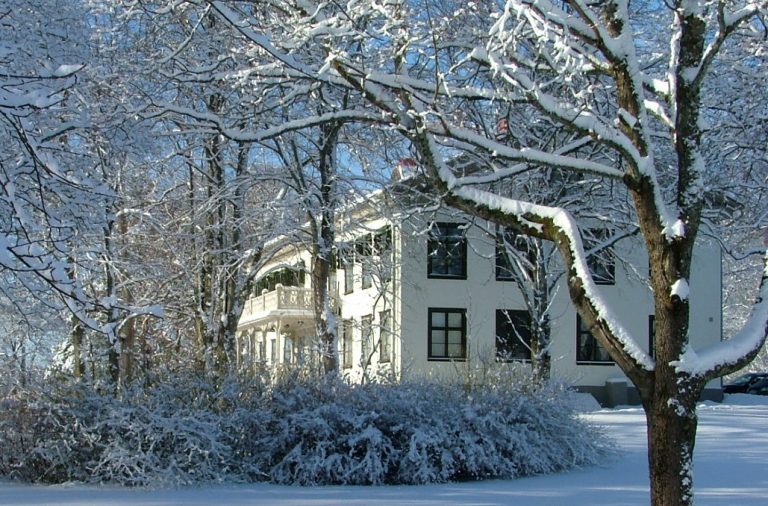
Björkborn Herrgård, near Karlskoga, was the home of Alfred Nobel. The manor house is now a museum, Nobel Prize Museum (Nobelmuséet).
The Picasso statue in Kristinehamn. Photo: Wikipedia
At Kristinehamn, west of Karlskoga, a 15-meter (49ft) high sculpture by Picasso is the most striking feature on Lake Vänern.
Örebro, is a dramatic, 17th century lakeside castle. Photo: Wikipedia
In the east, in the province of Närke, is Örebro, with a dramatic, 17th-century lakeside castle. Next summer, the Örebro Castle uncovers rooms, cellar vaults and towers that have not previously been open to the public. Discover forgotten areas of the castle and listen to new and fascinating stories from the past about nobles, prisoners and serving folk, and about some of the well-known and less familiar episodes from the castle’s rich and eventful history. Join a guided tour, follow the mystery trail or help your children with the challenges in the Children’s Castle Tower.
Swedish Nobel Laureates and Inventors, written by Tor Kjolberg
Feature image (on top): Björkborn Herrgård, near Karlskoga, was the home of Alfred Nobel and is today the Nobel Prize Museum.
Danish film director Bille August has directed a film based on a novel by Henrik Pontoppidan, first made into a screenplay by August and Anders Frithiof August. A Fortunate Man: A Danish Tragedy is available on Netflix and is well worth watching.
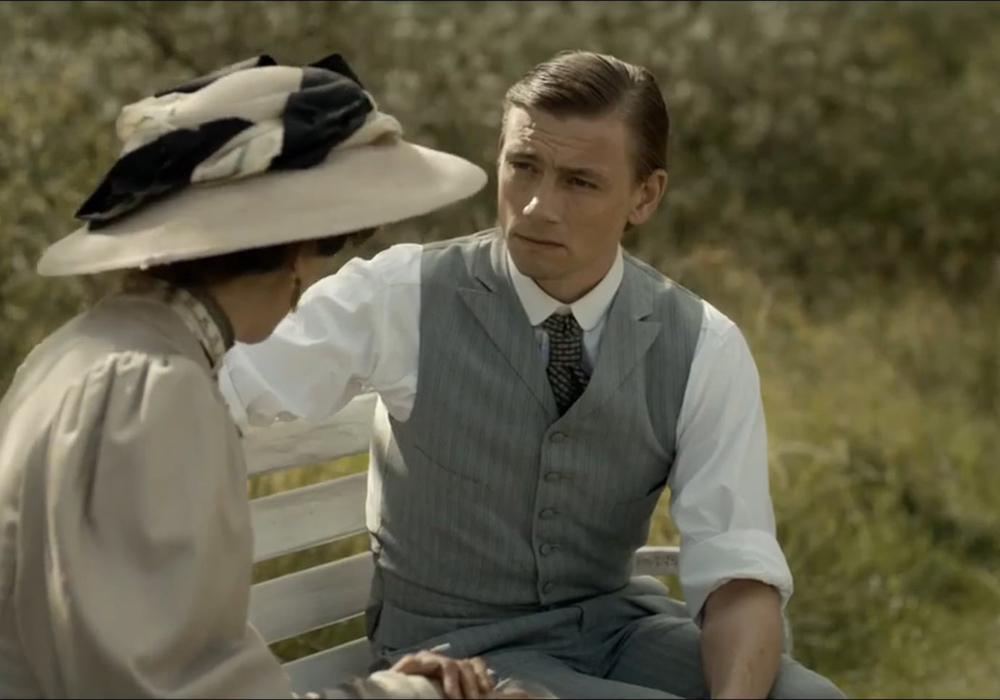
Lykke-Per (A Fortunate Man) is a drama from 2018 and was one of three films shortlisted to be the Danish entry for the Best Foreign Language Film at the 91st Academy Awards. The nearly three hour-film is based on the eight-volume novel written by Danish Nobel Prize-winning author Henrik Pontoppidan (1857–1943). It was originally published between 1898 and 1904.
film is based on the eight-volume novel written by Danish Nobel Prize-winning author Henrik Pontoppidan (1857–1943). Photo: Wikipedia
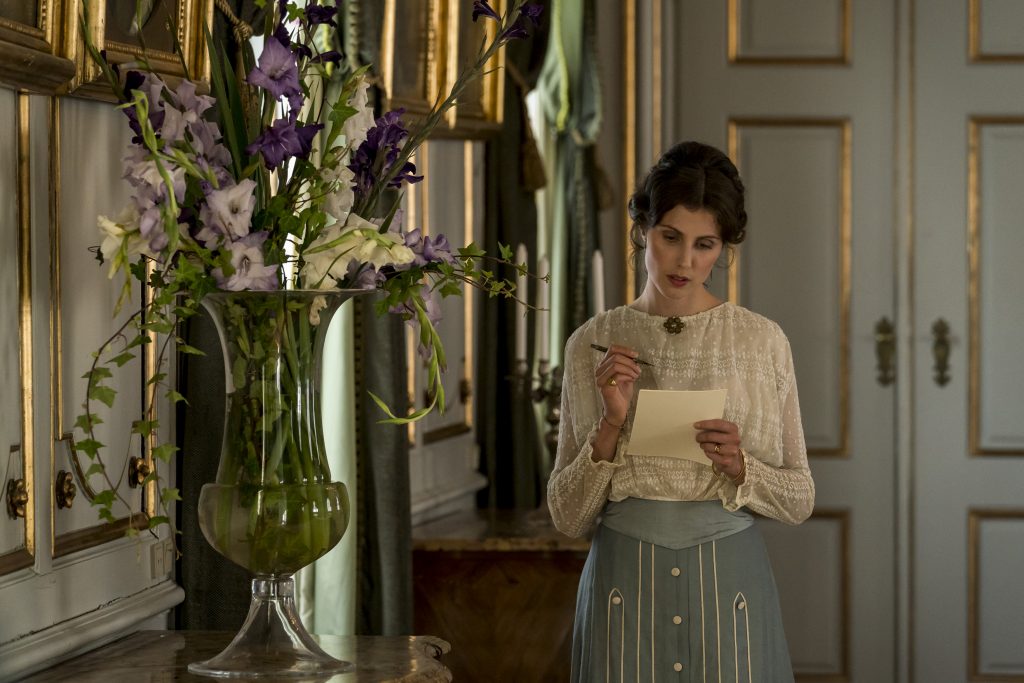
The plot The title “A Fortunate Man” has a double edge, as the movie, whose characters rarely fail to explain their motives and circumstances. The film is set in the late 19th century when the main character Peter Sidenius gets accepted to study Engineering at the College of Advanced Technology in Copenhagen. He leaves rural Jutland for Copenhagen and breaks ties with his overbearing, pious father’s calvinist background. He hates his father and he rejects a gift of his father’s pocket watch. The self-confident Peter, free of family and Christian religion, is poor but studies hard. He befriends a waitress who teaches him the ways of the city and introduces him to the world of sex but is dismissed on his rise up in social status.
A Fortunate Man is a drama from 2018 and was one of three films shortlisted to be the Danish entry for the Best Foreign Language Film at the 91st Academy Awards.
So, the movie asks whether it is possible to rise above humble origins or whether birth and character are destiny. Peter Andreas or Per, as he is increasingly called, believes that wind and water can be harnessed for energy — and that whoever controls the energy supply will have money and power. The title also apparently alludes to the Grimm Brothers’ fairytale, Lucky Hans (Hans im Glück), about a young man who keeps trading one item after another for one of lesser value and ends up empty-handed, but relieved.
The movie asks whether it is possible to rise above humble origins or whether birth and character are destiny.
The background clash
Peter meets Ivan Salomon, from a wealthy Jewish banking family. Ivan likes the ambitious, smart engineer and especially likes Peter’s revolutionary grand future project to harness water and wind power to develop the country with electricity. Ivan helps Peter adjust to free-thinking intellectuals, new political thought, monied-class businessmen, cultural rules and expectations, and the Salomon family.
Their daughter Jakobe was to marry Eybert, a little older, wealthy, and established Jewish man, but instead falls in love with Peter. Peter fails to win ministerial government approval for his plans. Phillip, the senior Salomon, decides to send Peter to Austria to further his engineering studies and get others’ review of his plans for canals, windmills, and water energy. Peter and Jakobe are separated by his travels.
However, their backgrounds clash: She has a high social standing and is Jewish. He is poor and, despite his desire to reject his father, inwardly conflicted about his strict Christian upbringing – and he is also too headstrong to bootlick.
From a Jewish perspective
At the 2019 New York Jewish Film Festival, Elisebeth Dyssegaard said about the film:
“A gifted but self-destructive young man leaves his suffocating Lutheran upbringing in the country for the metropolitan Copenhagen of the 1880s. An engineer with progressive ideas, he is welcomed by a wealthy Jewish family and insinuates himself into their opulent milieu, embarking on a journey of personal and professional ambition that teeters on the razor’s edge between triumph and catastrophe. A sprawling story of grand scope and high romance from the Academy Award–winning director of ‘Pelle the Conqueror’, ‘A Fortunate Man’ is a rare kind of film—beautifully realized, full of exceptional performances, and with a dramatic sweep on par with the great classics of cinema.”
“A Fortunate Man” is a great advertisement for the book.
The best of Bille August
The sprawling narrative sometimes gets the best of August. For instance, is the waitress Per rejects forgotten by him, or just by the movie? His habit of over-explaining each new development also appears to have removed nuance from a much more textured story. “A Fortunate Man” is a great advertisement for the book.
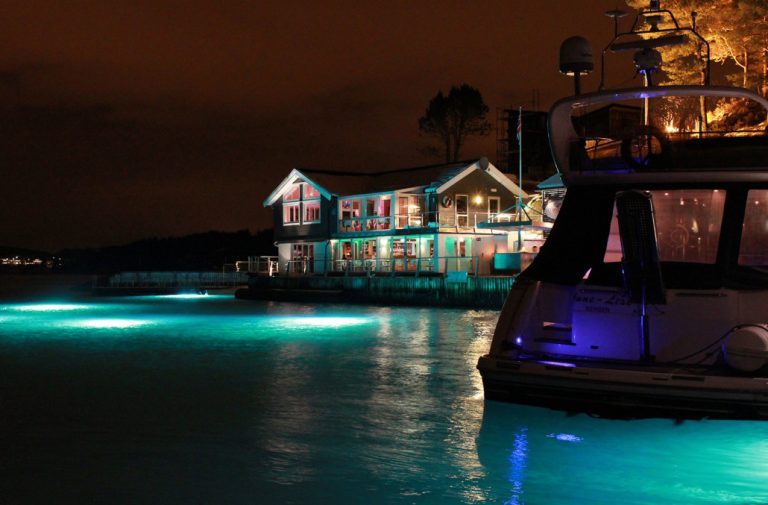
Enjoy a Christmas party with a twist of Cornelius on a Winter Islet Wonderland outside Bergen, Norway.
Choose from the season’s best seafood, traditional lutefisk or pinnekjøtt as you dine on the islet of Bjornøy, just outside Bergen. If you would like a different experience for your Christmas party, why not celebrate in a maritime, warm and cozy environment on this little islet?
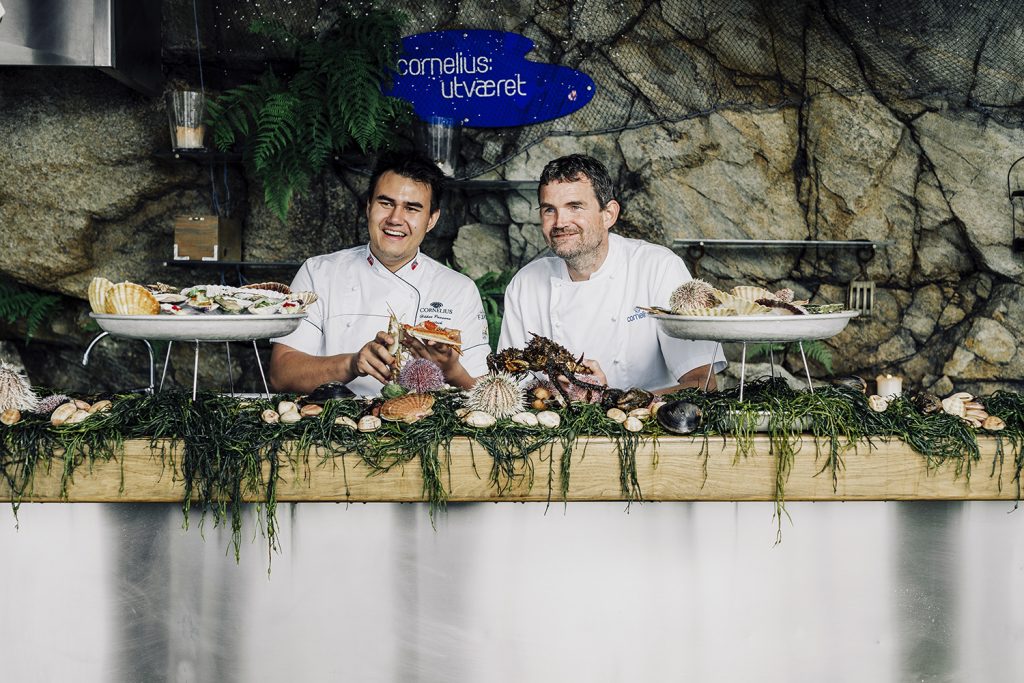
Now in its 18th successful year, beautiful reception rooms and modern conference facilities make this restaurant a real treat. The head chef and his team will prepare a meteorological Christmas menu a little out of the ordinary, in addition to traditional Norwegian Christmas food.
Choose from the season’s best seafood, traditional lutefisk og pinnekjøtt as you dine on the islet of Bjornøy, just outside Bergen
Cornelius’ famous Meteorological Menu
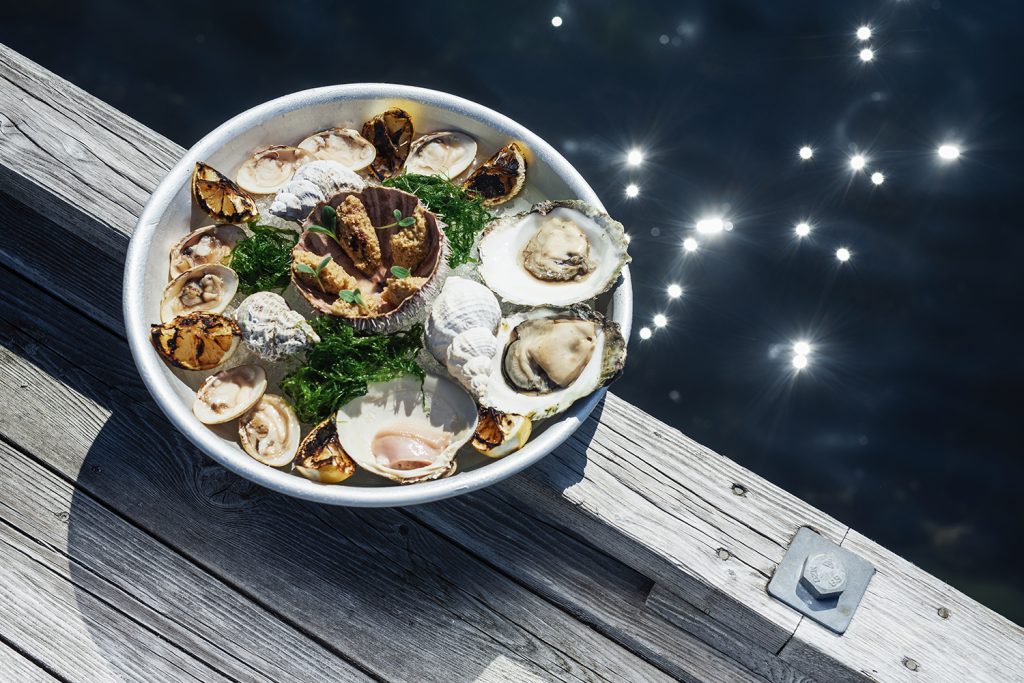
Cornelius’ famous Meteorological Menu is inspired by the weather of the day and consists of exquisite seafood and trimmings, prepared using innovative culinary techniques and with a genuine passion for seafood.
Cornelius uses the freshest seasonal raw materials and add to the flavor with a touch of Christmas. Additionally, Cornelius serves samples from the restaurant’s own smoke-oven and clams a la minute from the shellfish tower.
The head chef and his team will prepare a meteorological Christmas menu a little out of the ordinary
One of the most exotic attractions in the whole of Western Norway’s archipelago
Cornelius is one of the most exotic attractions in the whole of Western Norway’s archipelago and one of Norway’s best seafood restaurants. A Christmas party with a twist will undoubtedly be unforgettable.
Cornelius’ famous Meteorological Menu is inspired by the weather of the day
Cornelius Seafood Restaurant is situated right by the sea on a small island with spectacular views of the fjord, mountains, skerries, passing boats, and ships
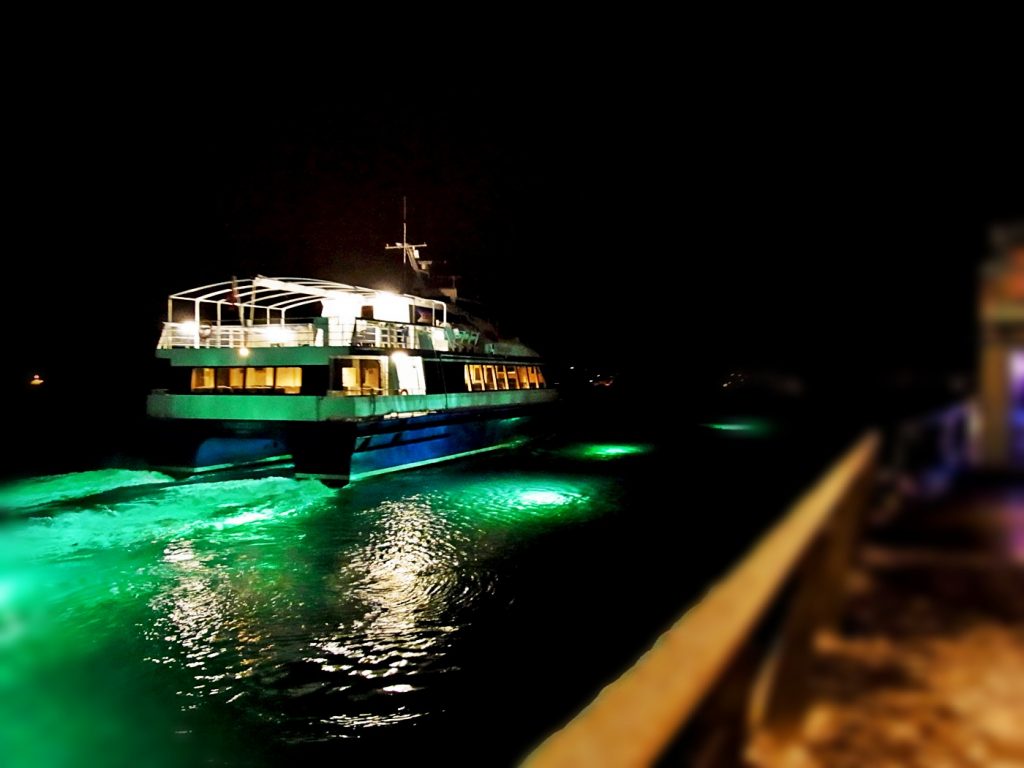
The shuttle ferry giving you a scenic boat ride leaves from Bryggen in Bergen
The shuttle ferry giving you a scenic boat ride leaves from Bryggen in Bergen at 6pm and transportation is included in menu prices. Both private and business groups are welcome.
Christmas Party With A Twist in Norway, written by Tor Kjolberg
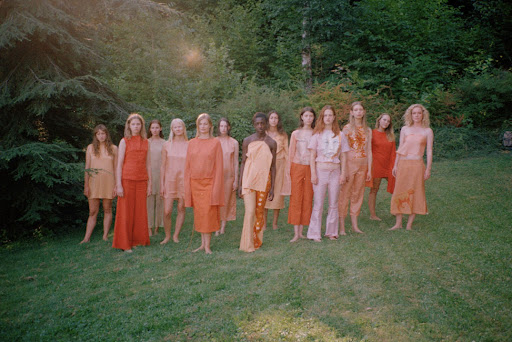
As a 17-year-old, Bror August Vestbø juggled the sewing line at Kuben Videregående skole with an internship with the Norwegian design collective Haik W. As an 18-year-old, his debut collection «Orange» was hailed in international online magazines and ended up at the fashion week in New York. Learn more about theinteresting up and coming Norwegian fashion designer.
His debut collection from 2016 presented at the New York Fashion Week consisted of sheer garments in nuances of orange worn by dancing models and immortalized on screen by Ori Hay Bachke.
Bror August Vestbø.Photo: Metal Magazine
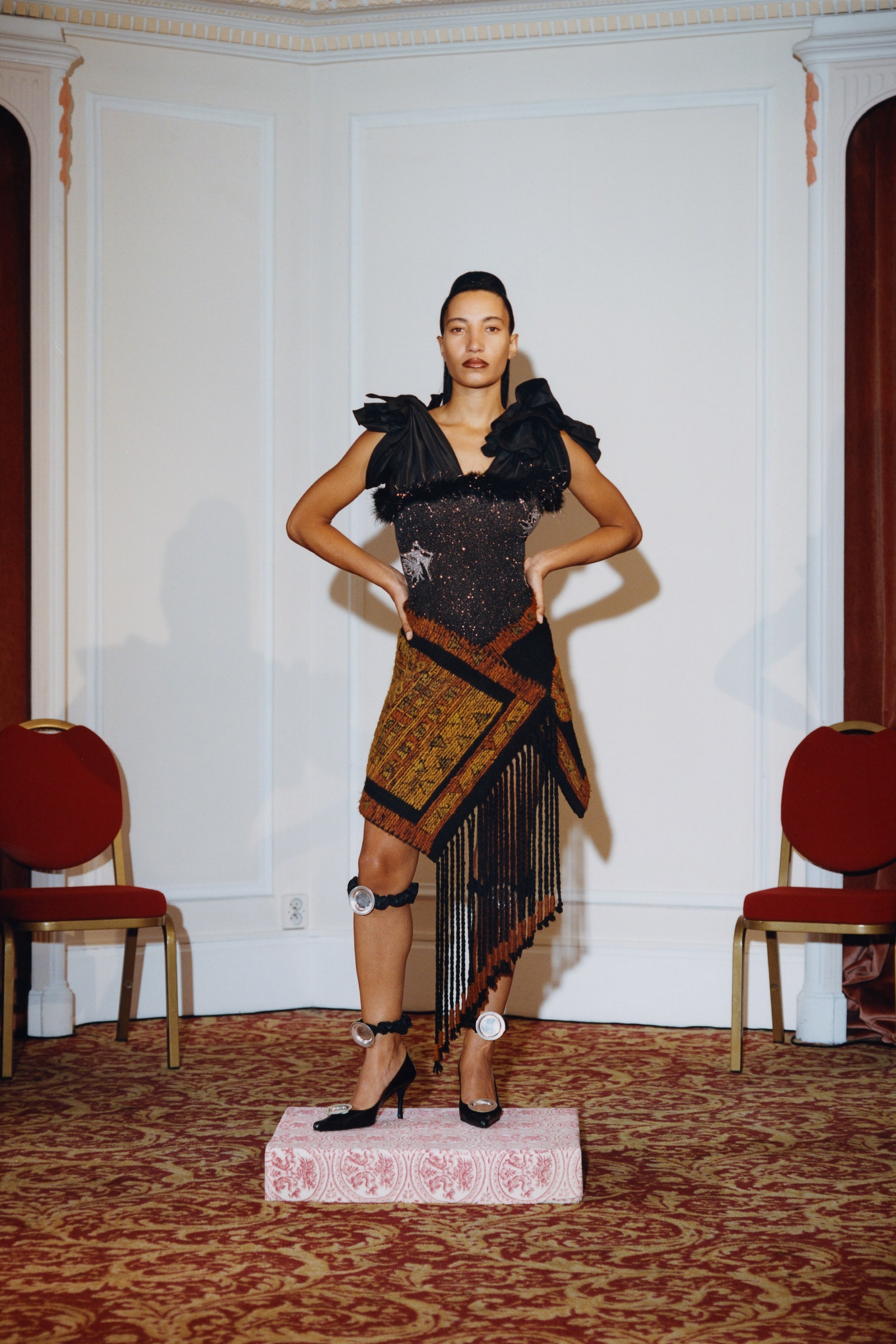
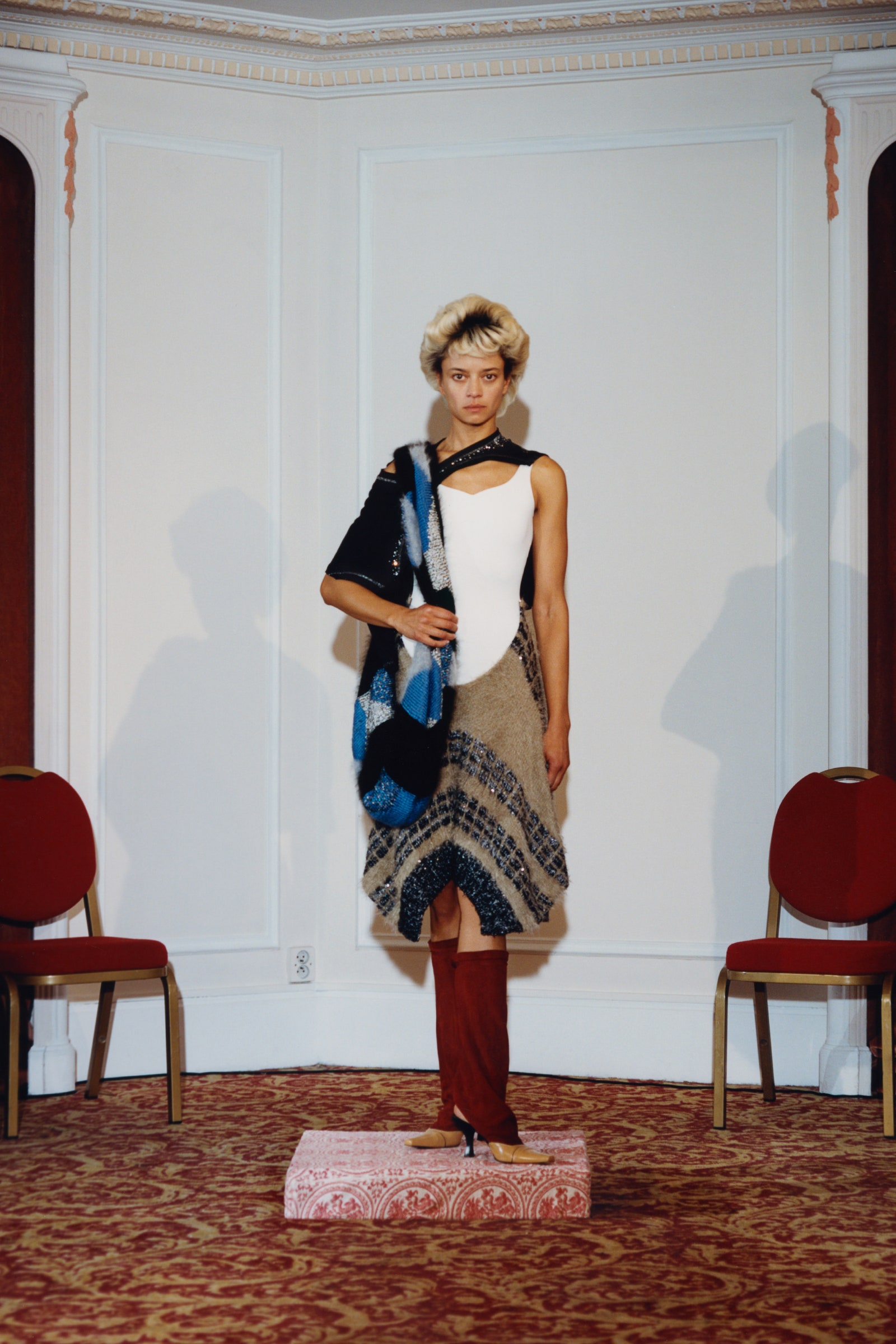
His Spring 2022 collection consists of a series of Cinderella-like transformations and Bror August in collaboration with Benjamin Barron have made new looks from existing materials. Bror August and Benjamin Barron spent the Covid-19 lockdown in Bror August’s hometown of Oslo to look for existing materials with which they could assemble their new collection. Their mantra was to see potential in something that to begin with they didn’t really like, or in other words, seemingly a bit ugly at first and then something they liked.
His Spring 2022 collection consists of a series of Cinderella-like transformations
Moving to New York
In 2015, Brother August was on a plane to New York where his mother had landed a job at the Norwegian embassy. He has been interested in clothing from an early age and recalls having the aim to be a designer since he was eight years old. Taking subway rides in New York, he always analyzed every detail of what people were wearing, all the way from the shape and the materials of the garments, down to every stitching detail.
Vestbø describes the Spring 2022 collection as “having the spirit of a little girl trying on her blanket and imagining it is a fancy gown”. The duo has been looking at the work of the great couturiers, which has inspired the pair to “create new structures and silhouettes.”
Bror August in collaboration with Benjamin Barron have made new looks from existing materials
“The fact that mom got a job in New York is the best coincidence that has happened to me and I am so grateful,” says Bror August. When he started out in New York it was important to him to let the brand develop with him personally. He didn’t want to force the concepts and the clothing to be beyond his age. “That’s why my clothing is going to be about things that obviously concerns me as a young person,” he said back then.
Vestbø was accepted as an intern at Eckhaus Latta, a designer who is at the forefront of innovative American fashion with leading stores such as Opening Ceremony, Assembly New York and LN-CC on his customer list.
Vestbø describes the Spring 2022 collection as “having the air of a little girl trying on her blanket and imagining it is a fancy gown”.
The Spring 2022 Collection
According to the designer, he has in his latest collection tried to create dresses that will be elegant although they’re made from just a bunch of pieces from flea markets and pieces left behind. This approach was put into practice on a color-blocked dress with an asymmetric hem, sheer front, and deeply draped back that played with the way Cristóbal Balenciaga worked “creating shape in between the body.”
According to the designer, he has in his latest collection tried to create dresses that will be elegant although they’re made from just a bunch of pieces from flea markets and pieces left behind. This
Hard to make it as a designer in Norway “There is a lot of good talent in Norway, but there is too much of old thinking, especially related to casting and models. I’m shocked that it’s always the same girl – tall, white and thin. It’s weird, we’re so forward thinking at a lot of other things», he says.
He adds that he really wants to be based in Oslo as well as New York. “I think it’s important to create our own platform and industry in Norway, which seems to be happening slowly. It’s very hard to make it as designer in Norway tough, especially because the Norwegian custumer has a very specific taste,” he explains.
The new collection, All-In, a collaboratin between Bror August and Benjamin Barron, is not only challenging the system but making us reevaluate what glamour and taste—good or bad—are.
Interesting Up And Coming Norwegian Fashion Designer, written by Tor Kjolberg
Feature image (on top): Debut collection ‘Orange’. Photo by Jacob Landvik
The unprecedented events of recent months have caused many of us to reevaluate our lives and make a completely fresh start. Every year, around 160,000 people choose to move to Scandinavia, and if you are deliberating where in the world to call home, you might just find our little corner of Europe ticking all the right boxes.Considering a New Start? Read why Scandinavia could be the perfect choice.
Easy communications What really defines a country, and indeed a region, is its people. Scandinavians have something of a reputation for being reserved, but don’t mistake that for unfriendliness. They might not be as demonstrative as those from, for example, the Mediterranean countries, but you’ll find the vast majority of Scandinavians to be welcoming and helpful towards new arrivals.
The vast majority of Scandinavians is welcoming and helpful towards new arrivals. Photo: Kevin Curtis/Unsplash
If you are coming from the UK or the US, you’ll be pleased to hear that you’ll be very unlikely to run up against any language barriers. Practically everyone speaks a little English and many are fluent. If you have children, you’ll find that the local kids will be delighted to practice their English and your youngsters will settle in all the more easily.
Amazing local food Swedish, Danish or Norwegian cuisine might not be as famous around the world as that of France or Italy, but that might just be because of that famous Scandinavian reserve we mentioned earlier. They don’t shout about it, but Scandinavian restaurants produce some incredible dishes.
Scandinavian restaurants produce some incredible dishes Photo: Brooke Lark/Unsplash
If you enjoy seafood, you’ve definitely come to the right place, and foods like prawns that are considered delicacies elsewhere are a staple. Then there’s the baked goods – let’s just say a Scandinavian bakery is like nothing else on earth.
Considering a New Start? Why Scandinavia Could Be the Perfect Choice – read on.
Healthy transportation Accustomed to driving everywhere? You’ll find you spend far less time behind the wheel in Scandinavia, especially if you settle in one of the major cities like Copenhagen or Stockholm. Here, bicycles are the transportation of choice – in fact, in Copenhagen, especially, they have practically reclaimed the streets!
Eløectric buses in Oslo. Photo: zero.no
Cycling is cheap, healthy and non-polluting, so there’s really no reason not to join in. Also, it makes the morning commute an absolute pleasure – just remember to put on some warm gloves in the winter months.
Considering a New Start? Why Scandinavia Could Be the Perfect Choice – read on.
Clean, natural living
The love of cycling is a clue towards what is, for many, Scandinavia’s biggest attraction of all. Sweden is ranked the greenest nation in the world, with Norway third and Denmark sixth. It’s a remarkable achievement and means that Scandinavia is by some margin the best place to live if sustainability, clean air and living in harmony with the environment are high on your agenda.
From Bodø, Norway. Photo: Guillaume Briard/Unsplash
There’s more to it than bicycles and EVs, however. Sustainability is truly a way of life here, and you will see it the moment you step into a Scandinavian home, from the materials used to the way the property is heated. Best of all, it doesn’t mean making compromises – in fact, stepping into a Scandinavian house feels a little like stepping into the future, so why not give it a try?
Karoline Gore
Considering a New Start? Why Scandinavia Could Be the Perfect Choice, written exclusively for Daily Scandinavian by Karoline Gore. Karoline is a freelance writer from Stoke on Trent in the UK who left the corporate grind when she started a family and has never looked back. She enjoys contributing to a range of online publications on the topics that are important to her.
Other articles written by Karoline Gore you might like to read:
The Food Hall in Oslo is a food market which opened in 2012 in a former industrial hall by the Akers river, built in 1902. Today, the hall contains 30 grocery stores, restaurants, specialty food shops and eateries, bakers, bars and more, all offering high-quality products from Norway and abroad. We met with the manager of development at Aspelin Ramm, Frode Rønne Malmo. Learn more about the foodie paradise in the capital of Norway.
Malmo tells us that this is a place for individuals, families or companies to sample and socialize. The staff are proud of their products and love to talk about food you cannot find elsewhere in the capital.
The manager of development at Aspelin Ramm, Frode Rønne Malmo tells us that this is a place for individuals, families or companies to sample and socialize.
History Mathallen is located in the old hall on Vulkan with three floors with almost 3,500 square meters. In former times, iron elements were cast for railways and bridges here.
It is said that Scandinavia’s largest silver mine was located in the area where the Vulkan (Volcano) site is now located. Legend has it that a terrible dragon guarded the area and that this is one of the reasons why Oslo is where it is. Furthermore, the area was extremely important for the industrial revolution, with water saws and bridge factories. “We have attempted to incorporate this energetic development into the area’s overall design,” says Frode Rønne Malmo.
Oslo Food all is an informal place for everybody.One of the entrances is located next to Dansens hus (House of Dance)
He adds, «Today, this is an informal place for everyone. There are no chain stores here, and the leases with the stores are from one to three years. They can be renewed, but it is important that our tenants fit in well with the environment. 3 of 30 leases are changed every year. 14 have been with us from the very beginning,” says Rønne Malmo.
Several of the shops and eateries have their own serving areasThere are no chain stores in Oslo Food Hall
The Food Hall
Several of the shops and eateries have their own serving areas, but it is also possible to enjoy your food in the common serving area of the Market. Although about 40% of visitors come from the local neighborhood, Mathallen has also become an attraction for all Oslo residents, particularly at the weekend. Before the corona, an increasingly number of foreign tourists found their way to Mathallen, and will probably be back again when the situation becomes more normal.
Oslo Food Hall contains 30 grocery stores, restaurants, specialty food shops and eateries, bakers bars and moreProbably the best fish and chips in Oslo
“Cooking classes and events are an important part of activities here,” explains Malmo. For example, Årets Kokk (Chef of the Year, i.e. Norway’s official selection for the international Bocuse d’Or cooking competition) takes often place at Mathallen. By the way, Norway is the most awarded country in Bocuse d’Or. Mathallen has also hosted a number of current affairs programs and TV series, not to mention the many festivals taking place throughout the year.”
Enjoy food and drinks you cannot find elsewhere in the capital40% of the visitors come from the local neighborhood
A world of food in one place
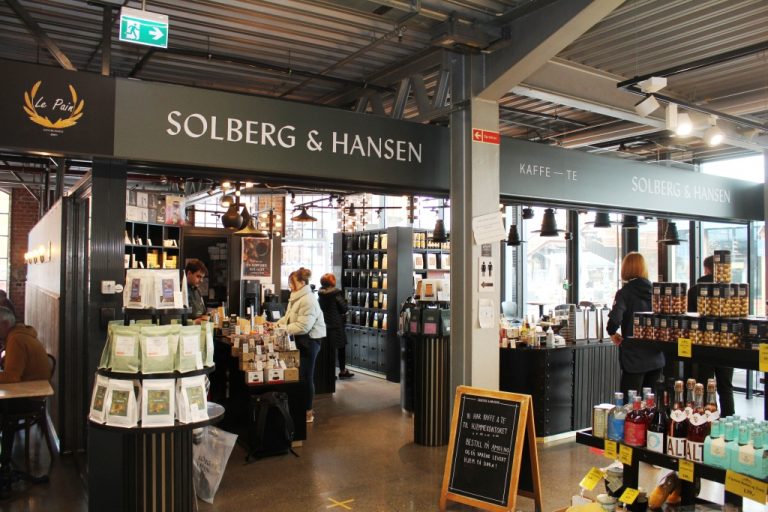
At present, visitors can enjoy Hungarian food at Bistro Budapest as well as a French creperie, Hopyard bar offers more than 200 different beers, French and Swedish founders at Le Pain have a pure passion and knowledge for bread and Via Italia is serving ecological food from Italy, just to mention a few. If you enjoy Fish & Ships, British visitors claim that the fish at Vulkanfisk is even better than at home.
If you’re in Oslo, be sure to check out Mathallen. You can get a great value meal at any one of the many food stalls, or mix and match your meals from different stalls the way we did. There are also several restaurants and eateries at the adjoining areas.
Check out Mathallen food hall if you’re ever in Oslo – it’s not far out from the center of Oslo (nothing much is, it’s a very walkable city), and well worth the trip.
Mathallen is closed on Mondays.
Scandic Vulkan Hotel
Staying in the area
If you want to stay in the area, Scandic Vulkan Hotel is a convenient design hotel. After the opening, the hotel was nominated for the European Design Awards for best lobby, lounge and public areas. “It was very important for both Scandic Hotel and the owner Aspelin Ramm that the city council took into account the site’s history,” said the creative director at the design agency Stylt Trampoli, who was responsible for the outline.
The Foodie Paradise in the Capital of Norway, written by Tor Kjolberg
In the idyllic town Grimstad in Norway you find the house where Henrik Ibsen worked as an apothecary’s assistant. This is also the house in which the Norwegian world-famous playwright’s very first drama “Catalina” was written.
The Ibsen Museum in Grimstad opened in 1916 – only ten years after Ibsen’s death. Grimstad Town’s Museums (Grimstad Bys Museer) is a cultural and historical complex of museums conserving the history of the town. It is the oldest museum of its kind in Norway.
The less known drama of Henrik Ibsen (1828 – 1906), Catalina, was written during winter 1848-49) and first performed under Ibsen’s name at the Nya Teatern in Stockholm in 1881. The first performance in Norway under Ibsen’s pseudonym Brynjolf Bjarme was at Det Nye Teater in Oslo in 1935.
Henrik Ibsen, 1869. Photo: Wikipedia
Forced to support himself after his father’s economic downfall, during a national economic crises, Ibsen went to Grimstad, an idyllic town located a half hour’s drive east of Kristiansand on Norway’s southern coast. He probably arrived in Grimstad as a 15-year-old around 1844 in order to start his education as a pharmaceutical assistant. He both prepared himself for university and experimented with various forms of poetry.
While studying, he found himself passionately drawn into the Catiline Orations, famous speeches by Cicero against the elected questor Catiline and his conspiracy to overthrow the republic. In the prologue to the second edition (1875) Ibsen expresses that he was profoundly inspired by the contemporary political situation of Europe, and that he favoured the Magyar uprising against the Habsburg empire. So, Catiline can be read as one of Ibsen’s troubled heroes, alongside Brand.
The main character in this historical drama is the noble Roman Lucius Catilina, based on the historical figure of Catiline. He is torn between two women, his wife Aurelia and the Vestal virgin Furia.
the Norwegian world-famous playwright Henrik Ibsen. Photo: Henrik Ibsen Museum, Grimstad
Although Catiline may not be among Ibsen’s best plays, it foreshadows many of the themes found in his later works and is a drama written in verse modeled after one of his great influences, William Shakespeare.
Ibsen worked in Grimstad until April 1850 when he was 22, using his limited free time to write poetry and paint. At the Ibsen Museum visitors will learn of his life prior to becoming famous, the harsh economic conditions in which he lived and the love stories.
Unlike many other writers and poets, Ibsen had a long and seemingly happy marriage to Suzannah Daae Thoresen. The couple wed in 1858 and welcomed their only child, son Sigurd, the following year. Ibsen also had a son from an earlier relationship. He had fathered a child with a maid in 1846 while working as an apprentice. While he provided some financial support, Ibsen never met the boy.
Norwegian World-Famous Playwright’s Very First Drama, written by Tor Kjolberg
Feature image (on top): Henrik Ibsen in Grand Cafe, Oslo
Autumn’s lobster premiere is like an early Christmas Eve on the Swedish west coast. Join us in the hunt of the sea’s black gold in Bohuslän.
On the first Monday after September 20, it’s lobster premiere in Bohuslän on the Swedish west coast. This is a genuine premiere because it is a statutory one – unlike the crayfish or surströmming (“sour herring”) premieres that are now only based on traditions. The last day of the season is April 30th. After the close of lobster season, lobsters may not be fished or held in any form.
The beautiful Swedish west coast The Swedish west coast is beautiful in the autumn, painted with a palette of orange, red and yellow trees, blustery clouds and blue skies. Bohuslän has received considerable attention in recent years in international media. Among other things, Bohuslän has been named the world’s seventh most beautiful wilderness area by CNN. The region has also been written about in The Times, Lonely Planet Traveller Magazine, and National Geographic Traveller.
The reddish-brown boathouses and shiny slopes of naked rocks combined with seagulls’ screams and crashing waves create a magical atmosphere . Here, from Smogen. Photo: Bohuslanguide
The reddish-brown boathouses and shiny slopes of naked rocks combined with seagulls’ screams and crashing waves create a magical atmosphere – not to forget, the intoxicating smell of one-year-old fermented mackerel – regarded as a recipe for success to attract the ocean’s black gold into their pots.
The fishermen are ready to start in the early hours. All lobster fishermen have their ideas about lobster pot sizes, fishing spots and bait. Wherever you go, there is endless discussion about bait tips, water temperature and fishing spots. In particular, tension is linked to weather conditions.
Perfect conditions for rich and tasty lobster stocks
Bohuslän is mostly ice-free coastline. Here salty Atlantic water comes in with the Gulf Stream. The clean and warm water creates perfect conditions for rich and tasty lobster stocks – it’s one of the reasons that Bohuslän has become a real lobster paradise. Eating your own catch at the end of the day paired with a special release of lobster beer from the Grebbestadsbryggeri brewery, you feel you’re in paradise.
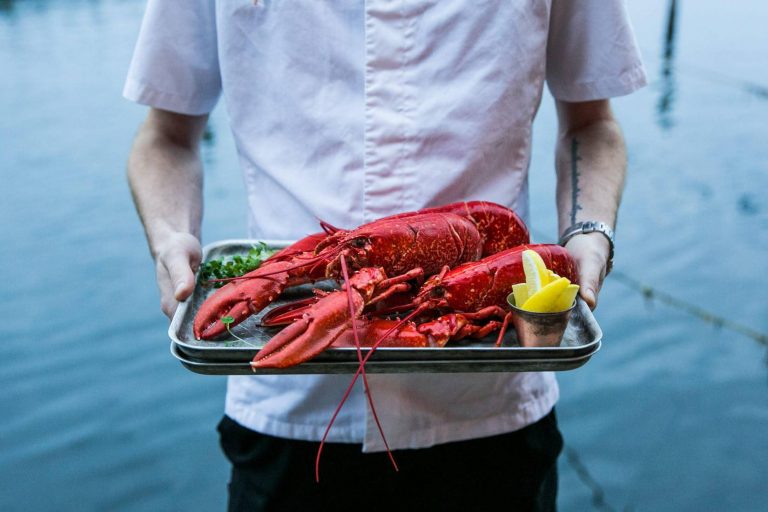
Lobsters found along the Swedish coast are known as Black Gold due to their black color in the wild.
Grönemad is an idyllic row of piers and boathouses two kilometers north of Grebbestad center. Almost half of the lobster caught in Sweden is hauled up by this archipelago. The same applies to 70 per cent of caged crayfish and as much as 90 per cent of all oysters.
The clean and warm water creates perfect conditions for a rich and tasty lobster stocks, Photo: Marstrand Event
A thriving livelihood for lobster and shellfish
The seabed In this part of Bohuslän is hard and rich in hiding places making it a thriving livelihood for lobster and shellfish. Along large parts of the Swedish coast, sediments from agriculture have been washed out into the sea and made the seabed soft, but it is not the case in this area.
According to traditional recipes lobsters are often cooked in dark beer to produce a savory flavor and lift the flavors of the seafood. Lobsters are luxury goods. At Gothenburg’s fish auction the first lobsters are usually sold for approximately SEK 7,000/kg during the first week of the season. In 2010 the first lobsters came in at 7,300 kronor per kilogram. 2012 was a peak of 102,000 SEK!
Bohuslän has been named the world’s seventh most beautiful wilderness area by CNN. Here, from Grundsund. Photo: Jonas Ingman/Väst Sverige
The Swedish Lobster Academy
The locals are so serious about lobster that in 1996 they established the Swedish Lobster Academy in Hunnebostrand. The academy promotes knowledge about lobsters’ living conditions, distribution, movement patterns, and reproduction. Members focus on sustainability and they collaborate with fishermen to address issues such as trapping and farming opportunities. The academy promotes quality assurance of lobster with respect to size, breed, and appearance.
The lobster premiere draws visitors from all over Europe. The first lobster safaris, on the other hand, do not start until the pots have been on the seabed for at least 24 hours. From September to December, many fishermen offer lobster safaris for tourists. Professional fishermen are allowed to release maximum 40 lobster pots only.
However, the vast majority of lobster pots you see in the Bohuslän archipelago belong to private individuals, and not just local residents. People throw their boats at trailers and pilgrimages from all over Sweden to hunt for the black gold. Commercial fishermen make up only a small part.
Fisherman throwing a cage. Photo: Västsverige
Lobster fishing in perspective
To give some perspective, remember that people have been fishing this coast since the Stone Age. Fishing has been a source of livelihood for generations. The sea and seafood have a culture all its own. To protect the species fishermen today are not allowed to catch small lobsters that have not yet reproduced itself. There is a minimum size to comply with: 8 centimeters measured from the rear edge of the eye cavity to the rear edge of the back. If the lobster is smaller, it has to be released back into the sea immediately. This also applies to females with external roe, according to the Swedish Board of Fisheries regulations.
Since 2011 hobby fishermen are no longer allowed to sell lobsters.
There have been many positive measures to safeguard and improve the lobster stock in Sweden, but it is still important to fish them with moderation.
A Swedish lobster is different from an American; it has clearer colors and larger claws. The water in northern Europe is colder, so the fish and shellfish grow less quickly, and therefore develop a richer flavor and better texture. The lobster season is based on protection of the species—making sure it is able to reproduce before being caught—and the time of year when it tastes the best.
Hunting The Black Gold in Sweden, written by Tor Kjolberg
The Sustainable Solutions of the Future are Sought After in China. Great opportunities lie ahead for Nordic architectural firms ready to explore the Chinese market. Nordic Architecture is in High Demandin China.
Nordic firms have proven to be excellent at creating high-quality, sustainable, and innovative architecture and city planning – something that is in high demand in rapidly developing China.
The five Nordic trade promotion organizations in China have interviewed three different Nordic firms with representation in China for their perspectives on the advantages of entering the Chinese market and their best advice for Nordic firms looking to get established abroad.
Demand for Nordic sustainability Nordic solutions are in demand on China’s growing markets, and that opens opportunities for architecture firms and innovative companies with an eye to the Asian market.
Øivind Eftestøl, CEO at Polybo AS, a Norwegian construction technology firm, has experienced this first hand. When he established his first contact with China in 2013, he felt very well-received, and he was quickly motivated by the possibilities in the large Chinese market.
“I highly recommend looking toward the great market in China,” Øivind Eftestøl says today.
With Polybo AS, Øivind Eftestøl has developed a sustainable, modular system for the construction industry. When it comes to sustainability, in particular, China has a huge demand for new solutions – something worth noting as a Nordic firm looking for international adventures.
“China has, as most markets in the world, a big goal for a greener construction industry and for new and innovative solutions. These are very important selling points to bring to China,” explains Øivind Eftestøl, adding that Nordic firms can benefit from this: “It’s a great help to Nordic companies that China is very open to Nordic architecture and Nordic solutions.”
Øivind Eftestøl, CEO at Polybo AS
Zhao Jinyan is the Executive President of VELUX China, and he knows the Chinese market from within. When talking about the development China has experienced, Zhao Jinyan also emphasizes how crucial sustainable innovations are to the future of the country, and how this creates strong demand for Nordic solutions.
Zhao Jinyan, Executive President of VELUX China
“Nordic solutions are really good at being sustainable – in knowledge, in product, and in service. And especially knowledge and service are something that the Chinese market is looking for,” Zhao Jinyan says. According to Zhao Jinyan, this demand for sustainable innovations combined with the sheer size of the Chinese market makes for great opportunities.
“There is, in many areas and in many industries, a wide scope of opportunities. I think many Nordic companies would benefit from starting in China; we have a population of 1.4 billion, and that makes for a huge potential,” he explains.
High-quality solutions China’s rapid development has created not only strong demand for sustainable innovations, but also for high-quality solutions.
“China is a huge country, and we have experienced robust development over the past 40 years. But now the growth speed has slowed down, so we are reaching a turning point. Our focus for the future is changing from quantity to quality,” Zhao Jinyan explains.
According to Zhao Jinyan, one reason for the success of Velux in the Chinese market can be found in precisely this focus on both quality and sustainability when it comes to architecture and building components. The Danish firm has been active in China for more than 25 years, and throughout that time, the focus at Velux has been on offering high-quality products that improve quality of life in the built environment.
“At Velux we want to offer not only a better living environment, but also sustainable and environmental building solutions for the Chinese market,” explains Zhao Jinyan, adding: “China has huge potential in this area.”
In 2020 this demand in China for high-quality, sustainable solutions secured Swedish architecture and engineering firm, Sweco, a contract to develop a new sustainable urban district, the Hainan Future Industry Park, in southern China. Sweco has been working with sustainable projects in China for the last 20 years, and the Hainan project is no exception to the firm’s positive experiences working in a dynamic and quickly developing environment. According to Johannes Tüll, Chief Design Architect, Studio Director and International Director Stockholm at Sweco Architects, the opportunities in a forward-looking China actually motivated their work on the project.
“We want to be involved where the development in the world takes place. Where we can make a good and sustainable impact,” says Johannes Tüll. “For me, personally, I’m grateful to have the opportunity to work on a project like this. It has a sustainability focus, we have a client that is forward-thinking, we have a location that is fantastic, and a chance to do a great project. As a company, and as a group of architects and engineers, we are very grateful to be a part of this,” he explains.
China has, as most markets in the world, a big goal for a greener construction industry and for new and innovative solutions. Photo by Unsplash
Creating an international network Establishing your firm as a foreigner in China requires both cultural understanding and a Chinese network that can introduce you to the local market. Øivind Eftestøl explains that his firm, Polybo AS, benefitted greatly from the network offered by the Norwegian embassy to newcomers in China.
“Before entering the huge market in China, you need to do your homework,” says Øivind Eftestøl.
“Use the Nordic network, like the embassies and the Nordic trade councils, to get input. They can help with all kinds of questions relating to cultural understanding, language and pitfalls, and how to protect the intellectual property rights of your product. To develop our network, including both Nordic countries that are already in China and Chinese companies, and to gain an even better understanding of the Chinese market and funding instruments, Polybo participated in several conferences and networks, both in Norway and China, hosted by the Nordic countries,” he explains.
Nordic Sustainable Cities Through Nordic Sustainable Cities, Nordic Innovation is working on behalf of the five Nordic prime ministers to promote Nordic solutions for sustainable, livable and smart cities on a global scale. Part of the program is about showcasing and promoting export of Nordic solutions to urban sustainable development challenges in three major markets; North America, India and China.
Zhao Jinyan also emphasizes the importance of connecting with Chinese partners when entering the Chinese market as a Nordic firm.
“It’s a good idea to get a Chinese partner to help you in the beginning to gain a better understanding of this market more quickly,” Zhao Jinyan explains, continuing: “There are a lot of professional companies that can help new players to gain experience. Just be aware that for different companies and different industries, you will need to contact different market players.”
Hainan landscape. Photo: Sweco architects
Learning from China An expanded international network can potentially lead to new inventions and fresh inspiration. This is what the architects at Sweco’s offices in China have experienced. For them, one key learning was the importance of teaming up with and learning from Chinese partners. Carlo Negri, Chief Design Architect and International Director at Sweco Architects, explains how the design process for the Hainan office project has been defined not only by interdisciplinary collaborations within Sweco, but also by a fruitful dialogue with local partners.
“Our process is very much about an integrated process. We work together with our experts here at Sweco; our energy experts, water experts, and building engineers who design together with the architects. It is important that we don’t just do that from within Sweco, but that we also do it together with our local design institute and our partners on this project. This is key to ensuring that our unique design meets all the requirements of the project, but also merges the international mindset with innovations that are already within China itself,” explains Carlo Negri.
Anders Neregård, Chief Design Architect, Studio Director and Chief Digital Officer at Sweco Architects, also stresses the benefits of working in an international milieu. He is convinced that working in China has expanded the team’s way of thinking – a learning they will bring back with them to Sweden.
“When we work in China, it’s an interesting and different kind of process than when we work in Europe or in Sweden. And for us, I think, that has been the most challenging part, and that has helped us. We will bring that mindset back to Europe as well,” Anders Neregård concludes.
Nordic Architecture in High Demand, written by Danish Architecture Center for Nordic Innovation. Republished by permission from Nordic Innovation.
The Scandinavian countries are home to some of the finest outdoor pursuits on Earth. The region’s outdoors and wilderness beckon many travelers and sports enthusiasts every year and, while there is never a shortage of things to do in Denmark, Norway, Sweden (the three countries that makeup Scandinavia), it can be hard to know where to start when choosing from such a vast range of activities. This guide is to help you get started with your outdoor pursuits in Scandinavia. Here’s your guide to outdoor sports in Scandinavia.
This guide will focus on major sports that are available throughout the region, like hiking, biking and some winter sports. You can find more information about each sport under its own heading at the end of the guide.
While each country has its own unique culture and language, they are all relatively small in terms of area, meaning that it often makes sense to start your research for where to go with one particular Scandinavian country in mind. For many outdoor pursuits, though, you can do most activities just about anywhere in Scandinavia.
The weather in the region can be a challenge for outdoor sports, but all Scandinavians are used to it. In warmer months, you will generally need lots of sunscreen and insect repellent. In the colder seasons, bring warm clothing, sturdy footwear and rain gear. If you plan well in advance, you might even want to try some of the winter sports that are on offer in Scandinavia.
Sailing in the Aarhus Bay. Photo: Wikipedia
Sailing in Denmark One of the top priorities for most travellers coming to Copenhagen is finding somewhere close by to rent a boat and explore the city’s surrounding canals. There are many rental companies dotted around the harbour front in the Nyhavn district, and most of these will rent you a traditional wooden ’17-footer’ style boat for an hour or two at a time (Rates start from about 500 Danish kroner.
Photo by Simon Paulin
Biking in Sweden Sweden’s extensive network of walking and cycling paths makes it one of the best countries to explore by bike or on foot. You can hire bikes for anywhere between a couple of hours and several days; check out the rates at your accommodation, but expect to pay around 200 kroner (approx. AU$40) for a day’s hire. Read more
Kayaking Reine in Lofoten. Photo by Mattias Fredriksson/VisitNorway
Kayaking in Norway The fjords and lakes of Western Norway offer some of the most challenging and breathtaking kayaking routes on Earth. The Nidelva river is particularly popular, where you can paddle your way along past waterfalls, through narrow channels and into the heart of Norway’s fourth-largest city, Trondheim. Read more.
Photo by Photo by Sébastien Goldberg/Unsplash
Campervan Hire in Denmark If you really want to explore the country and see its quiet corners and picturesque towns at your own pace, then campervan hire is one of the best ways to do it. There are many campervan companies dotted along the Danish coastline, so it’s easy enough to pick one up in Copenhagen or another major city and head out into nature at your leisure.
Photo by Jeremy Bezanger/Unsplash
Kitesurfing in Denmark The shores of Greenland, Norway’s Lofoten Islands and the west coast of Sweden are some of the top spots in all of Scandinavia to learn to kitesurf.
Mountain biking in Beia, Hallingdal. Photo by Lars Storheim/Visit Norway
Mountain Biking in Norway There is more than 1,000km worth of mountain bike trails throughout Norway that offers both scenic beauty and endless excitement. The country is also home to the world-famous Laerdal Global Routes, a 450km touring route through some of Norway’s most peaceful and spectacular scenery. Read more.
Scuba diving in Æræsund. Photo by Lars Kirkegaard/Visit Fyn
Scuba Diving in Denmark The waters surrounding Denmark’s coastline are so clear that you can often see for up to 13m under the surface. There are plenty of diving centres dotted around the country that will teach you how to explore this underwater world.
Sailing in Sweden. Photo by Visit Sweden
Sailing in Sweden You can find boat rental companies all over Sweden, with most located close to the ferry ports of the southern and western coasts (e.g. Gothenburg, Trelleborg, Karlskrona). If you want to explore some of the country’s beautiful natural harbours, then this is one of the best ways to do it. Read more.
Snowboarding in Norway. Photo by Fjord Norway
Snowboarding in Norway There are several ski resorts throughout northern Norway, but Norefjell Ski Resort near Lillehammer offers an incredibly scenic setting against the deep blue waters of the fjords.
Surfinng in Ervik.
Surfing in Norway There are plenty of surf schools throughout Norway that will teach you everything you need to know about conquering the waves. Some are even located close to incredibly picturesque beaches, such as Røstvik, where you can take a breather from surfing and admire the picturesque views of mountains and fishing boats. Read more.
Copenhagen Harbor Bath. Photo: Bjarke Ingels Group
Swimming in Denmark You can swim throughout Denmark – even in the sea – thanks to the water being so clean that it’s safe for swimming year-round. The clear, fresh waters are made up of melted glacial ice from Scandinavia’s countless glaciers, giving them their sparkling blue hue. Read more.
Snowmobile safari in beautiful northern Lyngen Alps. Photo: Visit Tromsø
Snowmobiling in Norway You can hire a snowmobile for short periods of time from countless rental companies dotted throughout southern Norway, either at one of the larger resorts or amidst some truly spectacular scenery. If you want to explore beyond the resort lifts, then this is one of the best ways to do it.
Waterskiing at Norsjø ferieland. Photo by Visit Norway
Waterskiing in Norway This is a favourite activity for most Scandinavians, whether it’s just for fun or to show off their impressive skills to friends and family. You can find waterski centers all over southern Norway, including locations in Oslo, Kristiansand and Bergen.
White water rafting at Sjoa rafting
White Water Rafting in Norway The glaciers of Norway are not only responsible for giving the country its stunning green landscapes but also the many raging rivers that flow down from them. You can experience this wild environment first-hand by taking part in one of Scandinavia’s many white-water rafting trips. Read more.
Casey Harward
Your Guide to Outdoor Sports in Scandinavia is compiled by Casey Harward. Casey is an editor at Researchprospect and essay writing website. She manages a team of writers and editors, creates academic courses and provides thesis consultations.
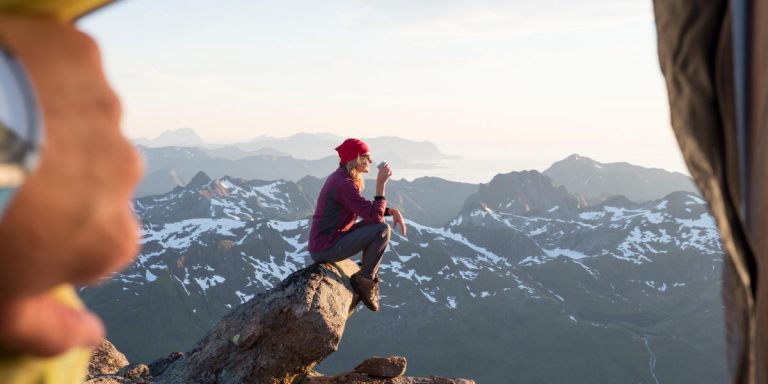
Feature image (on top): Hiking at Higravtindan, Lofoten northern Norway Photo by Kristin Folsland Olsen / visitnorway.com